
A complete issue · 20 pages · 1906
Life — August 9, 1906
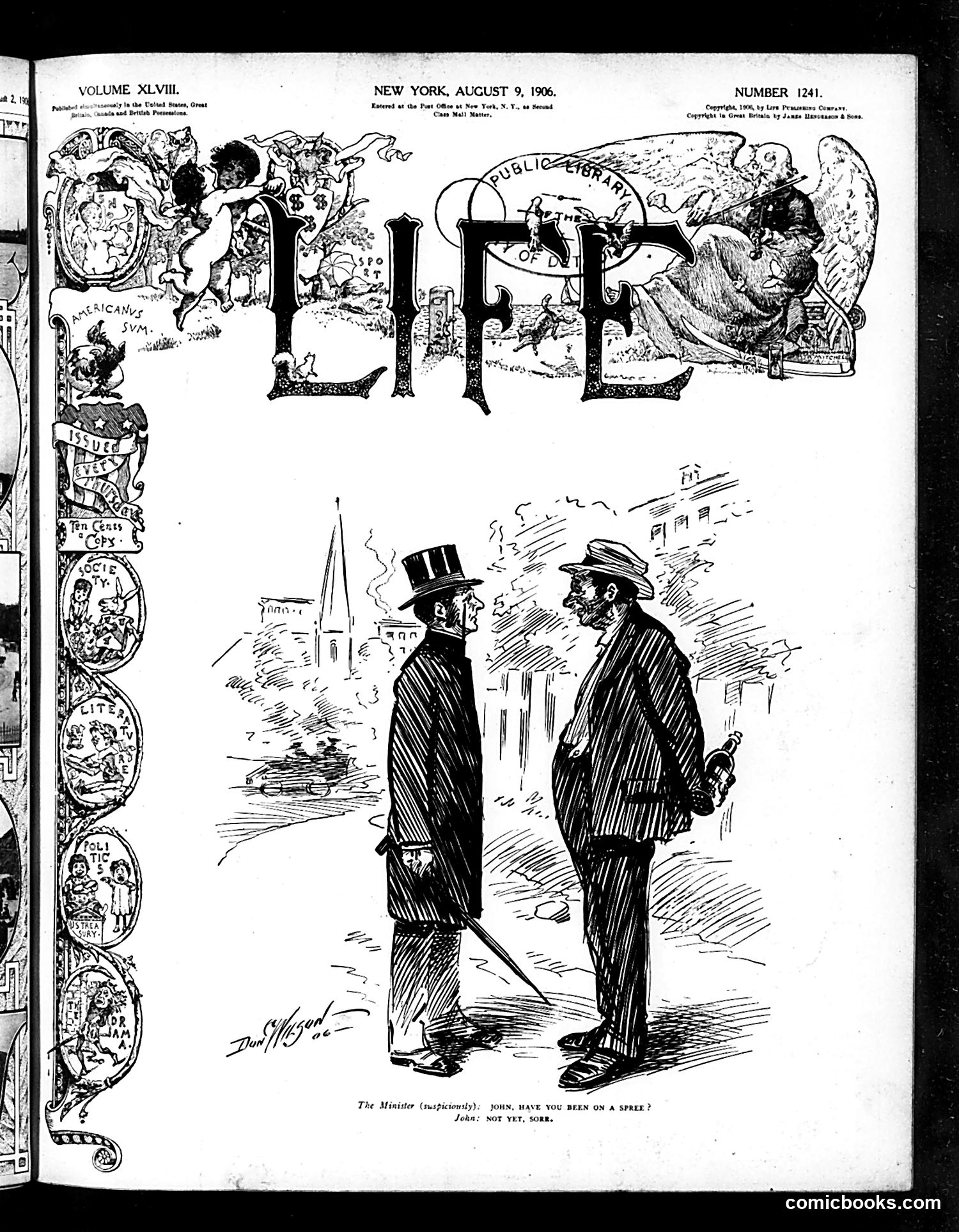
**August 9, 1906** The cartoon depicts two men in formal Victorian dress conversing on a street. One wears a top hat; the other a straw hat. The caption reads: "The Minister (inquisitively): 'JOHN, HAVE YOU BEEN ON A SPREE?' / John: 'NOT YET, SIR.'" This is a gentle social satire about temperance and respectability. A clergyman questions a working-class man (likely named John) about whether he's been drinking. John's defensive response—claiming he hasn't been on a "spree" yet—suggests ironic inevitability: the minister expects eventual misconduct. The joke reflects early-1900s anxieties about working-class morality and the era's active temperance movement, where religious figures monitored public behavior.
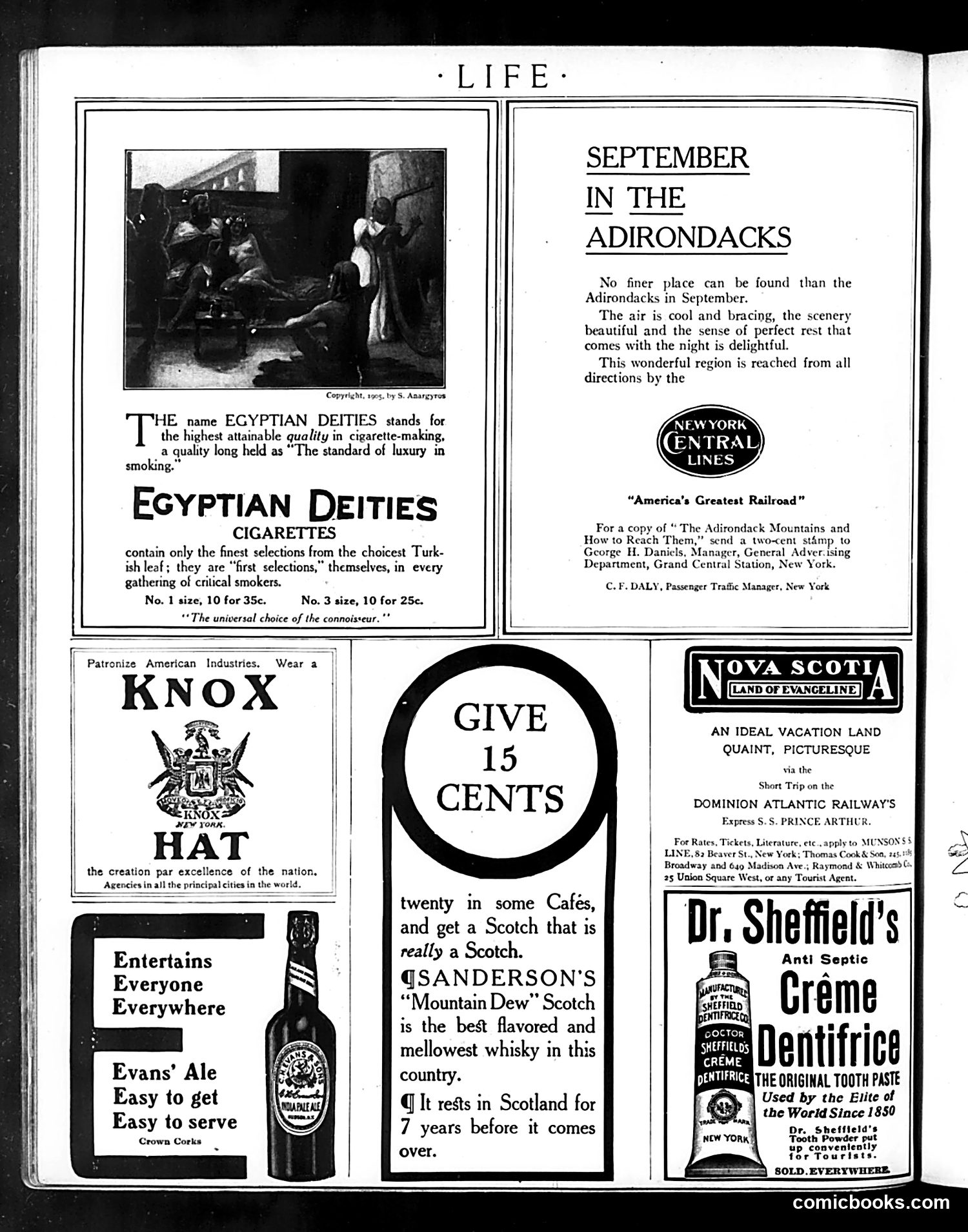
This page is **primarily advertising**, not political satire or comics. It contains four distinct ads: 1. **Egyptian Deities Cigarettes** — promoting Turkish tobacco as "the standard of luxury in smoking" 2. **Knox Hat** — positioning the hat as "the creation par excellence of the nation" 3. **Evans' Ale** — emphasizing easy consumption and service 4. **Sanderson's "Mountain Dew" Scotch** — highlighting its Scottish aging process 5. **Nova Scotia tourism** and **Dr. Sheffield's Tooth Paste** The one humorous element is the Sanderson's ad, which uses wordplay: "Give 15 cents twenty in some Cafes, and get a Scotch that is *really* a Scotch." This plays on the era's preference for genuine Scottish whisky. There are no political cartoons or social satire on this page—it's a straightforward collection of early-20th-century consumer product advertisements.
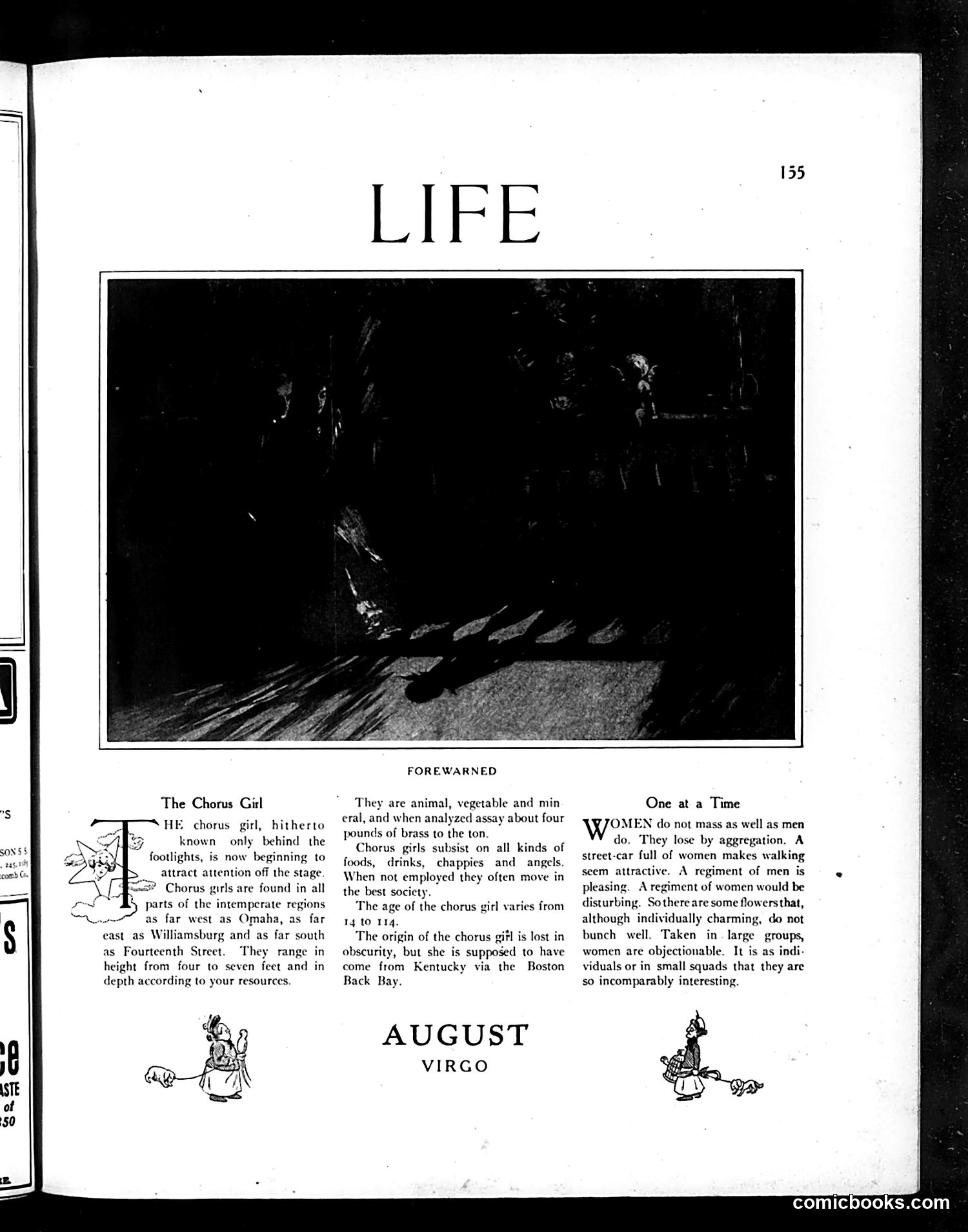
This page contains social commentary about **chorus girls** in early 20th-century American theater. The illustrated article describes chorus girls as working-class performers found in theaters from Omaha to lower Manhattan, earning modest wages by dancing in stage productions. The heading "One at a Time" presents a satirical observation about **gender and public behavior**: the author argues women lose charm and become objectionable when gathered in large groups, unlike men who remain pleasant in regiments. The commentary suggests individual women are attractive but groups of women are socially problematic—reflecting period prejudices about female behavior and acceptability. The accompanying dark photograph and Virgo zodiac symbol are decorative elements typical of Life's format.
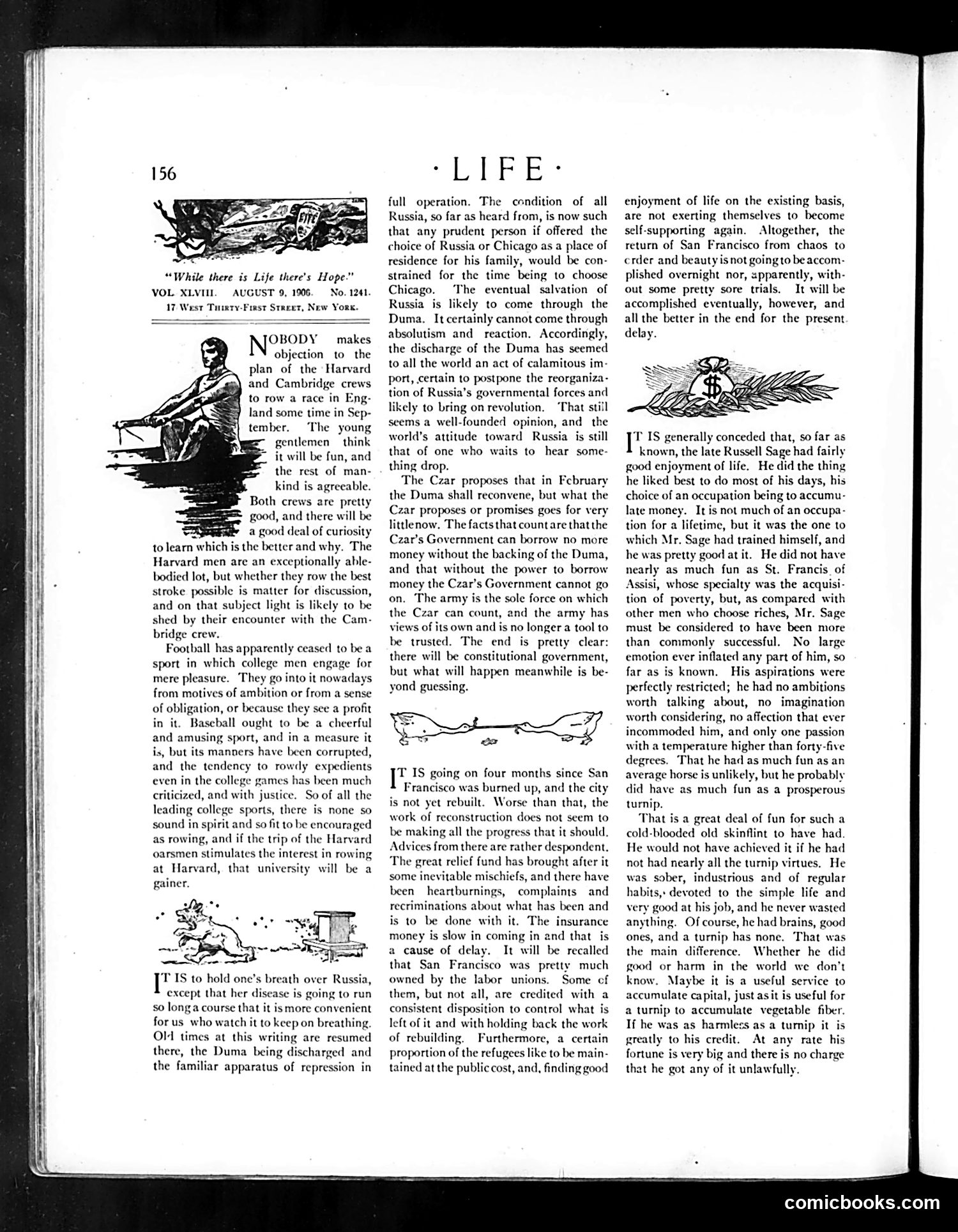
The page contains two illustrations accompanying articles about contemporary issues. **Left illustration**: Shows a rower in a boat, accompanying text about Harvard and Cambridge crews competing in England. The satire appears to mock college sports enthusiasm—the article notes that rowing "has apparently ceased to be a sport in which college men engage for mere pleasure" and criticizes how it's become tied to institutional prestige rather than genuine enjoyment. **Right illustration**: Depicts what appears to be a crude figure, accompanying commentary on Russell Sage (a wealthy financier who died recently). The text humorously reflects on Sage's modest lifestyle and simple pleasures despite his fortune, suggesting irony about wealth and happiness. Both pieces employ gentle satirical commentary on American institutional values and wealthy individuals.
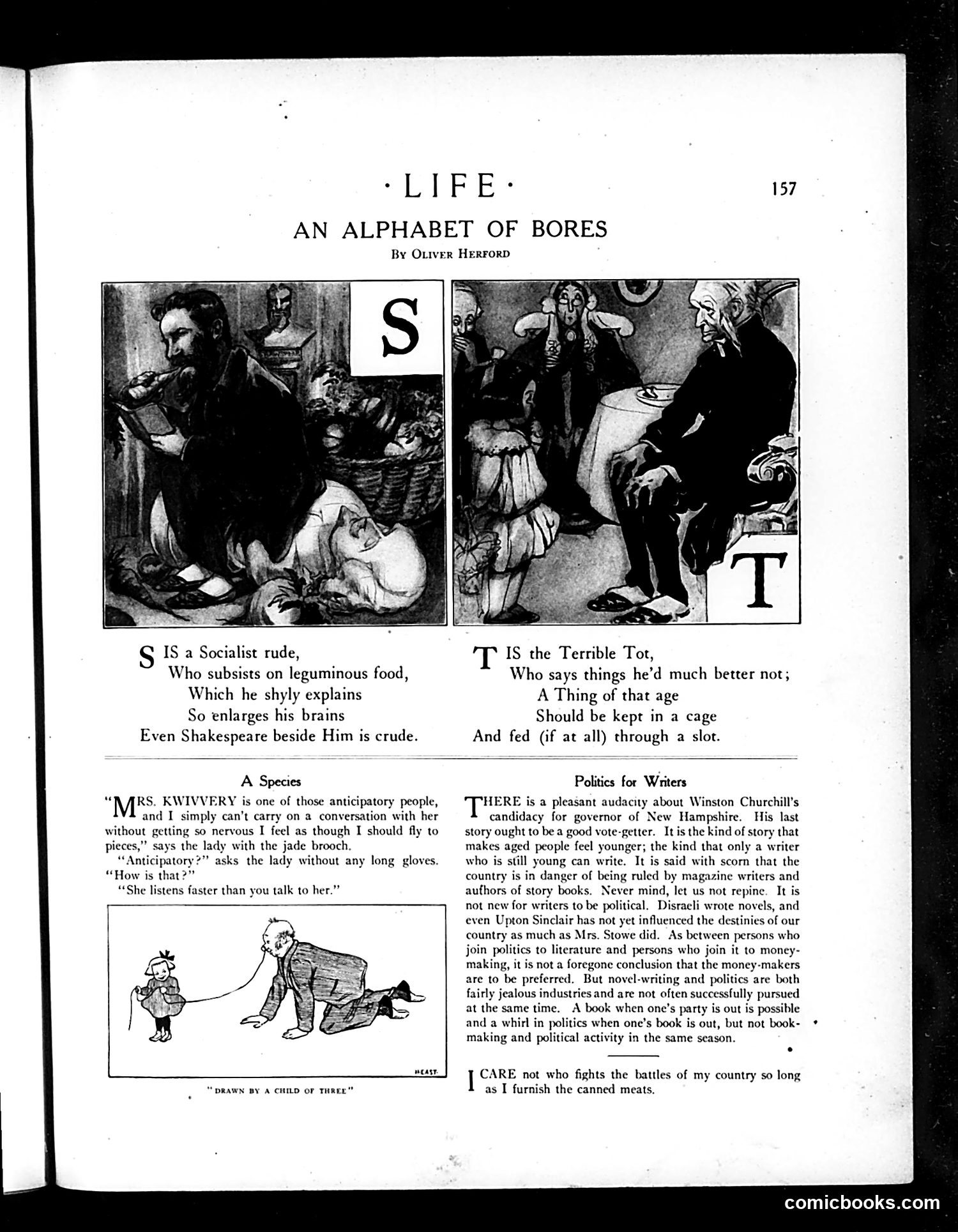
This satirical alphabet by Oliver Herford mocks social types through paired caricatures. **"S" (Socialist rude):** A bearded man in revolutionary garb, depicted as crude and subsisting on "leguminous food," with the joke that even Shakespeare seems refined by comparison. This reflects early-20th-century American anxiety about socialist immigrants and radicals. **"T" (Terrible Tot):** An elderly man at a dinner table, representing the bore who nostalgically insists "things he'd much better not" mention—a type who should be "kept in a cage." This mocks tedious elderly conversationalists. The accompanying anecdote about Mrs. Kwivvery satirizes women who dominate conversations with their own grievances, unable to listen. The page overall ridicules social types considered unbearable company.
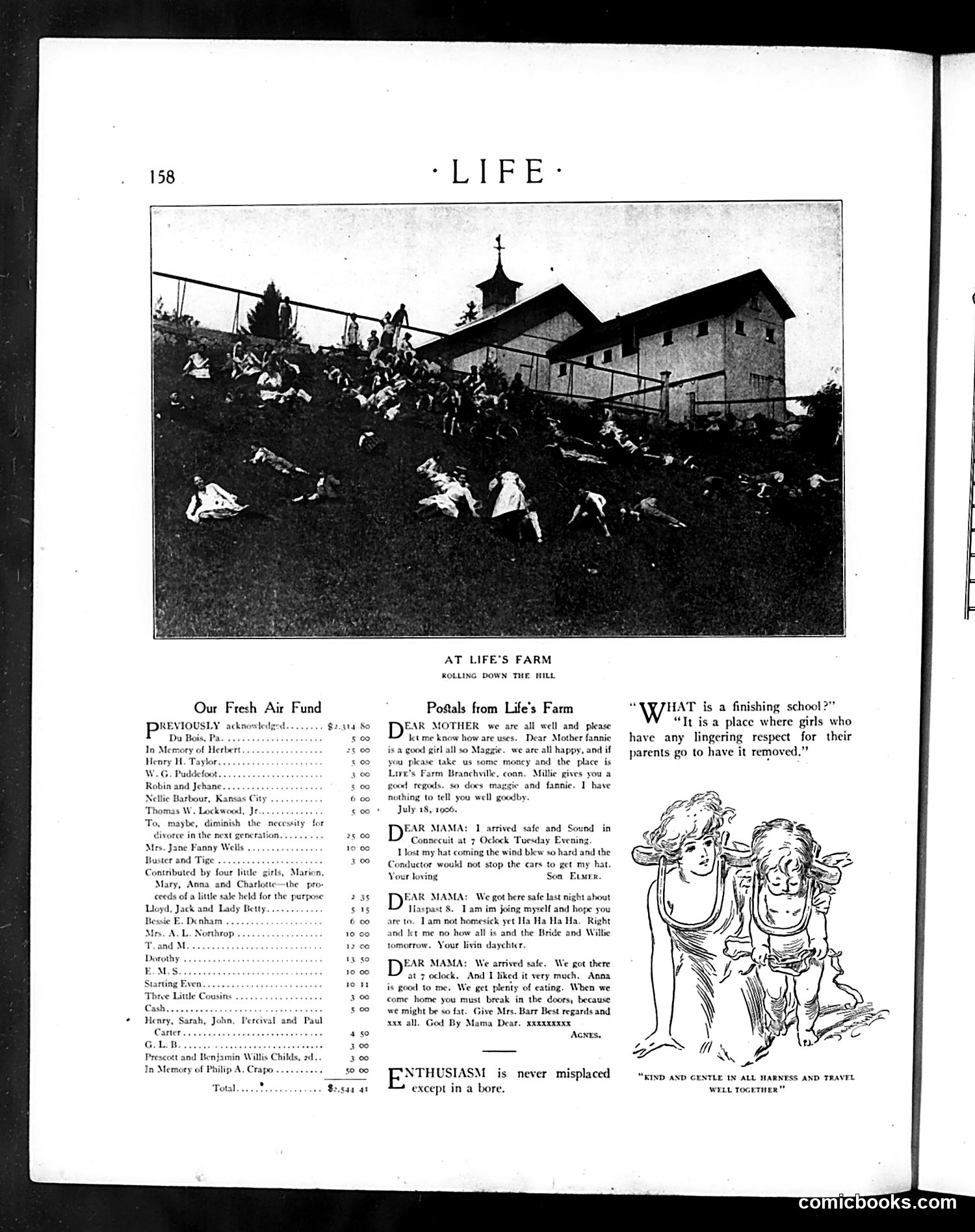
This page combines charitable fundraising with social commentary. The top photograph shows "Life's Farm" with children rolling down a hill—apparently a recreational facility or charitable institution. The left column lists donations to "Our Fresh Air Fund," a common early-20th-century charitable initiative providing urban children outdoor experiences. The right side presents letters from children at the farm to their mothers, expressing gratitude for the experience and describing simple pleasures like eating well and enjoying nature. The small illustration depicts two children, while the quote "What is a finishing school?" appears to satirize pretentious education, contrasting it with Life's Farm's value of character-building outdoor experience. The page reflects Progressive Era values emphasizing fresh air and nature as moral correctives for urban youth.
This is a satirical story (not a cartoon) about Colonel Peter Green, an insurance company executive, who is visited by a young man representing the "Patriotic Art Company." The salesman attempts to sell Green patriotic portraits of General U.S. Grant by appealing to his purported Civil War veteran status and sense of honor. The satire targets sales manipulation tactics—the young con artist tries flattery and patriotic appeals to pressure Green into buying overpriced artwork. The joke lies in Green's eventual deflation of the scheme: he exposes the salesman's transparent manipulation, revealing that high-pressure sales tactics targeting vanity and patriotism are fundamentally dishonest. The story critiques both aggressive salesmanship and gullibility in Gilded Age commerce.
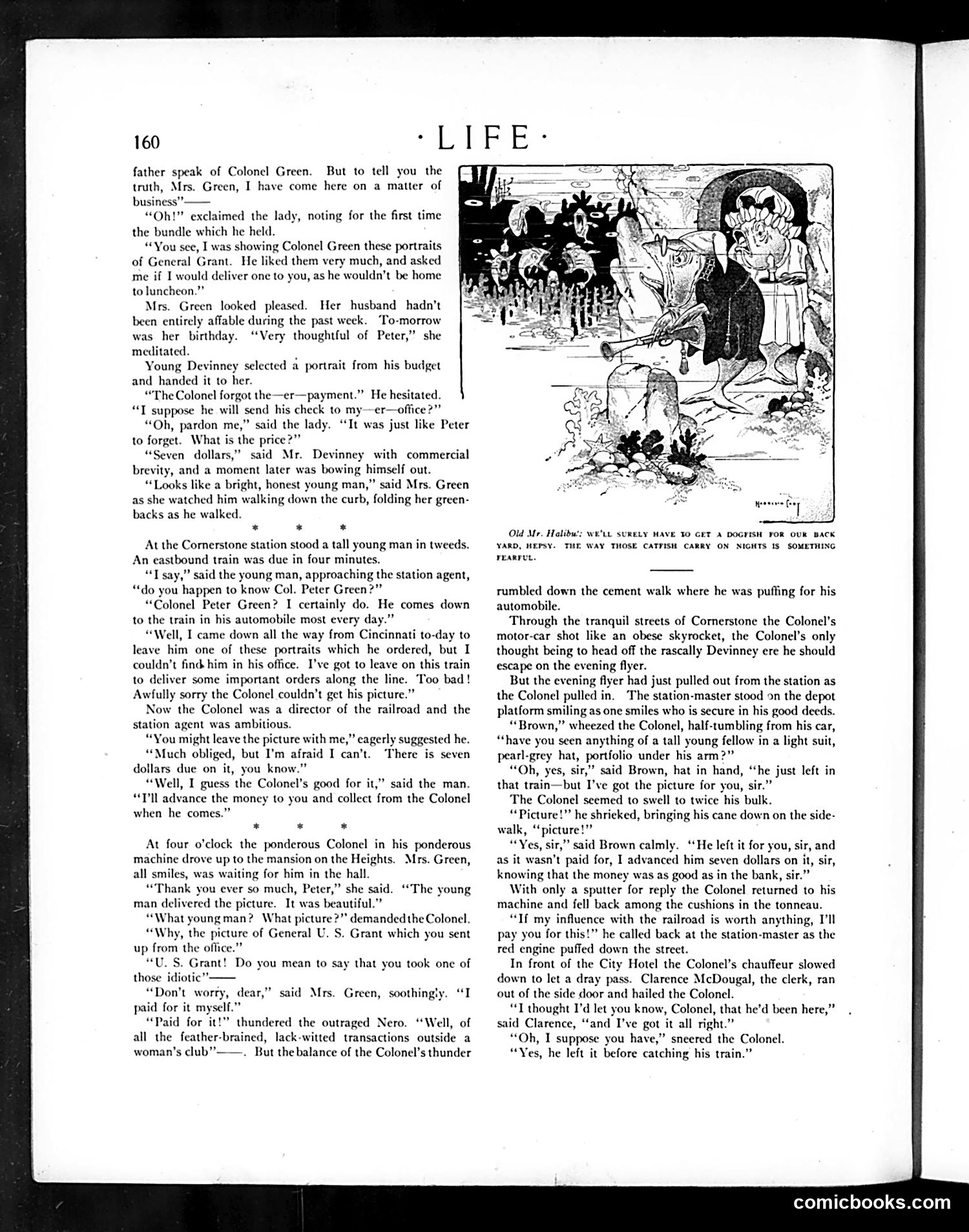
This page contains a short story with an accompanying illustration rather than political satire. The narrative depicts a social comedy about Colonel Green attempting to deliver portrait paintings as gifts. The illustration shows the Colonel arriving at a station with his automobile while various characters interact. The humor centers on Victorian-era class dynamics and gift-giving etiquette: Mrs. Green is delighted by the Colonel's thoughtfulness, but complications arise around payment and propriety. A young man named Devinney selected portraits, and the Colonel forgot to pay—leading to awkward negotiation about whether the gesture was appropriate without settling the bill first. The satire gently mocks upper-class social conventions and the pretenses surrounding charitable giving or gift-exchange among the wealthy.
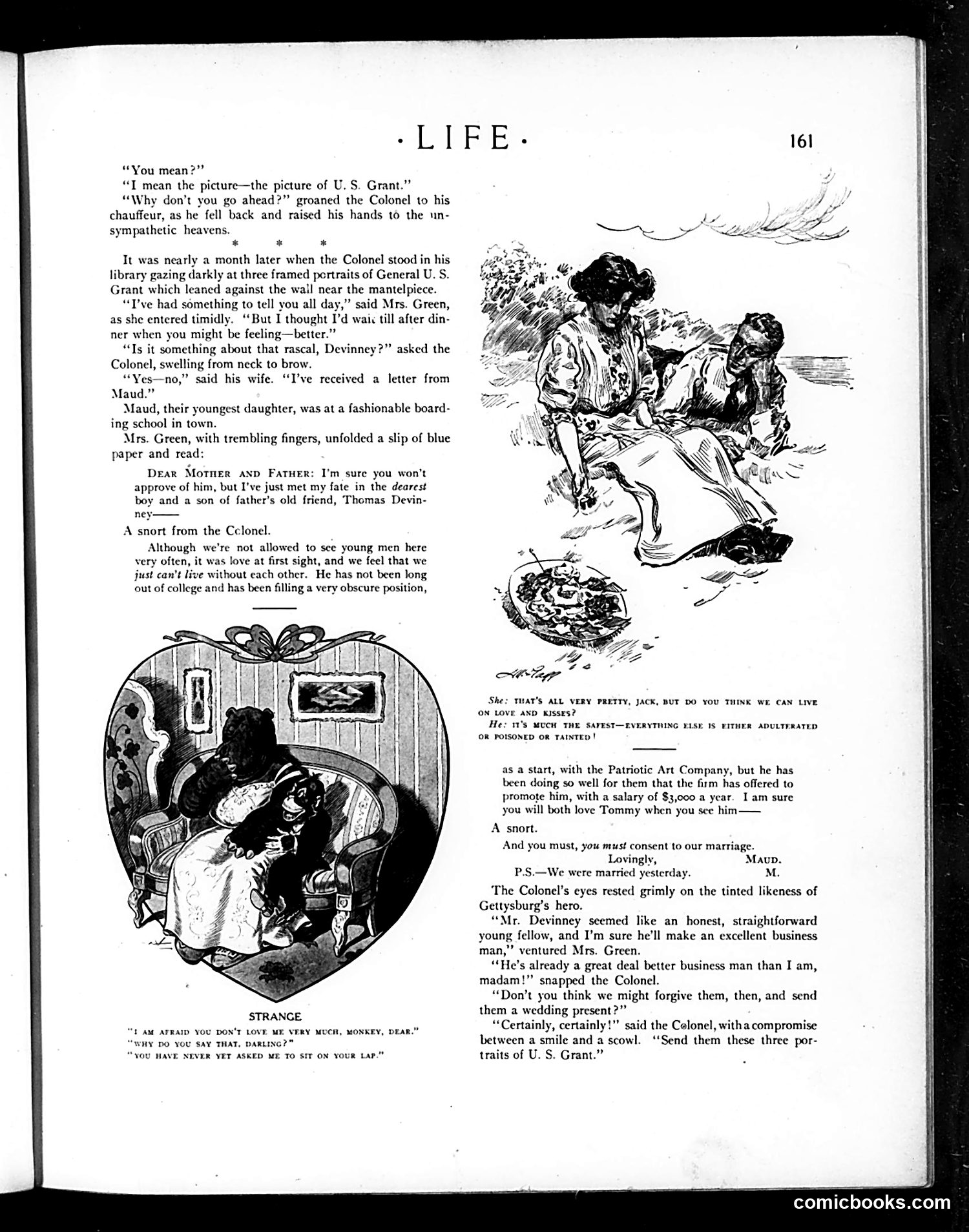
This page satirizes romantic and social pretensions. The main narrative concerns a Colonel confronted with a portrait of U.S. Grant—a figure of military authority and national prominence. The humor derives from the Colonel's discomfort with this image of Grant, suggesting social anxiety about representing oneself through association with famous figures. The accompanying illustrations depict intimate domestic scenes—a couple in bed and people in casual embrace. The text reveals a subplot about a young woman (Maud) who has married without parental approval, choosing a man of modest means over her family's expectations. The satire targets upper-class pretensions about marriage, propriety, and the gap between public respectability (Grant's heroic image) and private desires. The tone mocks both parental disapproval and the young couple's romantic idealism.
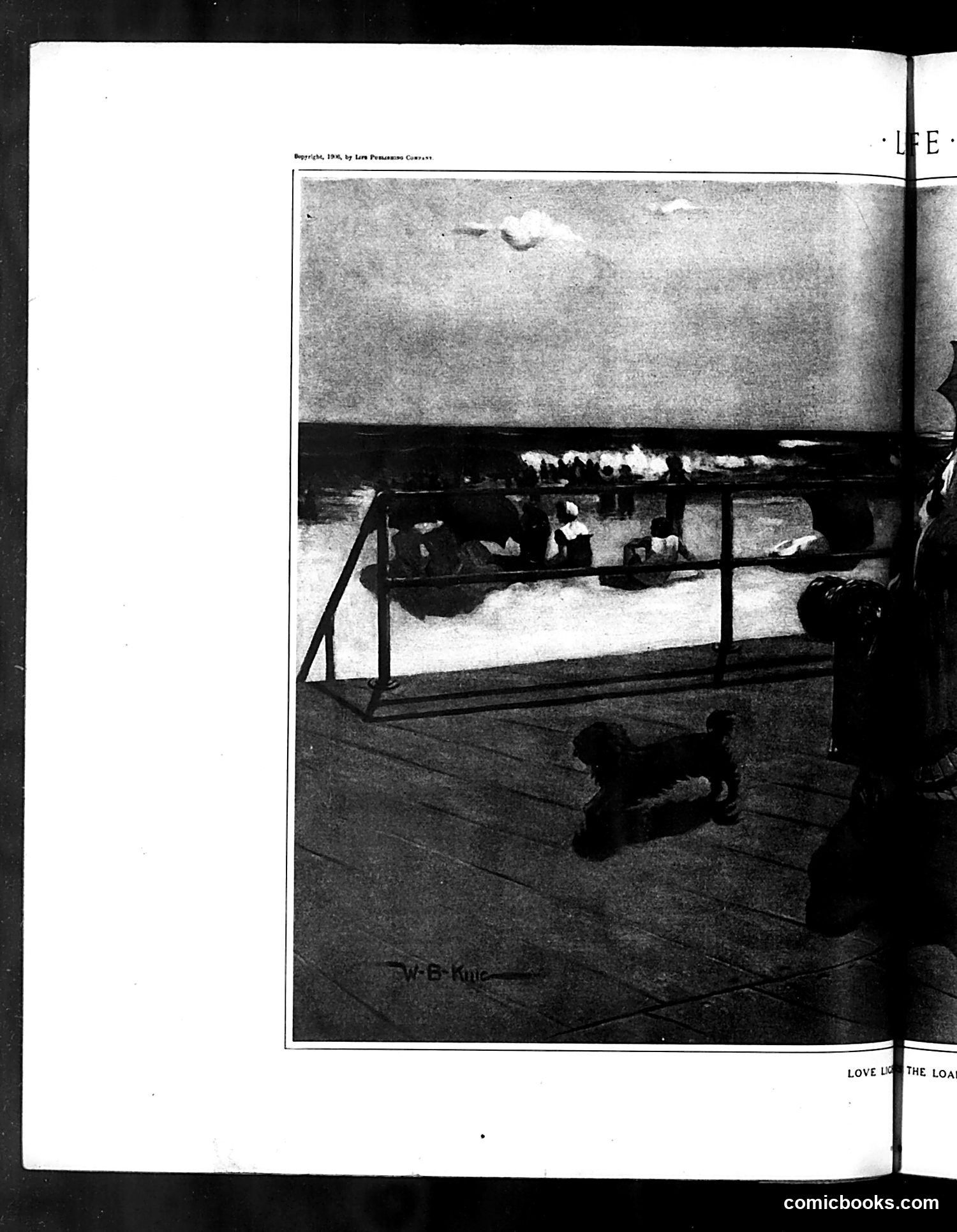
This page appears to be from *Life* magazine and contains a black and white photograph rather than a traditional cartoon. The image shows what looks like a theatrical or staged scene with a railing/barrier in the foreground, figures in the background near water with smoke or steam visible, and a dog in the lower right corner. The caption at the bottom reads "LOVE IS THE LOAD" (partially visible as "LOVE IS THE LOAI"). Without clearer text context or visible caricatures, I cannot definitively identify the specific political or social satire this image references. The theatrical staging and the juxtaposition of "love" with what appears to be an industrial or maritime scene suggests commentary on sentimentality versus harsh reality, but the exact target and meaning remain unclear from this reproduction.
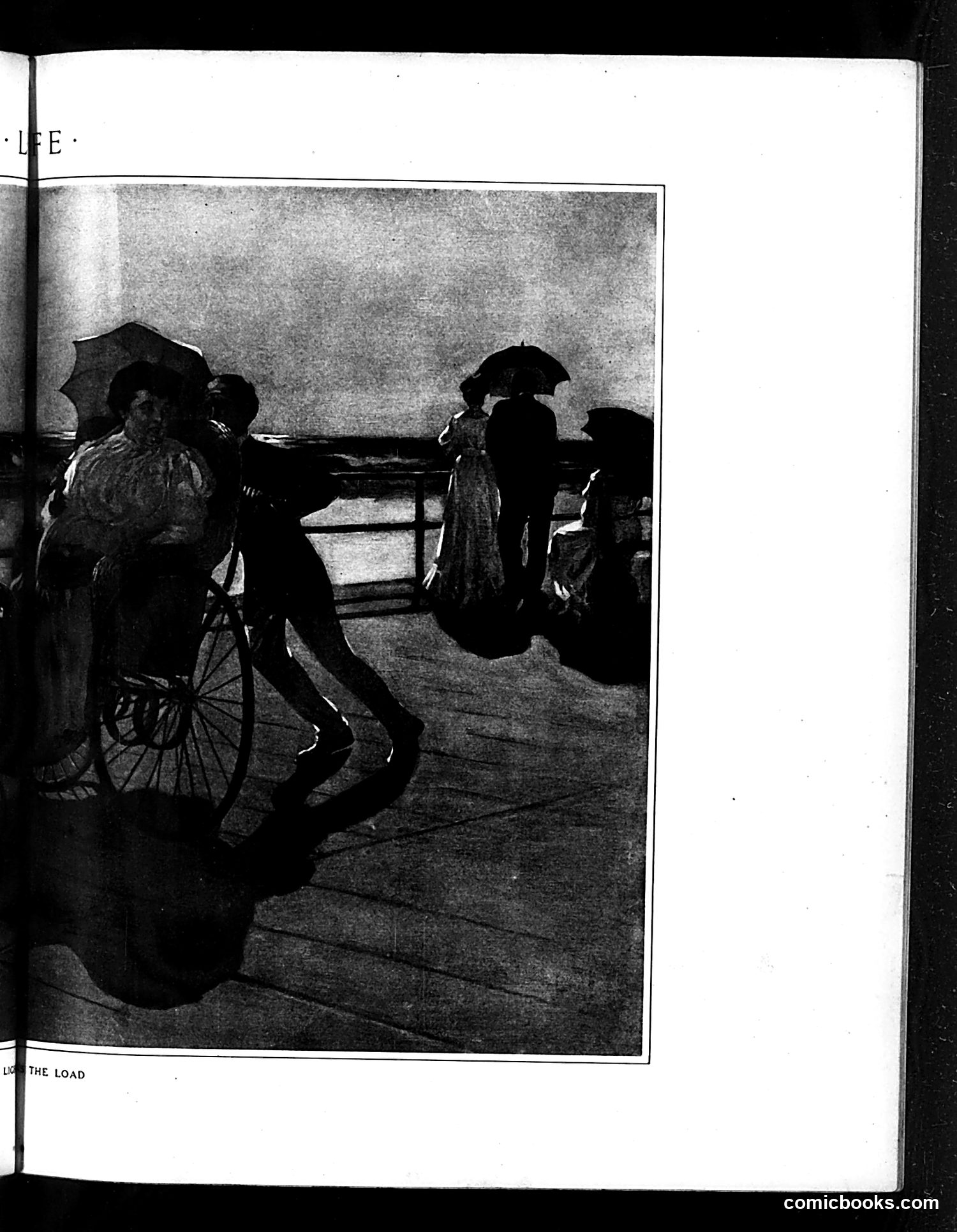
This page from *Life* magazine depicts several silhouetted figures with umbrellas on what appears to be a street or dock. The caption reads "THE LOAD," though the image is heavily shadowed, making specific details difficult to discern. The cartoon likely employs silhouettes intentionally—a common *Life* technique—to comment on burden-bearing or labor. The umbrellas suggest harsh weather, which often served as metaphors for difficult times or adversity in early 20th-century satire. Without additional context or clearer visibility of facial features or text labels identifying the figures, I cannot definitively state which specific political or social situation this references. The composition suggests commentary on shared hardship or collective struggle, but the exact target remains unclear from this image alone.
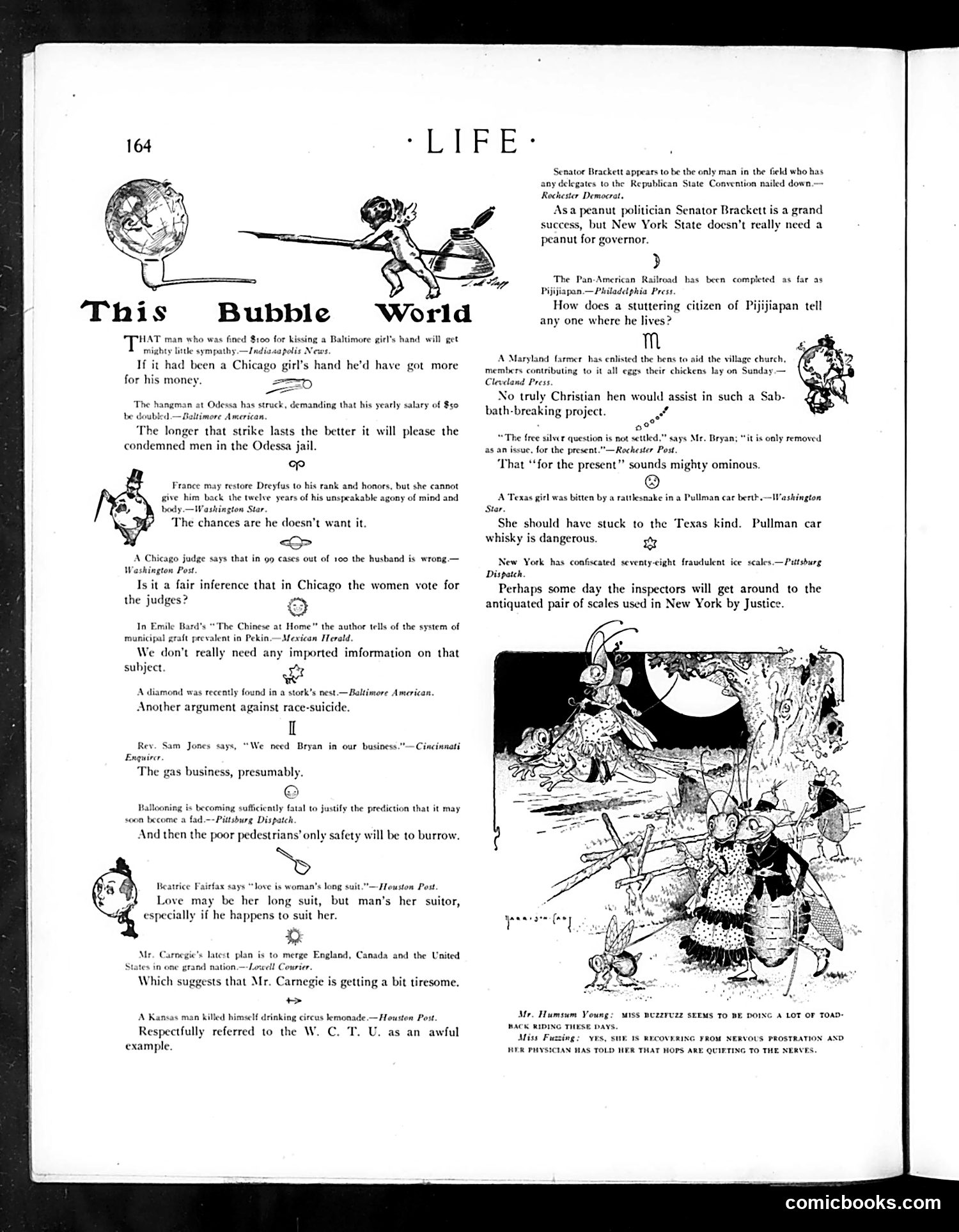
This page collects brief satirical comments on contemporary news and politics. The left column features short quips about various public figures and events: - **Senator Brackett**: Criticized as a "peanut politician" unfit for New York governor - **The Pan American Railroad**: Completed to Pittsburg - **Maryland farmer's hen**: Mocked for assisting in egg collection for church charity - **Texas girl and Pullman porter**: A dark joke about a rattlesnake bite and "dangerous" whiskey - **Mr. Carnegie's merger plan**: Satirized as making him "tiresome" The right side contains a detailed illustration labeled "Mr. Hammon Young" depicting toad-back riding, with accompanying text about a woman recovering from nervous exhaustion. The overall tone is irreverent commentary on wealthy industrialists, social customs, and contemporary news items.
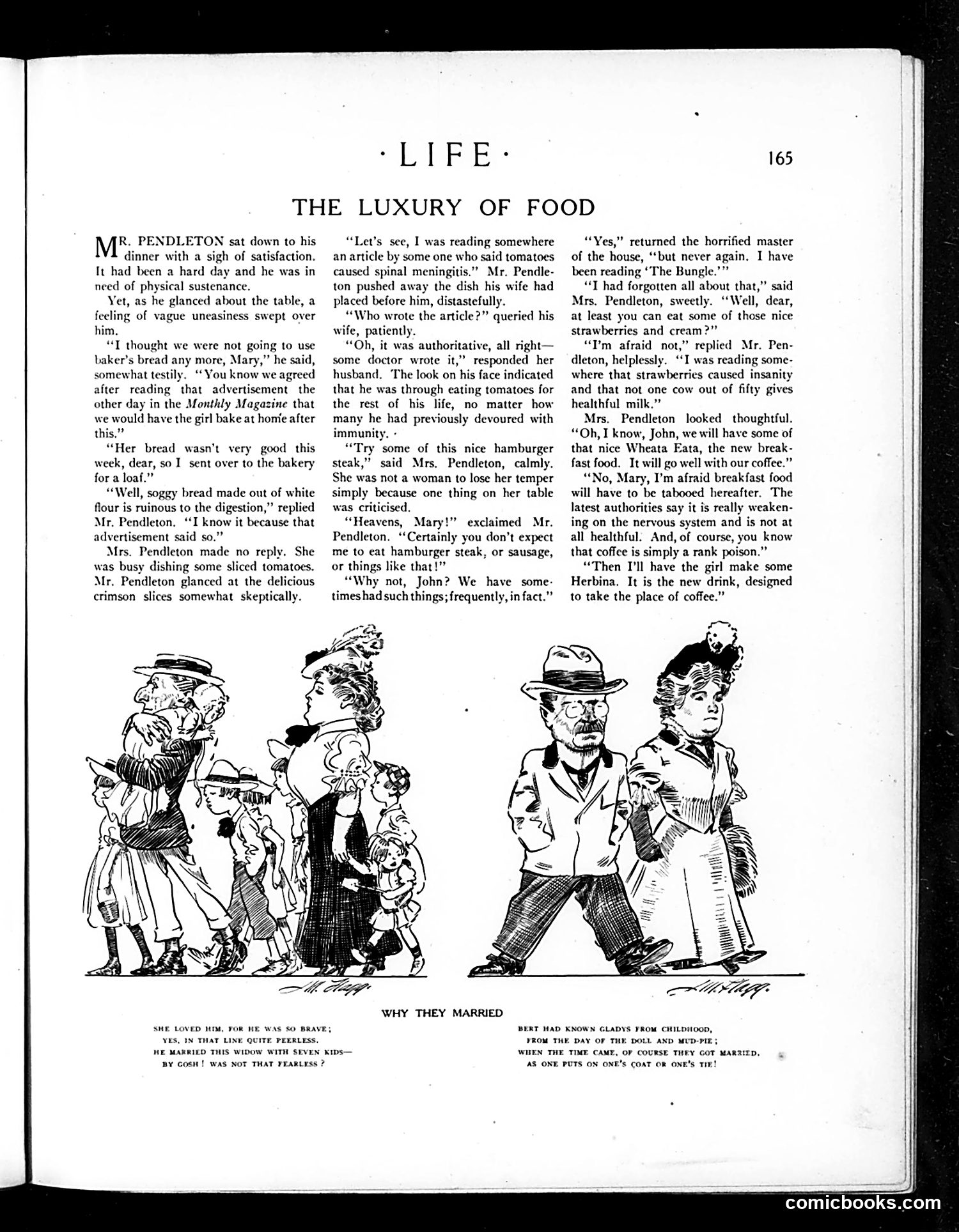
This page satirizes early 20th-century anxieties about food safety and nutrition fads. Mr. Pendleton refuses his wife's "baker's bread" due to a *Life* magazine advertisement warning it's "ruinous to digestion," then rejects tomatoes (linked to a medical article about meningitis). He demands hamburger steaks instead, only to be mocked for his inconsistency—he previously ate such foods without concern. The satire targets the era's emerging consumer culture: how modern advertisements and pseudo-scientific health claims manipulate the public into constant dietary worry and contradiction. The two cartoon vignettes below humorously contrast why people marry—bravery versus familiarity—suggesting marital choices are equally irrational as food choices.
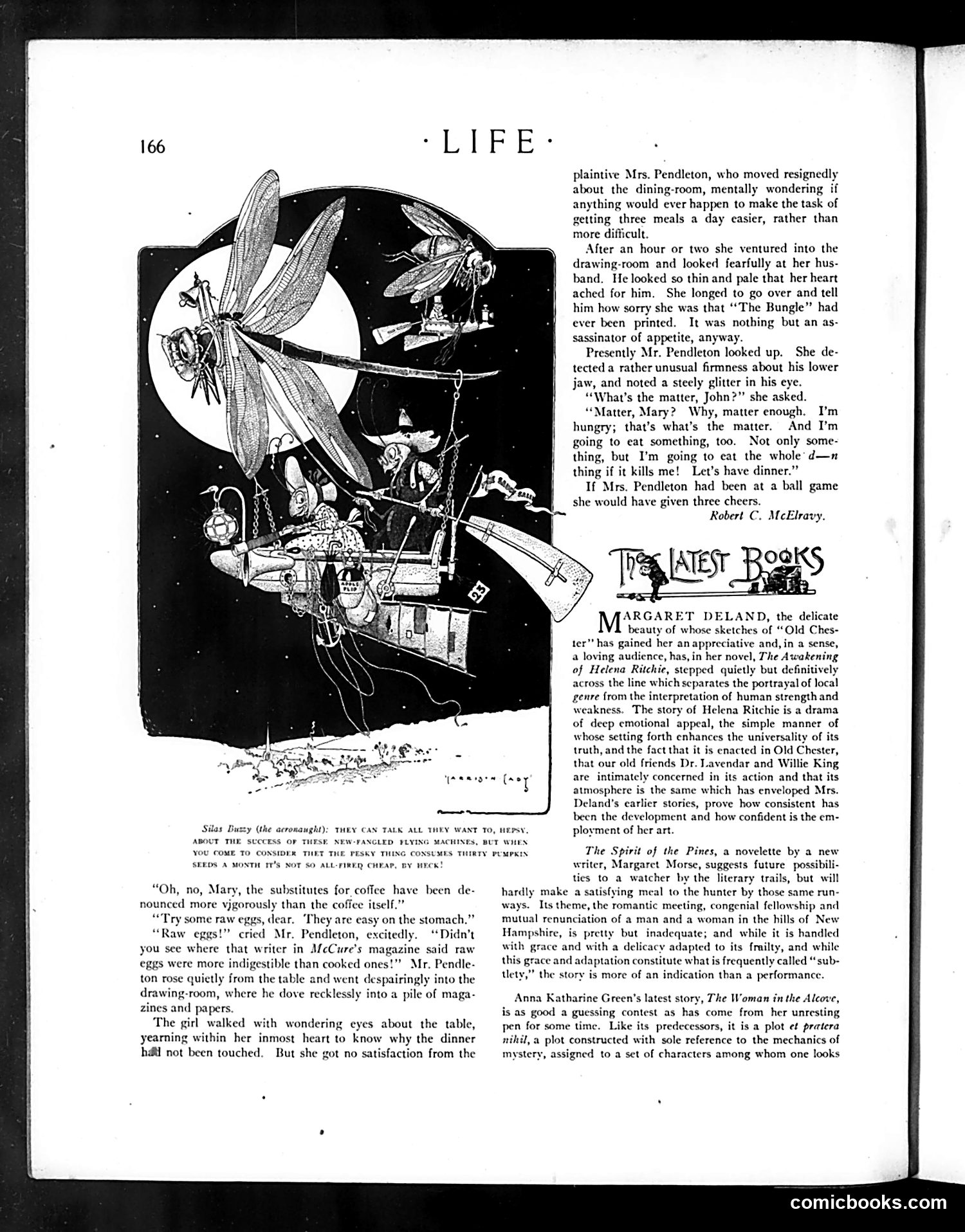
This is a humorous illustrated story, not political satire. The cartoon depicts **Silas Busty**, an early aviation pioneer, operating a primitive flying machine (an "aeronaut" with mechanical wings and propellers). The joke critiques emerging aviation technology: while the machines generate excitement about flight capabilities, they're impractical and expensive for everyday use. The rural character's complaint—that despite the marvel of flight, the machine "consumes thirty pumpkin" (fuel costs)—mocks the gap between technological promise and economic reality. The accompanying story involves Mr. Pendleton, whose appetite has been ruined by reading magazine articles (particularly "The Bungle") that contradict each other about food safety. The satire targets **turn-of-century magazine culture**: proliferating publications filled with contradictory health advice that paralyze rather than inform readers. Both pieces gently mock modern anxieties about new technology and information overload.
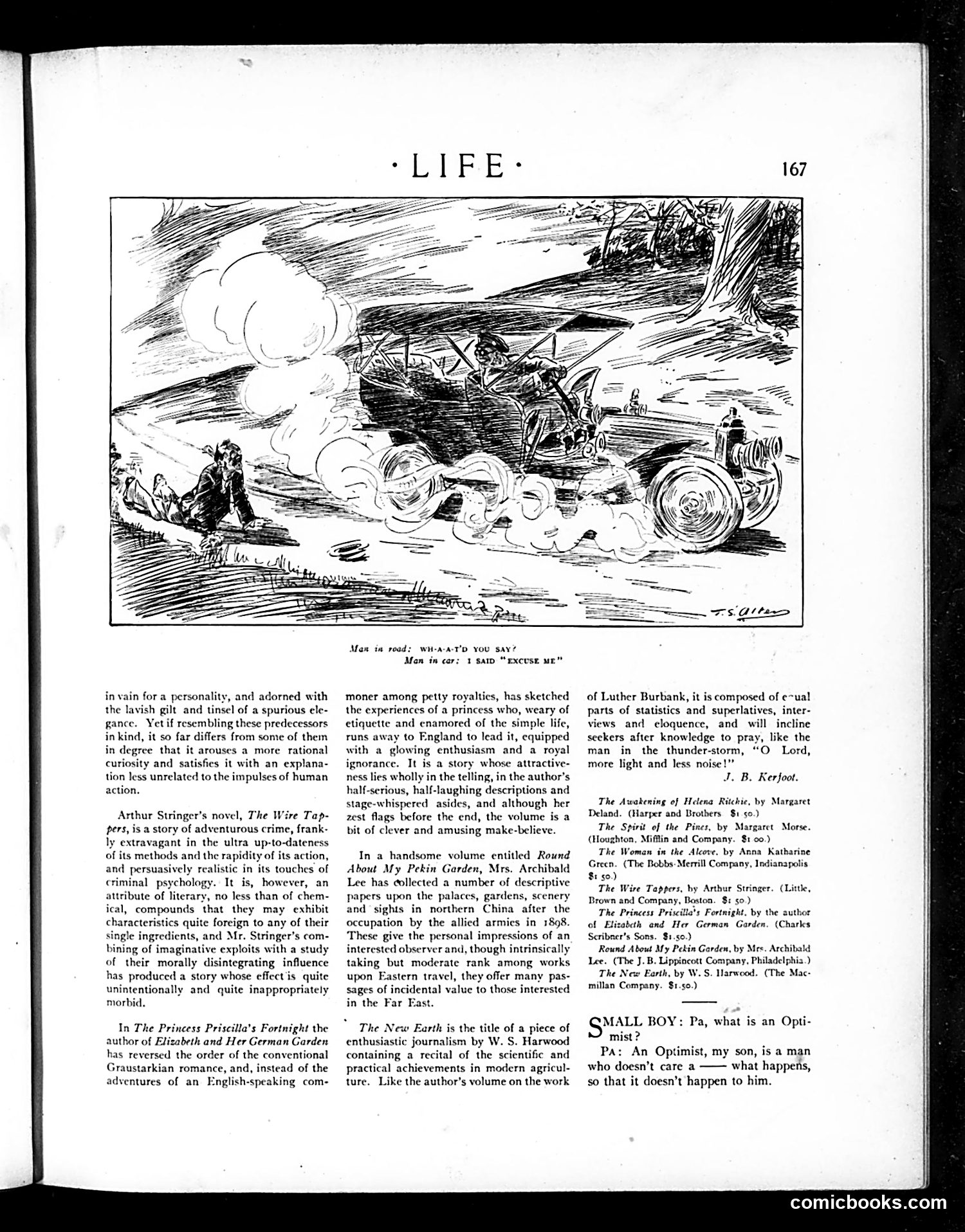
This page from *Life* magazine contains a book review section and a small cartoon joke about automobiles and hearing. **The Main Cartoon:** Shows two men in early automobiles on a road. The man in the car behind shouts "EXCUSE ME!" but the driver ahead, unable to hear over the noise of his vehicle, asks "WHAT'D YOU SAY?" The satire targets the *novelty and loudness of early automobiles*—a technology so new and noisy that basic communication between drivers was nearly impossible. This was a topical joke about the disruptive social impact of early motorcar travel. **The Joke at Bottom:** A father-son exchange about "optimists"—defined as men indifferent to what happens as long as it doesn't affect them personally. This appears unrelated to the automobile cartoon, likely a separate filler joke. **Context:** The page primarily reviews new books (novels by Arthur Stringer, Margaret Deland, and others). The automobile cartoon's humor relies on readers' familiarity with the chaos and noise of early 1900s car culture—something modern readers might not immediately recognize as satirical.
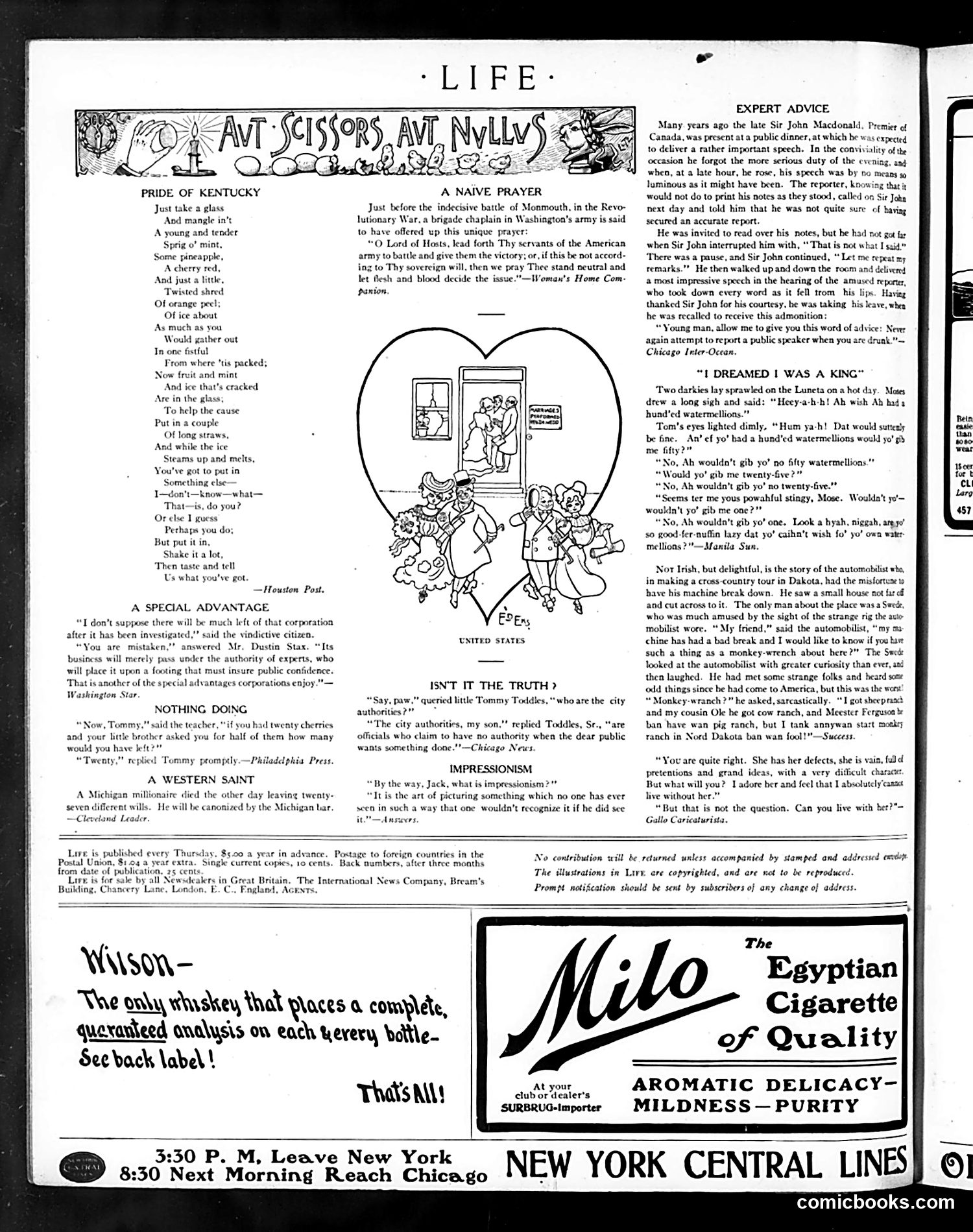
This page from *Life* magazine contains several brief humorous pieces typical of early 20th-century American satire: **Main content:** A collection of short jokes and anecdotes mocking everyday situations and human nature. "A Special Advantage" satirizes corporate corruption—suggesting that even after investigation, corporations exploit the system by hiring "experts" to restore public confidence while avoiding real accountability. "Nothing Doing" makes fun of a child's faulty logic about sharing. "Isn't It the Truth?" mocks ineffectual city government officials who claim powerlessness. "Impressionism" jokes that the art movement depicts things unrecognizably. **Social context:** The pieces reflect Progressive Era skepticism toward big business, government inefficiency, and modern artistic movements. The humor relies on wordplay and irony accessible to educated readers. The page also includes period advertisements (Wilson whiskey, Milo cigarettes) and a railroad schedule—standard *Life* magazine fare combining satire with commercial content.
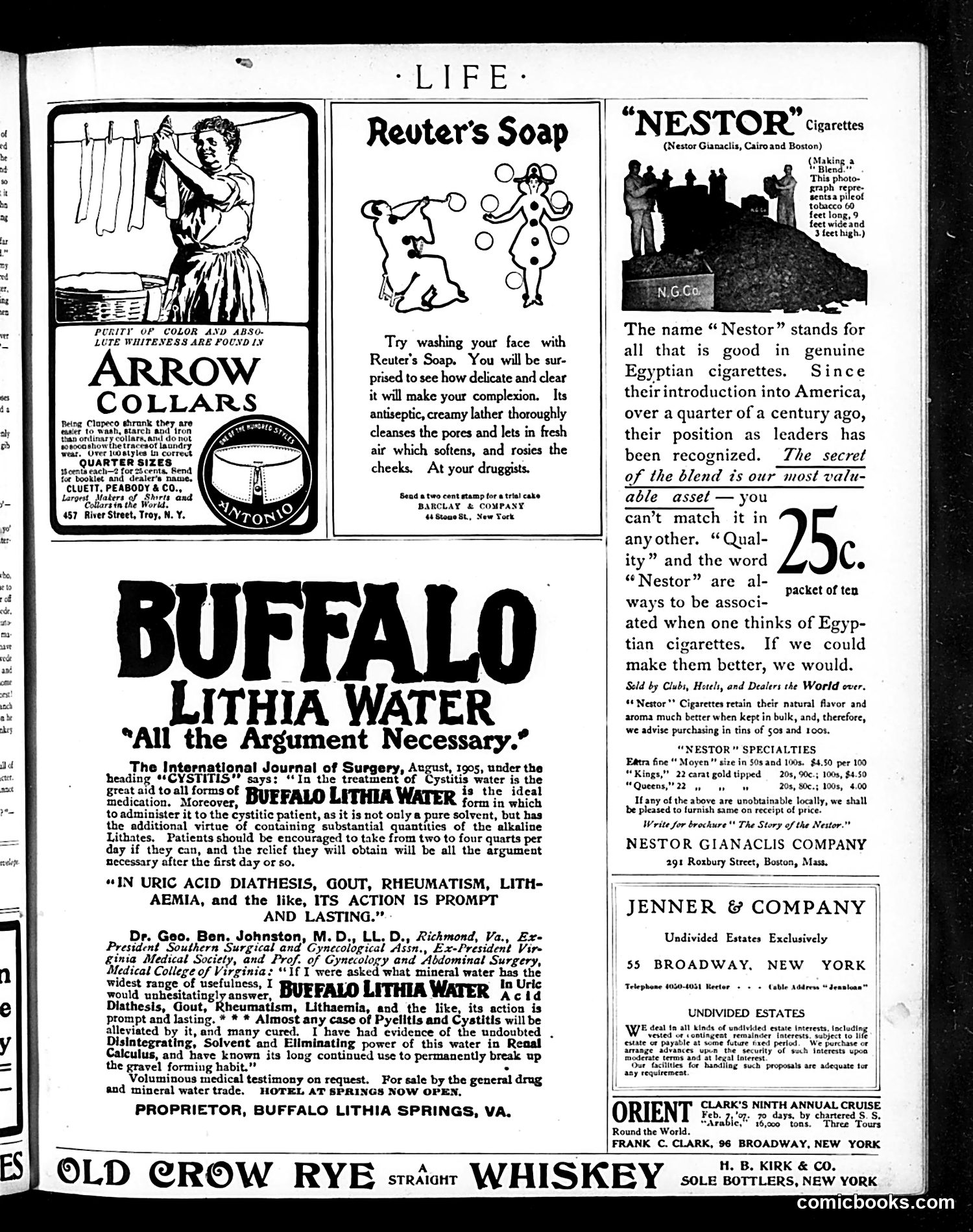
This page is primarily **advertising**, not political satire. It contains vintage product advertisements from an early 1900s Life magazine, including: - **Arrow Collars**: Markets detachable collars emphasizing purity and whiteness - **Reuter's Soap**: A beauty product claiming to cleanse pores and improve complexion - **Buffalo Lithia Water**: A patent medicine claiming to treat cystitis, gout, and rheumatism, supported by medical testimonials - **Nestor Cigarettes**: Egyptian cigarettes marketing their superior blend The only visual cartoon element is a small illustration of a woman hanging laundry above the Arrow Collars ad. The page reflects early 20th-century commercial culture: medical claims (now illegal) were openly made for patent medicines, and everyday products like collars and soap received extensive promotional space with questionable health benefits.
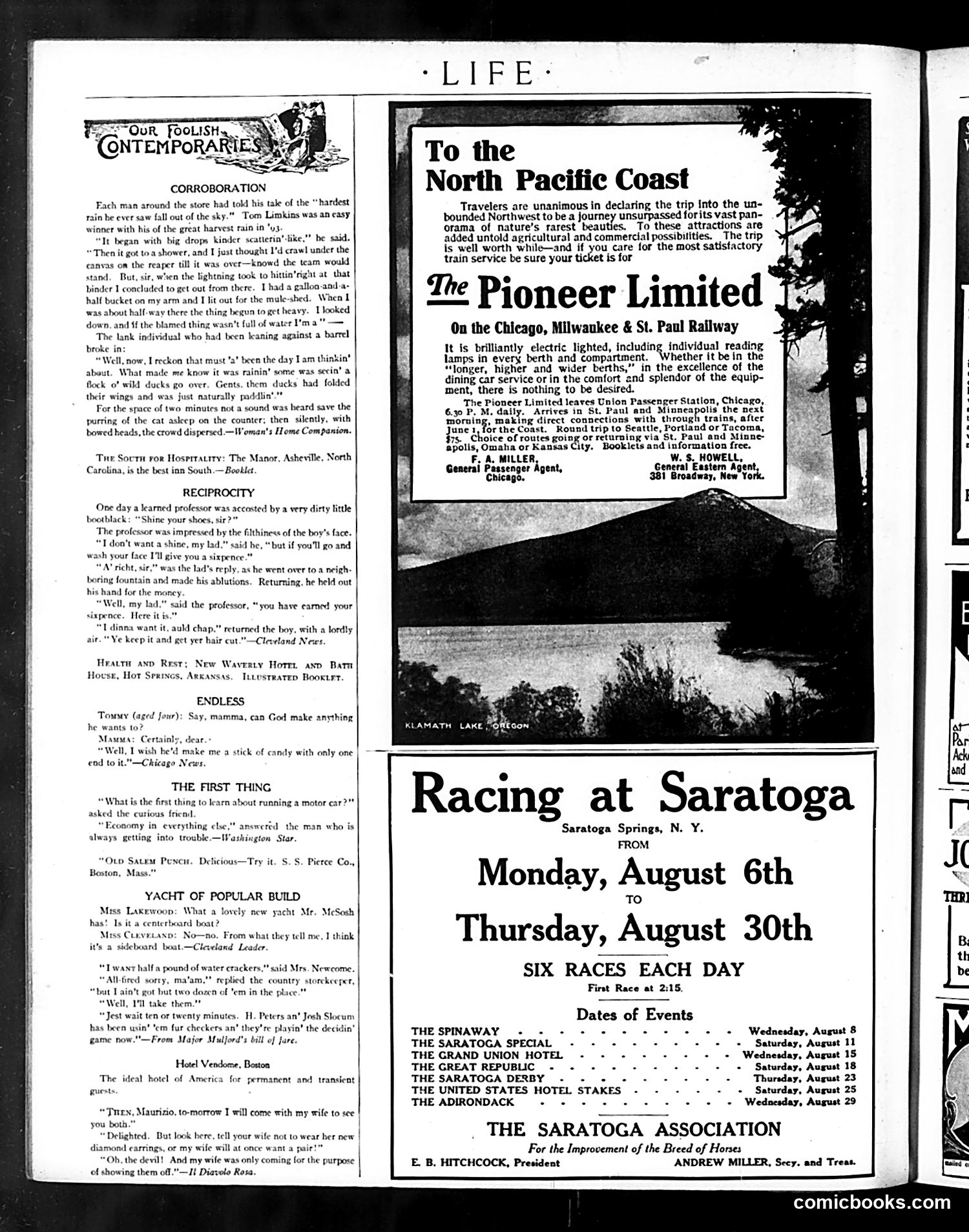
This page contains primarily **humorous anecdotes and advertisements** rather than political cartoons. The "Our Foolish Contemporaries" section features several brief jokes satirizing everyday American life circa early 1900s: **The main satire**: Rural men competing to tell the tallest tale about rainfall, with a farmer describing a storm so heavy that ducks folded their wings and "paddled" through the air like water. The joke mocks exaggeration and one-upmanship in rural storytelling—the other men concede defeat in stunned silence. **Other jokes**: Include a bootblack who demands payment for washing his face rather than shining shoes; a child asking if God could make one-ended candy; and women's competitive consumerism over jewelry. **Context**: These reflect common turn-of-the-century American humor: rural naïveté, class differences, and emerging consumer culture. The advertisements for trains and Saratoga racing indicate this is a magazine for middle-class readers. The page is primarily **light entertainment and advertising**, not serious social commentary.
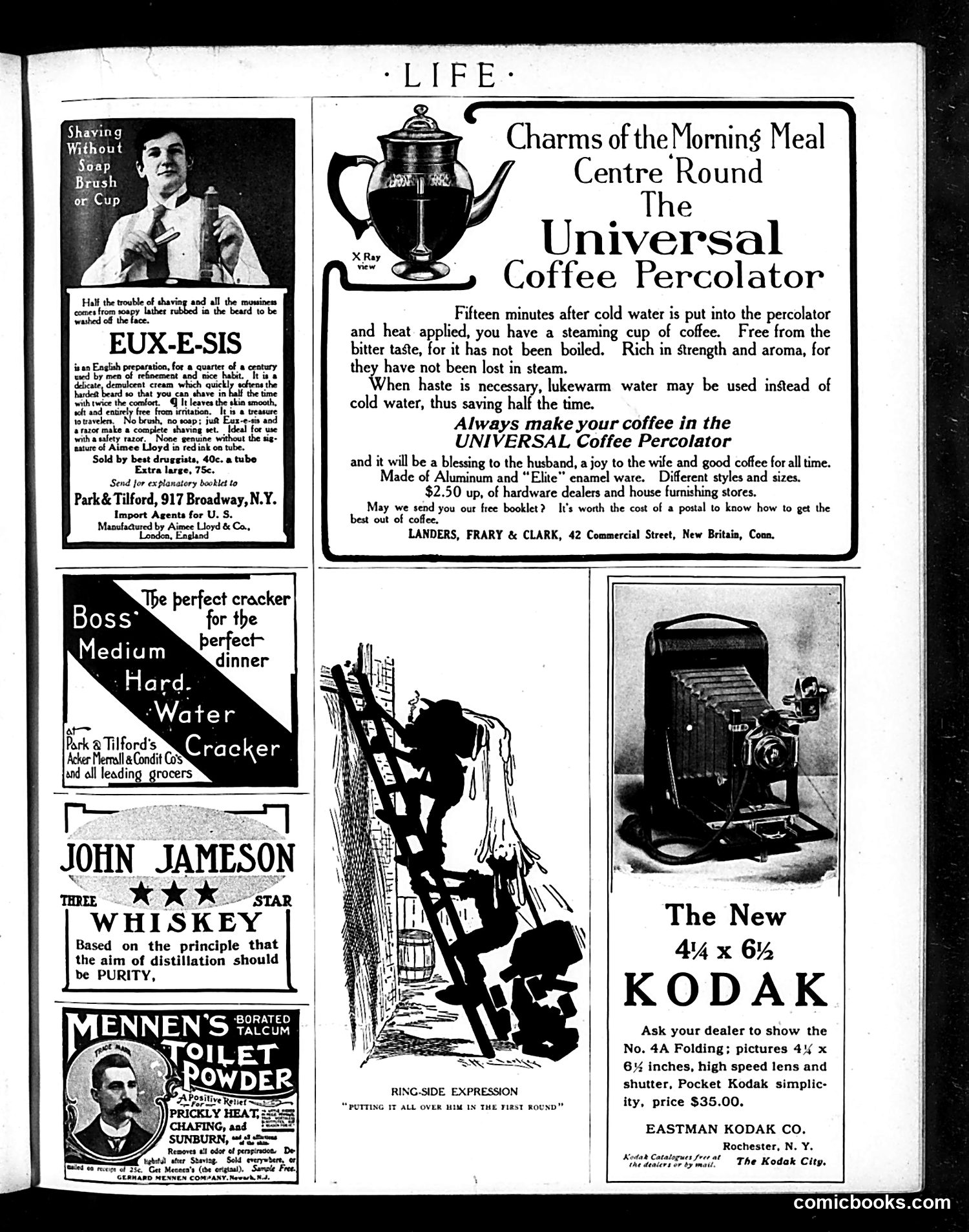
This is primarily an **advertising page** from an early 20th-century issue of Life magazine, with one small cartoon. The only comic content is the **"Ring-Side Expression"** cartoon, which depicts a boxer mid-fight with the caption "Putting it all over him in the first round." This is a straightforward boxing joke—a visual pun playing on the phrase "putting it all over someone" (meaning to defeat them decisively) by literally showing a fighter doing physical damage. The rest of the page contains period advertisements for: - **Eux-E-Sis** (shaving cream) - **Universal Coffee Percolator** - **Boss Cracker** - **John Jameson Whiskey** - **Mennen's Talcum Powder** - **Kodak camera** These ads reflect early 1900s consumer goods and marketing approaches, targeting middle-class households with promises of convenience and quality. There is no political satire on this page—it's a standard commercial publication layout typical of Life magazine's mixed advertising and editorial content.
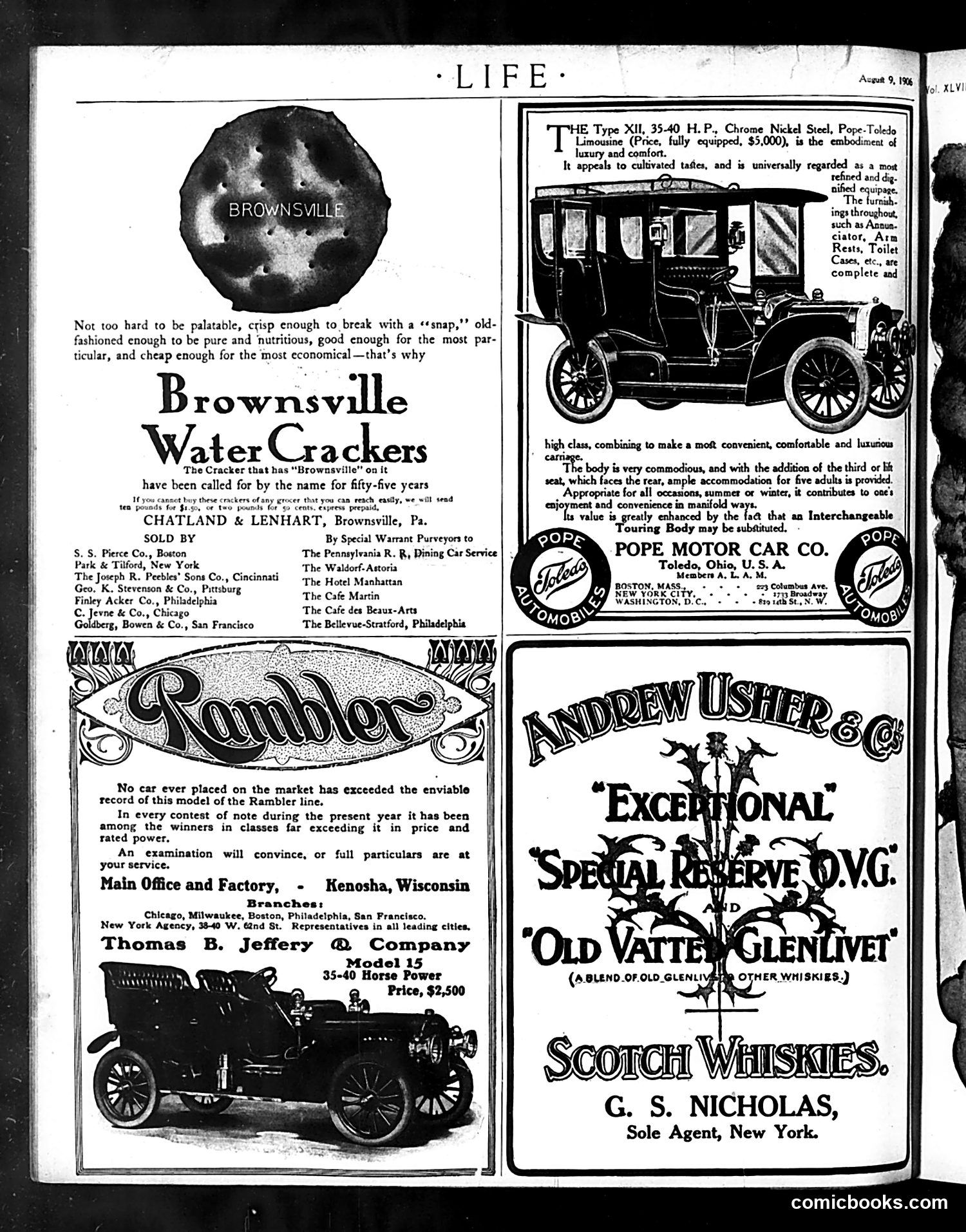
This is primarily an **advertising page** with no political cartoon or satire. It contains four commercial advertisements typical of early 1900s *Life* magazine: 1. **Brownsville Water Crackers** — a food product marketed as affordable, traditional, and nutritious, sold nationwide through various distributors. 2. **Pope-Toledo Limousine** ($5,000) — a luxury automobile appealing to "cultivated tastes," featuring premium appointments like armrests and toilet cases, positioned for wealthy clientele. 3. **Rambler automobile** (Model 15, $2,500) — a mid-range car emphasizing its competitive racing record and value proposition. 4. **Andrew Usher Scotch Whisky** — a premium spirits brand. These ads reflect the **emerging consumer culture** of the Gilded Age, targeting affluent readers with luxury goods (automobiles particularly new and status-laden). The contrast between cheap crackers and $5,000 cars illustrates the era's economic stratification. No satire or political commentary is present; this is straightforward commercial content.