
Life, 1906-08-09 · page 4 of 20
Life — August 9, 1906 — page 4: what you’re looking at
What you’re looking at
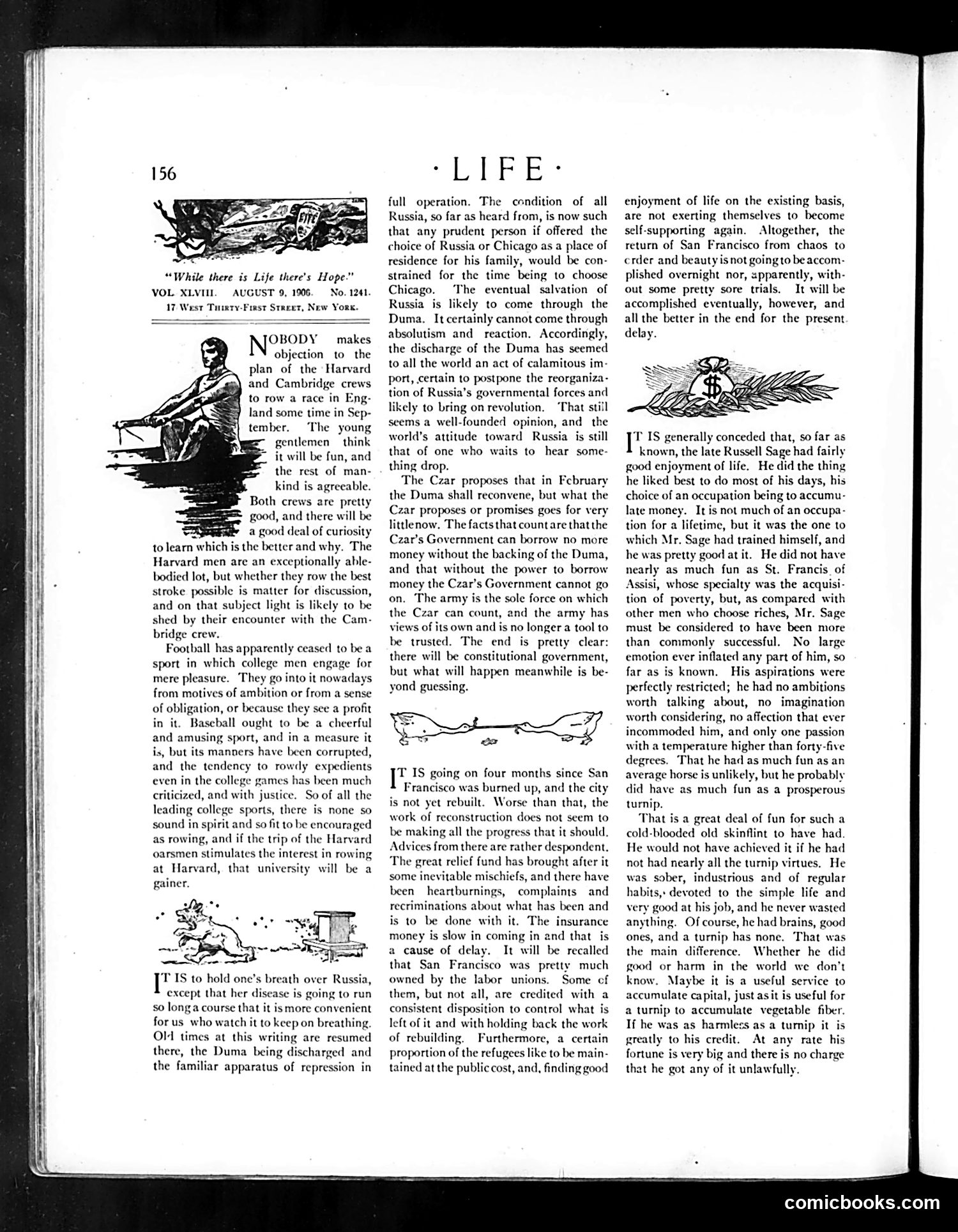
The page contains two illustrations accompanying articles about contemporary issues. **Left illustration**: Shows a rower in a boat, accompanying text about Harvard and Cambridge crews competing in England. The satire appears to mock college sports enthusiasm—the article notes that rowing "has apparently ceased to be a sport in which college men engage for mere pleasure" and criticizes how it's become tied to institutional prestige rather than genuine enjoyment. **Right illustration**: Depicts what appears to be a crude figure, accompanying commentary on Russell Sage (a wealthy financier who died recently). The text humorously reflects on Sage's modest lifestyle and simple pleasures despite his fortune, suggesting irony about wealth and happiness. Both pieces employ gentle satirical commentary on American institutional values and wealthy individuals.
📄 Transcribed text from this page (OCR, searchable)
Machine-transcribed from the original scan — historical spelling and the odd misread are preserved.
“While there is Life there's Hope.” VOL XLVIII. AUGUST 9, 1906. No. 1241 17 West Tuiety-Fiest Street, New Yor. OBODY — makes objection to the plan of the Harvard and Cambridge crews to row a race in Eng- land some time in Sep- tember. ‘The young gentlemen think it will be fun, and the rest of man- kind is agreeable. Both crews are pretty good, and there will be =. a good deal of curiosity to learn which is the better and why. The Harvard men are an exceptionally able- bodied lot, but whether they row the best stroke possible is matter for discussion, and on that subject light is likely to be shed by their encounter with the Cam- bridge crew. Football has apparently ceased to be a sport in which college men engage for mere pleasure. They go into it nowaday: from motives of ambition or from a sense of obligation, or because they see a profit in it. Baseball ought to be a cheerful and amusing sport, and in a measure it is, but its manners have been corrupted, and the tendency to rowdy expedients even in the college games has been much criticized, and with justice. So of all the leading college sports, there is none so sound in spirit and so fit to be encouraged as rowing, and if the trip of the Harvard oarsmen stimulates the interest in rowing at Harvard, that university will be a gainer. a IS to hold one’s breath over Russia, except that her disease is going to run so longa course that it ismore convenient for us who watch it to keep on breathing. Ol times at this writing are resumed there, the Duma being discharged and the familiar apparatus of repression in ‘*‘LIFE- full operation. The condition of all Russia, so far as heard from, is now such that any prudent person if offered the choice of Russia or Chicago as a place of residence for his family, would be con- strained for the time being to choose Chicago. ‘The eventual salvation of Russia is likely to come through the Duma. It certainly cannot come through absolutism and reaction. Accordingly, the discharge of the Duma has seemed to all the world an act of calamitous im- port, certain to postpone the reorganiza- tion of Russia’s governmental forces and likely to bring on revolution. ‘That stil seems a well-founded opinion, and the world’s attitude toward Russia is still that of one who waits to hear some- thing drop. The Czar proposes that in February the Duma shall reconvene, but what the Czar proposes or promises goes for ve littlenow, The facts that count are that the Czar’s Government can borrow no more money without the backing of the Duma, and that without the power to borrow money the Czar’s Government cannot go on, The army is the sole force on which the Czar can count, and the army has views of its own and is no longer a tool to be trusted. The end is pretty clear: there will be constitutional government, but what will happen meanwhile is be- yond guessing. [ IS going on four months since San Francisco was burned up, and the city is not yet rebuilt. Worse than that, the work of reconstruction does not seem to be making all the progress that it should. Advices from there are rather despondent. The great relief fund has brought after it some inevitable mischiefs, and there have been heartburnings, complaints and recriminations about what has been and is to be done with it. The insurance money is slow in coming in and that is a cause of dela Tt will be recalled that San Francisco was pretty much owned by the labor unions. Some cf them, but not all, are credited with a consistent disposition to control what is left of it and with holding back the work of rebuilding. Furthermore, a certain proportion of the refugees like to be main- tained at the public cost, and, finding good enjoyment of life on the existing basis, are not exerting themselves to become self-supporting again. Altogether, the return of San Francisco from chaos to erder and beauty is not going to beaccom- plished overnight nor, apparently, with- out some pretty sore trials. It will be accomplished eventually, however, and all the better in the end for the present delay. T IS generally conceded that, so far as known, the late Russell Sage had fairly good enjoyment of life. He did the thing he liked best to do most of his days, his choice of an occupation being to accumu- late money. It is not much of an occupa- tion for a lifetime, but it was the one to which Mr. Sage had trained himself, and he was pretty good at it. He did not have nearly as much fun as St. Francis of Assisi, whose specialty was the acqui: tion of poverty, but, as compared with other men who choose riches, Mr. Sage must be considered to have been more than commonly successful. No large emotion ever inflated any part of him, so far as is known. His aspirations were perfectly restricted; he had no ambitions worth talking about, no imagination worth considering, no affection that ever incommoded him, and only one passion with a temperature higher than forty-five degrees. That he had as much fun as an average horse is unlikely, but he probably did have as much fun as a prosperous turnip. ‘That is a great deal of fun for such a cold-blooded old skinflint to have had. He would not have achieved it if he had not had nearly all the turnip virtues. He was sober, industrious and of regular habits, devoted to the simple life and very good at his job, and he never wasted anything. Of course, he had brains, good ones, and a turnip has none. That was the main difference. Whether he did good or harm in the world we don’t know, Maybe it is a useful service to accumulate capital, just asit is useful for a turnip to accumulate vegetable fiber. If he was as harmless as a tumip it is greatly to his credit. At any rate his fortune is very big and there is no charge that he got any of it unlawfully. comicbooks.com