
Life, 1906-08-09 · page 8 of 20
Life — August 9, 1906 — page 8: what you’re looking at
What you’re looking at
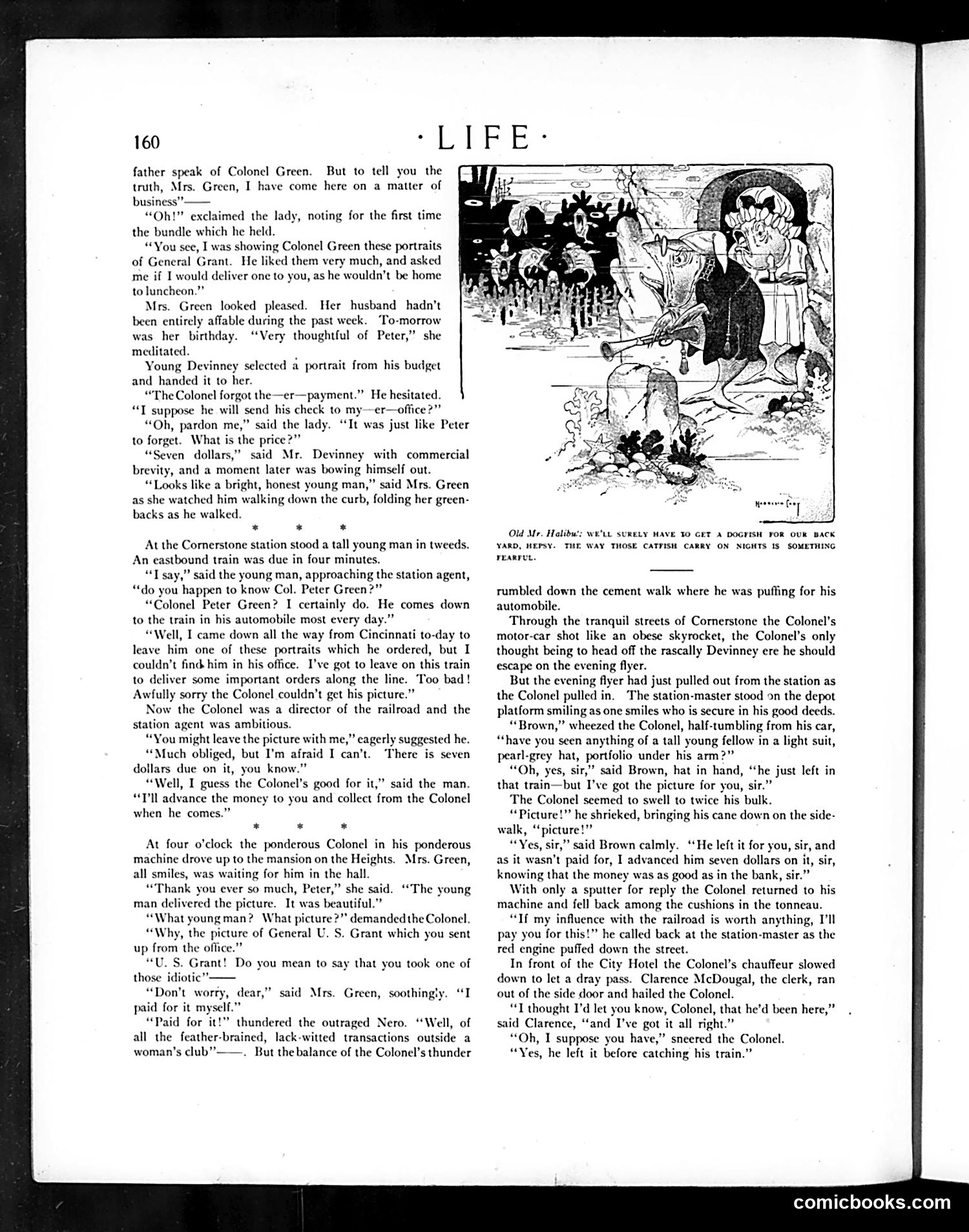
This page contains a short story with an accompanying illustration rather than political satire. The narrative depicts a social comedy about Colonel Green attempting to deliver portrait paintings as gifts. The illustration shows the Colonel arriving at a station with his automobile while various characters interact. The humor centers on Victorian-era class dynamics and gift-giving etiquette: Mrs. Green is delighted by the Colonel's thoughtfulness, but complications arise around payment and propriety. A young man named Devinney selected portraits, and the Colonel forgot to pay—leading to awkward negotiation about whether the gesture was appropriate without settling the bill first. The satire gently mocks upper-class social conventions and the pretenses surrounding charitable giving or gift-exchange among the wealthy.
📄 Transcribed text from this page (OCR, searchable)
Machine-transcribed from the original scan — historical spelling and the odd misread are preserved.
160 father speak of Colonel Green. But to tell you the truth, Mrs. Green, I have come here on a matter of business”. “Oh!” exclaimed the lady, noting for the first time the bundle which he held. “You sce, I was showing Colonel Green these portraits of General Grant. He liked them very much, and asked me if I would deliver one to you, as he wouldn't be home to luncheon.” Mrs. Green looked pleased. Her husband hadn't been entirely affable during the past week. ‘To-morrow was her birthday. ‘Very thoughtful of Peter,” she meditated. Young Devinney sel and handed it to her. “The Colonel forgot the— “I suppose he will send his check to my—er—office “Oh, pardon me,” said the lady. “It was just like Peter to forget. What is the price?” Seven dollars,” said Mr. Devinney with commercial brevity, and a moment later was bowing himself out. “Looks like a bright, honest young man,” said Mrs. Green as she watched him walking down the curb, folding her green- backs as he walked. * * * da portrait from his budget —payment.” He hesitated. At the Comerstone station stood a tall young man in tweeds. An eastbound train was due in four minutes. “Tsay,” said the young man, approaching the station agent, “(do you happen to know Col. Peter Green?” “Colonel Peter Green? I certainly do. He comes down to the train in his automobile most every day.” “Well, I came down all the way from Cincinnati to-day to leave him one of these portraits which he ordered, but I couldn’t find him in his office. I’ve got to leave on this train to deliver some important orders along the line. Too bad! Awfully sorry the Colonel couldn’t get his picture.” Now the Colonel was a director of the railroad and the station agent was ambitious. “You might leave the picture with me,” cagerly suggested he. “Much obliged, but I’m afraid I can’t. There is seven dollars due on it, you know.” “Well, I guess the Colonel’s good for it,” said the man. “T’ll advance the money to you and collect from the Colonel when he comes.” * * * At four o'clock the ponderous Colonel in his ponderous machine drove up to the mansion on the Heights. Mrs. Green, all smiles, was waiting for him in the hall. “Thank you ever so much, Peter,” she said. “The young man delivered the picture. It was beautiful.” “What young man? What picture ?”* demanded the Colonel. “Why, the picture of General U. S. Grant which you sent up from the office.” “U.S. Grant! Do you mean to say that you took one of those idiotic”. “Don’t worry, dear,” said Mrs. Green, soothingly. “I paid for it myself.” “Paid for it!” thundered the outraged Nero. ‘Well, of all the feather-brained, lack-witted transactions outside a woman's club” ——. But the balance of the Colonel’s thunder Old Mr. Halibu': WE'LL SURELY MAVE 10 GET A DOGYISH YOR OUR BACK YARD, MEPSY. TUE WAY THOSE CATFISH CARRY ON NIGHTS IS SOMETHING eaRFut. rumbled down the cement walk where he was puffing for his automobile. Through the tranquil streets of Cornerstone the Colonel’s motor-car shot like an obese skyrocket, the Colonel's only thought being to head off the rascally Devinney ere he should escape on the evening flyer. But the evening flyer had just pulled out from the station as the Colonel pulled in. The station-master stood on the depot platform smiling as one smiles who is secure in his good deeds. “Brown,” wheezed the Colonel, half-tumbling from his car, “have you seen anything of a tall young fellow in a light suit, pearl-grey hat, portfolio under his arm?” “Oh, yes, sir,” said Brown, hat in hand, ‘he just left in that train—but I’ve got the picture for you, sir.” The Colonel seemed to swell to twice his bulk. “Picture!” he shricked, bringing his cane down on the side- walk, “picture!” “Yes, sir,” said Brown calmly. ‘He left it for you, sir, and as it wasn’t paid for, I advanced him seven dollars on it, sir, knowing that the money was as good as in the bank, sir.” With only a sputter for reply the Colonel returned to his machine and fell back among the cushions in the tonneau. “If my influence with the railroad is worth anything, I’ll pay you for this!” he called back at the station-master as the red engine puffed down the street. In front of the City Hotel the Colonel’s chauffeur slowed down to let a dray pass. Clarence McDougal, the clerk, ran out of the side door and hailed the Colonel. “T thought I'd let you know, Colonel, that he’d been here,” said Clarence, ‘and I’ve got it all right.” “Oh, I suppose you have,” sneered the Colonel. “Yes, he left it before catching his train.” comicbooks.com