
Life, 1906-08-09 · page 15 of 20
Life — August 9, 1906 — page 15: what you’re looking at
What you’re looking at
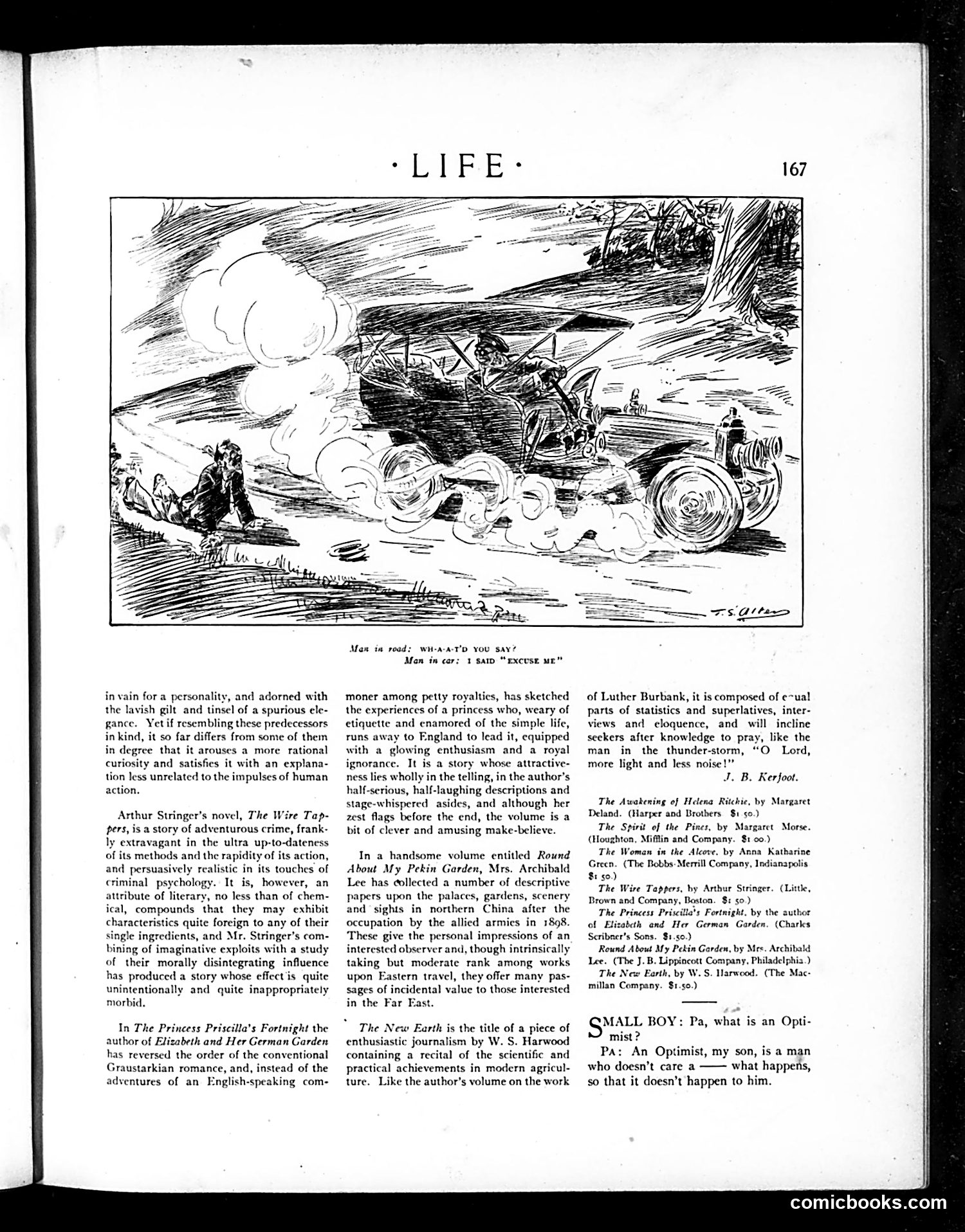
This page from *Life* magazine contains a book review section and a small cartoon joke about automobiles and hearing. **The Main Cartoon:** Shows two men in early automobiles on a road. The man in the car behind shouts "EXCUSE ME!" but the driver ahead, unable to hear over the noise of his vehicle, asks "WHAT'D YOU SAY?" The satire targets the *novelty and loudness of early automobiles*—a technology so new and noisy that basic communication between drivers was nearly impossible. This was a topical joke about the disruptive social impact of early motorcar travel. **The Joke at Bottom:** A father-son exchange about "optimists"—defined as men indifferent to what happens as long as it doesn't affect them personally. This appears unrelated to the automobile cartoon, likely a separate filler joke. **Context:** The page primarily reviews new books (novels by Arthur Stringer, Margaret Deland, and others). The automobile cartoon's humor relies on readers' familiarity with the chaos and noise of early 1900s car culture—something modern readers might not immediately recognize as satirical.
📄 Transcribed text from this page (OCR, searchable)
Machine-transcribed from the original scan — historical spelling and the odd misread are preserved.
in vain for a personality, and adorned with the lavish gilt and tinsel of a spurious ele- gance. Yet if resembling these predecessors inkind, it so far differs from some of them in degree that it arouses a more rational curiosity and satisfies it with an explana- tion less unrelated to the impulses of human action. Arthur Stringer’s novel, The Wire Tap- pers, is a story of adventurous crime, frank- ly extravagant in the ultra up-to-dateness of its methods and the rapidity of its action, and persuasively realistic in its touches of criminal psychology. It is, however, an attribute of literary, no less than of chem- , compounds that they may exhibit characteristics quite foreign to any of their single ingredients, and Mr. Stringer’s com- bining of imaginative exploits with a study of their morally disintegrating influence has produced a story whose effect'is quite unintentionally and quite inappropriately morbid. In The Princess Priscilla's Fortnight the author of Elizabeth and Her German Garden has reversed the order of the conventional Graustarkian romance, and, instead of the adventures of an English-speaking com- Man ia road: Man in car: WH-AATD YOU SAY? 1 SAID “EXCUSE ur” moner among petty royaltics, has sketched the experiences of a princess who, weary of etiquette and cnamored of the simple life, runs away to England to lead it, equipped with a glowing enthusiasm and a royal ignorance. It is a story whose attracti ness lies wholly in the telling, in the author’s half-serious, half-laughing descriptions and stage-whispered asides, and although her zest flags before the end, the volume is a bit of clever and amusing make-believe. In a handsome volume entitled Round About My Pekin Garden, Mrs. Archibald Lee has collected a number of descriptive papers upon the palaces, gardens, scene and sights in northern China after the occupation by the allied armies in 1898. These give the personal impressions of an interested observer and, though intrinsically taking but moderate rank among works upon Eastern travel, they offer many pas- sages of incidental value to those interested in the Far East. The New Earth is the title of a piece of tic journalism by W. S. Harwood ing a recital of the scientific and practical achievements in modern agricul- ture, Like the author's volume on the work of Luther Burbank, it is composed of e~ual parts of statistics and superlatives, inter- views and eloquence, and will incline seekers after knowledge to pray, like the man in the thunder-storm, “O Lord, more light and less noise !"” J. B. Kerfoot. The Awakening of Helena Ritchie, by Margaret Deland. (Harper and Brothers $1 50.) The Spirit of the Pines, by Margaret Morse. (Houghton, Mifflin and Company. $1 00.) The Woman in the Alcove. by Anna Katharine Green. (The Bobbs-Merrill Company, Indianapolis $1 50.) The Wire Tappers, by Arthur Stringer. (Little, Brown and Company, Boston. $1 50) The Princess Priscilla's Fortnight, by the author of Elizabeth end Her German Garden. (Charks Scribner's Sons. $1.50.) Round About My Pekin Garden, by Mrs. Archibald Lee. (The J.B. Lippincott Company, Philadelphia.) The New Earth, by W.S. Harwood. (The Mac- millan Company. $1.50.) MALL BOY: Pa, what is an Opti- mist ? Pa: An Optimist, my son, is a man who doesn’t care a what happens, so that it doesn’t happen to him. comicbooks.com