
Life, 1906-08-09 · page 5 of 20
Life — August 9, 1906 — page 5: what you’re looking at
What you’re looking at
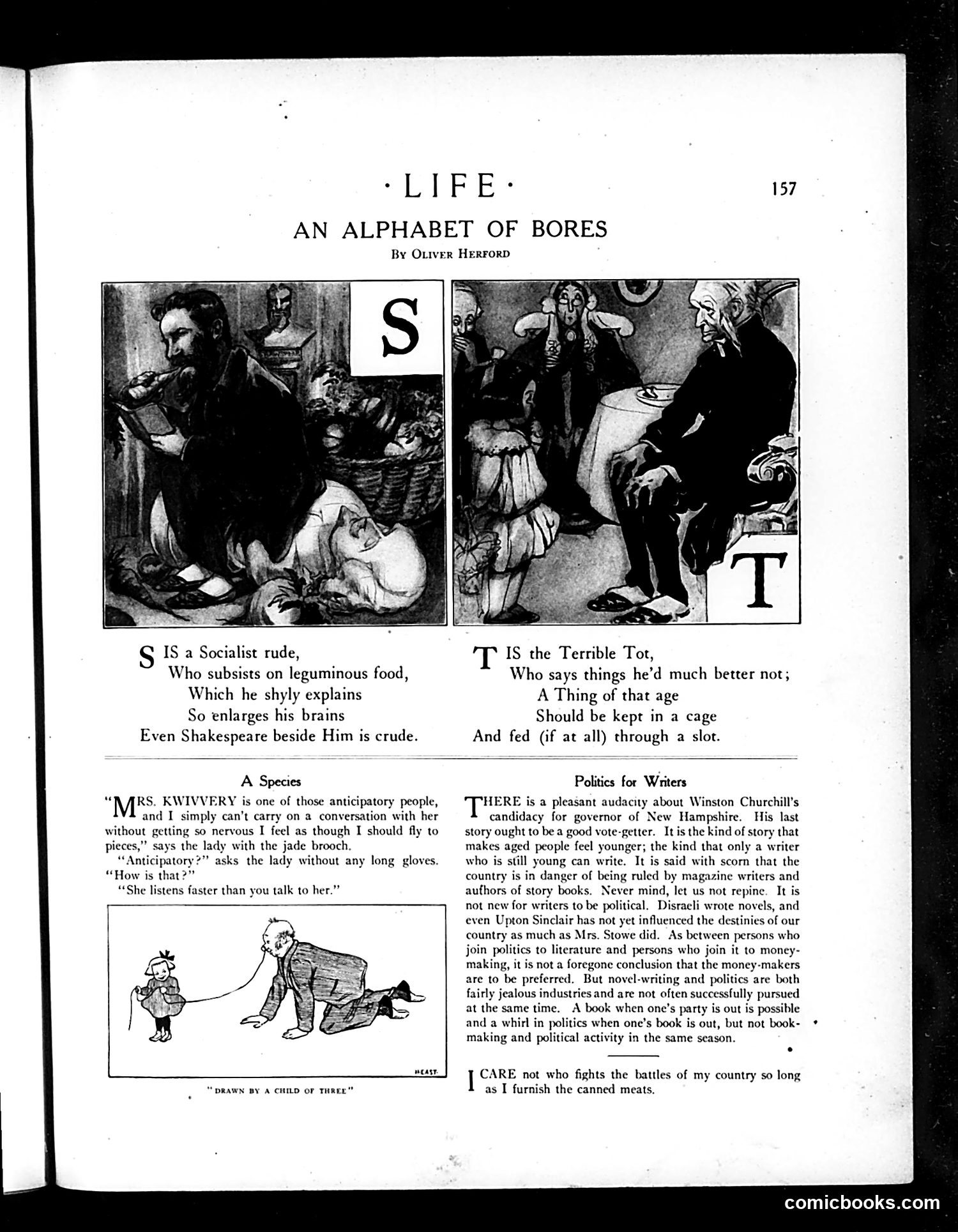
This satirical alphabet by Oliver Herford mocks social types through paired caricatures. **"S" (Socialist rude):** A bearded man in revolutionary garb, depicted as crude and subsisting on "leguminous food," with the joke that even Shakespeare seems refined by comparison. This reflects early-20th-century American anxiety about socialist immigrants and radicals. **"T" (Terrible Tot):** An elderly man at a dinner table, representing the bore who nostalgically insists "things he'd much better not" mention—a type who should be "kept in a cage." This mocks tedious elderly conversationalists. The accompanying anecdote about Mrs. Kwivvery satirizes women who dominate conversations with their own grievances, unable to listen. The page overall ridicules social types considered unbearable company.
📄 Transcribed text from this page (OCR, searchable)
Machine-transcribed from the original scan — historical spelling and the odd misread are preserved.
*LIFE: AN ALPHABET OF BORES By Ottver HERFORD S IS a Socialist rude, Who subsists on leguminous food, Which he shyly explains So enlarges his brains Even Shakespeare beside Him is crude. A Species “MES: KWIVVERY is one of those anticipatory people, and I simply can’t carry on a conversation with her without getting so nervous I feel as though I should fly to pieces,” says the lady with the jade brooch. “Anticipatory sks the lady without any long gloves. “How is that?” “She listens faster than you talk to her.” <o DD measr, “DRAWN BY A CHILD or THREE” IS the Terrible Tot, Who says things he’d much better not; A Thing of that age Should be kept in a cage And fed (if at all) through a slot. Politics for Writers HERE is a pleasant audacity about Winston Churchill's candidacy for governor of New Hampshire. His last story ought to be a good vote-getter. It is the kind of story that makes aged people feel younger; the kind that only a writer who is still young can write. It is said with scorn that the country is in danger of being ruled by magazine writers and authors of story books. Never mind, let us not repine. It is not new for writers to be political, Disraeli wrote novels, and even Upton Sinclair has not yet influenced the destinies of our country as much as Mrs. Stowe did. As between persons who join politics to literature and persons who join it to money- making, it is not a foregone conclusion that the money-makers are to be preferred. But novel-writing and politics are both fairly jealous industries and are not often successfully pursued at the same time. A book when one’s party is out is possible and a whirl in politics when one’s book is out, but not book- making and political activity in the same season. . I CARE not who fights the battles of my country so long as I furnish the canned meats. comicbooks.com