
Life, 1906-08-09 · page 14 of 20
Life — August 9, 1906 — page 14: what you’re looking at
What you’re looking at
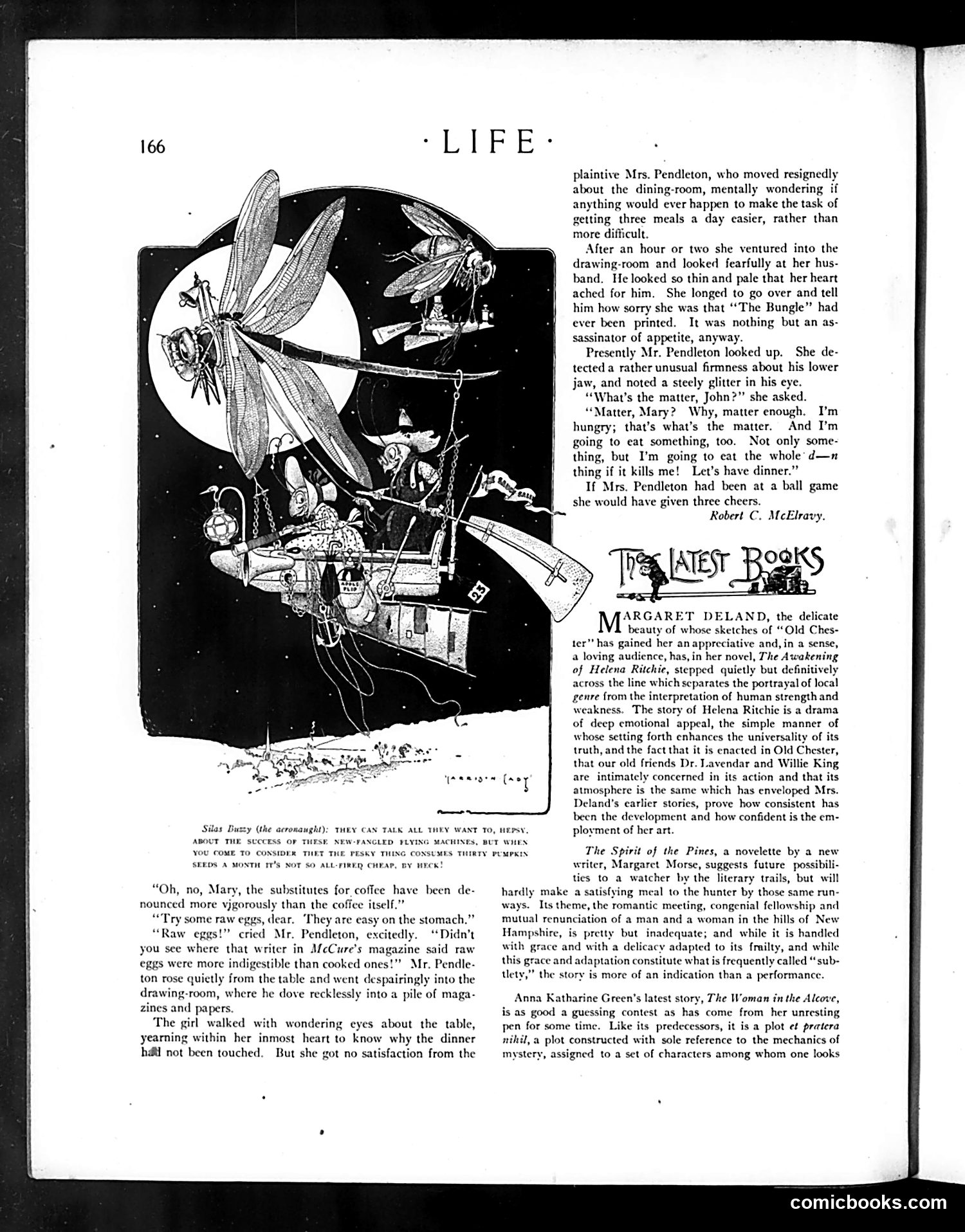
This is a humorous illustrated story, not political satire. The cartoon depicts **Silas Busty**, an early aviation pioneer, operating a primitive flying machine (an "aeronaut" with mechanical wings and propellers). The joke critiques emerging aviation technology: while the machines generate excitement about flight capabilities, they're impractical and expensive for everyday use. The rural character's complaint—that despite the marvel of flight, the machine "consumes thirty pumpkin" (fuel costs)—mocks the gap between technological promise and economic reality. The accompanying story involves Mr. Pendleton, whose appetite has been ruined by reading magazine articles (particularly "The Bungle") that contradict each other about food safety. The satire targets **turn-of-century magazine culture**: proliferating publications filled with contradictory health advice that paralyze rather than inform readers. Both pieces gently mock modern anxieties about new technology and information overload.
📄 Transcribed text from this page (OCR, searchable)
Machine-transcribed from the original scan — historical spelling and the odd misread are preserved.
awit (ey Silas Busty (the acromaught): THEY CAN TALK ALL THEY WANT TO, HEPSY plaintive Mrs. Pendleton, who moved resignedly about the dining-room, mentally wondering if anything would ever happen to make the task of getting three meals a day easier, rather than more difficult. After an hour or two she ventured into the drawing-room and looked fearfully at her hus- band. He looked so thin and pale that her heart ached for him. She longed to go over and tell him how sorry she was that “The Bungle” had ever been printed. It was nothing but an as- sassinator of appetite, anyway. Presently Mr. Pendleton looked up. She de- tected a rather unusual firmness about his lower jaw, and noted a steely glitter in his eye. “What's the matter, John?” she asked. “‘Matter, Mary? Why, matter enough. I’m hungry; that’s what’s the matter. And I’m going to eat something, too. Not only some- thing, but I’m going to eat the whole’ d—n thing if it kills me! Let’s have dinner.” If Mrs. Pendleton had been at a ball game she would have given three cheers. Robert C. McElravy. M‘ RGARET DELAND, the delicate beauty of whose sketches of “Old Ches- ter” has gained her an appreciative and, in a sense, a loving audience, has, in her novel, The Awakening of Helena Ritchie, stepped quietly but definitively across the line which separates the portrayal of local genre {rom the interpretation of human strength and weakness. The story of Helena Ritchie is a drama of deep emotional appeal, the simple manner of whose setting forth enhances the universality of its truth, and the fact that it is enacted in Old Chester, that our old friends Dr. Lavendar and Willie King are intimately concerned s action and that its atmosphere is the same which has enveloped Mrs. Deland’s carlier stories, prove how consistent has been the development and how confident is the em- ployment of her art. pout PCCESS OF THESE NEW-FANCLED PLYING MACHINES, BUT WHEN YoU COME TO CONSIDER THET THE PESKY THING SEEDS A MONTIL T'S NOT SO ALL-FIRER CHEAP, BY HECK! “Oh, no, Mary, the substitutes for coffee have been de- nounced more vy, than the coffee itself.” “Try some raw eggs, dear. ‘They are easy on the stomach.” “Raw eggs!” cried Mr. Pendleton, excitedly. ‘Didn't you see where that writer in AfcCure’s magazine said raw eggs were more indigestible than cooked one Mr. Pendle- ton rose quietly from the table and went despairingly into the drawing-room, where he dove recklessly into a pile of maga- zines and papers. The girl walked with wondering eyes about the table, yearning within her inmost heart to know why the dinner hal not been touched. But she got no satisfaction from the NSUMES THIRTY PUMPKIN The Spirit of the Pines, a novelette by a new writer, Margarct Morse, suggests future possibili- tics to a watcher by the literary trails, but will hardly make a satisfying meal to the hunter by those same run- ways. Its theme, the romantic meeting, congenial fellowship and mutual renunciation of a man and a woman in the hills of New Hampshire, is pretty but inadequate; and while it is handled with grace and with a delicacy adapted to its frailty, and while this grace and adaptation constitute what is frequently called “sub- tlety,”” the story is more of an indication than a performance. Anna Katharine Green's latest story, The Woman in the Alcove, is as good a guessing contest as has come from her unresting pen for some time. Like predecessors, it is a plot et pratera nihil, a plot constructed with sole reference to the mechanics of mystery, assigned to a set of characters among whom one looks comicbooks.com