
A complete issue · 25 pages · 1906
Life — June 28, 1906
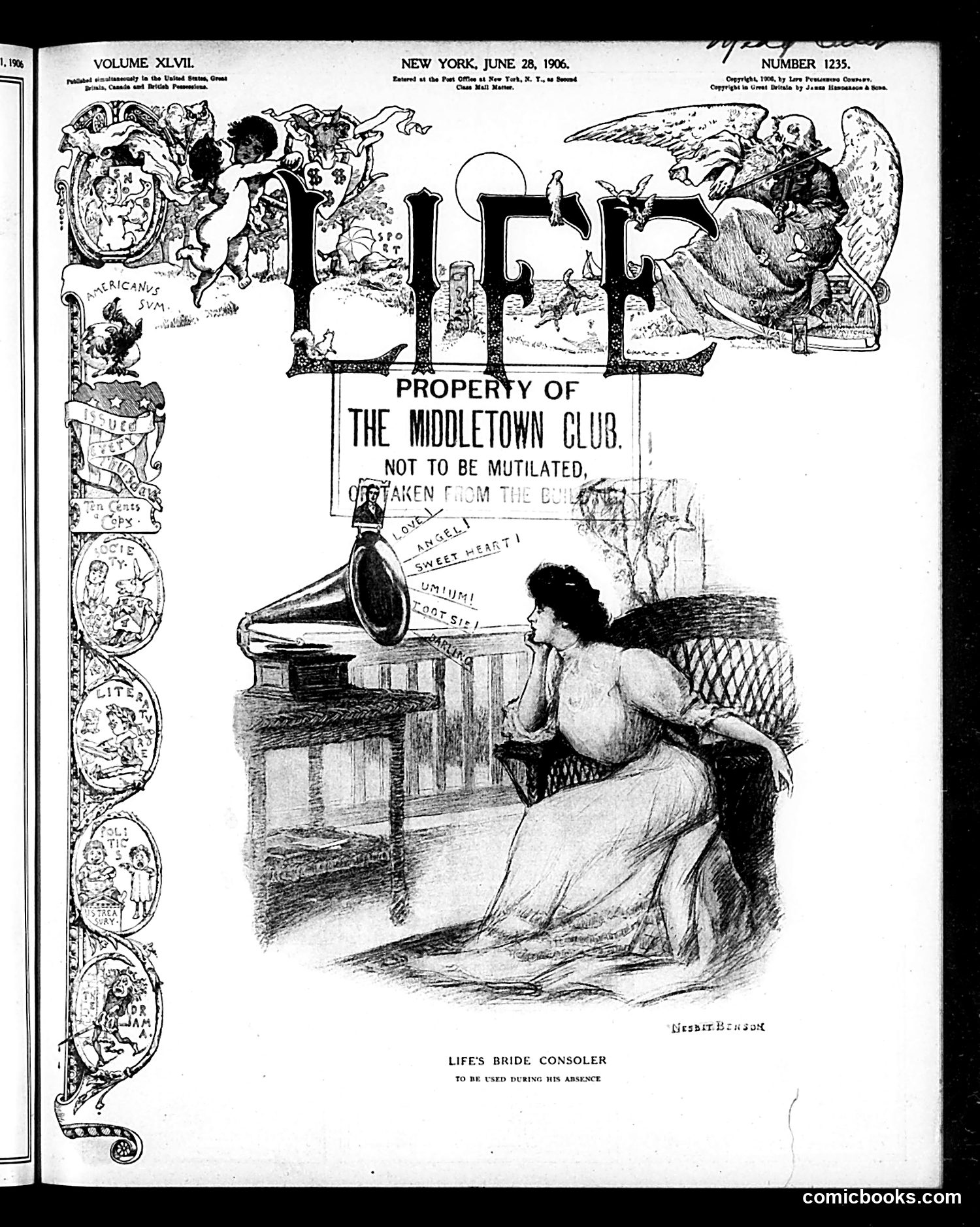
This page features a satirical cartoon titled "Life's Bride Consoler: To Be Used During His Absence." The illustration shows a woman listening to a gramophone—a new mechanical music player—while a man is away. The satire mocks both the gramophone as a substitute for human companionship and the gender dynamics of the era. The woman is positioned passively consuming entertainment via machine, suggesting that technology might "console" wives during their husbands' absences. The title implies marital separation or infidelity, treating the gramophone as a humorous replacement for attentive companionship. This reflects early-1900s anxieties about new technology and its role in domestic life, while commenting on marriage and gender expectations of the period.
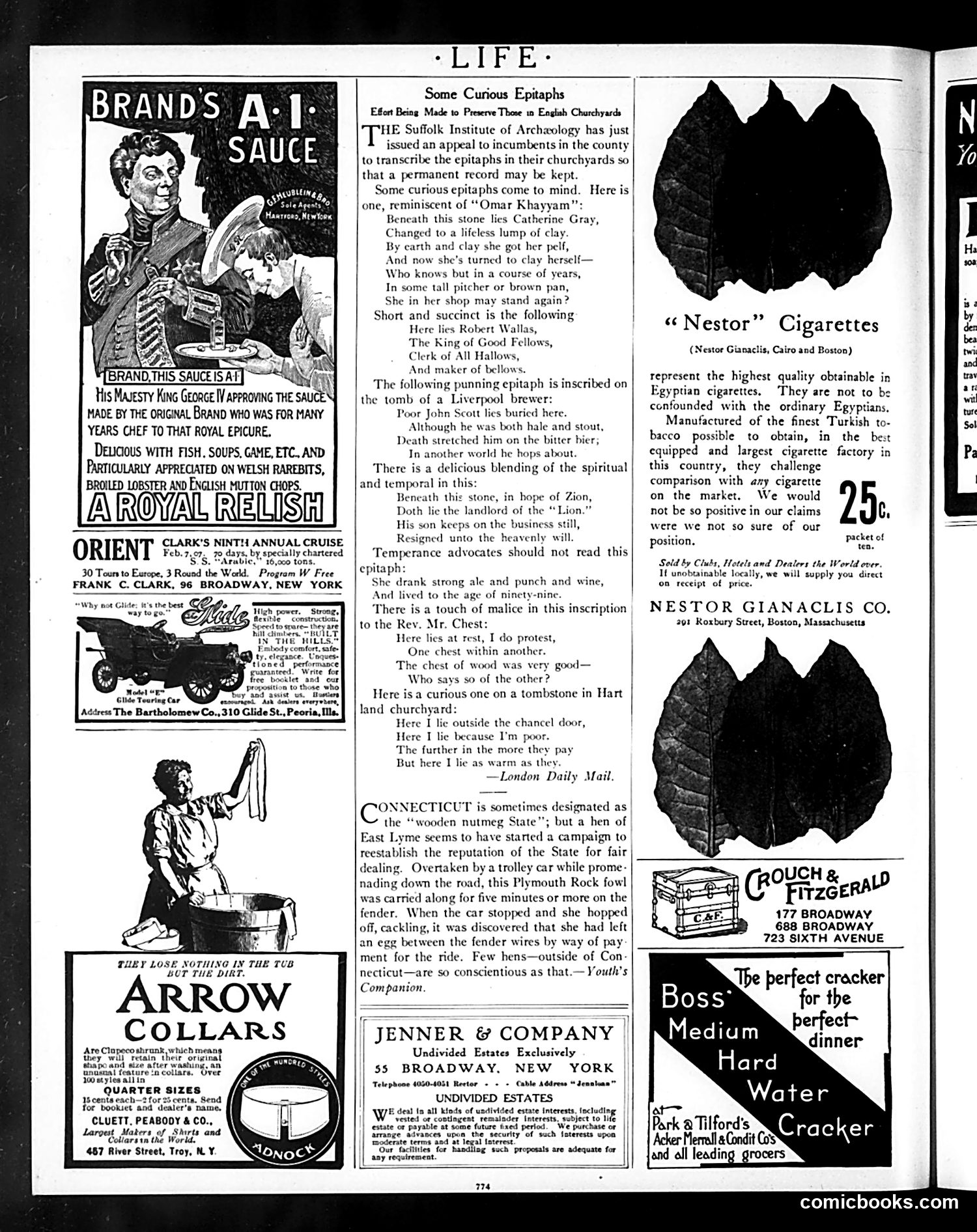
This page is primarily **advertising and miscellaneous content** rather than political satire. The dominant elements are commercial ads (Brand's Sauce, Arrow Collars, Nestor Cigarettes, Boss Crackers) interspersed with light feature articles. The main text content includes "Some Curious Epitaphs"—humorous tombstone inscriptions meant for entertainment rather than satire. One notable piece discusses Connecticut's reputation as the "wooden nutmeg State," referencing a historical stereotype about deceptive Yankee traders. The Arrow Collars ad features an illustration of a woman with a laundry item, using humor to sell menswear. Overall, this represents **early 20th-century Life magazine's blend of advertising revenue and genteel humor**—far removed from hard political commentary.
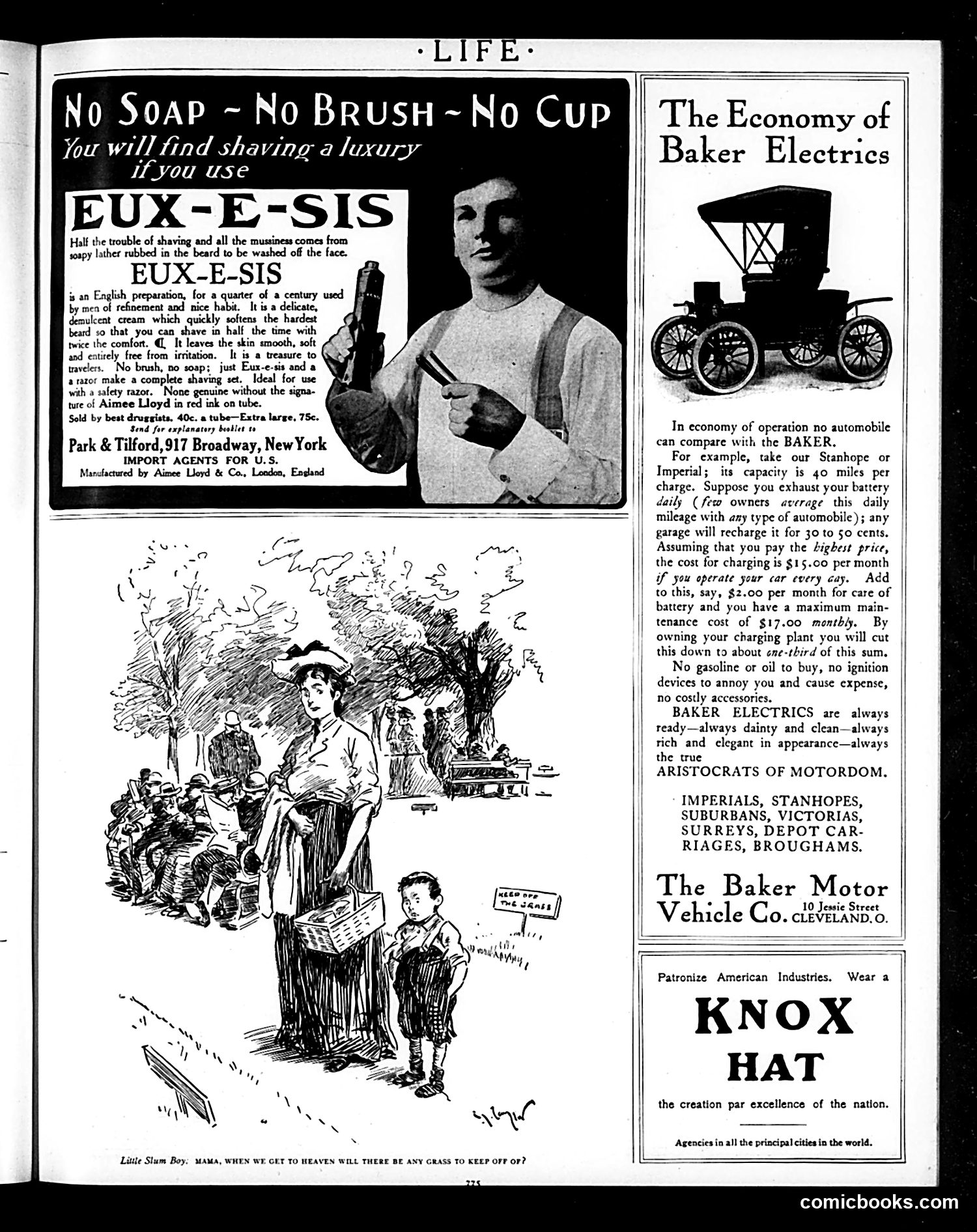
This page is primarily **advertising** rather than editorial content. The top left features an ad for **Eux-e-sis**, an English shaving preparation endorsed by actor **Aimee Lloyd**, emphasizing convenience ("No Soap – No Brush – No Cup"). The center contains a sketch cartoon labeled "Little Slum Boy," depicting a child asking his mother: **"Mama, when we get to heaven will there be any grass to keep off of?"** This appears to be social commentary on urban poverty—suggesting slum children have no access to green space or nature. The right side advertises **Baker Electrics** automobiles and a **Knox Hat**. The overall page reflects early 1900s consumer culture and class-consciousness typical of Life magazine's satirical approach.
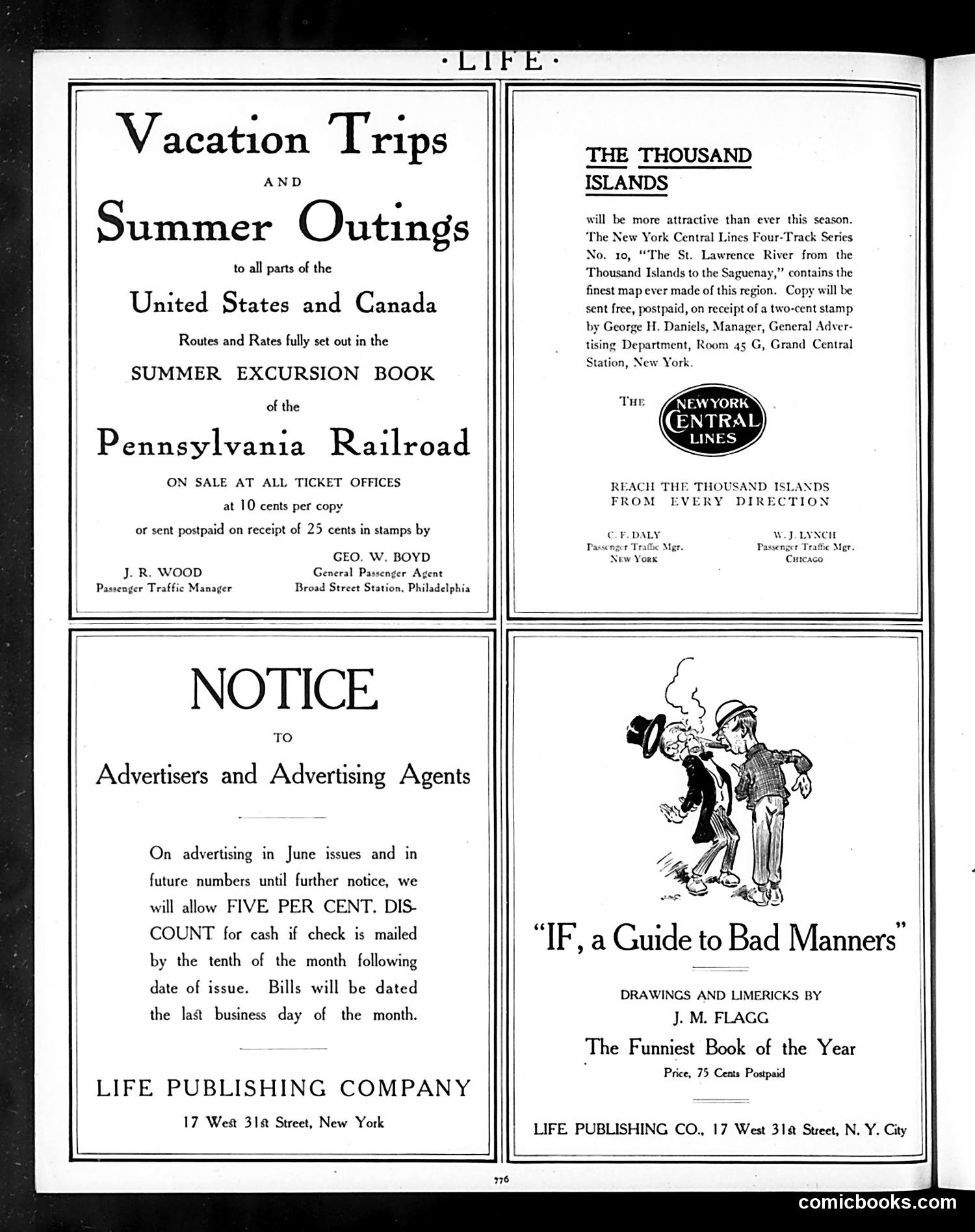
This page is primarily **advertising content** from Life Publishing Company, not political satire. It contains four advertisements: 1. **Pennsylvania Railroad** promoting vacation excursion booklets 2. **New York Central Lines** advertising maps of the Thousand Islands region 3. **Life Publishing Company** offering advertising discounts to agencies 4. **"If, a Guide to Bad Manners"** by J.M. Flagg—a humorous illustrated book The only visual content is a cartoon showing two figures with poor etiquette (one appears to be smoking inconsiderately near another person), accompanying the book advertisement. This is straightforward commercial promotion rather than political commentary. The page demonstrates how early 20th-century magazines monetized content through advertisements, with Flagg's illustrated humor book being the primary editorial content featured.
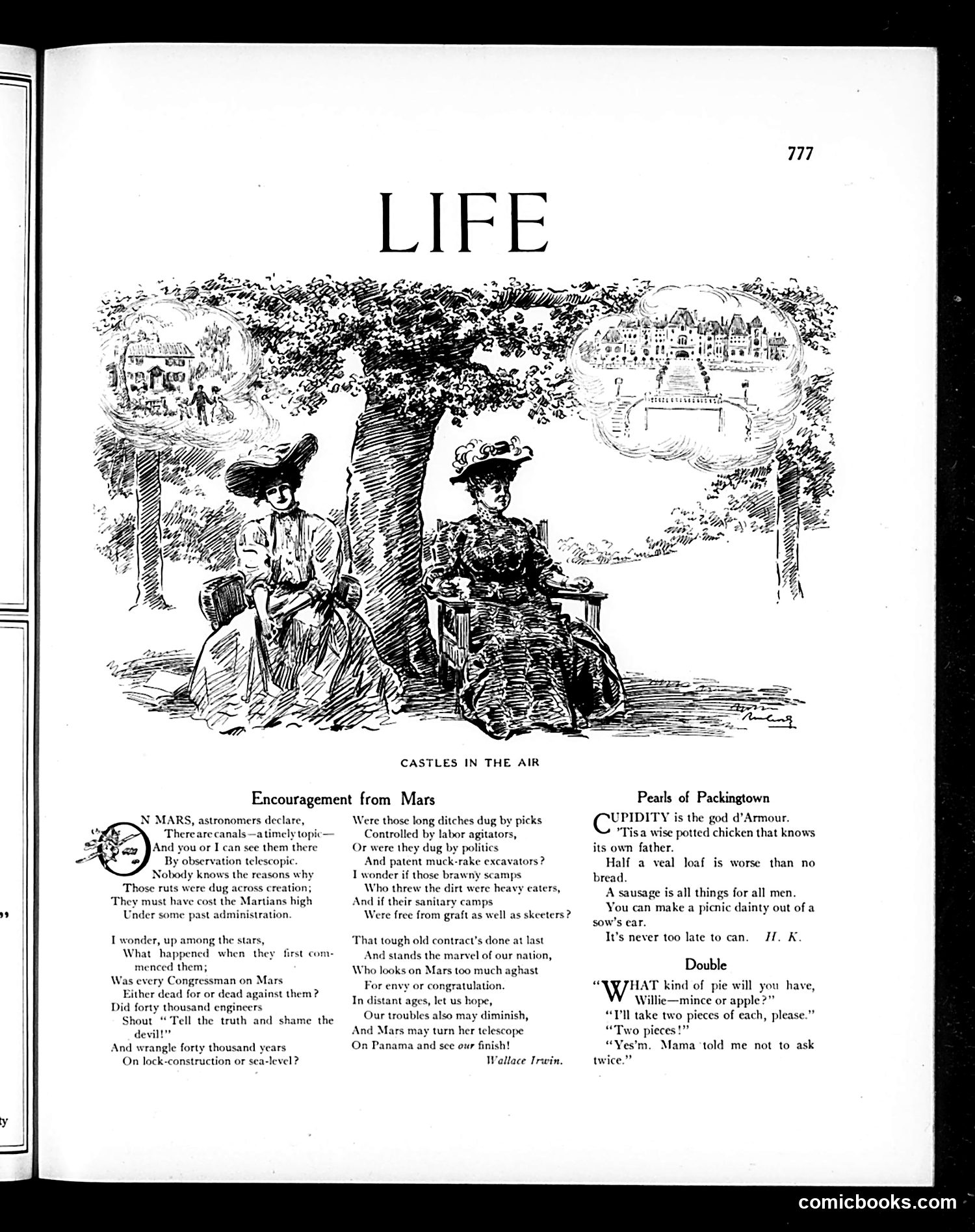
The main illustration shows two Edwardian-era women seated beneath a large tree, contemplating "castles in the air" (daydreams). The vignettes above depict their imaginings. **"Encouragement from Mars"** by Wallace Irwin satirizes contemporary debates about Mars exploration and engineering projects (the Panama Canal reference suggests early 1900s). The poem mocks grandiose American ambitions—whether congressmen worked on Mars, whether engineers built sea-walls—while suggesting such projects pale beside mundane earthly troubles. **"Pearls of Packingtown"** and **"Double"** are brief humorous aphorisms about daily life: Cupidity as the god of love, bread being worse than nothing, and a child's innocent bargaining over pie. The page reflects turn-of-the-century American optimism mixed with satirical skepticism about technological progress and romantic ideals.
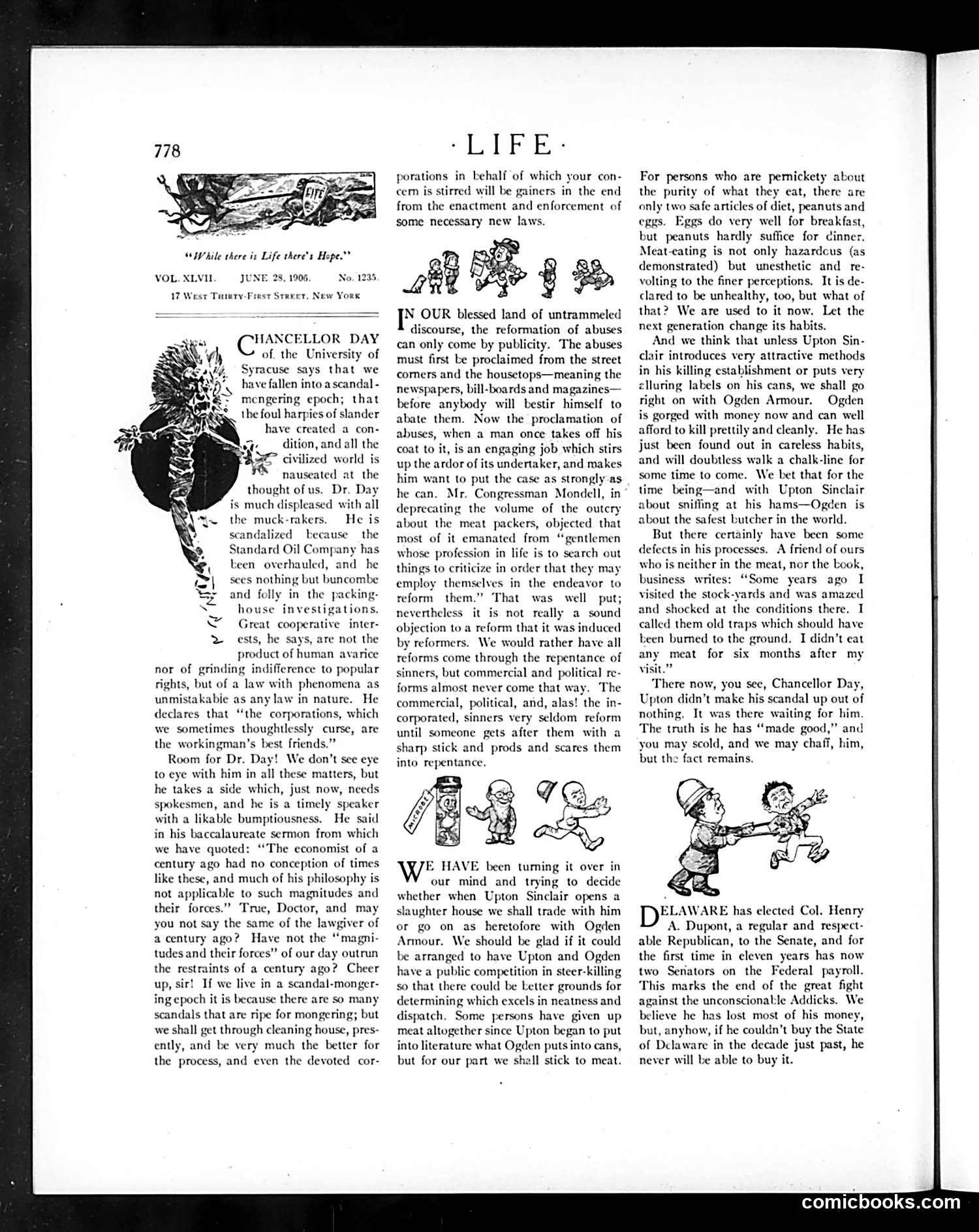
This page satirizes **Upton Sinclair's 1906 novel "The Jungle,"** which exposed horrific conditions in meatpacking plants. The article mocks reformers' reactions to Sinclair's scandal-mongering while defending the meat industry. The central cartoon depicts figures (likely representing Sinclair and reformers) agitating against meatpacking practices. The text dismisses calls for reform as exaggerated—claiming the industry's problems are overstated and that regulatory reform is unnecessary. The final item celebrates **Col. Henry A. Dupont's** election to the Delaware Senate, noting the "end of the great fight against unconscionable tricks," suggesting corporate interests triumphed over reform legislation in that state. Overall, the page reflects **corporate-friendly resistance** to Progressive Era meatpacking reforms that Sinclair's exposé had sparked.
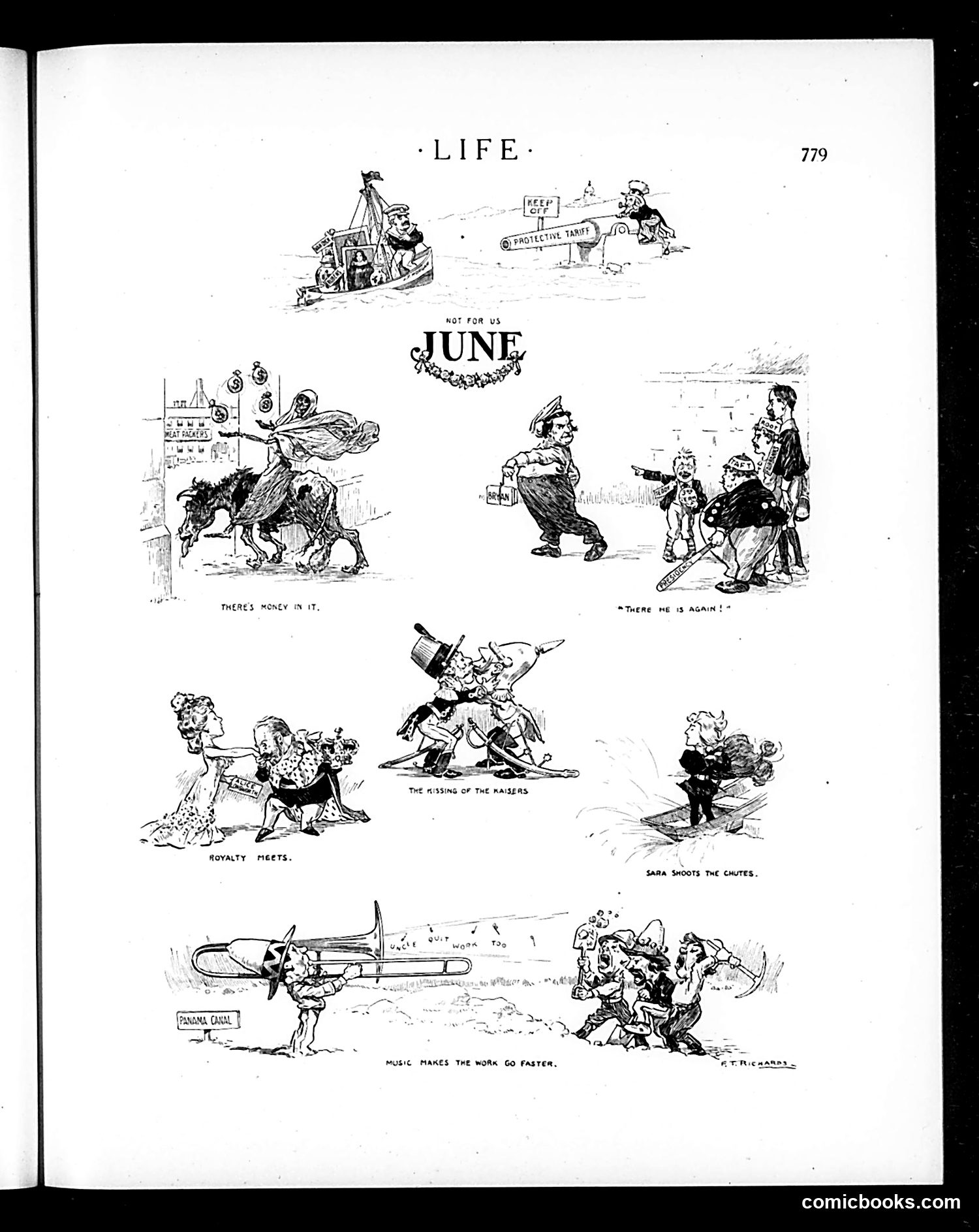
This page presents satirical cartoons about June 1912 events. The captions reference contemporary issues: "There's Money In It" (likely financial speculation), "There He Is Again!" (repeated political figure), "Royalty Meets," "The Kissing of the Kaisers" (European diplomatic relations), and "Sara Shoots the Chutes" (appears to reference someone named Sara in an amusement park context). The "Panama Canal" reference at bottom suggests ongoing construction debates. Overall, the cartoons mock wealthy elites, politicians, and international diplomacy of the era. The style employs exaggerated caricature typical of early 20th-century American satirical humor, though specific identities require historical context beyond what's visible here.
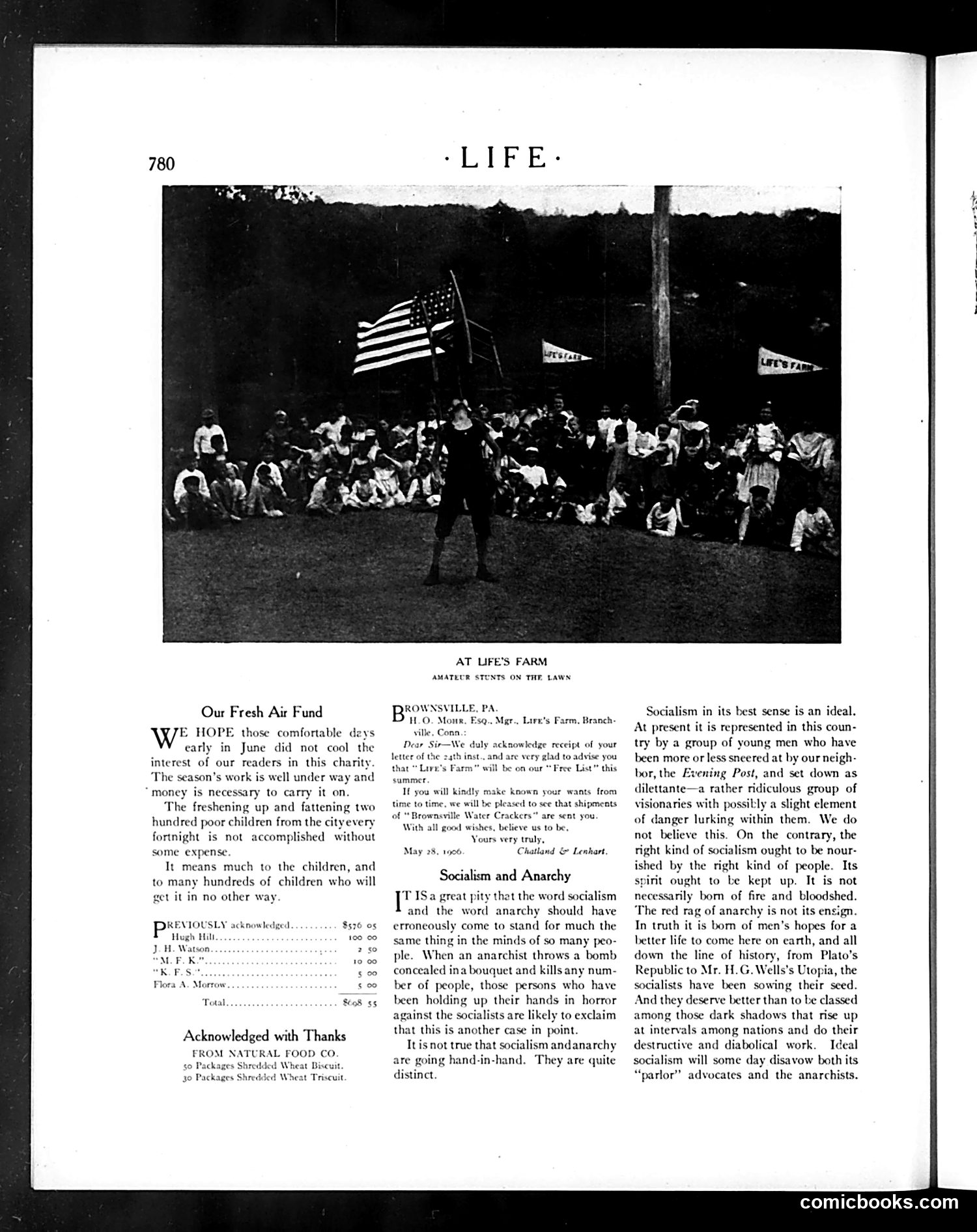
The main photograph shows an outdoor gathering at "Life's Farm" with an American flag prominently displayed and an audience seated on grass. The caption notes "Amateur Stunts on the Lawn." Below are three text sections: "Our Fresh Air Fund" (a charity appeal for poor children), "Socialism and Anarchy" (an editorial essay), and acknowledgments. The "Socialism and Anarchy" piece argues these are distinct ideologies, not synonymous. It criticizes conflating anarchists (who use bombs) with socialists, while also dismissing socialism itself as utopian—claiming it disavows violence but will inevitably require "fire and bloodshed." The page appears to reflect early 20th-century American anxiety about radical political movements, presenting socialism skeptically while distinguishing it from anarchism's perceived violence. The farm gathering likely represents genteel, wholesome American values contrasted against these foreign ideologies.
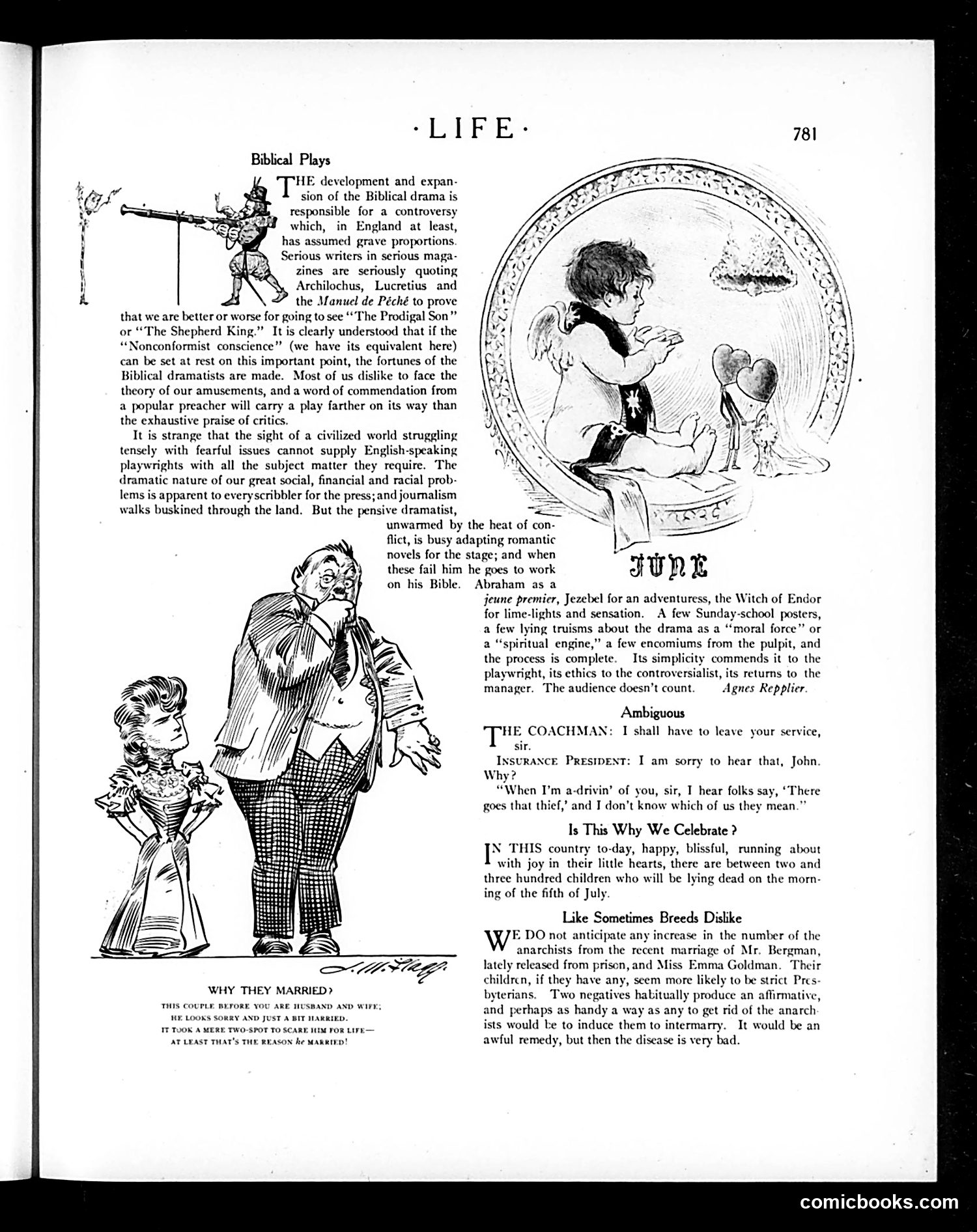
This page contains three distinct pieces: 1. **"Biblical Plays"** article discussing controversy over dramatizing Biblical stories on stage, arguing against dismissing such plays as mere entertainment. 2. **"Why They Married"** cartoon (lower left): A caricatured couple with the caption explaining the man married to escape his nagging wife—a common domestic humor trope of the era. The joke suggests marriage was a reluctant escape rather than a romantic choice. 3. **"June" illustration** (upper right): A decorative seasonal image with cherubs, typical of the magazine's monthly artwork. 4. **Text sections** on Fourth of July celebrations and anarchism, reflecting early 20th-century social anxieties about radicalism and public safety. The page reflects period concerns about moral entertainment standards and traditional marriage dynamics.
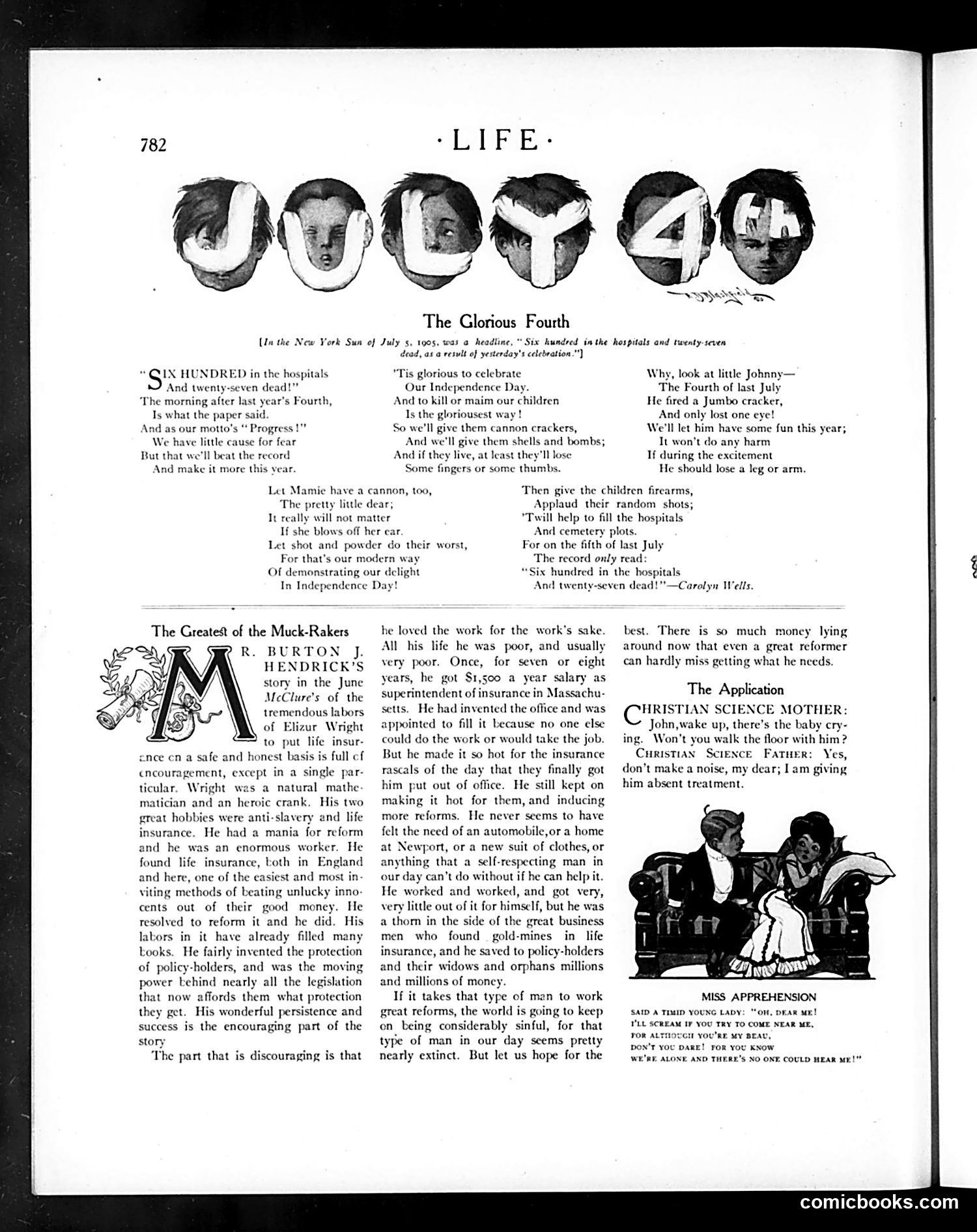
This page contains two pieces of satirical commentary on American society circa 1905: **"The Glorious Fourth"** mocks Independence Day celebrations by depicting how Americans actually commemorate it: through fireworks injuries. The satirical poem notes that "six hundred in the hospitals / Won't seven dead" result from the holiday, sarcastically celebrating this as the "glorious" way to demonstrate national delight. It suggests giving children dangerous fireworks and explosives as appropriate Fourth of July gifts, darkly implying that maiming and death are acceptable costs of patriotic celebration. **"The Greatest of the Muck-Rakers"** discusses reformer Elizar Wright's insurance industry advocacy. The text praises his lifetime commitment to honest business practices and worker protections, contrasting his modest success against the corrupt wealth of contemporary businessmen. It presents Wright as an admirable but nearly extinct reformer type in the Gilded Age.
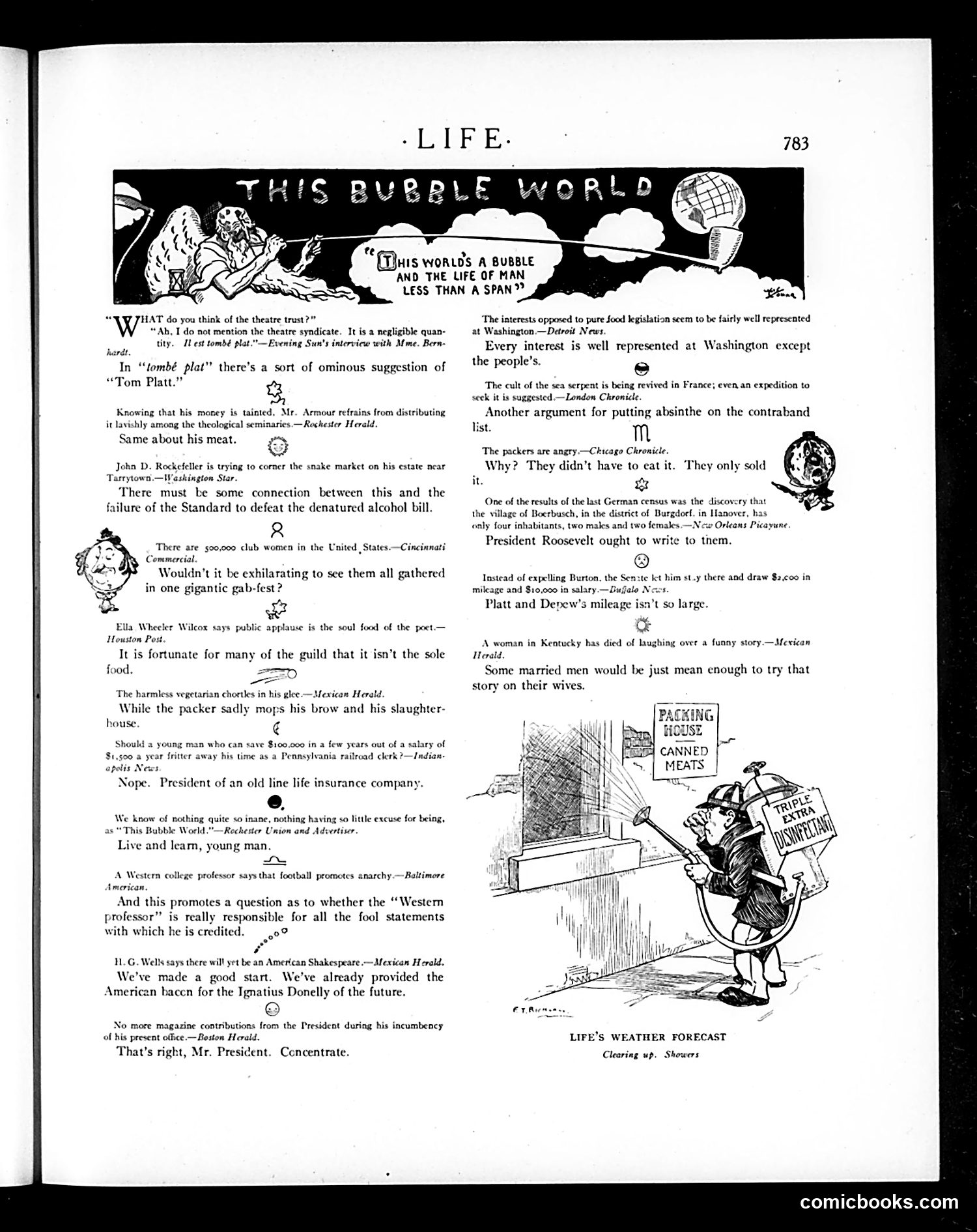
**Top Cartoon:** "This Bubble World" depicts life's brevity. A figure blows bubbles labeled with a globe, illustrating the philosophical notion that human existence is fleeting—"less than a span." **Main Content:** This page collects short satirical observations and jokes from Life magazine's editorial section. Topics include: - Theater trust monopolies - John D. Rockefeller's money distribution to seminaries - Women's clubs in America - Vegetarian ethics - Insurance company salary comparisons - Football's social effects - H.G. Wells predicting American Shakespeare - Presidential magazine contributions **Bottom Cartoon:** "Life's Weather Forecast: Clearing up Showers" shows a peddler hawking various goods (canned meats, extras) during rain—a visual pun on weather forecasts applied to commercial activity. The page exemplifies Life's signature blend of social commentary, wordplay, and gentle mockery of contemporary American institutions and figures.
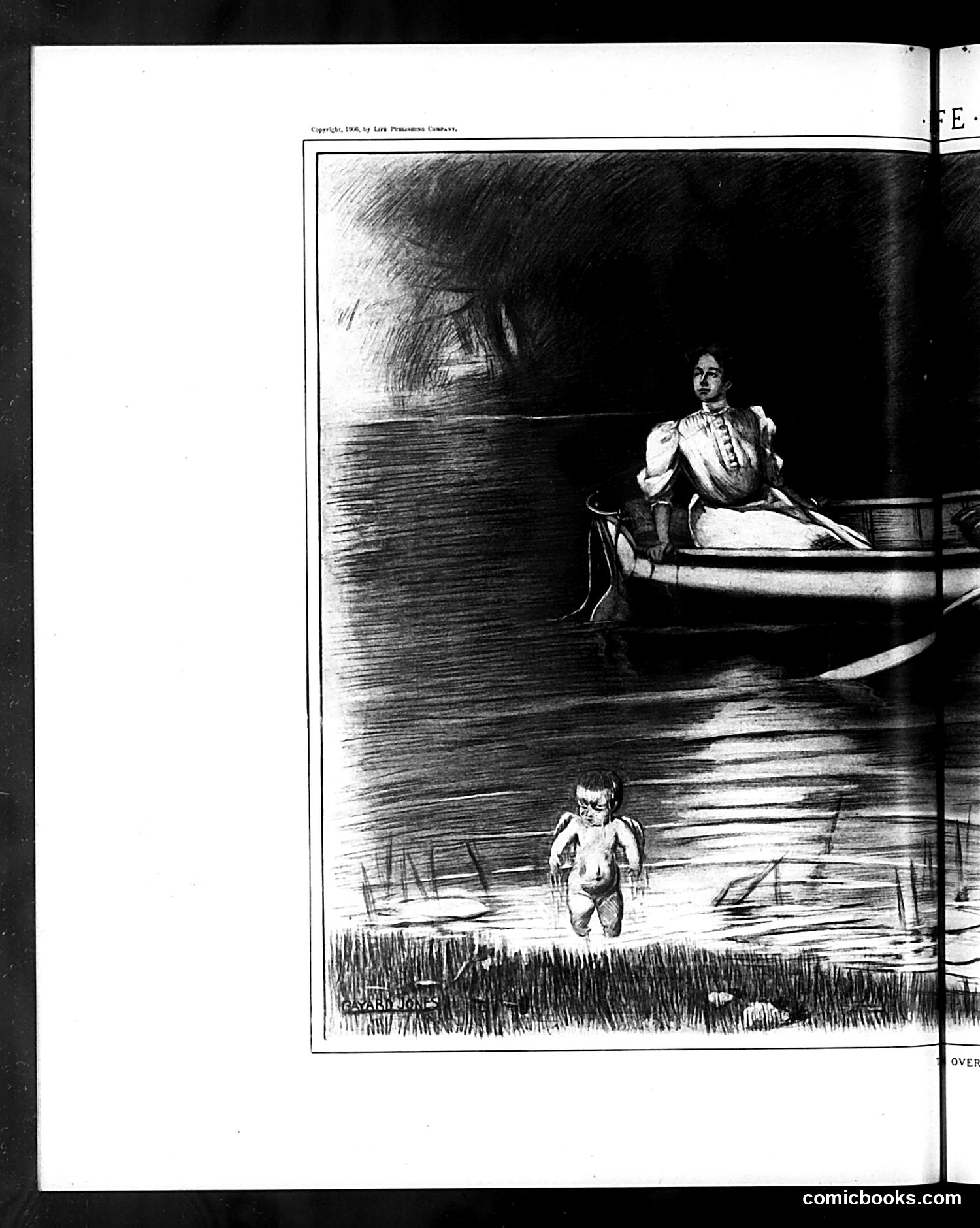
This appears to be a satirical illustration from *Life* magazine showing a domestic scene. A woman sits at a table indoors while a nude child wades in water outside. The style is sketch-like with heavy cross-hatching. Without visible text identifying the specific figures or date, the exact satirical target is unclear. However, the composition suggests commentary on **motherhood, domestic life, or child-rearing** — likely contrasting indoor domesticity with childhood freedom or nature. The woman's formal dress and composed posture against the child's uninhibited play in water could critique **Victorian-era restrictions on children** or **gender roles**, but I cannot definitively state the intended subject without additional context or visible captions.
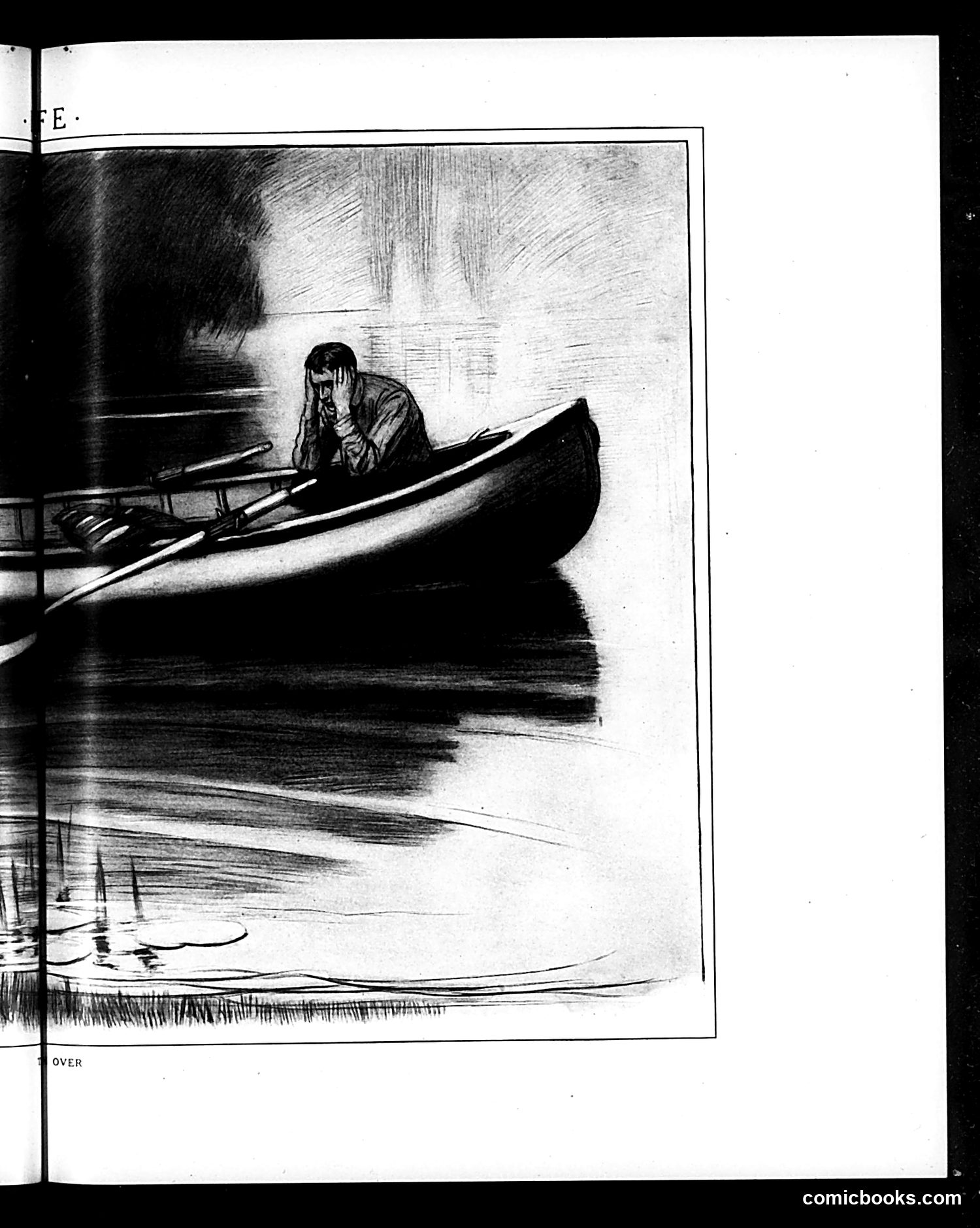
This appears to be an illustration from Life magazine showing a solitary figure in a small boat on dark water, head in hand in a posture suggesting despair or deep contemplation. The figure is rendered in stark black and white with heavy cross-hatching typical of early-to-mid 20th century editorial illustration. Without visible caption text or clear identifying details, I cannot definitively state which political or social situation this references. The mood is unmistakably one of melancholy or crisis—the lone figure adrift suggests isolation, loss, or difficult circumstances. The artistic style and composition suggest this is satirical commentary on contemporary events, but the specific subject requires additional context to identify accurately.
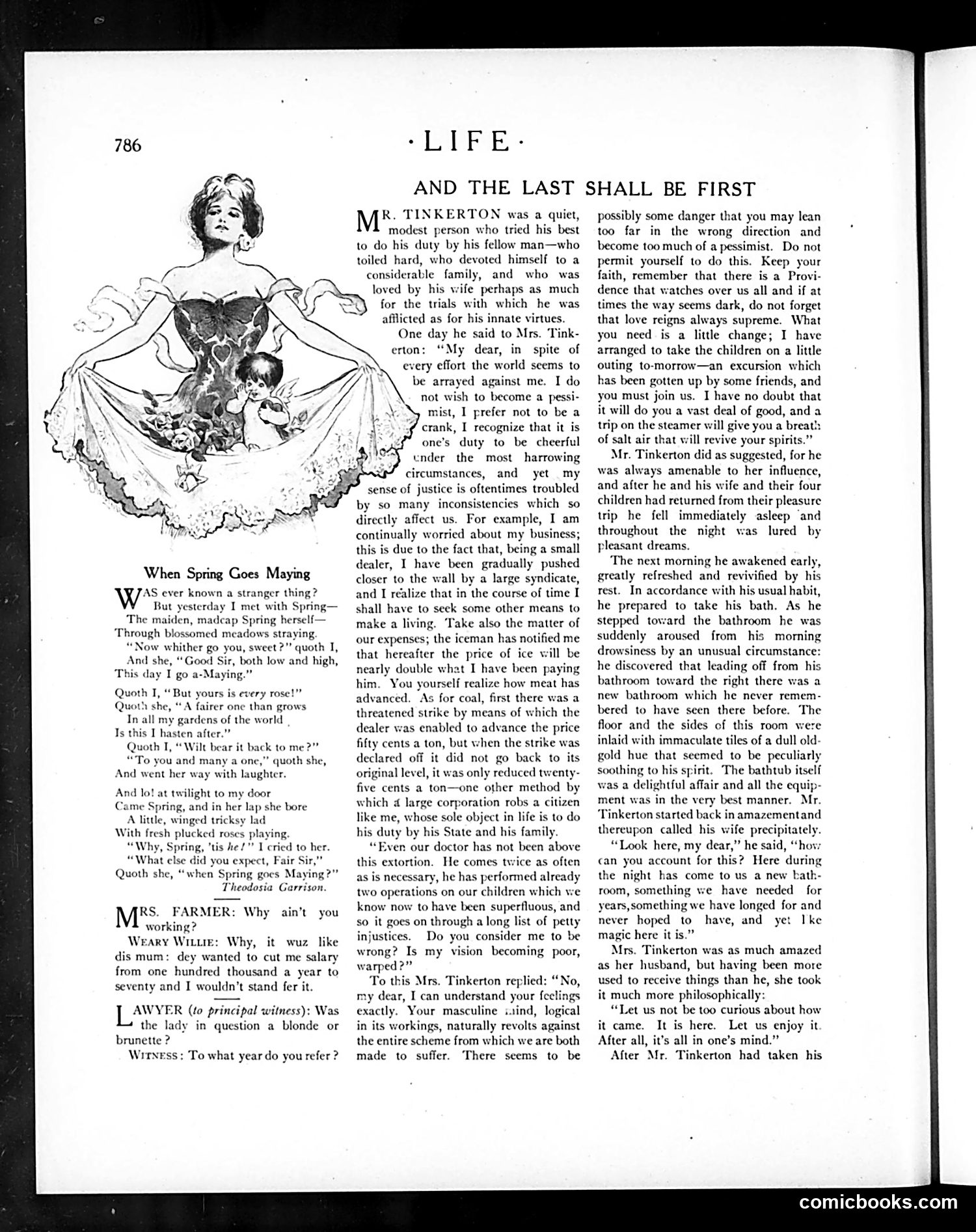
This page contains three separate pieces of satirical content typical of early-20th-century Life magazine humor: **"When Spring Goes Maying"** is a whimsical poem by Theodosia Garrison personifying Spring as a flirtatious maiden who encounters Cupid (the "little, winged tricksy lad"). It's light romantic verse rather than political satire. **The courtroom jokes** mock legal absurdity—a witness who can't remember a woman's hair color without knowing the year (implying female vanity/hair-dye use), and a man defending his refusal to accept a salary cut from $100,000 to $70,000 annually. **"And the Last Shall Be First"** is the main story satirizing the struggles of Mr. Tinkerton, an ordinary middle-class businessman victimized by monopolistic practices: price-fixing by ice and coal dealers, inflated medical bills, and wage pressure. His wife counsels faith in Providence. The satire targets corporate exploitation of small-business owners and working people—a common Progressive-era complaint about industrial monopolies squeezing ordinary citizens.
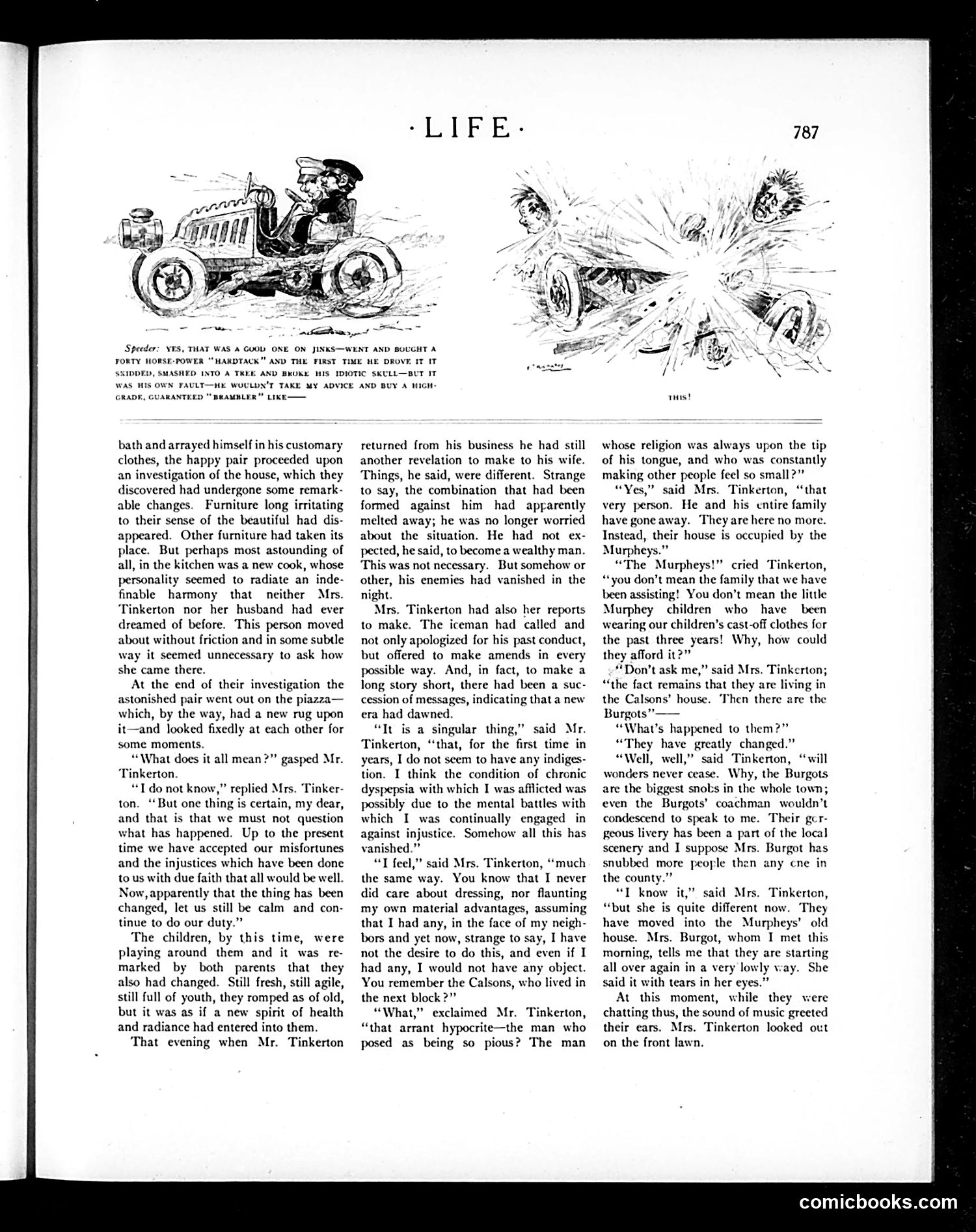
This page contains two satirical cartoons about early automobiles, plus fiction text unrelated to the cartoons. **Top Left Cartoon:** Shows a man driving a reckless "forty horse-power" car. The caption mocks someone named Jinks who bought a "Hardtack" automobile, crashed it into a tree, and died—but dismisses this as his own fault for not purchasing a reliable "Brambler" instead. This is automobile industry satire: the joke critiques both dangerous driving *and* uses the accident as a thinly-veiled advertisement for the safer Brambler brand. Early cars were notoriously unreliable and dangerous. **Top Right Cartoon:** Labeled "THIS!" shows a chaotic multi-car collision with figures flying everywhere—exaggerated visual commentary on automobile accidents. **Context:** These appear circa 1900s-1910s, when automobiles were new, expensive luxuries associated with wealthy, reckless drivers. The satire targets both automotive safety and the conspicuous consumption of the wealthy. The fiction text below is unrelated.
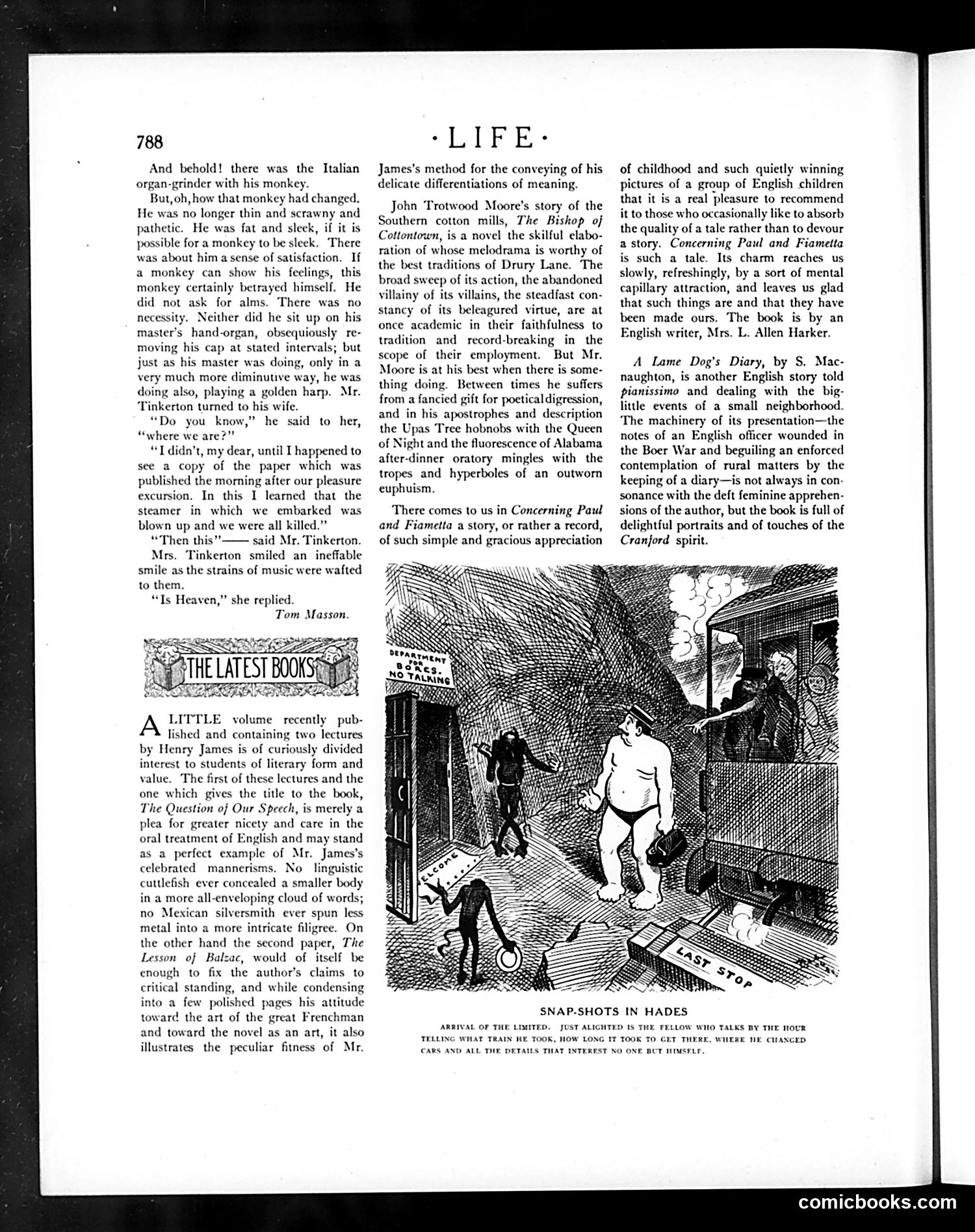
This cartoon illustrates a short story by Tom Masson about an afterlife encounter. A couple—Mr. and Mrs. Tinkerton—discover they died in a steamship explosion, yet find themselves in Heaven watching an Italian organ-grinder and his monkey. The satirical twist: the monkey, once thin and pathetic, now appears fat and content, playing a golden harp alongside his master. The joke plays on the reversal of earthly circumstances—even the street performer's monkey achieves dignity and prosperity in the afterlife. The caption's reference to "the Limited" (a train) and details about "how long it took to get there" suggests Masson is gently mocking both spiritualist beliefs about the afterlife and the banality of how people might discuss even Heaven's logistics. The cartoon exemplifies *Life* magazine's satirical humor: whimsical, philosophical, and quietly poking fun at American attitudes toward class, mortality, and the supernatural.
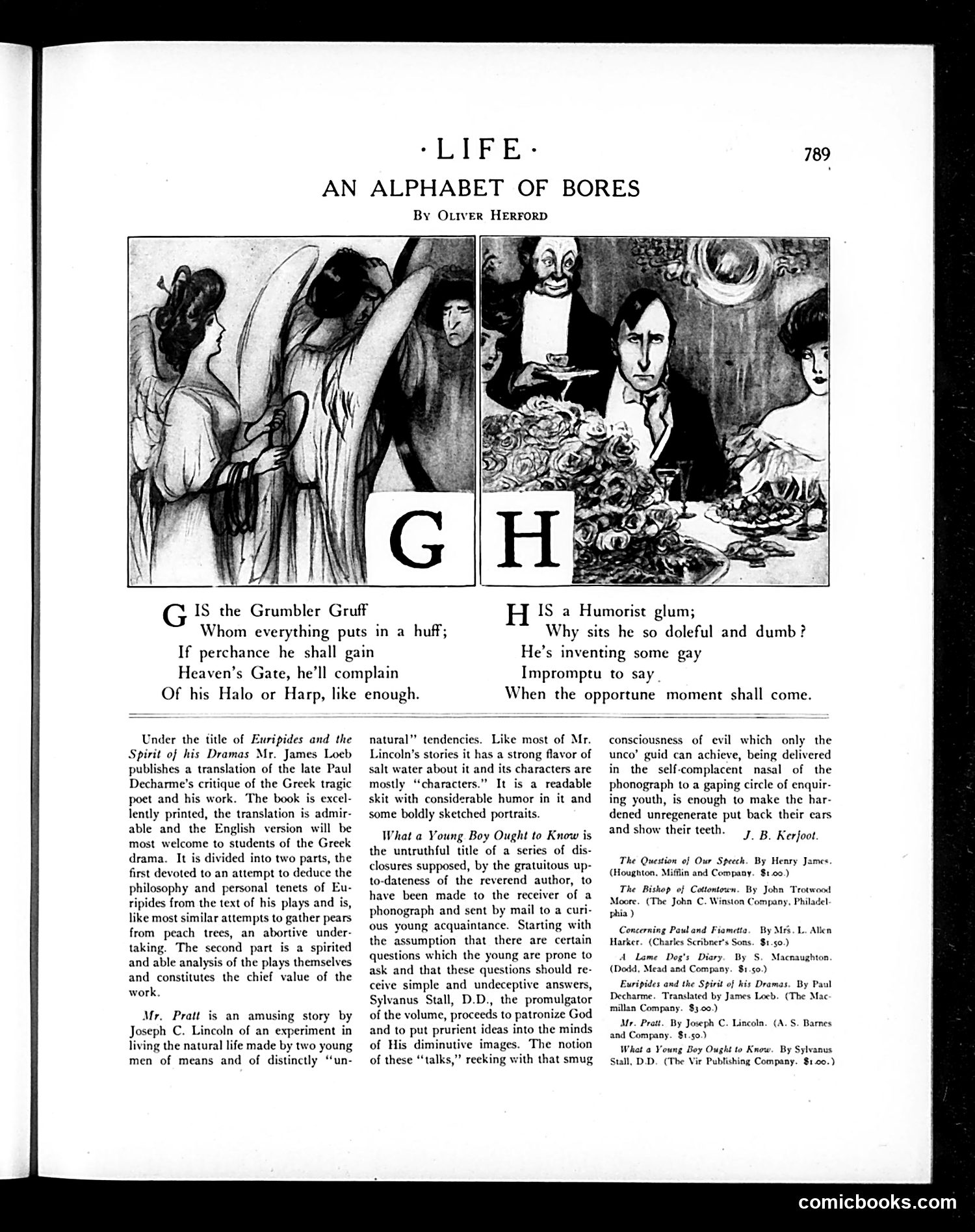
This page presents two character sketches from Oliver Herford's satirical alphabet series mocking social types: **"G - The Grumbler Gruff"**: A perpetually dissatisfied person who complains about everything, even paradise itself. The joke is that no circumstance—not even Heaven—could satisfy him; he'd grumble about his halo or harp. **"H - The Humorist Plum"**: A would-be wit so self-conscious about humor that he sits glumly preparing clever remarks, waiting for the "opportune moment" to deliver them. The satire targets people who are unfunny because they're too contrived and self-aware about trying to be funny. The accompanying text discusses recent book releases, including criticism of a reverend author's patronizing sex-education work delivered via phonograph to youth. The page satirizes recognizable personality types and contemporary pretension rather than specific political figures.
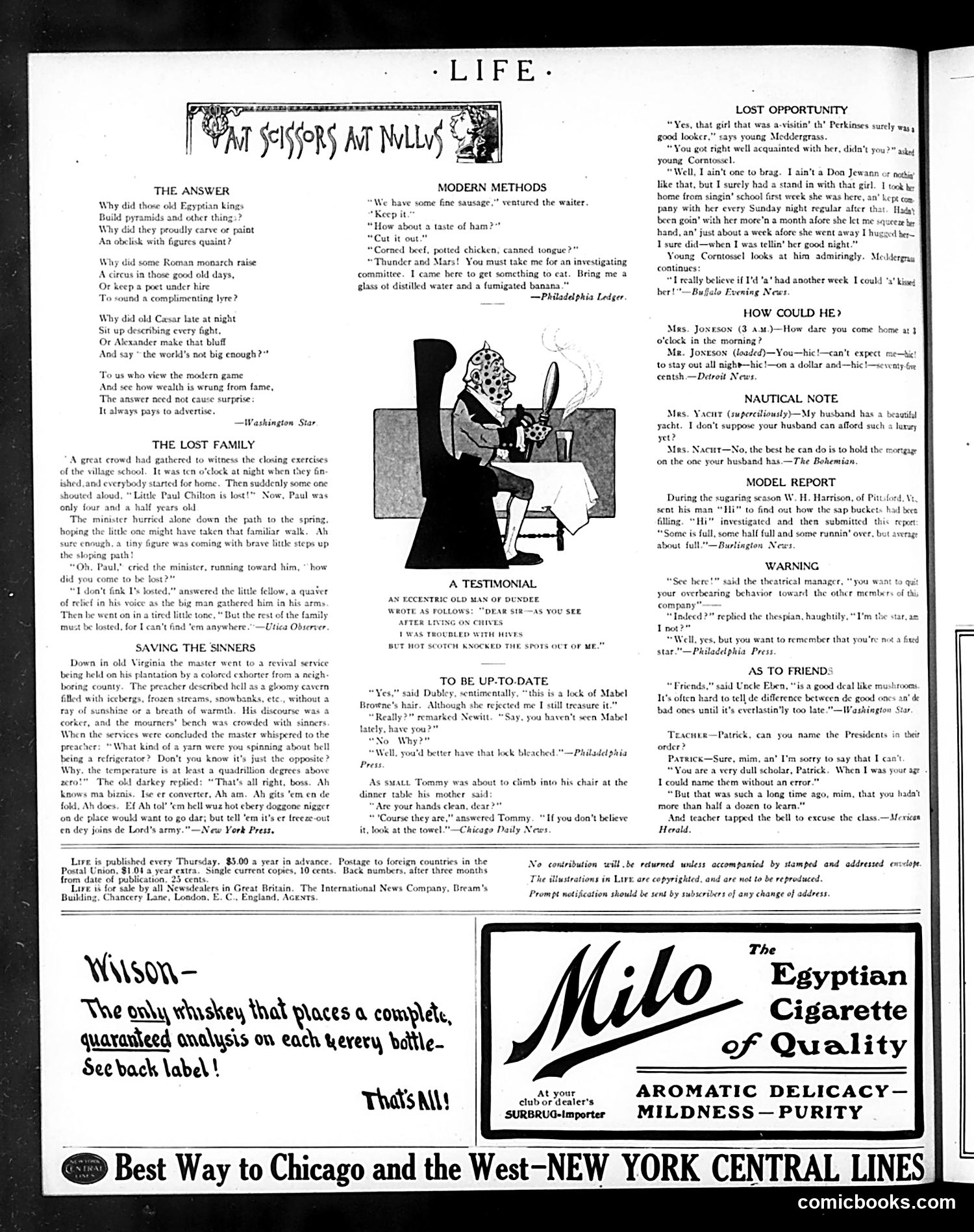
This page contains humorous short stories and jokes typical of early 20th-century American satire. The main cartoons and pieces include: **"The Answer"** — A tongue-in-cheek poem suggesting historical monuments (Egyptian pyramids, Caesar's writings, Alexander's conquests) were ultimately about self-promotion and advertising—a modern satirical take on ancient vanity. **"The Lost Family"** — A sentimental anecdote about a child lost after a village school event, with gentle humor about the child's confused logic. **"Saving the Sinners"** — Racial satire depicting a Virginia preacher describing hell as frozen rather than hot, with a plantation owner questioning the logic. This reflects the era's crude racial stereotyping common in period humor. **"Modern Methods"** — A diner joke about a finicky customer rejecting all food offerings. The page also includes period advertisements (Wilson whiskey, Milo Egyptian Cigarettes, New York Central Lines) and reflects early 1900s American magazine humor conventions, combining gentle domestic comedy with problematic racial caricature.
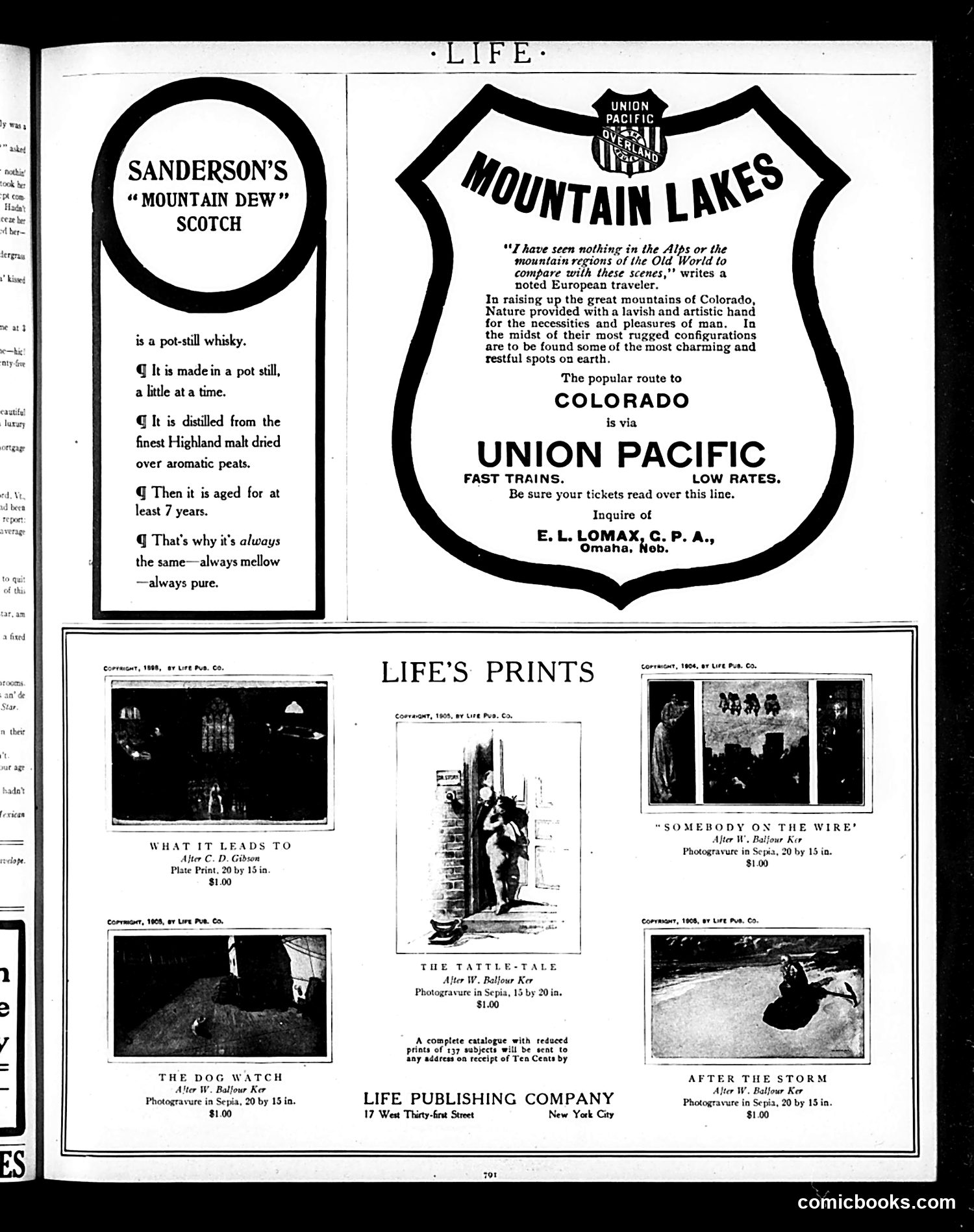
This page is primarily **advertising and merchandise** rather than satirical content. The top portion contains ads for **Sanderson's Mountain Dew Scotch** (emphasizing traditional pot-still production and aging) and **Union Pacific Railroad** promoting travel to Colorado's mountain landscapes. Below is a **"Life's Prints" catalog section** offering photogravure reproductions by artist W. Balfour Ker. The four prints shown—"What It Leads To," "The Dog Watch," "The Tattle-Tale," and "After the Storm"—appear to be narrative or genre scenes typical of early 1900s illustration. The titles suggest domestic or social situations, though specific details are unclear from the reproductions' quality. The page reflects Life magazine's business model: combining satirical editorial content (in other sections) with commercial advertising and merchandise sales to support publication.
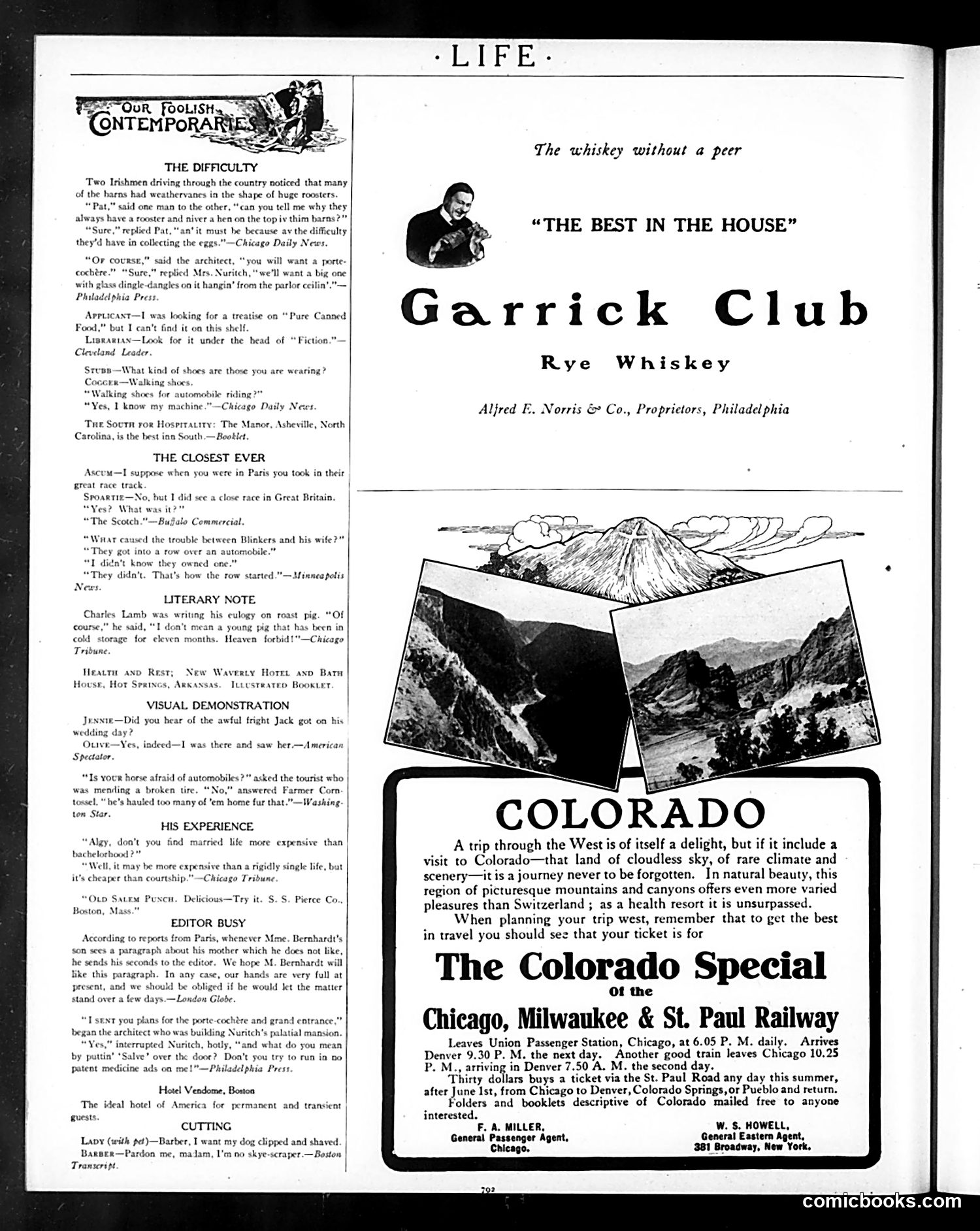
This is primarily an **advertising and humor page** from Life magazine, not political satire. The page contains: **"Our Foolish Contemporaries"** section: A collection of short jokes mocking Irish immigrants and rural Americans. Examples include an Irish farmer's joke about roosters on barns (playing on stereotypes of Irish dialect and rural ignorance) and jokes about automobiles, which were still novel technology. **Main content**: Large advertisements for **Garrick Club Rye Whiskey** and **The Colorado Special** railroad service—typical commercial ads of the era. **Minor jokes** at bottom satirize pretentious wealthy people (Mrs. Nuritch and her mansion), celebrities (Sarah Bernhardt), and class differences (the barber joke). The humor relies on **ethnic stereotypes** (Irish dialect), **class humor** (rich vs. working-class), and **topical references** to emerging technology (automobiles, railroads). Modern readers would find the casual ethnic mockery dated and offensive, though contemporary readers found it mainstream humor.
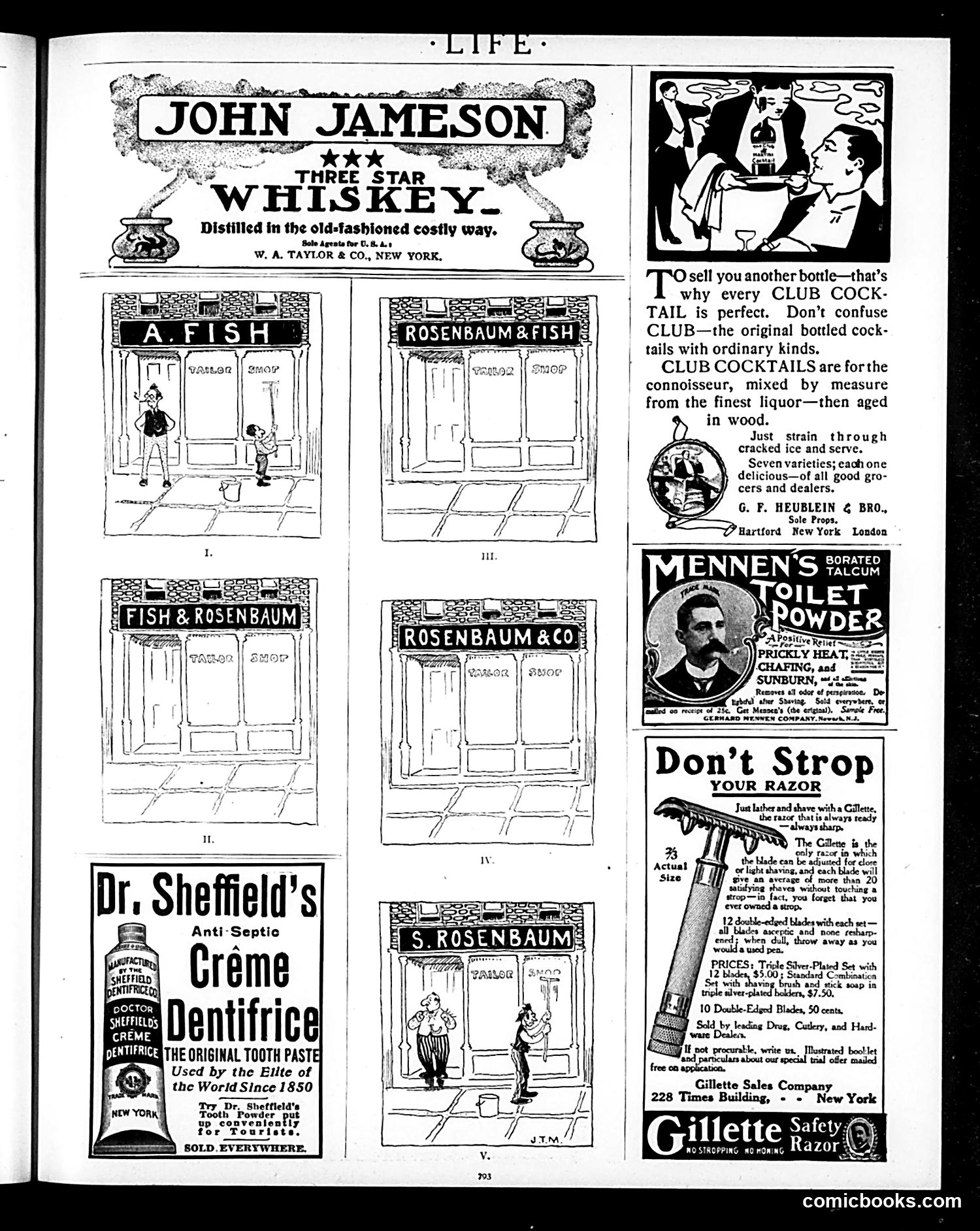
This page is primarily **advertising**, not political satire or comics. It contains five distinct product advertisements from the early 20th century: 1. **John Jameson Three Star Whiskey** — Irish whiskey marketed as "old-fashioned costly" 2. **Club Cocktails** — Pre-mixed bottled cocktails by Heublein & Bros., positioned as superior to ordinary brands 3. **Dr. Sheffield's Anti-Septic Crème Dentifrice** — Toothpaste claiming elite usage since 1850 4. **Mennen's Borated Talcum Toilet Powder** — Talc powder for preventing chafing and heat rash 5. **Gillette Safety Razor** — Razors with replaceable blades, marketed against stropping The cartoon strips (I-V) appear to be a sequential narrative about storefronts evolving from "A. Fish" to "S. Rosenbaum," likely illustrating a business succession or competition—possibly satirizing commercial consolidation or immigrant business ownership, though the specific context remains unclear without additional page context.
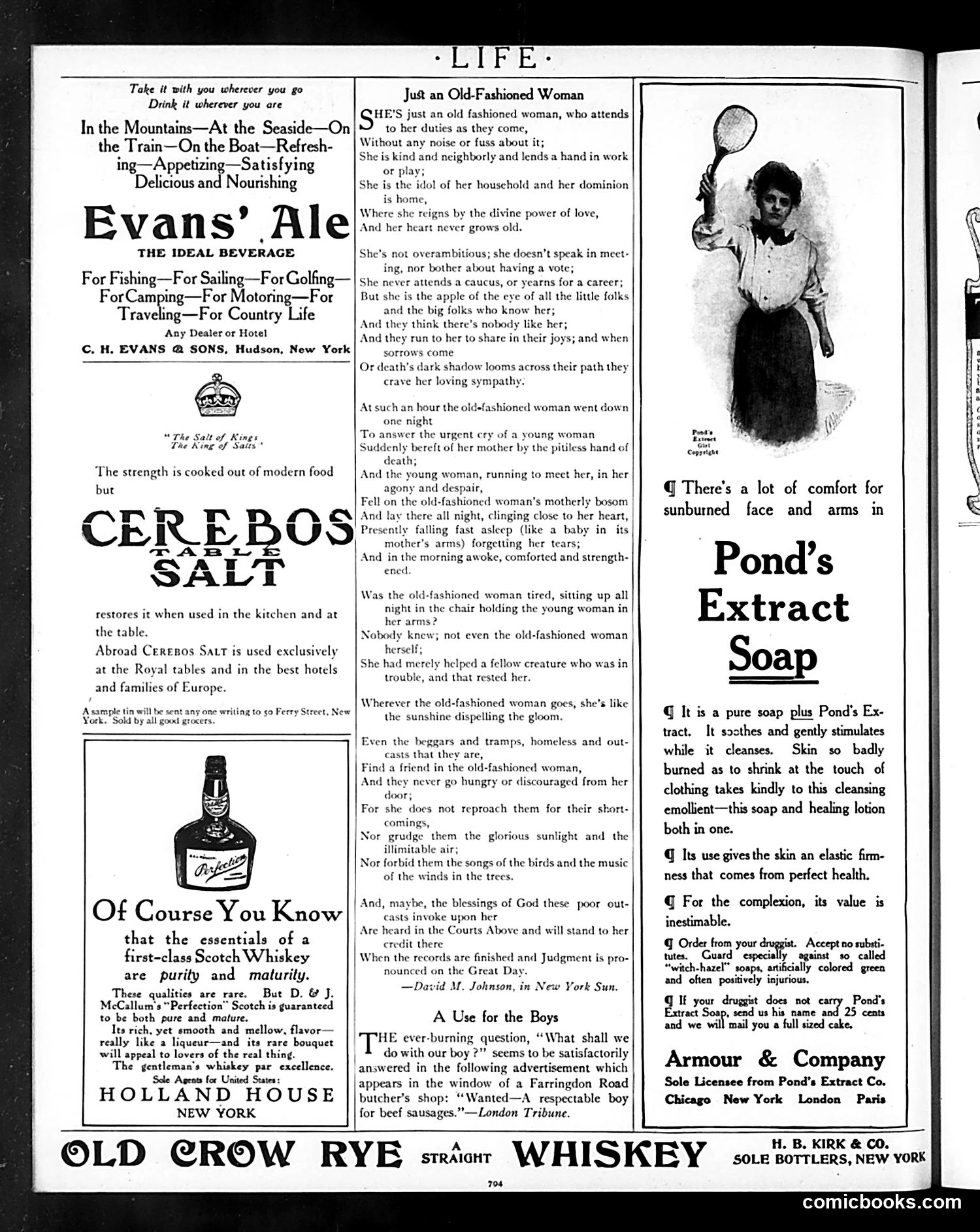
This page is primarily **advertisements with one satirical piece**. The main content is a sentimental poem titled "Just an Old-Fashioned Woman" celebrating traditional domestic femininity—a woman who serves her family and community without seeking political rights ("doesn't speak in meeting, nor bother about having a vote"). This appears to be **anti-suffrage messaging**, common in this era, idealizing women confined to home and caregiving while implicitly dismissing women's political ambitions. The accompanying illustration shows a young woman with a tennis racket—possibly ironic contrast, depicting modern leisure versus the poem's praised self-sacrifice. At bottom, "A Use for the Boys" is a brief satirical joke mocking help-wanted ads seeking "respectable boys for beef sausages"—dark humor implying the boys themselves might become sausage ingredients. The rest of the page contains period alcohol and health product advertisements (ale, whiskey, soap, salt), typical of *Life* magazine's commercial content.
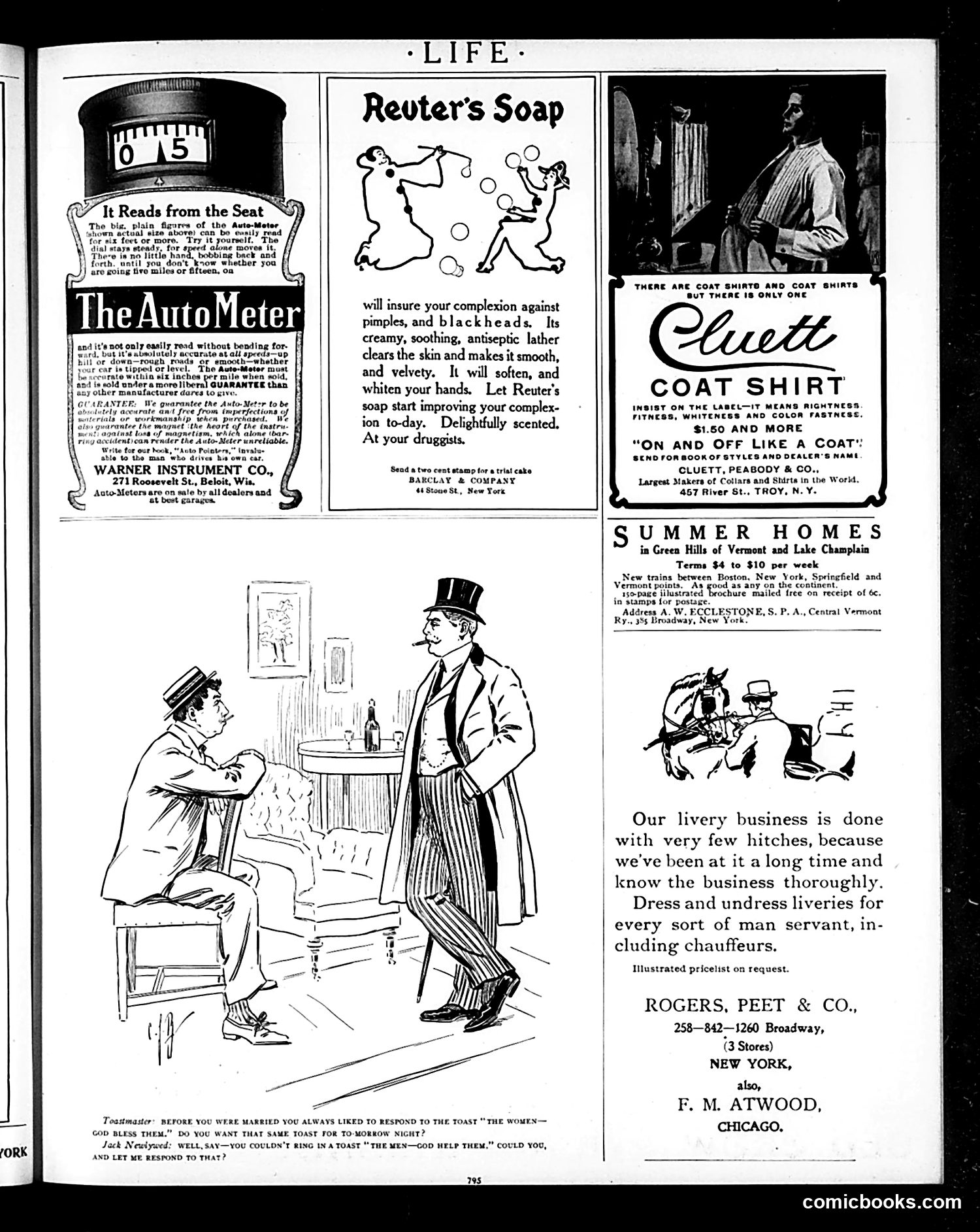
This page is primarily **advertising**, with one small satirical cartoon at the bottom. ## The Cartoon The bottom cartoon depicts a "Toastmaster" scenario: a newly married man (Jack Newlywed) responds to his toastmaster's request to give a toast "to the women." The joke relies on early-20th-century etiquette—toasts to "the women: God bless them" were conventional at formal dinners. The newlywed's response humorously inverts this: he wants to propose a toast to "the men—God help them" instead, suggesting marriage has already worn down his optimism about masculinity. This gentle marital humor was common in the era. ## The Advertisements The page features product ads typical of the period: - **AutoMeter** (automotive gauge) - **Reuter's Soap** (complexion care) - **Cluett Coat Shirts** (menswear) - **Rogers, Peet & Co.** (livery/servant uniforms) - **Summer Homes** (Vermont vacation rentals) These ads reveal period concerns: automobiles, personal grooming, formal menswear, and leisure travel.
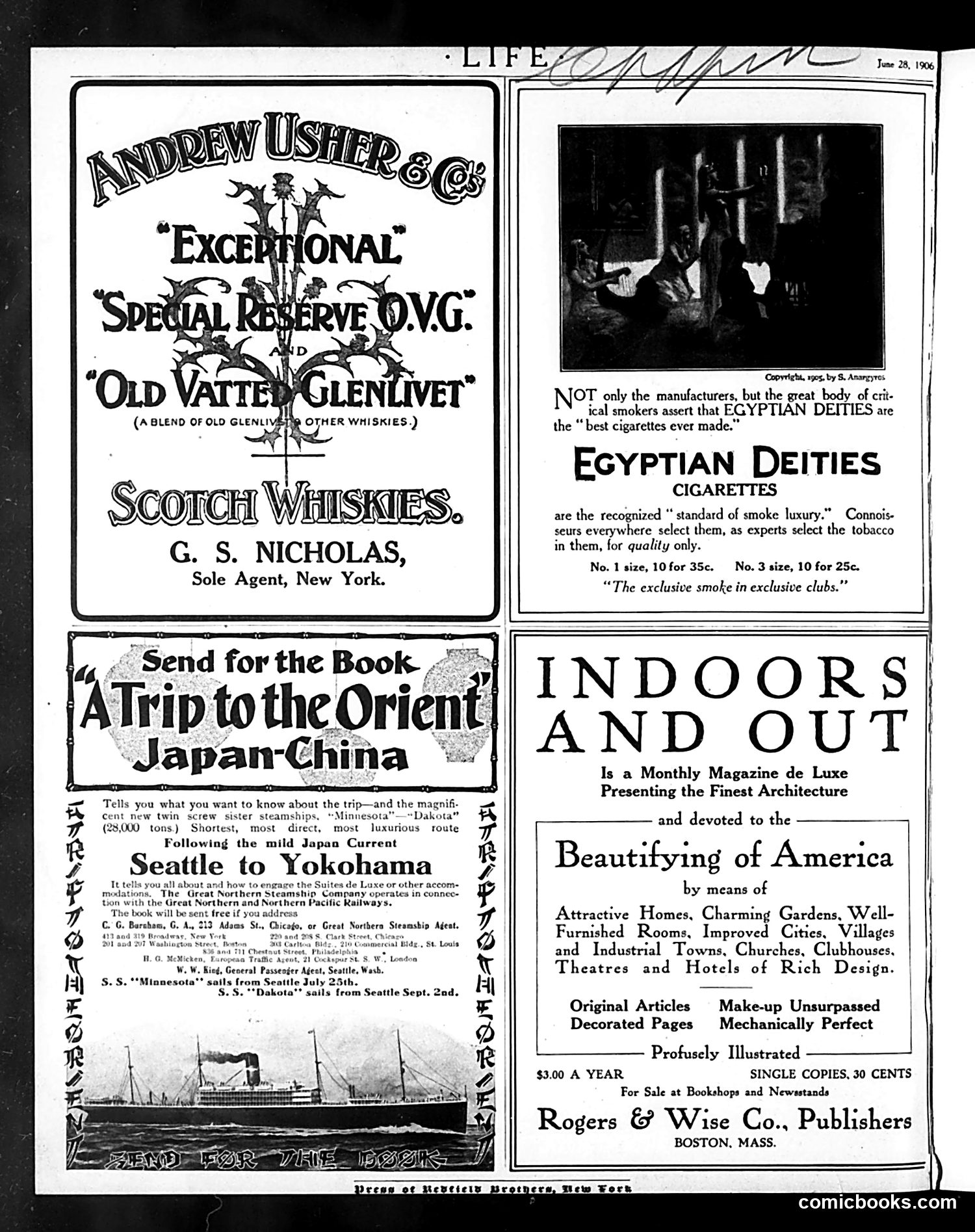
This page contains **no political cartoons or satire**—it is primarily **advertising**. The ads include: - **Andrew Usher & Co. Scotch Whiskies** (top left) - **Egyptian Deities Cigarettes** (top right), marketed as "the exclusive smoke in exclusive clubs" - **"A Trip to the Orient: Japan-China"** travel book promoting steamship voyages from Seattle to Yokohama via the Great Northern Steamship Company - **"Indoors and Out"** magazine (bottom right), a luxury publication about American architecture and home beautification The **only notable detail** is the Egyptian Deities ad's implicit class snobbery—cigarettes branded as exclusive luxury goods for wealthy clubgoers. The steamship ads similarly target affluent travelers seeking exotic journeys. Together, these ads reflect the magazine's audience: wealthy, cultured Americans in 1906.
I'm unable to provide a meaningful analysis of this page. The image appears to be almost entirely blank or blank white space, with only a date notation "28, 1906" visible in the upper left corner and the "comicbooks.com" watermark at the bottom right. Without visible cartoon illustrations, captions, or readable text content, I cannot identify figures, political references, or explain any satirical intent. This appears to be either a blank page from a publication, a scan quality issue, or a page that has deteriorated significantly. To properly analyze this material, a clearer image showing the actual cartoon or text content would be necessary.