
Life, 1906-06-28 · page 10 of 25
Life — June 28, 1906 — page 10: what you’re looking at
What you’re looking at
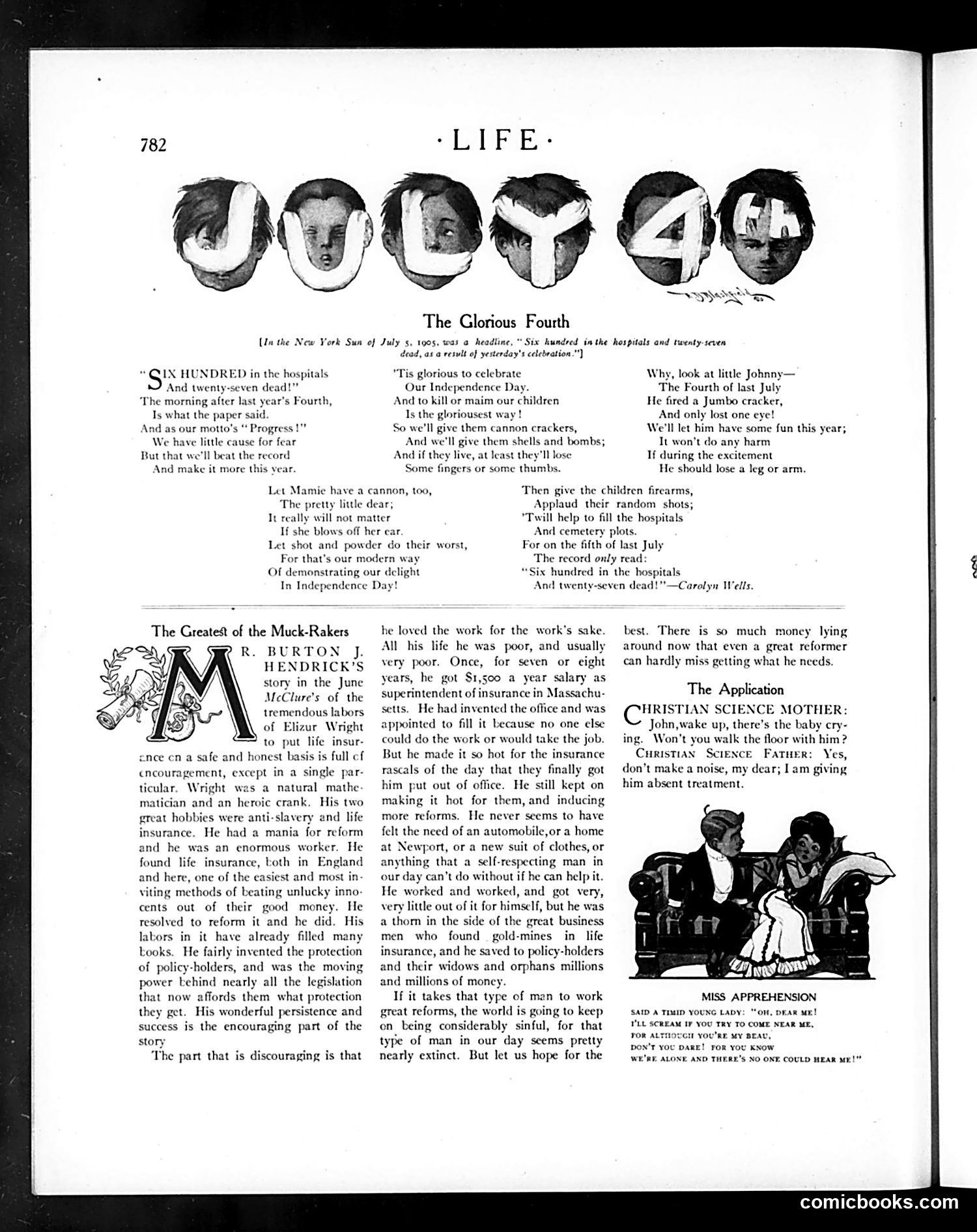
This page contains two pieces of satirical commentary on American society circa 1905: **"The Glorious Fourth"** mocks Independence Day celebrations by depicting how Americans actually commemorate it: through fireworks injuries. The satirical poem notes that "six hundred in the hospitals / Won't seven dead" result from the holiday, sarcastically celebrating this as the "glorious" way to demonstrate national delight. It suggests giving children dangerous fireworks and explosives as appropriate Fourth of July gifts, darkly implying that maiming and death are acceptable costs of patriotic celebration. **"The Greatest of the Muck-Rakers"** discusses reformer Elizar Wright's insurance industry advocacy. The text praises his lifetime commitment to honest business practices and worker protections, contrasting his modest success against the corrupt wealth of contemporary businessmen. It presents Wright as an admirable but nearly extinct reformer type in the Gilded Age.
📄 Transcribed text from this page (OCR, searchable)
Machine-transcribed from the original scan — historical spelling and the odd misread are preserved.
(In the New York Sun of July s, 1998, was a headline, © *“ QIX HUNDRED in the he And twenty-seven dead! ‘The morning after last year’s Fourth, Is what the paper said. And as our motto’s “ Progress !"” We have little cause for fear But that we'll beat the record And make it more this year. pitals Let Mamie have a cannon, too, The pretty little dear; It really will not matter If she blows off her Let shot and powder For that’s our modern wa Of demonstrating our In Independence Da The Greatest of the Muck-Rakers R. BURTON J. HENDRICK’S story in the June McClure’s of the tremendous labors of i Wright to put life insur- ence en a safe and honest basis is full ef cncouragement, except in a single par- ticular. Wright was a natural mathe matician and an heroic crank. His two great hobbies were anti-slavery and life insuran: He had a mania for reform and he was an enormous worker. He found life insurance, both in England and here, one of the easiest and most in- viting methods of beating unlucky inno- cents out of their good moncy. He resolved to reform it and he did. His labors in it have already filled many books. He fairly invented the protection of policy-holders, and was the moving power tehind nearly all the legislati that now affords them what protection they get. His wonderful persistence and success is the encouraging part of the story ‘The part that is discouraging is that The Glorious Fourth dead, as a result of yesterday's celebration") "Tis glorious to celebrate Our Independence Day. And to kill or maim our children Is the gloriousest way ! So we'll give them cannon crackers, And we'll give them shells and bombs; And if they live, at least they'll lose Some fingers or some thumbs. And cemete do their worst, delight he loved the work for the work's sake. | his life he was poor, and usually very poor. Once, for seven or eight years, he got $1,500 a year salary as superintendent of insurance in Massachu- setts. He had invented the office and was appointed to fill it because no one else could do the work or would take the job. But he made it so hot for the insurance rascals of the day that they finally got him put out of office. He still kept on making it hot for them, and inducing more reforms. He never seems to have felt the need of an automobile,or a home at Newport, or a new suit of clothes, or anything that a self-respecting man in our day can’t do without if he can help it. He worked and worked, and got very, very little out of it for himself, but he was a thor in the side of the great business men who found gold-mines in. life insurance, and he saved to policy-holders and their widows and orphans millions and millions of money. If it takes that type of man to work great reforms, the world is going to keep on being considerably sinful, for that type of man in our day seems pretty nearly extinct. But let us hope for the Six hundred inthe hospitals and twenty-seven Why, look at little Johnny— The Fourth of last Jul He fired a Jumbo cracker, And only lost one eye! We'll let him have some fun this year; It won't do any harm If during the excitement He should lose a leg or arm. Then give the children firearms, Applaud their random shots; ‘Twill help to fill the y plots. For on the fifth of last July The record only read: “Six hundred in the hospitals ! And twenty-seven dead!" —Carolyn Wells. hospitals best. There is so much money lying around now that even a great reformer can hardly miss getting what he needs. The Application HRISTIAN SCIENCE MOTHER: John,wake up, there’s the baby cry ing. Won't you walk the floor with him? CuristiaAN Science FATHE! Yes, don’t make a noise, my dear; lam giving him absent treatment. MISS APPREHENSION SAID A THEID YOUNG LADY: “OM, DEAR ME! I'LL SCREAM IF YOU TRY TO COME NEAR ME, Tok ALTHOGH YOU'RE MY BEAU, DON'T YOU DARE! YOR YOU KNOW WE'RE ALONE AND THERE'S NO ONE COULD MEAR we!” comicbooks.com