
Life, 1906-06-28 · page 16 of 25
Life — June 28, 1906 — page 16: what you’re looking at
What you’re looking at
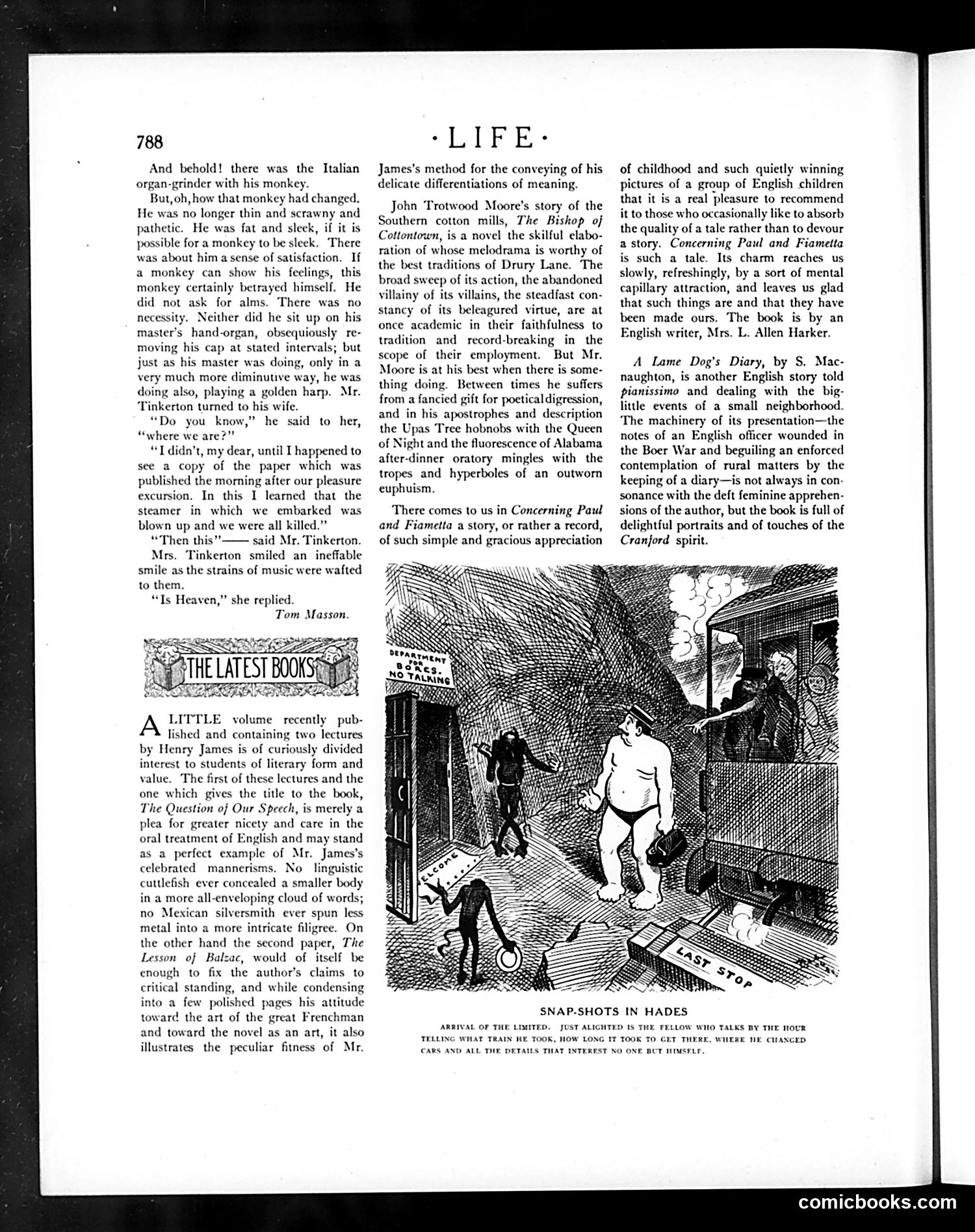
This cartoon illustrates a short story by Tom Masson about an afterlife encounter. A couple—Mr. and Mrs. Tinkerton—discover they died in a steamship explosion, yet find themselves in Heaven watching an Italian organ-grinder and his monkey. The satirical twist: the monkey, once thin and pathetic, now appears fat and content, playing a golden harp alongside his master. The joke plays on the reversal of earthly circumstances—even the street performer's monkey achieves dignity and prosperity in the afterlife. The caption's reference to "the Limited" (a train) and details about "how long it took to get there" suggests Masson is gently mocking both spiritualist beliefs about the afterlife and the banality of how people might discuss even Heaven's logistics. The cartoon exemplifies *Life* magazine's satirical humor: whimsical, philosophical, and quietly poking fun at American attitudes toward class, mortality, and the supernatural.
📄 Transcribed text from this page (OCR, searchable)
Machine-transcribed from the original scan — historical spelling and the odd misread are preserved.
788 And behold! there was the Italian organ-grinder with his monkey. But, oh, how that monkey had changed. He was no longer thin and scrawny and pathetic. He was fat and s| if it is possible fora monkey to be sleck. There was about him a sense of satisfaction. If a monkey can show his feelings, this monkey certainly betrayed himself. He did not ask for alms. There was no necessity. Neither did he sit up on his master’s hand-organ, obsequiously re- moving his cap at stated intervals; but just as his master was doing, only in a very much more diminuuve way, he was doing also, playing a golden harp. Mr. Tinkerton turned to his wife. “Do you know,” he said to her, “where we are?” “T didn’t, my dear, until I happened to see a copy of the paper which was published the morning after our pleasure excursion. In this I learned that the steamer in which we embarked was blown up and we were all killed.” “Then thi said Mr. Tinkerton. Mrs. Tinkerton smiled an ineffable smile as the strains of music were wafted to them. “Is Heaven,” she replied. Tom Masson. SEE Se LENS PLA RIALS LITTLE volume recently pub- lished and containing two lectures by Henry James is of curiously divided interest to students of literary form and value, The first of these lectures and the one which gives the title to the book, The Question of Our Speech, is merely a plea for greater nicety and care in the oral treatment of English and may stand as a perfect example of Mr. James’s celebrated mannerisms. No linguistic cuttlefish ever concealed a smaller body in a more all-enveloping cloud of words; no Mexican silversmith ever spun less metal into a more intricate filigree. On the other hand the second paper, The Lesson oj Balzac, would of itself be enough to fix the author’s claims to critical standing, and while condensing into a few polished pages his attitude toward the art of the great Frenchman and toward the novel as an art, it also illustrates the peculiar fitness of Mr. ~LIFE- James's method for the conveying of his delicate differentiations of meaning. John Trotwood Moore's story of the Southern cotton mills, The Bishop of Cottontown, is a novel the skilful elabo- ration of whose melodrama is worthy of the best traditions of Drury Lane. The broad sweep of its action, the abandoned villainy of its villains, the steadfast con- stancy of its beleagured virtue, are at once academic in their faithfulness to tradition and record-breaking in the scope of their employment. But Mr. Moore is at his best when there is some- thing doing. Between times he suffers from a fancied gift for poeticaldigression, and in his apostrophes and description the Upas Tree hobnobs with the Queen of Night and the fluorescence of Alabama after-dinner oratory mingles with the tropes and hyperboles of an outworn euphuism. There comes to us in Concerning Paul and Fiametta a story, or rather a record, of such simple and gracious appreciation Sa Hi eZ i of childhood and such quietly winning pictures of a group of English children that it is a real pleasure to recommend it to those who occasionally like to absorb the quality of a tale rather than to devour a story. Concerning Paul and Fiametta is such a tale. Its charm reaches us slowly, refreshingly, by a sort of mental capillary attraction, and leaves us glad that such things are and that they have been made ours. The book is by an English writer, Mrs. L. Allen Harker. A Lame Dog’s Diary, by S. Mac- naughton, is another English story told pianissimo and dealing with the big- little events of a small neighborhood. The machinery of its presentation—the notes of an English officer wounded in the Boer War and beguiling an enforced contemplation of rural matters by the keeping of a diary—is not always in con- sonance with the deft feminine apprehen- sions of the author, but the book is full of delightful portraits and of touches of the Cranford spirit. SNAP-SHOTS IN HADES ARRIVAL OF THE LIMITED. JUST ALIGHTED 15 THE FELLOW WHO TALKS BY THE TOUR TELLING WHAT TRAIN HE TOOK, HOW LONG IT TOOK TO CET TIUERE, WHERE NE CHANCED CARS AND ALL THE DETAILS THAT INTEREST NO ONE BUT HIMSFLY, comicbooks.com