
Life, 1906-06-28 · page 15 of 25
Life — June 28, 1906 — page 15: what you’re looking at
What you’re looking at
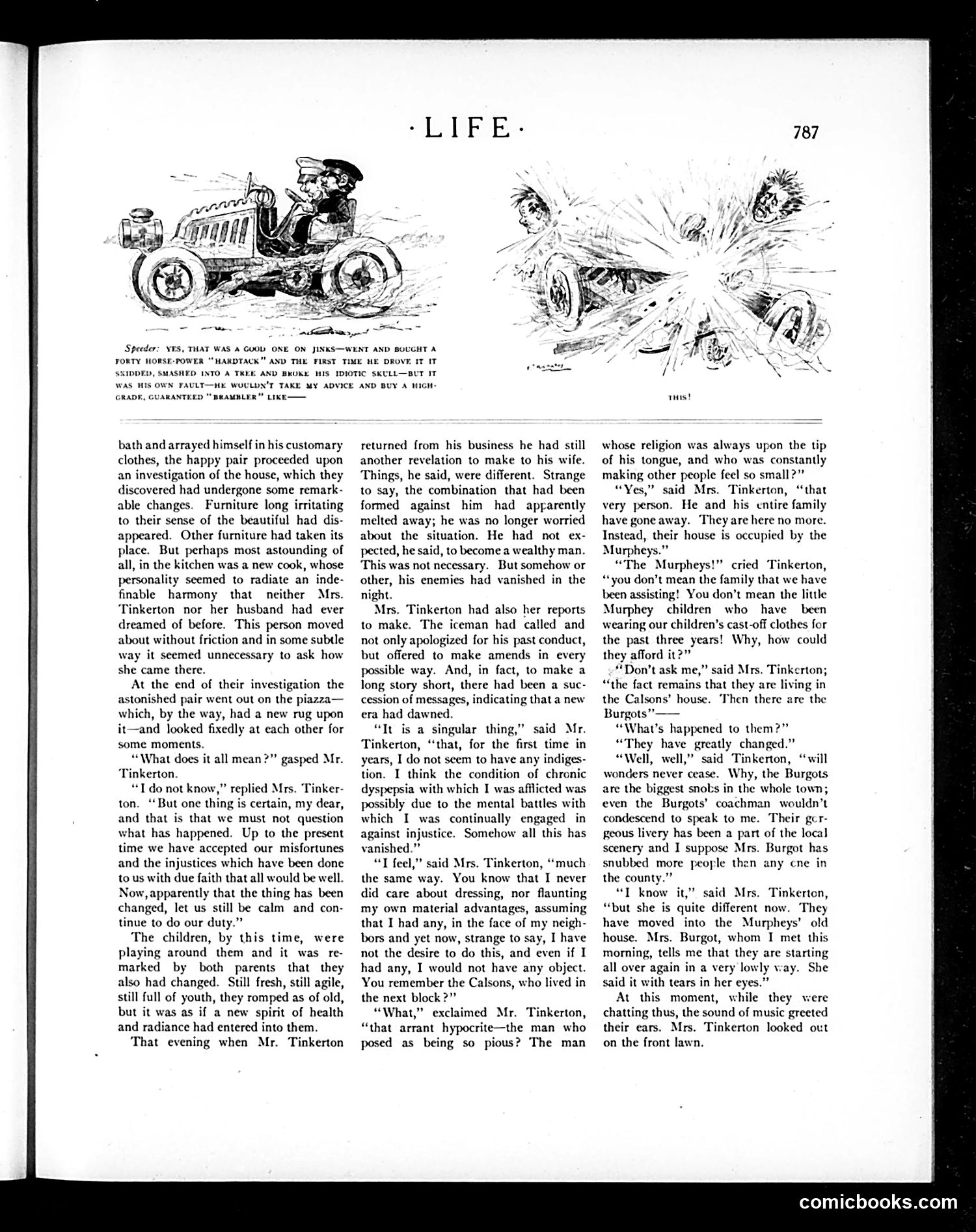
This page contains two satirical cartoons about early automobiles, plus fiction text unrelated to the cartoons. **Top Left Cartoon:** Shows a man driving a reckless "forty horse-power" car. The caption mocks someone named Jinks who bought a "Hardtack" automobile, crashed it into a tree, and died—but dismisses this as his own fault for not purchasing a reliable "Brambler" instead. This is automobile industry satire: the joke critiques both dangerous driving *and* uses the accident as a thinly-veiled advertisement for the safer Brambler brand. Early cars were notoriously unreliable and dangerous. **Top Right Cartoon:** Labeled "THIS!" shows a chaotic multi-car collision with figures flying everywhere—exaggerated visual commentary on automobile accidents. **Context:** These appear circa 1900s-1910s, when automobiles were new, expensive luxuries associated with wealthy, reckless drivers. The satire targets both automotive safety and the conspicuous consumption of the wealthy. The fiction text below is unrelated.
📄 Transcribed text from this page (OCR, searchable)
Machine-transcribed from the original scan — historical spelling and the odd misread are preserved.
Speeder FORTY HORSE-POWER YES, THAT WAS A GUOD ONE ON JINKS—WENT AND BOUGHT A “MARDTACK" AND THE FIRST TIME HE DROVE IT IT SSIDDED, SMASHED INTO A TREE AND BROKE MIS IDIOTIC SKULL—BUT IT WAS HIS OWN FAULT—ME WOULDN'T TAKE MY ADVICE AND BUY A HIGH: GRADE, GUARANTEED " BRAMBLER" LIKE— bath and arrayed himself in his customary clothes, the happy pair proceeded upon an investigation of the house, which they discovered had undergone some remark- able changes. Furniture long irritating to their sense of the beautiful had dis- appeared. Other furniture had taken its place. But perhaps most astounding of all, in the kitchen was a new cook, whose personality seemed to radiate an inde- finable harmony that neither Mrs. Tinkerton nor her husband had ever dreamed of before. This person moved about without friction and in some subtle way it seemed unnecessary to ask how she came there. At the end of their investigation the astonished pair went out on the piazza— which, by the way, had a new rug upon it—and looked fixedly at each other for some moments. “What does it all mean?” gasped Mr. Tinkerton. “I do not know,” replied Mrs. Tinker- ton. “But one thing is certain, my dear, and that is that we must not question what has happened. Up to the present time we have accepted our misfortunes and the injustices which have been done to us with due faith that all would be well. Now, apparently that the thing has been changed, let us still be calm and con- tinue to do our duty.” The children, by this time, were playing around them and it was re- marked by both parents that they also had changed. Still fresh, still agile, still full of youth, they romped as of old, but it was as if a new spirit of health and radiance had entered into them. That evening when Mr. Tinkerton returned from his business he had still another revelation to make to his wife. Things, he said, were different. Strange to say, the combination that had been formed against him had apparently melted away; he was no longer worried about the situation. He had not ex- pected, he said, to become a wealthy man. ‘This was not necessary. But somehow or other, his enemies had vanished in the night. Mrs. Tinkerton had also her reports to make. The iceman had called and not only apologized for his past conduct, but offered to make amends in every possible way. And, in fact, to make a long story short, there had been a suc- cession of messages, indicating that a new era had dawned. “It is a singular thing,” said Mr. Tinkerton, ‘that, for the first time in years, I do not seem to have any indiges- tion. I think the condition of chronic dyspepsia with which I was afflicted was possibly due to the mental battles with which I was continually engaged in against injustice. Somehow all this has vanished.” “T feel,” said Mrs. Tinkerton, “much the same way. You know that I never did care about dressing, nor flaunting my own material advantages, assuming that I had any, in the face of my neigh- bors and yet now, strange to say, I have not the desire to do this, and even if I had any, I would not have any object. You remember the Calsons, who lived in the next block ?” “What,” exclaimed Mr. Tinkerton, “that arrant hypocrite—the man who posed as being so pious? The man mis! whose religion was always upon the tip of his tongue, and who was constantly making other people feel so small?” “Yes,” said Mrs. Tinkerton, “that very person. He and his entire family have gone away. They are here no more. Instead, their house is occupied by the Murpheys.”” “The Murpheys!” cried ‘Tinkerton, “you don’t mean the family that we have been assisting! You don’t mean the little Murphey children who have been wearing our children’s cast-off clothes for the past three years! Why, how could they afford it?” “Don’t ask me,” said Mrs. Tinkerton; “the fact remains that they are living in the Calsons’ house. ‘Then there are the Burgots” “What’s happened to them?” “They have greatly changed.” “Well, well,” said Tinkerton, “will wonders never ce Why, the Burgots are the biggest snoks in the whole town; even the Burgots’ coachman wouldn’t condescend to speak to me. Their ger- geous livery has been a part of the local scenery and I suppose Mrs. Burgot has snubbed more people then any cne in the county.”” “T know it,” said Mrs. Tinkerton, “but she is quite different now. They have moved into the Murpheys’ old house. Mrs. Burgot, whom I met this morning, tells me that they are starting all over again in a very lowly way. She said it with tears in her eyes.” At this moment, while they were chatting thus, the sound of music greeted their ears. Mrs. Tinkerton looked out on the front lawn. comicbooks.com