
Life, 1906-06-28 · page 6 of 25
Life — June 28, 1906 — page 6: what you’re looking at
What you’re looking at
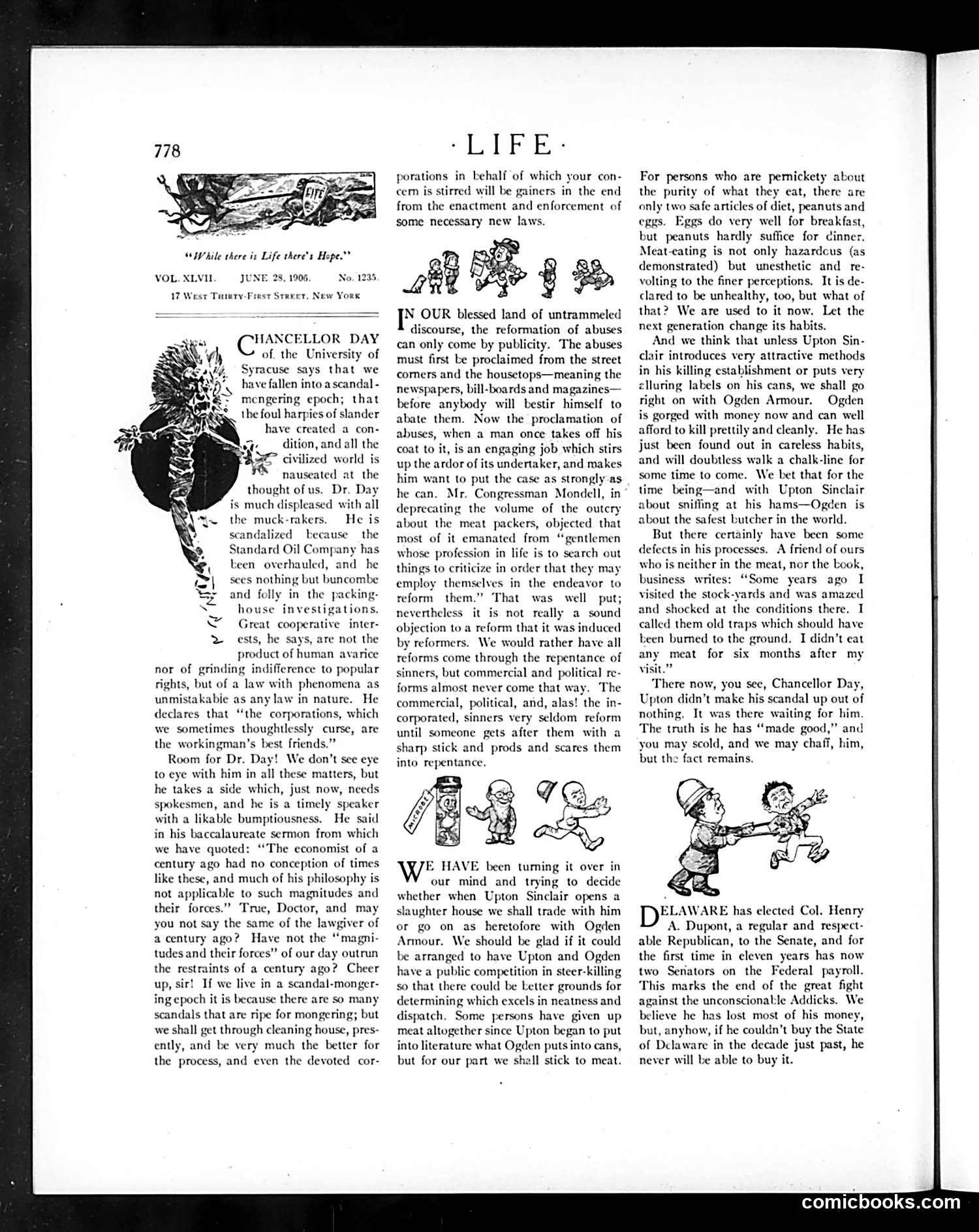
This page satirizes **Upton Sinclair's 1906 novel "The Jungle,"** which exposed horrific conditions in meatpacking plants. The article mocks reformers' reactions to Sinclair's scandal-mongering while defending the meat industry. The central cartoon depicts figures (likely representing Sinclair and reformers) agitating against meatpacking practices. The text dismisses calls for reform as exaggerated—claiming the industry's problems are overstated and that regulatory reform is unnecessary. The final item celebrates **Col. Henry A. Dupont's** election to the Delaware Senate, noting the "end of the great fight against unconscionable tricks," suggesting corporate interests triumphed over reform legislation in that state. Overall, the page reflects **corporate-friendly resistance** to Progressive Era meatpacking reforms that Sinclair's exposé had sparked.
📄 Transcribed text from this page (OCR, searchable)
Machine-transcribed from the original scan — historical spelling and the odd misread are preserved.
“While there is Life there's Hope.” VOL. XLVI JUNE 28, 1906 No. 1235. 17 West Tauery-First Steret, New Yore Cun LLOR DAY of. the University of Syracuse says that we have fallen into a scandal - mengering epoch; that the foul harpies of slander have created a con- q _ dition, and all the 3 civilized world is “nauseated at the thought of us. Dr. Day is much displeased with all the muck-rakers. He is scandalized because the Standard Oil Company has been overhauled, and he sees nothing but buncombe and folly in the packing- house investigations, eat cooperative inter- ests, he says, are not the product of human avarice nor of grinding indifference to popular rights, but of a law with phenomena as unmistakabie as any law in nature. He declares that “the corporations, which we sometimes thoughtlessly curse, are the workingman’s best friends.” Room for Dr. Day! We don’t sce eye to eye with him in all these matters, but he takes a side which, just now, needs spokesmen, and he is a timely speaker with a likable bumptiousness. He said in his baccalaureate sermon from which we have quoted: “The economist of a century ago had no conception of times like these, and much of his philosophy is not applicable to such magnitudes and their forces.” True, Doctor, and may you not say the same of the lawgiver of a century ago? Have not the “magni- tudes and their forces” of our day outrun the restraints of a century ago? Cheer up, sir! If we live in a scandal-monger- ing epoch it is because there are so many scandals that are ripe for mongering; but we shall get through cleaning house, pres- ently, and be very much the better for the process, and even the devoted cor- -LIFE- porations in behalf of which your con- cem is stirred will be gainers in the end from the enactment and enforcement of some necessary new laws. IX OUR blessed land of untrammeled discourse, the reformation of abuses can only come by publicity. The abuses must first te proclaimed from the street comers and the housetops—meaning the newspapers, bill-boards and magazines— before anybody will bestir himself to abate them. Now the proclamation of abuses, when a man once takes off his coat to it, is an engaging job which stirs up the ardor of its undertaker, and makes him want to put the case as strongly-as. he can. Mr. Congressman Mondell, in deprecating the volume of the outcry about the meat packers, objected that most of it emanated from ‘gentlemen whose profession in life is to search out things to criticize in order that they may employ themselves in the endeavor to reform them.” That was well put; nevertheless it is not really a sound objection to a reform that it was induced by reformers. We would rather have all reforms come through the repentance of sinners, but commercial and political re- forms almost never come that way. The commercial, political, and, alas! the in- corporated, sinners very seldom reform until someone gets after them with a sharp stick and prods and scares them into repentance. been tuming it over in our mind and trying to decide whether when Upton Sinclair opens a slaughter house we shall trade with him or go on as heretofore with Ogden Armour. We should be glad if it could be arranged to have Upton and Ogden have a public competition in steer-killing so that there could be better grounds for determining which excels in neatness and dispatch. Some persons have given up meat altogether since Upton began to put into literature what Ogden puts into cans, but for our part we shall stick to meat. For persons who are pemickety about the purity of what they cat, there are only two safe articles of diet, peanuts and eggs. Eggs do very well for breakfast, but peanuts hardly suffice for cinn Meat-eating is not only hazardcus (as demonstrated) but unesthetic and re- volting to the finer perceptions. It is de- clared to be unhealthy, too, but what of that? We are used to it now. Let the next generation change its habits. And we think that unless Upton Sin- clair introduces very attractive methods in his killing establishment or puts very elluring labels on his cans, we shall go right on with Ogden Armour. Ogden is gorged with money now and can well afford to kill prettily and cleanly. He has just been found out in careless habits, and will doubtless walk a chalk-line for some time to come. We bet that for the time being—and with Upton Sinclair about snifling at his hams—Ogden is about the safest butcher in the world. But there certainly have been some defects in his processes. A friend of ours who is neither in the meat, nor the book, business writes: “Some years ago I isited the stock-yards and was amazed and shocked at the conditions there. I called them old traps which should have been burned to the ground, I didn’t eat ny meat for six months after my visit.” There now, you see, Chancellor Day, Upton didn’t make his scandal up out of nothing. It was there waiting for him. The truth is he has “made good,” and you may scold, and we may chaff, him, but the fact remains. SLAWARE has elected Col. Henry . Dupont, a regular and respect- able Republican, to the Senate, and for the first time in eleven years has now two Seriators on the Federal payroll. This marks the end of the great fight against the unconscionable Addicks. We believe he lost most of his money, but, anyhow, if he couldn’t buy the State of Delaware in the decade just past, he never will be able to buy it. comicbooks.com