
A complete issue · 26 pages · 1905
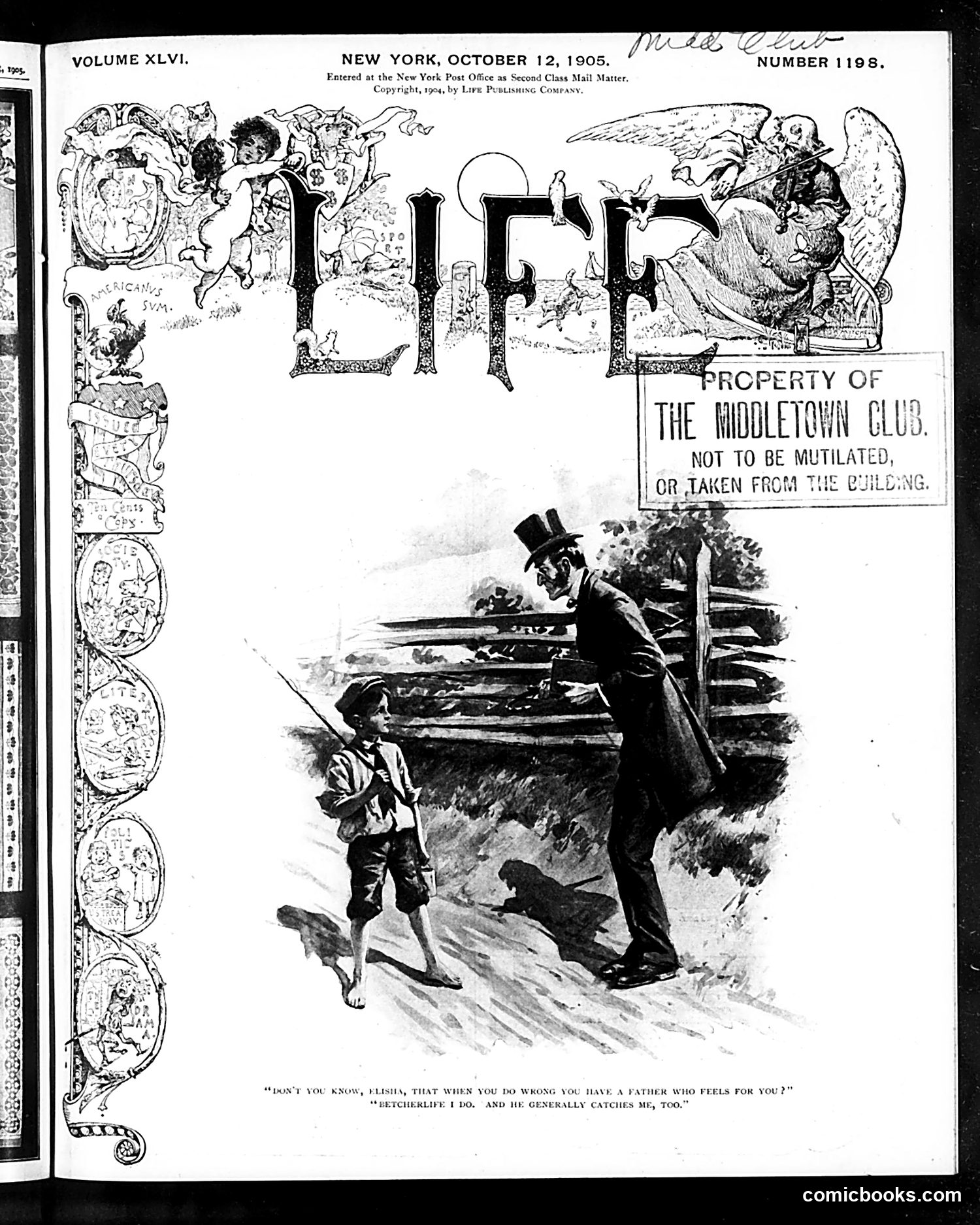
Life — October 12, 1905
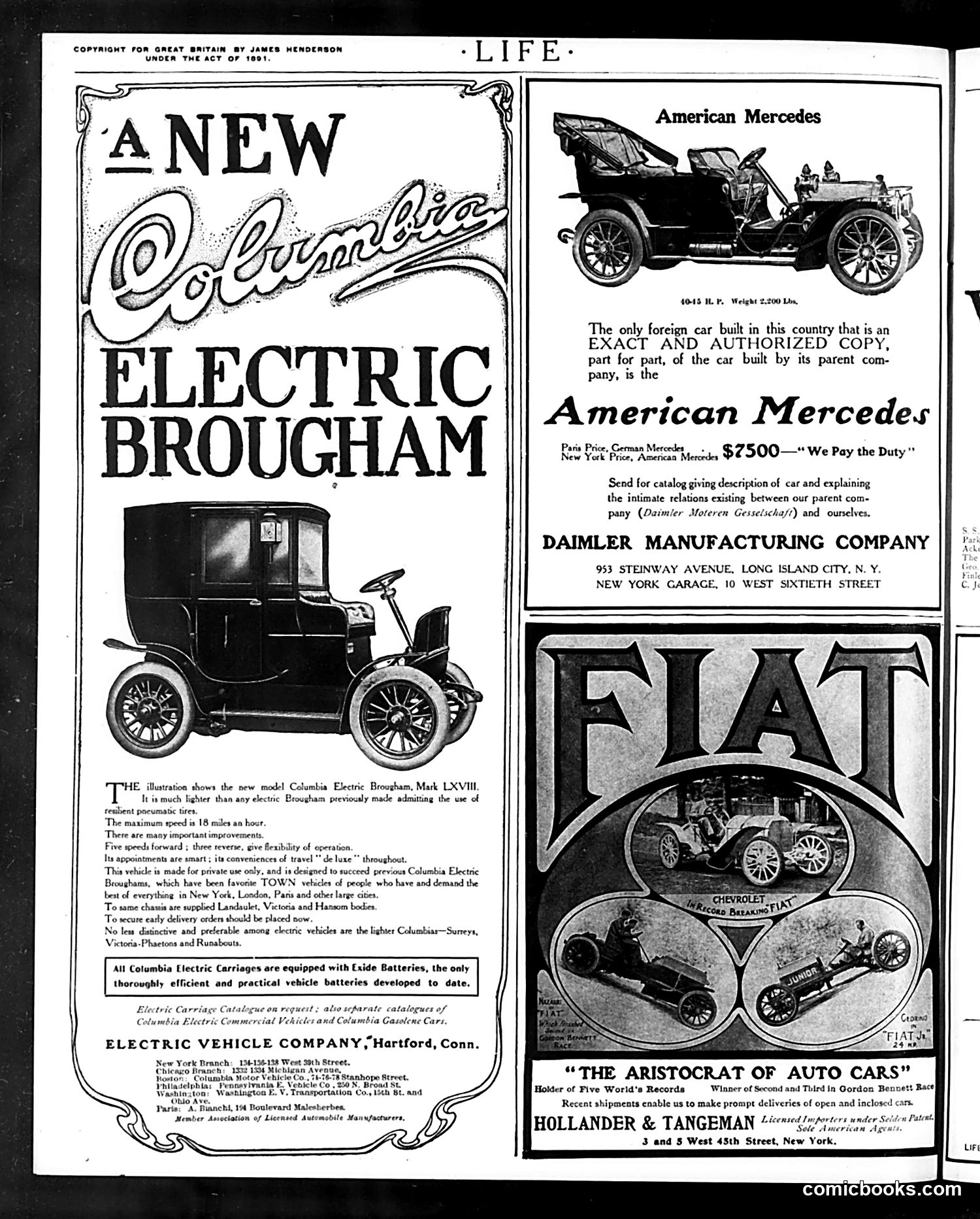
This page contains **no political cartoons or satire**—it is primarily **automobile advertisements** from the early 1900s. The left side advertises the **Columbia Electric Brougham**, an electric vehicle marketed as an improvement over previous models, emphasizing its 18-mile-per-hour maximum speed and ease of operation. The text notes it's designed for "private use only." The right side features ads for the **American Mercedes** (built under license in New York) and the **Fiat**, described as "The Aristocrat of Auto Cars." These ads highlight luxury, foreign prestige, and manufacturing quality. The advertisements reflect the early automotive era when electric vehicles competed with gasoline cars, and foreign makes signified status and sophistication to American consumers.
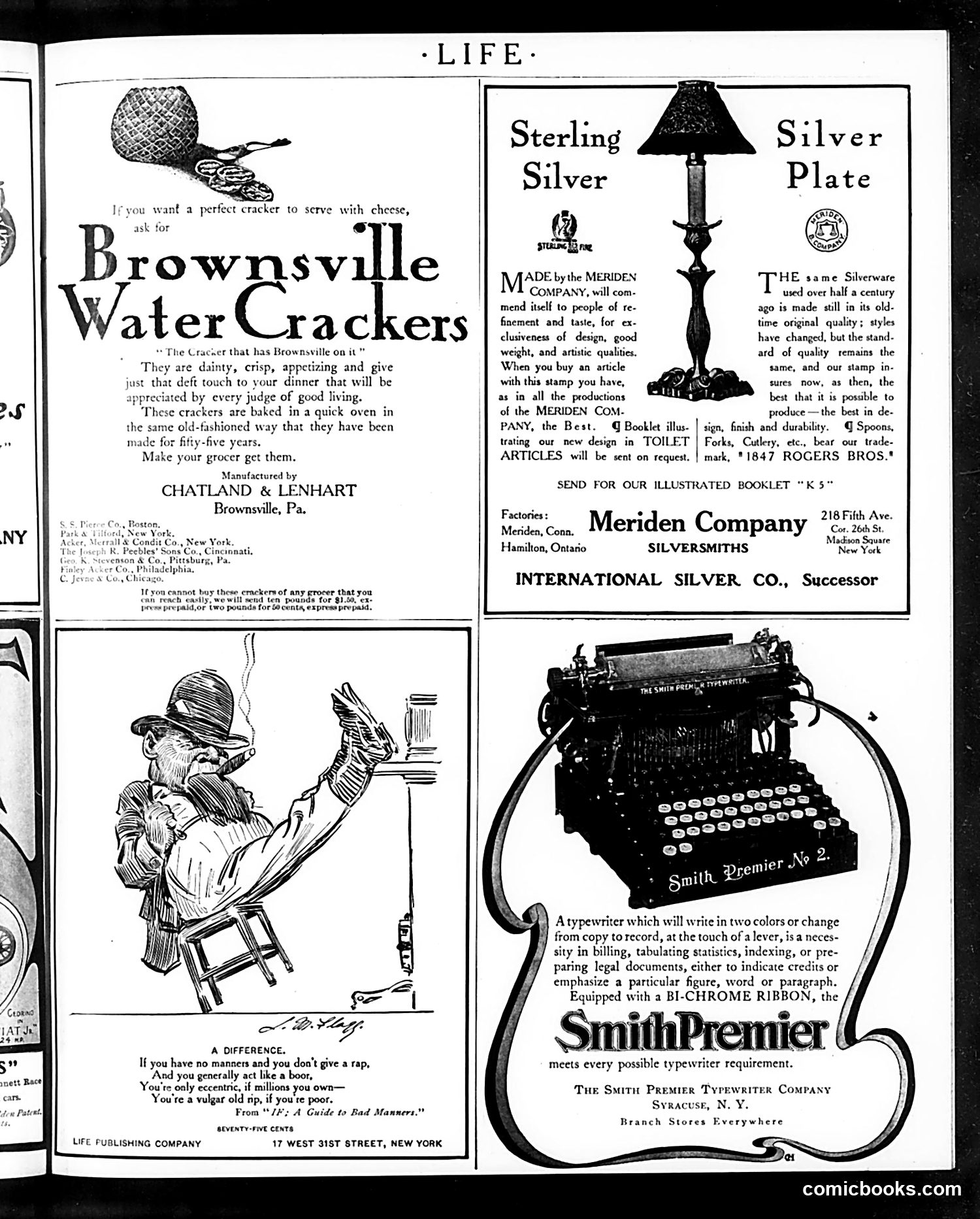
This page consists primarily of **advertisements rather than editorial cartoons**. The main content includes ads for Brownsville Water Crackers, Meriden Company silverware, and Smith Premier typewriters. There is one small cartoon labeled "A Difference" showing a figure in tattered clothes at a door, with text contrasting behavior toward a "book" versus a "poor" person—apparently satirizing class-based hypocrisy in how people treat others based on social status. The cartoon's message appears to be social commentary on inconsistent moral standards: one shouldn't behave courteously only to those perceived as refined while being rude to the poor. However, the specific context and any particular social event being referenced remains unclear from this isolated image alone.
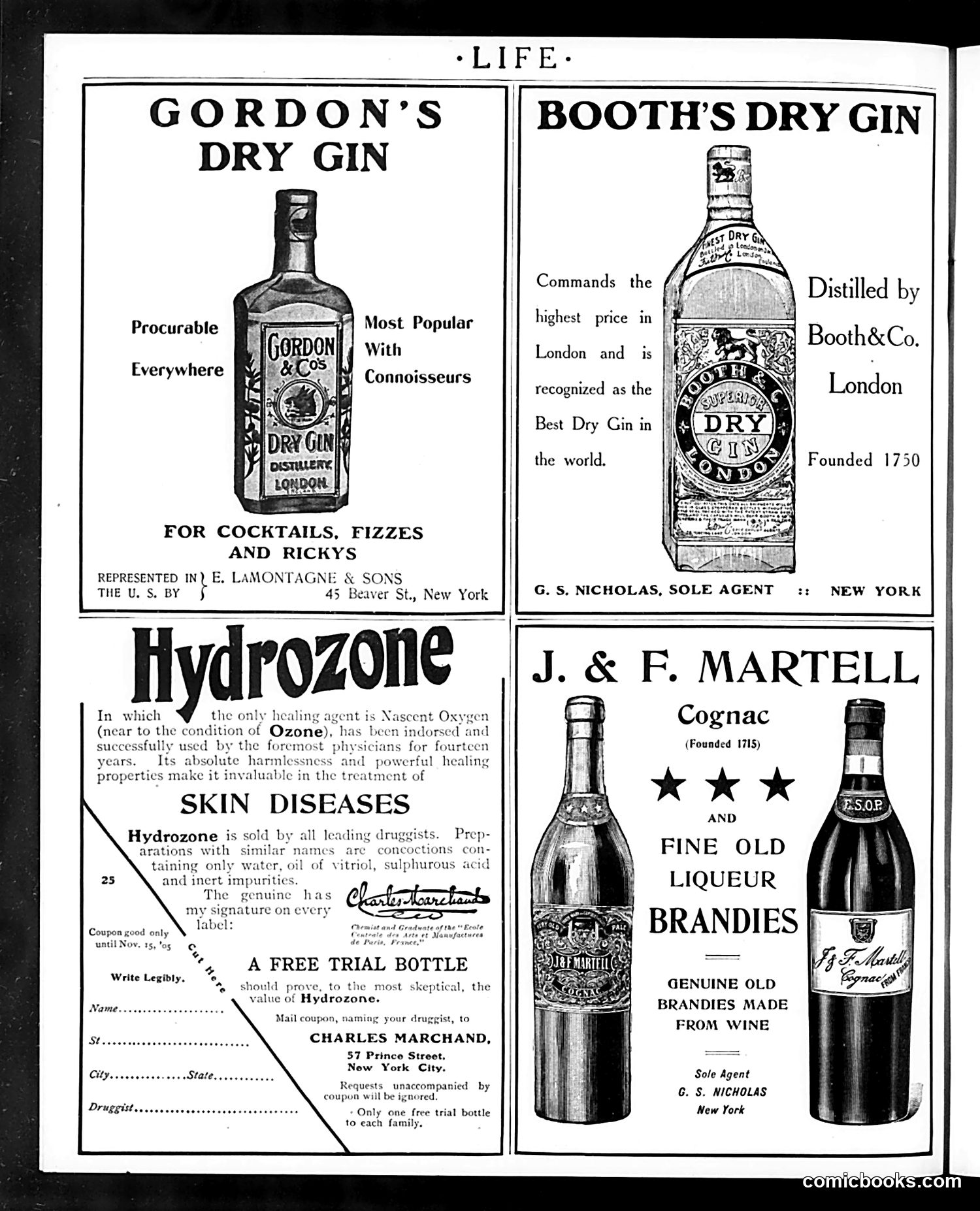
This page contains **advertisements, not satire or editorial cartoons**. It features four product promotions from the early 20th century: 1. **Gordon's Dry Gin** — advertised as "procurable everywhere" and popular with connoisseurs 2. **Booth's Dry Gin** — claimed as "the Best Dry Gin in the world," founded 1750 3. **Hydrozone** — a medical product claiming to heal skin diseases using "Nascent Oxygen" (similar to ozone), with a coupon for a free trial bottle 4. **J. & F. Martell Cognac and Brandies** — fine spirits founded 1715 The page reflects early-1900s marketing: alcohol promotion without modern health warnings, and medicinal claims for products (Hydrozone) that would now be considered fraudulent. This was typical Life magazine content from its satirical-newspaper era.
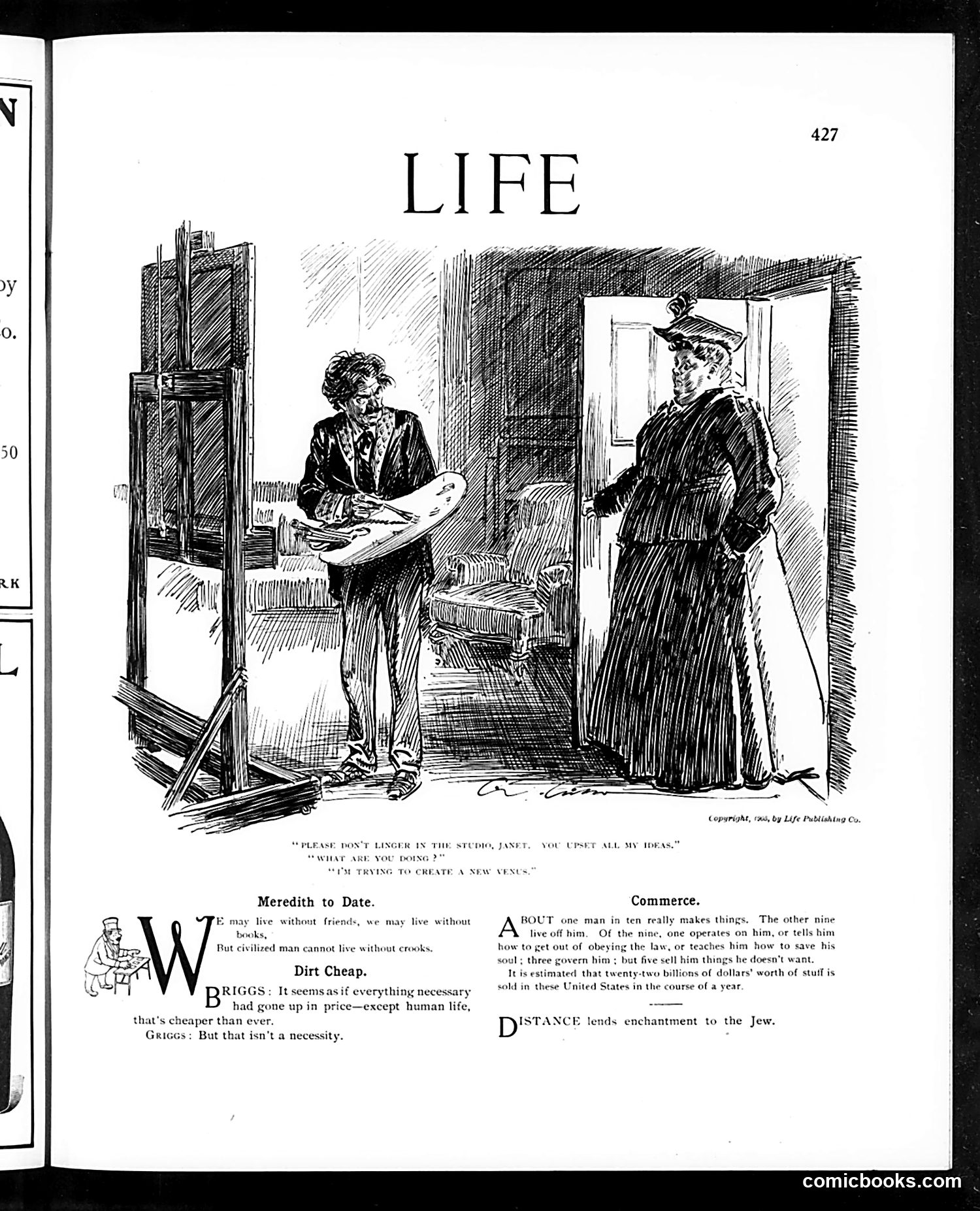
The main cartoon depicts an artist in a studio showing work to an elegantly dressed woman visitor. The caption reads: "Please don't linger in the studio, Janet. You upset all my ideas" / "What are you doing?" / "I'm trying to create a new Venus." This satirizes the romantic notion of artistic inspiration—the artist claims he needs isolation to create beauty, yet his "Venus" appears mundane. The joke mocks pretentious artists who blame external distractions for uninspired work. Below are two brief commentary sections: "Dirt Cheap" discusses price inflation except for human life, and "Commerce" uses a mathematical analogy about Jewish merchants. The latter reflects period stereotyping common to early Life magazine's satirical content.
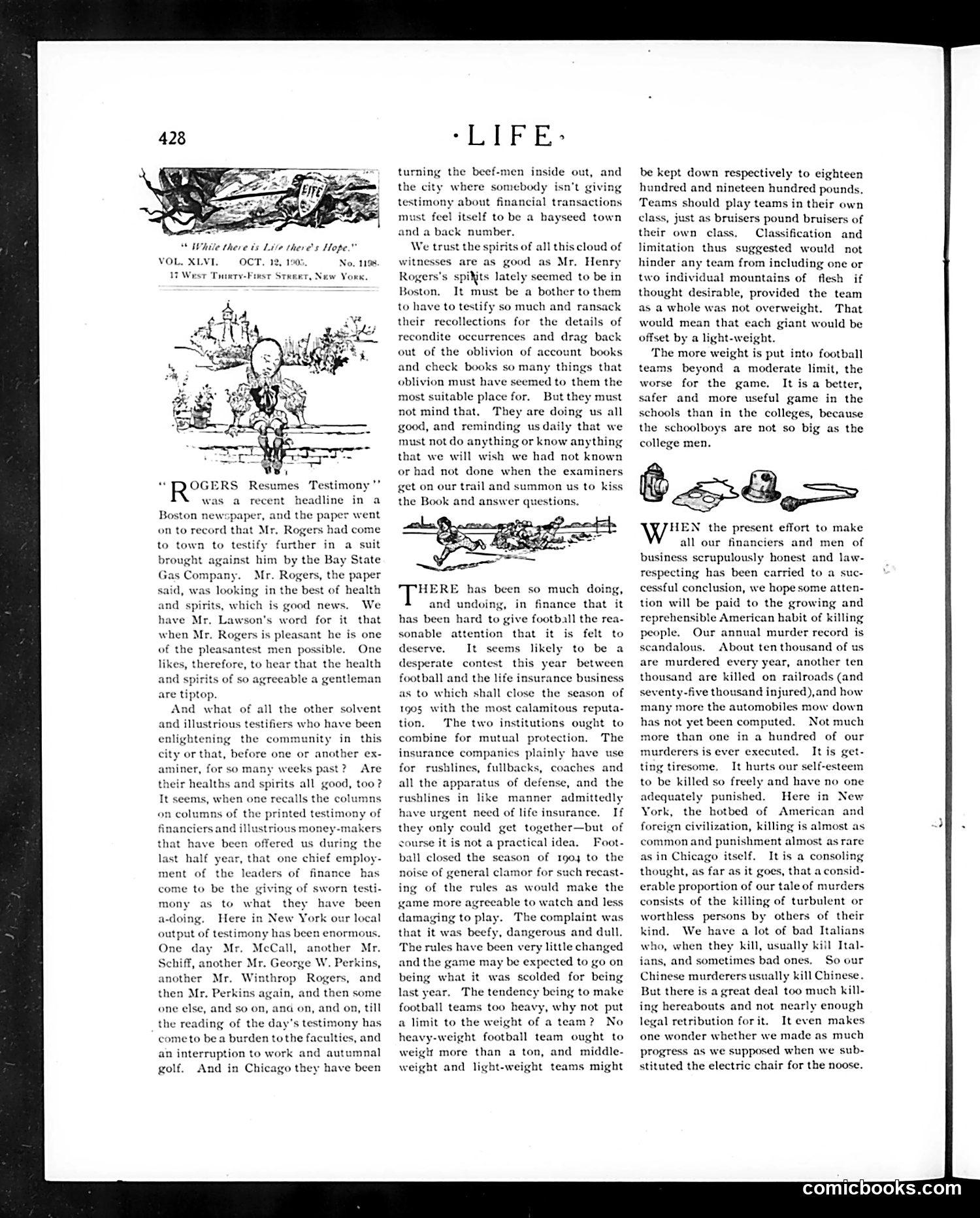
This page from *Life* magazine (Vol. XLVI, October 12, 1905) contains editorial commentary rather than political cartoons. The text discusses "Rogers Resumes Testimony"—apparently referring to ongoing testimony in a Boston lawsuit involving the Bay State Gas Company and a figure named Rogers. The small decorative illustrations are generic vignettes rather than satirical cartoons. The main editorial argues for honesty in finance and business, criticizing excessive corporate litigation. It also debates football team weight regulations and player safety, suggesting lighter teams are preferable. The page reflects early-1900s concerns about corporate accountability, business ethics, and sports safety—issues where reformist sentiment was gaining traction during the Progressive Era.
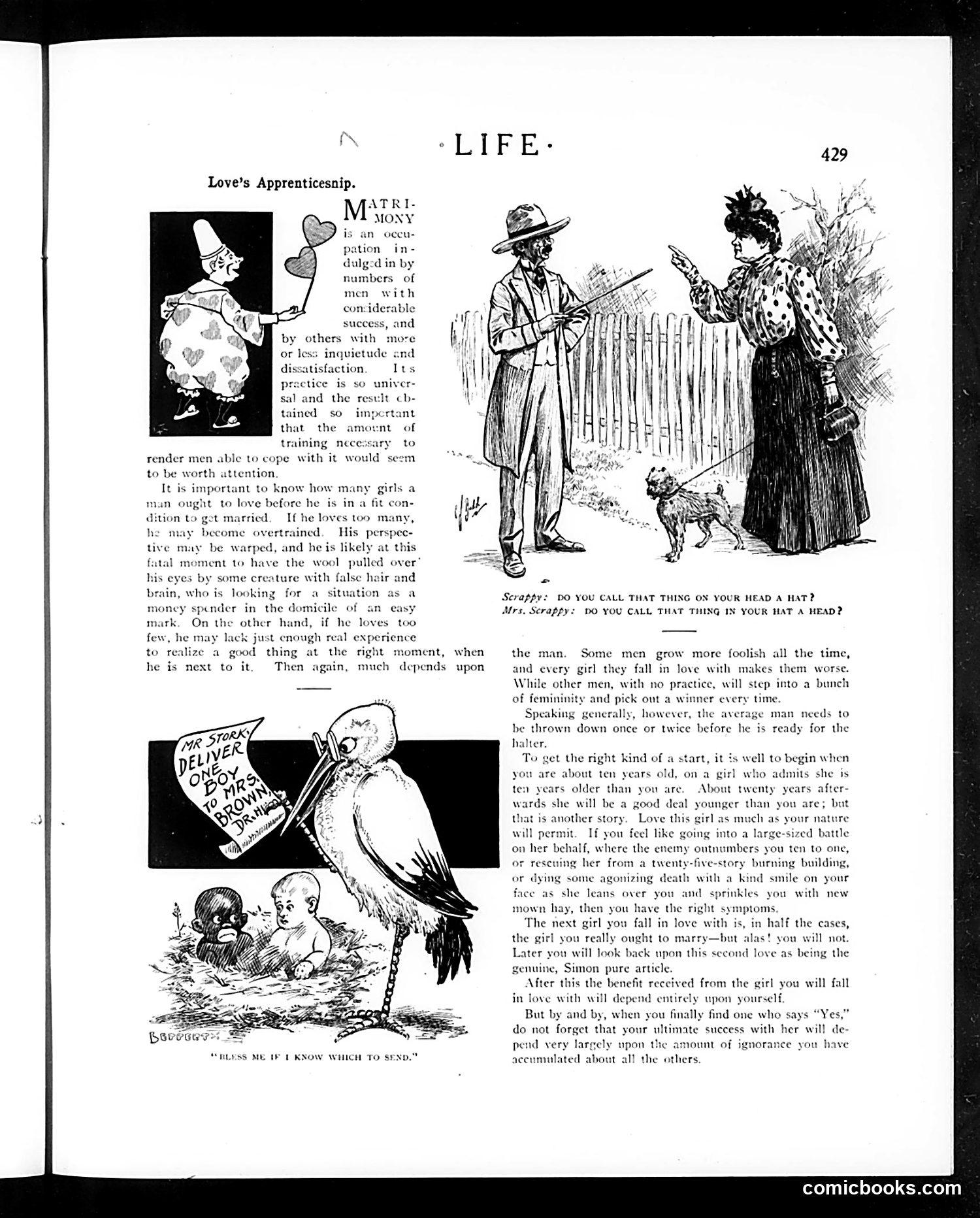
This page satirizes young men's romantic inexperience through multiple cartoons. The main article argues that men need practice in courtship before marriage, comparing it to an apprenticeship. The top cartoon shows a pudgy man juggling hearts—depicting the "training" phase. The middle illustration depicts a awkward encounter between a man and woman at a fence, with the caption "Do you call that thing on your head a hat?"—mocking his appearance and social clumsiness. The bottom cartoon by Barrouds shows a stork delivering a baby, with the caption "Bless me if I know which to send"—a joke about reproduction and the randomness of parenthood. Overall, the page humorously critiques men's need for romantic education before committing to marriage.
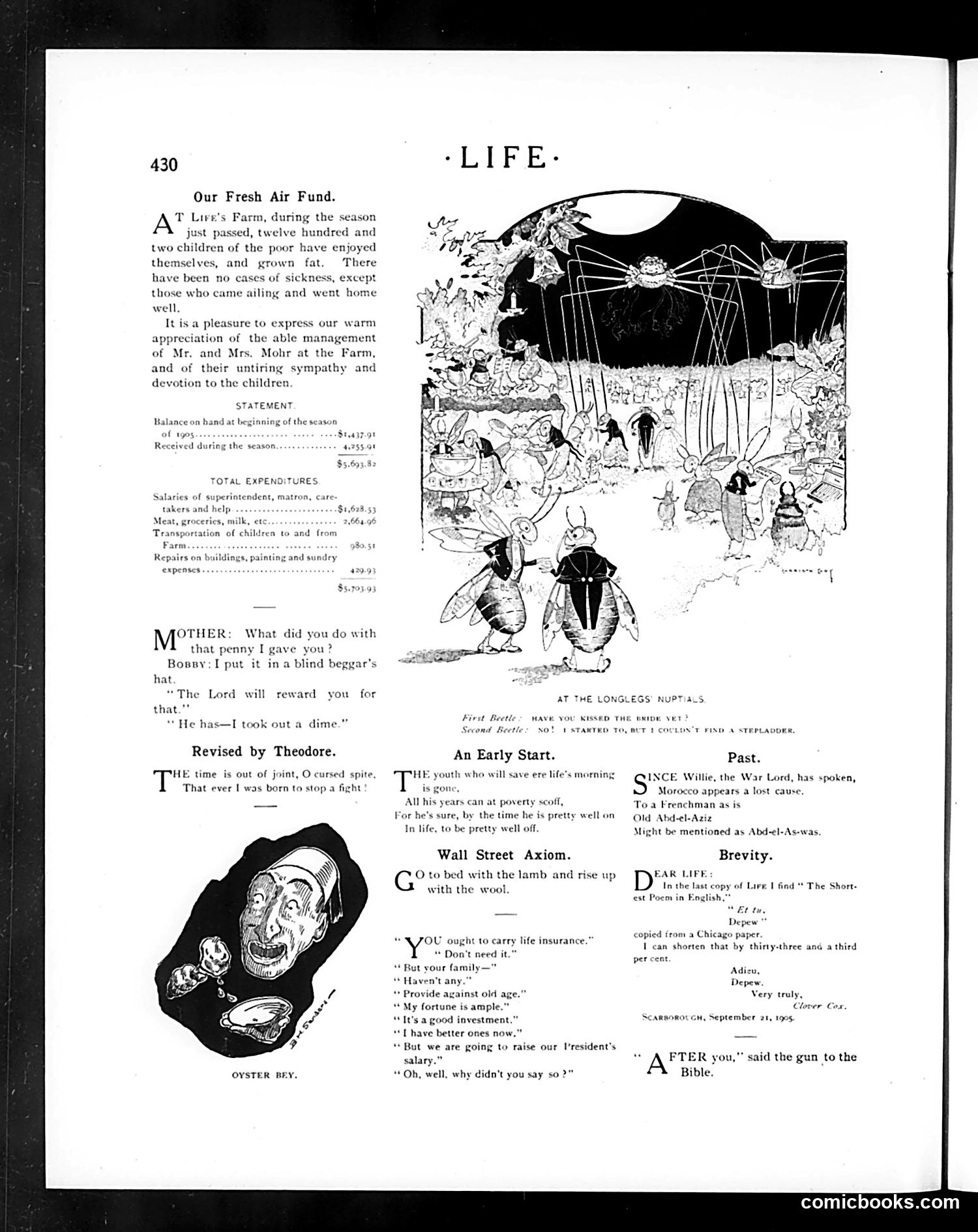
This page contains several satirical pieces typical of early 20th-century Life magazine: **"Our Fresh Air Fund"** presents financial statements about a children's farm program, with a humorous dialogue between mother and Bobby about charity ("I put it in a blind beggar's hat"). **"At the Longnose Hurdles"** shows an illustrated scene of anthropomorphic beetles racing, with one beetle saying it "started to, but I couldn't find a steplalder"—a visual pun about insects' size. **"Oyster Rev."** depicts a grotesque oyster character addressing life insurance arguments, satirizing sales pitches of the era. The remaining sections include brief philosophical pieces ("Revised by Theodore," "An Early Start," "Wall Street Axiom," "Brevity," and "Past"), offering wry social commentary on age, poverty, life insurance, and other contemporary concerns typical of Life's satirical style.
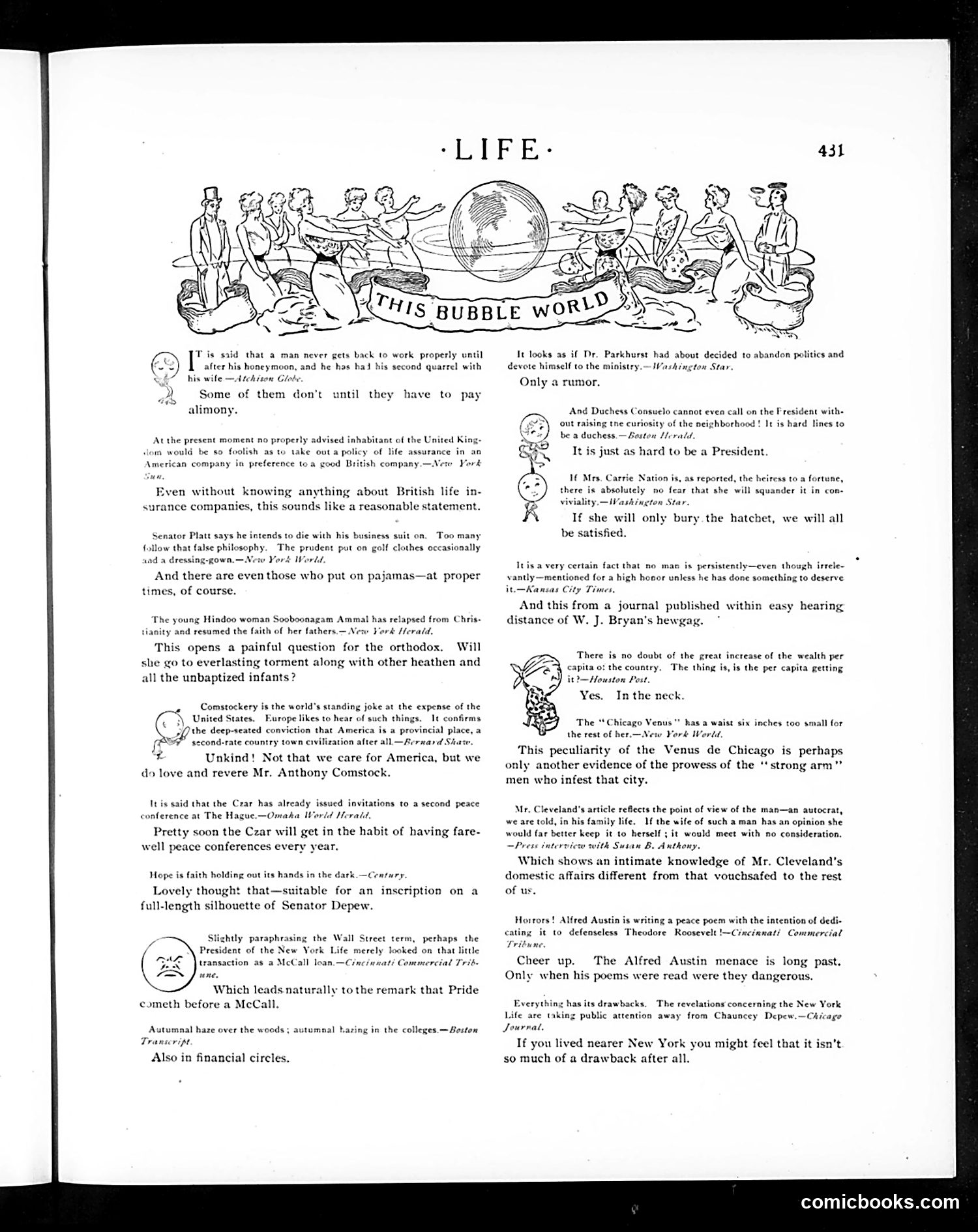
This page satirizes early 20th-century American social and political absurdities through brief humorous commentary. The central cartoon depicts figures balancing precariously on or around a large bubble, symbolizing the fragility of contemporary society. The text mocks various topics: honeymoon quarrels, life insurance practices, British companies, Senator Platt's business interests, Hindu women's conversion to Christianity, peace conferences, and wealth inequality. References include W.J. Bryan's "cross of gold" speech and Chicago's competitive social scene. The satire targets hypocrisy, materialism, and political pretension of the era. Each snippet critiques specific public figures or social trends, using irony to expose contradictions between stated values and actual behavior in American life.
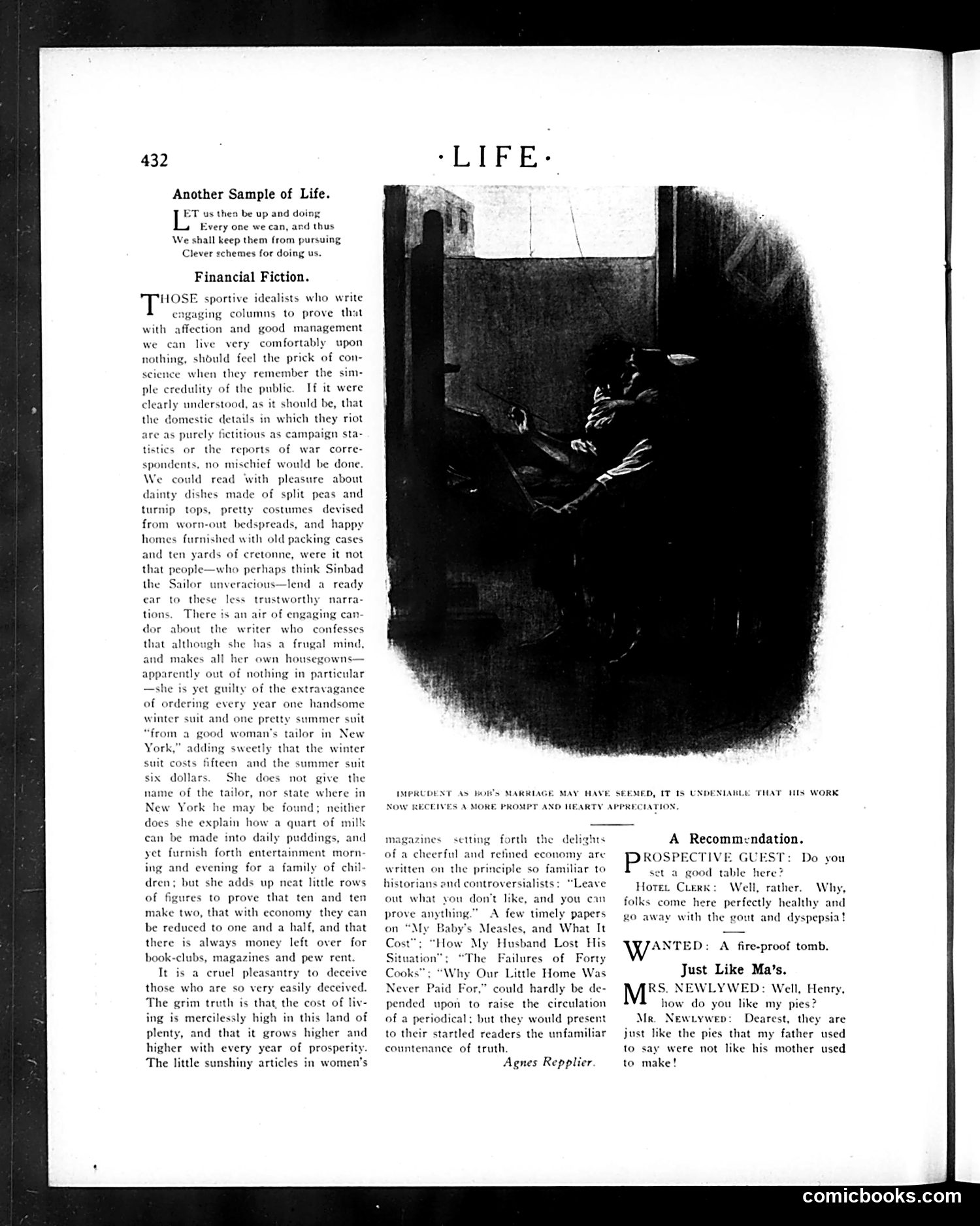
This page contains satirical essays rather than traditional political cartoons. The main illustration shows a darkened interior scene, likely depicting domestic life. The text critiques "Financial Fiction"—articles in magazines that paint overly rosy pictures of household management and frugal living. The author argues these pieces are misleading, claiming that people (invoking "Sinbad the Sailor") naively accept unrealistic advice about stretching budgets, making meals from scraps, and furnishing homes cheaply. The satire targets both the *writers* of such advice columns (who allegedly live luxuriously while preaching economy) and *readers* who believe their claims. The author notes these magazines profit from advertising while promoting false economies, suggesting the genre itself is dishonest propaganda rather than genuine practical guidance.
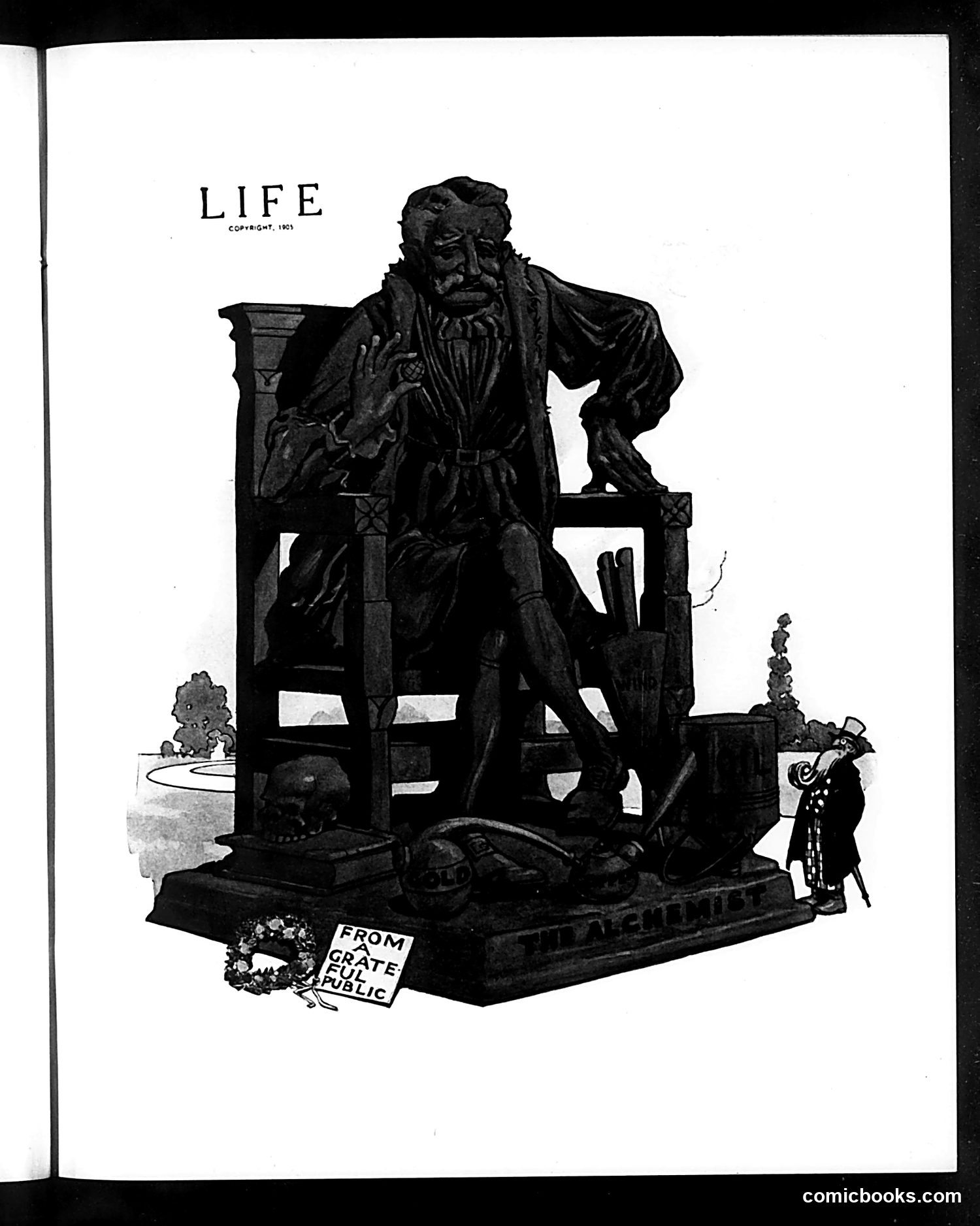
This is a **Life magazine cover** (copyright 1903) featuring a satirical illustration titled "From Crate to Public." The image depicts a grotesque, menacing figure emerging from or sitting atop a large wooden crate, with an exaggerated brutal expression. The figure appears threatening and uncivilized—suggesting someone or something dangerous being "unpacked" or revealed to the public. The satire likely comments on **immigration or the introduction of a threatening element into American society**. The phrase "from crate to public" suggests something contained or imported that now poses a danger. Without additional context from the article text, the specific target remains unclear, but the visual language emphasizes brutality and the public's alarm at what is being "delivered" to them. The small figures to the right appear to witness or react to this threat.

I can see this is a blank or nearly blank page from Life magazine, with only "comicbooks.com" visible at the bottom right. There is no discernible cartoon, text content, or satirical material visible on the page itself that I can analyze. Without readable text or visible illustrations to examine, I cannot identify any figures, political references, or satirical points. The page appears to be either: - A blank page between sections - A title page - Improperly scanned or reproduced To provide meaningful analysis of Life magazine's satire and historical context, I would need a page with visible cartoon artwork and legible OCR text.
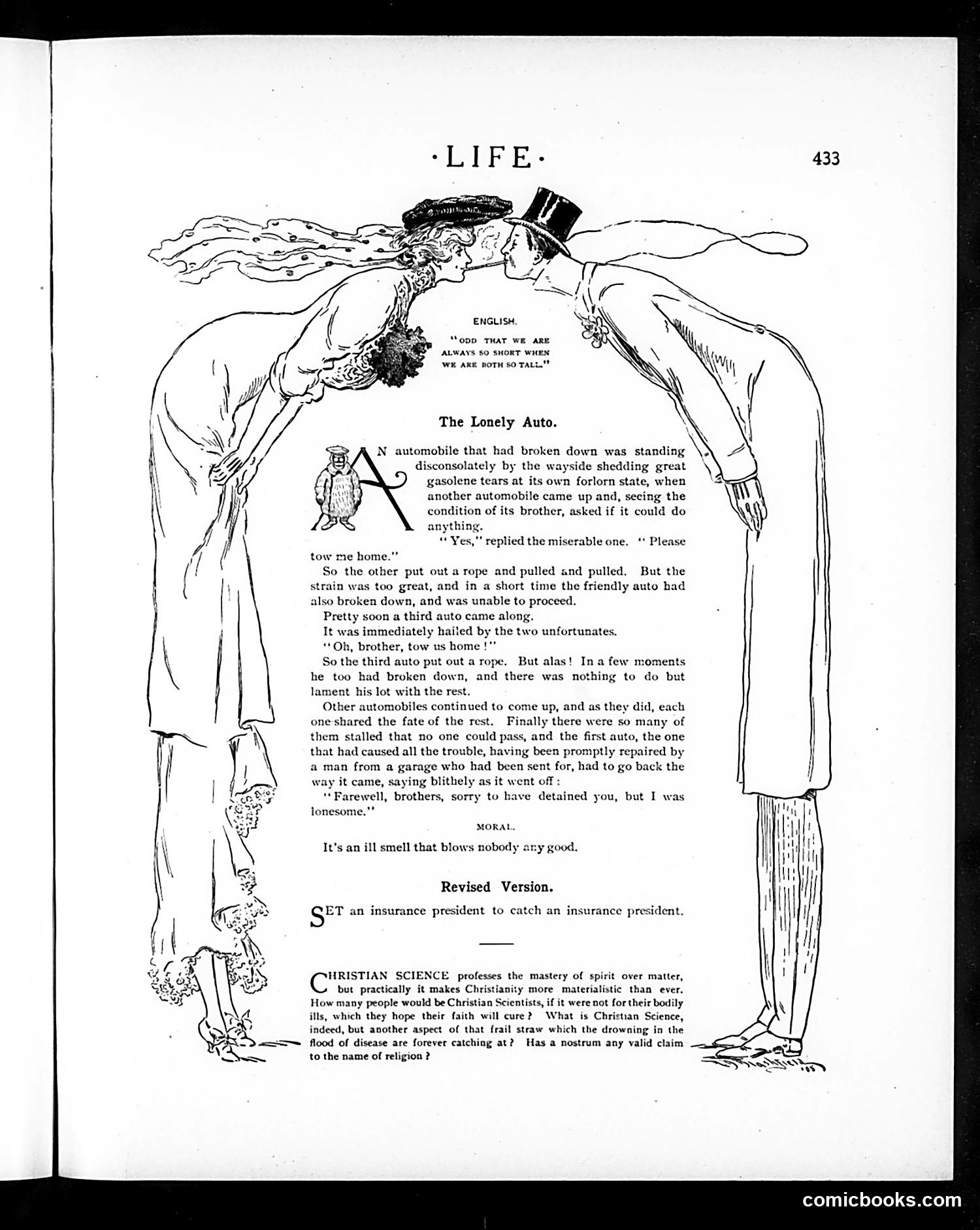
This page contains three distinct items: 1. **"The Lonely Auto"** (main story with illustration): A satirical fable about automobiles that break down in sequence, each unable to help the next. The moral warns that "it's an ill smell that blows nobody any good"—suggesting mutual misfortune provides no benefit. 2. **"Revised Version"**: A single-line quip: "Set an insurance president to catch an insurance president," playing on the phrase "set a thief to catch a thief." 3. **Christian Science critique**: A longer editorial passage criticizing Christian Science as overly materialistic despite its spiritual claims, questioning whether its faith-healing practices have actual validity. The page uses humor and moral commentary to critique social institutions—automobiles (emerging technology), insurance fraud, and religious practices.
This appears to be a copyright notice and page marker from Life magazine, dated 1902. The actual cartoon or illustration is extremely dark and difficult to discern in this reproduction. While some figures and what might be a checkered floor pattern are vaguely visible in the shadowed image, the details are too obscured to reliably identify specific caricatures, political figures, or social references with confidence. To accurately explain the satire or joke to a modern reader, I would need a clearer reproduction where the artwork's details are visible. The page itself offers no accompanying text that would clarify the cartoon's subject matter or meaning.
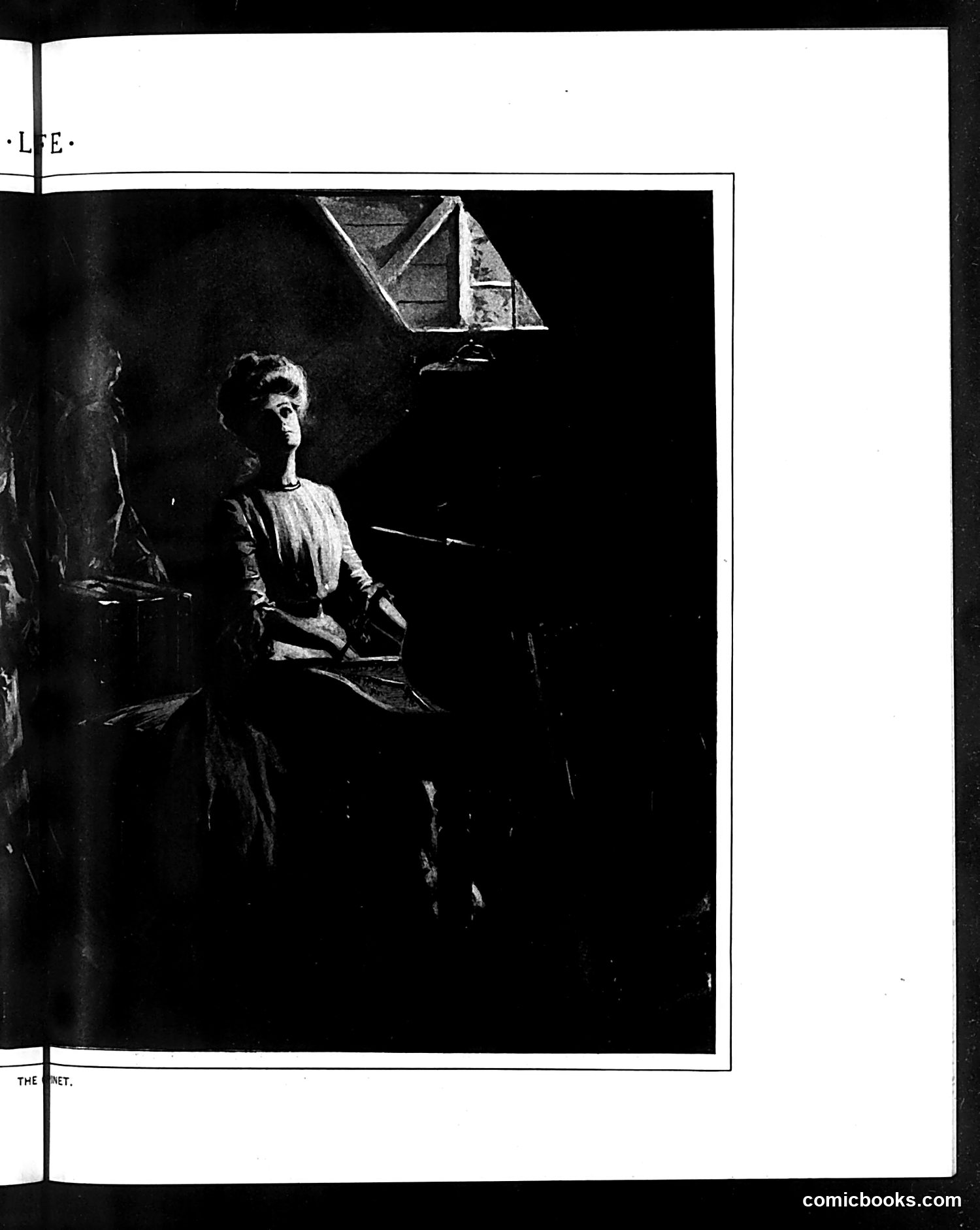
This black and white photograph appears to be from a theatrical production or dramatic scene, showing a woman seated in a dimly lit interior space with a small window visible above. The image has strong chiaroscuro lighting typical of early-to-mid 20th century photography. However, without clearer OCR text or identifying captions on this page, I cannot definitively identify the specific figure, production, or satirical point being made. The page header reads "LIFE" and appears to reference "THE [?] NET" at the bottom, but the critical context—who this depicts, what event or play is referenced, and what social or political satire is intended—is not sufficiently legible in the provided materials. To accurately explain this content's meaning to modern readers, I would need clearer text or caption information identifying the subject matter.
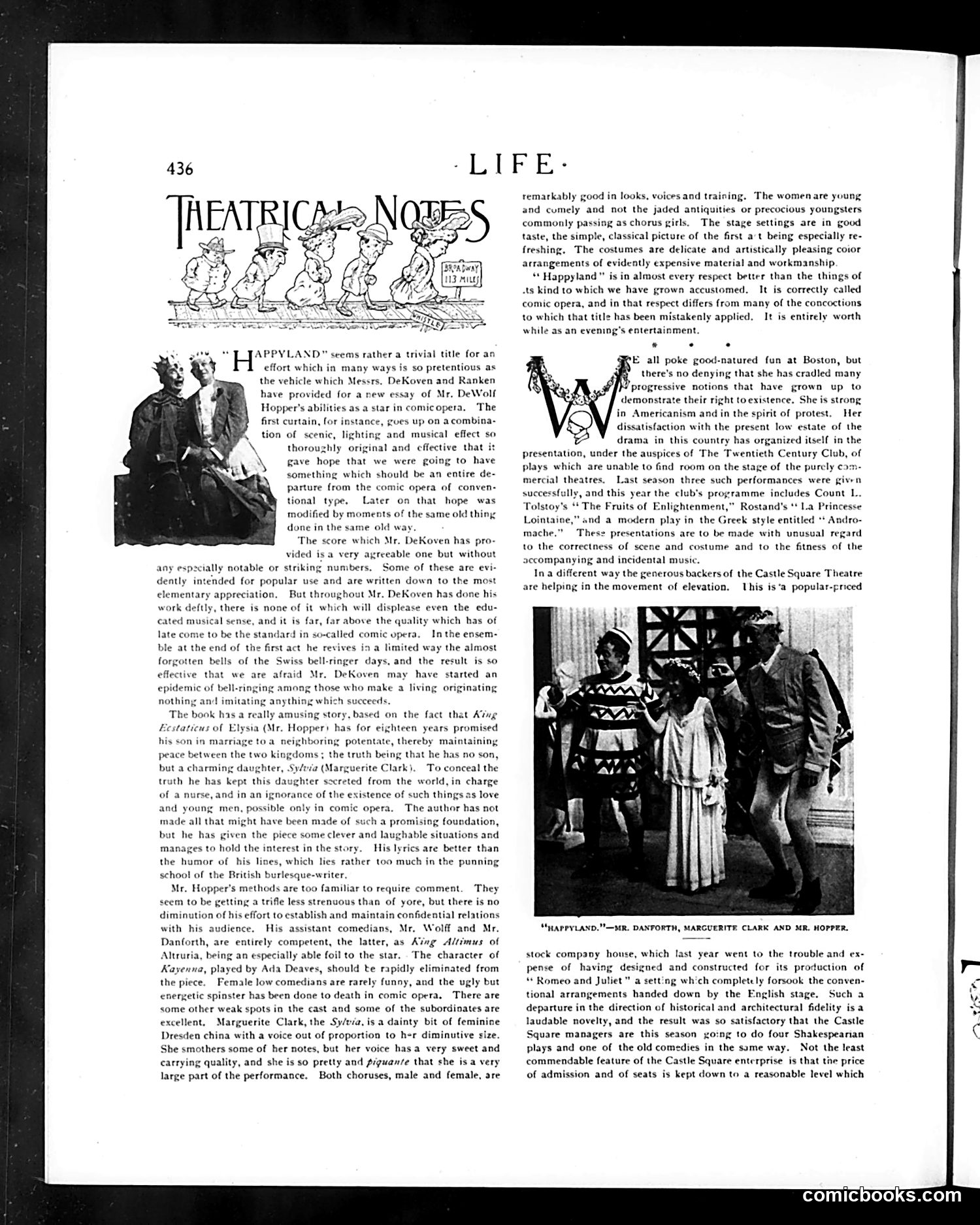
This is a theater review of the comic opera "Happyland," starring DeWolf Hopper. The critic praises composer DeKoven's musical score as competent but unremarkable, lacking memorable numbers. The plot—about a king who has concealed his daughter (played by Marguerite Clark) to maintain a peace treaty based on a false promise of a son—is deemed amusing but underexploited. The review credits Hopper's comedic talents while noting his methods are becoming "less strenuous than of yore." It praises Clark's performance despite her tendency to oversing, and commends the chorus and staging. However, it criticizes the character of Kayenna (Ada Deaves) as a tired comic-opera cliché. Overall, the piece is judged entertaining but somewhat conventional, failing to fully realize its promising foundation.
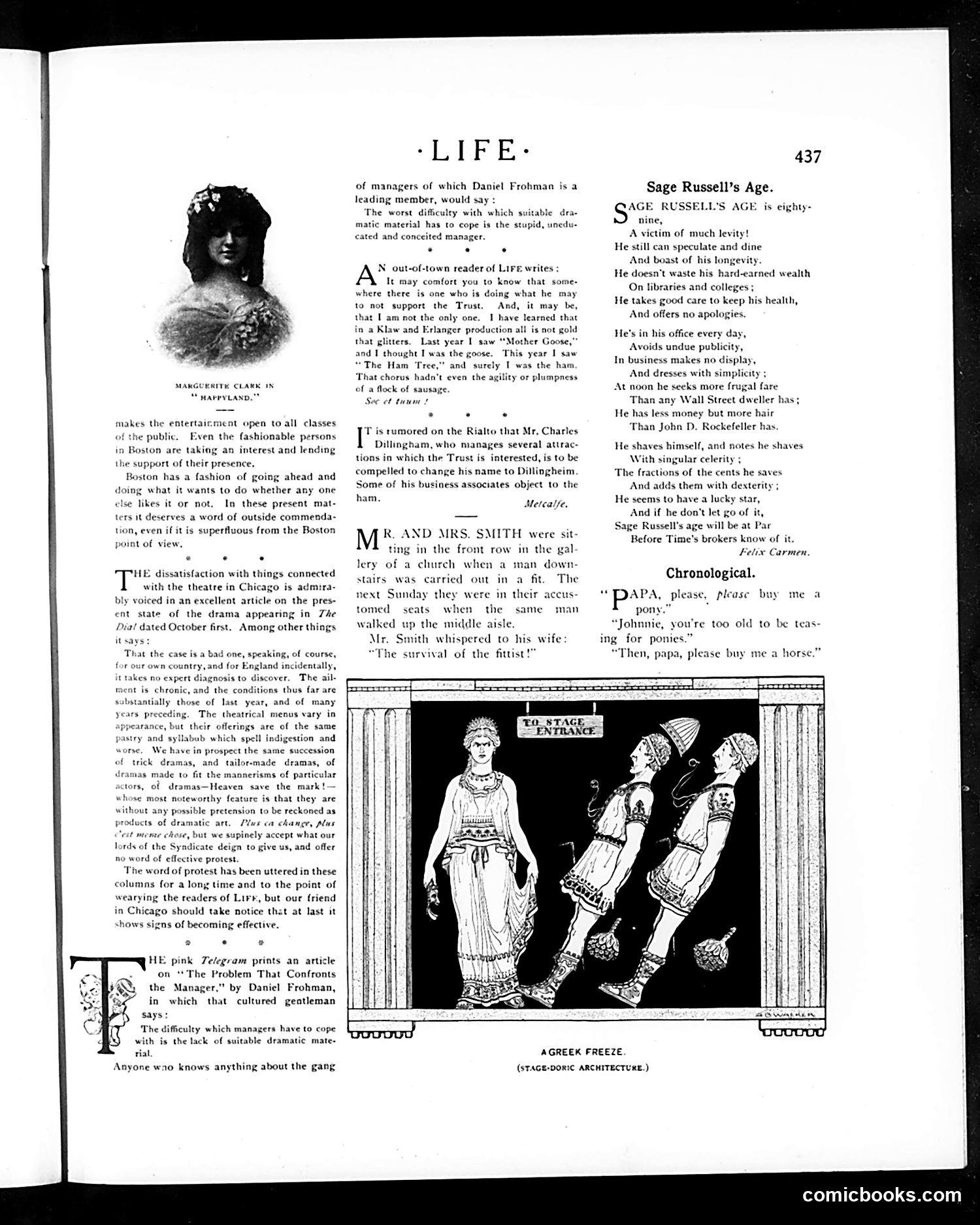
This page contains several satirical pieces criticizing theatrical management and the theatrical "Trust" (the Klaw and Erlanger syndicate that controlled American theater). **Main targets:** The cartoonist mocks **Daniel Frohman**, a leading theater manager, who complains that managers lack suitable dramatic material. Life's response: the real problem is "the stupid, uneducated and conceited manager"—blaming management incompetence, not lack of scripts. A related jab targets **Charles Dillingham**, another Trust-affiliated manager, with a rumor that he's being pressured to change his surname to "Dillingheim" by business associates objecting to "ham" (bad acting) in his name. **Context:** This reflects early 1900s resentment of the theatrical Trust's monopoly control over American theater, which limited artistic quality and theatrical competition. The page celebrates Boston audiences and Chicago critics who are resisting Trust productions and demanding better drama. The satirical humor relies on theatrical in-jokes: "ham" acting, chorus line incompetence, and the Trust's formula-driven approach to theatrical production.
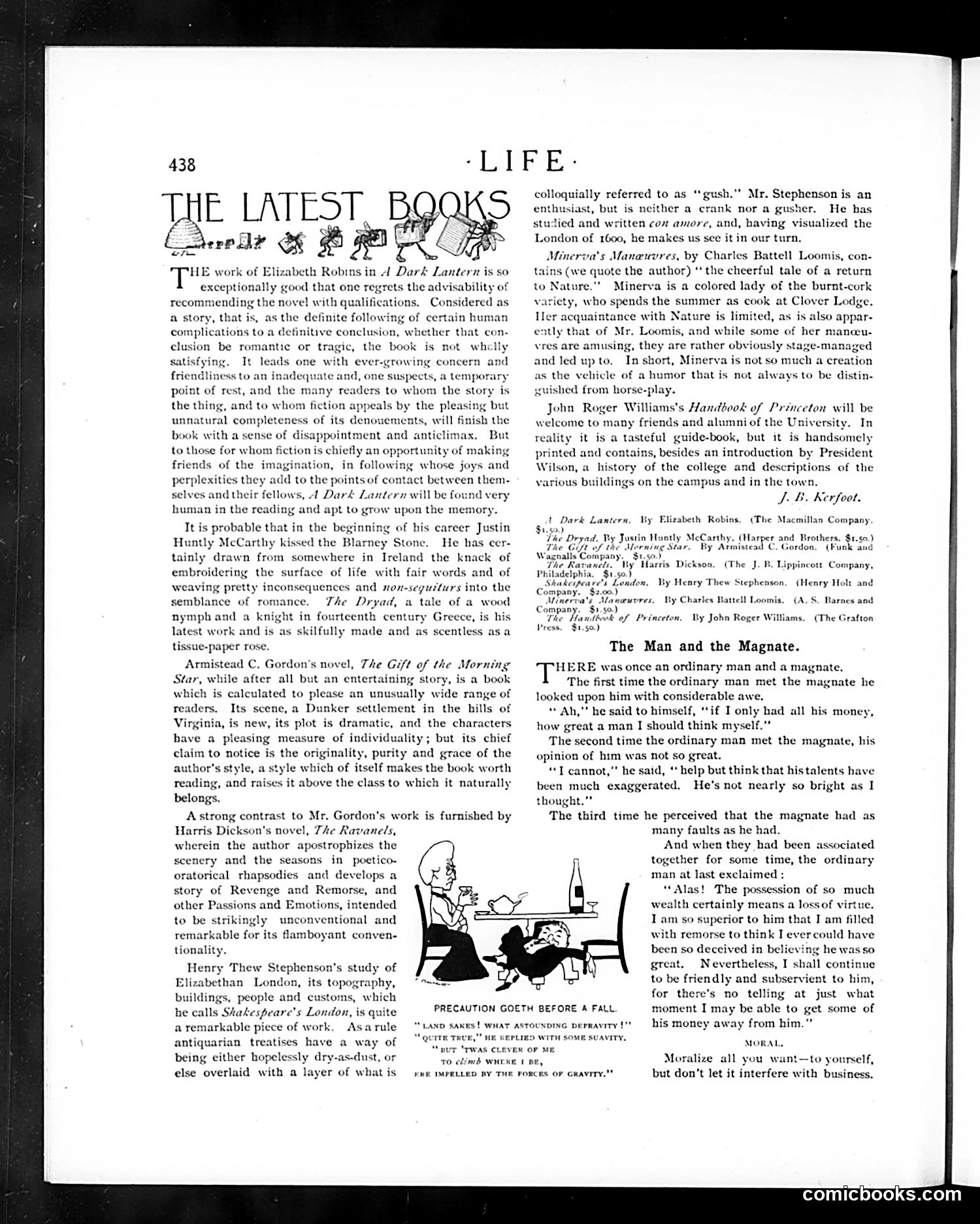
This single-panel cartoon illustrates a moral lesson about wealth and character. It depicts two men at a dining table: an ordinary man and a wealthy "magnate" (indicated by the bottle of wine). The caption presents their evolving relationship: the magnate initially envies the ordinary man's perceived talents, then dismisses him as untalented, and finally recognizes he himself has serious character flaws. The ordinary man's realization—that wealth often corrupts virtue rather than conferring superiority—prompts his moral conclusion: "Moralize all you want—to yourself, but don't let it interfere with business." The satire critiques Gilded Age hypocrisy: wealthy industrialists who acknowledge moral failings yet continue prioritizing profit over ethics. The cartoon suggests that self-awareness about one's vices doesn't necessarily produce ethical behavior in American business culture.
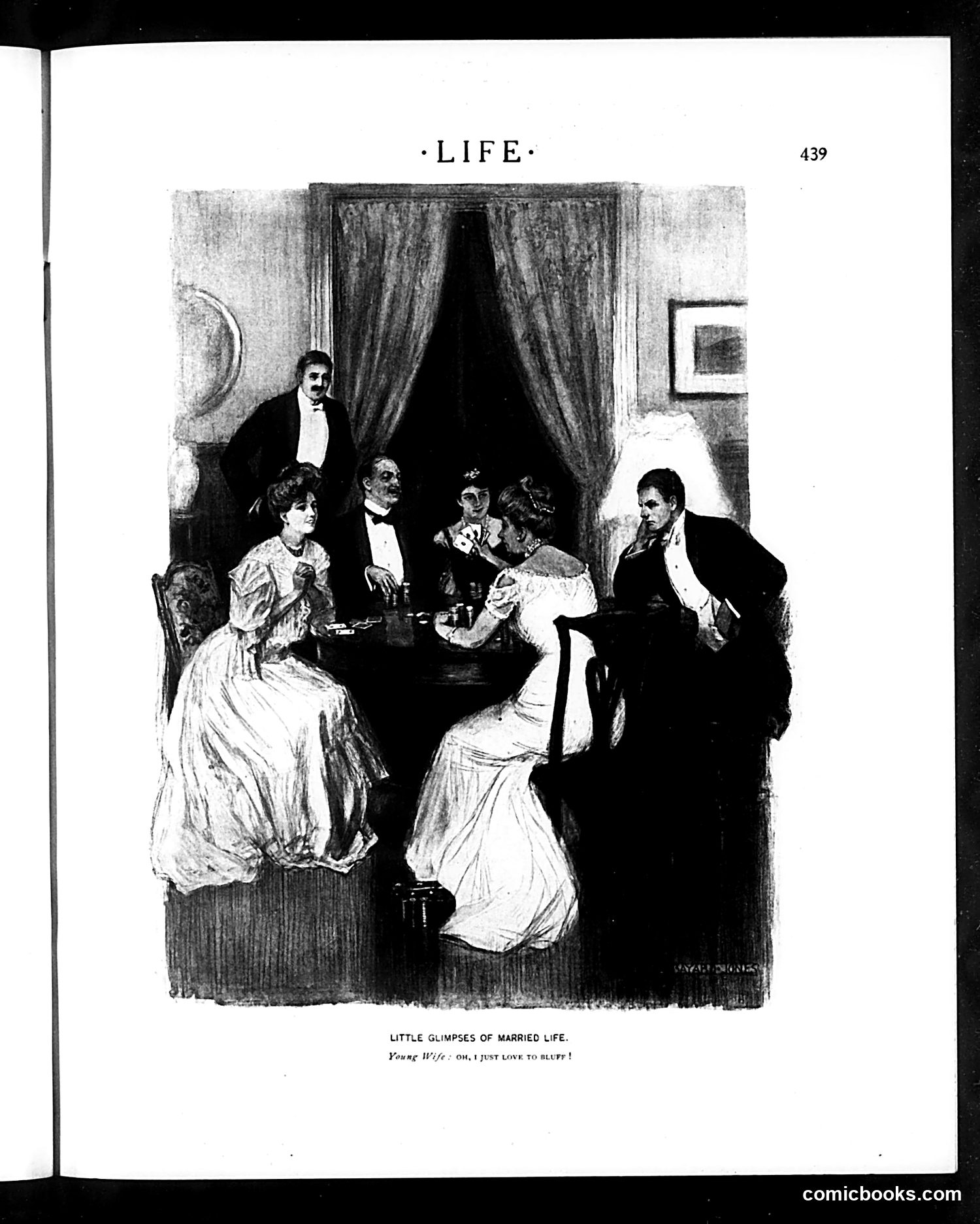
This is a satirical illustration titled "Little Glimpses of Married Life." The scene depicts an elegant dinner party or social gathering with well-dressed men in formal attire and women in evening gowns seated around a table. The caption attributes a quote to "Young Wife" saying "Oh, I just love to bluff!" The satire appears to mock the social pretenses of married life among the upper classes. The young wife's statement suggests she enjoys deceiving others or maintaining appearances despite inner reality—a commentary on the performative nature of polite society and matrimonial relationships. The formal, somewhat strained gathering illustrated supports this theme of people engaging in social facades rather than genuine interaction. This reflects early 20th-century humor about marriage, domesticity, and the gap between public propriety and private truth.
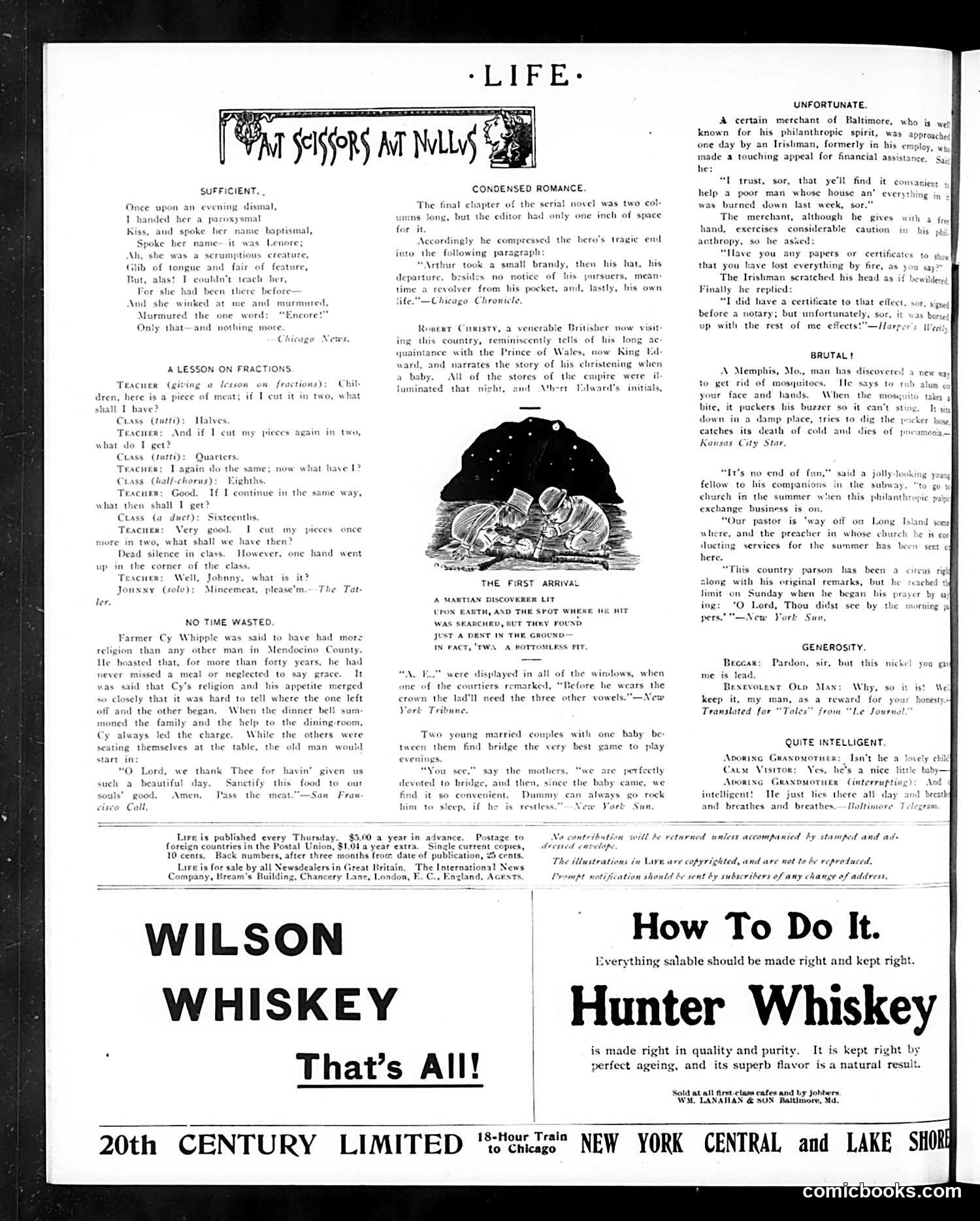
This page from *Life* magazine contains several humorous short pieces and anecdotes typical of the publication's satirical style: **"Unfortunate"** mocks a Baltimore merchant's selective philanthropy—he demands proof of loss (certificates, documentation) from an Irish immigrant seeking aid, only to learn the man's proof was destroyed in the same fire he's reporting. **"A Lesson on Fractions"** is a classroom joke where a teacher demonstrates fractions by cutting meat, but a student's innocent request for "mincemeat" creates an absurdist non-sequitur ending. **"The First Arrival"** appears to be a Martian-discovery joke playing on the idea of extraterrestrials studying Earth. Other brief anecdotes mock mosquito remedies, overly-enthusiastic preachers, and similar everyday absurdities. The page also includes advertisements for Wilson Whiskey and Hunter Whiskey, typical of early 20th-century magazine publishing. The overall tone is light, class-conscious humor aimed at middle-class readers, gently satirizing human nature, social pretension, and bureaucratic absurdity.
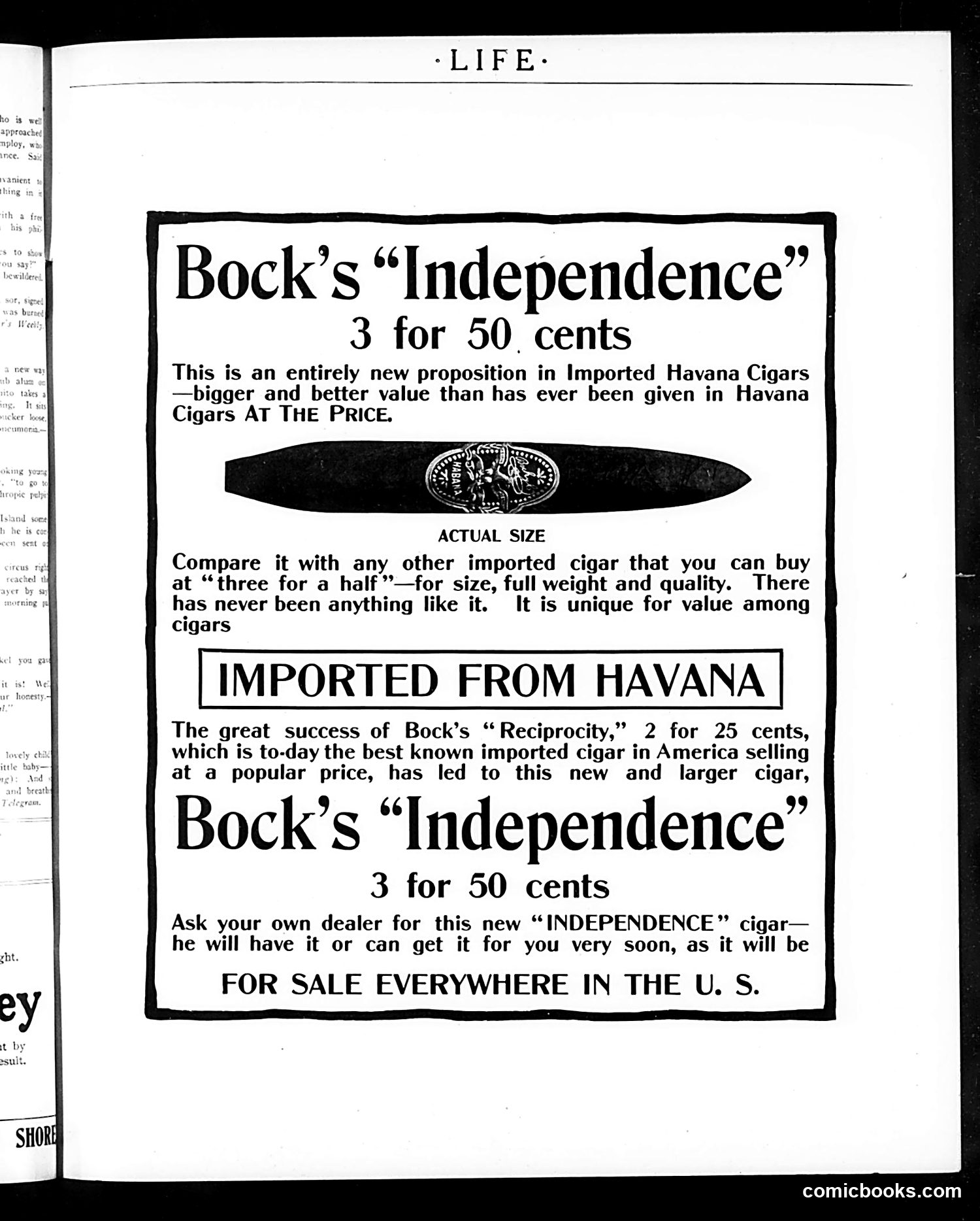
This page is not a cartoon or satire—it's a **straightforward advertisement** for Bock's "Independence" cigars, appearing in *Life* magazine. The ad promotes imported Havana cigars at 3 for 50 cents, emphasizing superior size and quality compared to competitors' "three for a half" offerings. It references the success of Bock's earlier "Reciprocity" brand (2 for 25 cents), which the ad claims is "the best known imported cigar in America." The naming—"Reciprocity" and "Independence"—likely plays on trade policy language familiar to early 20th-century American readers, though the ad makes no explicit political argument. It simply uses patriotic-sounding brand names to market a luxury import product. The "actual size" illustration shows the cigar's dimensions to demonstrate value. This is commercial advertising, not editorial content or satire.
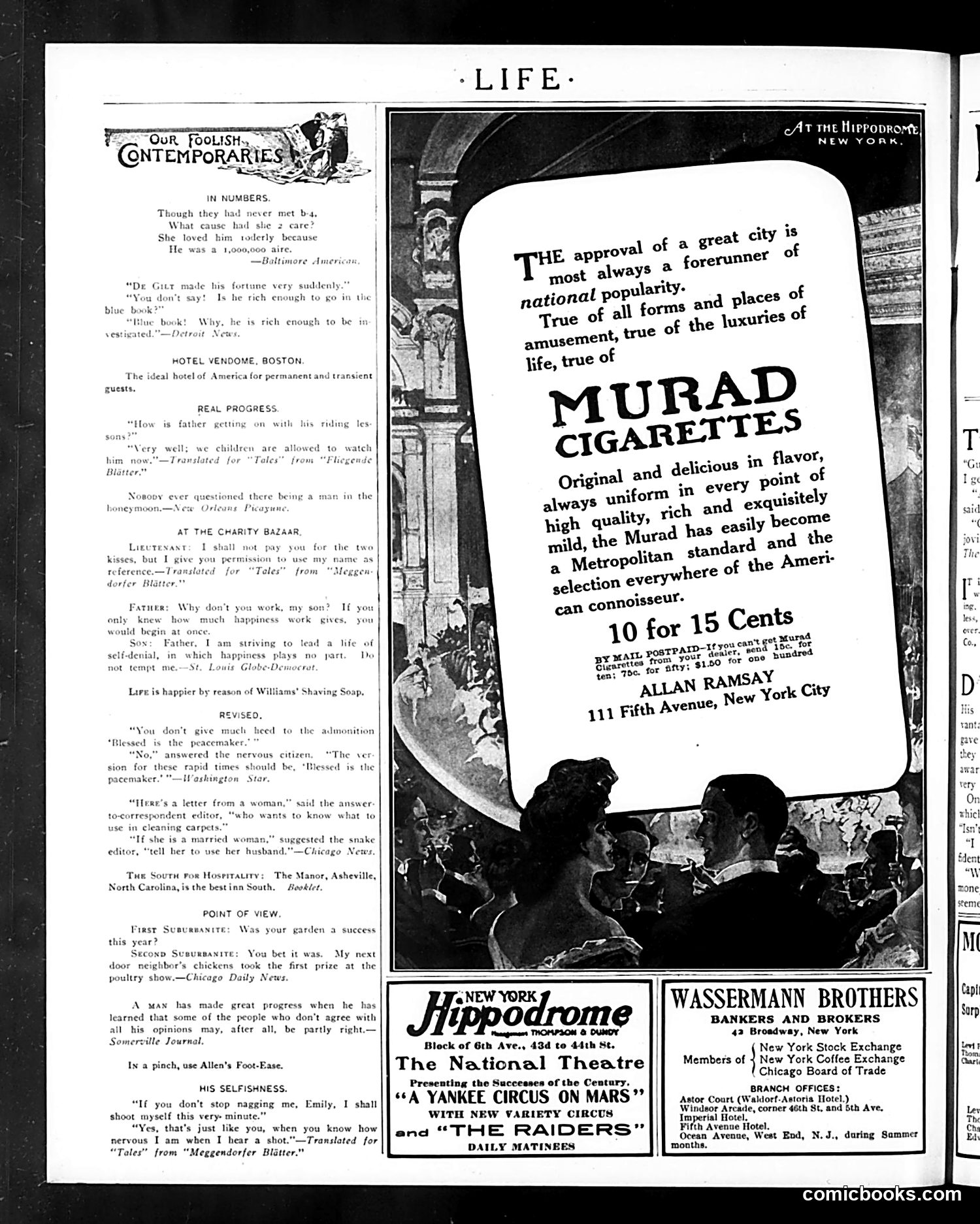
This page contains miscellaneous satirical vignettes rather than a unified cartoon. The left column presents short, quip-based humor pieces mocking contemporary society, while the right side is dominated by advertising. The humor targets wealthy industrialists and nouveau riche pretension: one quip mocks a man who made his fortune "very suddenly" and is now rich enough to warrant investigation (likely referencing robber baron scandals). Another jokes about a millionaire marrying a woman solely for his wealth. A third ridicules social pretense at charity events. Other pieces satirize domestic life—nagging wives, gardening boasting, and general marital discord—through exaggerated anecdotes presented as reader submissions. The commentary on "progress" suggests irony about modern American values. The advertisements (Murad Cigarettes, theaters, banking firms) reflect early 20th-century luxury consumer culture that Life's satirical content implicitly critiques.
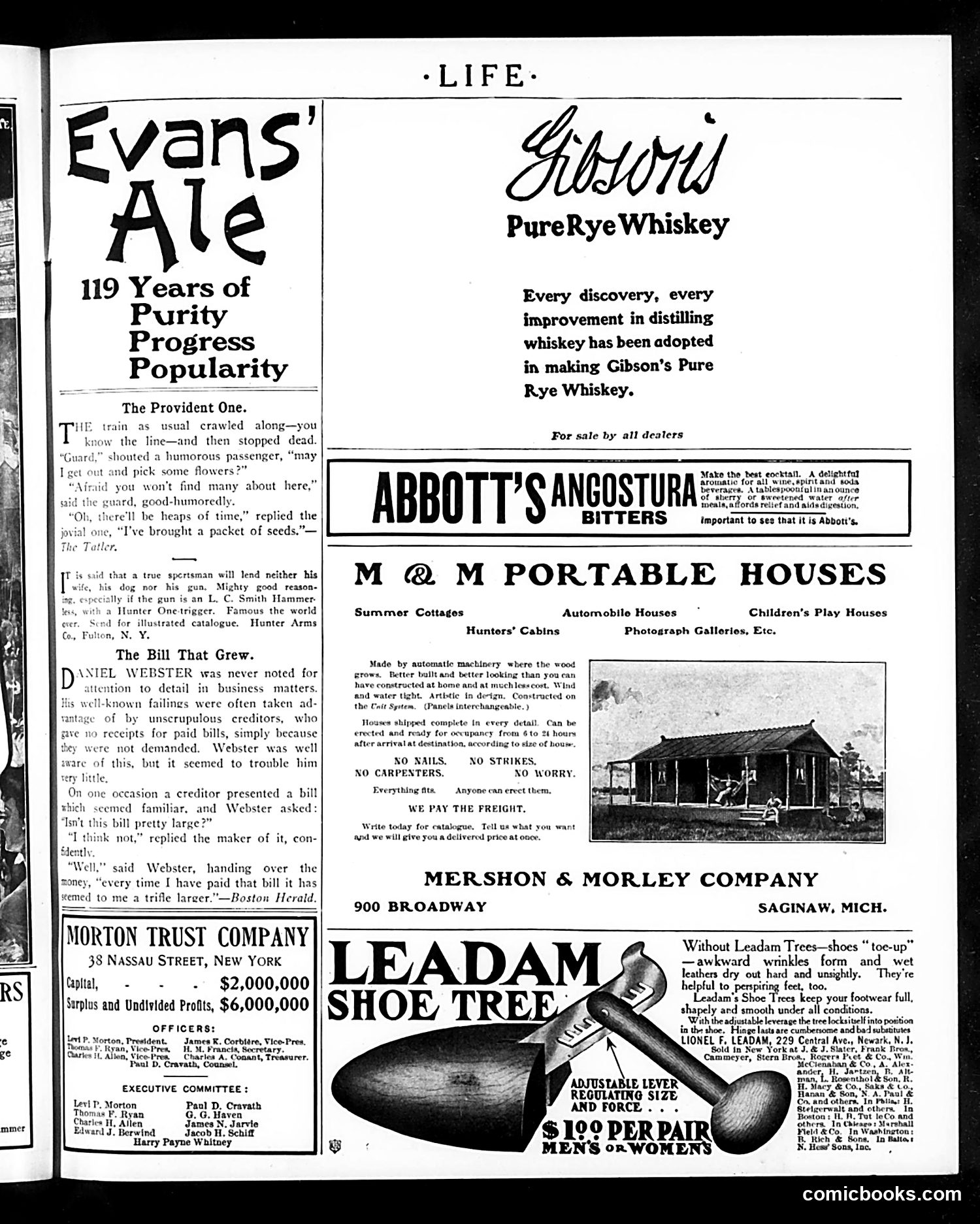
This page is primarily **advertising**, not political satire. It contains two brief humorous anecdotes ("The Provident One" and "The Bill That Grew") alongside numerous product advertisements typical of early 20th-century magazines. **The two short pieces:** - "The Provident One" is a light joke about a train passenger who wants to pick flowers during a stop, claiming he brought seeds—implying he'll plant them in the time available. - "The Bill That Grew" mocks businessman Daniel Webster's carelessness with finances; a creditor presents an inflated bill, and Webster pays it without complaint, only to realize he's been habitually overcharged. These are gentle, domestic humor pieces rather than political commentary. The page's content reflects Life's mixed format of satirical writing and commercial advertising, aimed at middle-class readers. The advertisements (whiskey, portable houses, shoe trees, banking services) suggest the magazine's affluent audience.
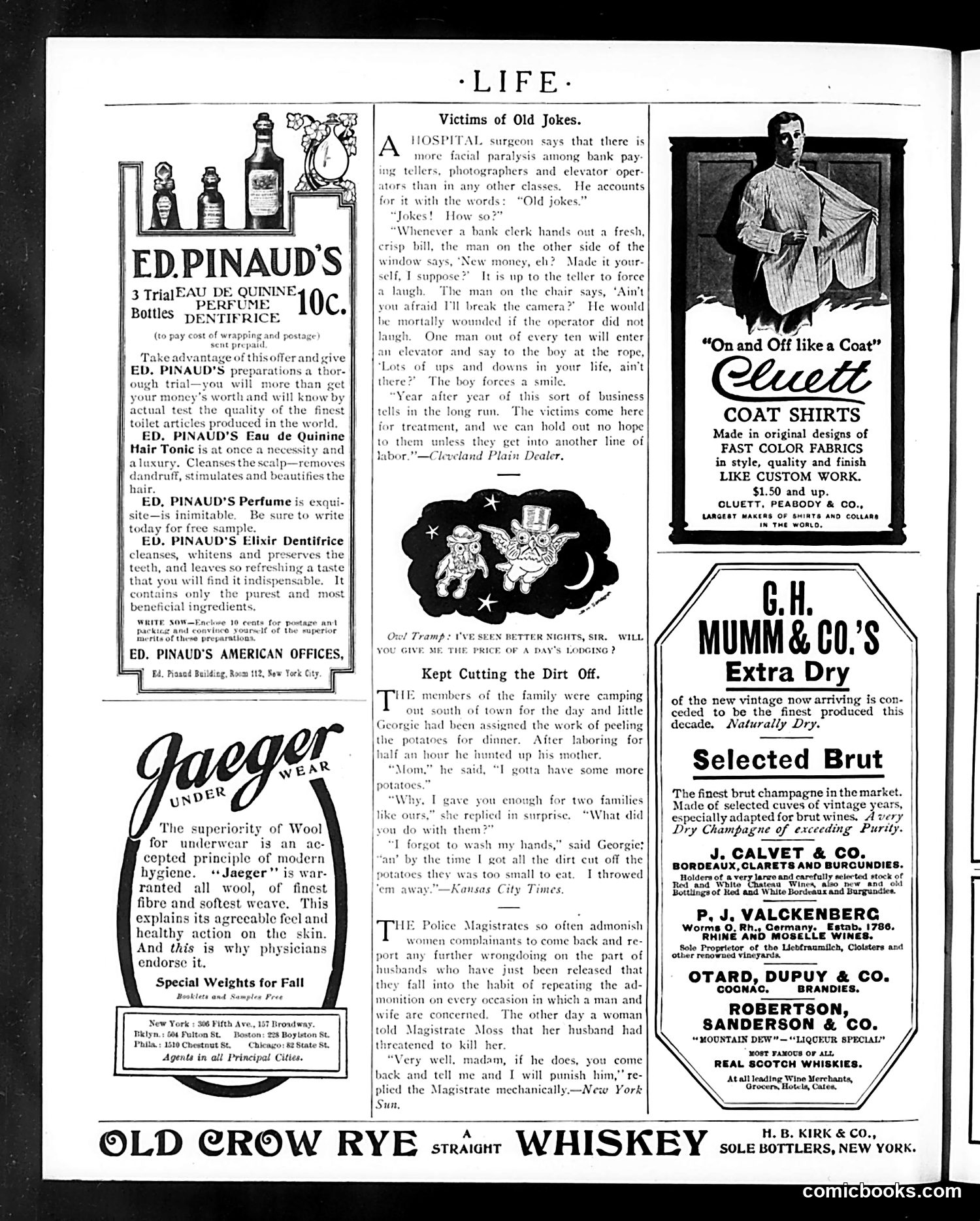
This page presents three brief humorous pieces satirizing everyday annoyances, plus advertisements. The lead article describes occupational facial paralysis afflicting bank tellers, photographers, and elevator operators—caused by forced smiling at repetitive jokes. Bank customers say "New money, eh?" to tellers handing out fresh bills; photographers endure "Ain't you afraid I'll break the camera?"; elevator boys hear "Lots of ups and downs in your life, ain't there?" The satirical point: these worn-out quips, repeated countless times daily, literally damage workers' facial nerves from constant forced laughter. Two shorter pieces follow: one about a boy peeling potatoes who removes so much dirt he's left with nothing to cook, and another mocking a magistrate who mechanically advises a woman whose husband threatened murder to "come back and tell me" if he follows through—absurdly deferring justice. The page is otherwise filled with period advertisements for patent medicines, underwear, and liquor.
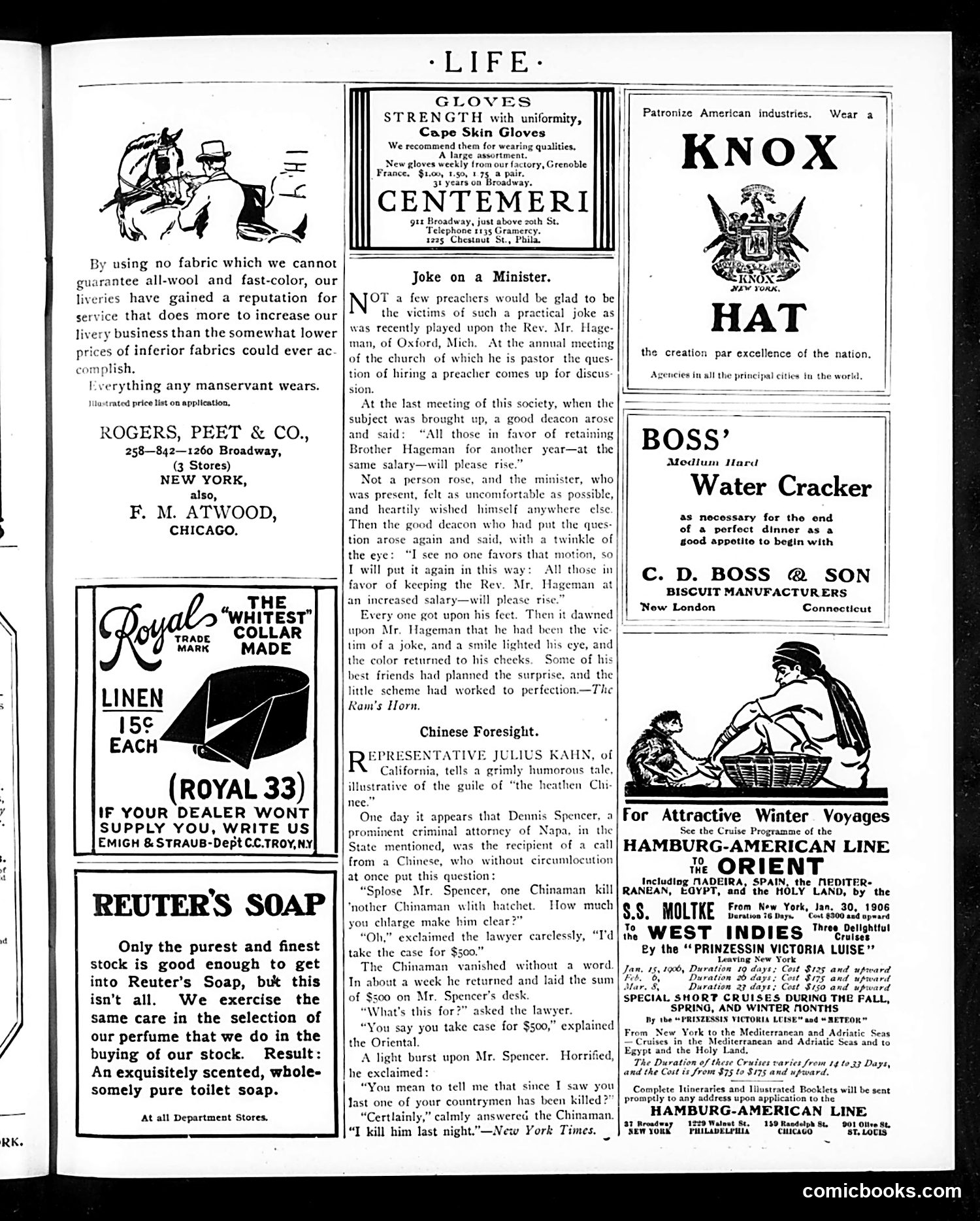
This page contains two humorous anecdotes typical of early 1900s Life magazine's satirical content. **"Joke on a Minister"** recounts a practical joke on Reverend Hageman of Oxford, Michigan. At a church meeting about his reemployment, a deacon asks those favoring his retention at current salary to rise—nobody does. The deacon then reframes the question, asking those favoring a *salary increase* to rise, and everyone stands. The minister, initially humiliated, realizes he's been the subject of a affectionate surprise orchestrated by friends. The satire gently mocks both clerical anxieties about job security and congregational reluctance to fairly compensate preachers. **"Chinese Foresight"** presents a darker joke attributed to Congressman Julius Kahn. A Chinese man hires attorney Dennis Spencer for $500 to defend a murder case. When Spencer casually accepts, the man vanishes, returns a week later with the $500, and reveals he's already killed a fellow countryman—thus obtaining legal representation *after* committing the crime. The "foresight" satirizes period stereotypes depicting Chinese immigrants as cunning and lawless. Both reinforce era-typical attitudes; the second reflects anti-Chinese prejudice common in early 20th-century America.
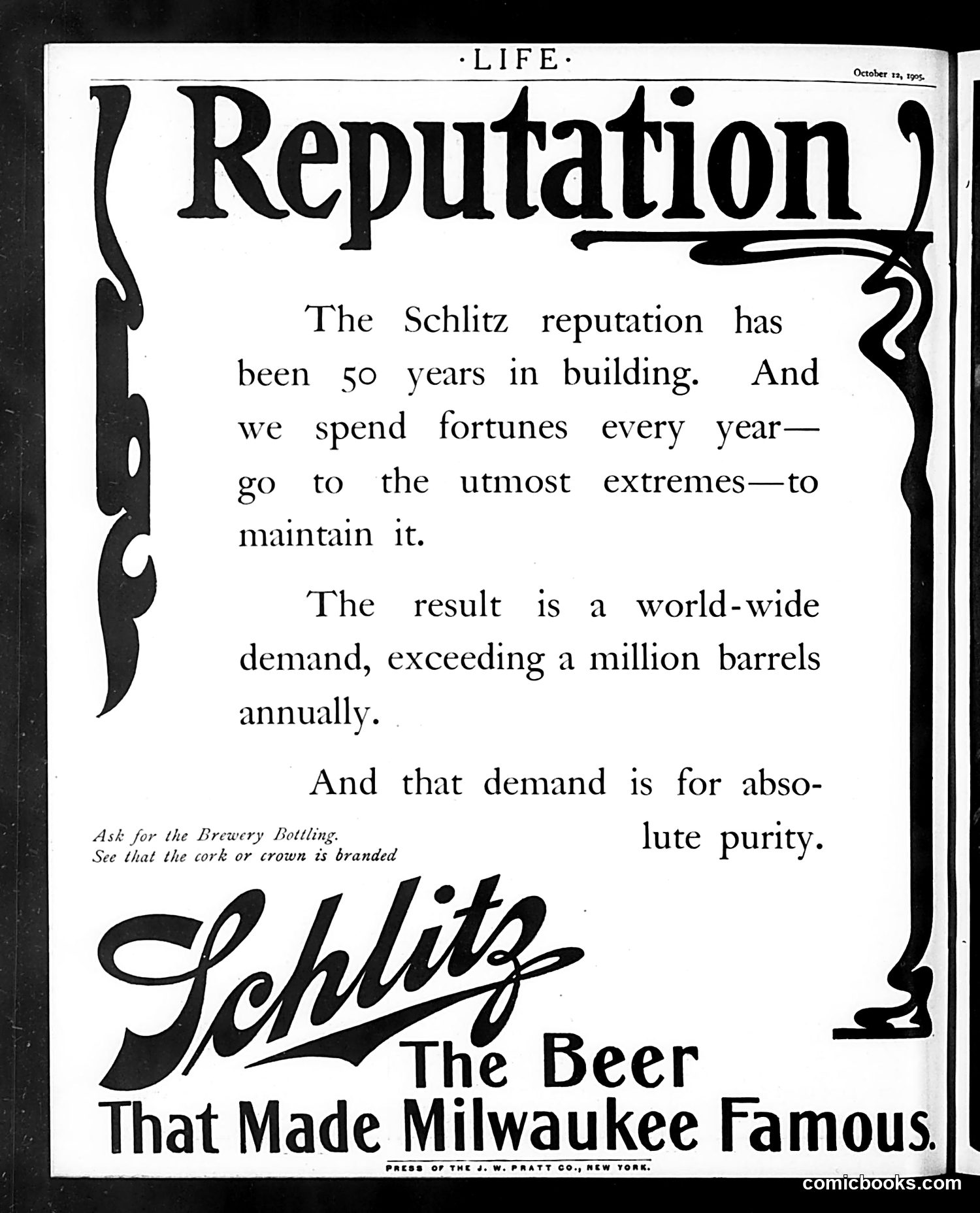
This is a Schlitz beer advertisement, not a political cartoon. The page promotes Schlitz's reputation for purity and quality, claiming 50 years of reputation-building and annual expenditures to maintain standards. The ad boasts of worldwide demand exceeding one million barrels annually, emphasizing that customers want "absolute purity." The advertisement includes instructions to consumers: ask for "Brewery Bottling" and verify the cork or crown is branded—anti-counterfeiting measures suggesting concern about fake products. The tagline "The Beer That Made Milwaukee Famous" connects the product to Milwaukee's brewing heritage. This represents early-twentieth-century advertising emphasizing product reliability and authenticity to consumers.