
Life, 1905-10-12 · page 18 of 26
Life — October 12, 1905 — page 18: what you’re looking at
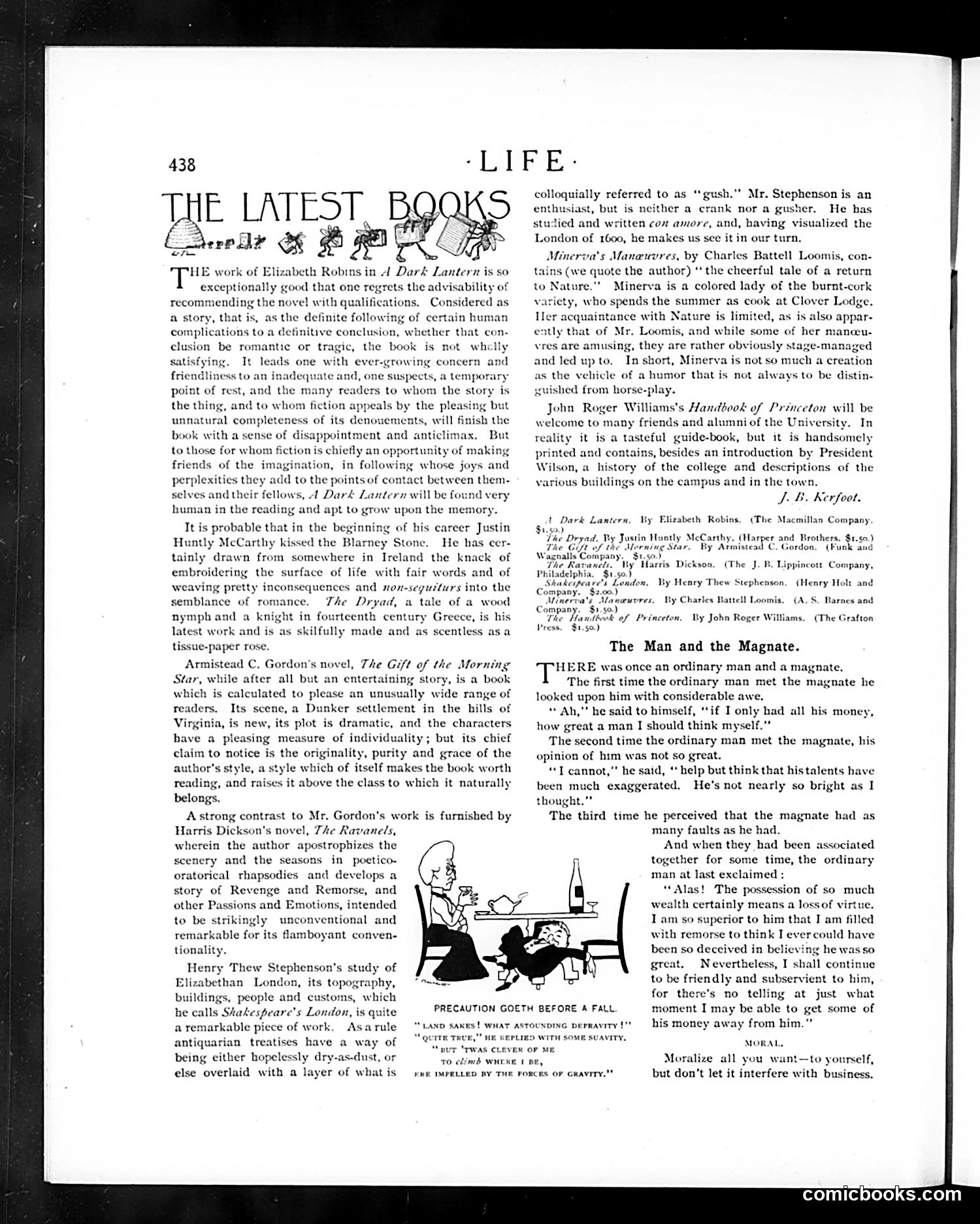
What you’re looking at
This single-panel cartoon illustrates a moral lesson about wealth and character. It depicts two men at a dining table: an ordinary man and a wealthy "magnate" (indicated by the bottle of wine). The caption presents their evolving relationship: the magnate initially envies the ordinary man's perceived talents, then dismisses him as untalented, and finally recognizes he himself has serious character flaws. The ordinary man's realization—that wealth often corrupts virtue rather than conferring superiority—prompts his moral conclusion: "Moralize all you want—to yourself, but don't let it interfere with business." The satire critiques Gilded Age hypocrisy: wealthy industrialists who acknowledge moral failings yet continue prioritizing profit over ethics. The cartoon suggests that self-awareness about one's vices doesn't necessarily produce ethical behavior in American business culture.
📄 Transcribed text from this page (OCR, searchable)
Machine-transcribed from the original scan — historical spelling and the odd misread are preserved.
438 THE LATEST. 5 =a erp ll¥ & 6 HE work of Elizabeth Robins in A Dark Lantern is so exceptionally good that one regrets the advisability of recommending the novel with qualifications, Considered as a story, that is, as the definite following of certain human complications to a definitive conclusion, w er that con- clusion be romantic or tragic, the book is not whclly satisfying. It ever-growing concern and friendliness to a nd, one suspects, a temporary point of rest, and the many readers to whom the story the thing, and to whom fiction appeals by the pleasing but unnatural completeness of its denouements, will finish the book with a sense of disappointment and anticlimax. But to those for whom fiction is chiefly an opportunity of making friends of the imagination, in following whose joys and perplexities the 'd to the points of contact between them- selves and their fellows, 4 Dark Lantern will be found very human in the reading and apt to grow upon the memory. It is probable that in the beginning of his career Justin Huntly McCarthy kissed the Blarney Stone. He has cer= tainly drawn from somewhere in Ireland the knack of embroidering the surface of life with fair words and of weaving pretty inconsequences and non-seguéturs into the semblance of romance. The Dryad, a tale of a wood nymph and a knight in fourteenth century Greece, is his latest work and is as skilfully made and as scentl asa tissue-paper rose. Armistead C, Gordon’s novel, The Gift of the Morning Star, while after all but an entertaining stor which is calculated to please an unusually wide range of reade Its scene, a Dunker settlement in the hills of Virginia, is new, its plot is dramatic, and the characters have a pleasing measure of individuality; but its chief claim to notice is the originality, purity and grace of the author's styl style which of itself makes the book worth reading, and raises it above the class to which it naturally belongs. A strong contrast to Mr. Gordon's work is furnished by Harris Dickson's novel, The Ravaneds, wherein the author apostrophizes the scenery and the seasons in poetico- oratorical rhapsodies and develops a story of Revenge and Remorse, and other Passions and Emotions, intended to be strikingly unconventional and remarkable for its flamboyant conven- tionality. Henry Thew Stephenson’s study of Elizabethan London, its topography, buildings, people and customs, which he calls Shakespeare's London, is quite a remarkable piece of work. Asa rule antiquarian treatises have a way of being either hopelessly dry else overlaid with a layer of what is “Quite Tre as-dust, or PRECAUTION GOETH BEFORE A FALL LAND SAKES! WHAT ASTOUNDING DerkaviTy ! “pur “TWAS CLEVER OF ME 70 climb WHERE 1 BE, PRE IMPELLED BY THE FORCES OF GRAVITY.'* “LUE Ee colloquially referred to as ‘gush."" Mr. Stephenson is an enthusiast, but is neither a crank nor a gusher. He has studied and written coz amore, and, having visualized the London of 1600, he makes us see it in our turn, Minerva’s Manauvres, by Charles Battell Loomis, con- tains (we quote the author) ‘the cheerful tale of a return to Nature." Minerva is a colored lady of the burnt-cork variety, who spends the summer as cook at Clover Lodge. Her acquaintance with Nature is limited, as is also appar- ently that of Mr. Loomis, and while some of her manau- vres are amusing, they are rather obviously stage-managed and led up to. In short, Minerva is not so much a creation as the vehicle of a humor that is not always to be distin- suished from horse-play. John Roger Williams's Handbook of Princeton will be welcome to many friends and alumni of the University. In reality it is a tasteful guide-book, but it is handsomely printed and contains, besides an introduction by President Wilson, a history of the college and descriptions of the various buildings on the campus and in the town, J.B. Kerfoot. gph Dark Lanter $s) The Dryad. By Justin Wustly McCarthy. (Harper and Brothers. $ The Gift of the Morning Star. By Armistead C. Gordon. (Funk Company. $1.50.) anels, Wy Harris Dickson. Philadelphia. | $1.50.) , Shakespeare's London. By Neary Thew Stephenson, Ry Elizabeth Robins. (The Macmillan Company (The J.B. Lippincott Company, (Henry Holt and ‘Manauvres, By Charles Battell Loomis. Company. $1.50.) The Hanithe Press. $1.50.) (A. S. Barnes and of Princeton, By John Roger Williams. (The Grafton The Man and the Magnate. HERE was once an ordinary man and a magnate. The first time the ordinary man met the magnate he looked upon him with considerable awe. “ Ah," he said to himself, if I only had all his money, how great a man I should think myself.”" The second time the ordinary man met the magnate, his opinion of him was not so great. “T cannot,” he said, ‘ help but think that histalents have been much exaggerated. He's not nearly so bright as I thought.”” The third time he perceived that the magnate had as many faults as he had. And when they bad been associated together for some time, the ordinary man at last exclaimed : “Alas! The possession of so much wealth certainly means a loss of virtue. Iam so superior to him that I am filled with remorse to think I ever could have been so deceived in believing he was so great, Nevertheless, I shall continue to be friendly and subservient to him, for there's no telling at just what moment I may be able to get some of his money away from him." MORAL. Moralize all you want—to yourself, but don’t let it interfere with busi comicbooks.com