
Life, 1905-10-12 · page 6 of 26
Life — October 12, 1905 — page 6: what you’re looking at
What you’re looking at
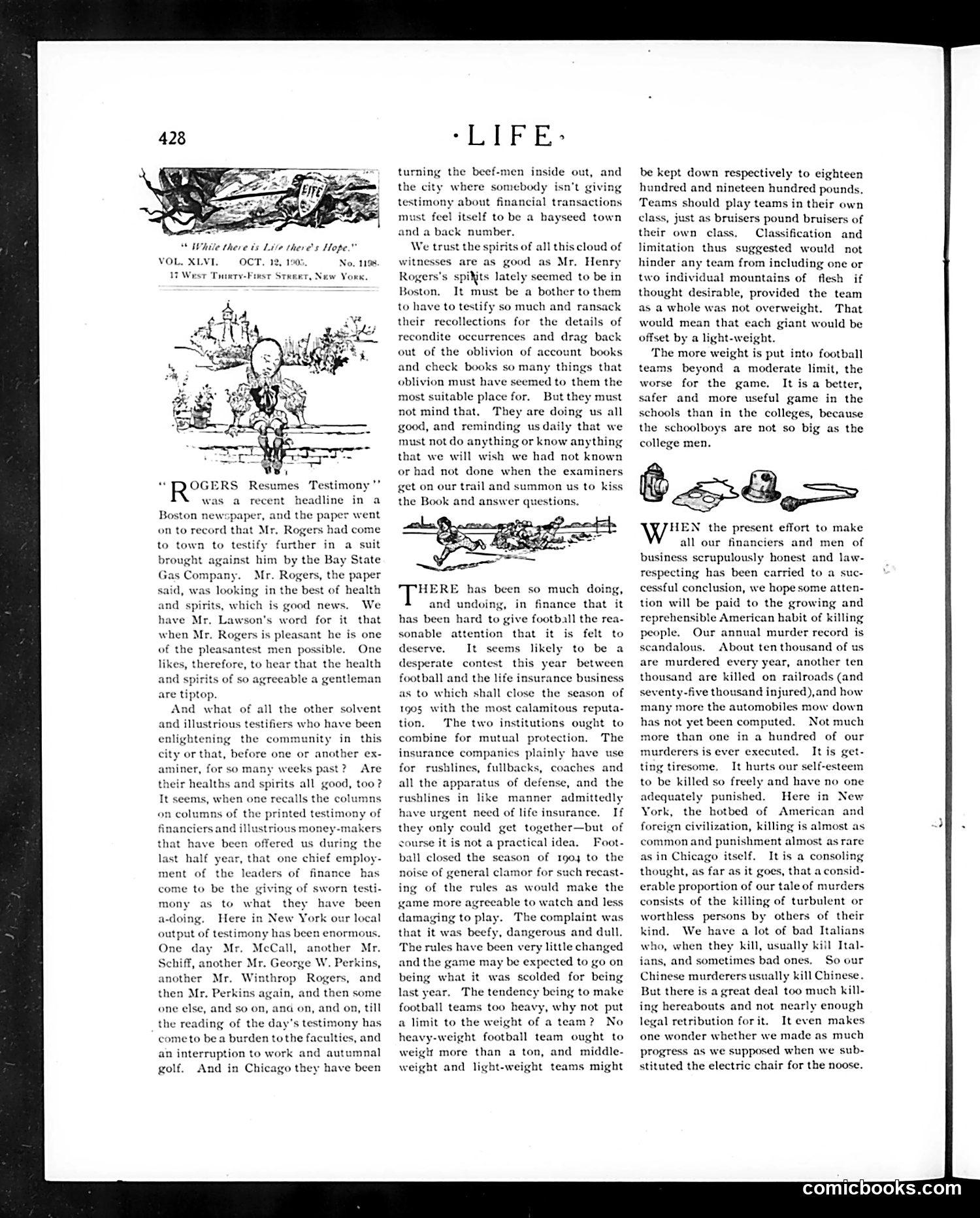
This page from *Life* magazine (Vol. XLVI, October 12, 1905) contains editorial commentary rather than political cartoons. The text discusses "Rogers Resumes Testimony"—apparently referring to ongoing testimony in a Boston lawsuit involving the Bay State Gas Company and a figure named Rogers. The small decorative illustrations are generic vignettes rather than satirical cartoons. The main editorial argues for honesty in finance and business, criticizing excessive corporate litigation. It also debates football team weight regulations and player safety, suggesting lighter teams are preferable. The page reflects early-1900s concerns about corporate accountability, business ethics, and sports safety—issues where reformist sentiment was gaining traction during the Progressive Era.
📄 Transcribed text from this page (OCR, searchable)
Machine-transcribed from the original scan — historical spelling and the odd misread are preserved.
“While there is Lite there's Hope.” 1. OCT, 12, 105, No. 1198 TREET, New Yorn, “ OGERS Resumes Testimony" recent headline in a Boston newspaper, and the pape on to record that Mr, Rogers had come to town to testify further in a suit brought against him by the Bay State Mr. Rogers, the paper d, was looking in the best of health and spirits, which is good news. We have Mr. Lawson's word for it that when Mr. Rogers is pleasant he is one of the pleasantest men possible. One likes, therefore, to hear that the health and s of so agreeable a gentleman are tiptop. And what of all the other solvent and illustrious testifiers who have been he community in this was a s Company’ enlightening city or that, befo: aminer, for so many weeks past? ir healths and spiri It seems, when one rei one or another ex- Are all good, too? n columns of the printed testimony of nanciers and il money-makers ered us during the t one chief employ- ders of finance has that have bee last half year, th the 1 come to be the giving of sworn testi- what they have been ment of mony as to a-doing. Here in New York our local output of testimony has been enormous. One day Mr. McCall, another Mr. Schiff, another Mr. George W. Perkins, another Mr. Winthrop Rogers, and then Mr. Perkins again, and then some one else, and so on, ana on, and on, till the reading of the day's testimony has come to bea burden tothe faculties, and an interruption to work and autumnal golf. And in Chicago they have been eT UP SES * turning the beef-men inside out the city where somebody isn’t giving testimony about financial transactions must feel itself to be a bayseed town and a back number. We trust the spirits of all this cloud of witnesses are as good as Mr. Henry Rogers's spits lately seemed to be in Boston. It must be a bother to them to have to testify so much and ransack their recollections for the de! recondite occurrences out of the oblivion of account books and check books so many things tha oblivion must have seemed to them the most suitable place for. But they must not mind that, They are doing us all good, and reminding us daily that we must not do anything or know anything that we will wish we had not known or had not done when the examiners get on our trail and summon us to kiss the Book and answer questions. HERE has been so much doing, and undoing, in finance that it has been hard to give football the rea- sonable attention that it is felt to deserve. It seems likely to be a desperate contest this year between football and the life insurance business as to which shall close the season of 1905 with the most calamitous reputa- tion. The two institutions ought to combine for mutual protection. The insurance companics plainly have use for rushlines, fullbacks, coaches and all the apparatus of defense, and the ner admitted insurance. If rushlines in like ma have urgent need of I they only could get together—but of course it is not a practical idea. Foot- ball closed the season of 1904 to the noise of general clamor for such recast- ing of the rules as would make the game more agreeable to watch and le: damaging to play. The complaint was that it was beefy, dangerous and dull. ‘The rules have been very little changed and the game may be expected to go on being what it was scolded for being last year, The tendency being to make football teams too heavy, why not put a limit to the weight of a team? No heavy-weight football team ought to weigh more than a ton, and middle- weight and light-weight teams might be kept down respectively to eighteen hundred and nineteen hundred pounds, Teams should play teams in their own class, just as bruisers pound bruisers of their own class, Classification and limitation thus suggested would not hinder any team from including one or two individual mountains of flesh if thought desirable, provided the team as a whole was not overweight. That would mean that each giant would be offset by a light-weight. The more weight is put into football teams beyond a moderate limit, the worse for the game. It is a better, fer and more useful game in the schools than in the colleges, because the schoolboys are not so big as the college men. GC.a—> HEN the present effort to make all our financiers and men of business scrupulously honest and law- respecting has been carried to a suc- cessful conclusion, we hope some atten- tion will be paid to the growing and reprehensible American habit of killing people, Our annual murder record is ndalous. About ten thousand of us are murdered every year, another ten thousand are killed on railroads (and seventy-five thousand injured),and how many more the automobiles mow down has not yet been computed. Not much more than one in a hundred of our murderers is ever executed. It is get- ting tiresome, It hurts our self-esteem to be killed so freely and have no one adequately punished. Here in New York, the hotbed of Ame; and foreign civilization, killing is almost common and punishment almost as rare as in Chicago itself. It is a consoling thought, as far as it goes, that aconsid- erable proportion of our tale of murders consists of the killing of turbulent or worthless persons by others of their kind. We have a lot of bad Italians when they kill, usually kill I ians, and sometimes bad ones. So our Chinese murderers usually kill Chinese. But there is a great deal too much kill- ing hereabouts and not nearly enough legal retribution for ii It even makes one wonder whether we made as much progress as we supposed when we sub- stituted the electric chair for the noose. comicbooks.com