
Life, 1905-10-12 · page 16 of 26
Life — October 12, 1905 — page 16: what you’re looking at
What you’re looking at
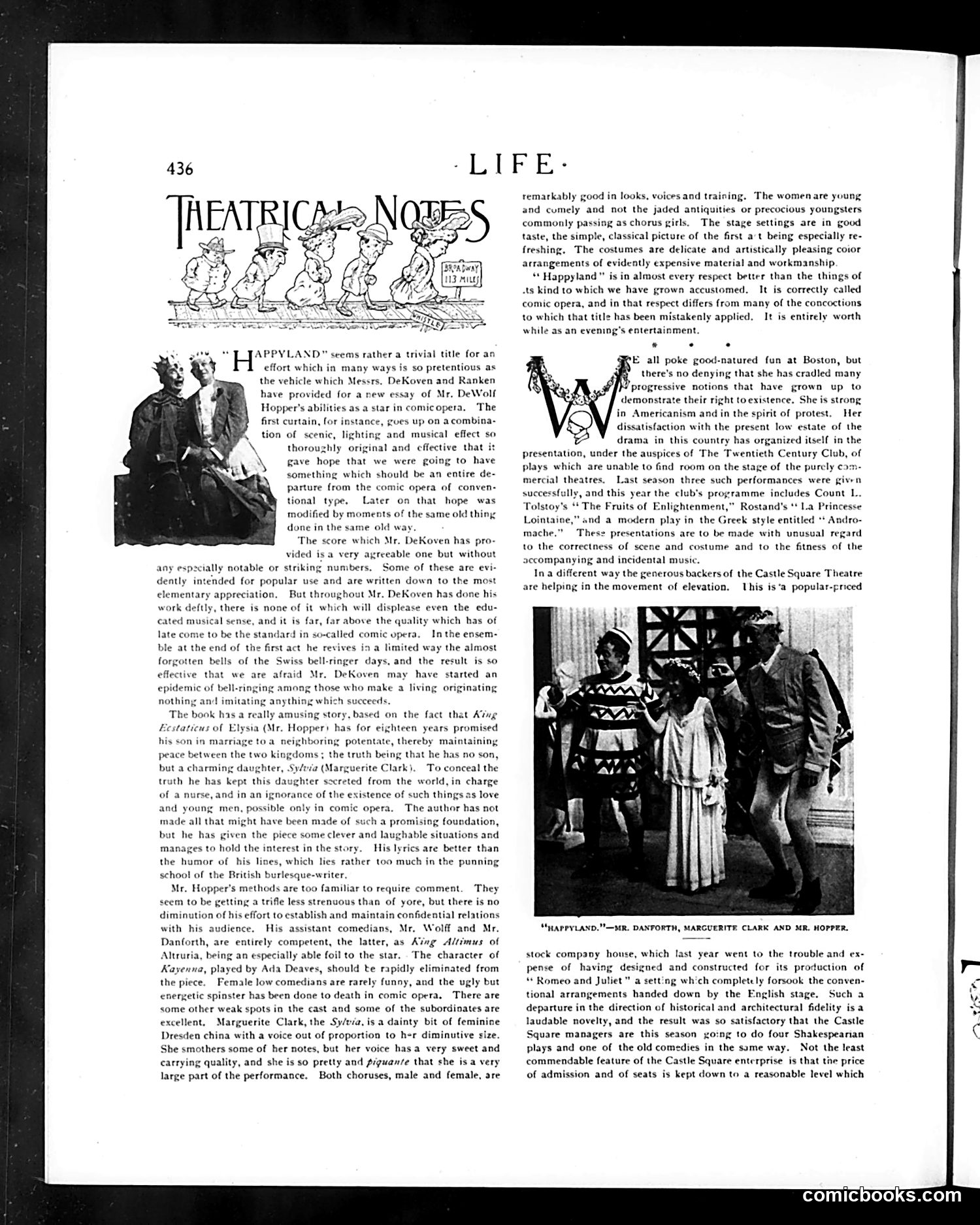
This is a theater review of the comic opera "Happyland," starring DeWolf Hopper. The critic praises composer DeKoven's musical score as competent but unremarkable, lacking memorable numbers. The plot—about a king who has concealed his daughter (played by Marguerite Clark) to maintain a peace treaty based on a false promise of a son—is deemed amusing but underexploited. The review credits Hopper's comedic talents while noting his methods are becoming "less strenuous than of yore." It praises Clark's performance despite her tendency to oversing, and commends the chorus and staging. However, it criticizes the character of Kayenna (Ada Deaves) as a tired comic-opera cliché. Overall, the piece is judged entertaining but somewhat conventional, failing to fully realize its promising foundation.
📄 Transcribed text from this page (OCR, searchable)
Machine-transcribed from the original scan — historical spelling and the odd misread are preserved.
-LIFE- “ Hee AND” seems rather a trivial title for an effort which in many ways is so pretentious as the vehicle which Messrs. DeKoven and Ranken have provided for anew essay of Mr, DeWolf Hopper’s abilities as a star in comicopera, The first curtain, for instance, gues up on acombina- tion of scenic, lighting and musical effect so thorouzhly original and effective that it gave hope that we were going to have something which should be an entire de- parture from the comic opera of conven- tional type, Later on that hope was modified by moments of the same old thing done in the same old way, ‘The score which Mr, DeKoven has pro- vided isa very agreeable one but without notable or striking numbers. Some of these are evi- dently intended for popular use and are written down to the most But throughout Mr. DeKoven has done his there is none of it which will displease even the edu- any esp elementary appreciation, work deft cated musical sense, and it is far, far above the quality which has of late come to be the standard in so-called comic opera. In the ensem- ble at the end of the first act he revives in a limited way the almost forgotten bells of the Swiss bell-ringer days, and the result is so flective that we are afraid Mr, DeKoven may have started an epidemic of bell-ringing among those who make a living originating nothing and imitating anyth The book has a really amusing story, based on the fact that Aig Ecstaticus of Elysia (Mr. Hoppers has for eighteen years promised his son in m. ge toa neighboring potentate, thereby maintaining n the two kingdoms; the truth being that he has no son, but a charming daughter, Sy/vva (Marguerite Clark}, To conceal the truth he has kept this daughter sccreted from the world, in charge nd in an ignorance of the existence of such things as love and young men, possible only in comic opera. The author has not made all that might have been made of such a promising foundation, peace betw but he has given the piece some clever and laughable situations and manages to hold the interest in the story. His lyrics are better than the humor of his lines, which lies rather too much in the punning school of the British burlesque-writer, Mr. Hopper’s methods are too familiar to require comment. They em to be getting a trifle less strenuous than of yore, but there is no diminution of his effort to establish and maintain confidential relations with his audience. His assistant comedians, Mr, Wolff and Mr. Danforth, are entirely competent, the latter, as Ang Altimus of Altruria, being an especially able foil to the star. The character of Kayenna, played by Ada Deaves, should te rapidly eliminated from the piece. Female low comedians are rarely funny, and the ugly but energetic spinster has been done to death in comic opera, There are some other weak spots in the cast and some of the subordinates are excellent, Marguerite Clark, the Sy/vva, is a dainty bit of feminine Dresden china with a voice out of proportion to her diminutive size. She smothers some of her notes, but her voice has a very sweet and carrying quality, and she is so pretty and piguante that she is a very large part of the performance. Both choruses, male and female, are remarkably good in looks, voices and training, The womenare young and cumely and not the jaded antiquities or precocious youngsters commonly passing as chorus girls, The stage settings are in good taste, the simple, classical picture of the first a't being especially re- freshing, The costumes are delicate and artistically pleasing coir arrangements of evidently expensive material and workmanship “ Happyland” is in almost every respect better than the things of ts kind to which we have grown accustomed. It is correctly called comic opera, and in that respect differs from many of the concoctions to which that title has been mistakenly applied, It is entirely worth while as an evening's entertainment. « . . E all poke good-natured fun at Boston, but there's no denying that she has cradled many progressive notions that have grown up to demonstrate their right toexistence, She is strong in Americanism and in the spirit of protest, Her dissatisfaction with the present low estate of the drama in this country has organized itself in the presentation, under the auspices of The Twentieth Century Club, of plays which are unable to find room on the stage of the pul mercial theatres. Last season three such performances were given successfully, and this year the club's programme includes Count 1 Tolstoy's “The Fruits of Enlightenment,” Rostand’s ** La Princesse Lointaine,” snd a modern play in the Greek style entitled * Andro- mache, ly coms Thess presentations are to be made with unusual regard to the correctness of scene and costume and to the fitness of the accompanying and incidental music. Ina different way the generous backers of the Castle Square Theatre are helping in the movement of elevation. Uhis is‘a popular-priced APPYLAND.""—MR. DANFORTH, MARGUERITE CLARK AND MR. HOPPER. stock company house, which last year went to the trouble and ex- pense of having designed and constructed for its production of ** Romeo and Juliet" a setting which completely forsook the conven- tional arrangements handed down by the English stage, Such a departure in the direction of historical and architectural fidelity is a laudable novelty, and the result was so satisfactory that the Castle Square managers are this season yo:ng to do four Shakespearian plays and one of the old comedies in the same way. Not the least commendable feature of the Castle Square enterprise is that tie price of admission and of seats is kept down to a reasonable level which comicbooks.com