
A complete issue · 20 pages · 1904
Life — September 29, 1904
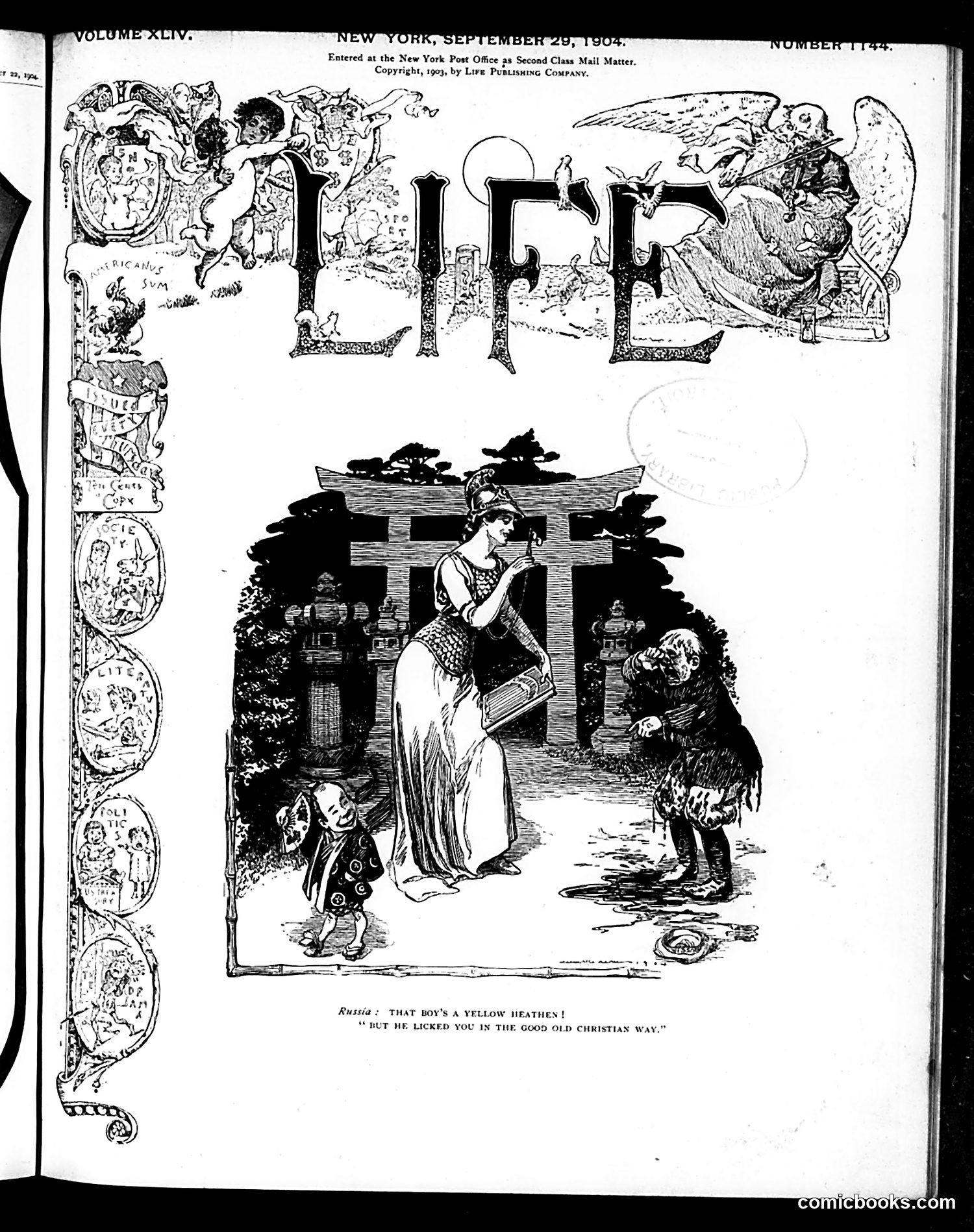
This is the cover of *Life* magazine from 1904, featuring decorative Art Nouveau border illustrations on the left and a central engraving. The main cartoon depicts a woman in classical dress gesturing toward two figures—a small child and what appears to be a monkey or ape—near an ornate Japanese torii gate. The caption reads: "Russia: 'THAT BOY'S A YELLOW HEATHEN!' 'BUT HE LICKED YOU IN THE GOOD OLD CHRISTIAN WAY.'" This references the Russo-Japanese War (1904-1905). Russia is personified as the woman criticizing Japan ("that boy") for being non-Christian, despite Japan militarily defeating Russia—a major geopolitical shock. The satire mocks Russian hypocrisy: condemning Japan's religion while losing to their superior military strategy.
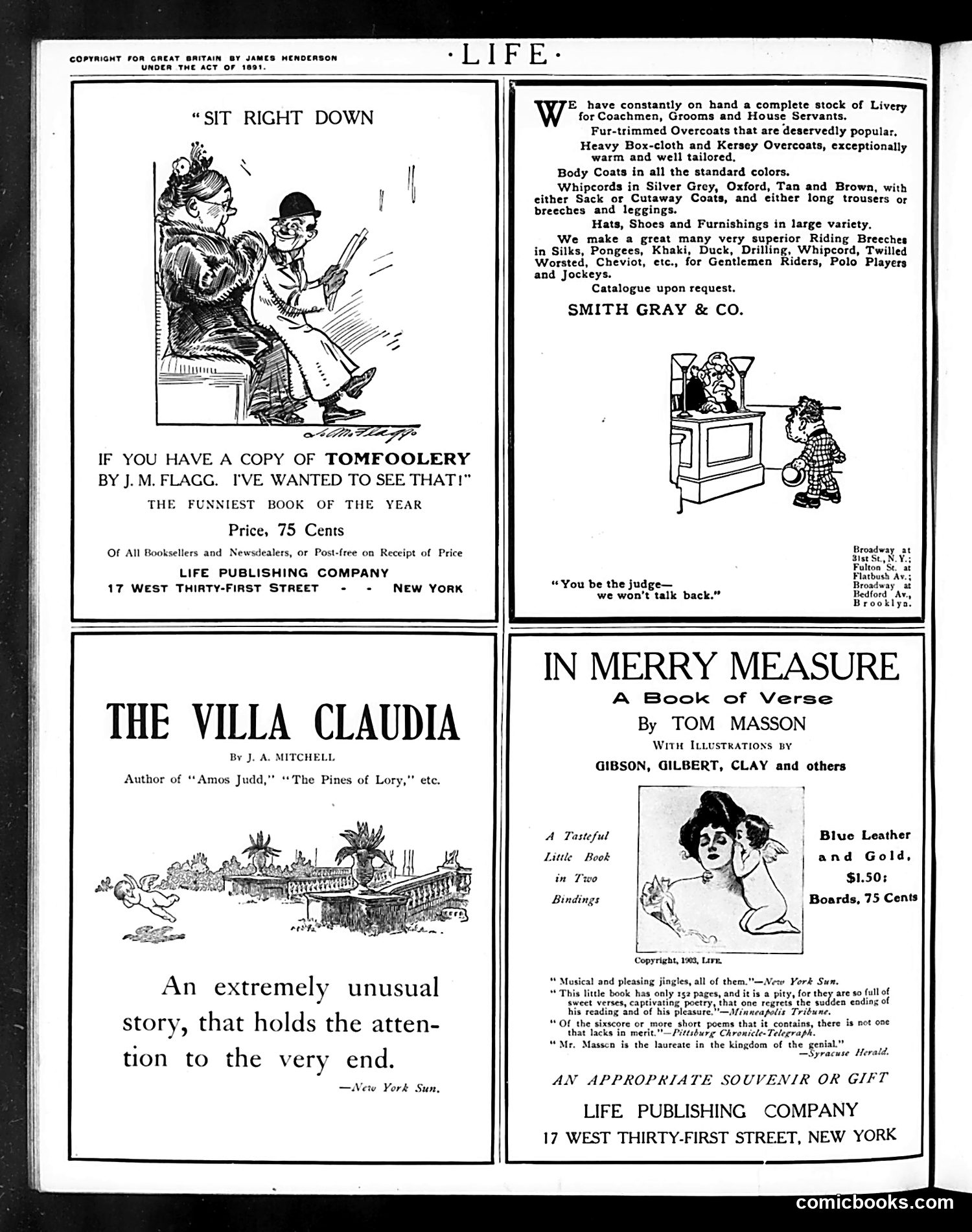
This page contains primarily **advertisements** rather than political satire. The top-left shows "Sit Right Down," a cartoon advertising *Tomfoolery* by J.M. Flagg—described as "the funniest book of the year" (75 cents). The cartoon depicts two figures in a humorous situation, though the specific joke is unclear without fuller context. The remaining three advertisements promote books and merchandise: Smith Gray & Co. (clothing), *The Villa Claudia* by J.A. Mitchell (described as an "extremely unusual story"), and *In Merry Measure*, a verse collection by Tom Masson with illustrations by Gibson, Gilbert, and Clay. All advertisements are from or direct readers to Life Publishing Company in New York, indicating this is a **commercial page** rather than editorial satire.
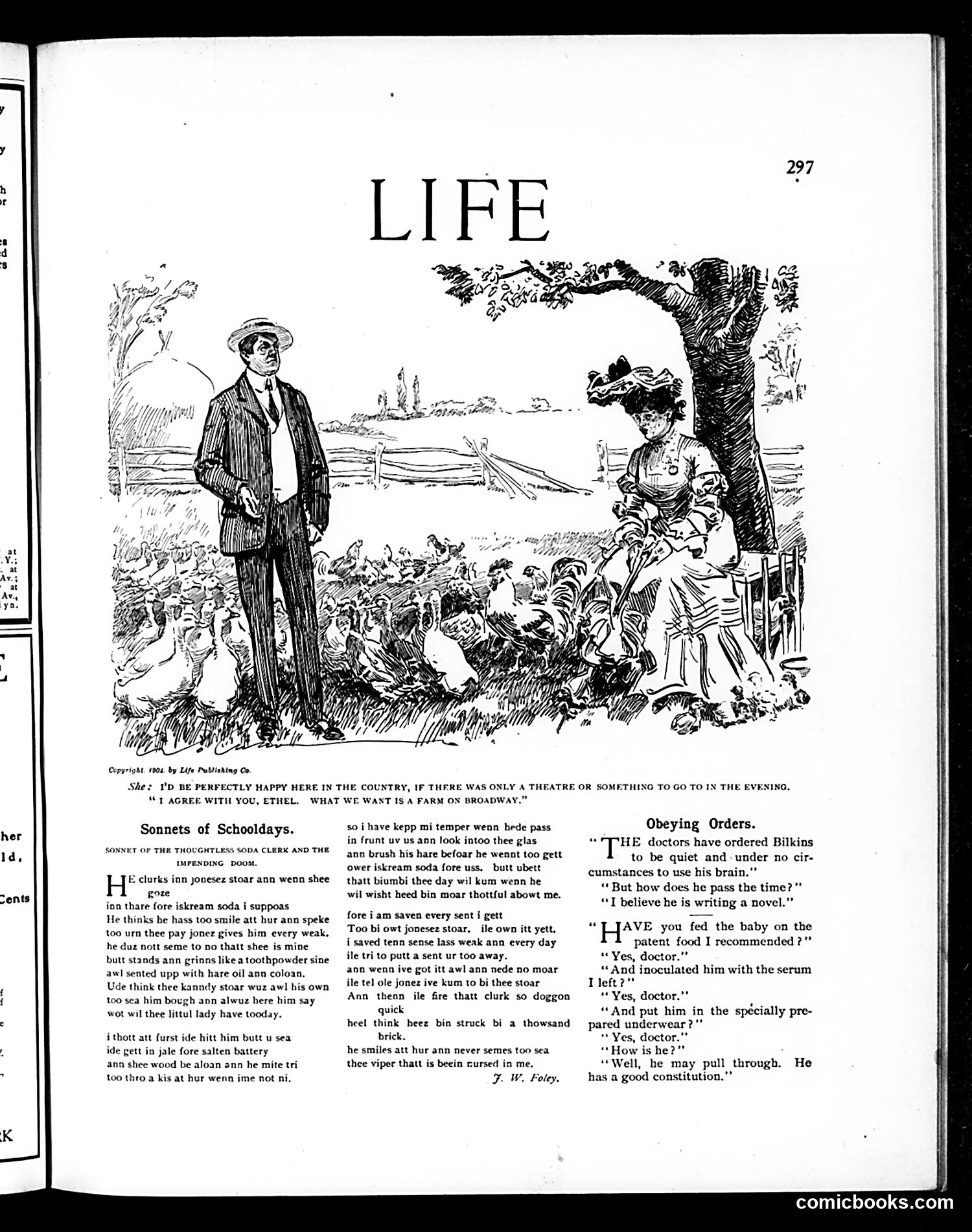
The illustration depicts a country gentleman and woman among barnyard animals, with the woman saying she'd be perfectly happy in the country "if there was only a theatre or something to go to in the evening." This satirizes **upper-class dissatisfaction with rural life**—specifically, the tension between idealizing pastoral simplicity while craving urban entertainments and culture. The joke targets wealthy people who romanticize country living but cannot actually abandon city conveniences and social diversions. The two text pieces below—"Sonnets of Schooldays" and "Obeying Orders"—appear unrelated editorial content, likely humorous verse and a brief dialogue about medical orders, typical of Life's mixed satirical format.
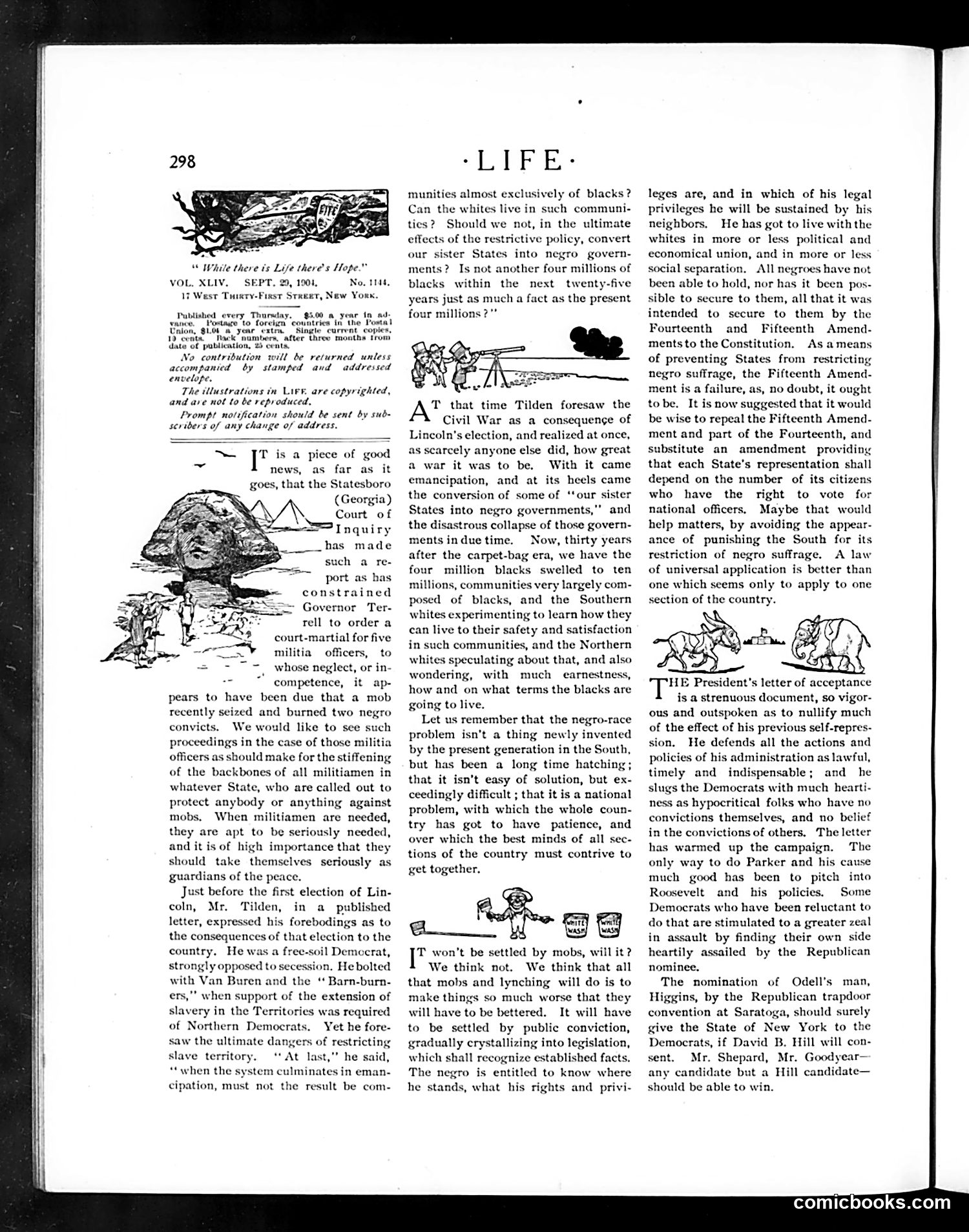
This page contains political commentary on race and governance following Lincoln's anticipated election. The text discusses the "negro-race problem" and debates whether restricting Black suffrage or granting representation would better solve racial tensions. The three small cartoons appear to illustrate political anxiety: one shows figures at a telescope (suggesting observation/concern), another depicts what appears to be figures in conflict or distress. The commentary reflects deep anxieties about Black political power and representation, framed as a "national problem." The text cites Tilden's pre-Civil War warnings about dangers of "converting sister States into negro governments," revealing the author's opposition to Reconstruction-era policies. This represents typical Progressive-Era elite discourse on race—discussing Black Americans as a "problem" requiring management rather than as citizens with rights.
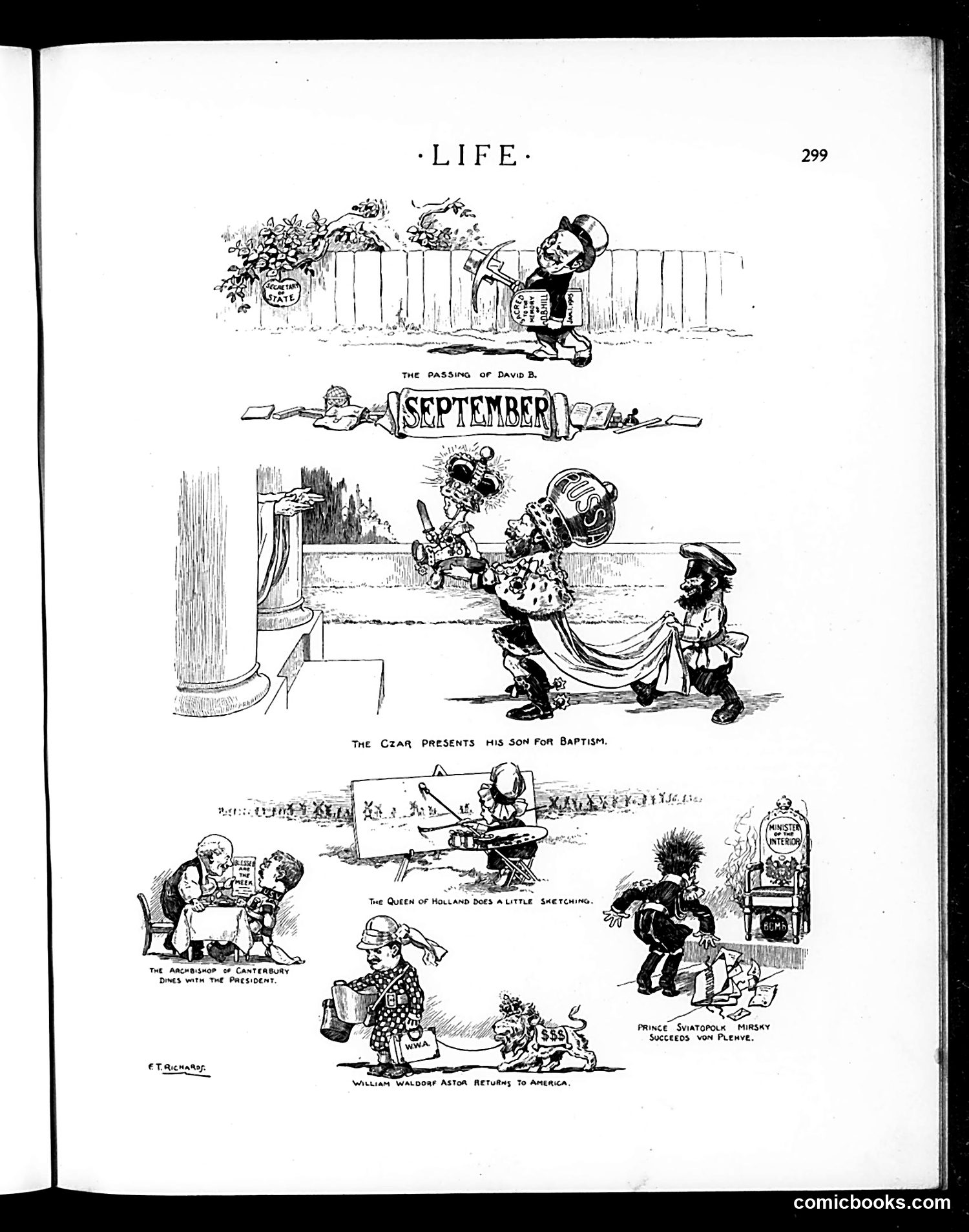
This page contains six satirical sketches commenting on September 1909 news events: 1. **"The Passing of David B."** - A figure discards items marked "DAVID B," likely referencing a political or public figure's decline or departure. 2. **"The Czar Presents His Son for Baptism"** - Mocks Russian imperial customs, showing the Czar presenting his son. 3. **"The Archbishop of Canterbury Dines with the President"** - References a notable diplomatic visit between British and American leadership. 4. **"The Queen of Holland Does a Little Sketching"** - A lighthearted observation about Queen Wilhelmina's artistic pursuits. 5. **"William Waldorf Astor Returns to America"** - Comments on the wealthy Astor family's transatlantic movements. 6. **"Prince Sviatolpolsk Murray Succeeds von Plehve"** - References Russian political succession, likely involving security or governmental changes. The cartoons employ caricature and domestic humor to satirize contemporary royal, diplomatic, and wealthy figures.
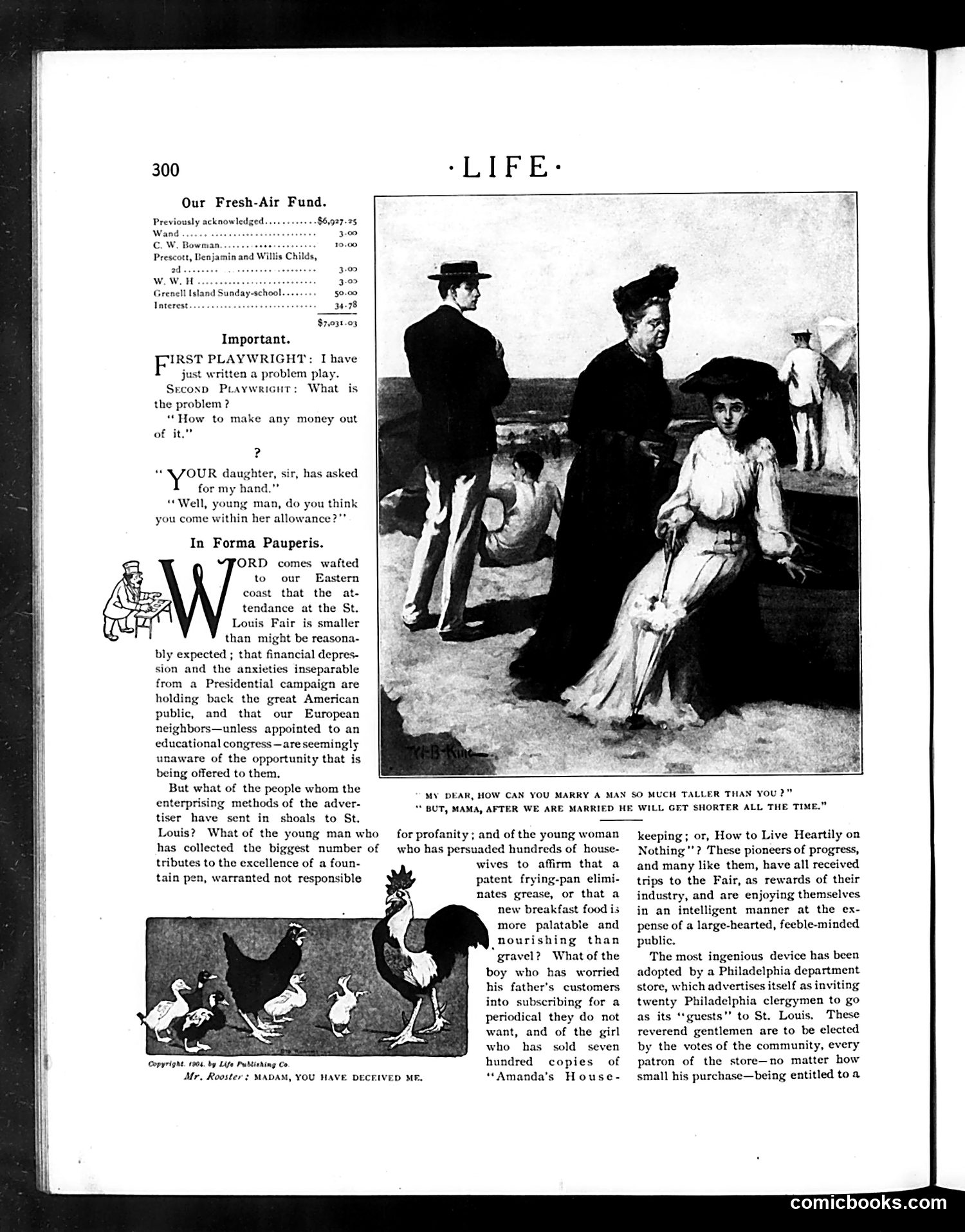
This page contains satirical content about the St. Louis World's Fair (early 1900s). The main cartoon depicts well-dressed men and women at what appears to be the fairgrounds, with a caption about a daughter asking for her suitor's hand in marriage—a joke about marriage prospects and social climbing at the fair. The "In Forma Pauperis" section satirizes how the Fair's financial success contrasts with poverty among working Americans. It mocks entrepreneurs pitching dubious schemes (like grease-eliminating frying pans) to fair visitors, and jokes about a Philadelphia store's gimmick of using community voting to elect "guests" to St. Louis—poking fun at commercialism disguised as democratic participation. The lower cartoon appears unrelated, featuring roosters and a domestic joke ("Madam, you have deceived me").
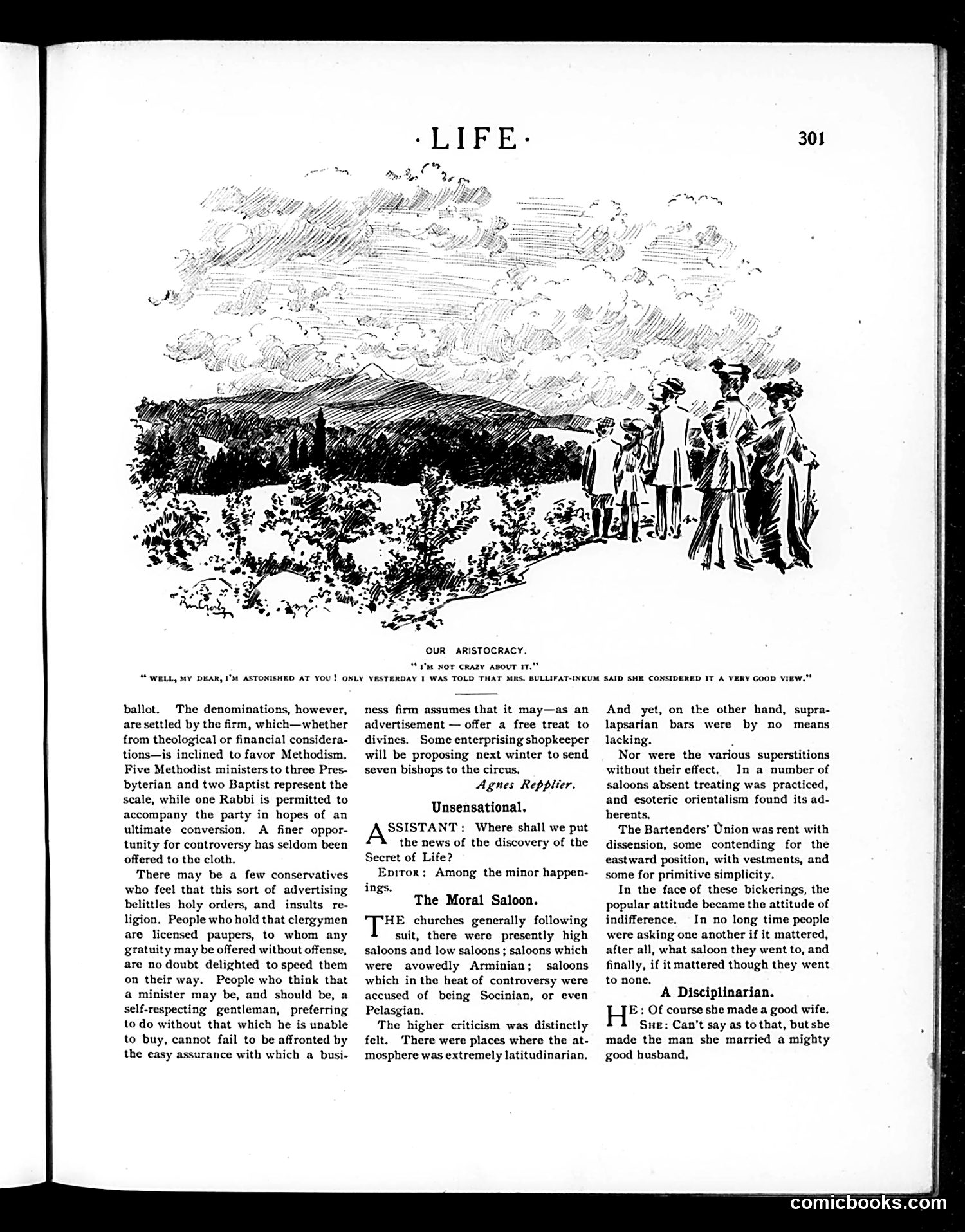
This satirical cartoon depicts wealthy individuals (recognizable by their formal dress and fashionable hats) observing a pastoral landscape. The caption reads: "It's not crazy about it," with dialogue about Mrs. Bullfat-Irkum's estate opinion. The satire targets the American upper class and their pretentious attitudes toward land ownership and rural estates. The exaggerated name "Bullfat-Irkum" suggests nouveau riche vulgarity. The joke mocks aristocratic snobbery—these wealthy people are surveying property yet finding fault, implying their refined sensibilities are affectation rather than genuine taste. The accompanying text discusses saloons and Methodism controversies, suggesting this page addresses broader class tensions in early 20th-century America between established wealth, morality debates, and social propriety.
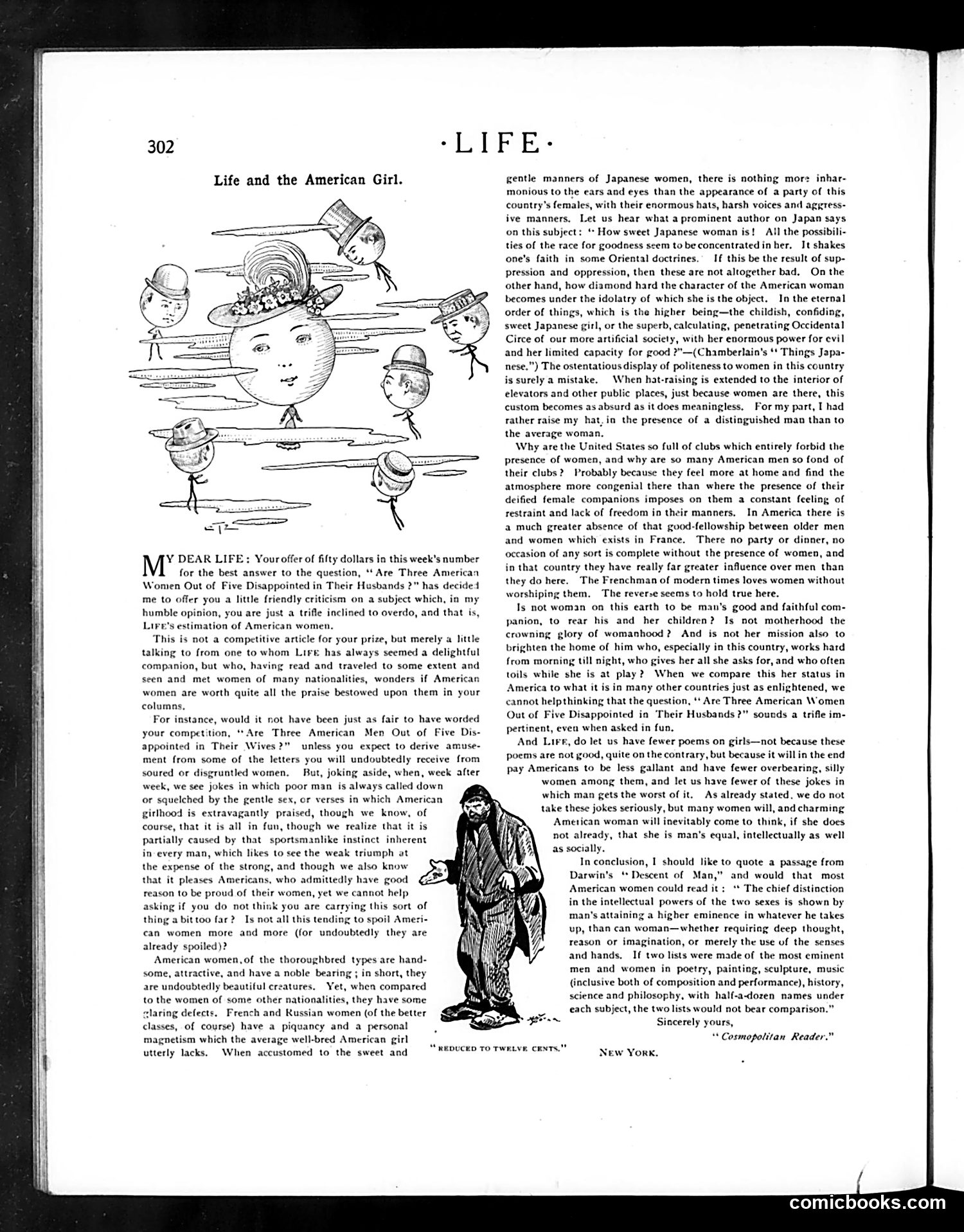
This satirical piece contrasts American and Japanese women, using caricature to mock both. The illustration shows exaggerated female heads with elaborate hats surrounded by small male figures, visually emphasizing the "enormous hats, harsh voices and aggressive manners" the text attributes to American women. The letter defends American women against implied criticism, claiming they possess greater freedom and intellectual capability than their Japanese or European counterparts. The author argues American women's assertiveness—previously mocked—actually reflects admirable independence and influence. The piece appears to respond to earlier *Life* content questioning American femininity, turning the satire back on detractors. The Darwin quote at the end suggests intellectual equality between sexes, positioning American women's boldness as evolutionary progress rather than social failing.
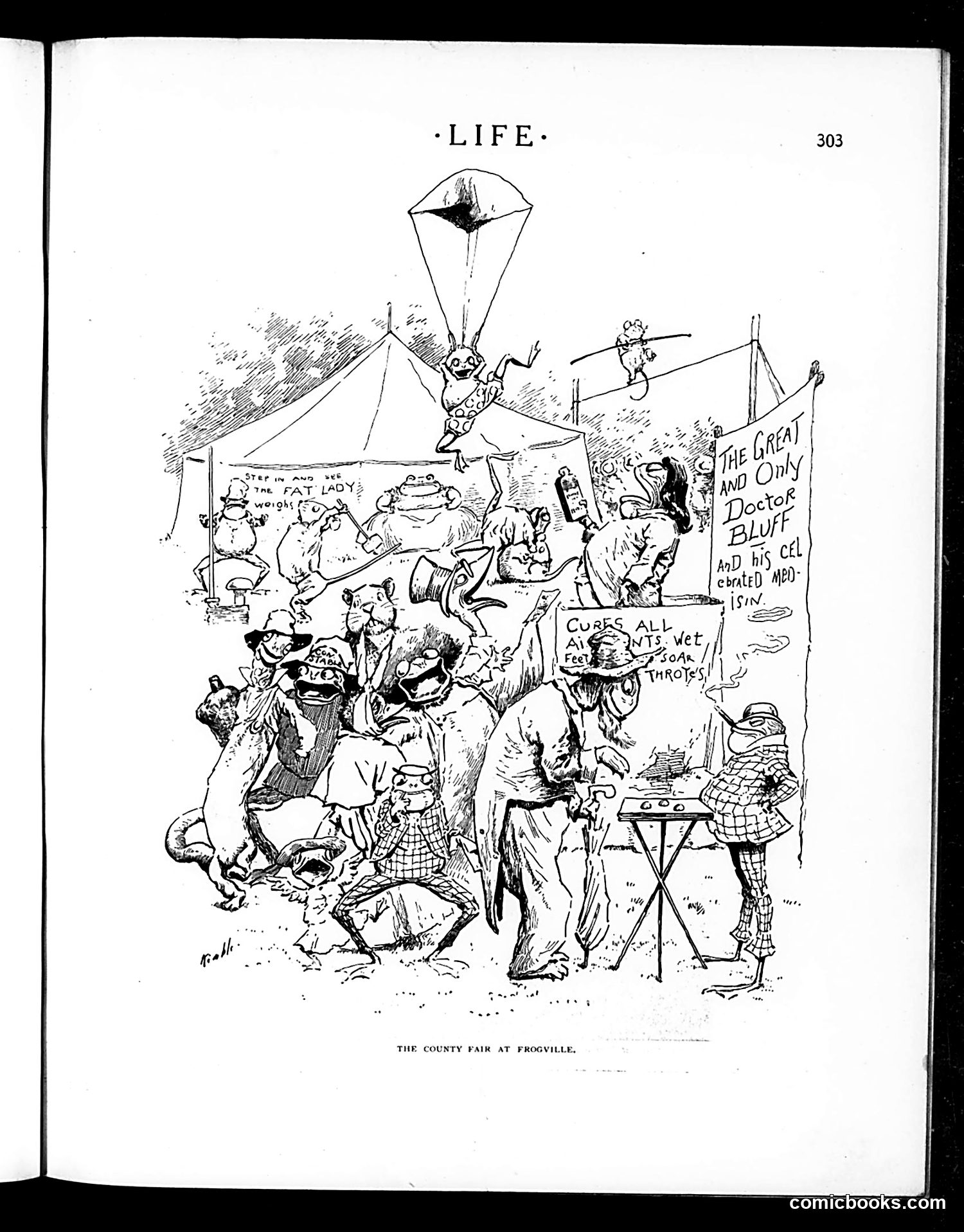
This is a satirical carnival scene depicting a traveling medicine show or quack doctor's exhibition. The central figure is "Doctor Bluff and his Celebrated Modus [unclear]," advertised on a banner as "The Great and Only Doctor Bluff." The cartoon mocks fraudulent medical practitioners who exploited rural communities at county fairs. The sign claims he "cures all ailments, wet feet, soak throats" — absurdly broad medical claims typical of patent medicine charlatans of this era. The gathering crowd of rural folks (depicted with exaggerated features) represents the gullible audience these con artists targeted. The hot-air balloon emerging from the tent suggests the "hot air" of false medical promises. This satirizes both the quacks themselves and the vulnerability of rural populations to medical fraud during this period.
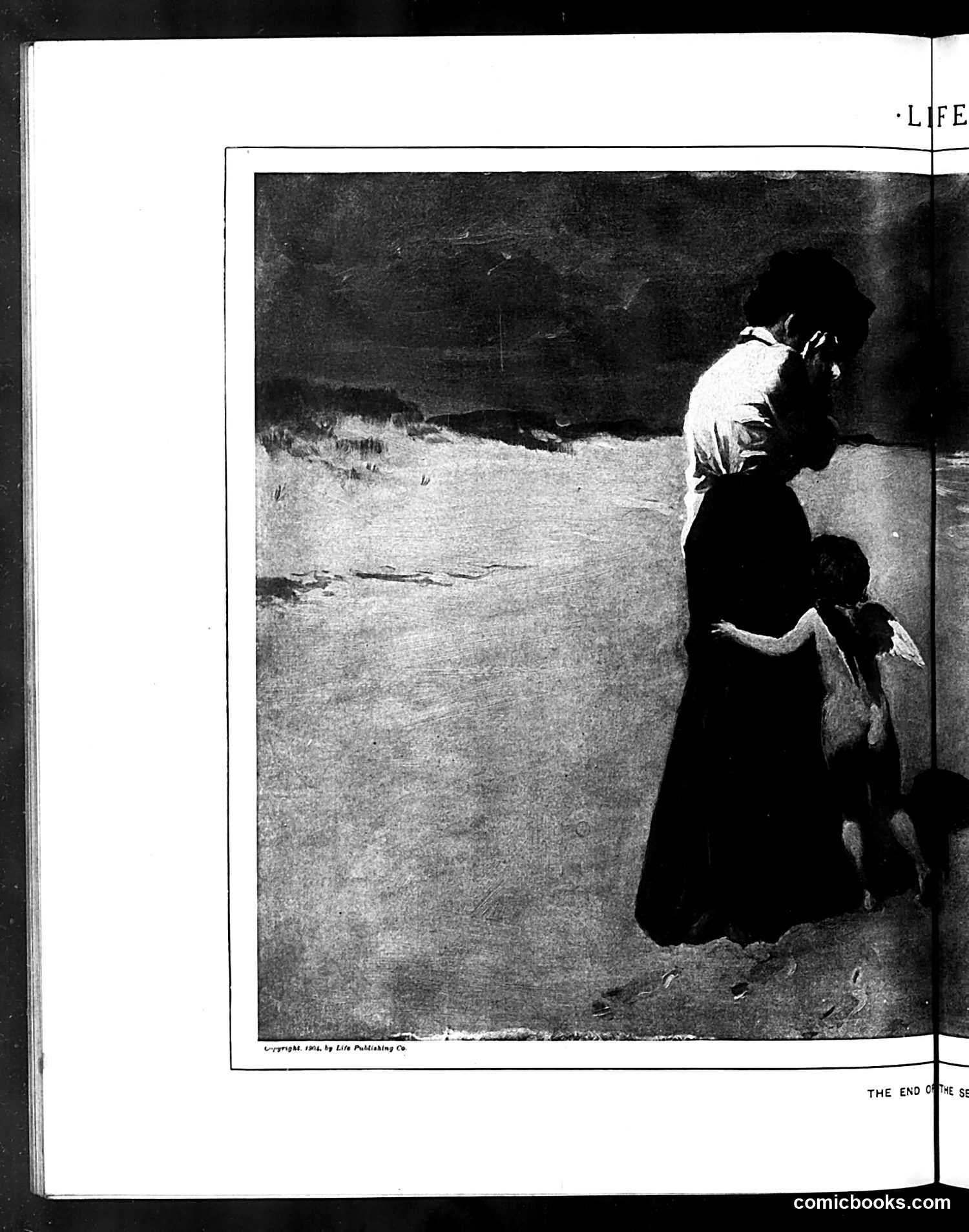
This appears to be a page from *Life* magazine showing a black and white photograph rather than a cartoon. The image depicts a woman and child standing on a beach or sandy area, looking out at water, with the woman's back to the camera. The caption text is partially visible but largely illegible in this reproduction. Without readable caption text, I cannot definitively identify the subjects, the specific social or political commentary intended, or what contemporary reference this was meant to satirize. The copyright notice indicates "Life Publishing Co." The page header reads "LIFE" and there's partial text at bottom reading "THE END OF THE SE[ASON]" (presumably "season"), suggesting this may illustrate a seasonal theme or conclude a narrative sequence, but the exact meaning remains unclear without legible accompanying text.
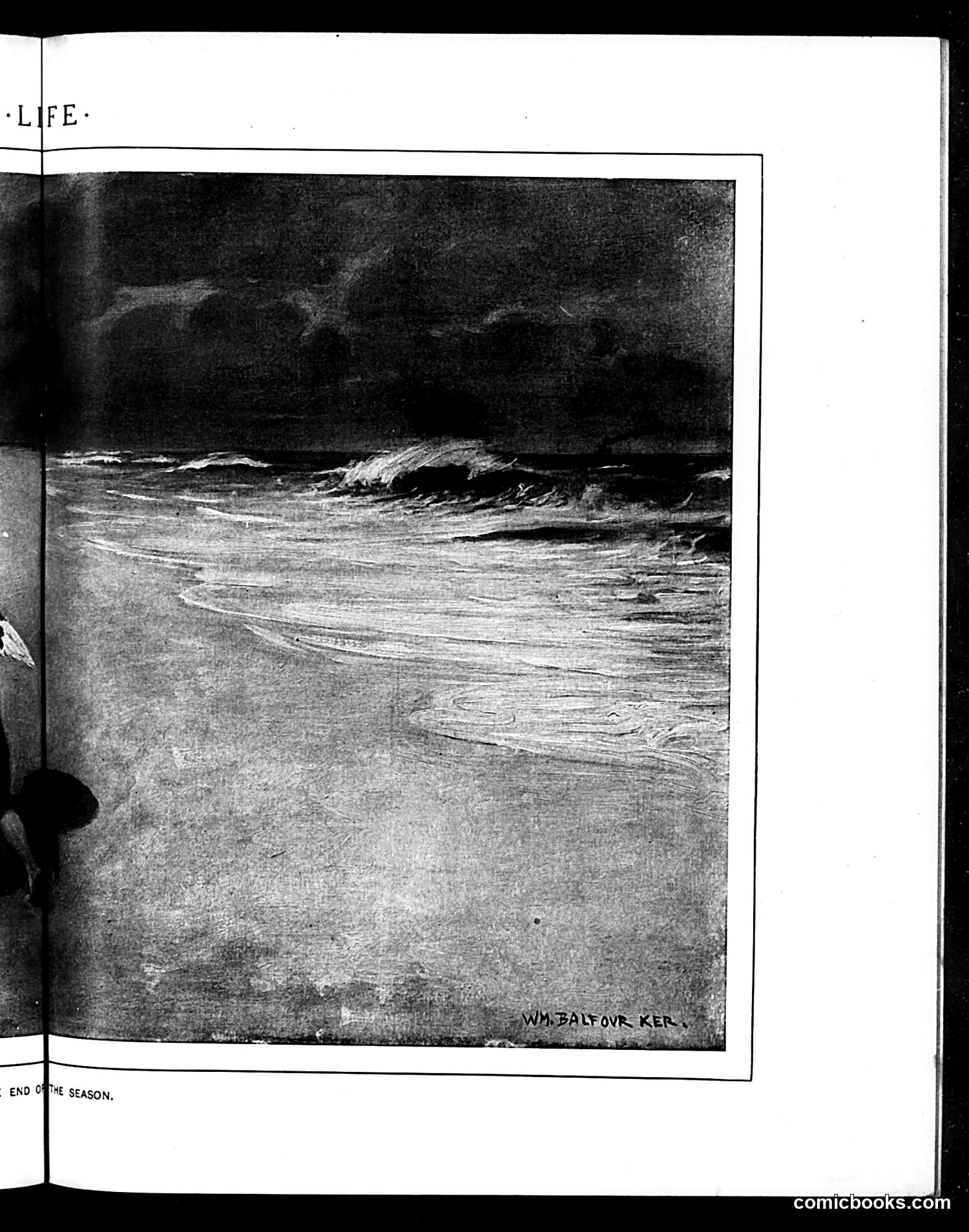
This page from *Life* magazine features a black and white photograph credited to "WM. BALFOUR KER" showing a turbulent seascape with waves and dark stormy skies. The caption fragment reads "END OF THE SEASON," suggesting a seasonal or temporal transition. The image itself appears to be a straightforward nature photograph rather than a political cartoon. Without additional context or visible satirical elements, caricatures, or text explaining the image's meaning, it's unclear what specific social or political commentary this photograph was meant to convey to *Life*'s readers. The dramatic weather conditions may carry metaphorical significance related to contemporary events, but the page provides insufficient information to determine what that reference might be.
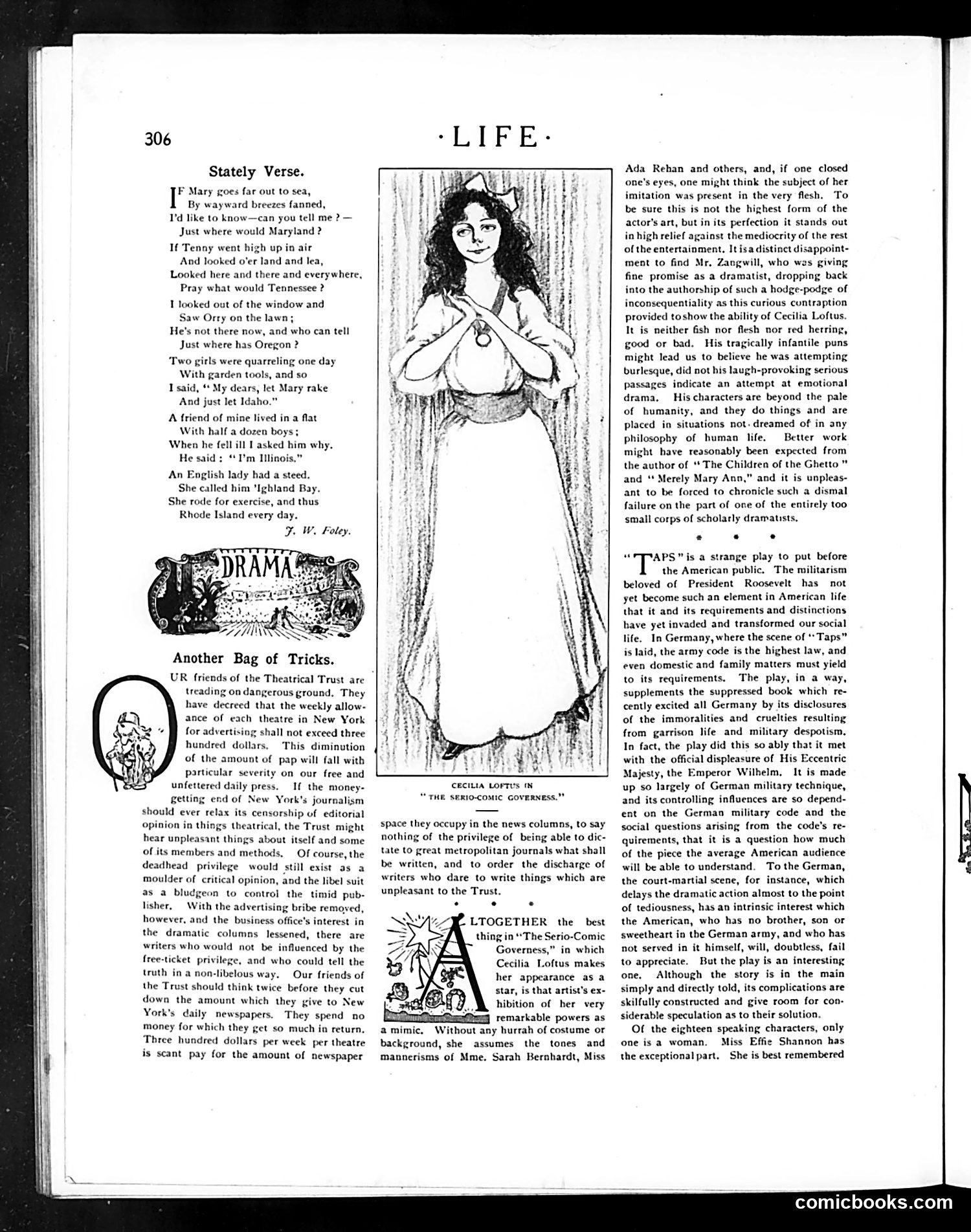
This page contains drama criticism and theatrical commentary rather than political cartoons. The main content discusses Cecilia Loftus's performance in a play, critiquing her acting as technically skilled but emotionally shallow—lacking the depth expected from serious drama. The "Another Bag of Tricks" section satirizes the Theatrical Trust's monopolistic control over New York theater advertising. It mocks their censorship of editorial content and their financial leverage over newspapers, arguing they suppress critical commentary. The piece advocates for press freedom against corporate control of theatrical coverage. The accompanying illustration labeled "Cecilia Loftus in 'The Sericomic Governess'" shows the actress in costume, supporting the dramatic criticism above.
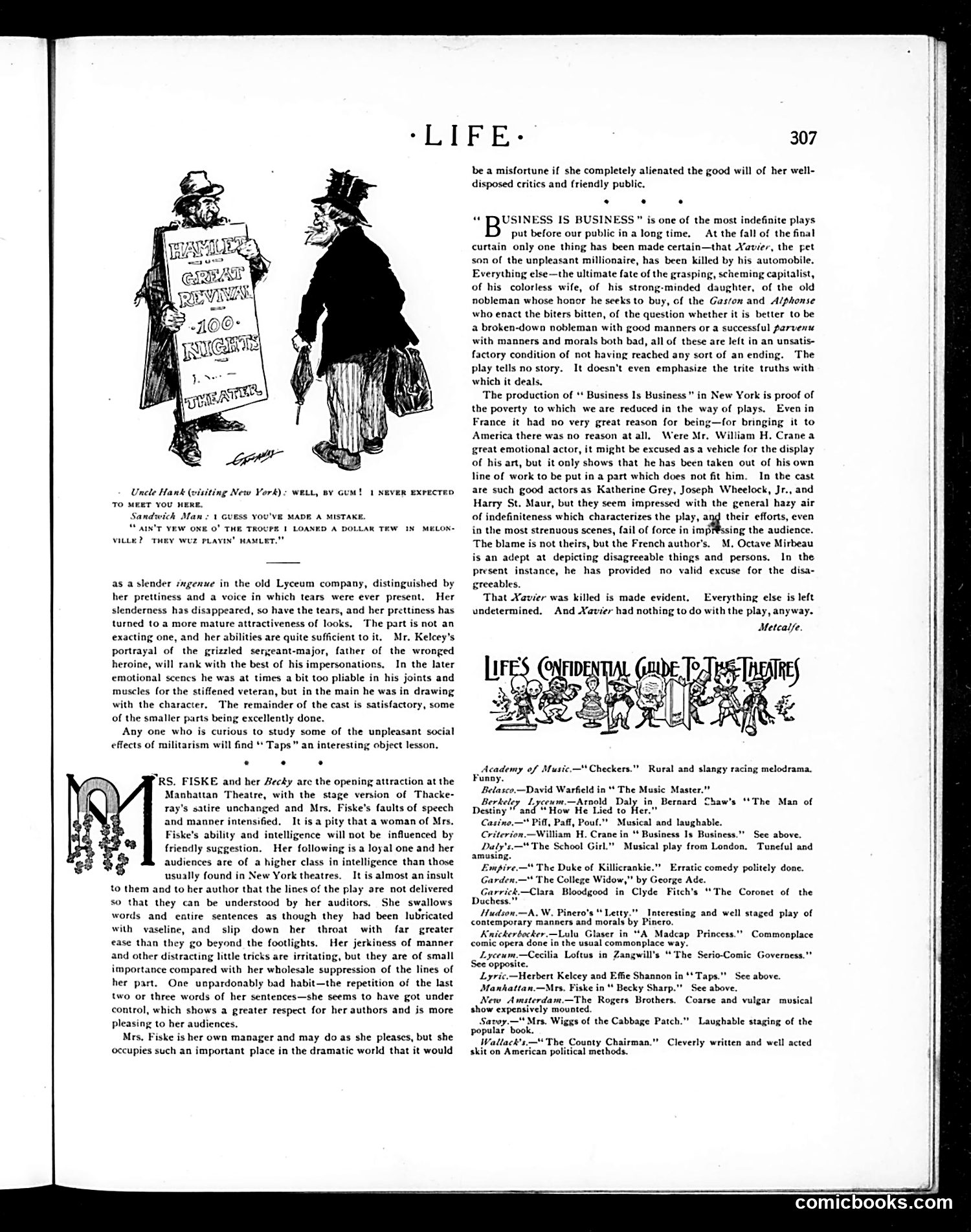
The cartoon depicts a humorous encounter between two men in New York City. One figure, labeled "Uncle Hank (visiting New York)," carries a placard advertising a theatrical troupe performing *Hamlet* in a rural area ("Melonville"). He mistakes the well-dressed urban man for a member of that touring company, asking if he's "one o' the troupe" he loaned money to. The satire contrasts rural and urban America: the unsophisticated country visitor, dressed plainly with his theatrical announcement, encounters a city dweller he wrongly assumes shares his provincial background. The joke plays on the incongruity—the urbanite's refined appearance and evident status make the misidentification absurd to contemporary readers, mocking both rural naïveté and the vast cultural gap between small-town and metropolitan America circa the early 1900s.
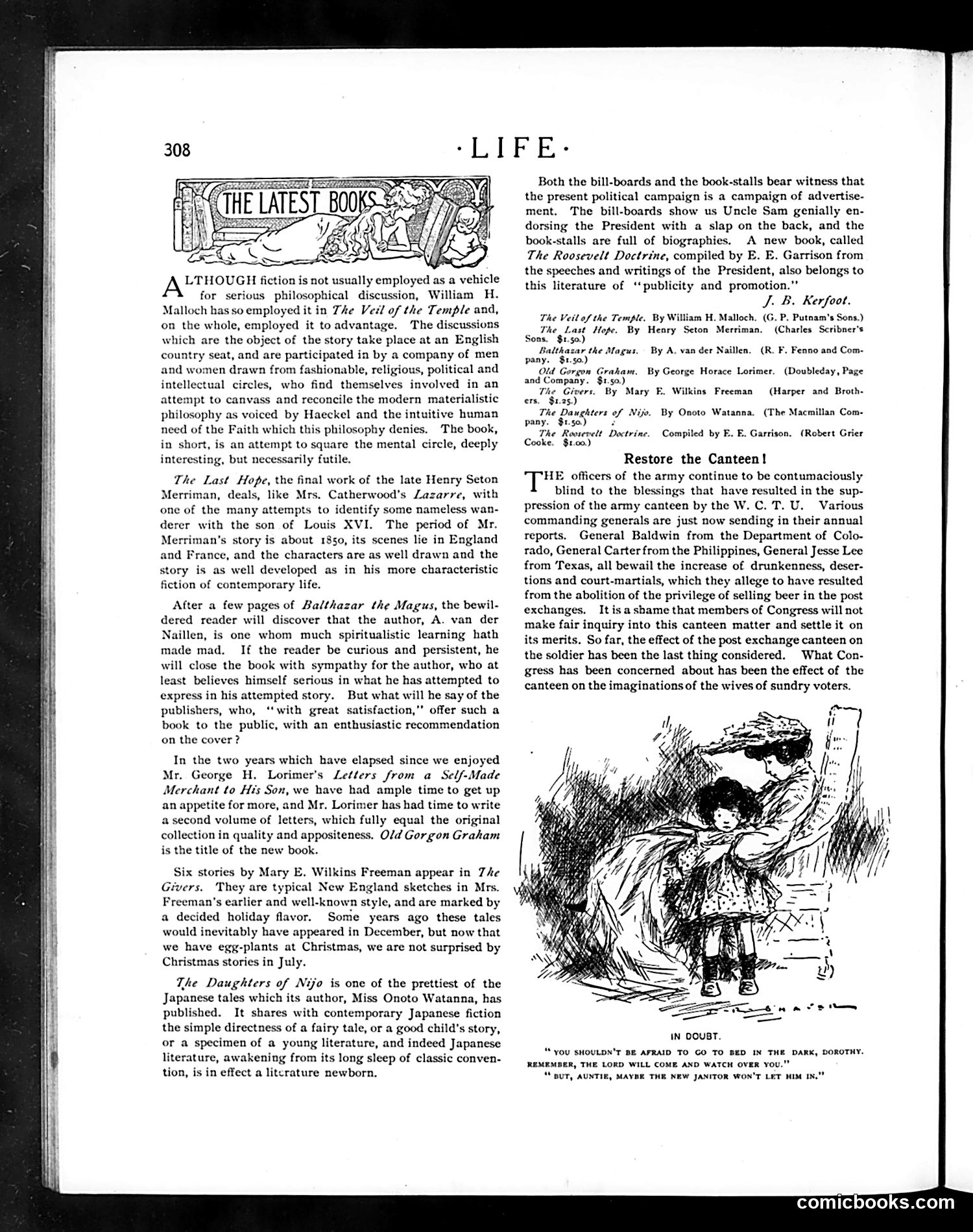
This page reviews contemporary books while satirizing the 1904 presidential campaign's commercialization. The text notes that political billboards feature "Uncle Sam genially endorsing the President with a slap on the back," referring to Theodore Roosevelt's reelection campaign as essentially an advertising campaign rather than serious political discourse. The accompanying illustration titled "In Doubt" depicts a woman and child in prayer, with a caption quoting religious reassurance about God's protection. This appears to contrast spiritual faith with the materialistic "publicity and promotion" dominating the political sphere—a theme echoed in the book reviews themselves, particularly regarding *The Veil of the Temple*, which debates materialism versus faith. The satire suggests concern that American public life, including elections, had become mere marketing spectacles rather than substantive civic engagement.
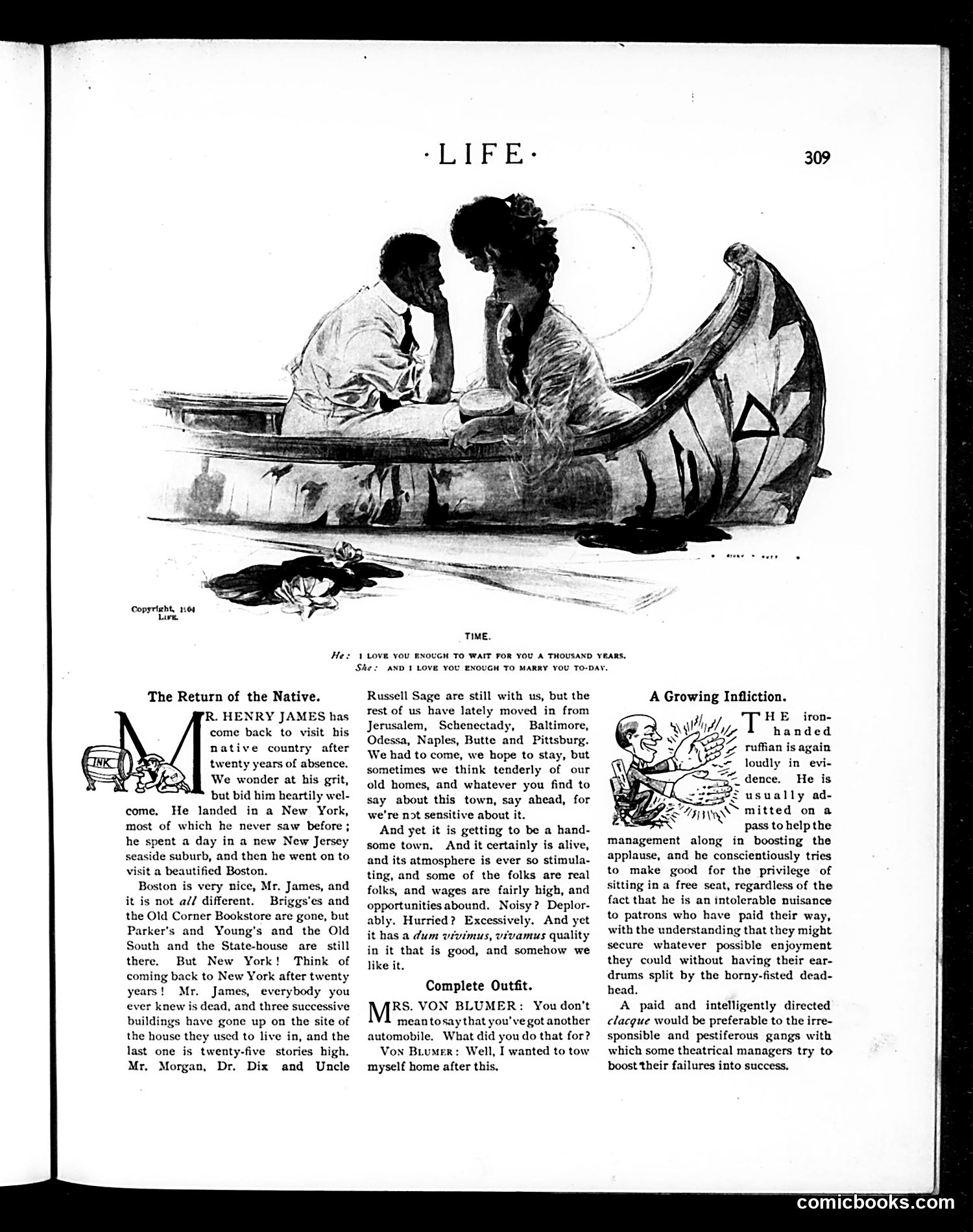
**Main Cartoon ("TIME"):** Two figures in a canoe exchange romantic declarations. The satire appears to mock sentimental romantic tropes—the absurdly exaggerated declarations ("wait a thousand years," "marry you today") are presented as clichéd sentiment, likely lampooning contemporary romance writing or theater. **"The Return of the Native":** This piece welcomes author Henry James back to America after twenty years abroad. The satire notes New York's radical transformation—buildings demolished and rebuilt multiple times over—while acknowledging the city's vitality despite (or because of) its chaotic energy and immigrant population influx ("moved in from Jerusalem, Schenectady, Baltimore..."). The tone is affectionate mockery of American restlessness and progress. **"Complete Outfit":** Mrs. Von Blumer jokes about buying another automobile to "tow myself home"—satirizing excessive wealth and the absurdity of conspicuous consumption among the wealthy. **"A Growing Infliction":** Criticizes paid theater "claque" (hired applauders) who disrupt performances, arguing that such artificial enthusiasm is worse than having none at all.
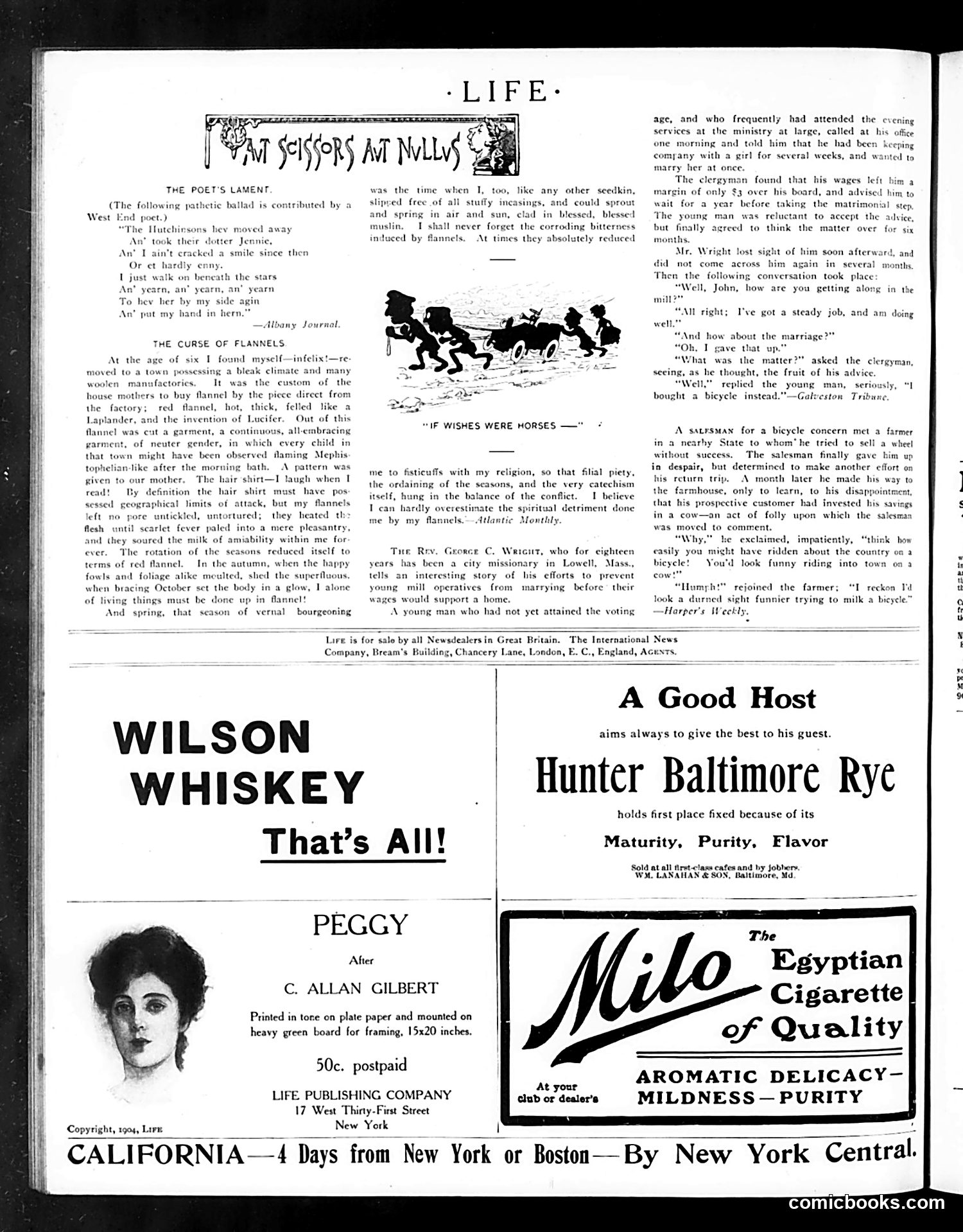
This page contains three humorous pieces satirizing American life circa early 1900s: **"The Poet's Lament"** mocks sentimental verse about lost love, presented as a contribution from a "West End poet." The crude dialect and overwrought emotion parody the popular romantic poetry of the era. **"The Curse of Flannels"** is a nostalgic complaint about childhood suffering from itchy red flannel underwear—a common complaint from that period when such garments were standard despite their discomfort. It's satirical social commentary on parental practices. **Three brief anecdotes** (including "If Wishes Were Horses") humorously contrast people's romantic or aspirational intentions with their actual choices—a young man choosing a bicycle over marriage, a farmer choosing a cow. These mock the gap between desire and practical decision-making. The page also contains period advertisements for Wilson Whiskey, Hunter Baltimore Rye, and Milo Egyptian Cigarettes—typical of Life's commercial content. Overall, the page satirizes sentiment, nostalgia, and human contradictions through accessible humor.
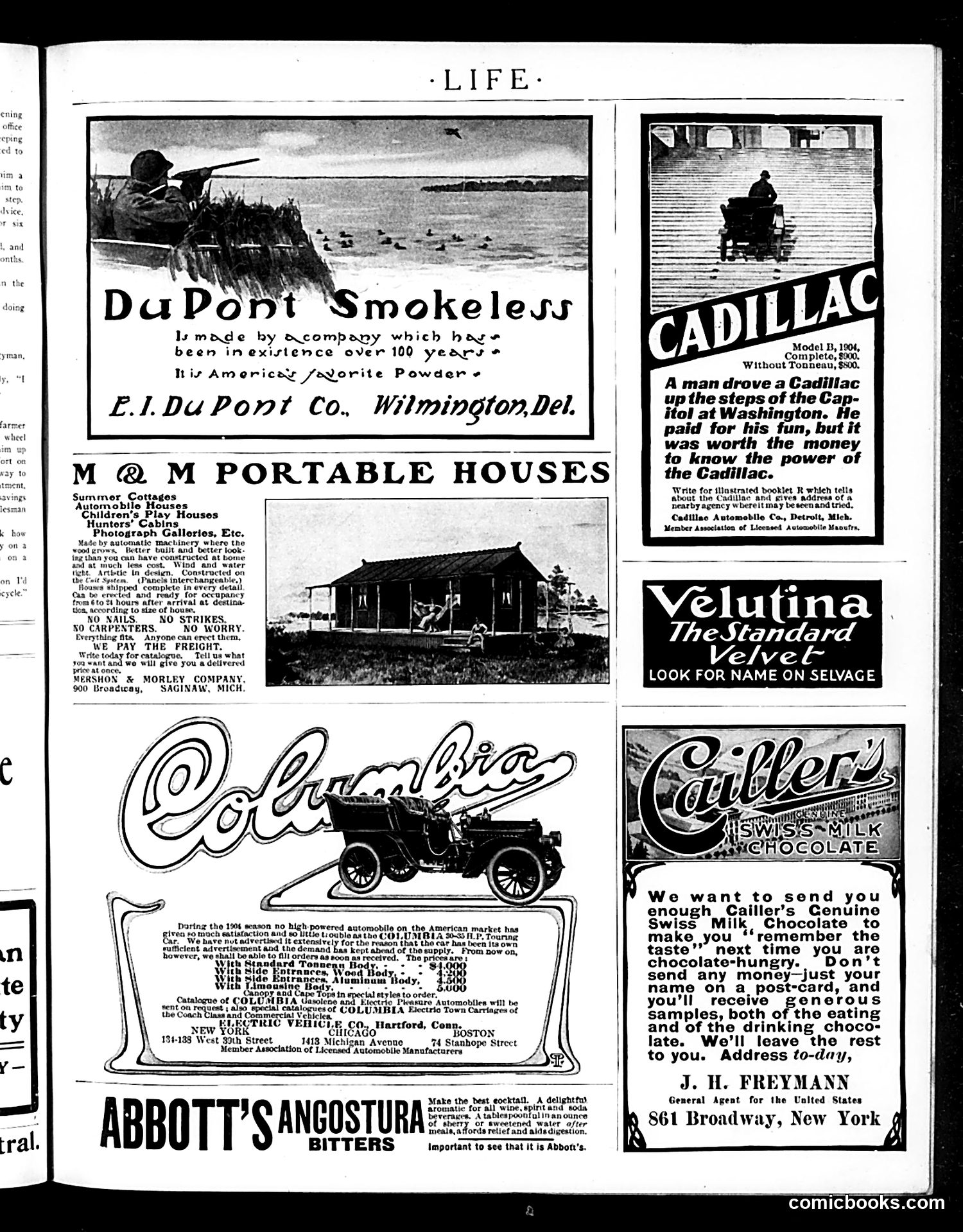
This is primarily an **advertising page** from Life magazine (circa 1904, based on car models shown). Rather than political satire, it showcases consumer products of the era. Notable ads include: - **DuPont Smokeless Powder** — emphasizing America's favorite gunpowder - **M&M Portable Houses** — prefabricated structures for summer cottages and hunting cabins, marketed as requiring no carpenters or skilled labor - **Columbia automobiles** — promoting their dominance in the market - **Cadillac** — featuring an anecdote about a man driving up the Capitol steps to demonstrate the car's power (a real 1902 stunt by Eugene Baker) - **Abbott's Angostura Bitters** — cocktail ingredients - **Cailler's Swiss Chocolate** and **Velvetina fabric** — consumer goods The page reflects early-1900s American consumer culture: industrial innovation, automobile enthusiasm, and leisure products for the growing middle class. There is no apparent political cartoon or satire here.
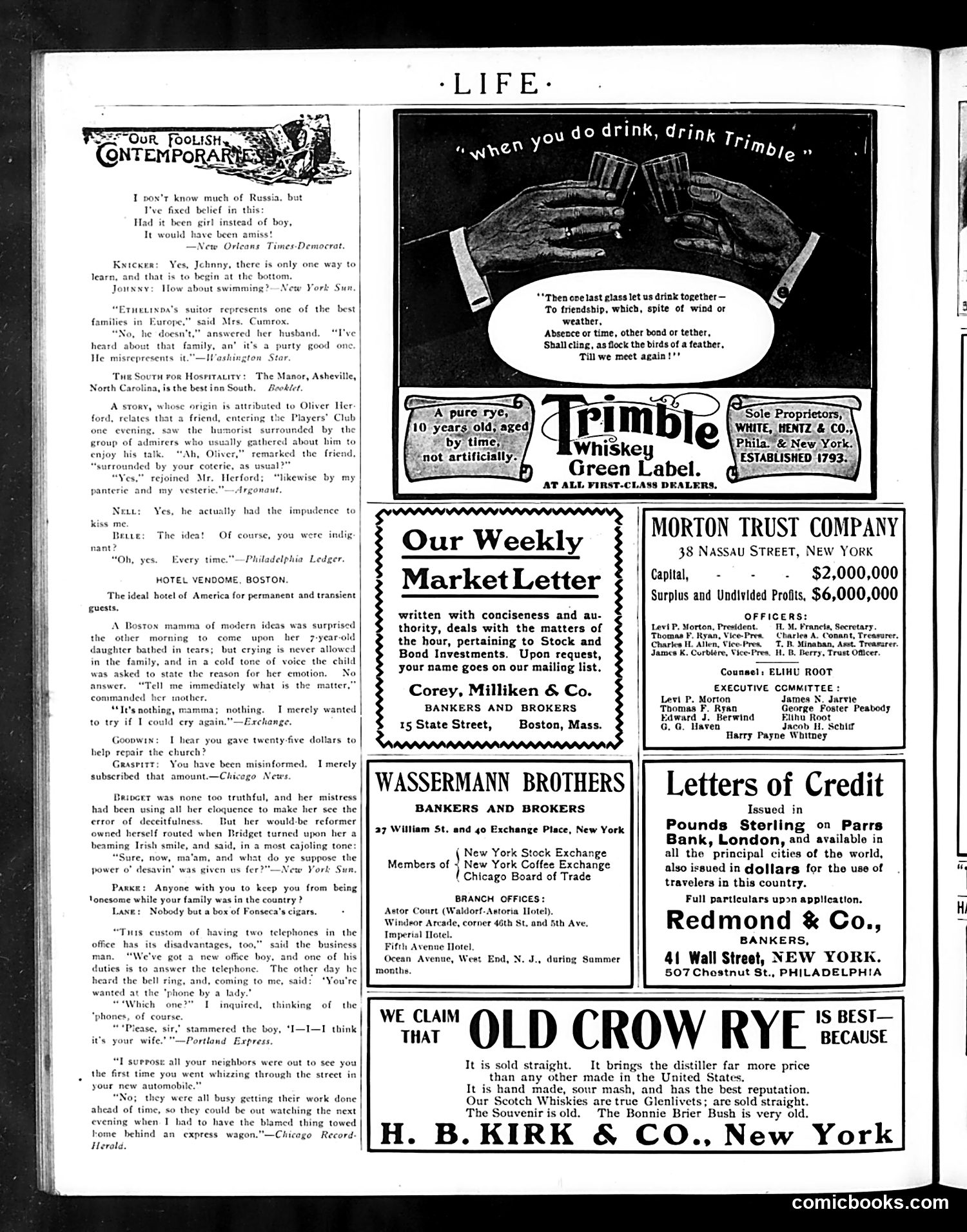
This page is primarily **advertisements and humor columns** rather than political cartoons. The main content includes: **Humor Pieces:** Short anecdotes about social etiquette, family dynamics, and Irish servant stereotypes—typical of early 20th-century American magazines. One recurring joke involves an Irish maid character exploiting her employer's sentimentality. **The Satire:** "Our Foolish Contemporary" section mocks newspaper clichés and sentimental writing about Russia and family values. **Advertisements:** The page features financial institutions (Morton Trust Company, Redmond & Co., Wassermann Brothers) and liquor ads (Trimble Whiskey, Old Crow Rye)—reflecting this era's open alcohol marketing before Prohibition. **Cultural Context:** The stereotypical Irish servant character and class-based humor reflect attitudes common to the period. The financial ads target wealthy readers, Life's core audience. The page lacks traditional political cartoons; it's essentially a humor/advertising hybrid typical of early 1900s American magazines.
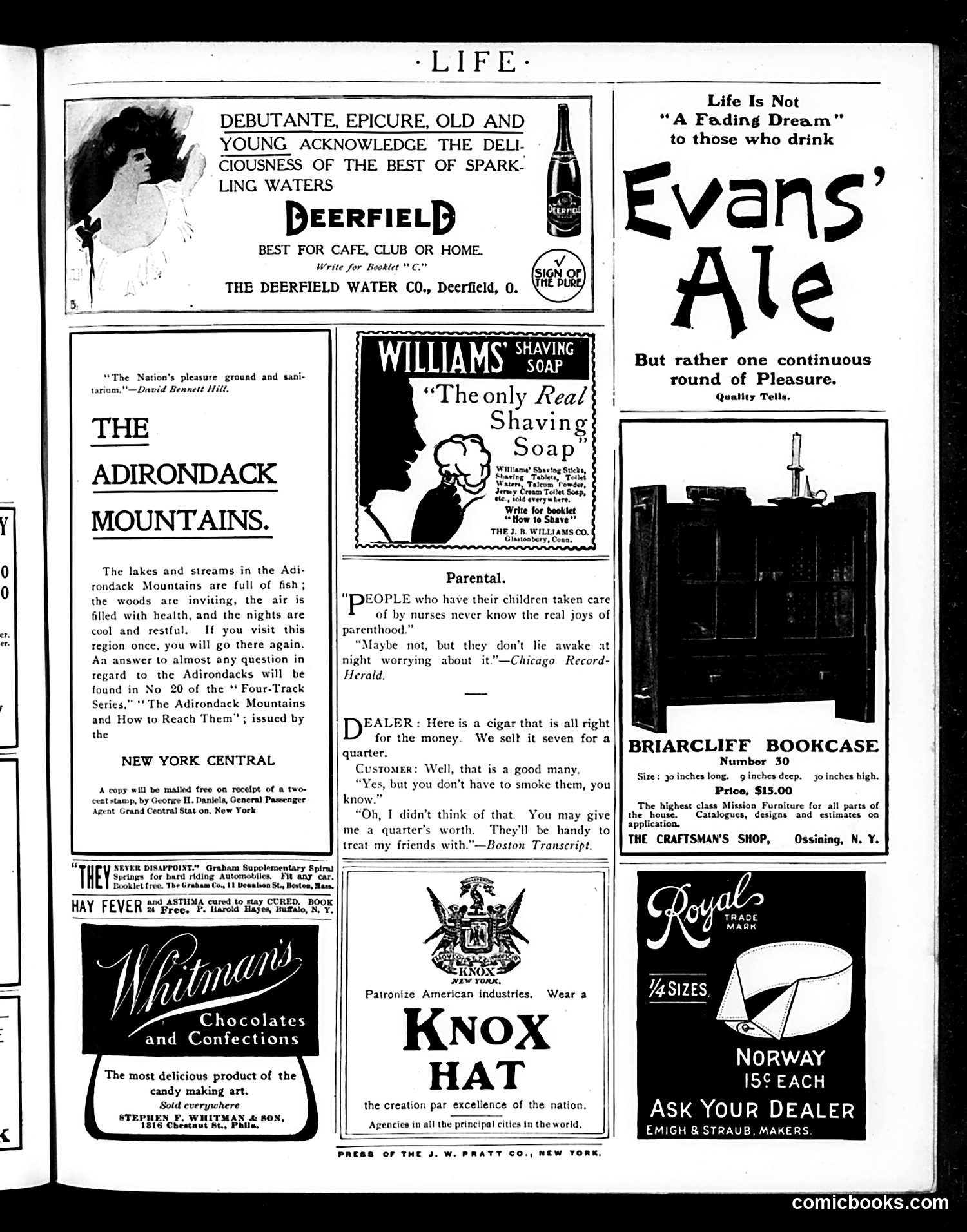
This is primarily an **advertising page** rather than editorial content or political cartoons. The page contains multiple product advertisements typical of early 20th-century American magazines. Notable content includes: **Evans' Ale advertisement** (right): Uses the phrase "Life Is Not 'A Fading Dream'" to position beer consumption as a source of continuous pleasure—reflecting the pre-Prohibition era when alcohol advertising was commonplace and unregulated. **Small comic dialogue** (center): A brief exchange between a cigar dealer and customer satirizes consumer culture—the customer initially objects to buying seven cigars for a quarter, then accepts them to impress friends, illustrating how social pressure drives spending. **Other advertisements** promote luxury goods (Briarcliff Bookcase, Knox Hats, Norway corsets) and services (Adirondack Mountains tourism, Whitman's chocolates), reflecting the aspirational consumer culture marketed to Life's educated, affluent readership. The page demonstrates how early 20th-century magazines blended advertising with light social commentary.
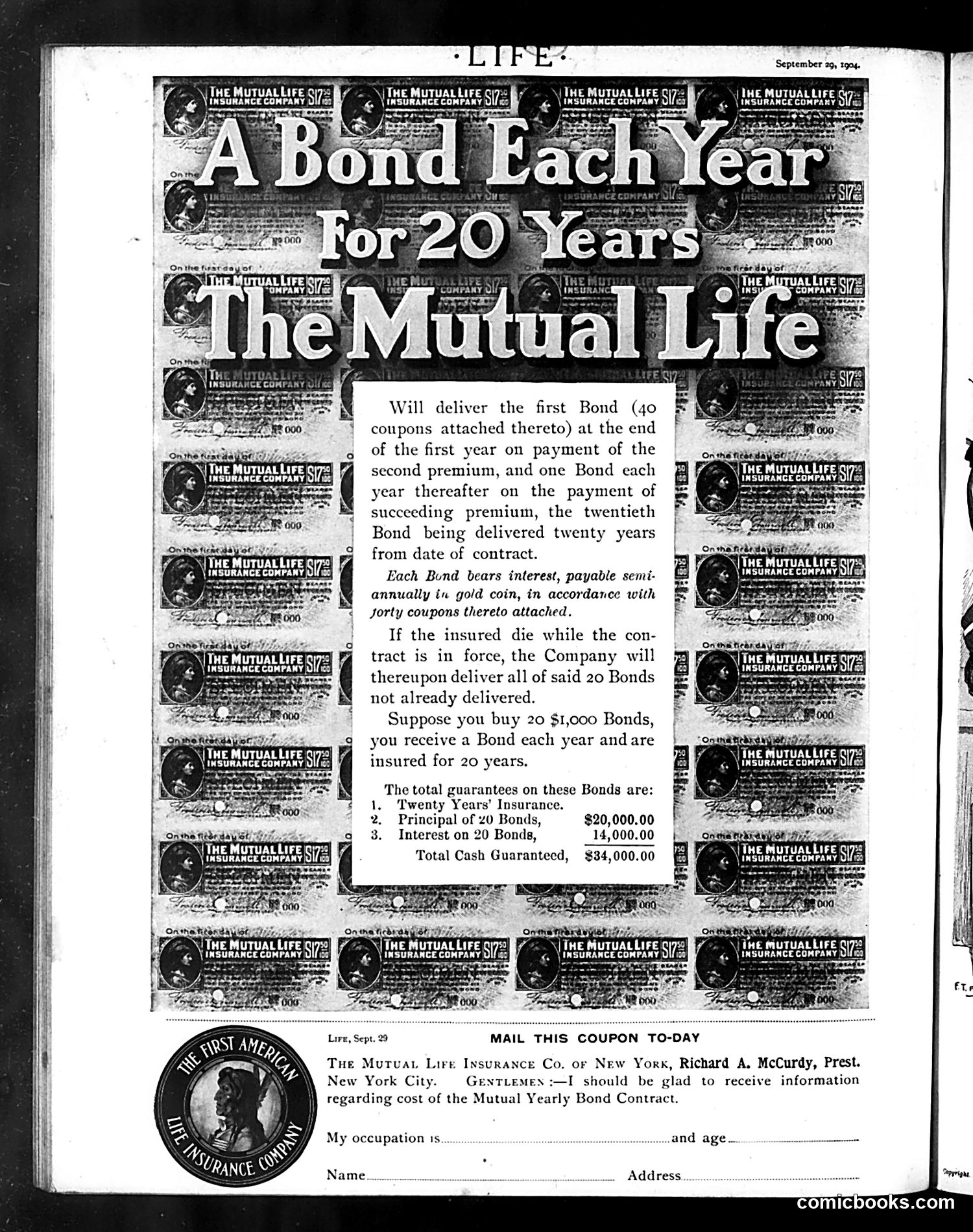
This is **not a cartoon but a financial advertisement** for The Mutual Life Insurance Company of New York, headed by President Richard A. McCurdy. The page promotes the company's "Yearly Bond Contract"—a 20-year insurance product where customers purchase $1,000 bonds annually, receiving one bond per year plus interest payments in gold coin. The total guaranteed value is $34,000 on a $20,000 principal investment. The visual strategy uses repeated images of Mutual Life Insurance Company certificates/bonds surrounding the text to create an impression of legitimacy and abundance. A mail-in coupon at the bottom invites interested readers to request more information. **Historical context**: This represents early-1900s life insurance marketing before modern consumer protections. The appeal to "gold coin" guarantees and specific numerical returns reflects the financial anxieties of the era and insurance companies' efforts to appear rock-solid and trustworthy.