
Life, 1904-09-29 · page 8 of 20
Life — September 29, 1904 — page 8: what you’re looking at
What you’re looking at
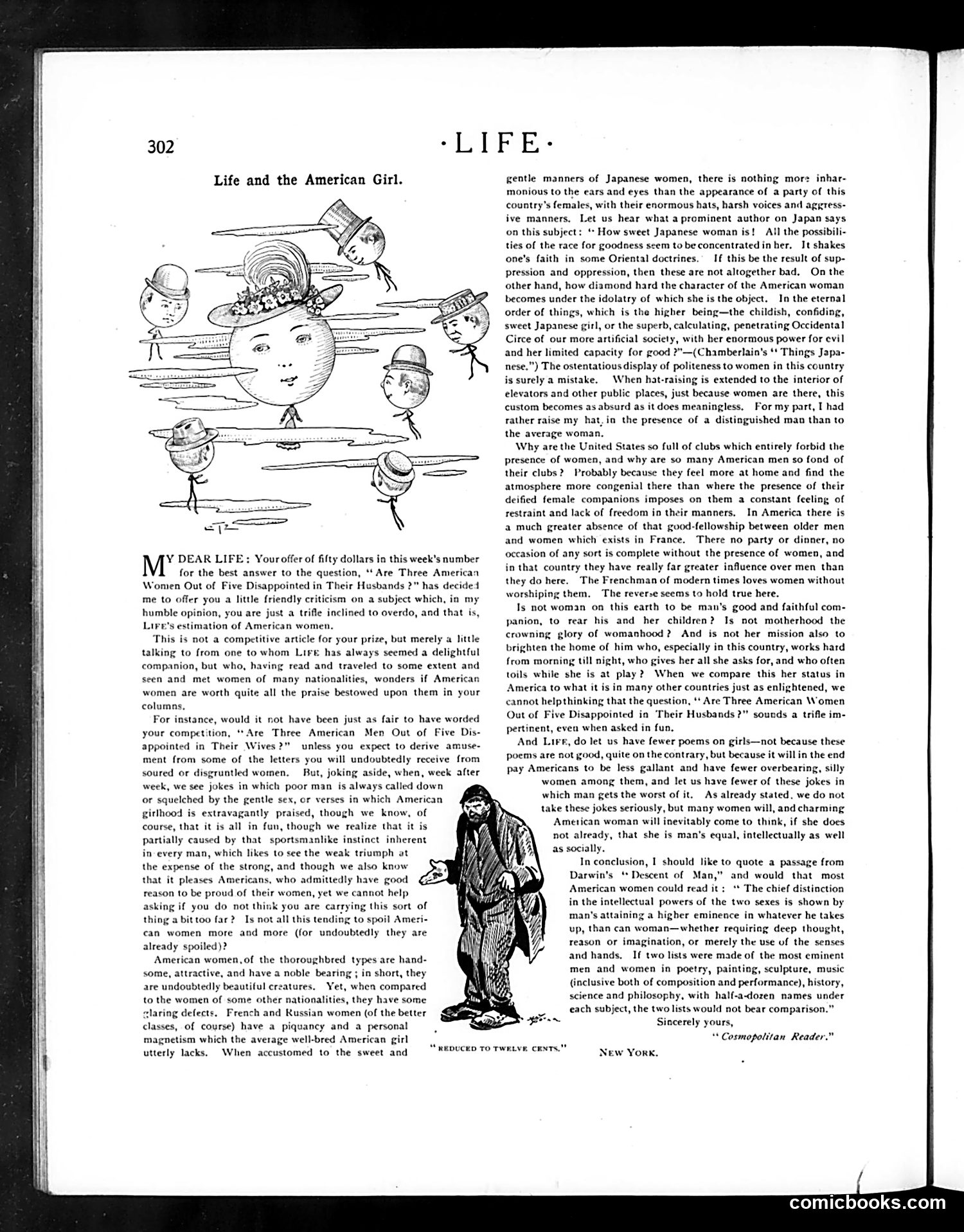
This satirical piece contrasts American and Japanese women, using caricature to mock both. The illustration shows exaggerated female heads with elaborate hats surrounded by small male figures, visually emphasizing the "enormous hats, harsh voices and aggressive manners" the text attributes to American women. The letter defends American women against implied criticism, claiming they possess greater freedom and intellectual capability than their Japanese or European counterparts. The author argues American women's assertiveness—previously mocked—actually reflects admirable independence and influence. The piece appears to respond to earlier *Life* content questioning American femininity, turning the satire back on detractors. The Darwin quote at the end suggests intellectual equality between sexes, positioning American women's boldness as evolutionary progress rather than social failing.
📄 Transcribed text from this page (OCR, searchable)
Machine-transcribed from the original scan — historical spelling and the odd misread are preserved.
*LIPFE: Life and the American Girl. 'Y DEAR LIFE: Youroffer of fifty dollars in this week's number for the best answer to the question, ‘Are Three American Women Out of Five Disappointed in Their Husbands 2” has decided me to offer you a little friendly criticism on a subject which, in my humble opinion, you are just a trifle inclined to overdo, and that is, Lire’s estimation of American women. This is not a competitive article for your prize, but merely a little talking to from one to whom Lire has always seemed a delightful companion, but who, having read and traveled to some extent and seen and met women of many nationalities, wonders if American women are worth quite all the praise bestowed upon them in your columns, For instance, would it not have been just as fair to have worded your competition, Are Three American Men Out of Five Dis- appointed in Their Wives?” unless you expect to derive amuse- ment from some of the letters you will undoubtedly receive from soured or disgruntled women. But, joking aside, when, week after week, we see jokes in which poor man is always called down or squelched by the gentle sex, or verses in which American girlhood is extravagantly praised, though we know, of course, that it is all in fun, though we realize that it is partially caused by that sportsmanlike instinct inherent in every man, which likes to see the weak triumph at the expense of the strong, and though we also know that it pleases Americans, who admittedly have good reason to be proud of their women, yet we cannot help asking if you do not think you are carrying this sort of thing abit too far? Is not all this tending to spoil Am can women more and more (for undoubtedly they are already spoiled)? American women,of the thoroughbred types are hand- some, attractive, and have a noble bearing ; in short, they are undoubtedly beautiful creatures. Yet, when compared to the women of some other nationalities, they have some glaring defects, French and Russian women (of the better classes, of course) have a piquancy and a personal magnetism which the average well-bred American girl utterly lacks. When accustomed to the sweet and “ REDUCED TO TWELVE CENTS." gentle manners of Japanese women, there is nothing mor? inhar- monious to the ears and eyes than the appearance of a party of this country’s females, with their enormous bats, harsh voices and aggress- ive manners. Let us hear what a prominent author on Japan says on this subject: * How sweet Japanese woman is! All the possibili- ties of the race for goodness seem to be concentrated in her, It shakes one’s faith in some Oriental doctrines. If this be the result of sup- pression and oppression, then these are not altogether bad, On the other hand, how diamond hard the character of the American woman becomes under the idolatry of which she is the object. In the eternal order of things, which is the higher being—the childish, confiding, sweet Japanese gitl, or the superb, calculating, penetrating Occidental Circe of our more artificial society, with ber enormous power for evil and her limited capacity for good ?"—(Chamberlain’s * Things Japa- nese.") The ostentatious display of politeness to women in this country is surely a mistake. When hat-raising is extended to the interior of elevators and other public places, just because women are there, this custom becomes as absurd as it does meaningless, For my part, I had rather raise my hat, in the presence of a distinguished man than to the average woman, Why are the United States so full of clubs which entirely forbid the presence of women, and why are so many American men so fond of their clubs? Probably because they feel more at home and find the atmosphere more congenial there than where the presence of their deified female companions imposes on them a constant feeling of restraint and lack of freedom in their manners. In America there is a much greater absence of that good-fellowship between older men and women which exists in France, There no party or dinner, no occasion of any sort is complete without the presence of women, and in that country they have really far greater influence over men than they do here. The Frenchman of modern times loves women without worshiping them, The reverse seems to hold true here. Is not woman on this earth to be man’s good and faithful com- panion, to rear his and her children? Is not motherhood the crowning glory of womanhood? And is not her mission also to brighten the home of him who, especially in this country, works hard from morning till night, who gives her all she asks for, and who often toils while she is at play? When we compare this her status in America to what it is in many other countries just as enlightened, we cannot helpthinking that the question, ‘* Are Three American Women Out of Five Disappointed in Their Husbands?” sounds a trifle im- pertinent, even when asked in fun, And Lire, do let us have fewer poems on girls—not because these poems are not good, quite on the contrary, but because it will in the end pay Americans to be less gallant and have fewer overbearing, silly women among them, and let us have fewer of these jokes in which man gets the worst of it. As already stated. we do not take these jokes seriously, but many women will, and charming American woman will inevitably come to think, if she does not already, that she is man's equal, intellectually as well as socially. In conclusion, 1 should like to quote a passage from Darwin's Descent of Man," and would that most American women could read it: ** The chief distinction in the intellectual powers of the two sexes is shown by man’s attaining a higher eminence in whatever he takes vp, than can woman—whether requiring deep thought, reason or imagination, or merely the use of the senses and hands. If two lists were made of the most eminent men and women in poetry, painting, sculpture, music (inclusive both of composition and performance), history, science and philosophy, with half-a-dozen names under each subject, the two lists would not bear comparison.” Sincerely yours, “Cosmopolitan Reader. New York. comicbooks.com