
Life, 1904-09-29 · page 12 of 20
Life — September 29, 1904 — page 12: what you’re looking at
What you’re looking at
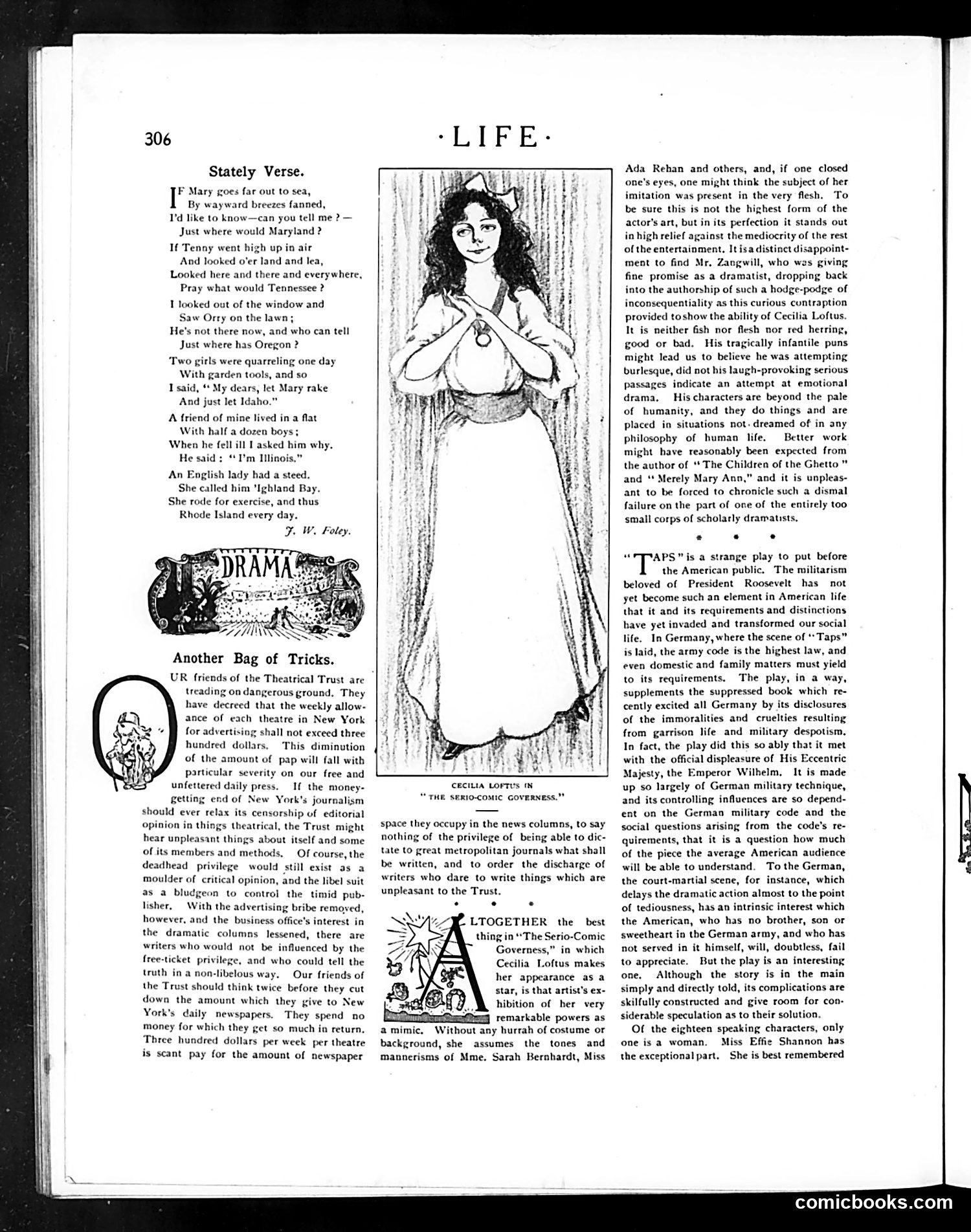
This page contains drama criticism and theatrical commentary rather than political cartoons. The main content discusses Cecilia Loftus's performance in a play, critiquing her acting as technically skilled but emotionally shallow—lacking the depth expected from serious drama. The "Another Bag of Tricks" section satirizes the Theatrical Trust's monopolistic control over New York theater advertising. It mocks their censorship of editorial content and their financial leverage over newspapers, arguing they suppress critical commentary. The piece advocates for press freedom against corporate control of theatrical coverage. The accompanying illustration labeled "Cecilia Loftus in 'The Sericomic Governess'" shows the actress in costume, supporting the dramatic criticism above.
📄 Transcribed text from this page (OCR, searchable)
Machine-transcribed from the original scan — historical spelling and the odd misread are preserved.
306 Stately Verse. F Mary goes far out to sea, By wayward breezes fanned, I'd like to know—can you tell me? — Just where would Maryland 2 If Tenny went high up in air And looked o'er land and lea, Looked here and there and everywhere, Pray what would Tennessee ? I looked out of the window and Saw Orty on the lawn; He's not there now, and who can tell Just where has Oregon ? ‘Two girls were quarreling one day With garden tools, and so I said, My dears, let Mary rake And just let Idaho.” A friend of mine lived in a flat With half a dozen boys; When he fell ill I asked him why. He said : “I'm Ilinois.” An English lady had a steed. She called him "Igbland Bay. She rode for exercise, and thus Rhode Island every day. J. W. Foley. Another Bag of Tricks. UR friends of the Theatrical Trust are treading on dangerous ground. They have decreed that the weekly allow- ance of each theatre in New York for advertising shall not exceed three hundred dollars, This diminution 6 of the amount of pap will fall with particular severity on our free and unfettered daily press. If the money- getting end of New York's journalism should ever relax its censorship of editorial opinion in things theatrical, the Trust might hear unpleasant things about itself and some of its members and methods, Of course, the deadhead privilege would still exist as a moulder of critical opinion, and the libel suit asa bludgeon to control the timid pub- lisher, With the advertising bribe removed, however, and the business office's interest in the dramatic columns lessened, there are writers who would not be influenced by the free-ticket privilege, and who could tell the truth in a non-libelous way. Our friends of the Trust should think twice before they cut down the amount which they give to New York's daily newspapers. They spend no money for which they get so much in return, Three hundred dollars per week per theatre is scant pay for the amount of newspaper CECILIA LOFTUS (8 “THE SERIO-COMIC GOVERNESS.” space they occupy in the news columns, to say nothing of the privilege of being able to dic- tate to great metropolitan journals what shall be written, and to order the discharge of writers who dare to write things which are unpleasant to the Trust. . . LTOGETHER the _ best thing in “The Serio-Comic Governess,” in which Cecilia Loftus makes her appearance as a star, is that artist's ex- hibition of her very remarkable powers as ic. Without any hurrah of costume or background, she assumes the tones and mannerisms of Mme. Sarah Bernhardt, Miss Ada Rehan and others, and, if one closed one’s eyes, one might think the subject of her imitation was present in the very flesh. To be sure this is not the highest form of the actor's art, but in its perfection it stands out in high relief against the mediocrity of the rest of the entertainment. It isa distinct disappoint- ment to find Mr, Zangwill, who was giving fine promise as a dramatist, dropping back into the authorship of such a hodge-podge of inconsequentiality as this curious contraption provided toshow the ability of Cecilia Loftus. It is neither Gsh nor flesh nor red herring, good or bad. His tragically infantile puns might lead us to believe he was attempting burlesque, did not his laugh-provoking serious passages indicate an attempt at emotional drama, His characters are beyond the pale of humanity, and they do things and are placed in situations not. dreamed of in any philosophy of human life. Better work might have reasonably been expected from the author of “The Children of the Ghetto” and “ Merely Mary Ano,” and it is unpleas- ant to be forced to chronicle such a dismal failure on the part of one of the entirely too small corps of scholarly dramatists. * . . “APS "is a strange play to put before the American public, The militarism beloved of President Roosevelt has not yet become such an element in American life that it and its requirements and distinctions have yet invaded and transformed our social life. In Germany, where the scene of “Taps” is laid, the army code is the highest law, and even domestic and family matters must yield to its requirements, The play, in a way, supplements the suppressed book which re- cently excited all Germany by its disclosures of the immoralities and cruelties resulting from garrison life and military despotism. In fact, the play did this so ably that it met with the official displeasure of His Eccentric Majesty, the Emperor Wilhelm, It is made up so largely of German military technique, and its controlling influences are so depend- ent on the German military code and the social questions arising from the code's re- quirements, that it is a question how much of the piece the average American audience will be able to understand, To the German, the court-martial scene, for instance, which delays the dramatic action almost to the point of tediousness, has an intrinsic interest which the American, who has no brother, son or sweetheart in the German army, and who has not served in it himself, will, doubtless, fail to appreciate. But the play is an interesting one, Although the story is in the main simply and directly told, its complications are skilfully constructed and give room for con- siderable speculation as to their solution. Of the eighteen speaking characters, only one is a woman. Miss Effie Shannon has the exceptional part, She is best remembered comicbooks.com