
Life, 1904-09-29 · page 16 of 20
Life — September 29, 1904 — page 16: what you’re looking at
What you’re looking at
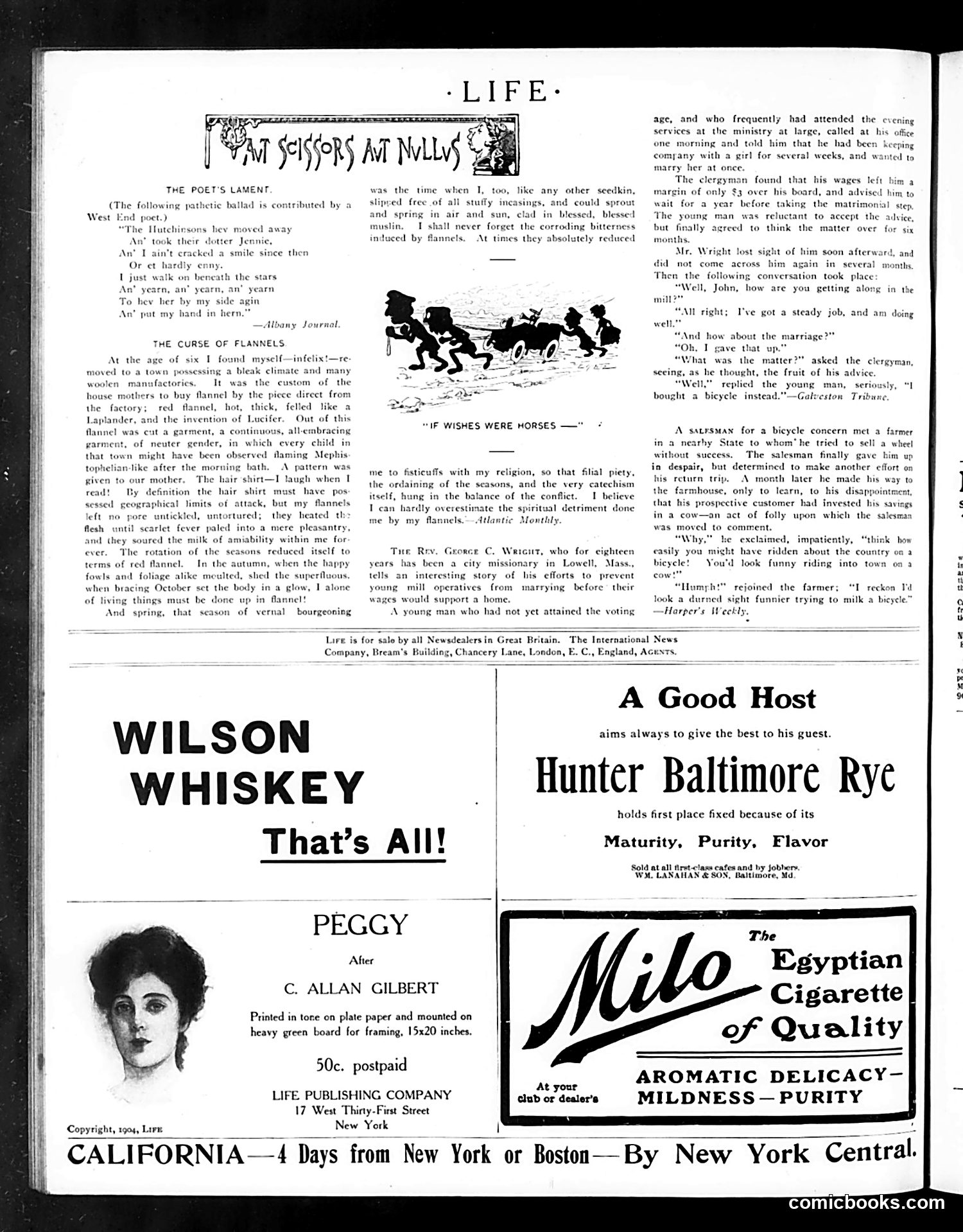
This page contains three humorous pieces satirizing American life circa early 1900s: **"The Poet's Lament"** mocks sentimental verse about lost love, presented as a contribution from a "West End poet." The crude dialect and overwrought emotion parody the popular romantic poetry of the era. **"The Curse of Flannels"** is a nostalgic complaint about childhood suffering from itchy red flannel underwear—a common complaint from that period when such garments were standard despite their discomfort. It's satirical social commentary on parental practices. **Three brief anecdotes** (including "If Wishes Were Horses") humorously contrast people's romantic or aspirational intentions with their actual choices—a young man choosing a bicycle over marriage, a farmer choosing a cow. These mock the gap between desire and practical decision-making. The page also contains period advertisements for Wilson Whiskey, Hunter Baltimore Rye, and Milo Egyptian Cigarettes—typical of Life's commercial content. Overall, the page satirizes sentiment, nostalgia, and human contradictions through accessible humor.
📄 Transcribed text from this page (OCR, searchable)
Machine-transcribed from the original scan — historical spelling and the odd misread are preserved.
oe Sq See ee f AT SEIGRS AT Mullis & ORS AT MLL & THE POET'S LAMENT was the time when like any other scedkin, (The following pathetic ballad is contributed by a Slipred free of all vey incasings, and could sprout West End poet.) “The Ilutehinsons hey moved away * took their dotter Jennie An’ I ain't cracked a smile since then Or et hardly er I just walk on beneath the stars and sprin a clad in. blessed, blessed t the corroding bitte At times they absolutely reduce An’ yearn, an’ yearn, an’ yearn To hev her by my side agin An’ pat my hand in her.” —Albany Jourr THE CURSE OF FLANNELS. At the age of six I found myself—infetix moved to a town possessing a bleak climate and woolen manufactorics. It was the om of house mothers to buy flannel by the piece direct from the factory; red flannel, hot, thick, felled like a ap Laplander, and the invention of Luci Out of this flannel was ev t, a cont all-embrac’ garment, of neuter gender, in which every child that town might have been observed flaming Mephis tophelian-like after the morning bath. A pattern was given to our mother. The hair shirt—I laugh when 1 rea Ry definition the hair shirt must have pos sessed geographical limits of attack, but my flannels “IF WISHES WERE HORSES — me to fisticuffs with my religion, so that filial piety, the ordaining of the seasons, and the very catechism itself, hung in the balance of the conflict. I believe I can hardly overestimate the spiritual detriment done left_no pore untickted, untortured; they heated th> ne by my flannels.” Atlantic Monthly. flesh until scarlet fever paled into a mere pleasantry, and they soured the milk of amiability within me for ever. The rotation of the seasons reduced itself to Tue Rev. Georce C. Werrcit, who for eighteen terms of red flannel. In the autumn, when the happy cars has been a city missionary in Lowell, Mass., fowls and foliage alike moulted, shed the superfluous, interesting story of his efforts to prevent when bracing October set the body in a glow, I al young mill operatives from marrying before their ing things must be done up in flannel! wages would support a home. And spring, that season of vernal bourgeoning \ young man who had not yet attained the voting age, and who frequently had attended the cvening services at the ministry at large, called at his office one morning and told him that he bad been keeping company with a girl for several weeks, and wanted to marry her at once. The clergyman found that his wages left him a margin of only $3 over his board, and advised him to wait for a year before taking the matrimonial step, The young man was reluctant to accept the advice, but finally agreed to think the matter over for six months. Mr. Wright lost didnot come across again in several ‘Then the following conversation took “Well, John, how are you getting along in the mill?" “All right; I've got a steady job, and am doing well.” “And how about the marriage?” “Oh, I gave that up What was the matter?" asked the clergy as he thought, the fruit of his advic “Well,” replied the young man, seri bought a bicycle instead."—Galveston Tribune A satrsman for a bicycle concern met a farmer in a near! State to whom"he tried to sell a wheel without success. The salesman finally gave bim up in despair, but determined to make another effort on his return trip. A month later he made his way to the farmhouse, only to learn, to his disappointment, that his prospective customer had invested his savings in a cow—an act of folly upon which the salesman was moved to comment. “Why,” he exclaimed, impatiently, “think how asily you might have ridden about the country oa a bicycle! You’ look funny riding into town on a cow “Humph!" rejoined the farmer; “I reckon Til look a durned sight funnier trying to milk a bicycle.” “Harper's Weekly. Lire is for sale by all Newsdealers in Great Britain. ‘The Internatio! apany, Bream's Building, Chancery Lane, London, E. C., England, nal News Acents. A Good Host W ] 1 S Oo N aims always to give the best to his guest. WHISKEY hol Hunter Baltimore Rye ds first place fixed because of its That’s A I ! Maturity, Purity, Flavor PEGGY After Cc. ALLAN GILBERT Printed in tone on plate paper and mounted on heavy green board for framing, 15x20 inches. 50c. postpaid At LIFE PUBLISHING COMPANY Guy cc oui 17 West Thiny-First Street Mt 1904, Lire New York 1d at all first-class cafes and by jobhery. “WM. LANAHAN & SON, Baltimore, Md. Egyptian Cigarette of Quality AROMATIC DELICACY— MILDNESS— PURITY CALIFORNIA —4 Days from New York or Boston—By New York Central comicbooks.com