
Life, 1904-09-29 · page 13 of 20
Life — September 29, 1904 — page 13: what you’re looking at
What you’re looking at
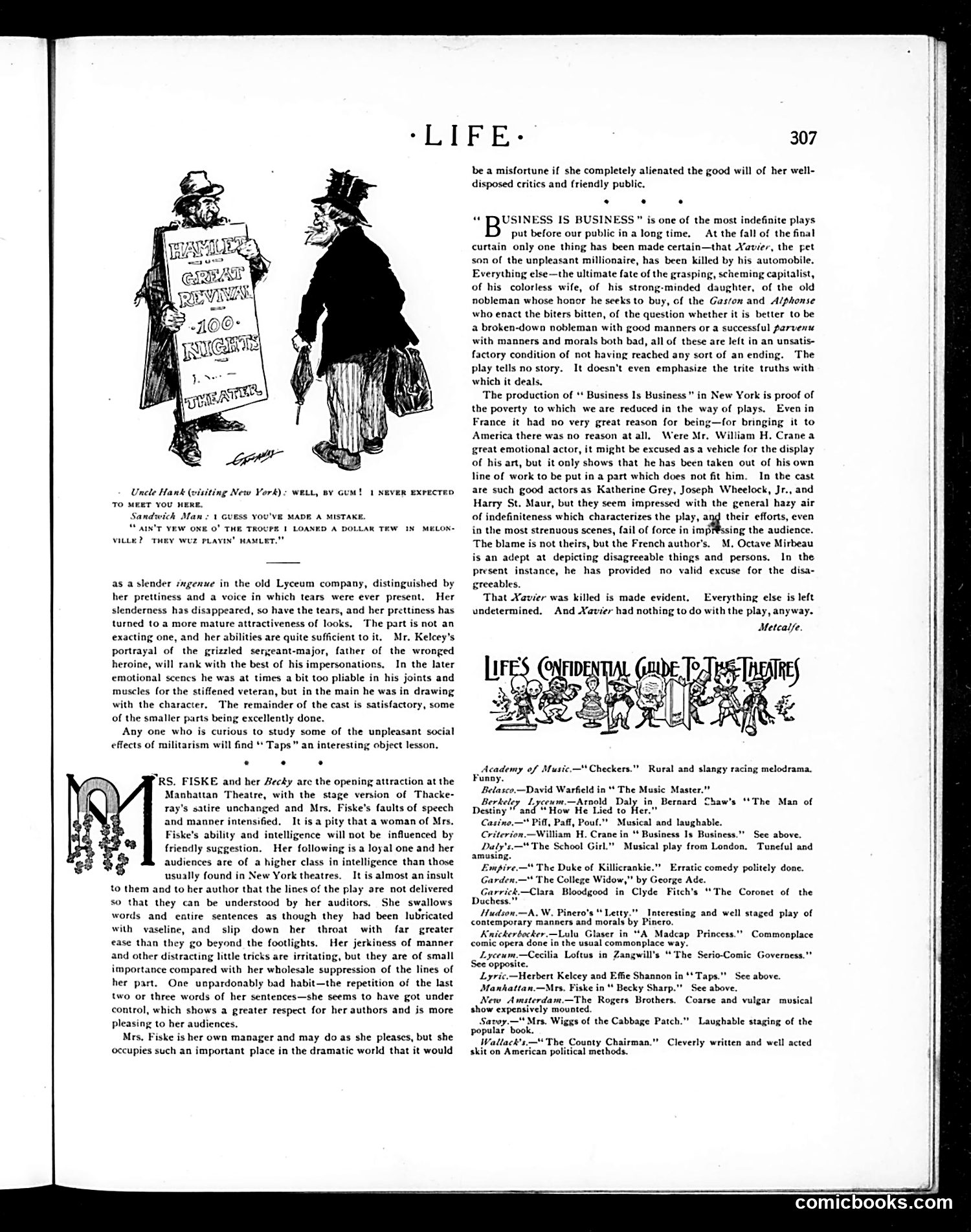
The cartoon depicts a humorous encounter between two men in New York City. One figure, labeled "Uncle Hank (visiting New York)," carries a placard advertising a theatrical troupe performing *Hamlet* in a rural area ("Melonville"). He mistakes the well-dressed urban man for a member of that touring company, asking if he's "one o' the troupe" he loaned money to. The satire contrasts rural and urban America: the unsophisticated country visitor, dressed plainly with his theatrical announcement, encounters a city dweller he wrongly assumes shares his provincial background. The joke plays on the incongruity—the urbanite's refined appearance and evident status make the misidentification absurd to contemporary readers, mocking both rural naïveté and the vast cultural gap between small-town and metropolitan America circa the early 1900s.
📄 Transcribed text from this page (OCR, searchable)
Machine-transcribed from the original scan — historical spelling and the odd misread are preserved.
gS) a a ch ing New York): wett, By GuM! 1 NEVER EXPECTED To MEET YoU MERE. Sandwick Man: 1 GUESS YOU'VE MADE A MISTAKE “AIN'T YEW ONE O° IE TROUPE | LOANED A DOLLAR TEW IN MELON- VILLE? THEY WUZ PLAYIN’ HAMLET." as a slender :ngenue in the old Lyceum company, distinguished by her prettiness and a voice in which tears were ever present. Her slenderness has disappeared, so have the tears, and her prettiness has turned toa more mature attractiveness of looks, The part is not an exacting one, and her abilities are quite sufficient to it. Mr. Kelcey’s portrayal of the grizzled sergeant-major, father of the wronged heroine, will rank with the best of his impersonations. In the later emotional scencs he was at times a bit too pliable in his joints and muscles for the stiffened veteran, but in the main he was in drawing with the character, The remainder of the cast is satisfactory, some of the smaller parts being excellently done. Any one who is curious to study some of the unpleasant social effects of militarism will find ** Taps” an interesting object lesson. PRS. FISKE and her Sechy are the opening attraction at the Manhattan Theatre, with the stage version of Thacke- ray's satire unchanged and Mrs. Fiske’s faults of speech and manner intensified. It is a pity that a woman of Mrs. Fiske’s ability and intelligence will not be influenced by friendly suggestion. Her following is a loyal one and her audiences are of a higher class in intelligence than those usually found in New York theatres. It is almost an insult to them and to her author that the lines of the play are not delivered so that they can be understood by her auditors. She swallows words and entire sentences as though they had been lubricated with vaseline, and slip down her throat with far greater ease than they go beyond the footlights, Her jerkiness of manner and other distracting little tricks are irritating, but they are of small importance compared with her wholesale suppression of the lines of her part. One unpardonably bad habit—the repetition of the last two or three words of her sentences—she seems to have got under control, which shows a greater respect for her authors and is more pleasing to her audiences. Mrs, Fiske is her own manager and may do as she pleases, but she occupies such an important place in the dramatic world that it would 307 be a misfortune if she completely alienated the good will of her well- disposed critics and friendly public. . . USINESS IS BUSINESS" is one of the most indefinite plays put before our public ina long time. At the fall of the final curtain only one thing has been made certain—that Xavier, the pet son of the unpleasant millionaire, has been killed by his automobile. Everything else—the ultimate fate of the grasping, scheming capitalist, of his colorless wife, of his strong-minded daughter, of the old nobleman whose honor he seeks to buy, of the Gasfon and Alphonse who enact the biters bitten, of the question whether it is better to be a broken-down nobleman with good manners or a successful parvent with manners and morals both bad, all of these are left in an unsatis- factory condition of not having reached any sort of an ending. The play tells no story. It doesn't even emphasize the trite truths with which it deals. The production of * Business Is Business" in New York is proof of the poverty to which we are reduced in the way of plays, Even in France it had no very great reason for being—for bringing it to America there was no reason at all, Were Mr, William H. Crane a great emotional actor, it might be excused as a vehicle for the display of his art, but it only shows that he has been taken out of his own line of work to be put in a part which does not fit him. In the cast are such good actors as Katherine Grey, Joseph Wheelock, Jr., and Harry St. Maur, but they seem impressed with the general hazy air of indefiniteness which characterizes the play, aa tele efforts, even in the most strenuous scenes, fail of force in impréssing the audience. The blame is not theirs, but the French author's. M, Octave Mirbeau is an adept at depicting disagreeable things and persons. In the present instance, he has provided no valid excuse for the disa- greeables, That Xavier was killed is made evident. Everything else is left undetermined. And Xavier had nothing to do with the play, anyway. Metcalfe. Academy of Music.—* Checkers.” Funny. Belasco,—David Warfield in Berkeley Lyceum—Arnold Daly in Bernard Shaw's Destiny 'f and How He Lied to Her.” Musical and laughable. in “Business Is Business.” Musical play from London. Rural and slangy racing melodrama. The Music Master.”” “The Man of See above. Daly's Tuneful and amusing. Empire: Garden. Garric Duchess.” Hudson.—&.W. Pinero's “ Letty."" Interesting and well staged play of contemporary manners and morals by Pinero. Knickerbocker.—Lulu Glaser in “A Madcap Princess.” comic opera done in the usual commonplac Lyceum—Cecilia Loftus in Zangwill’s See opposite. Lyric.—Herbert Kelcey and Effie Shannon in ‘*Taps."" See above. Manhattan.—Mrs. Fiske in“ Becky Sharp."" See above. New Amsterdam.—The Rogers Brothers. Coarse and vulgar musical show expensively mounted. Satoy.—" Mrs. Wiggs of the Cabbage Patch.”” popular bool Wallack's.—“ The County Chairman.” skit on American political methods. ‘The Duke of Killicrankie.”” Erratic comedy politely done. “The College Widow,” by George Ad: —Clara Bloodgood in Clyde Fitch’s “The Coronet of the Commonplace fhe Serio-Comic Governess."* Laughable staging of the Cleverly written and well acted comicbooks.com