
Life, 1904-09-29 · page 4 of 20
Life — September 29, 1904 — page 4: what you’re looking at
What you’re looking at
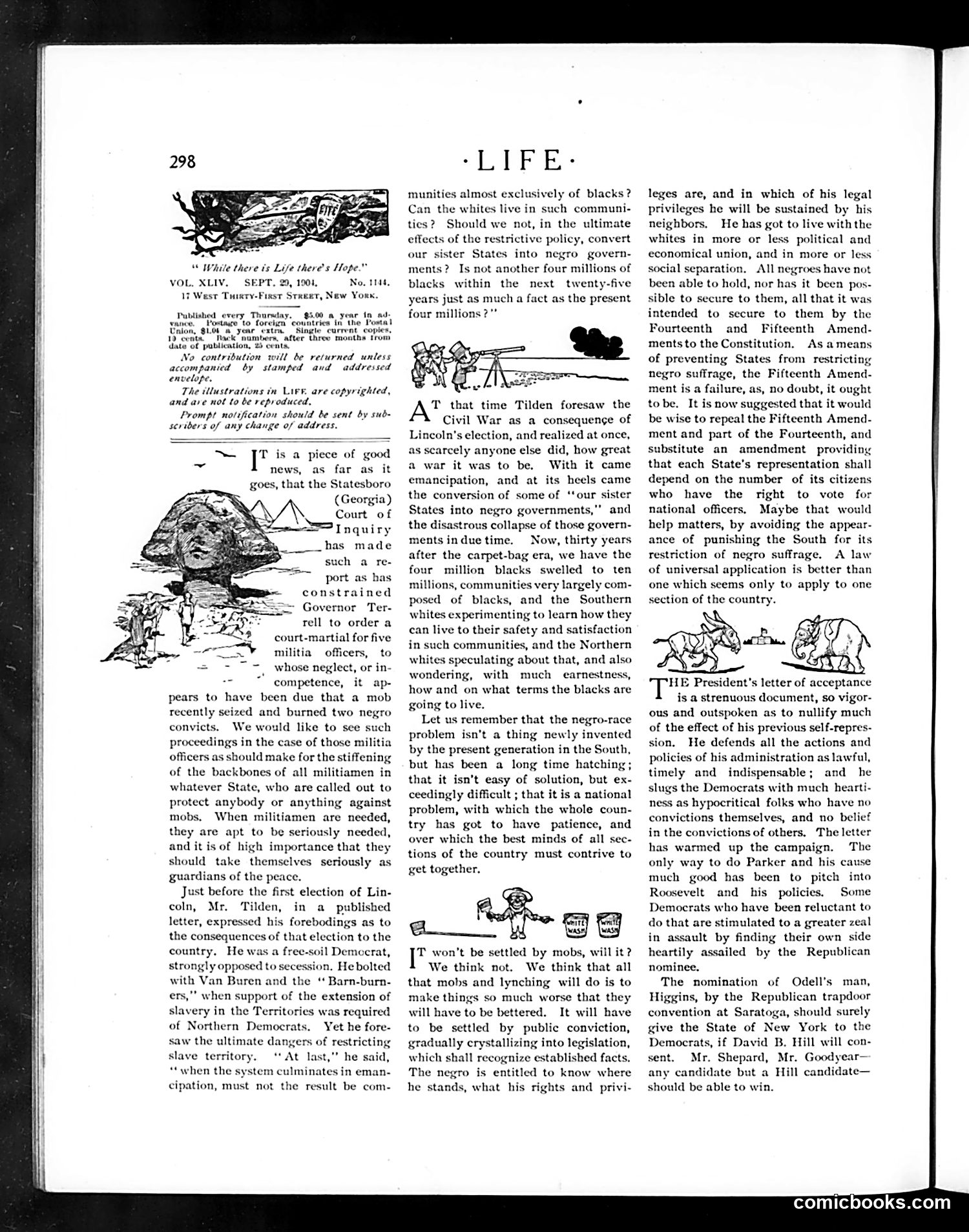
This page contains political commentary on race and governance following Lincoln's anticipated election. The text discusses the "negro-race problem" and debates whether restricting Black suffrage or granting representation would better solve racial tensions. The three small cartoons appear to illustrate political anxiety: one shows figures at a telescope (suggesting observation/concern), another depicts what appears to be figures in conflict or distress. The commentary reflects deep anxieties about Black political power and representation, framed as a "national problem." The text cites Tilden's pre-Civil War warnings about dangers of "converting sister States into negro governments," revealing the author's opposition to Reconstruction-era policies. This represents typical Progressive-Era elite discourse on race—discussing Black Americans as a "problem" requiring management rather than as citizens with rights.
📄 Transcribed text from this page (OCR, searchable)
Machine-transcribed from the original scan — historical spelling and the odd misread are preserved.
“ While there is Life there's Hope.” XLIV. SEPT, 2, 1901, No. 144, 1 West Tuery-Fiest Stxeet, New You. Unto of publication, 23 cents No contribution will be returned unless accompanied by stamped and addressed envelope. The illustrations in Lark. are copyrighted, and ave not to be reproduced, Prompt notification should be sent by sub- scribers of any change of address. ~ T is a piece of good news, as far as it goes, that the Statesboro (Georgia) Court of Inquiry ____ has made such a re- port as has constrained Governor Ter- rell to order a court-martial for five militia officers, to whose neglect, or in- competence, it ap- pears to have been due that a mob recently seized and burned two negro convicts. We would like to see such proceedings in the case of those militia officers as should make for the stiffening of the backbones of all militiamen in whatever State, who are called out to protect anybody or anything against mobs. When militiamen are needed, they are apt to be seriously needed, and it is of high importance that they should take themselves seriously as guardians of the peace. Just before the first election of Lin- coln, Mr, Tilden, in a published letter, expressed his forebodings as to the consequences of that election to the country. He was a free-soil Demccrat, strongly opposed to s on. Hebolted with Van Buren and th Barn-burn- * when support of the extension of slavery in the Territories was required of Northern Democrats. Yet he fore- saw the ultimate dangers of restricting slave territory, ‘At last,"’ he said, “when the system culminates in eman- cipation, must not the result be com- -LIFE- munities almost exclusively of blacks? Can the whites live in such communi- ties? Should we not, in the ultimate effects of the restrictive policy, convert our sister States into negro govern- ments? Is not another four millions of within the next twenty-five years just as much a fact as the present four millions ?”" T that time Tilden foresaw the Civil War as a consequenge of Lincoln's election, and realized at once, as scarcely anyone else did, how great a war it was to be, With it came emancipation, and at its heels came the conversion of some of ‘tour sister States into negro governments,” and the disastrous collapse of those govern- ments induetime. Now, thirty years after the carpet-bag era, we have the four million bla swelled to ten millions, communities very largely com- posed of blacks, and the Southern whites experimenting to learn how they can live to their safety and satisfaction in such communities, and the Northern whites speculating about that, and also wondering, with much earnestness, how and on what terms the blacks are going to live. Let us remember that the negro-race problem isn't a thing newly invented by the present generation in the South, but has been a long time hatching; that it isn’t easy of solution, but ex- ceedingly difficult ; that it is a national problem, with which the whole coun- try has got to have patience, and over which the best minds of all sec- tions of the country must contrive to get together, «Rag if won't be settled by mobs, will it? We think not. We think that all that mobs and lynching will do is to make things so much worse that they will have to be bettered. It will have to be settled by public conviction, gradually crystallizing into legislation, which shall recognize established facts. The negro is entitled to know where he stands, what his rights and_privi- leges are, and in which of his legal privileges he will be sustained by his neighbors, He has got to live with the whites in more or less political and economical union, and in more or less social separation, All negroe e not been able to hold, nor has it been pos- sible to secure to them, all that it was intended to secure to them by the Fourteenth and Fifteenth Amend- ments to the Constitution. As ameans of preventing States from restricting negro suffrage, the Fifteenth Amend- ment is a failure, as, no doubt, it ought tobe. It is now suggested that it would be wise to repeal the Fifteenth Amend- ment and part of the Fourteenth, and substitute an amendment providing that each State’s representation shall depend on the number of its citizens who have the right to vote for national officers. Maybe that would help matters, by avoiding the appear- ance of punishing the South for its restriction of negro suffrage. A law of universal application is better than one which seems only to apply to one section of the country. HE President's letter of acceptance is a strenuous document, so vigor- ous and outspoken as to nullify much of the effect of his previous self-repres- sion. He defends all the actions and policies of his administration as lawful, timely and indispensable; and he slugs the Democrats with much hearti- ness as hypocritical folks who have no convictions themselves, and no belief in the convictions of others, The letter has warmed up the campaign. The only way to do Parker and his cause much good has been to pitch into Roosevelt and his policies. Some Democrats who have been reluctant to do that are stimulated to a greater zeal in assault by finding their own heartily assailed by the Republican nominee. The nomination of Odell’s man, Higgins, by the Republican trapdoor convention at Saratoga, should surely give the State of New York to the Democrats, if David B. Hill will con- sent. Mr. Shepard, Mr. Goodyear— any candidate but a Hill candidate— should be able to win. comicbooks.com