
Life, 1904-09-29 · page 7 of 20
Life — September 29, 1904 — page 7: what you’re looking at
What you’re looking at
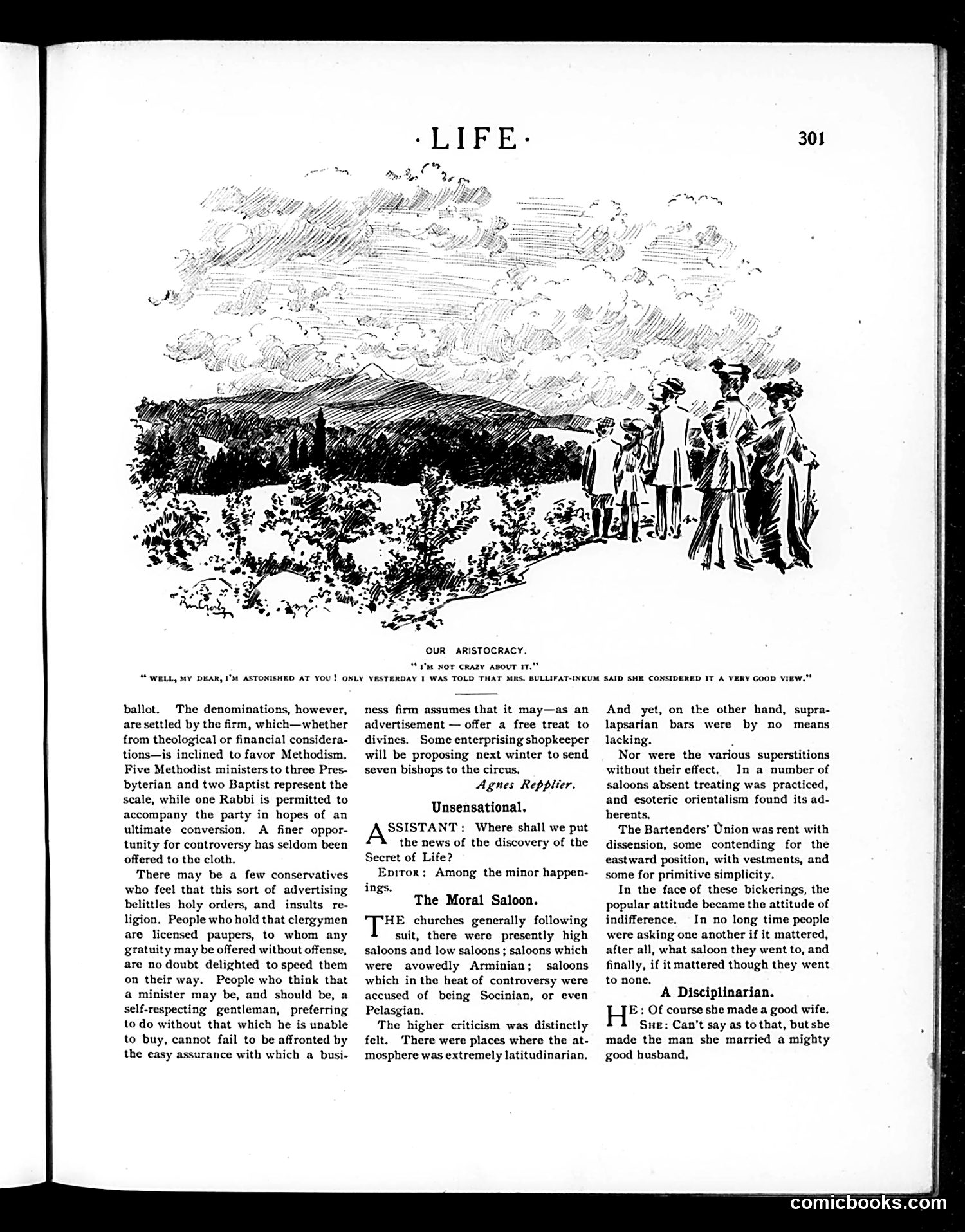
This satirical cartoon depicts wealthy individuals (recognizable by their formal dress and fashionable hats) observing a pastoral landscape. The caption reads: "It's not crazy about it," with dialogue about Mrs. Bullfat-Irkum's estate opinion. The satire targets the American upper class and their pretentious attitudes toward land ownership and rural estates. The exaggerated name "Bullfat-Irkum" suggests nouveau riche vulgarity. The joke mocks aristocratic snobbery—these wealthy people are surveying property yet finding fault, implying their refined sensibilities are affectation rather than genuine taste. The accompanying text discusses saloons and Methodism controversies, suggesting this page addresses broader class tensions in early 20th-century America between established wealth, morality debates, and social propriety.
📄 Transcribed text from this page (OCR, searchable)
Machine-transcribed from the original scan — historical spelling and the odd misread are preserved.
OUR ARISTOCRACY. “i'M NOT CRAZY ABOUT 17."” “ WRLL, MY DEAR, I'M ASTONISHED AT YOU! ONLY YESTERDAY I WAS TOLD THAT MRS. BULLIFAT-INKUM SAID SHE CONSIDERED IT A VERY GooD VIEW." ballot. The denominations, however, are settled by the firm, which—whether from theological or financial considera- tions—is inclined to favor Methodism, Five Methodist ministers to three Pres- byterian and two Baptist represent the scale, while one Rabbi is permitted to accompany the party in hopes of an ultimate conversion. A finer oppor- tunity for controversy has seldom been offered to the cloth. There may be a few conservatives who feel that this sort of advertising belittles holy orders, and insults re- ligion. People who hold that clergymen are licensed paupers, to whom any gratuity may be offered without offense, are no doubt delighted to speed them on their way. People who think that a minister may be, and should be, a self-respecting gentleman, preferring todo without that which he is unable to buy, cannot fail to be affronted by the easy assurance with which a busi- ness firm assumes that it may—as an advertisement — offer a free treat to divines. Some enterprising shopkeeper will be proposing next winter to send seven bishops to the circus. Agnes Repplier. Unsensational. SSISTANT: Where shall we put the news of the discovery of the Secret of Life? Epitor: Among the minor happen- ings. The Moral Saloon. Te churches generally following suit, there were presently high saloons and low saloons ; saloons which were avowedly Arminian; saloons which in the heat of controversy were accused of being Socinian, or even Pelasgian. The higher criticism was distinctly felt. ‘There were places where the at- mosphere was extremely latitudinarian, And yet, on the other hand, supra- lapsarian bars were by no means lacking. z Nor were the various superstitions without their effect. In a number of saloons absent treating was practiced, and esoteric orientalism found its ad- herents. ‘The Bartenders’ Union was rent with dissension, some contending for the eastward position, with vestments, and some for primitive simplicity. In the face of these bickerings, the popular attitude became the attitude of indifference. In no long time people were asking one another if it mattered, after all, what saloon they went to, and finally, if it mattered though they went to none, A Disciplinarian. E: Of course she made a good wife. Sue: Can't say as to that, but she made the man she married a mighty good husband. comicbooks.com