
A complete issue · 20 pages · 1904
Life — September 15, 1904
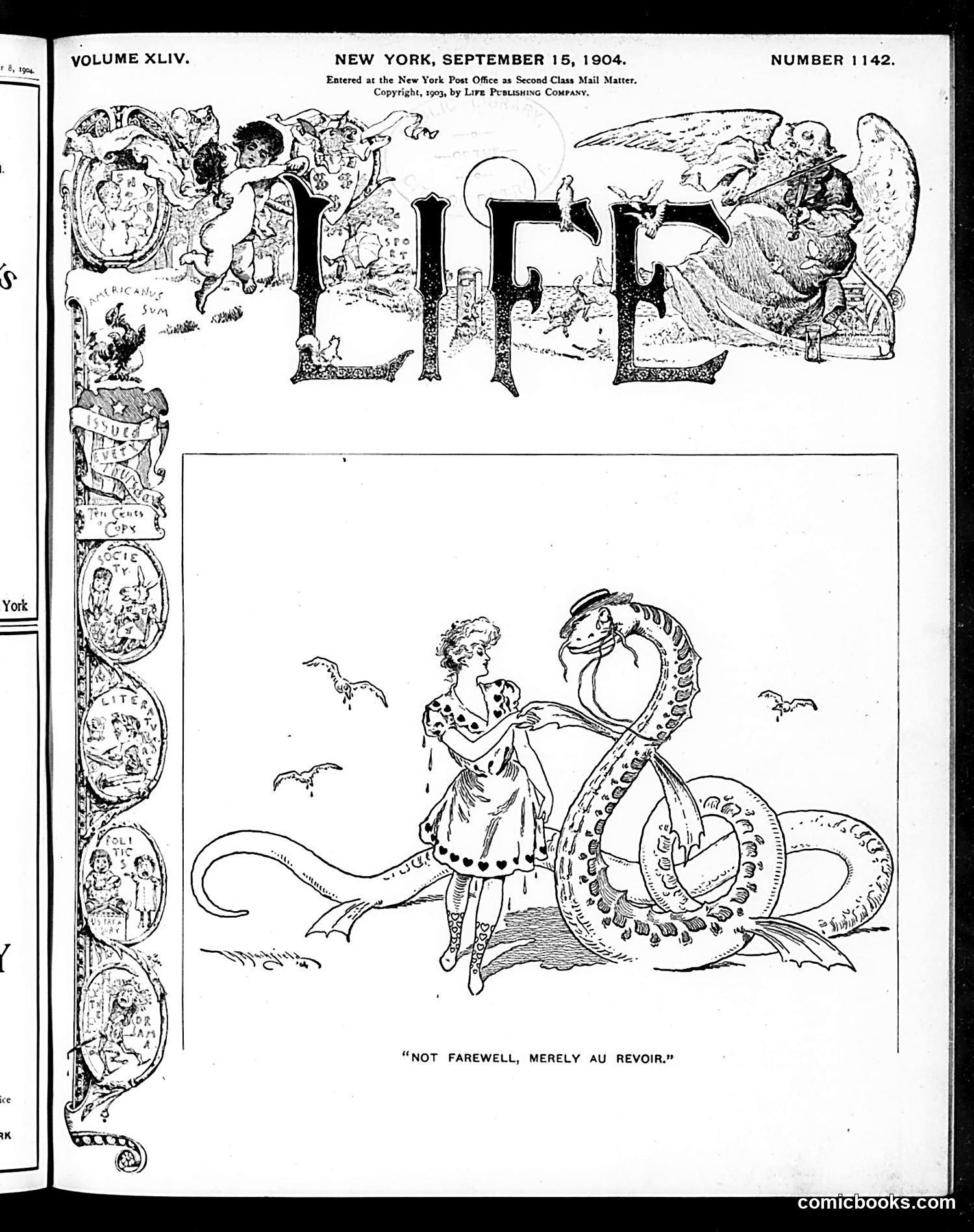
This satirical illustration depicts a woman with a large serpent or sea creature, captioned "Not Farewell, Merely Au Revoir" (French for "until we meet again"). The cartoon appears to reference a romantic or dramatic parting—the woman's gesture and the creature's anthropomorphized expression suggest an emotional goodbye rather than a final separation. The French phrase implies the relationship will resume. Without additional historical context from this specific 1904 issue, the precise identity of the figures and their political or social reference remain unclear. The illustration could relate to a theatrical production, a contemporary scandal, or a political situation of that moment. The ornate decorative border and whimsical style were typical of Life's satirical aesthetic during this period.
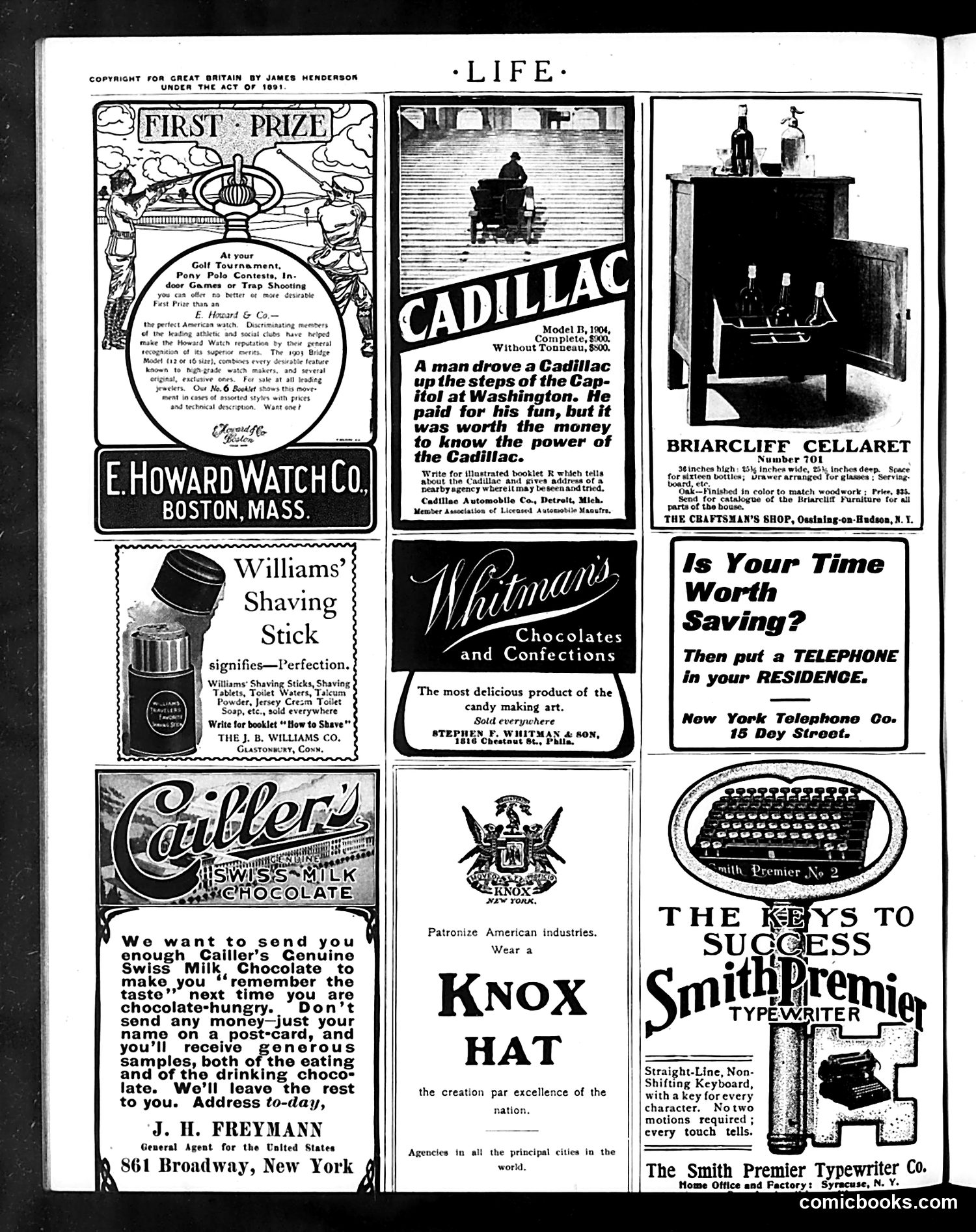
This page is **primarily advertisements** from an early 1900s Life magazine, not political satire. The ads showcase period products: E. Howard watches, Cadillac automobiles, Williams shaving cream, Whitman's chocolates, Cailler's Swiss milk chocolate, Knox hats, a telephone service, and Smith-Premier typewriters. The only non-advertising content is a small patriotic image encouraging readers to "Patronize American industries" and wear Knox hats—a gentle nationalist appeal typical of the era, not pointed satire. The Cadillac ad's anecdote about driving up Capitol Hill is a testimonial, not political commentary. Overall, this page reflects early 20th-century consumer culture and luxury goods marketing to Life's affluent readership, with minimal editorial cartoon content.
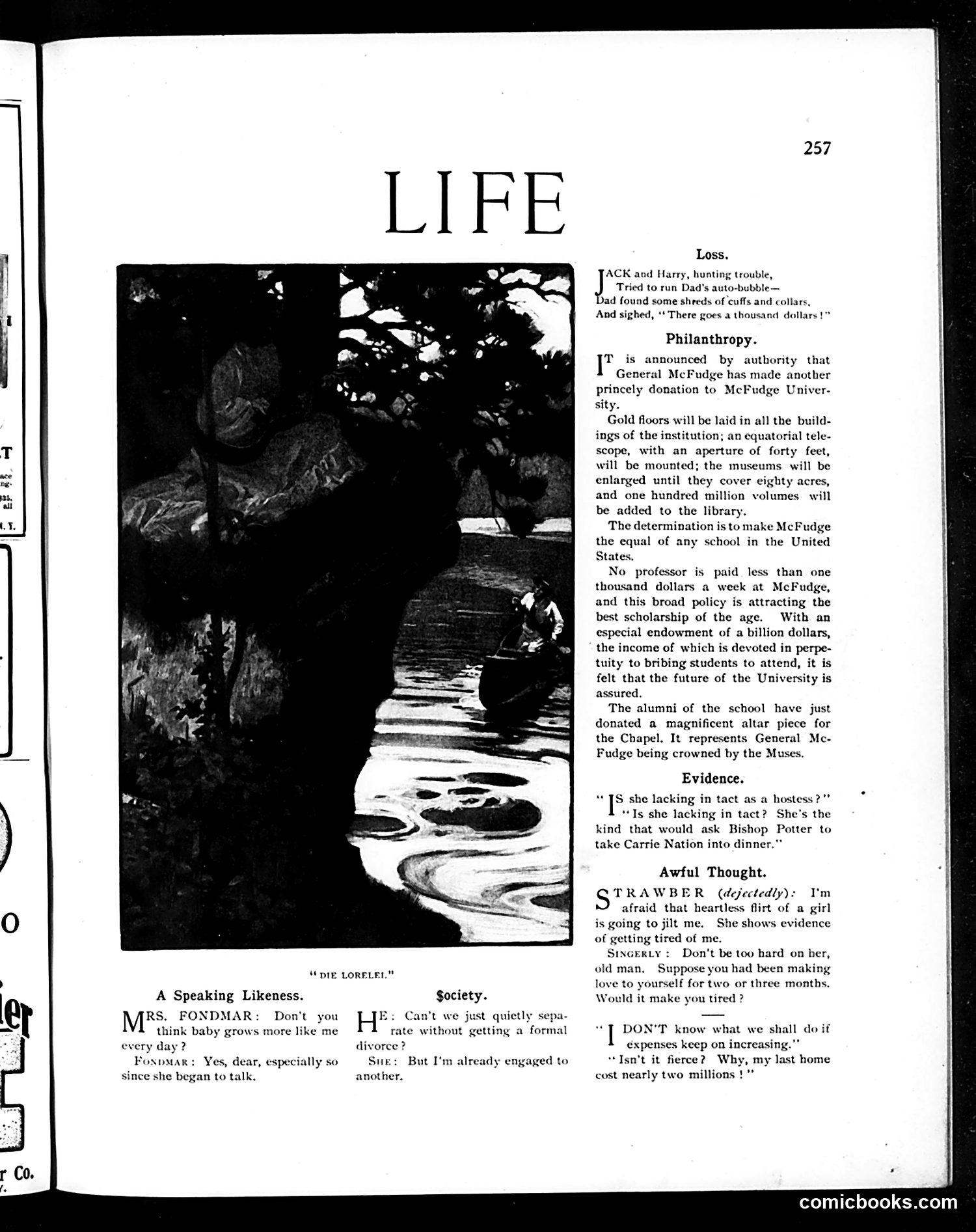
This page contains several brief satirical pieces rather than a single cartoon: **"Loss"** jokes about a father discovering his sons raided his cuff links and collars, losing "a thousand dollars." **"Philanthropy"** announces General McFudge's donation to McFudge University, detailing campus improvements and the alumni's gift of a chapel with McFudge "crowned by the Muses"—satirizing wealthy industrialists' vanity projects and self-aggrandizing philanthropy. **"Evidence," "Awful Thought,"** and "Society"** are brief comic dialogues mocking social conventions: women's tactlessness, marital anxiety, and divorce etiquette among the wealthy. **"A Speaking Likeness"** contains a domestic joke about a wife's changing appearance. The overall theme critiques upper-class pretension, materialism, and social anxieties of the era.
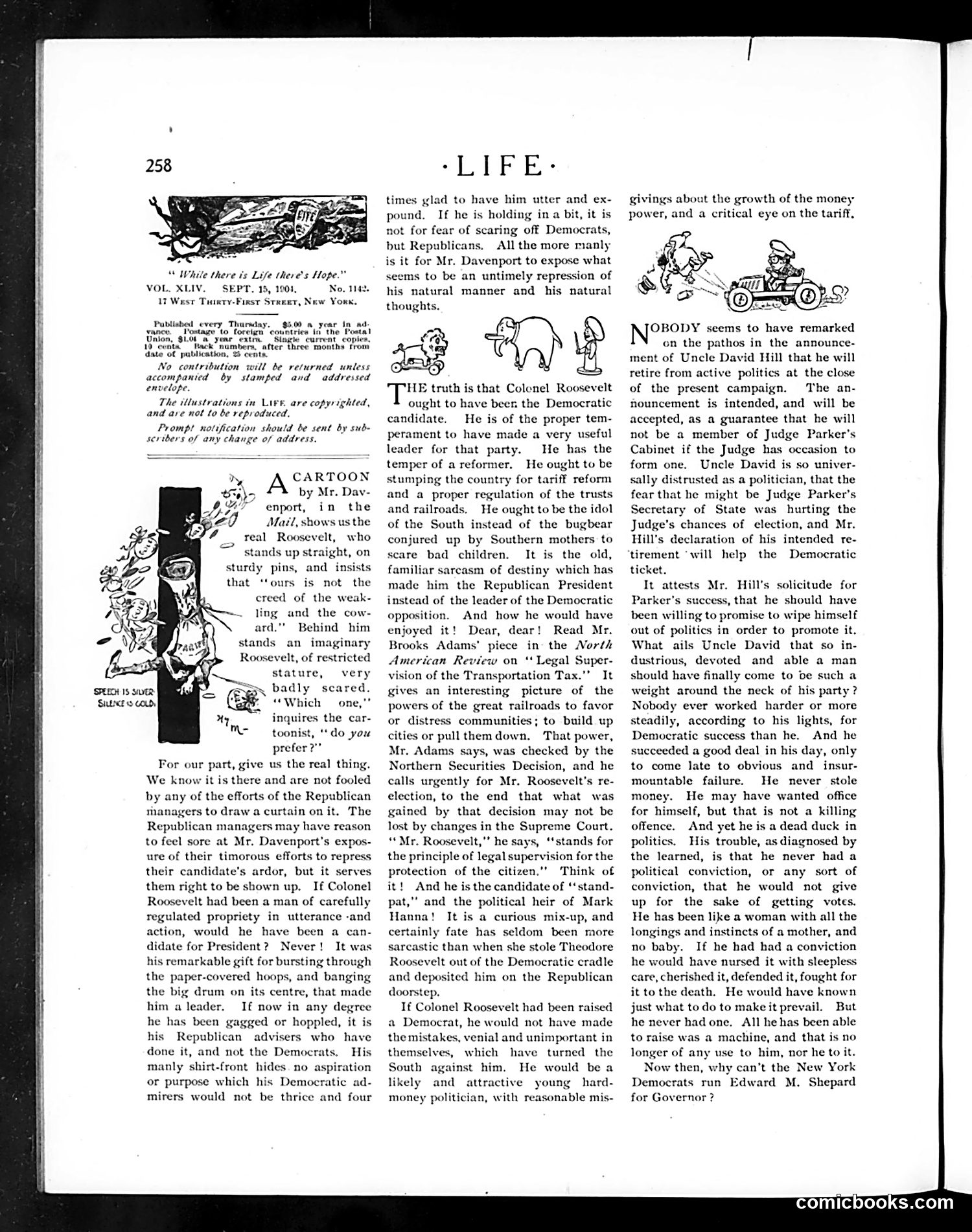
The cartoon titled "Which one?" satirizes Colonel Roosevelt as a potential Democratic presidential candidate. The image depicts Roosevelt as an elephant labeled "REAL ROOSEVELT" standing among smaller figures, with the caption asking "Which one" he prefers. The text argues Roosevelt—despite being Republican—would have made an excellent Democratic leader due to his reformist temperament: his support for tariff reform, trust regulation, and railroad oversight. The satire suggests Roosevelt's progressive policies align better with Democratic principles than typical Republican ideology. The joke's irony: Republicans might fear losing their "useful" reformer to the opposition, while Democrats lament they cannot claim him as their own candidate. This reflects the political fluidity and Roosevelt's cross-party appeal during the early 1900s.
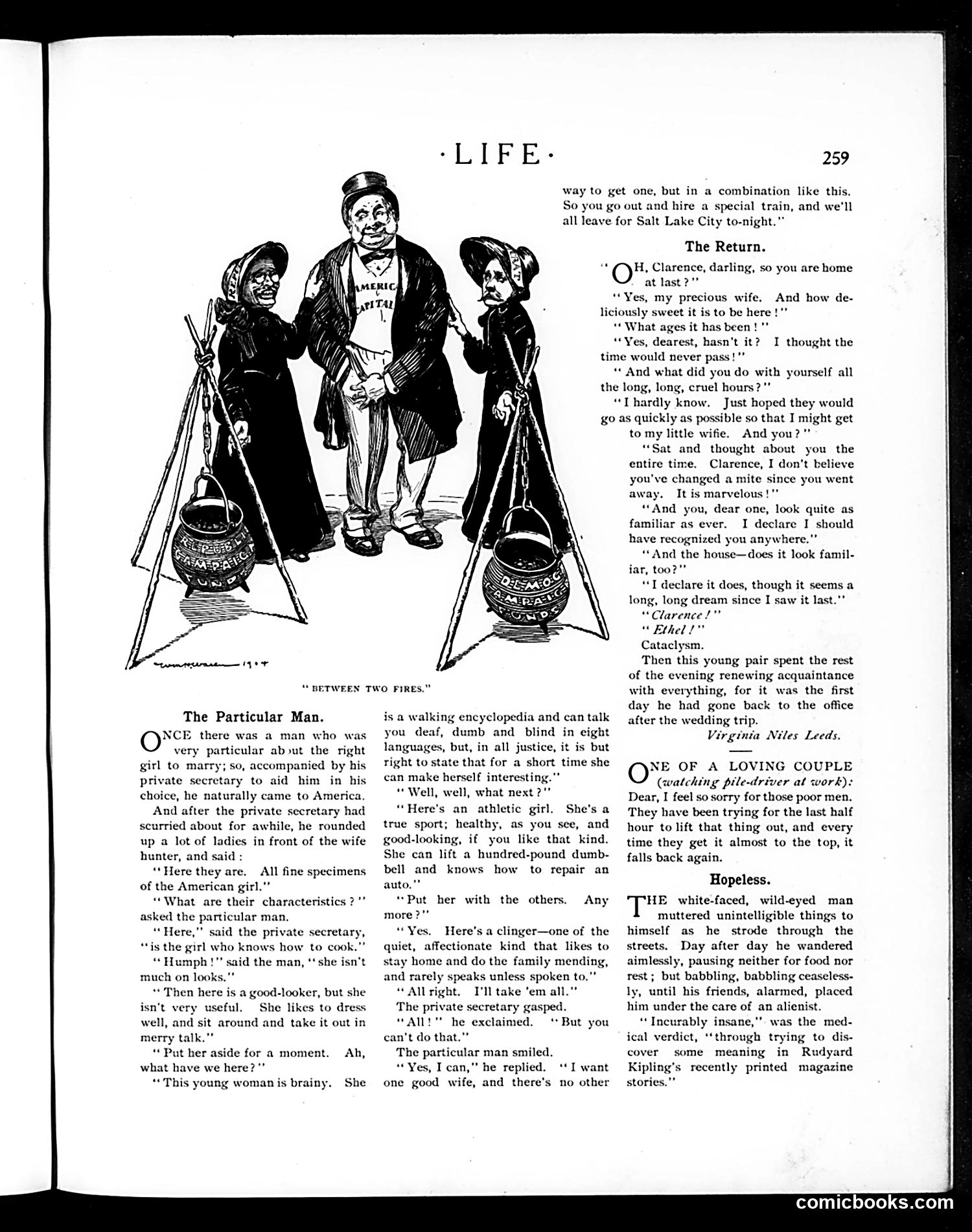
This cartoon depicts a man standing between two women holding cooking pots over fires, illustrating the story "The Particular Man" below it. The image satirizes domestic life and marital predicament. The man appears caught in an awkward situation with two women, literalizing the expression "between two fires" — meaning trapped between competing demands or pressures. The accompanying text reveals the satirical point: the "particular man" is difficult to please regarding wives, wanting one who is both athletically capable (can lift dumbbells, repair cars) yet traditionally domestic (good cook, family-minded). The cartoon mocks impossible male standards and the contradictions men impose on women's roles, presenting matrimonial dissatisfaction as self-inflicted.
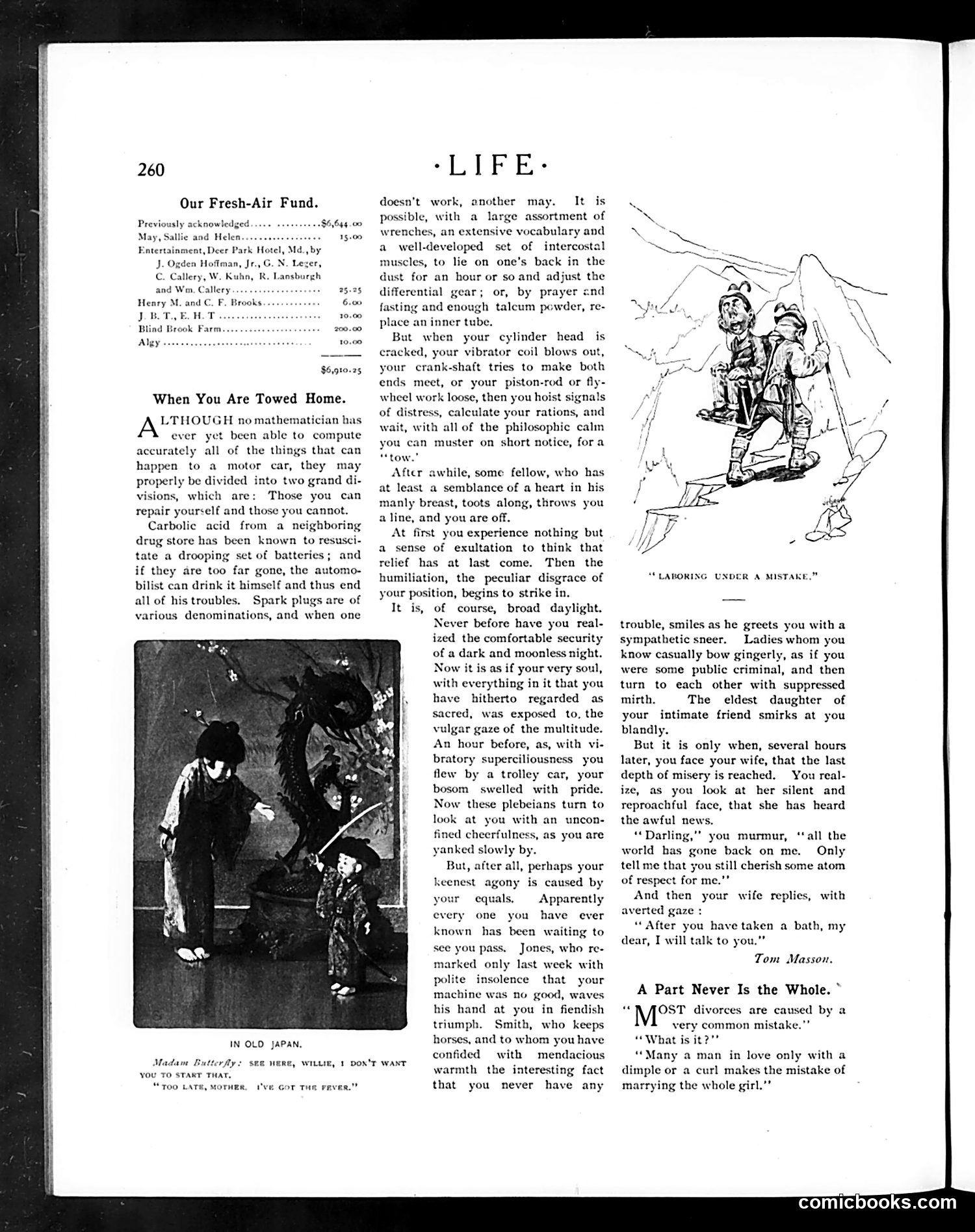
This page contains two distinct pieces: **"When You Are Towed Home"** is a humorous essay about the indignity of automobile breakdown and being towed by neighbors. The accompanying photograph labeled "In Old Japan" shows what appears to be a rickshaw scene, creating a satirical comparison—suggesting that being towed home puts one in a similarly dependent, embarrassing position as riding in a rickshaw, stripping away one's dignity and independence. **"A Part Never Is the Whole"** is a brief commentary on divorce, suggesting that men commonly make the mistake of marrying for one attractive feature (like a dimple or curl) rather than appreciating the whole person. This reflects early 20th-century cynicism about marriage. The page satirizes modern automotive culture's vulnerabilities and marital misconceptions with gentle humor typical of Life magazine's tone.
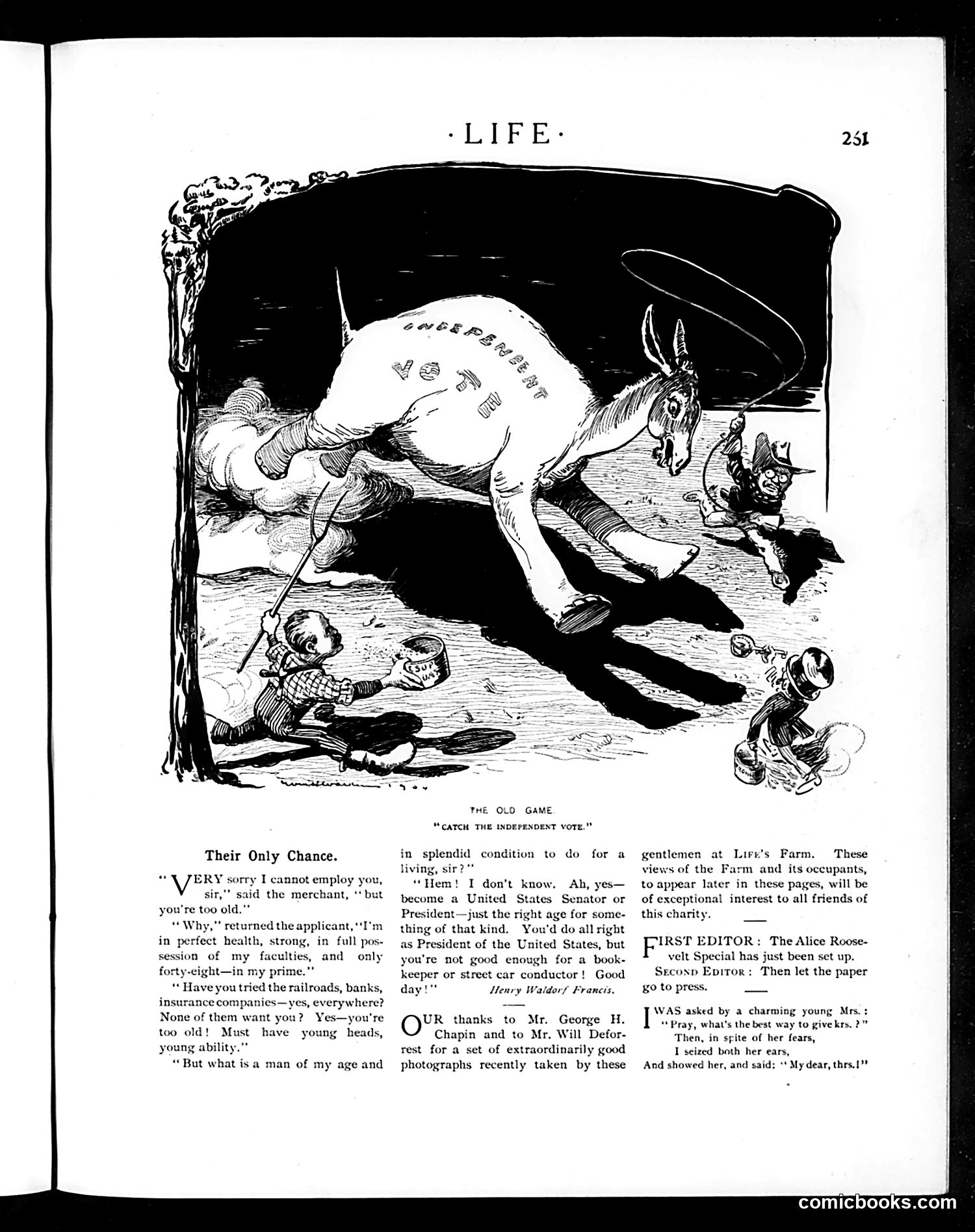
This political cartoon satirizes candidates' desperate pursuit of swing voters during elections. The central image depicts a goat labeled "INDEPENDENT VOTE" being chased by multiple figures—representing competing politicians—in an undignified scramble. The goat, an animal associated with stubbornness and unpredictability, symbolizes voters who refuse party loyalty. The satire mocks how politicians treat the independent voter as a prize to be "caught" through manipulation rather than genuine persuasion. The chaotic scene suggests the unseemly nature of this political pursuit. The title "Their Only Chance" indicates that courting these swing voters represents candidates' last hope for electoral victory, highlighting how crucial the independent vote had become in American elections during this era.
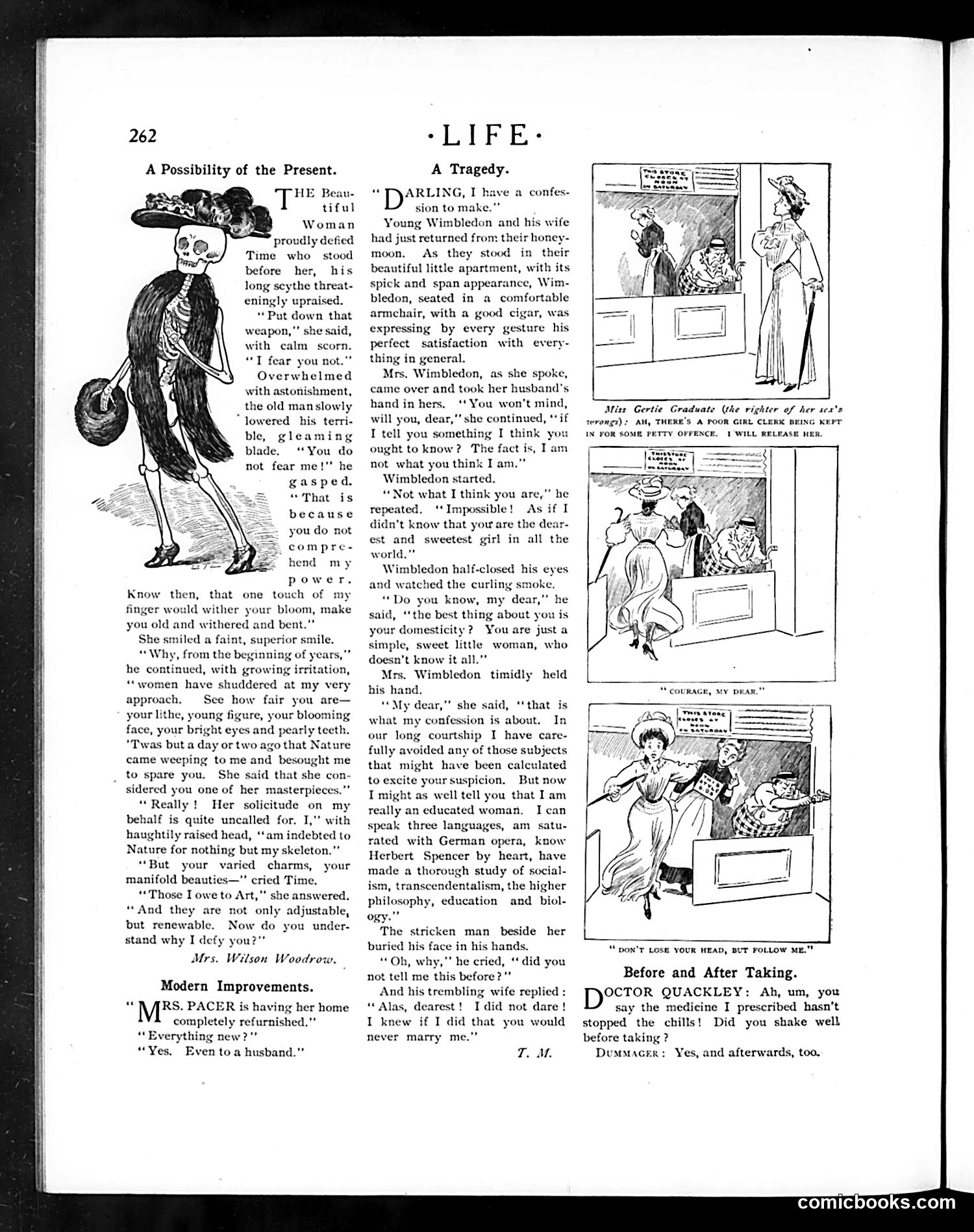
This page contains three separate satirical pieces: 1. **"A Possibility of the Present"**: A skeletal Death figure in Victorian dress threatens a woman, warning that one touch would "wither your bloom" and destroy her youth and beauty. This satirizes society's obsession with female youth and appearance. 2. **"A Tragedy"**: Depicts newlyweds Young Wimbledon and his wife, where she confesses her education and intellectual accomplishments. His response—praising her only for "domesticity" and "simplicity"—satirizes how educated women were expected to hide their knowledge to appeal to men. 3. **"Before and After Talking"**: A brief dialogue between Doctor Quackley and a patient, likely mocking dubious medical practices or quack doctors. The page satirizes gender expectations, beauty standards, and medical fraud of the era.
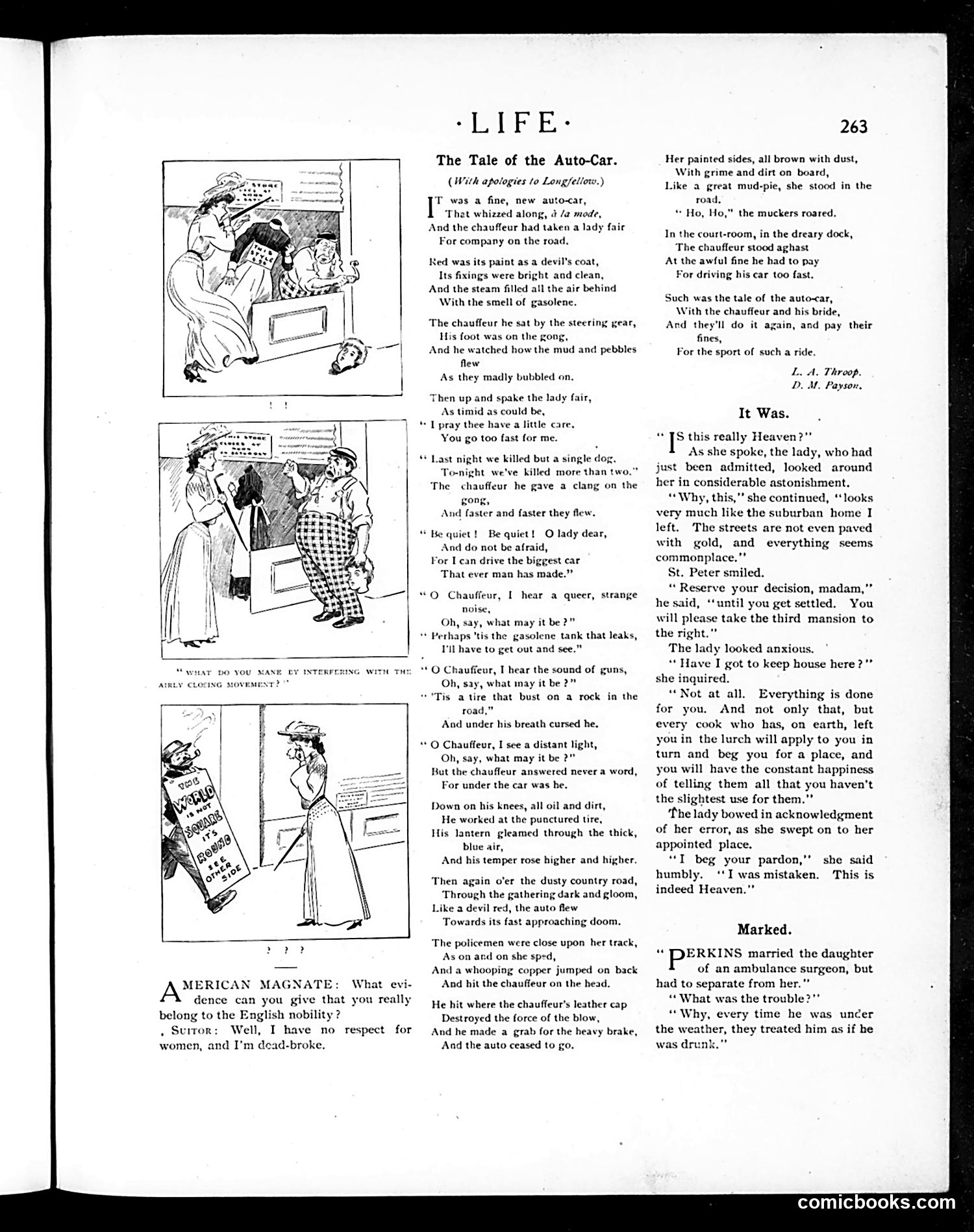
This is a humorous story with illustrations about an early automobile ride gone wrong. A chauffeur drives a lady passenger at dangerously high speed, hitting dogs and causing general mayhem. The vehicle repeatedly breaks down despite the chauffeur's confident assurances he can "drive the biggest car that ever man has made." The satire targets early automotive culture: the reckless speeds, mechanical unreliability, and the social pretension of automobile ownership. The chauffeur's repeated failures—a punctured tire, engine overheating, brake failure—mock both the technology's immaturity and the hubris of drivers who operate these temperamental machines. The accompanying dialogue and illustrations emphasize the automobile as a source of danger and embarrassment rather than progress.
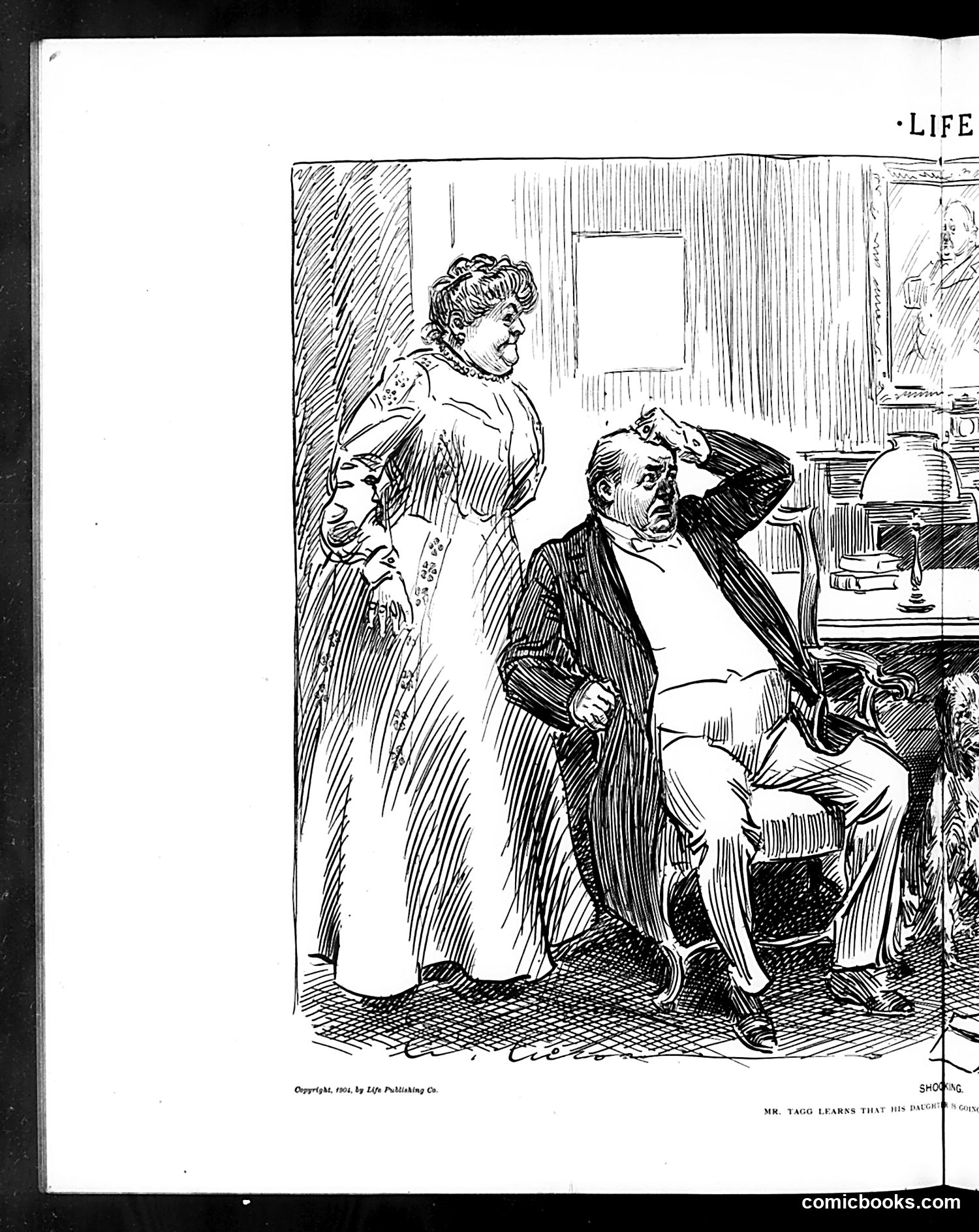
This is a satirical cartoon from *Life* magazine (copyright 1904, per the visible credit). The caption reads "MR. TAGO LEARNS THAT HIS DAUGHTER IS GOING..." (text cuts off). The scene depicts a domestic interior where a woman stands with a young child while a middle-aged man sits, appearing distressed with his hand to his head. The cartoon appears to satirize a character named "Mr. Tago" learning troubling news about his daughter—likely an elopement or romantic entanglement, given the man's shocked reaction and the formal Victorian setting. Without the complete caption, the specific reference remains unclear, though this appears to be commentary on a society scandal or notable public figure of 1904. The humor relies on the viewer recognizing "Mr. Tago" as a recognizable contemporary personality.
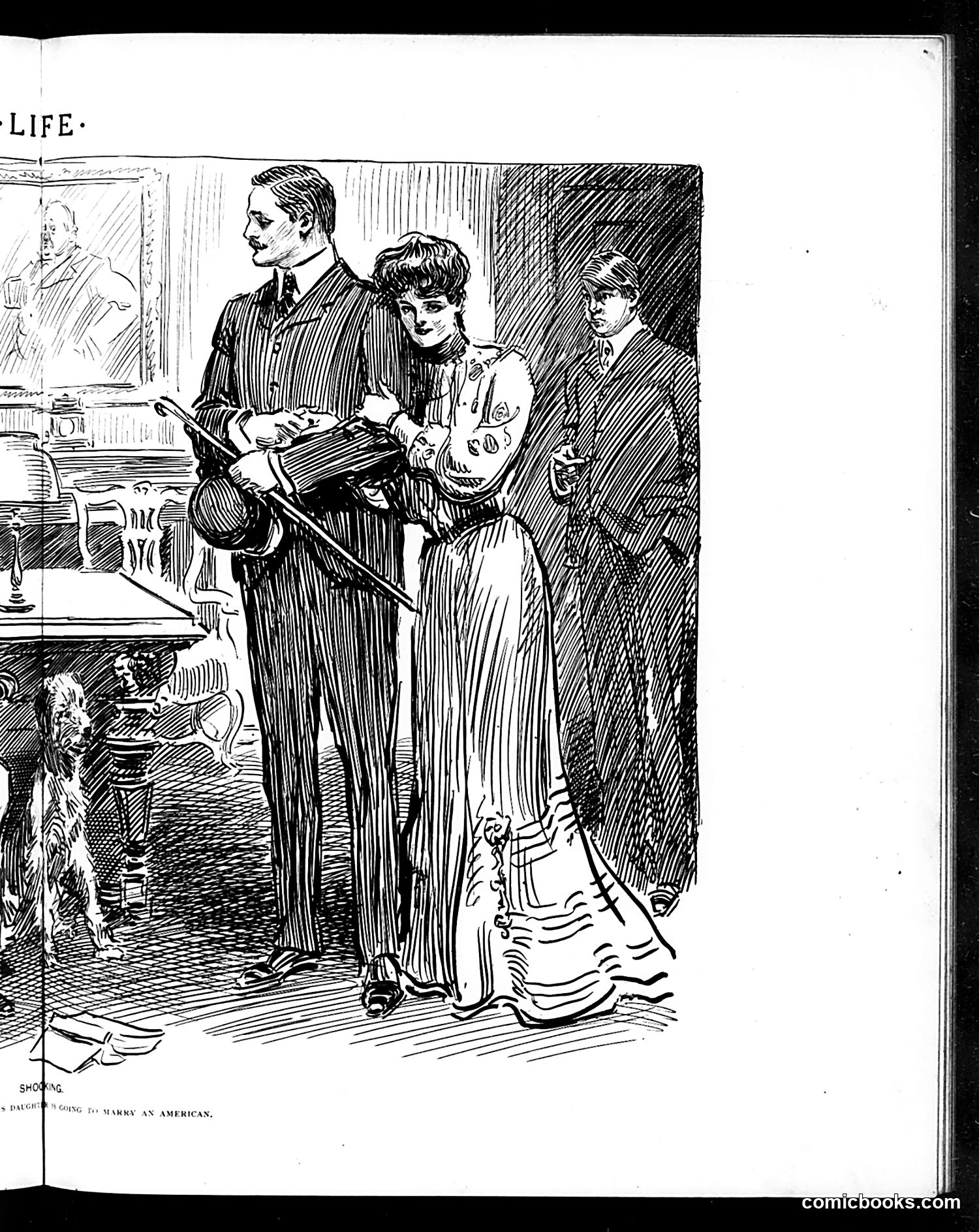
This appears to be a satirical illustration from *Life* magazine showing a domestic scene titled "Showing a Daughter Going to Marry an American" (based on the partially visible caption). The cartoon depicts three figures—a tall man in a pinstriped suit examining what appears to be a document or portfolio, a woman in an elegant dress, and a younger figure on the right. A small dog is visible at the lower left. The satire likely comments on transatlantic courtship or marriage practices, possibly mocking the scrutiny foreign suitors faced when courting American women, or conversely, the careful evaluation Americans conducted when considering international matches. The gentleman's formal examination of the portfolio suggests financial or social vetting—a common satirical theme in early 20th-century American humor about class-conscious matrimonial negotiations.
This page discusses theatrical productions, particularly "The School Girl," a musical piece performed at Daly's Theatre in New York. The illustration shows a cherub or cupid figure, which appears decorative rather than specifically satirical. The text critiques the Theatrical Syndicate's monopoly over American stages, lamenting their control leaves little quality entertainment for the public. The author argues the Syndicate prioritizes profit over artistic merit, reducing theatrical offerings to low-class entertainment. The review of "The School Girl" notes it's a British musical adapted for American audiences, with mixed results. The text mentions several performers and compares it unfavorably to other English pieces, suggesting American theatrical productions lack the refinement of their British counterparts—a common early 20th-century criticism reflecting American anxieties about cultural sophistication.
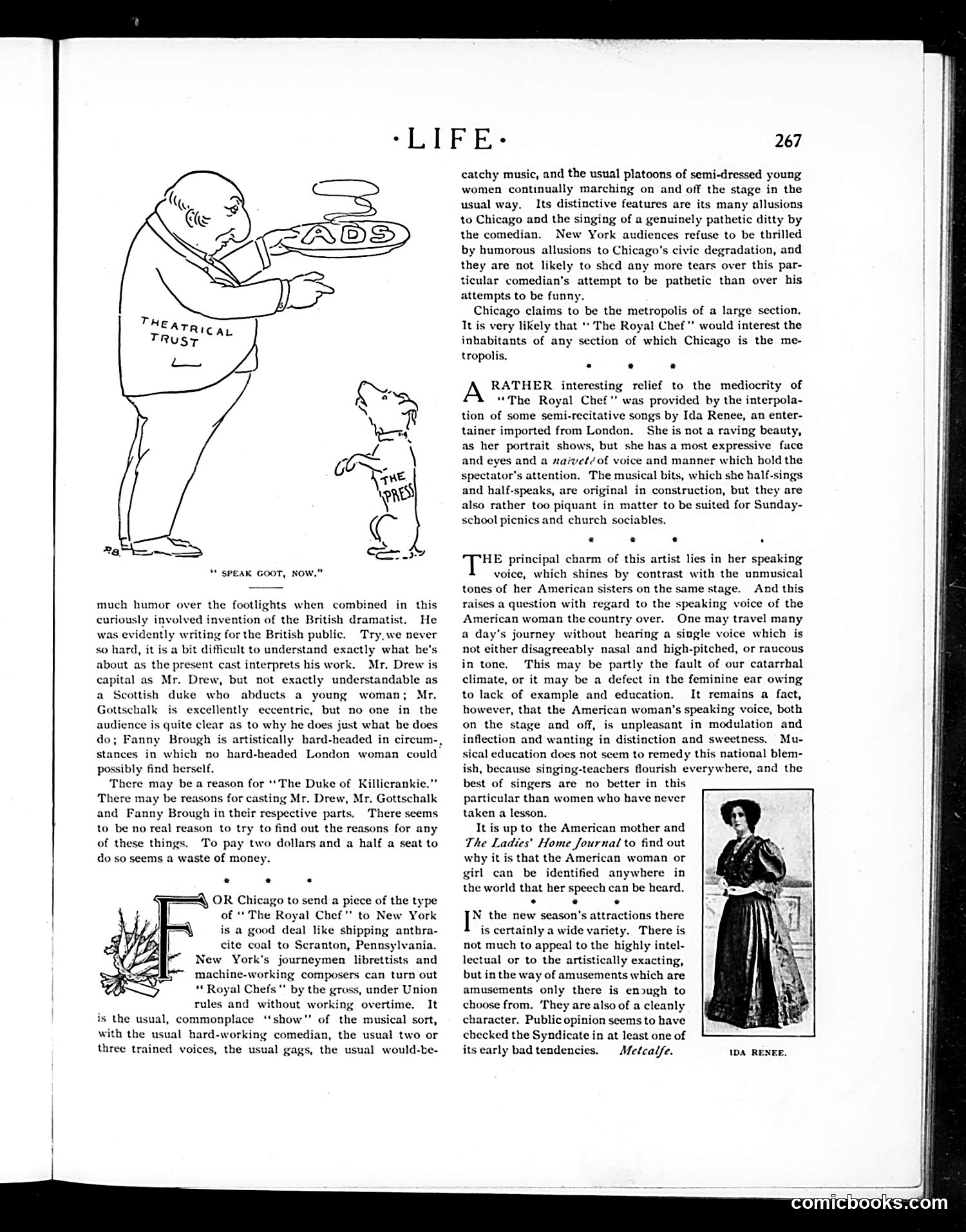
The cartoon depicts a man labeled "Theatrical Trust" holding a plate labeled "Ads" while a small dog (likely representing New York theatrical interests) looks on. The caption reads "Speak Goot, Now." **The Satire:** This mocks the dominance of theatrical trusts—monopolistic combinations controlling production and distribution of plays. The cartoon suggests these trusts feed inferior content ("ads" rather than quality theater) to audiences while smaller competitors are left begging for scraps. **The Context:** The accompanying text reviews "The Royal Chef," a musical imported from Chicago. Life magazine criticizes it as generic, pandering product—precisely the mediocre fare theatrical monopolies could churn out "by the gross, under Union rules." The review contrasts this with imported British performer Ida Renee, whose refined speaking voice shames American actresses. The overall message: theatrical trusts prioritize profit over artistry, flooding markets with forgettable shows while audiences suffer from declining performance standards. It's an anti-monopoly critique wrapped in entertainment criticism.
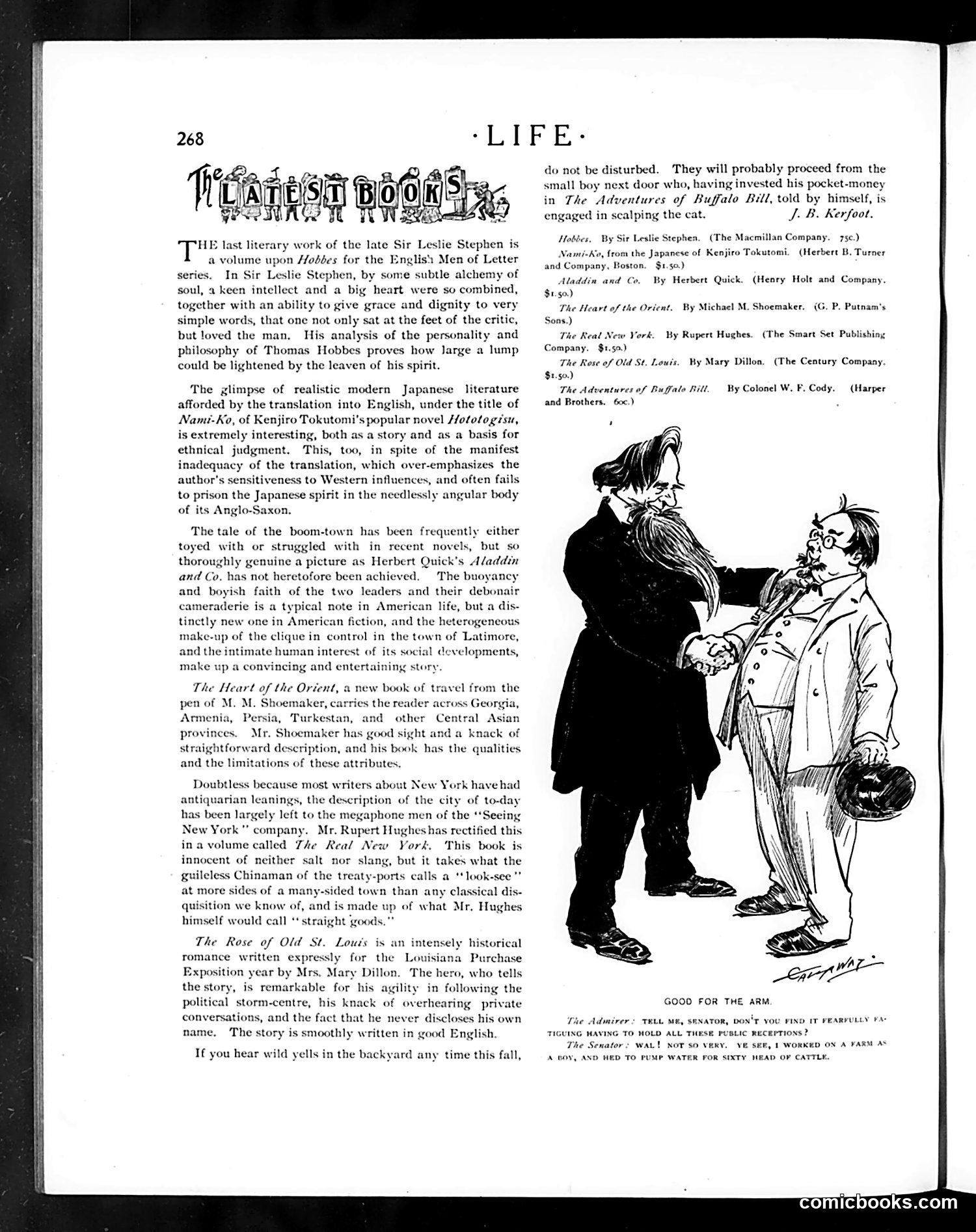
This cartoon depicts a social-climber (the "Admirer") approaching a seated Senator, attempting flattery about his physical prowess. The Senator responds dismissively, revealing the cartoon's joke: he claims his strength comes not from gentlemanly exercise but from crude manual labor—"pumping water for sixty head of cattle." The satire targets wealthy politicians who present themselves as refined gentlemen while their actual fortunes derive from unglamorous, working-class origins. The Admirer's fawning compliments about "the arm" are undercut by the Senator's blunt admission that his muscular build reflects farming work, not aristocratic cultivation. This mocks the pretensions of Gilded Age politicians who rose from humble beginnings yet adopted airs of sophistication. The humor lies in exposing the gap between their self-presentation and their actual (albeit successful) working-class past.
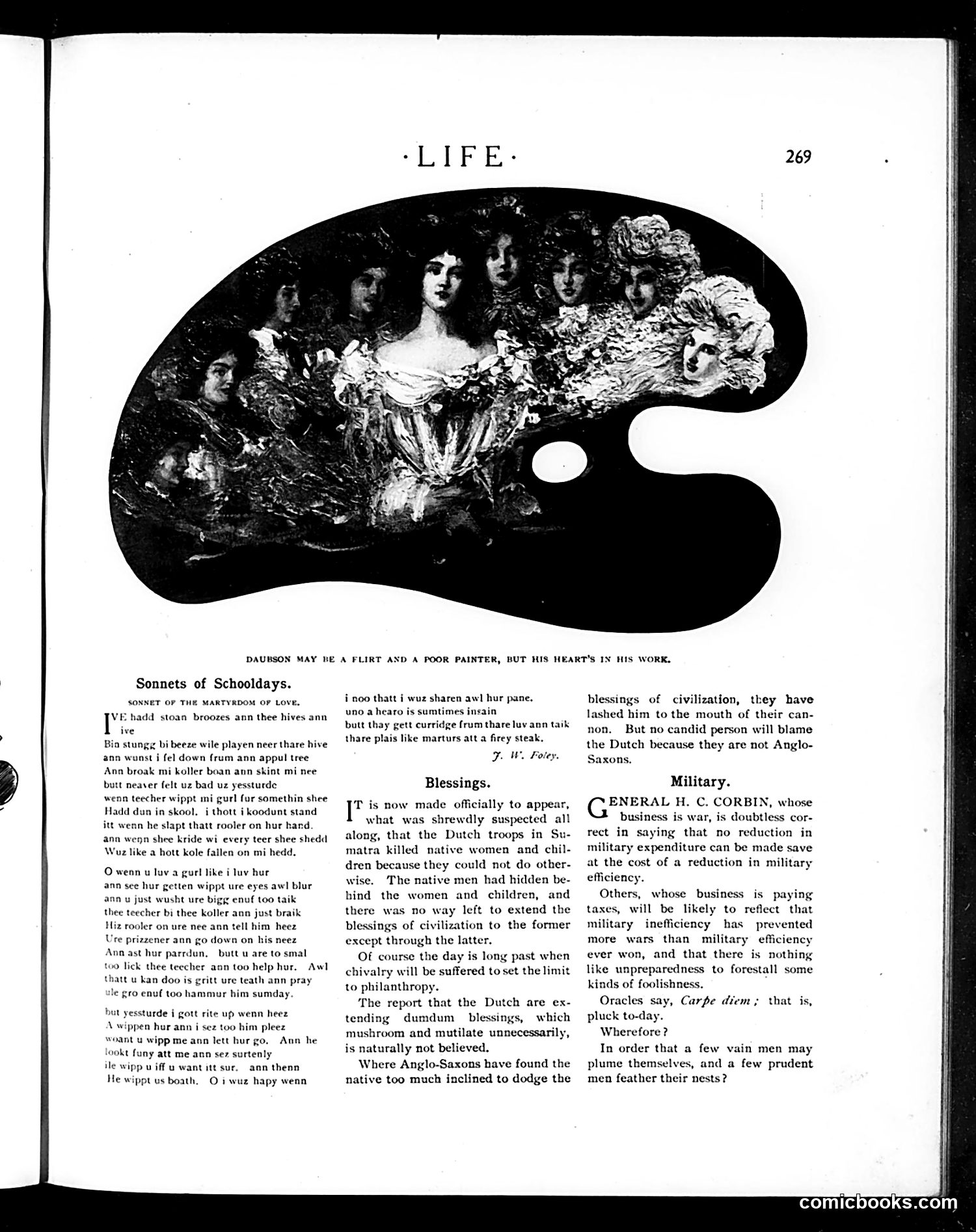
The page contains two distinct pieces of satire: **"Sonnets of Schooldays"**: A deliberately misspelled, phonetically-written poem mocking both bad student poetry and pupil crushes. A boy watches his crush get beaten by a teacher, feels helpless due to his small size, then rejoices when the teacher beats him too—so he shares her suffering. It's satirizing overwrought romantic sentiment and schoolboy melodrama. **"Blessings" and "Military"**: These sections satirize imperial justifications for violence. They mock the Dutch colonial military in Sumatra for killing native women and children (hidden shields for combatants), sarcastically calling this "extending civilization." The satire attacks how imperial powers rationalize atrocities and how military budgets are justified through appeals to "efficiency"—suggesting that actual military unpreparedness better prevents foolish wars than expensive readiness. The palette-shaped illustration at top appears decorative rather than directly illustrative of the text.
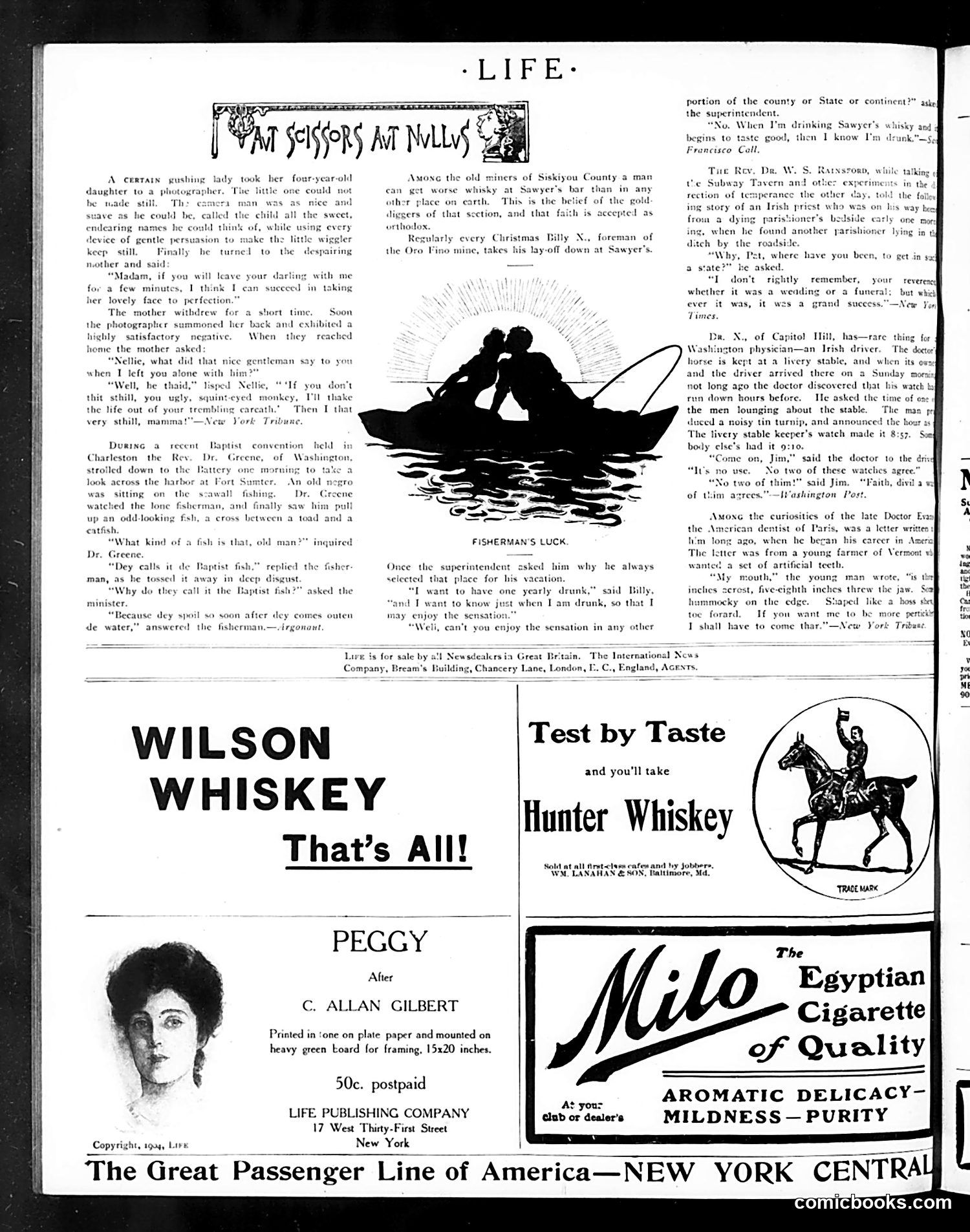
This page contains three unrelated humor pieces typical of early 1900s Life magazine: 1. **"I'm Scissors at Nullus"** (top): A satirical anecdote about a photographer struggling to photograph a hyperactive four-year-old, who finally succeeds only after the child leaves. The joke mocks overly indulgent parenting. 2. **"Fisherman's Luck"** (center): A silhouette illustration accompanying stories about miners and clergy. One anecdote mocks Baptist hypocrisy by claiming they call a repulsive fish "Baptist fish" because it spoils quickly—a barb at clergy. Another joke features an Irish-accented doctor complaining about unreliable pocket watches. 3. **Dental humor** (right): A farmer requests artificial teeth shaped like a horse shell, positioned oddly so food won't lodge there—absurdist rural humor. The advertisements (Wilson Whiskey, Hunter Whiskey, Milo cigarettes) are standard period marketing. The page reflects Life's satirical style: gentle mockery of pretension, ethnic stereotypes (Irish), and eccentric characters.
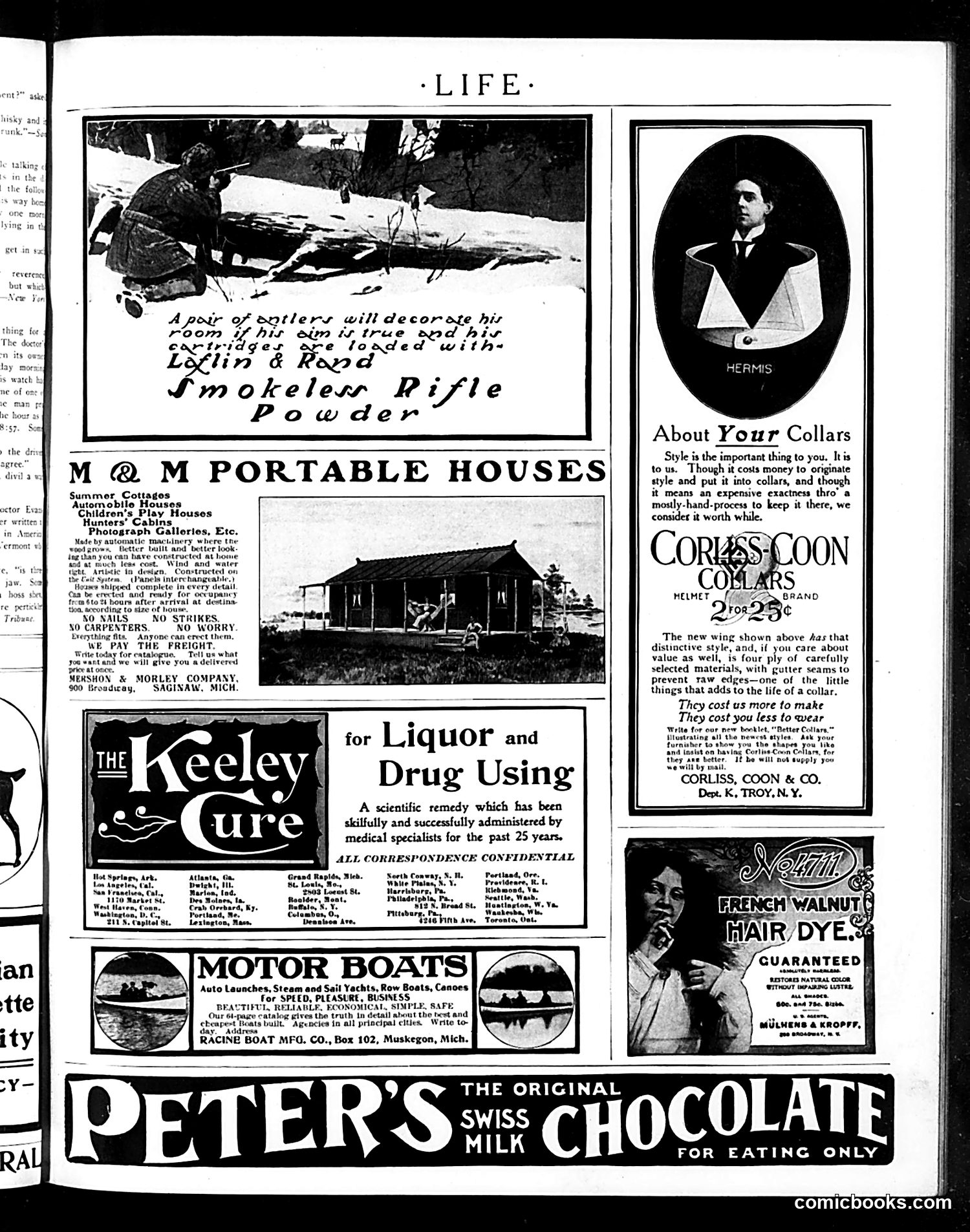
This page is primarily **advertising**, not political satire. It contains commercial advertisements from the early 20th century, including: - **M&M Portable Houses**: Pre-fabricated homes marketed as quick, easy-to-assemble structures - **The Keeley Cure**: A "scientific remedy" for alcohol and drug addiction—a legitimate (if dubious) medical treatment of that era - **Motor Boats**: Recreation vessels for sale - **Corliss Coon Collars**: Men's collar advertisement emphasizing style and durability - **Saphir French Walnut Hair Dye**: A hair coloring product - **Peter's Swiss Milk Chocolate**: Confectionery product The top image shows a soldier decorating his room with rifle ammunition, supporting the ammunition advertisement. There is no political cartoon or satire present—this is a standard magazine page mixing editorial space with paid advertisements typical of early Life magazine's format.
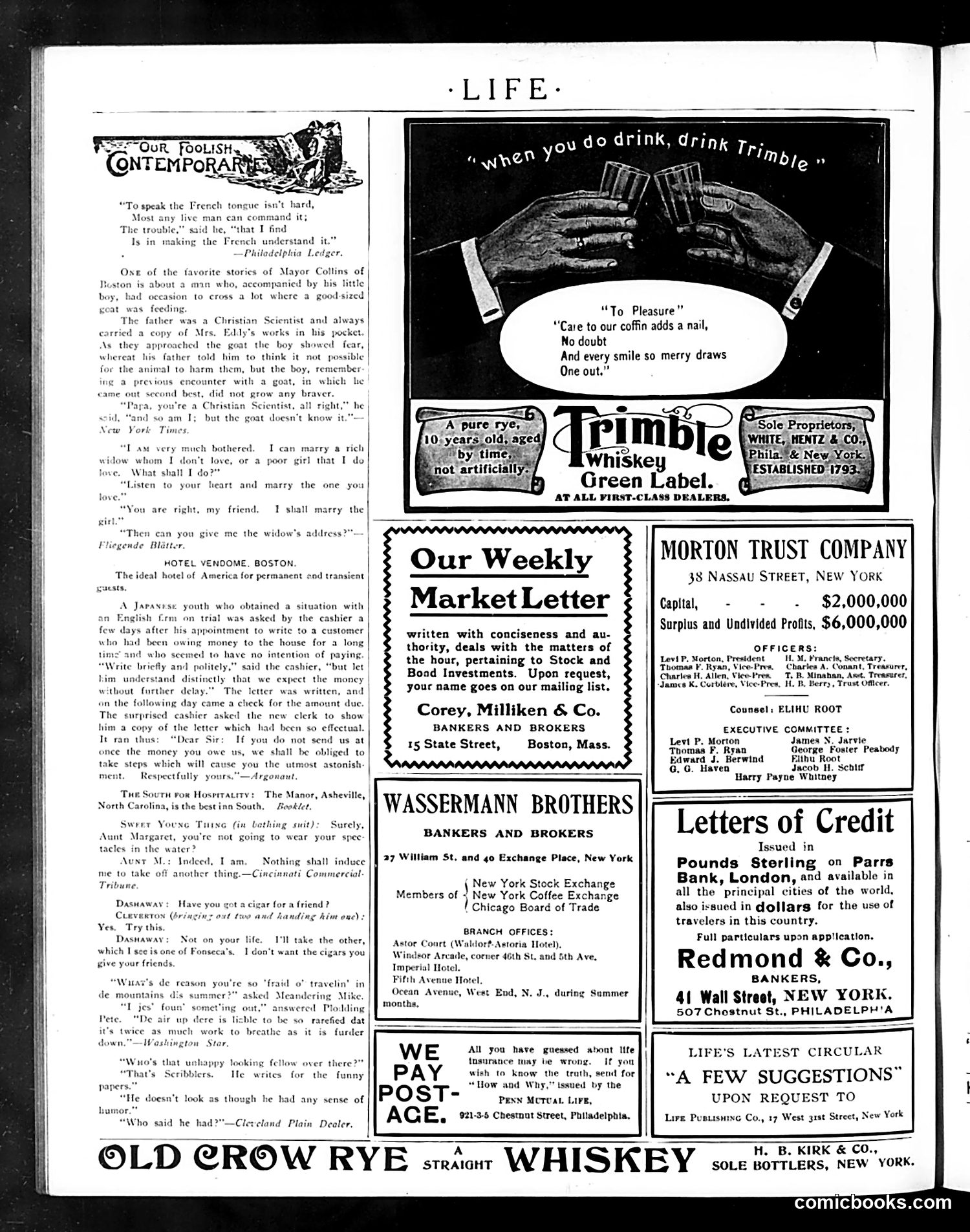
This page combines satirical commentary with advertising. The left column contains **"Our Foolish Contemporaries,"** Life's humor section featuring anecdotes that mock various subjects: - A story about Mayor Collins of Boston and a Christian Scientist father who claimed thinking prevents harm from a goat - Jokes about a Japanese clerk's hilariously blunt debt-collection letter that unexpectedly works - Various brief humorous exchanges about travel, cigars, and writers The satire targets **religious absurdity, naïveté in business practices, and intellectual pretension** common to the era. The right side features **predominantly financial advertising**—trust companies, bankers, brokers, and whiskey promotions, with one advertisement celebrating Trimble Whiskey as a beverage ("When you do drink, drink Trimble"). The page reflects early 20th-century Life magazine's dual purpose: irreverent social commentary aimed at educated readers alongside advertisements for investment services and luxury goods catering to that same audience.
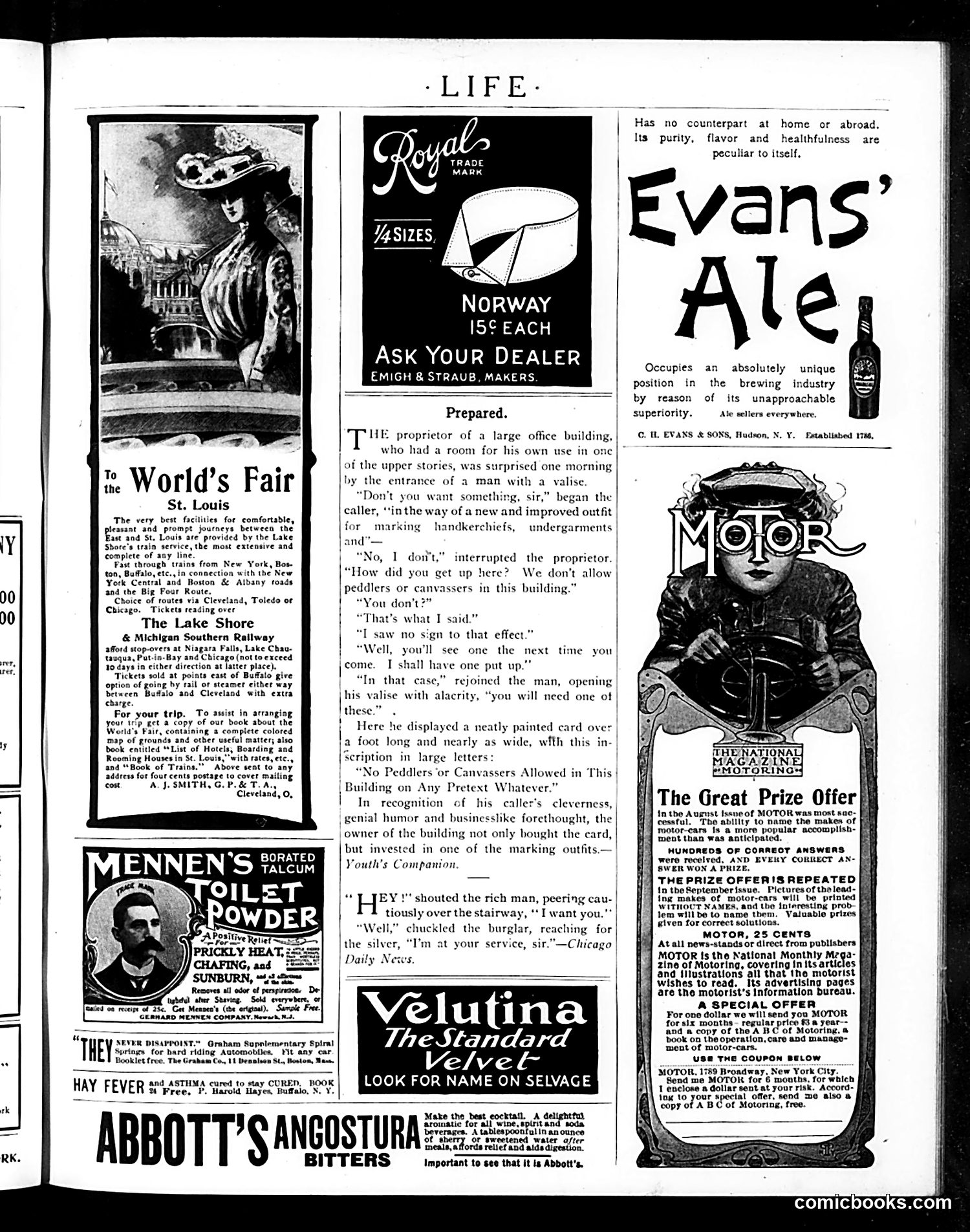
This is primarily an **advertising page** from Life magazine, with brief humorous anecdotes interspersed between ads. The main content includes: 1. **"Prepared"** – A short joke about a office building owner who refuses a door-to-door salesman, only to be outsmarted when the man displays a sign reading "No Peddlers or Canvassers Allowed" and sells him the sign itself. It's gentle satire on salesmanship and cleverness overcoming rejection. 2. **"Hey!"** – A brief joke about a burglar being summoned by a wealthy man and responding as if called to service, playing on class dynamics and the absurdity of the situation. The page is dominated by **period advertisements** for products like Evans' Ale, Abbott's Angostura Bitters, Mennen's Talcum Powder, Velutina fabric, and rail services to the St. Louis World's Fair. The ads reflect early 1900s consumer culture and marketing appeals to health and convenience. No political cartoons or caricatures appear on this page.
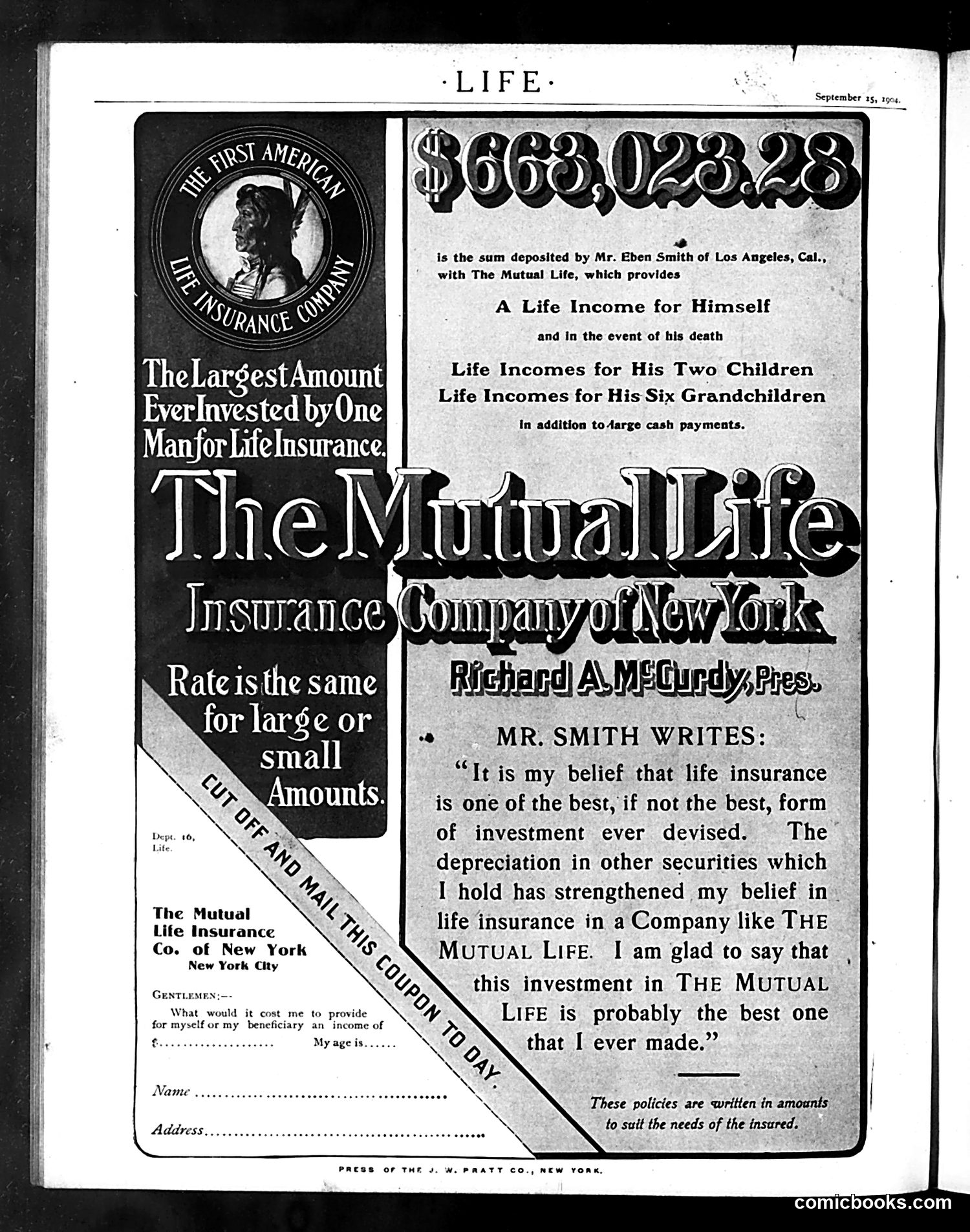
This is **not satire or a cartoon**—it's a straightforward insurance advertisement. The page features a testimonial from Eben Smith of Los Angeles, who deposited $663,023.28 with The Mutual Life Insurance Company of New York. The ad emphasizes that his policy provides lifetime income for himself, his two children, and six grandchildren, plus cash payments. Smith's quote endorses life insurance as superior to other investments, particularly noting that depreciation in other securities (likely referring to stock market losses during economic uncertainty) has convinced him of insurance's stability. The left side includes a coupon for readers to request rate information. The historical context: this appears to be from early 1920s *Life* magazine, when life insurance was marketed as a serious financial investment rather than mere death protection—a selling point during economically volatile times.