
Life, 1904-09-15 · page 13 of 20
Life — September 15, 1904 — page 13: what you’re looking at
What you’re looking at
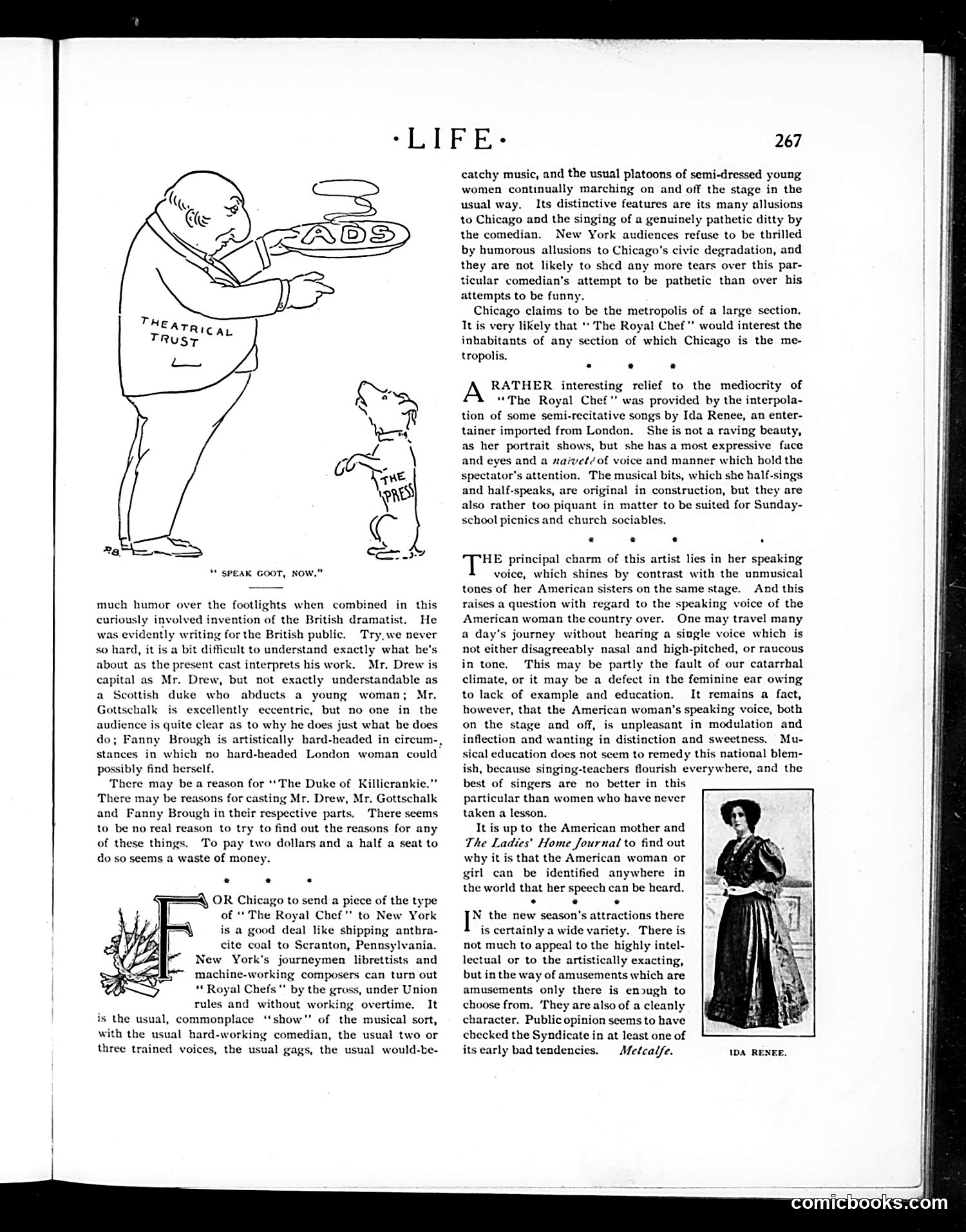
The cartoon depicts a man labeled "Theatrical Trust" holding a plate labeled "Ads" while a small dog (likely representing New York theatrical interests) looks on. The caption reads "Speak Goot, Now." **The Satire:** This mocks the dominance of theatrical trusts—monopolistic combinations controlling production and distribution of plays. The cartoon suggests these trusts feed inferior content ("ads" rather than quality theater) to audiences while smaller competitors are left begging for scraps. **The Context:** The accompanying text reviews "The Royal Chef," a musical imported from Chicago. Life magazine criticizes it as generic, pandering product—precisely the mediocre fare theatrical monopolies could churn out "by the gross, under Union rules." The review contrasts this with imported British performer Ida Renee, whose refined speaking voice shames American actresses. The overall message: theatrical trusts prioritize profit over artistry, flooding markets with forgettable shows while audiences suffer from declining performance standards. It's an anti-monopoly critique wrapped in entertainment criticism.
📄 Transcribed text from this page (OCR, searchable)
Machine-transcribed from the original scan — historical spelling and the odd misread are preserved.
“ltREe ‘* SPEAK GOOT, Now.” much humor over the footlights when combined in this curiously involved invention of the British dramatist. He was evidently writing for the British public. Try,we never so hard, it is a bit difficult to understand exactly what he’s about as the present cast interprets his work. Mr. Drew is capital as Mr, Drew, but not exactly understandable as a Scottish duke abducts a young woman; Mr. Gottschalk is excellently eccentric, but no one in the audience is quite clear as to why he does just what he does do; Fanny Brough is artistically hard-headed in circum-, stances in which no hard-headed London woman could possibly find herself. There may bea reason for ‘The Duke of Killicrankie.”” There may be reasons for casting Mr. Drew, Mr. Gottschalk and Fanny Brough in their respective parts, There seems to be no real reason to try to find out the reasons for any of these things. To pay two dollars and a half a seat to do so seems a waste of money. who OR Chicago to send a piece of the type of ** The Royal Chef" to New York is a good deal like shipping anthra- cite coal to Scranton, Pennsylvania. New York's journeymen librettists and machine-working composers can turn out “ Royal Chefs by the gross, under Union rules and without working overtime. It is the usual, commonplace ‘‘show" of the musical sort, with the usual hard-working comedian, the usual two or three trained voices, the usual gags, the usual would-be- 267 catchy music, and the usual platoons of semi-dressed young women continually marching on and off the stage in the usual way, Its distinctive features are its many allusions to Chicago and the singing of a genuinely pathetic ditty by the comedian. New York audiences refuse to be thrilled by humorous allusions to Chicago's civic degradation, and they are not likely to shed any more tears over this par- ticular comedian’s attempt to be pathetic than over his attempts to be funny. Chicago claims to be the metropolis of a large section. It is very likely that ** The Royal Chef” would interest the inhabitants of any section of which Chicago is the me- tropolis. . * * RATHER interesting relief to the mediocrity of “The Royal Chef’ was provided by the interpola- tion of some semi-recitative songs by Ida Renee, an enter- tainer imported from London. She is not a raving beauty, as her portrait shows, but she has a most expressive face and eyes and a xafvet/of voice and manner which hold the spectator's attention. The musical bits, which she half-sings and half-speaks, are original in construction, but they are also rather too piquant in matter to be suited for Sunday- school picnics and church sociables. HE principal charm of this artist lies in her speaking voice, which shines by contrast with the unmusical tones of her American sisters on the same stage. And this raises a question with regard to the speaking voice of the American woman the country over. One may travel many a day's journey without hearing a single voice which is not either disagreeably nasal and high-pitched, or raucous in tone. This may be partly the fault of our catarrhal climate, or it may be a defect in the feminine ear owing to lack of example and education. It remains a fact, however, that the American woman's speaking voice, both on the stage and off, is unpleasant in modulation and inflection and wanting in distinction and sweetness. Mu- sical education does not seem to remedy this national blem- ish, because singing-teachers flourish everywhere, and the best of singers are no better in this particular than women who have never taken a lesson. It is up to the American mother and The Ladies’ Home Journal to find out why it is that the American woman or girl can be identified anywhere in the world that her speech can be heard. . . * N the new season's attractions there is certainly a wide variety. There is not much to appeal to the highly intel- lectual or to the artistically exacting, but in the way of amusements which are amusements only there is enough to choose from. ‘They are also of a cleanly character. Public opinion seems to have checked the Syndicate in at least one of its early bad tendencies. Metcalfe. WA RENEE.