
Life, 1904-09-15 · page 12 of 20
Life — September 15, 1904 — page 12: what you’re looking at
What you’re looking at
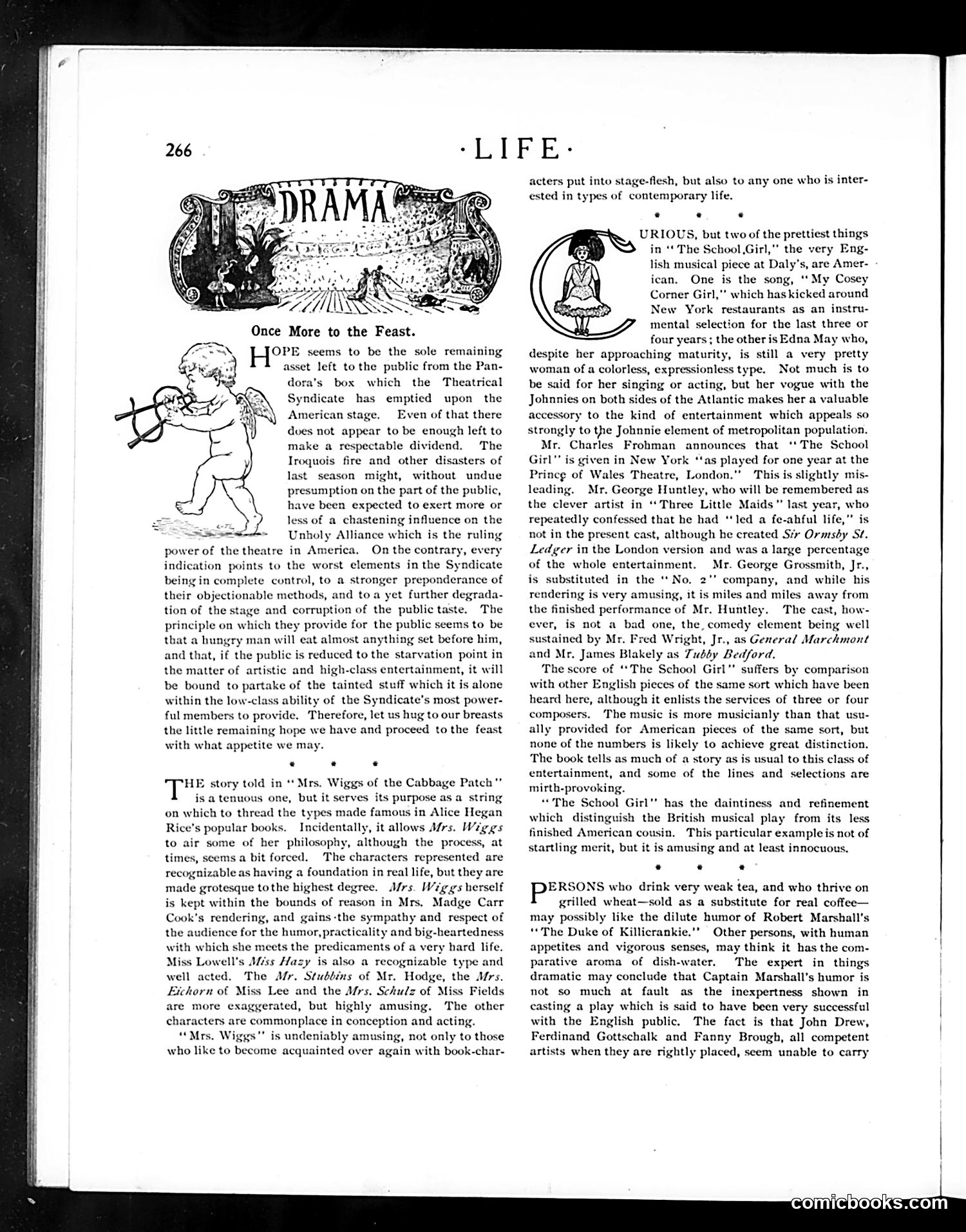
This page discusses theatrical productions, particularly "The School Girl," a musical piece performed at Daly's Theatre in New York. The illustration shows a cherub or cupid figure, which appears decorative rather than specifically satirical. The text critiques the Theatrical Syndicate's monopoly over American stages, lamenting their control leaves little quality entertainment for the public. The author argues the Syndicate prioritizes profit over artistic merit, reducing theatrical offerings to low-class entertainment. The review of "The School Girl" notes it's a British musical adapted for American audiences, with mixed results. The text mentions several performers and compares it unfavorably to other English pieces, suggesting American theatrical productions lack the refinement of their British counterparts—a common early 20th-century criticism reflecting American anxieties about cultural sophistication.
📄 Transcribed text from this page (OCR, searchable)
Machine-transcribed from the original scan — historical spelling and the odd misread are preserved.
LIFE: Once More to the Feast. Hore seems to be the sole remaining asset left to the public from the Pan- dora’s box Syndicate has emptied the Theatrical upon the American stage. Even of that there dues not appear to be enough left to make a respectable dividend. ‘The Iroquois fire and other disasters of last season might, without undue presumption on the part of the public, have been expected to exert more or less of a chastening influence on the Unholy Alliance which is the ruling power of the theatre in America, On the contrary, every indication points to the worst elements in the Syndicate being in complete control, to a stronger preponderance of their objectionable methods, and toa yet further degrada- tion of the stage and corruption of the public taste. The principle on which they provide for the public seems to be that a hungry man will eat almost anything set before him, and that, if the public is reduced to the starvation point in the matter of artistic and high-class entertainment, it will be bound to partake of the tainted stuff which it is alone within the low-class ability of the Syndicate’s most power- ful members to provide. Therefore, let us hug to our brea the little remaining hope we have and proceed to the feast with what appetite we may. which T? story told in ‘* Mrs. Wiggs of the Cabbage Patch" is a tenuous one, but it serves its purpose as a string on which to thread the types made famous in Alice Hegan Rice’s popular books. Incidentally, it allows Mrs. Wiggs to air some of her philosophy, although the process, at times, seems a bit forced. The characters represented are recognizable as having a foundation in real life, but they are made grotesque tothe highest degree. Mrs. Wiggs herself is kept within the bounds of reason in Mrs, Madge Carr Cook's rendering, and gains -the sympathy and respect of the audience for the humor, practicality and big-heartedne: with which she meets the predicaments of a very hard life. Miss Lowell's Miss Hazy is also a recognizable type and well acted. The Mr. Studbbins of Mr. Hodge, the Mrs. Echorn of Miss Lee and the Mfrs, Schulz of Miss Fields are more exaggerated, but highly amusing. The other charac! are commonplace in conception and acting. “Mrs. Wiggs” is undeniably amusing, not only to those who like to become acquainted over again with book-char- acters put into stage-flesh, but also to any one who is inter- ested in types of contemporary life. * . * URIOUS, but two of the prettiest things in ‘The School,Girl,” the very Eng- lish musical piece at Daly's, are Amer- ican. One is the song, ‘My Cosey Corner Girl,’ which has kicked around New York restaurants as an instru- mental selection for the last three or four years ; the other is Edna May who, despite her approaching maturity, is still a very pretty woman of a colorless, expressionless type. Not much is to be said for her singing or acting, but her vogue with the Johnnies on both sides of the Atlantic makes her a valuable accessory to the kind of entertainment which appeals so strongly to the Johnnie element of metropolitan population. Mr. Charles Frohman announces that ‘The School Girl” is given in New York ‘as played for one year at the Princg of Wales Theatre, London." This is slightly mis- leading. Mr. George Huntley, who will be remembered as the clever artist in ‘Three Little Maids” last year, who repeatedly confessed that he had ‘‘led a fe-ahful life,” not in the present cast, although he created Sr Ormsby St. Ledger in the London version and was a large percentage of the whole entertainment. Mr. George Grossmith, Jr., is substituted in the ‘No. 2"' company, and while his rendcring is very amusing, it is miles and miles away from the finished performance of Mr. Huntley. ‘The cast, how- ever, is not a bad one, the, comedy element being well ned by Mr. Fred Wright, Jr., as General Marchmont and Mr, James Blakely as Tubby Bedford. The score of ‘*The School Girl" suffers by comparison with other English pieces of the same sort which have been heard here, although it enlists the services of three or four composers. The music is more musicianly than that usu- ally provided for American pieces of the same sort, but none of the numbers is likely to achieve great distinction. ‘The book tells as much of a story as is usual to this class of entertainment, and some of the lines and selections are mirth-provoking. “The School Girl'’ has the daintiness and refinement which distinguish the British musical play from its less finished American cousin, This particular example is not of startling merit, but it is amusing and at least innocuous, ERSONS who drink very weak tea, and who thrive on grilled wheat—sold as a substitute for real coffee— may possibly like the dilute humor of Robert Marshall's ‘The Duke of Killicrankie."’ Other persons, with human appetites and vigorous senses, may think it has the com- parative aroma of dish-water. The expert in things dramatic may conclude that Captain Marshall's humor is not so much at fault as the inexpertness shown in casting a play which is said to have been very successful with the English public. The fact is that John Drew, Ferdinand Gottschalk and Fanny Brough, all competent artists when they are rightly placed, seem unable to carry