
Life, 1904-09-15 · page 4 of 20
Life — September 15, 1904 — page 4: what you’re looking at
What you’re looking at
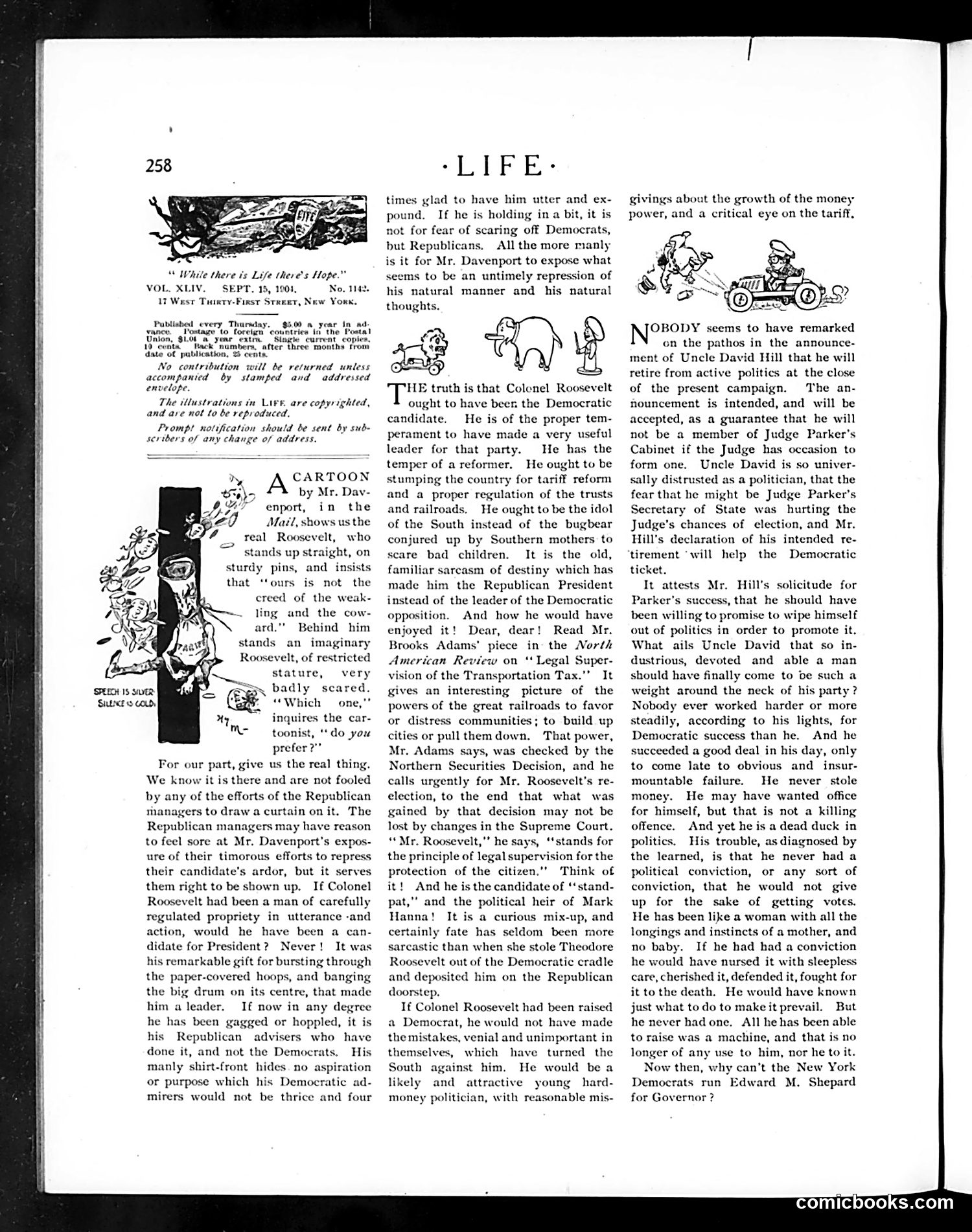
The cartoon titled "Which one?" satirizes Colonel Roosevelt as a potential Democratic presidential candidate. The image depicts Roosevelt as an elephant labeled "REAL ROOSEVELT" standing among smaller figures, with the caption asking "Which one" he prefers. The text argues Roosevelt—despite being Republican—would have made an excellent Democratic leader due to his reformist temperament: his support for tariff reform, trust regulation, and railroad oversight. The satire suggests Roosevelt's progressive policies align better with Democratic principles than typical Republican ideology. The joke's irony: Republicans might fear losing their "useful" reformer to the opposition, while Democrats lament they cannot claim him as their own candidate. This reflects the political fluidity and Roosevelt's cross-party appeal during the early 1900s.
📄 Transcribed text from this page (OCR, searchable)
Machine-transcribed from the original scan — historical spelling and the odd misread are preserved.
“ While there i's Life there's Hope.” XLIV. SEPT. 15, 1905, No. 1142. West Taiety-Fist Street, New Youn, VOL Published every Thursday. $5.00 year in ad Tostage to foreign countries i the Postal my nu publication, 25 cents, No contribution will be returned unless accompanied by stamped and addressed envelope. The illustrations in Live, are copyrighted, and are not to be reproduced. Prompt notification should be sent by sub- scribers of any change of address. CARTOON by Mr. Dav- in the Mail, shows us the real Roosevelt, who stands up straight, on sturdy pins, and insists that ‘ours the creed of the weak- ling and the cow- ard." Behind him stands an imaginary Roosevelt, of restricted stature, very badly scared. “Which one, inquire toonist, do you prefer?’ For our part, give us the real thing. We know it is there and are not fooled by any of the efforts of the Republican managers to draw a curtain on it. The Republican managers may have reason to feel sore at Mr. Davenport's expos- ure of their timorous efforts to repress their candidate's ardor, but it serves them right to be shown up. If Colonel Roosevelt had been a man of carefully regulated propriety in utterance -and action, would he have been a can- didate for President? Never! It was his remarkable gift for bursting through the paper-covered hoops, and banging the big drum on its centre, that made him a leader. If now in any degree he has been gagged or hoppled, it is his Republican advisers who have done it, and not the Democrats. His manly shirt-front hides. no aspiration or purpose which his Democratic ad- mirers would not be thrice and four is not N the car- -LIFE- times ylad to have him utter and ex- pound. If he is holding in a bit, it is not for fear of scaring off Democrats, but Republicans. All the more manly is it for Mr. Davenport to expose what s to be an untimely repression of his natural manner and his natural thoughts. &% 4 @ HE truth is that Colonel Roosevelt ought to have beer the Democratic candidate. He is of the proper tem- perament to have made a very useful leader for that party. He has the temper of a reformer. He ought to be stumping the country for tariff reform and a proper regulation of the trusts and railroad: He ought to be the idol of the South instead of the bugbear conjured up by Southern mothers to scare bad children. It is the old, familiar sarcasm of destiny which has made him the Republican President instead of the leader of the Democratic opposition. And how he would have enjoyed it! Dear, dear! Read Mr. Brooks Adams’ piece in the North American Review on Legal Super- vision of the Transportation Tax."” It gives an interesting picture of the powers of the great railroads to favor or distress communities; to build up cities or pull them down, That power, Mr. Adams says, was checked by the Northern Securities Decision, and he calls urgently for Mr. Roosevelt's re- election, to the end that what was gained by that decision may not be lost by changes in the Supreme Court. “Mr. Roosevelt,” he says, ‘‘stands for the principle of legal supervision for the protection of the citizen." Think of it! And he is the candidate of ‘‘stand- pat,"’ and the political heir of Mark Hanna! It is a curious mix-up, and certainly fate has seldom been more sarcastic than when she stole Theodore Roosevelt out of the Democratic cradle and deposited him on the Republican doorstep. If Colonel Roosevelt had been raised a Democrat, he would not have made the mistakes, venial and unimportant in themselves, which have turned the South against him. He would be a likely and attractive young hard- money politician, with reasonable mis- givings about the growth of the money power, and a critical eye on the tariff, OBODY seems to have remarked on the pathos in the announce- ment of Uncle David Hill that he will retire from active politics at the close of the present campaign. The an- nouncement is intended, and will be accepted, as a guarantee that he will not be a member of Judge Parker's Cabinet if the Judge has occasion to form one. Uncle David is so univ sally distrusted as a politician, that the fear that he might be Judge Parker's Secretary of State was hurting the Judge’s chances of election, and Mr. Hill’s declaration of his intended re- tirement ‘will help the Democratic ticket. It attests Mr. Hill's solicitude for Parker’s success, that he should have been willing to promise to wipe himself out of politics in order to promote it. What ails Uncle David that so in- dustrious, devoted and able a man should have finally come to ce such a weight around the neck of his party? Nobody ever worked harder or more steadily, according to his lights, for Democratic success than he. And he succeeded a good deal in his day, only to come late to obvious and insur- mountable failure. He never stole money. He may have wanted office for himself, but that is not a killing offence. And yet he is a dead duck in politics. His trouble, as diagnosed by the learned, is that he never had a political conviction, or any sort of conviction, that he would not give up for the sake of getting votes. He has been like a woman with all the longings and instincts of a mother, and no baby. If he had had a conviction he would have nursed it with sleepless care, cherished it, defended it, fought for it to the death. He would have known just what to do to make it prevail. But he never had one, All he has been able to raise was a machine, and that is no longer of any use to him, nor he to i Now then, why can’t the New York Democrats run Edward M. Shepard for Governor ? comicbooks.com