
Life, 1904-09-15 · page 14 of 20
Life — September 15, 1904 — page 14: what you’re looking at
What you’re looking at
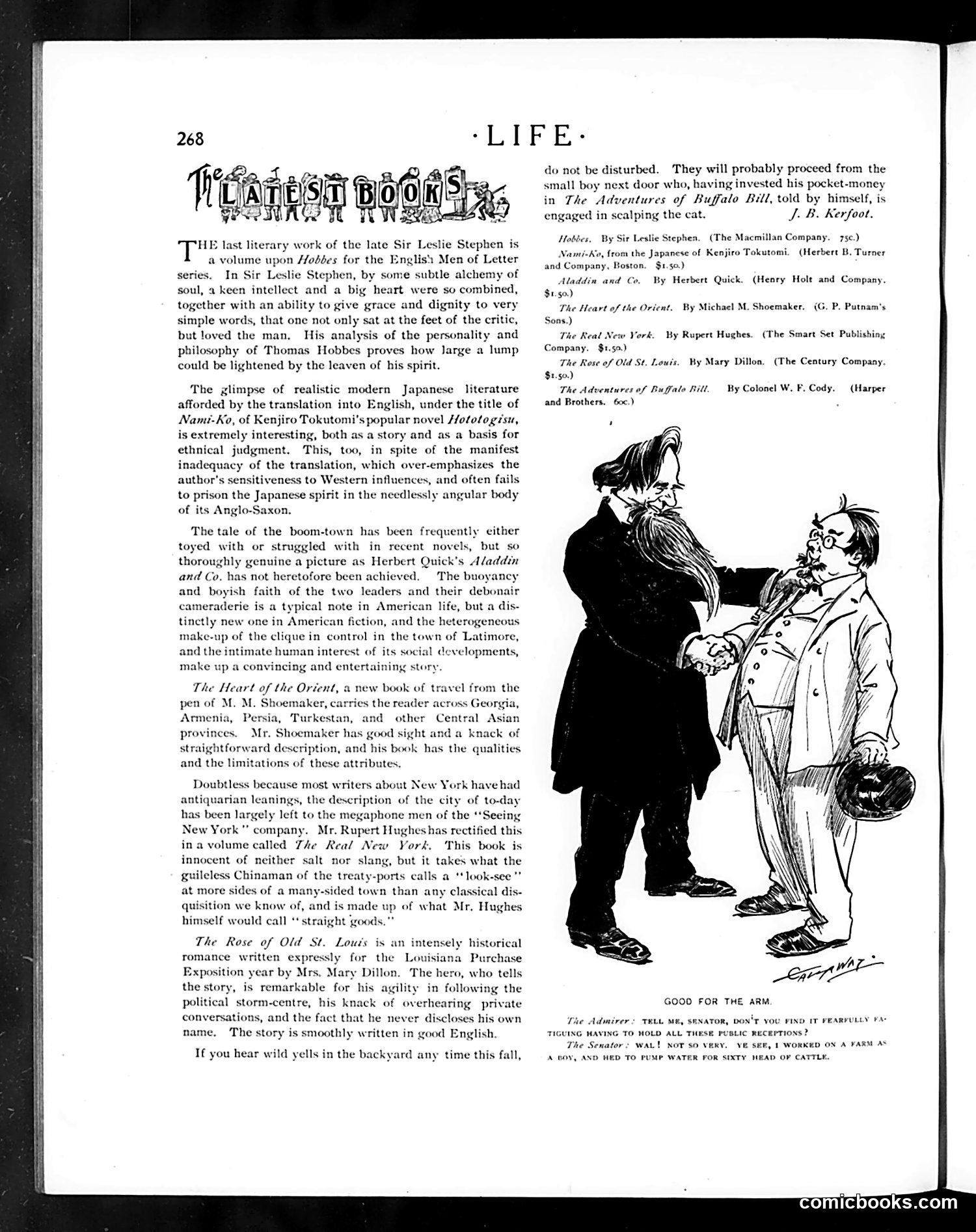
This cartoon depicts a social-climber (the "Admirer") approaching a seated Senator, attempting flattery about his physical prowess. The Senator responds dismissively, revealing the cartoon's joke: he claims his strength comes not from gentlemanly exercise but from crude manual labor—"pumping water for sixty head of cattle." The satire targets wealthy politicians who present themselves as refined gentlemen while their actual fortunes derive from unglamorous, working-class origins. The Admirer's fawning compliments about "the arm" are undercut by the Senator's blunt admission that his muscular build reflects farming work, not aristocratic cultivation. This mocks the pretensions of Gilded Age politicians who rose from humble beginnings yet adopted airs of sophistication. The humor lies in exposing the gap between their self-presentation and their actual (albeit successful) working-class past.
📄 Transcribed text from this page (OCR, searchable)
Machine-transcribed from the original scan — historical spelling and the odd misread are preserved.
*LIFE« do not be disturbed. ‘They will probably proceed from the small boy next door who, having invested his pocket-money in The Adventures of Buffalo Bill, told by himself, is engaged in scalping the cat. J. B. Kerfoot. Hobbes, By Sir Leslie Stephea. (The Macmillan Company. 75¢.) an . ; Nami-Ko, from the Japanese of Kenjiro Tokutomi. (Herbert B. Turner a volume upon Hobdes for the I i eS series. In Sir Leslie Stephen, by some subtle alchemy of Atidtdin andca By Werwert Quik: When, Wle-aid Company, soul, a keen intellect and a big heart were so combined, gy 5.) together with an ability to give grace and dignity to very simple words, that one not only sat at the feet of the critic, but loved the man, His anal. of the personality and The Real New York. Wy Rupert Hughes. (The Smart Set Publishing philosophy of Thomas Hobbes proves how Jarge a lump Company could be lightened by the leaven of his spirit. : ze Rose of Old St. Louis. Wy Mary Dillon. (The Century Company. #.§0. The glimpse of realistic modern Japanese literature The Adventures of Buffalo Rill, By Colonel W. F. Cody. (Harper afforded by the translation into English, under the title of and Brothers. 60.) Nami-Ko, of Kenjiro Tokutomi's popular novel Hototogisu, is extremely interesting, both as a story and as a basis for ethnical judgment. This, too, in spite of the manifest inadequacy of the translation, which over-emphasizes the author's sensitiveness to Western influences, and often fails to prison the Japanese spirit in the needlessly angular body of its Anglo-Saxon. The Heart of the Orient. By Michael M. Shoemaker. (G. P. Putnam's The tale of the boom-town has been frequently either toyed with or struggled with in recent novels, but so thoroughly genuine a picture as Herbert Quick's Aladdin and Co. has not heretofore been achieved. ‘The buoyancy and boyish faith of the two leaders and their debonair cameraderie is a typical note in American life, but a dis- tinctly new one in American fiction, and the heterogencous make-up of the clique in control in the town of Latimore, and the intimate human interest of its social developments, make up a convincing and entertaining story. The Heart of the Orient, a new book of travel from the pen of M. M, Shoemaker, carries the reader across Georgia Armenia, Pe Turkestan, and other Central Asian provinces. Mr, Shoemaker has good sight and a knack of straightforward description, and his book has the qualities and the limitations of these attributes. Doubtless because most writers about New York have had antiquarian leanings, the description of the city of to-day has been largely left to the megaphone men of the ‘Seeing ew York" company. Mr. Rupert Hughes has rectified this ina volume called The Real New York. This book is innocent of neither salt nor slang, but it takes what the guileless Chinaman of the treaty-ports calls a‘ look-see* at more sides of a ny-sided town than any classical dis- quisition we know of, and is made up of what Mr. Hughes himself would call ** straight goods."" The Rose of Old St. Louts is an intensely historical romance written expressly for the Louisiana Purchase Expositi ar by Mrs. Mary Dillon, The hero, who tells the story, is remarkable for his agility in following the political storm-centre, his knack of overhearing private GOOO FOR THE ARM. conversations, and the fact that he never discloses his own The Admirer: TLL MB, SENATOR, DON'T YOU FIND IT FEARFULLY FA- name. The story is smoothly written in good E: glish, TIGUING MAVING TO HOLD ALL THESE PUBLIC RECEPTIONS? The Senator: WAL! NOT SO VERY. VE SER, 1 WORKED ON A FARM AS If you hear wild yells in the backyard any time this fall, 4 voy, axb NED To FUMP WATER POR SIXTY KAD OF CATTLE comicbooks.com