
A complete issue · 22 pages · 1904
Life — August 18, 1904
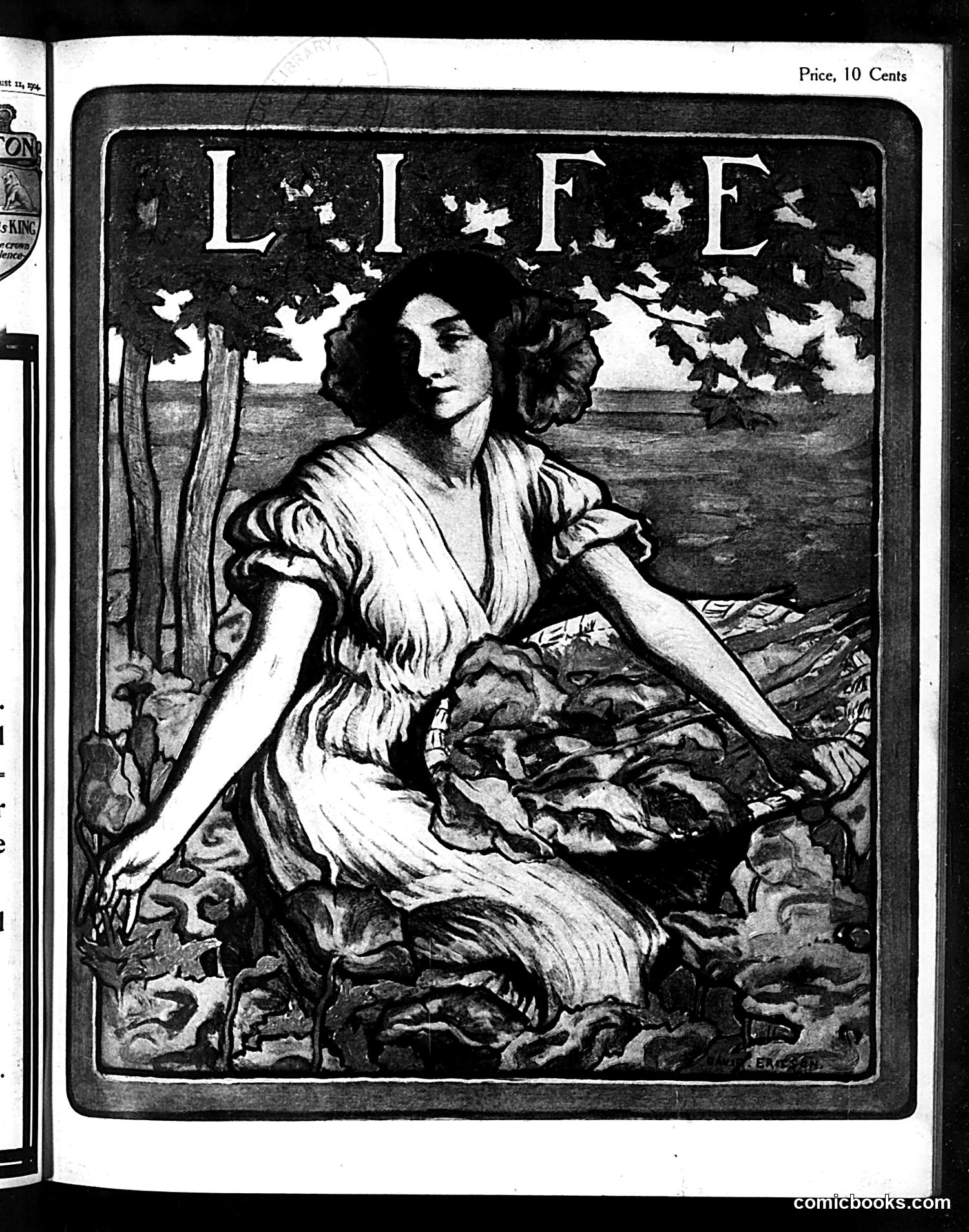
This appears to be a cover or feature from *Life* magazine (price 10 cents, dating it to early 20th century). The image depicts a classical allegorical figure of a woman in flowing white garments, surrounded by natural imagery—vegetation, water, and sky. The single word "LIFE" appears at the top. The artwork uses classical artistic conventions to personify the concept of "Life" itself as a beautiful, idealized female form. This reflects the magazine's use of allegorical imagery common to that era's satirical publications. Without additional OCR'd text from the page body, I cannot identify specific political or social commentary this may contain. The cover appears primarily artistic/decorative rather than overtly satirical, though *Life* magazine was known for social critique.
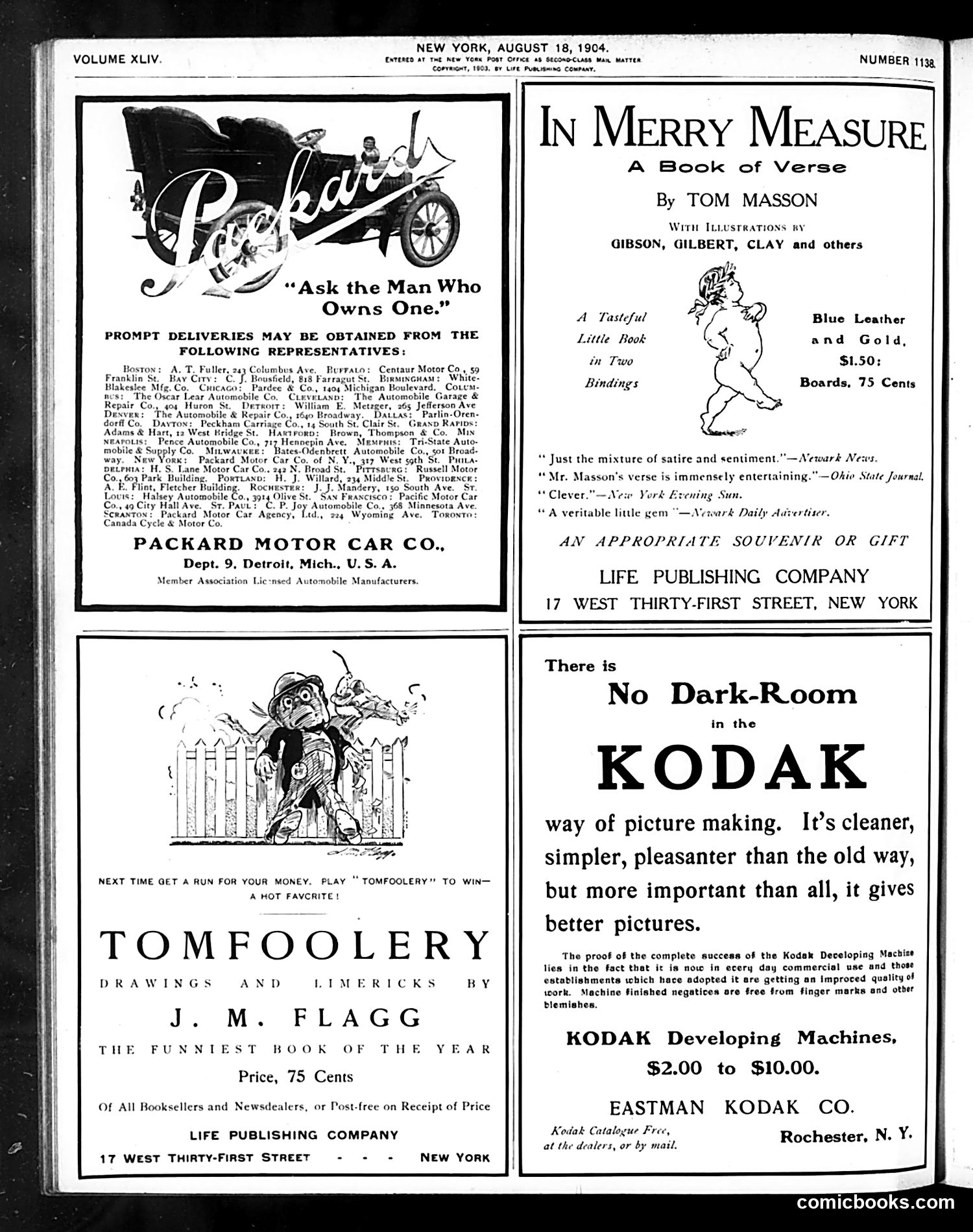
This page consists primarily of **advertisements** for books and products rather than political cartoons. The visible cartoon is titled "**Tomfoolery: Drawings and Limericks**" by J.M. Flagg. It depicts a mischievous character jumping over a fence with the caption "Next time get a run for your money. Play 'Tomfoolery' to win—a hot favorite!" This appears to be promotional artwork for a humorous book of drawings and verses—lighthearted entertainment rather than social commentary. The other advertisements promote Tom Masson's book of verse, Packard motor cars, and Kodak developing machines. The page reflects early 20th-century consumer culture and entertainment aimed at middle-class readers.
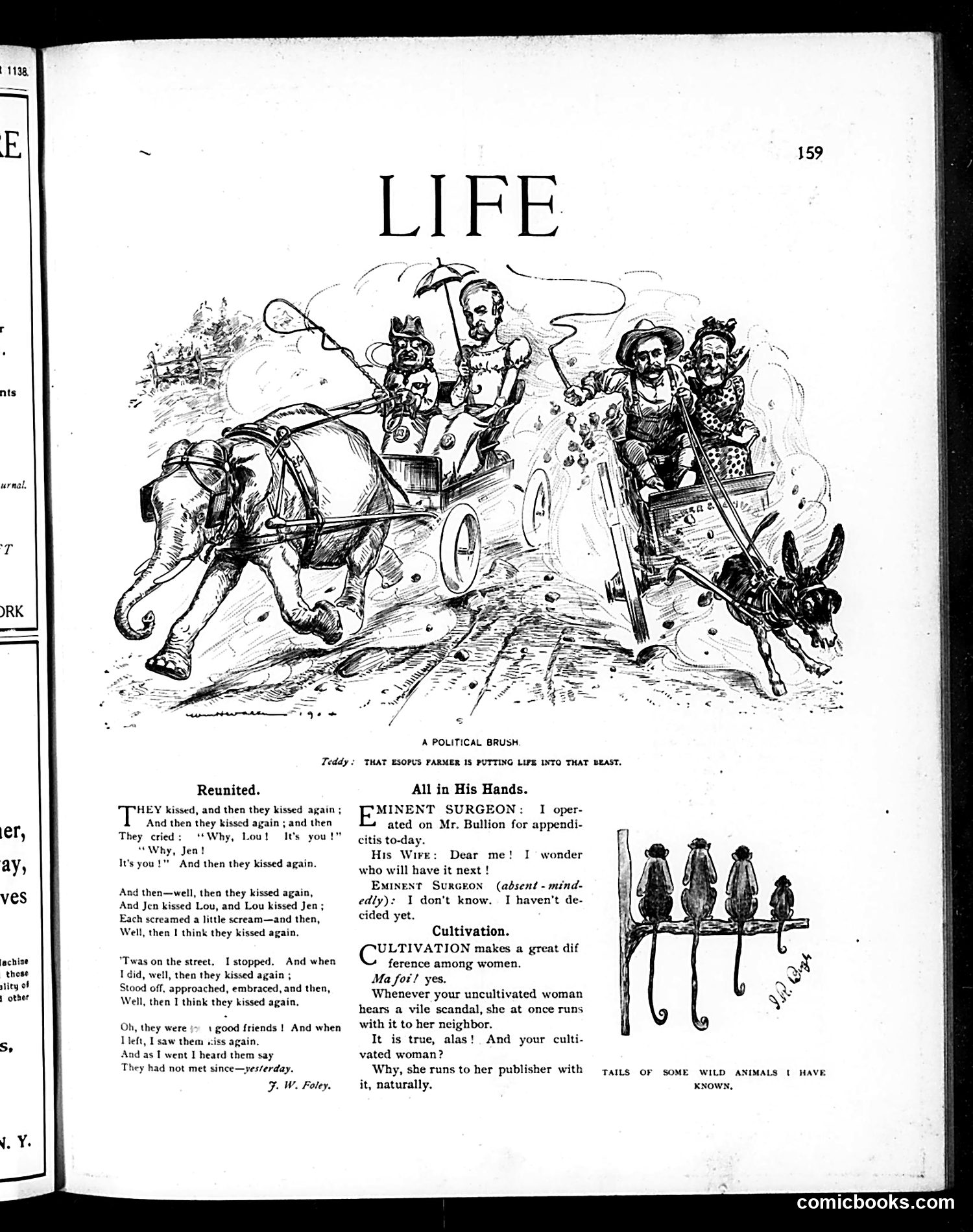
The main cartoon titled "A Political Brush" depicts an elephant (the Republican symbol) being driven like a beast of burden, pulling a cart containing multiple figures. The caption attributes the statement "THAT ESOPS FARMER IS PUTTING LIFE INTO THAT BEAST" to "Teddy," likely Theodore Roosevelt. The satire critiques Roosevelt's political influence—the cartoon suggests he's energizing or "putting life into" the Republican Party apparatus through vigorous leadership. The elephant straining under its load reflects satirical commentary on the party's burdens or the demands placed upon it. The remaining page content consists of brief humorous dialogues about romance ("Reunited") and social commentary on women's cultivation and scandal-spreading—typical Life magazine satirical humor of its era.
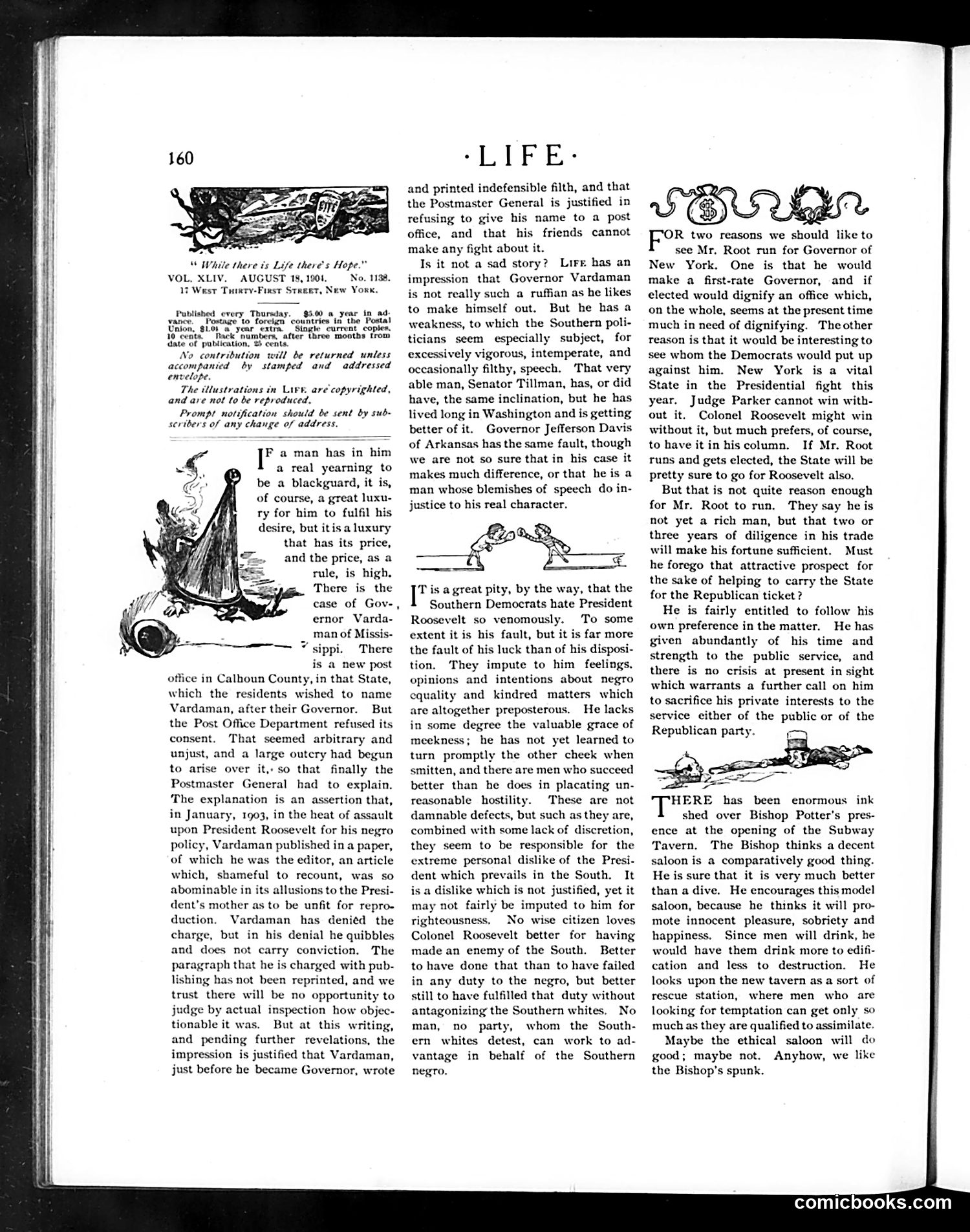
This page contains political commentary rather than cartoons. The main editorial discusses a potential New York gubernatorial race, arguing for Mr. Root as a candidate against Judge Parker. The text considers whether Root, described as having made his fortune through three years of diligent trade work, should sacrifice private interests to run for the Republican ticket. The piece also critiques Governor Vardaman of Mississippi, accusing him of anti-Roosevelt sentiment and racist views toward Black citizens. It questions whether Vardaman's hostility stems from legitimate policy disagreements or personal animosity. A separate item discusses Bishop Potter's opening of a "Subway Tavern," suggesting alcohol consumption might improve public morality—a satirical jab at temperance advocates and clergy involvement in social reform.
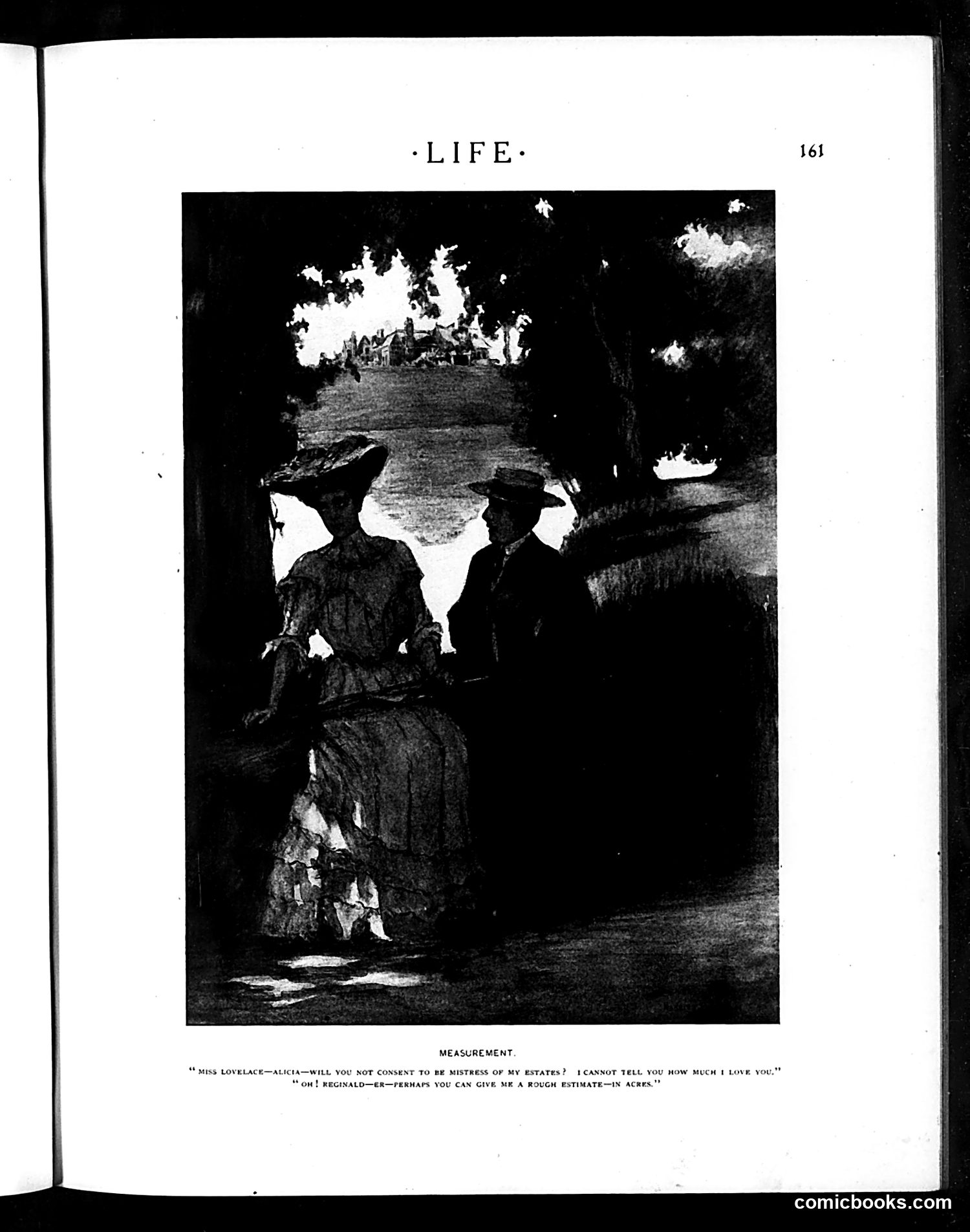
This cartoon depicts a romantic scene titled "Measurement," showing a man and woman in Victorian-era clothing viewing a distant landscape. The dialogue reveals social satire about marriage and property: The woman (identified as "Miss Lovelace—Alicia") proposes marriage, but the man (addressed as "Reginald") deflects by asking her to estimate the acreage of the visible estates. His response is dismissive—he won't commit to her emotionally but instead redirects to quantifying her property value in acres. The satire mocks upper-class courtship conventions where matrimonial prospects were evaluated based on wealth and land ownership rather than genuine affection. The "measurement" becomes both literal (calculating acreage) and figurative (assessing her worth as a potential wife based on economic value).
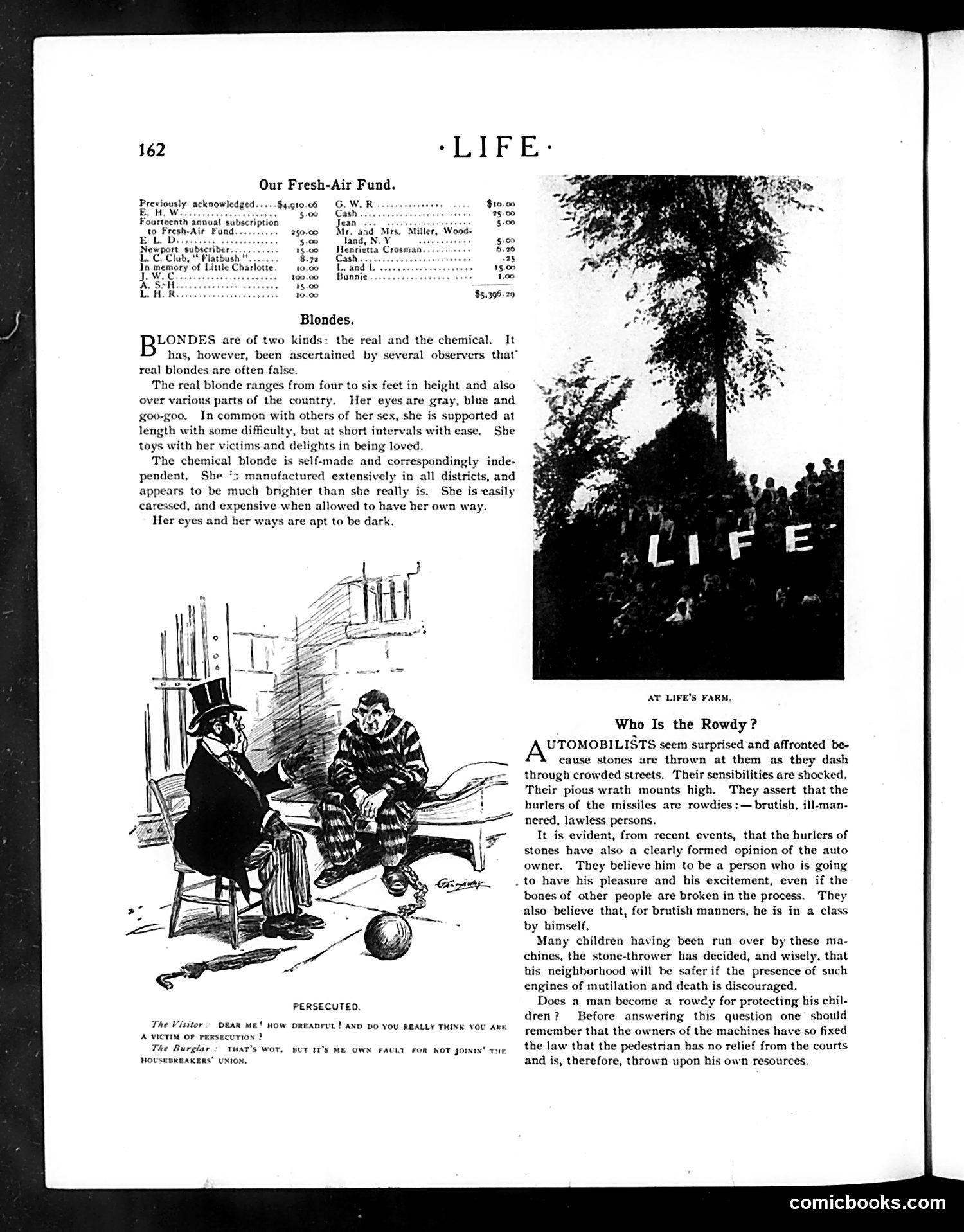
**Main Content: "Who Is the Rowdy?"** This satirical article addresses early 1900s conflict between automobiles and pedestrians. The text defends automobile owners against accusations that they're reckless "rowdies," arguing instead that stone-throwing pedestrians are the actual troublemakers. **The Cartoon:** The illustration labeled "PERSECUTED" depicts two figures (likely an automobile driver and pedestrian) in confrontation, with a ball visible—possibly representing thrown objects. The dialogue snippet suggests a burglar/thief analogy, implying the pedestrian wrongly blames the driver. **Social Context:** This reflects genuine tension during automobiles' early adoption—new vehicles were viewed with suspicion by traditional street users who resented both the vehicles and their wealthy owners. The article sarcastically portrays auto owners as victims rather than privileged aggressors, a perspective that modern readers would likely find ironic given automobiles' eventual dominance.
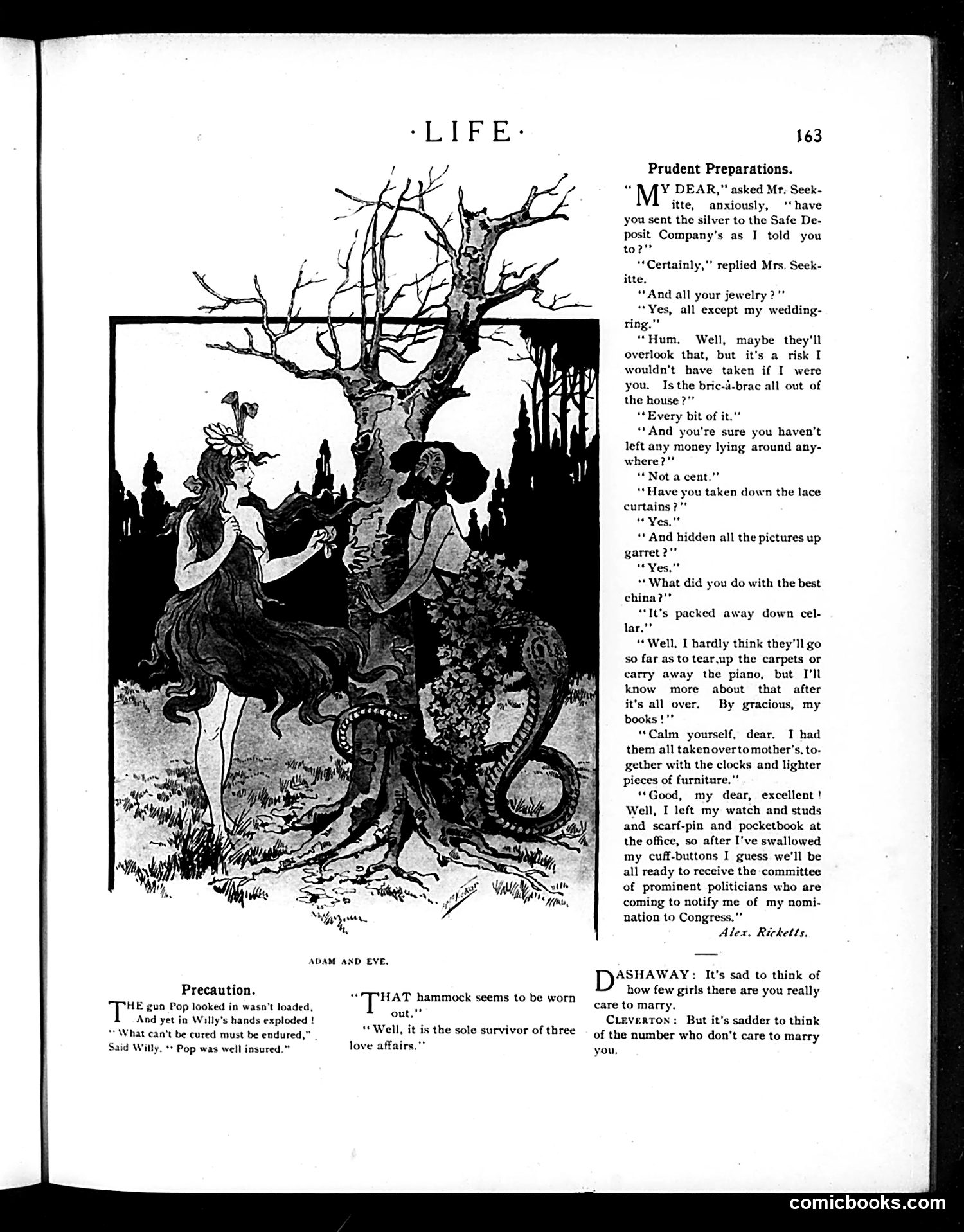
**Main Cartoon: "Adam and Eve"** The illustration depicts two figures beneath a gnarled tree in a classical style. The caption "Adam and Eve" indicates this is a biblical reference, likely satirizing traditional gender roles or marital dynamics. The woman appears to be gesturing expressively while the man listens—possibly commenting on domestic argument or relationship power dynamics. **Text Sections:** - "Precaution": A brief humorous anecdote about a gun and insurance, unrelated to the cartoon. - "Prudent Preparations": A dialogue between Mr. and Mrs. Seekitte about hiding valuables before visitors arrive—satirizing middle-class anxiety about burglary or theft. - "Dashaway/Culverton" exchange: A witty commentary on marriage prospects for women. The page uses satire to mock bourgeois concerns and romantic attitudes of the era.
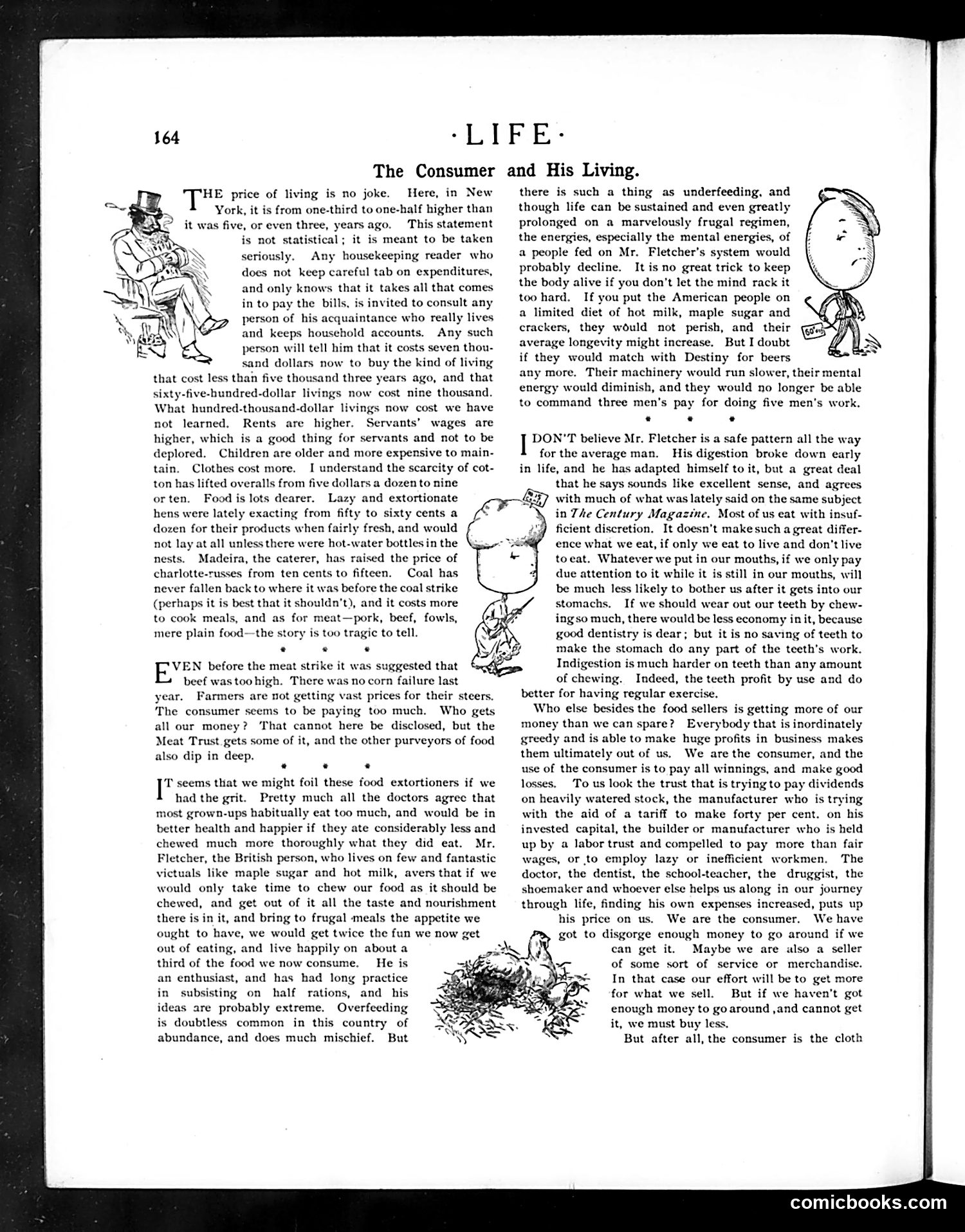
This satirical article criticizes rising costs of living and food prices in early 20th-century America. The illustrations depict ordinary citizens (recognizable by their simple clothing and expressions) being squeezed financially by increasing expenses. The text argues that consumers are being exploited by food sellers and profiteers who charge excessive prices while workers' wages stagnate. It references a specific proposal by "Mr. Fletcher" advocating extreme frugality (eating only milk, maple sugar, and crackers) as impractical—such deprivation would reduce worker productivity and mental capacity. The article's central satire: while food prices soar and profiteers grow wealthy, ordinary working people struggle to afford basic living necessities, forced to choose between eating adequately or maintaining their health and labor capacity.
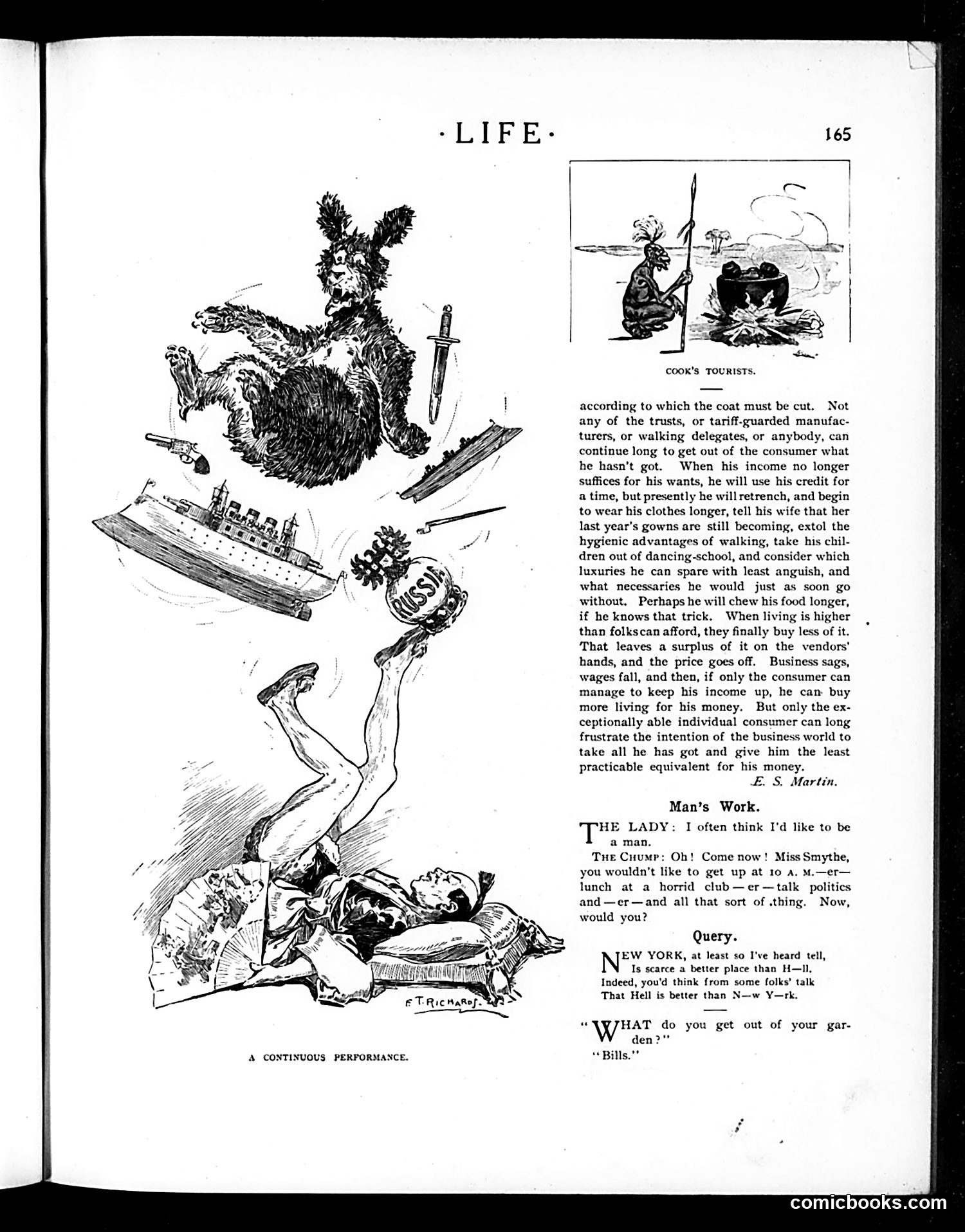
This political cartoon depicts a kangaroo struggling beneath an enormous pile of consumer goods and military equipment (ship, gun, sword, bottle labeled "Whisky"). The kangaroo appears to represent Australia or the British Empire's colonial burden. The accompanying text criticizes consumer culture and class economics. It argues that workers cannot escape poverty despite wages because trusts and manufacturers control pricing. The satirical dialogue mocks wealthy women who claim to want "a man's" freedom while enjoying privilege. The cartoon's title suggests this endless cycle of consumption, debt, and economic struggle is "continuous" — relentless and inescapable. The kangaroo symbolizes the strain of maintaining imperial economic systems.
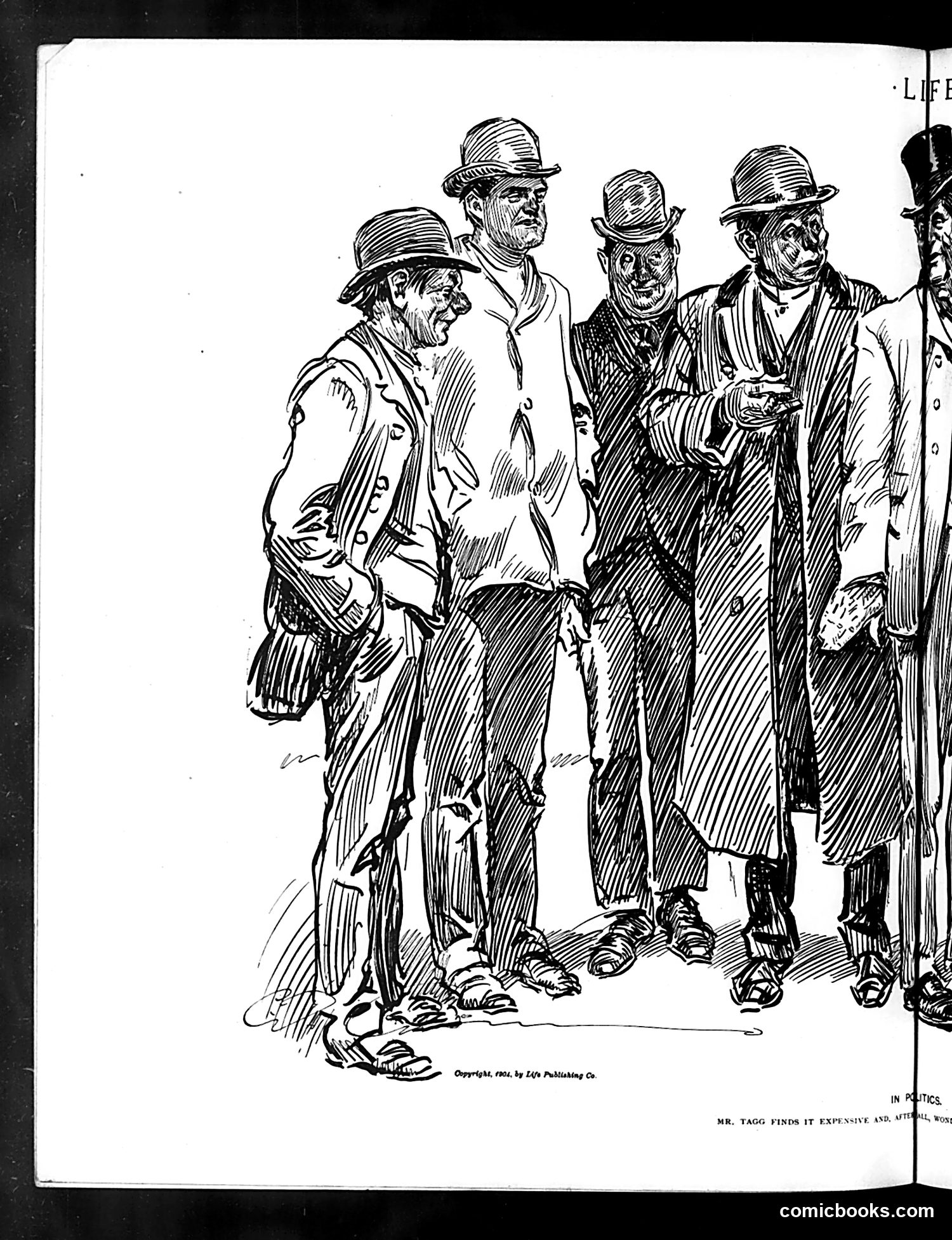
This 1904 Life magazine cartoon depicts a group of working-class men in worn clothing and hats confronting what appears to be a well-dressed political figure. The caption references "Mr. Tagg" finding something "expensive and worthwhile." The satire likely concerns labor disputes or economic inequality of the early 1900s—a period of significant labor unrest in America. The contrast between the shabby appearance of the group and their apparent confrontation with authority suggests commentary on workers' grievances over wages or working conditions. Without clearer identification of "Mr. Tagg" or additional context, the specific political target remains unclear, though the cartoon clearly mocks either a politician dismissive of workers' concerns or the workers' inability to effect change despite their numerical advantage.
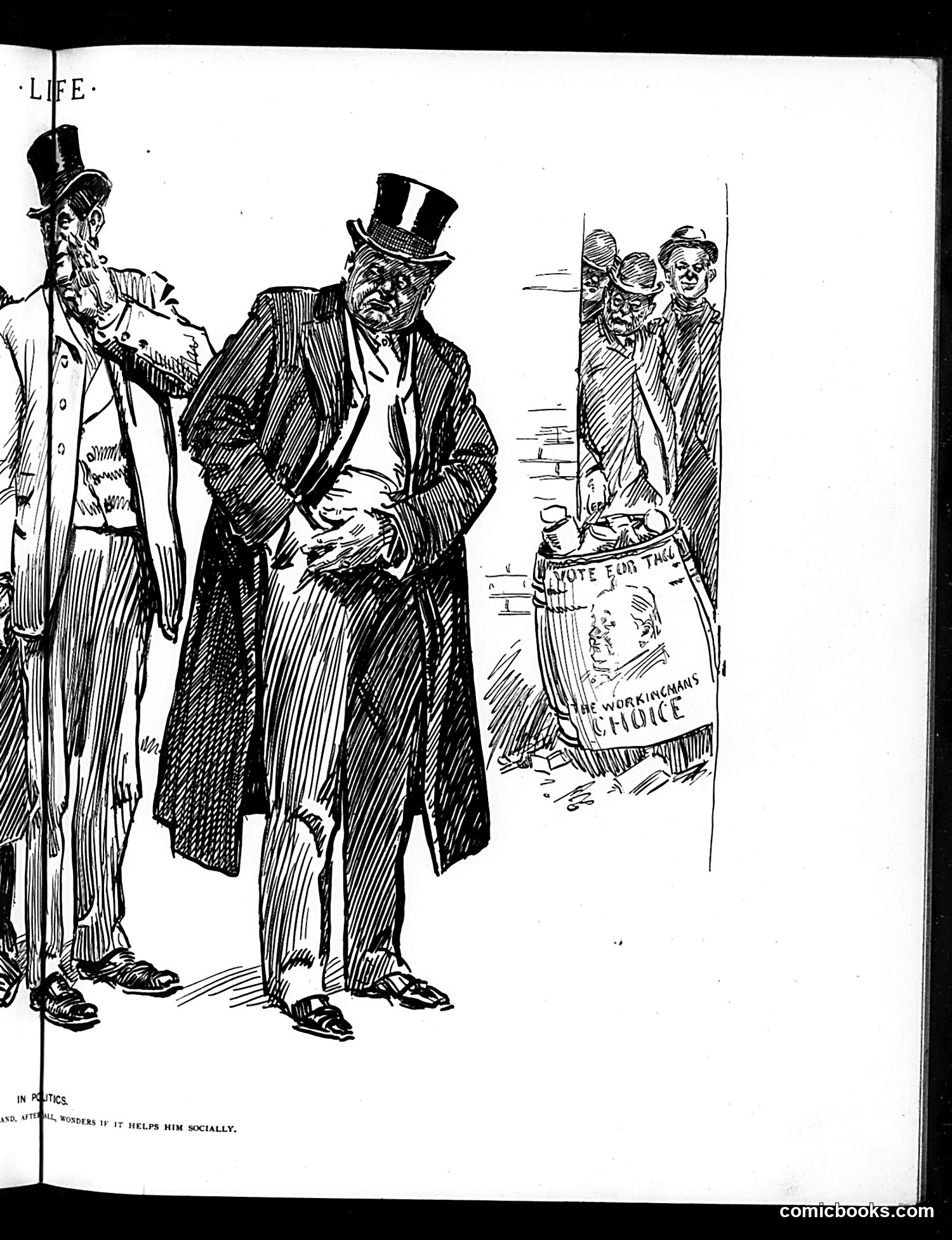
This satirical Life magazine cartoon depicts a wealthy gentleman in a top hat—likely representing a plutocrat or robber baron—dismissing working-class concerns. On the right, a group of workers holds a sign reading "VOTE FOR THE WORKINGMAN'S CHOICE," but the well-dressed figure appears indifferent or contemptuous toward their political participation. The caption references "politics" and notes "an awful wonder if it helps him socially," suggesting the cartoon mocks the wealthy man's detachment from democratic processes and working-class interests. The contrast between his formal attire and the workers' simpler dress emphasizes class divide. This reflects early 20th-century tensions between labor movements and wealthy industrialists, satirizing the wealthy's perceived disregard for workers' political voice and social concerns.
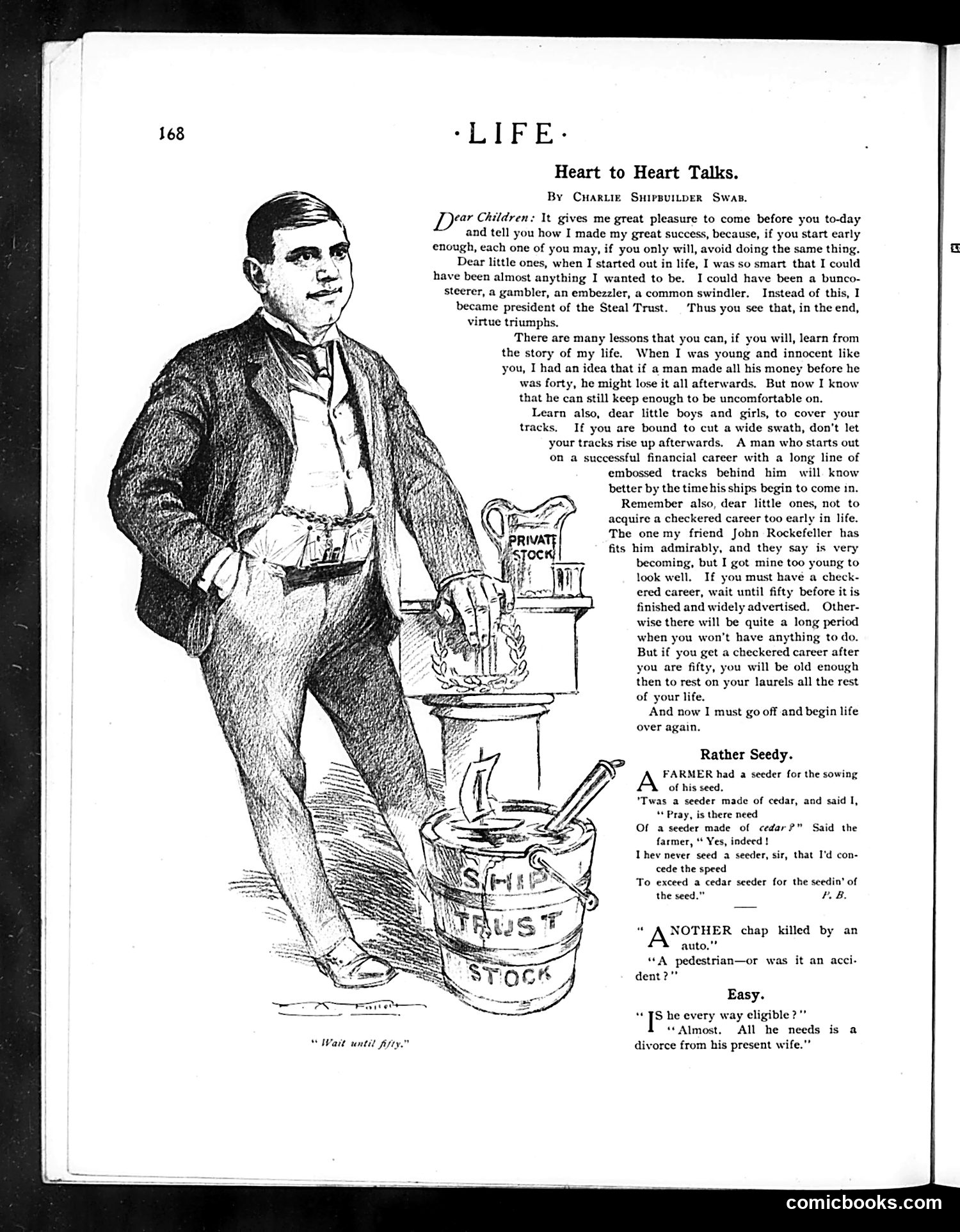
**Main Illustration & "Heart to Heart Talks":** The large illustration depicts a well-dressed man standing among three labeled vessels: "Private Stock," "Sham," "Trust," and "Stock." The accompanying article by Charlie Shipbuilder Swab addresses children, using the man's success as an example. He claims to have become "president of the Steal Trust" through virtue—an ironic statement suggesting he actually built wealth through dubious means. The satire targets wealthy industrialists who publicly claim moral virtue while their business practices ("stealing," trusts, sham dealings) are predatory. **Bottom Jokes:** Three brief satirical quips follow: one about cedar seeders, one about auto casualties, and one about divorce eligibility. These are unrelated to the main cartoon, offering quick social commentary on contemporary topics. The overall page satirizes Gilded Age business ethics and hypocritical wealthy moralizing.
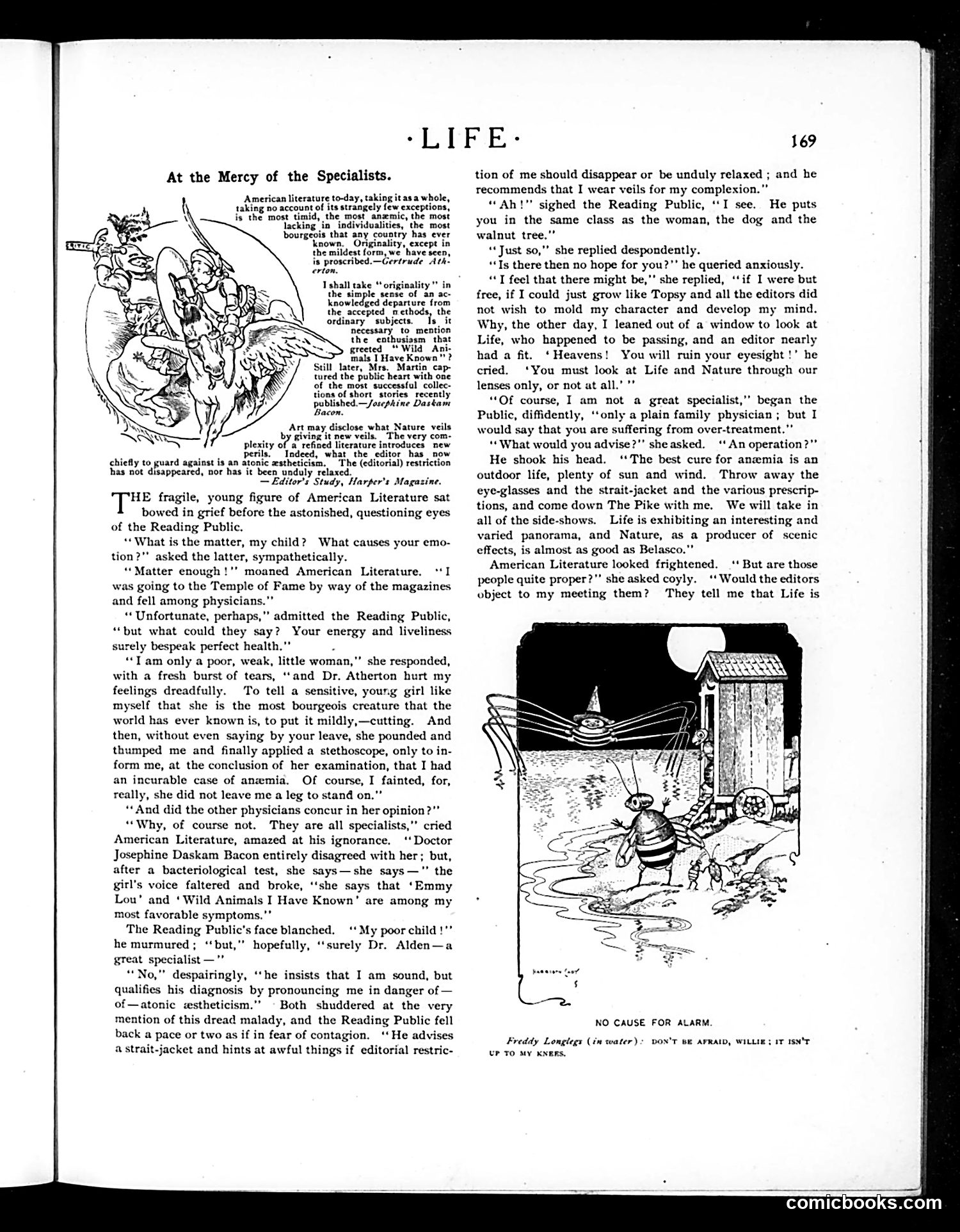
This satirical piece critiques literary critics and editors who constrain American writers through excessive analysis and restrictive standards. **The Setup:** American Literature is personified as a fragile young woman who has collapsed after consulting various "specialists"—literary critics including Gertrude Atherton, Josephine Daskam Bacon, and Dr. Alden. Each has diagnosed her with different ailments: Atherton called her "bourgeois" and "anemic"; others offer conflicting medical metaphors for her condition. **The Satire:** The joke treats literary criticism like medical practice, where competing specialists provide contradictory diagnoses while the patient (literature itself) deteriorates. The "disease" appears to be lack of originality—yet the critics themselves are blamed for killing creativity through their judgmental scrutiny and editorial restrictions. **The Point:** Editors and critics, though well-intentioned, damage literature by over-analyzing it, imposing conformity, and preventing natural creative growth. Literature would thrive if simply left free to develop organically ("grow like Topsy"), rather than being subjected to constant professional evaluation and "strait-jacket" restrictions.
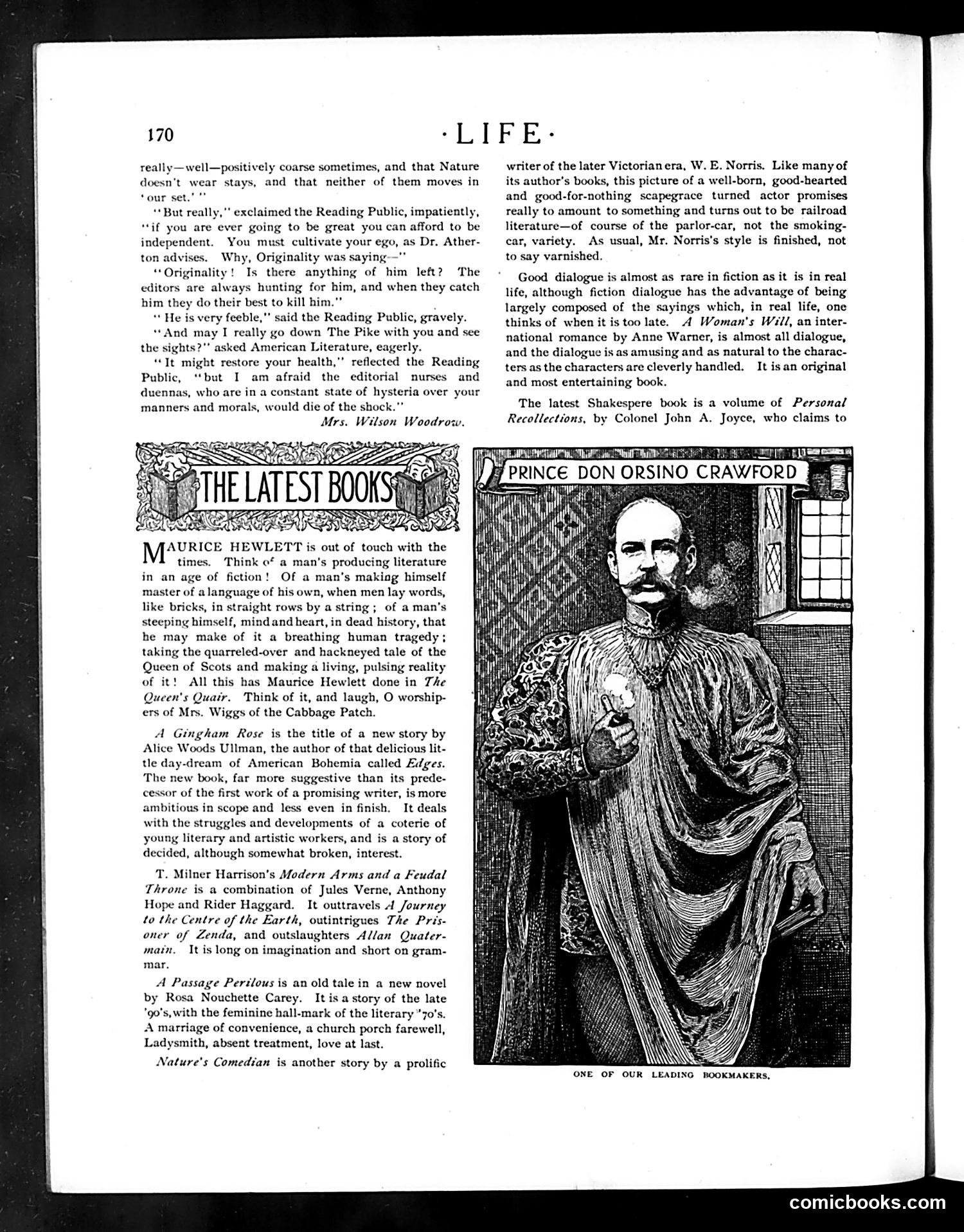
This page from *Life* magazine presents literary criticism and book reviews typical of early 20th-century American publishing discourse. The left column contains satirical dialogue mocking literary pretension. Characters like "the Reading Public" and personified abstractions ("Originality," "American Literature") discuss how editors hunt down and destroy originality in literature. The satire targets both writers who affect artistic independence and the publishing industry's standardization of literature. The right side showcases a portrait labeled "Prince Don Orsino Crawford" with caption "One of Our Leading Bookmakers"—likely a publisher or editor of the era. The reviews below critique contemporary books by Maurice Hewlett, Alice Woods Ullman, T. Milner Harrison, and others, with *Life's* characteristic snark. The magazine dismisses some works as derivative or overly polished ("varnished"), while praising genuine dialogue and originality. The overall satire targets the tension between literary ambition and commercial publishing demands in the era.
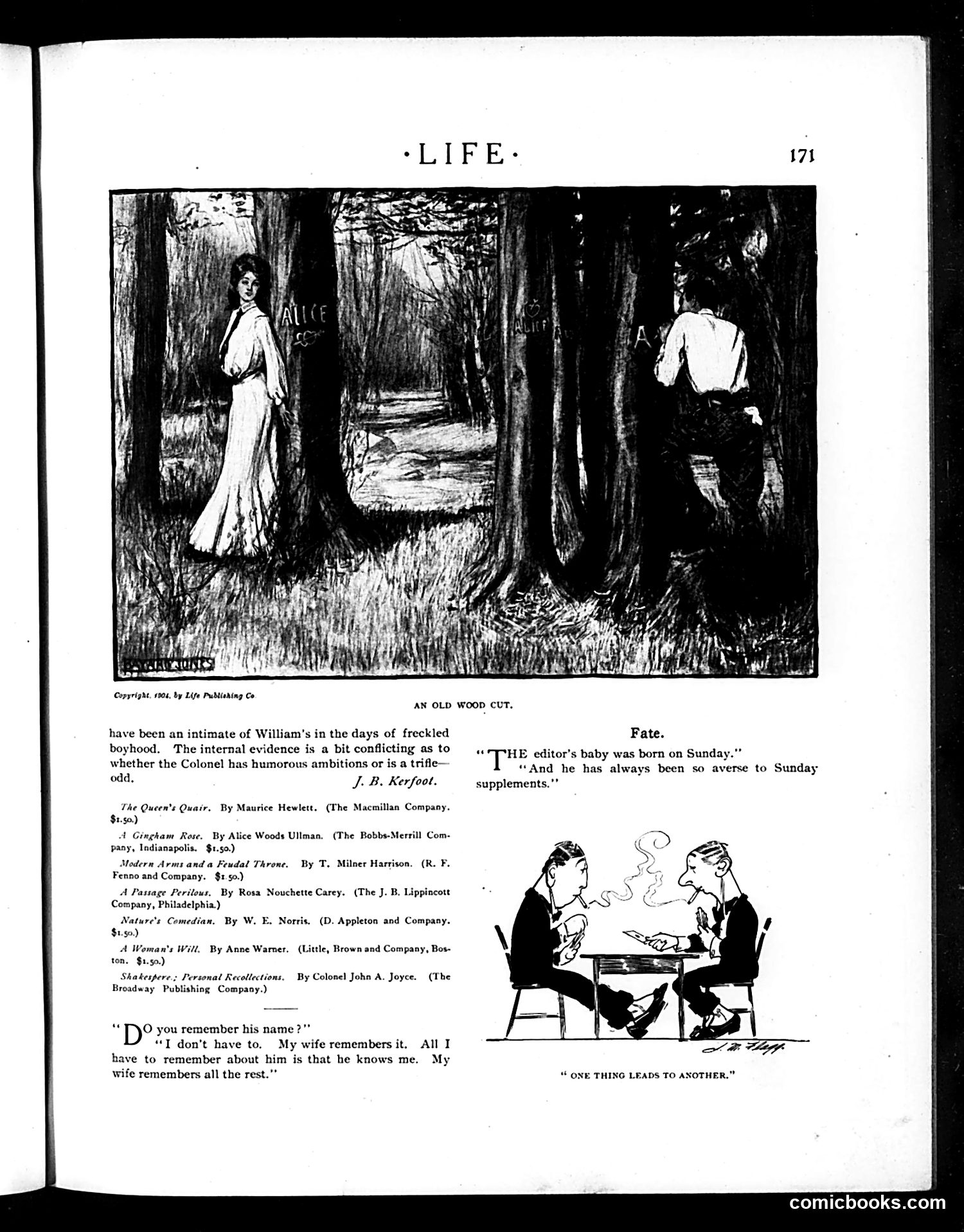
This page contains **book reviews** and **two separate jokes/cartoons**: ## "An Old Wood Cut" A woodblock-style illustration depicting two figures in a forest setting. The text references "William" and "the Colonel," suggesting it illustrates a literary work, though the specific reference remains unclear from the visible text. ## Two Humor Pieces **"Fate":** A brief joke about an editor whose baby was born on Sunday. The humor plays on the editor's supposed aversion to "Sunday supplements"—the illustrated sections of newspapers. The irony: his newborn arrived on the very day he dislikes professionally. **"One Thing Leads to Another":** A cartoon showing two men at a table in conversation. One man explains he doesn't need to remember his acquaintance's name because his wife remembers everything about him—implying wives handle all social memory and details in marriage. This reflects early-1900s domestic humor stereotypes about male forgetfulness versus female attentiveness. Both jokes rely on domestic and marital comedy conventions typical of the era's satirical magazine humor.
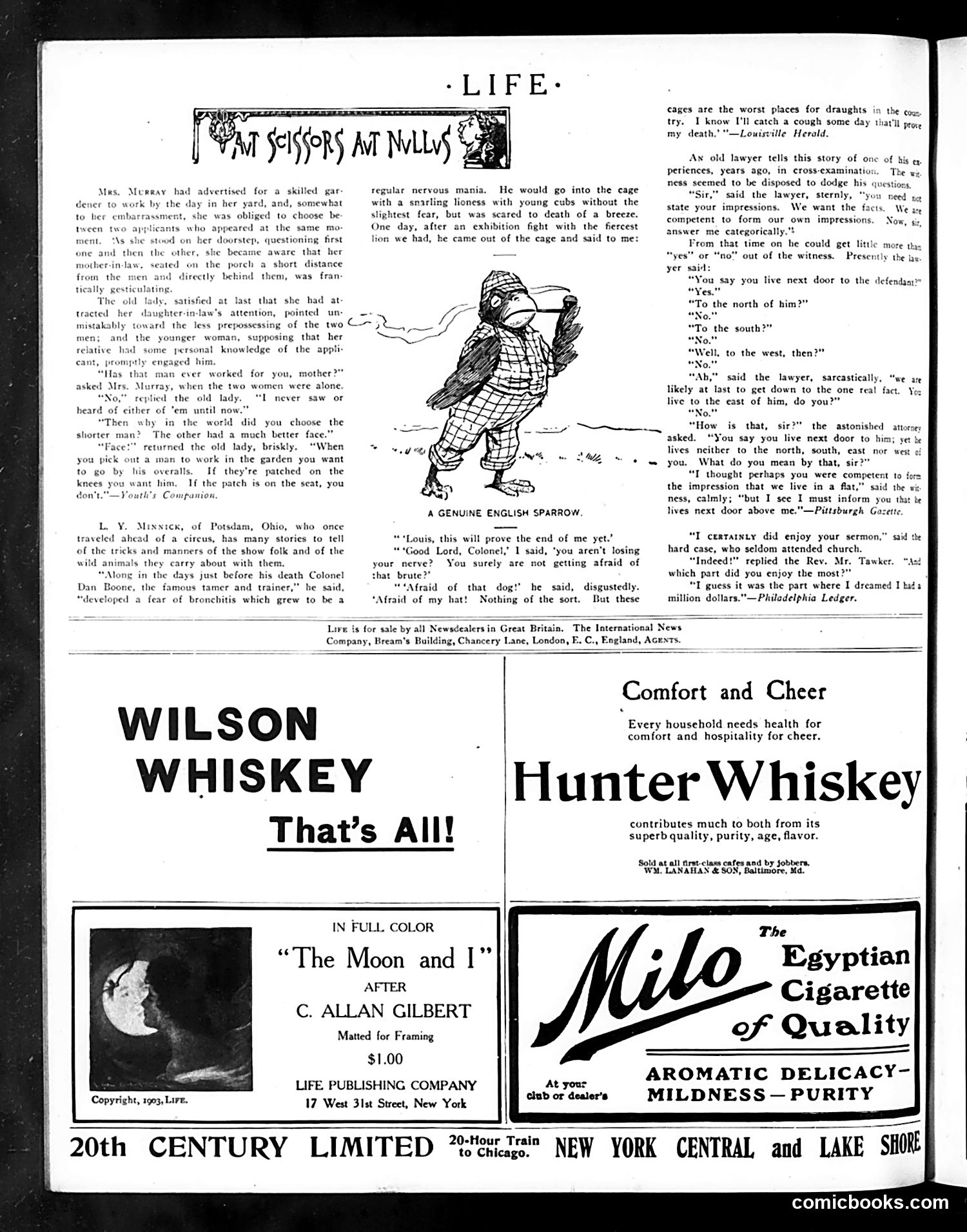
This page contains **humorous anecdotes and advertisements** rather than political cartoons. The main content includes: **"Scissors at Nulls"** — A story about Mrs. Murray hiring a gardener. The humor derives from the old lady's practical wisdom: when choosing a laborer, judge by his patched overalls—patches on the knees indicate honest work, while patches on the seat suggest laziness. **Supporting anecdotes** include a story about Colonel Dan Boone (a famous animal trainer) who feared drafts more than dangerous lions, and a lawyer's frustrating cross-examination of a witness who lived "next door above" the defendant rather than in any cardinal direction. The cartoons appear minimal; the illustration labeled "A Genuine English Sparrow" accompanies one anecdote. **The advertisements** promote Wilson Whiskey, Hunter Whiskey, a C. Allan Gilbert art print, Milo Egyptian Cigarettes, and the 20th Century Limited train—typical early-20th-century luxury goods marketed alongside humor content. The satire is gentle, focusing on human folly and misunderstanding rather than political critique.
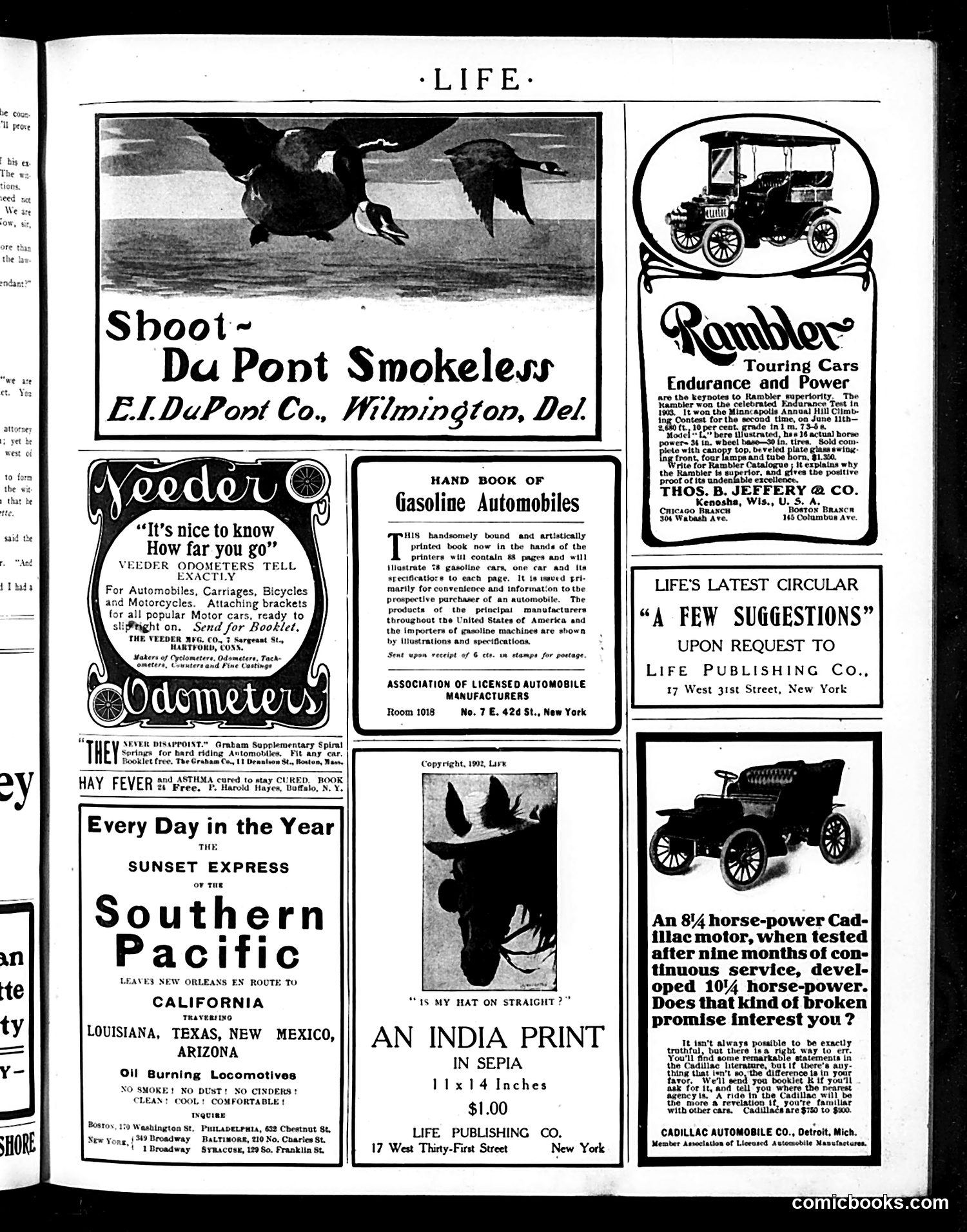
This is primarily a **commercial advertisement page** from Life magazine circa 1902, showcasing early automobile industry products and services. There is no political satire or cartoon humor to interpret. The page features multiple competing automobile manufacturers and related businesses advertising their products: Du Pont Smokeless powder for touring cars, Rambler touring cars, Veeder odometers, a Handbook of Gasoline Automobiles, Cadillac motors, and various other automotive services. The single illustrative element—"Is My Hat on Straight?" accompanying an India print—appears to be unrelated decorative content rather than satirical commentary. The advertisements reflect the nascent American automotive industry's rapid expansion in the early 1900s, emphasizing technical specifications (horsepower, endurance, reliability) to appeal to prospective buyers. This represents early automotive marketing rather than editorial commentary or satire.
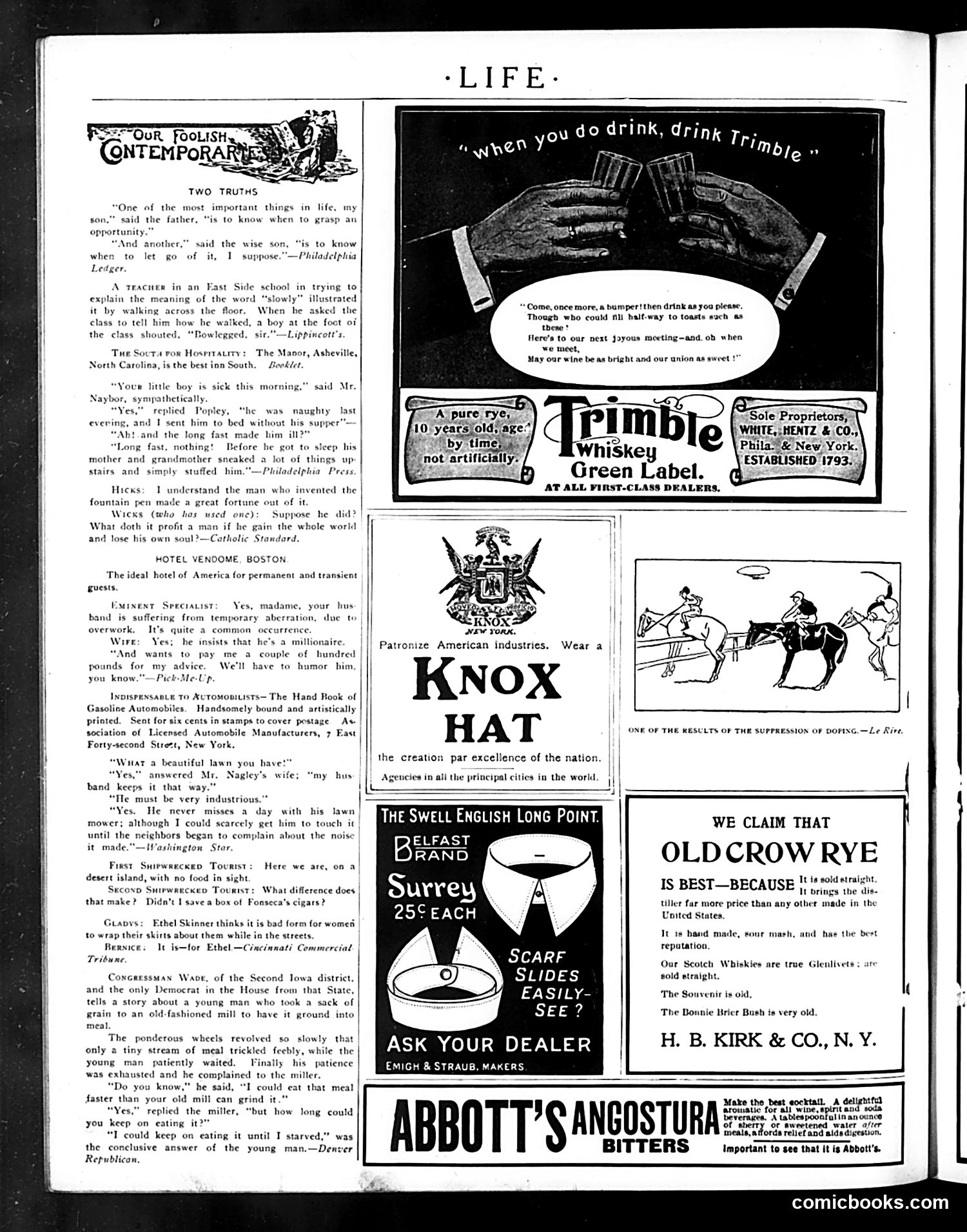
This page from *Life* magazine (a satirical publication, not the photo magazine) mixes humor columns with period advertisements. **The satirical content** consists of brief anecdotes mocking contemporary foolishness: a teacher's unintentional insult about walking "bowlegged," a man claiming to be a millionaire due to overwork, a congressman's story about slow mill wheels. These target common human absurdities rather than specific political figures. **The advertisements** dominate the layout, promoting whiskey (Trimble, Old Crow Rye), hats (Knox Hat), scarves, and bitters—typical of early 20th-century *Life*. They use period conventions: testimonials, claims of superiority, and appeals to "American industries." **No identifiable political cartoons appear** on this page. The single illustration showing figures on horseback caption-references doping suppression in racing, a contemporary sports scandal. The page reflects *Life*'s formula: light satirical humor about ordinary people's foibles, paired with advertising revenue.
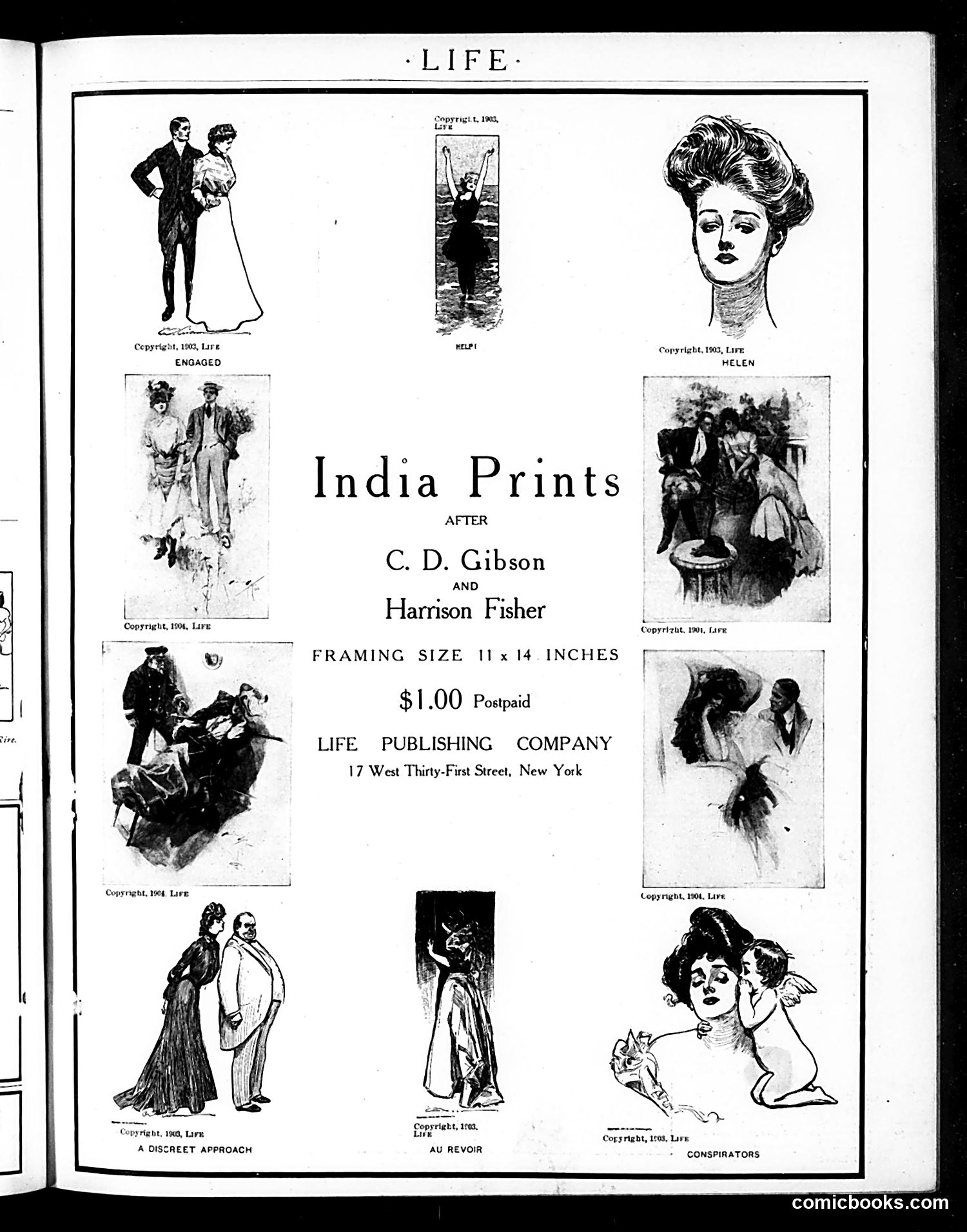
This is primarily an **advertisement page** for framed prints by artists C.D. Gibson and Harrison Fisher, published by Life Magazine around 1903-1908. The page showcases eight illustrated vignettes depicting **romantic and social situations** among the upper classes: an engaged couple, a woman named "Helen," people saying goodbye ("Au Revoir"), a "discreet approach" between a man and woman, and "conspirators" (appears to show a woman with cherubs or cupids). The satire targets **turn-of-the-century courtship rituals and social conventions**—the delicate dance of romance, proposals, and flirtation among genteel society. Gibson and Fisher were famous for depicting idealized "Gibson Girl" imagery and upper-class romantic scenarios. The prints sold for **$1.00 postpaid** in 11x14-inch framing size. Rather than editorial content, this page functions as a product catalog appealing to middle and upper-class readers who purchased such sentimental domestic artwork for home decoration.
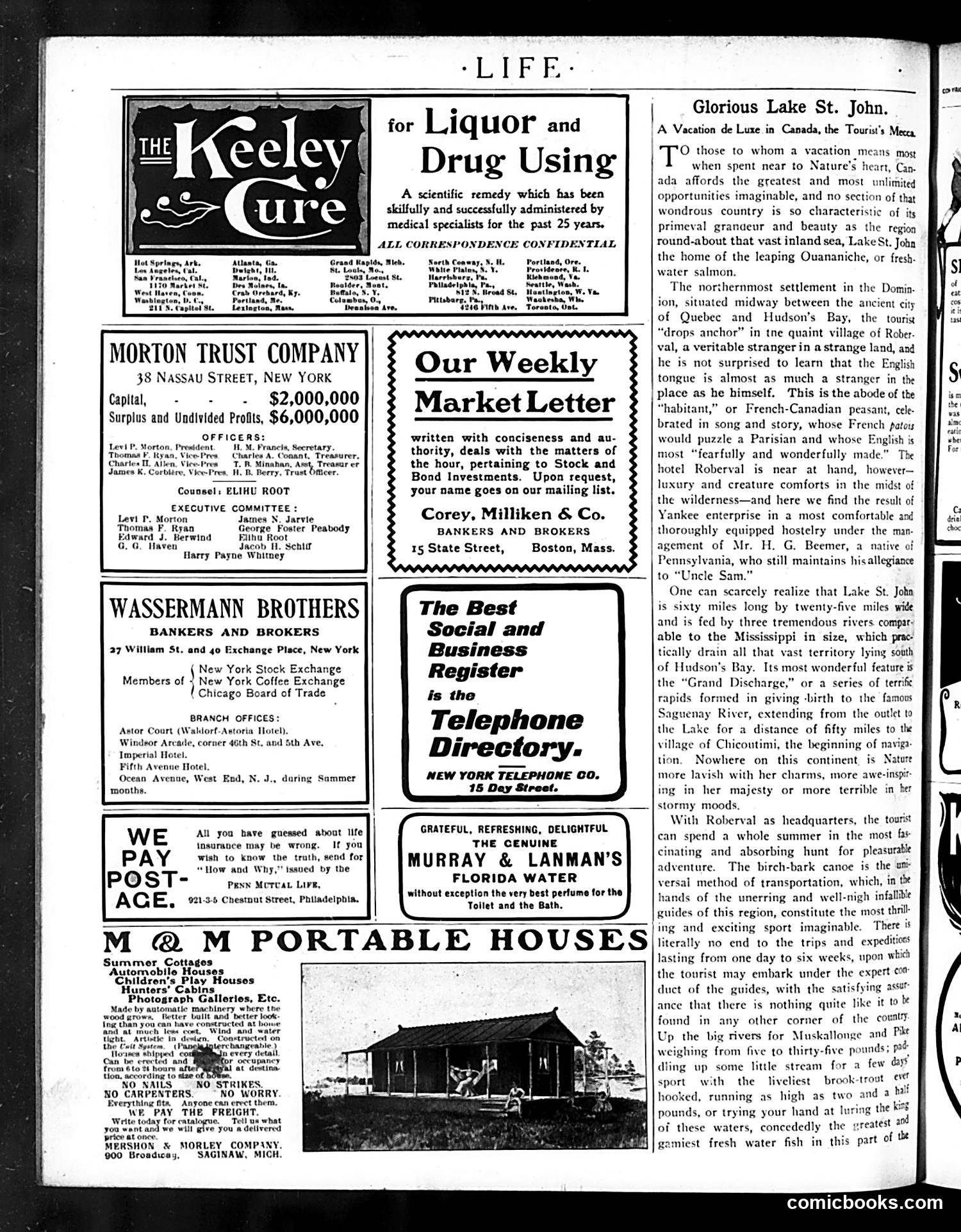
This page is primarily **advertisements and business listings**, not satirical content. The main pieces are: 1. **"The Keeley Cure"** - advertises a medical "remedy" for liquor and drug addiction, claiming 25 years of success by "medical specialists." This reflects early 20th-century attitudes toward addiction treatment (before modern understanding of substance abuse). 2. **Financial/Banking ads** - Morton Trust Company, Wassermann Brothers, and Corey, Milliken & Co. showcase major financial institutions of the era. 3. **"Glorious Lake St. John"** travel piece - promotes a Canadian vacation destination, emphasizing its "primeval grandeur" and the "habitant" (French-Canadian peasant) culture as exotic appeal for wealthy tourists. 4. **M&M Portable Houses** - advertises prefabricated housing ("made by automatic machinery"), marketed as convenient, requiring "no carpenters." The page reveals **class-based consumer culture**: luxury vacations, investment services, and convenient modern conveniences for affluent readers. No clear satirical intent is evident—these are straightforward period advertisements.
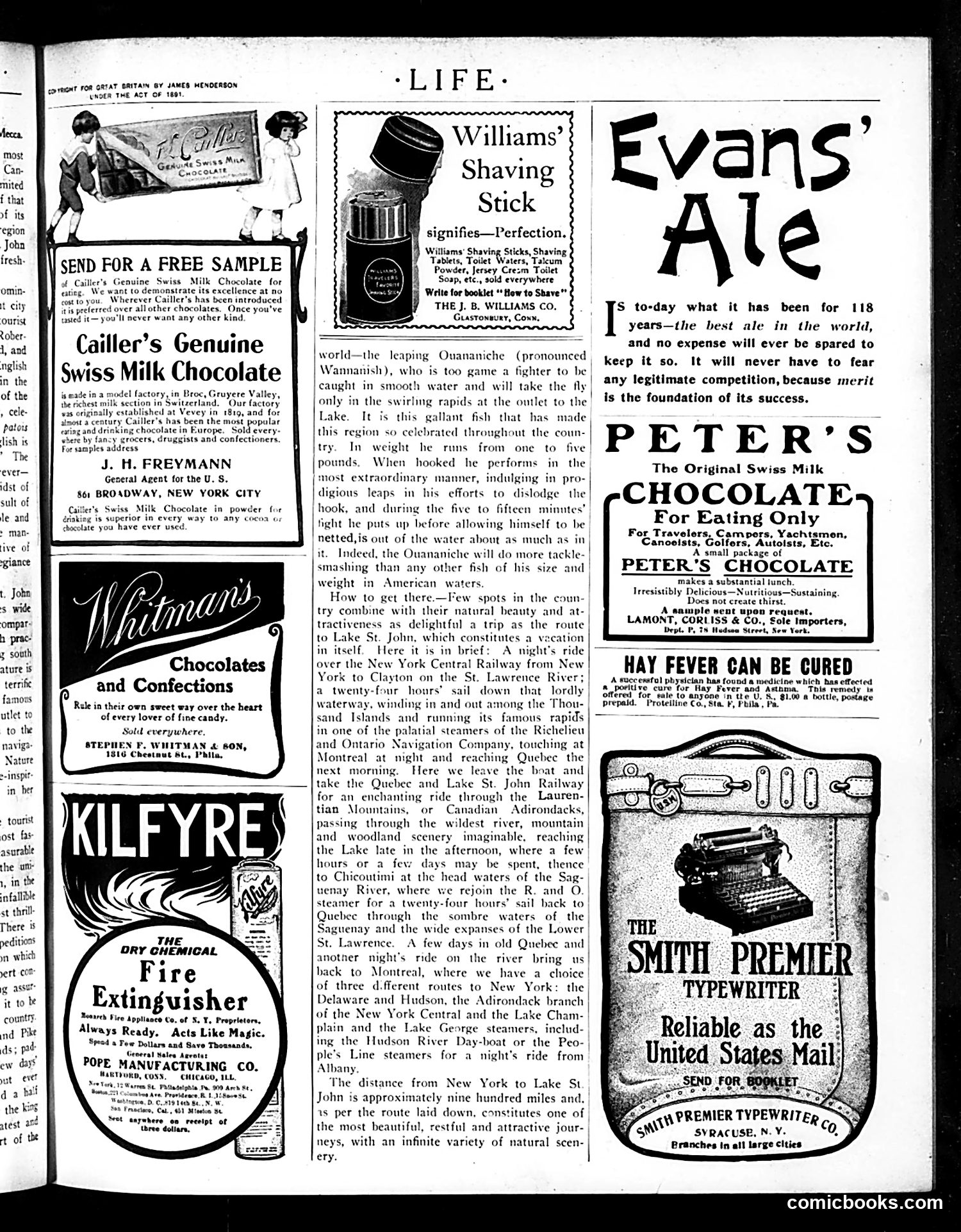
This page is primarily **advertising**, not political satire. It contains product advertisements for luxury goods and services popular with upper-class readers circa 1900-1910s: **Key Advertisements:** - Cailler's Swiss Milk Chocolate - Whitman's Chocolates and Confections - Williams' Shaving Stick - Kilfyre Fire Extinguisher - Peter's Swiss Milk Chocolate - Smith Premier Typewriter - Evans' Ale - A "Hay Fever Can Be Cured" medical advertisement **Central Content:** A lengthy travel narrative (appears to be advertising Lake St. John, Quebec) describing fishing trips for Ouananiche (a type of salmon), with detailed descriptions of railway and steamship routes from New York through Canadian wilderness. The page reflects **Gilded Age consumer culture**—marketing expensive imported chocolates, fancy toiletries, travel experiences, and modern conveniences to affluent readers. There is **no apparent political cartoon or satire** on this particular page.
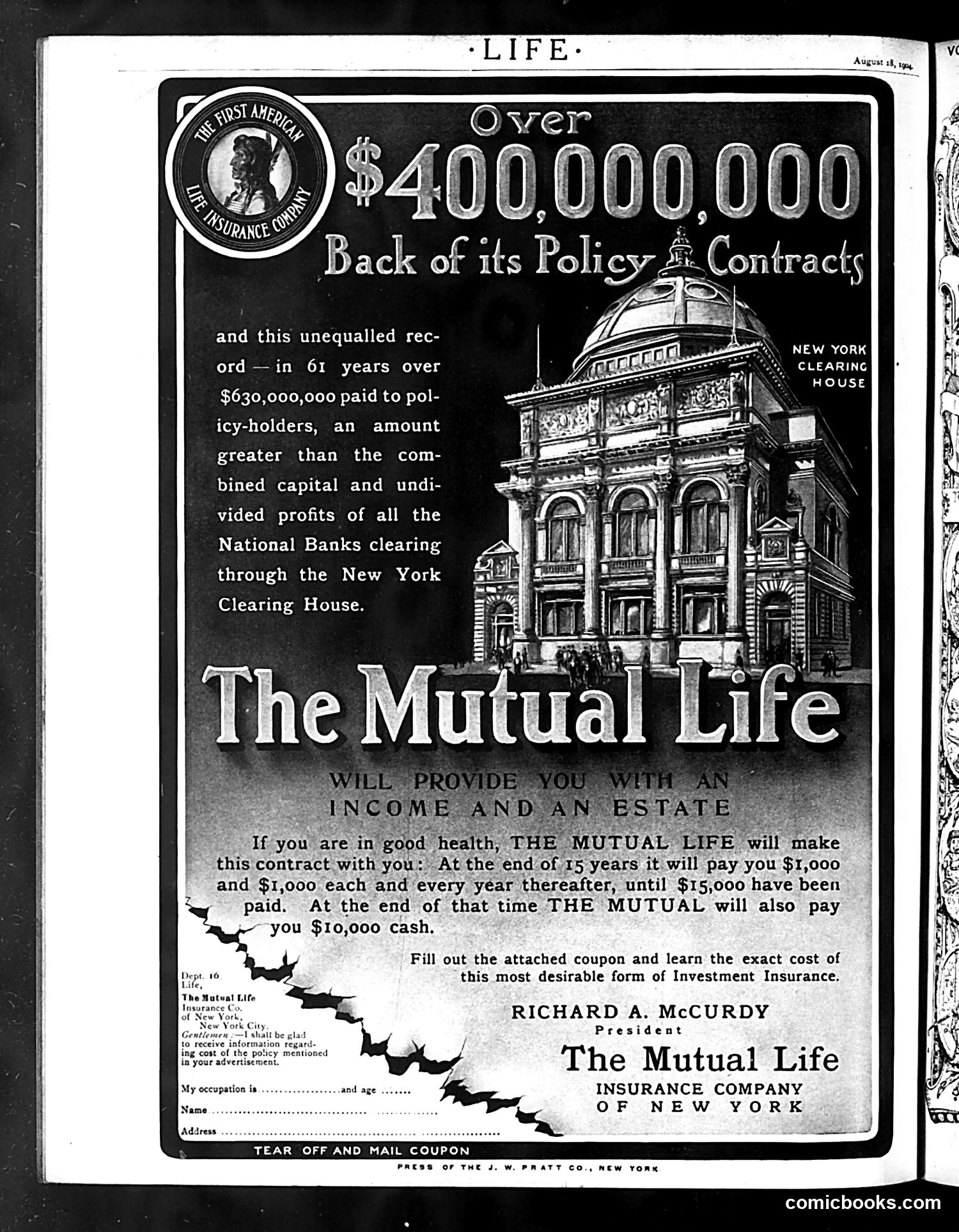
This is primarily a **Life magazine advertisement** (not satire or cartoon) for The Mutual Life Insurance Company of New York, dated August 18, 1904. The ad boasts the company's financial strength: over $400 million backing its policies and $630 million paid to policyholders in 61 years—allegedly exceeding the combined capital of all National Banks clearing through New York's Clearing House. This comparison was meant to reassure potential customers of the insurer's stability. The featured policy offers: $1,000 annually for 15 years, then $10,000 cash at the end—marketed as both income and estate-building for healthy individuals. The prominent illustration of New York's Clearing House building serves as a symbol of financial legitimacy and trustworthiness. The tear-off coupon invites readers to request pricing information. This reflects early-20th-century life insurance marketing, when companies competed heavily on claims of financial solidity and policyholder payouts.