
Life, 1904-08-18 · page 13 of 22
Life — August 18, 1904 — page 13: what you’re looking at
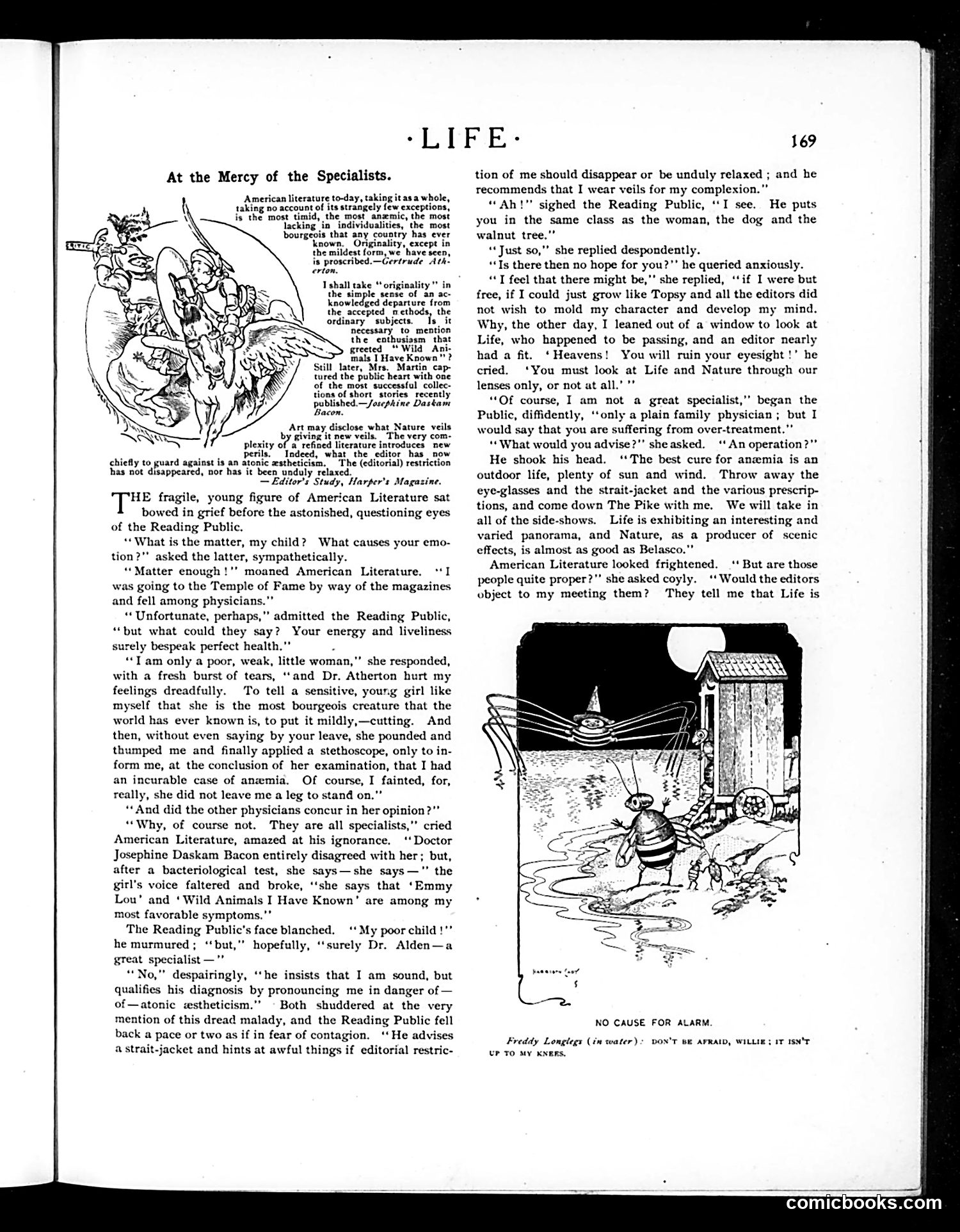
What you’re looking at
This satirical piece critiques literary critics and editors who constrain American writers through excessive analysis and restrictive standards. **The Setup:** American Literature is personified as a fragile young woman who has collapsed after consulting various "specialists"—literary critics including Gertrude Atherton, Josephine Daskam Bacon, and Dr. Alden. Each has diagnosed her with different ailments: Atherton called her "bourgeois" and "anemic"; others offer conflicting medical metaphors for her condition. **The Satire:** The joke treats literary criticism like medical practice, where competing specialists provide contradictory diagnoses while the patient (literature itself) deteriorates. The "disease" appears to be lack of originality—yet the critics themselves are blamed for killing creativity through their judgmental scrutiny and editorial restrictions. **The Point:** Editors and critics, though well-intentioned, damage literature by over-analyzing it, imposing conformity, and preventing natural creative growth. Literature would thrive if simply left free to develop organically ("grow like Topsy"), rather than being subjected to constant professional evaluation and "strait-jacket" restrictions.
📄 Transcribed text from this page (OCR, searchable)
Machine-transcribed from the original scan — historical spelling and the odd misread are preserved.
“LIF E« At the Mercy of the Specialists. American literature to-day, taking it asa whole, taking no account of its strangely few exceptions, is the most timid, the most anzemic, the most lacking in individualities, the most bourgeois that any country has ever known. Originality, except in the mildest form, we ‘have seen, is proscribed.—Gertrude Ath: erton, I shall take “originality” in the simple sense of an ac- knowledged departure from the accepted methods, the ordinary subjects. Is it necessary to. mention the enthusiasm that greeted “Wild Ani- mals I Have Known”? Still later, Mrs. Martin cap- tured the public heart with one of the most successful collec- tions of short stories recently published Josephine Dastam acon. Art may disclose what Nature veils by giving it new veils. The very com- plexity of a refined literature introduces ‘new perils. Indeed, what the editor has now chiefly to guard against is an atonic astheticism. ‘The (editorial) restriction has not disappeared, nor has it been unduly relaxed. — Editor's Study, Harper's Magazine. TH fragile, young figure of American Literature sat bowed in grief before the astonished, questioning eyes of the Reading Public. ‘What is the matter, my child? What causes your emo- tion?” asked the latter, sympathetically. “Matter enough !'’ moaned American Literature. ‘1 was going to the Temple of Fame by way of the magazines and fell among physicians.”” “Unfortunate, perhaps,” admitted the Reading Public, “but what could they say? Your energy and liveliness surely bespeak perfect health." ; “Tam only a poor, weak, little woman," she responded, with a fresh burst of tears, ‘and Dr. Atherton hurt my feelings dreadfully. To tell a sensitive, young girl like myself that she is the most bourgeois creature that the world has ever known is, to put it mildly,—cutting. And then, without even saying by your leave, she pounded and thumped me and finally applied a stethoscope, only to in- form me, at the conclusion of her examination, that I had an incurable case of anemia. Of course, I fainted, for, really, she did not leave me a leg to stand on.” ‘‘And did the other physicians concur in her opinion?” “Why, of course not. They are all specialists,” cried American Literature, amazed at his ignorance. ‘ Doctor Josephine Daskam Bacon entirely disagreed with her; but, after a bacteriological test, she says—she says—" the girl's voice faltered and broke, ‘‘she says that ‘Emmy Lou’ and ‘ Wild Animals I Have Known’ are among my most favorable symptoms."’ The Reading Public's face blanched. ‘‘ My poor child !"" he murmured ; ‘‘but,"” hopefully, ‘‘surely Dr. Alden—a great specialist —"’ “No,” despairingly, ‘‘he insists that I am sound, but qualifies his diagnosis by pronouncing me in danger of — of—atonic wstheticism.” Both shuddered at the very mention of this dread malady, and the Reading Public fell back a pace or two as if in fear of contagion. ‘He advises a strait-jacket and hints at awful things if editorial restric- tion of me should disappear or be unduly relaxed recommends that I wear veils for my complexion. “Ah!” sighed the Reading Public, ‘I see. He puts you in the same class as the woman, the dog and the walnut tree.” ‘*Just so,’ she replied despondently. “Ts there then no hope for you?"’ he queried anxiously. “T feel that there might be," she replied, “if I were but free, if I could just grow like Topsy and all the editors did not wish to mold my character and develop my mind. Why, the other day, I leaned out of a window to look at Life, who happened to be passing, and an editor nearly had a fit. ‘Heavens! You will ruin your eyesight!’ he cried. ‘You must look at Life and Nature through our lenses only, or not at all.’ ”* “Of course, I am not a great specialist,” began the Public, diffidently, ‘‘only a plain family physician; but I would say that you are suffering from over-treatment.”” “What would you advise?’’ sheasked. ‘‘ An operation?"” He shook his head. ‘*The best cure for anemia is an outdoor life, plenty of sun and wind. Throw away the eye-glasses and the strait-jacket and the various prescrip- tions, and come down The Pike with me. We will take in all of the side-shows. Life is exhibiting an interesting and varied panorama, and Nature, as a producer of scenic effects, is almost as good as Belasco."’ American Literature looked frightened. ‘ But are those people quite proper?" she asked coyly. ‘* Would the editors object to my meeting them? They tell me that Life is NO CAUSE FOR ALARM. Freddy Longlegs (in water): DON'T be AFRAID, WILLIE; IT ISN'T UP TO MY KNERS, comicbooks.com