
Life, 1904-08-18 · page 4 of 22
Life — August 18, 1904 — page 4: what you’re looking at
What you’re looking at
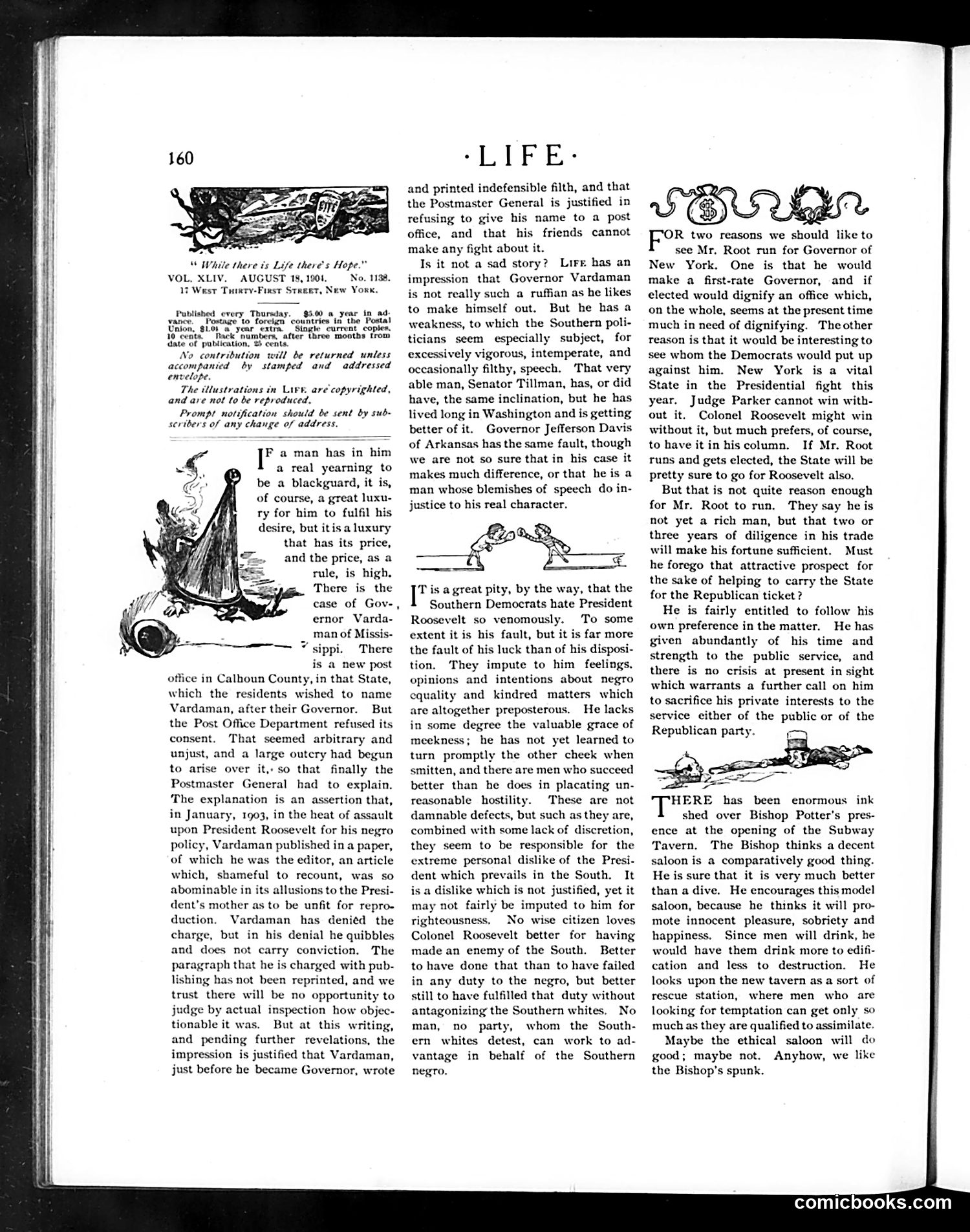
This page contains political commentary rather than cartoons. The main editorial discusses a potential New York gubernatorial race, arguing for Mr. Root as a candidate against Judge Parker. The text considers whether Root, described as having made his fortune through three years of diligent trade work, should sacrifice private interests to run for the Republican ticket. The piece also critiques Governor Vardaman of Mississippi, accusing him of anti-Roosevelt sentiment and racist views toward Black citizens. It questions whether Vardaman's hostility stems from legitimate policy disagreements or personal animosity. A separate item discusses Bishop Potter's opening of a "Subway Tavern," suggesting alcohol consumption might improve public morality—a satirical jab at temperance advocates and clergy involvement in social reform.
📄 Transcribed text from this page (OCR, searchable)
Machine-transcribed from the original scan — historical spelling and the odd misread are preserved.
VOL. XLIV. AUGUST 18, 1904. 17 West Tatery-Fixst Street, New Published every Thursday. $5.00 a year in ad- wance. Posture to foreign ‘countries in the Postal Union, $1.01 a year extra. ‘Single current copies, 10 cents. Rack numbera after three months {row date of pablication, 2 cents, No contribution will be returned unless accompanied by stamped and addressed envelope. The illustrations in Lit. are copyrighted, and are not to be reproduced. Prompt notification should be sent by sub- seriber’s of any change of address. F a man has in him a real yearning to be a blackguard, it is, of course, a great luxu- ry for him to fulfil his desire, but itis a luxury that has it and the price, as rule, is high, There is the case of Gov- ernor Varda- man of Missis- There new post office in Calhoun County, in that State, which the residents wished to name Vardaman, after their Governor. But the Post Office Department refused its consent, That seemed arbitrary and unjust, and a large outcry had begun to arise over it, so that finally the Postmaster General had to explain. The explanation is an assertion that, in January, 1903, in the heat of assault upon President Roosevelt for his negro policy, Vardaman published in a paper, of which he was the editor, an article which, shameful to recount, was so abominable in its allusions to the Presi- dent's mother as to be unfit for repro- duction. Vardaman has deniéd the charge, but in his denial he quibbles and does not carry conviction. The paragraph that he is charged with pub- lishing has not been reprinted, and we trust there will be no opportunity to judge by actual inspection how objec- tionable it was. But at this writing, and pending further revelations, the impression is justified that Vardaman, just before he became Governor, wrote *LIF E> and printed indefensible filth, and that the Postmaster General is justified in refusing to give his name to a post office, and that his friends cannot make any fight about it. Is it not a sad story? Lire has an impression that Governor Vardaman is not really such a ruffian as he likes to make himself out, But he has a weakness, to which the Southern poli- ticians seem especially subject, for excessively vigorous, intemperate, and occasionally filthy, speech. That very able man, Senator Tillman, has, or did have, the same inclination, but he has lived long in Washington and is getting better of it. Governor Jefferson Davis of Arkansas has the same fault, though we are not so sure that in his case it makes much difference, or that he is a man whose blemishes of speech do in- justice to his real character. Se T is a great pity, by the way, that the Southern Democrats hate President Roosevelt so venomously. To some extent it is his fault, but it is far more the fault of his luck than of his disposi- tion. They impute to him feelings. opinions and intentions about negro equality and kindred matters which are altogether preposterous. He lacks in some degree the valuable grace of meekness; he has not yet learned to turn promptly the other cheek when smitten, and there are men who succeed better than he does in placating un- reasonable hostility. These are not damnable defects, but such as they are, combined with some lack of discretion, they seem to be responsible for the extreme personal dislike of the Presi- dent which prevails in the South. It is a dislike which is not justified, yet it may not fairly be imputed to him for righteousness. No wise citizen loves Colonel Roosevelt better for having made an enemy of the South. Better to have done that than to have failed any duty to the negro, but better still to have fulfilled that duty without antagonizing the Southern whites. No man, no party, whom the South- ern whites detest, can work to ad- vantage in behalf of the Southern negro. R two reasons we should like to see Mr. Root run for Governor of New York. One is that he would make a first-rate Governor, and if elected would dignify an office which, on the whole, seems at the present time much in need of dignifying. The other reason is that it would be interesting to see whom the Democrats would put up against him. New York is a vital State in the Presidential fight this year, Judge Parker cannot win with- out it. Colonel Roosevelt might win without it, but much prefers, of course, to have it in his column. If Mr. Root runs and gets elected, the State will be pretty sure to go for Roosevelt also. But that is not quite reason enough for Mr. Root to run, They say he is not yet a rich man, but that two or three years of diligence in his trade will make his fortune sufficient. Must. he forego that attractive prospect for the sake of helping to carry the State for the Republican ticket ? He is fairly entitled to follow his own preference in the matter. He has given abundantly of his time and strength to the public service, and there is no crisis at present in sight which warrants a further call on him to sacrifice his private interests to the service cither of the public or of the Republican party. rm HERE has been enormous ink shed over Bishop Potter's p ence at the opening of the Subway Tavern, The Bishop thinks a decent saloon is a comparatively good thing. He is sure that it is very much better than a dive. He encourages this model saloon, because he thinks it will pro- mote innocent pleasure, sobriety and happiness. Since men will drink, he would have them drink more to edifi- cation and less to destruction. He looks upon the new tavern as a sort of rescue station, where men who are looking for temptation can get only so much as they are qualified to assimilate. Maybe the ethical saloon will do good; maybe not. Anyhow, we like the Bishop’s spunk. comicbooks.com