
Life, 1904-08-18 · page 9 of 22
Life — August 18, 1904 — page 9: what you’re looking at
What you’re looking at
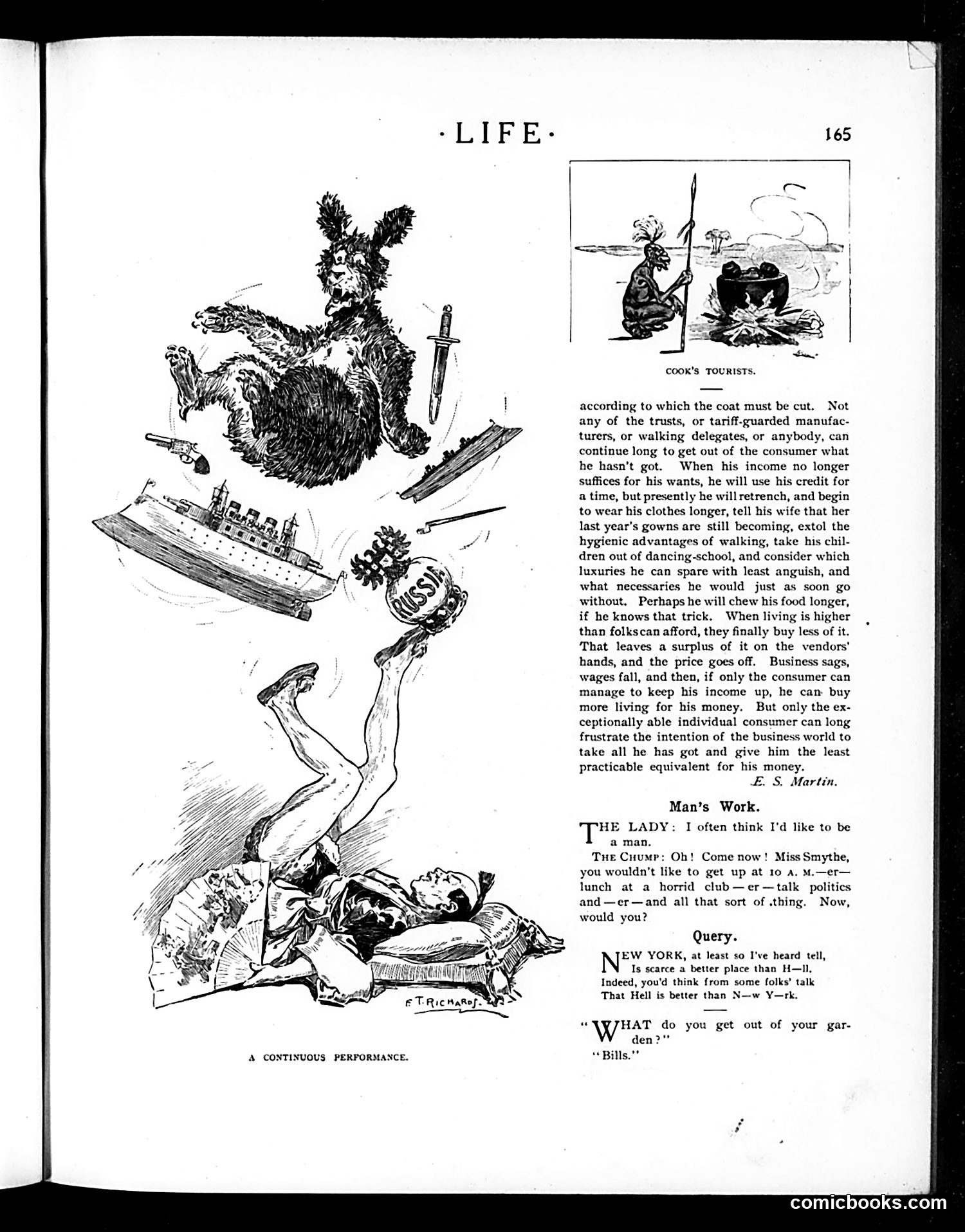
This political cartoon depicts a kangaroo struggling beneath an enormous pile of consumer goods and military equipment (ship, gun, sword, bottle labeled "Whisky"). The kangaroo appears to represent Australia or the British Empire's colonial burden. The accompanying text criticizes consumer culture and class economics. It argues that workers cannot escape poverty despite wages because trusts and manufacturers control pricing. The satirical dialogue mocks wealthy women who claim to want "a man's" freedom while enjoying privilege. The cartoon's title suggests this endless cycle of consumption, debt, and economic struggle is "continuous" — relentless and inescapable. The kangaroo symbolizes the strain of maintaining imperial economic systems.
📄 Transcribed text from this page (OCR, searchable)
Machine-transcribed from the original scan — historical spelling and the odd misread are preserved.
COOK'S TOURISTS. according to which the coat must be cut. Not any of the trusts, or tariff-guarded manufac- turers, or walking delegates, or anybody, can continue long to get out of the consumer what he hasn't got. When his income no longer suffices for his wants, he will use his credit for a time, but presently he will retrench, and begin to wear his clothes longer, tell his wife that her last year’s gowns are still becoming, extol the hygienic advantages of walking, take his chil- dren out of dancing-school, and consider which luxuries he can spare with least anguish, and what necessaries he would just as soon go without, Perhaps he will chew his food longer, if he knows that trick. When living is higher than folkscan afford, they finally buy less of it. That leaves a surplus of it on the vendors’ hands, and the price goes off. Business sags, wages fall, and then, if only the consumer can manage to keep his income up, he can buy more living for his money. But only the ex- ceptionally able individual consumer can long frustrate the intention of the business world to take all he has got and give him the least practicable equivalent for his money. £. S. Martin. Man’s Work. HE LADY: I often think I'd like to be a man. Tue Cuump: Oh! Come now! Miss Smythe, you wouldn't like to get up at 10 a. M.—er— lunch at a horrid club—er—talk politics and —er—and all that sort of thing. Now, would you? Query. NY YORK, at least so I've heard tell, Is scarce a better place than H—Il, Indeed, you'd think from some folks’ talk That Hell is better than N—w Y—rk. i HAT do you get out of your gar- den?” A CONTINUOUS PERFORMANCE. “Bills.”” comicbooks.com