
Life, 1904-08-18 · page 8 of 22
Life — August 18, 1904 — page 8: what you’re looking at
What you’re looking at
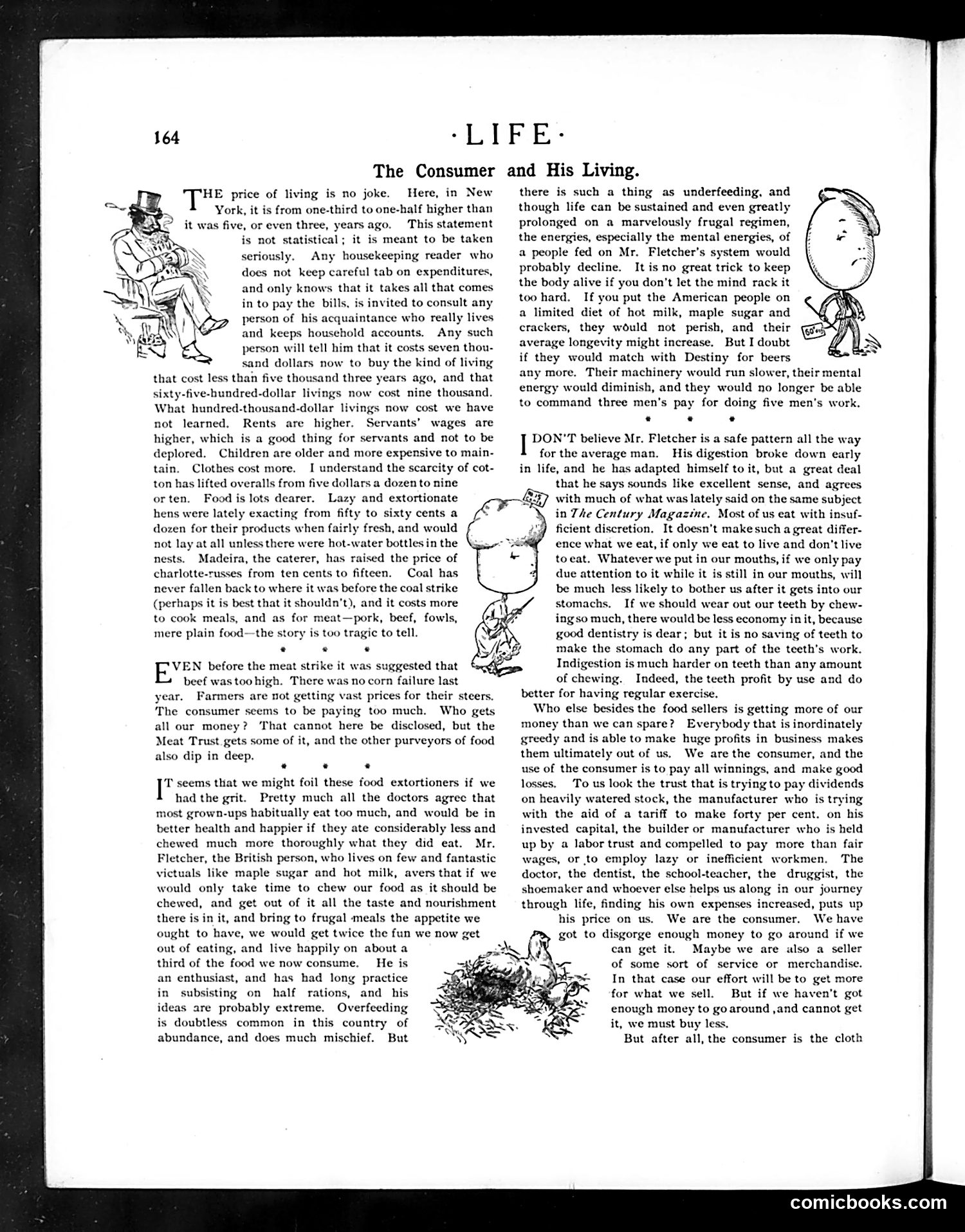
This satirical article criticizes rising costs of living and food prices in early 20th-century America. The illustrations depict ordinary citizens (recognizable by their simple clothing and expressions) being squeezed financially by increasing expenses. The text argues that consumers are being exploited by food sellers and profiteers who charge excessive prices while workers' wages stagnate. It references a specific proposal by "Mr. Fletcher" advocating extreme frugality (eating only milk, maple sugar, and crackers) as impractical—such deprivation would reduce worker productivity and mental capacity. The article's central satire: while food prices soar and profiteers grow wealthy, ordinary working people struggle to afford basic living necessities, forced to choose between eating adequately or maintaining their health and labor capacity.
📄 Transcribed text from this page (OCR, searchable)
Machine-transcribed from the original scan — historical spelling and the odd misread are preserved.
164 The Consumer TH price of living is no joke. Here, in New York, it is from one-third to one-half higher than it was five, or even three, years ago. This statement is not statistical; it is meant to be taken Any housekeeping reader who does not keep careful tab on expenditures, and only knows that it takes all that comes in to pay the bills, is invited to consult any person of his acquaintance who really lives and keeps household accounts. Any such person will tell him that it costs seven thou- sand dollars now to buy the kind of living that cost less than five thousand three years ago, and that sixty-five-hundred-dollar livings now cost nine thousand. What hundred-thousand-dollar livings now cost we have not learned. Rents are higher. Servants’ wages are higher, which is a good thing for servants and not to be deplored. Children are older and more expensive to main- tain. Clothes cost more. I understand the scarcity of cot- ton has lifted overalls from five dollars a dozen to nine orten. Food is lots dearer. Lazy and extortionate hens were lately exacting from fifty to sixty cents a dozen for their products when fairly fresh, and would not lay at all unless there were hot-water bottles in the nests. Madeira, the caterer, has raised the price of charlotte-russes from ten cents to fifteen. Coal has never fallen back to where it was before the coal strike (perhaps it is best that it shouldn't), and it costs more to cook meals, and as for meat—pork, beef, fowls, mere plain food—the story is too tragic to tell. seriously. . * * EYE* before the meat strike it was suggested that beef was too high. There was no corn failure last year. Farmers are not getting vast prices for their steers. ‘The consumer seems to be paying too much. Who gets all our money? That cannot here be closed, but the Meat Trust gets some of it, and the other purveyors of food also dip in deep, . * I" seems that we might foil these food extortioners if we had the grit. Pretty much all the doctors agree that most grown-ups habitually eat too much, and would be in better health and happier if they ate considerably less and wed much more thoroughly what they did eat. Mr. cher, the British person, who lives on few and fantastic victuals like maple sugar and hot milk, avers that if we would only take time to chew our food as it should be chewed, and get out of it all the taste and nourishment there is in it, and bring to frugal meals the appetite we ought to have, we would get twice the fun we now get out of eating, and live happily on about a third of the food we now consume. He is an enthusi: and has had long practice in subsisting on half rations, and his ideas are probably extreme. Overfeeding is doubtless common in this country of abundance, and does much mischief. But ‘LIF E® and His Living. there is such a thing as underfeeding, and though life can be sustained and even greatly prolonged on a marvelously frugal regimen, the energies, especially the mental energies, of a people fed on Mr. Fletcher's system would probably decline. It is no great trick to keep the body alive if you don’t let the mind rack it too hard. If you put the American people on a limited diet of hot milk, maple sugar and crackers, they would not perish, and their average longevity might increase. But I doubt if they would match with Destiny for beers any more, Their machinery would run slower, their mental energy would diminish, and they would no longer be able to command three men’s pay for doing five men's work. * * ° DON'T believe Mr. Fletcher is a safe pattern all the way for the average man, His digestion broke down early in life, and he has adapted himself to it, but a great deal that he says sounds like excellent sense, and agrees with much of what was lately said on the same subject in The Century Magazine, Most of us eat with insuf- ficient discretion. It doesn’t make such a great differ- ence what we eat, if only we eat to live and don’t live toeat. Whatever we put in our mouths, if we only pay due attention to it while it is still in our mouths, will be much less likely to bother us after it gets into our stomachs. If we should wear out our teeth by chew- ing so much, there would be less economy in it, because good dentistry is dear; but it is no saving of teeth to make the stomach do any part of the teeth’s work. Indigestion is much harder on teeth than any amount of chewing. Indeed, the teeth profit by use and do better for having regular exercise, Who else besides the food sellers is getting more of our money than we can spare? Everybody that is inordinately greedy and is able to make huge profits in business makes them ultimately out of us, We are the consumer, and the use of the consumer is to pay all winnings, and make good losses. To us look the trust that is trying to pay dividends on heavily watered stock, the manufacturer who is trying with the aid of a tariff to make forty per cent. on his invested capital, the builder or manufacturer who is held up by a labor trust and compelled to pay more than fair wages, or to employ lazy or inefficient workmen. The doctor, the dentist, the school-teacher, the druggist, the shoemaker and whoever else helps us along in our journey through life, finding his own expenses increased, puts up his price on us. We are the consumer. We have got to disgorge enough money to go around if we can get it. Maybe we are also a seller of some sort of service or merchandise. In that case our effort will be to get more for what we sell. But if we haven't got enough money to go around ,and cannot get it, we must buy less, But after all, the consumer is the cloth comicbooks.com