
Life, 1904-08-18 · page 14 of 22
Life — August 18, 1904 — page 14: what you’re looking at
What you’re looking at
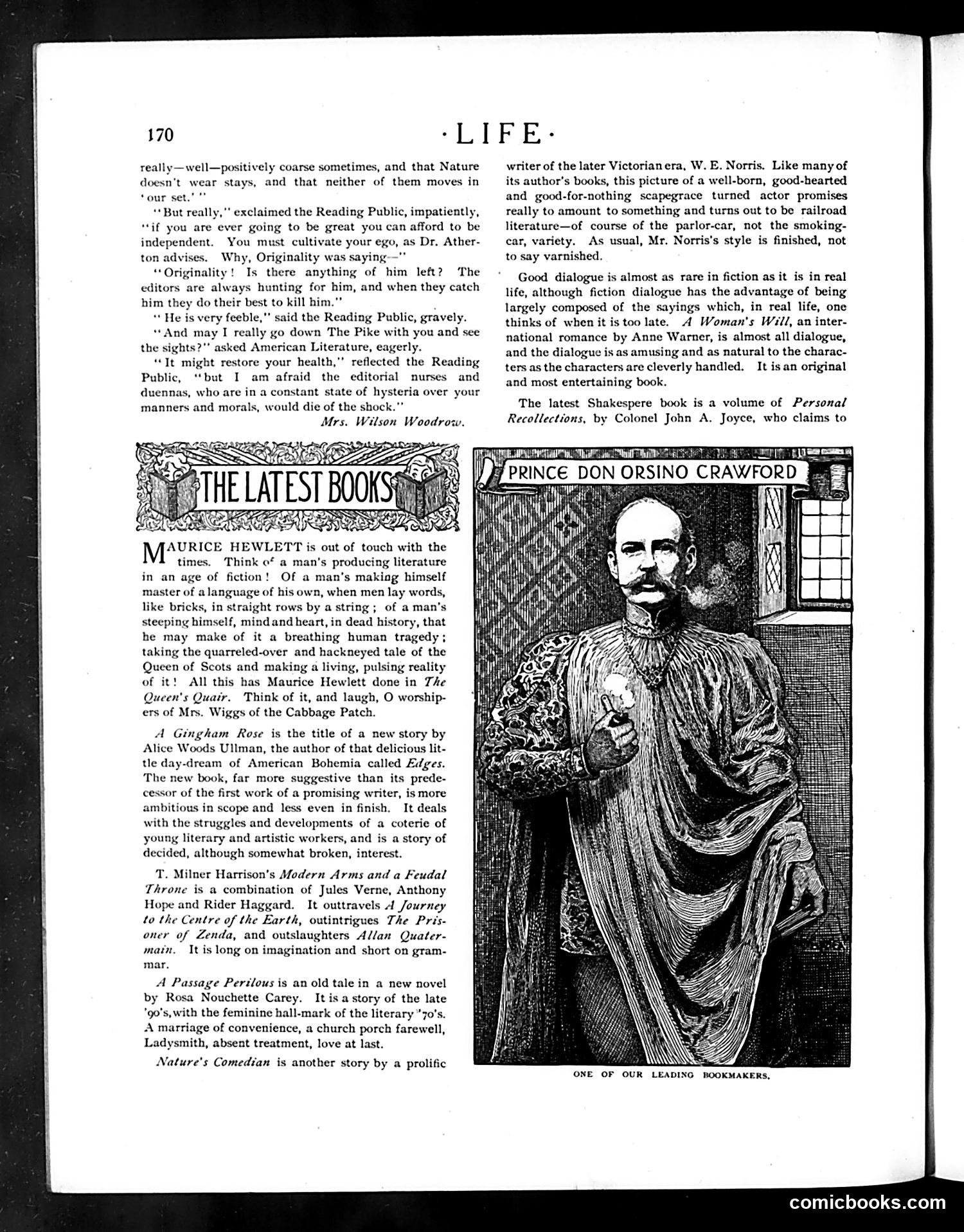
This page from *Life* magazine presents literary criticism and book reviews typical of early 20th-century American publishing discourse. The left column contains satirical dialogue mocking literary pretension. Characters like "the Reading Public" and personified abstractions ("Originality," "American Literature") discuss how editors hunt down and destroy originality in literature. The satire targets both writers who affect artistic independence and the publishing industry's standardization of literature. The right side showcases a portrait labeled "Prince Don Orsino Crawford" with caption "One of Our Leading Bookmakers"—likely a publisher or editor of the era. The reviews below critique contemporary books by Maurice Hewlett, Alice Woods Ullman, T. Milner Harrison, and others, with *Life's* characteristic snark. The magazine dismisses some works as derivative or overly polished ("varnished"), while praising genuine dialogue and originality. The overall satire targets the tension between literary ambition and commercial publishing demands in the era.
📄 Transcribed text from this page (OCR, searchable)
Machine-transcribed from the original scan — historical spelling and the odd misread are preserved.
-LI really—well—positively coarse sometimes, and that Nature doesn't wear stays, and that neither of them moves in ‘our set.’ "" “But really,”’ exclaimed the Reading Public, impatiently, “if you are ever going to be great you can afford to be independent. You must cultivate your ego Dr. Ather- ton advises. Why, Originality was saying “Originality! Is there anything of him left? The editors are always hunting for him, and when they catch him they do their best to kill him.” “ He is very feeble," said the Reading Public, gravely. “And may I really go down The Pike with you and see the sights?" asked American Literature, eagerly. “It might restore your health,"’ reflected the Reading “but Iam afraid the editorial nurses and who are in a constant state of hysteria over your manners and morals, would die of the shock."” 170 Mrs. Wilson Woodrow. ak tones ae HEWLETT is out of touch with the times. Think of a man’s producing literature in an age of fiction! Of a man’s makiog himself master of a language of his own, when men lay words, like bricks, in straight rows by a string ; of a man's steeping himself, mind and heart, in dead history, that he may make of it a breathing human tragedy; taking the quarreled-over and hackneyed tale of the Queen of Scots and making a living, pulsing reality of it! All this has Maurice Hewlett done in The Queen's Quair. Think of it, and laugh, O worship- ers of Mrs. Wiggs of the Cabbage Patch. A Gingham Rose is the title of a new story by Alice Woods Ullman, the author of that delicious lit- tle day-dream of American Bohemia called Edges. The new book, far more suggestive than its prede- cessor of the first work of a promising writer, is more ambitious in scope and less even in finish. It deals with the struggles and developments of a coterie of young literary and artistic workers, and is a story of decided, although somewhat broken, interest. T. Milner Harrison's Modern Arms and a Feudal Throne is a combination of Jules Verne, Anthony Hope and Rider Haggard. It outtravels A Journey to the Centre of the Earth, outintrigues The Pris- oner of Zenda, and outslaughters Al/an Quater- main. It is long on imagination and short on gram- mar. A Passage Perilous is an old tale in a new novel by Rosa Nouchette Carey. It is a story of the late ‘go's, with the feminine hall-mark of the literary "70's. A marriage of convenience, a church porch farewell, Ladysmith, absent treatment, love at last. Nature's Comedian is another story by a prolific FE? writer of the later Victorian era, W. E. Norris. Like many of its author’s books, this picture of a well-born, good-hearted and good-for-nothing scapegrace turned actor promises really to amount to something and turns out to be railroad literature—of course of the parlor-car, not the smoking- car, variety. As usual, Mr. Norris's style is finished, not to say varnished. Good dialogue is almost as rare in fiction as it is in real life, although fiction dialogue has the advantage of being largely composed of the sayings which, in real life, one thinks of when it is too late. 4 Woman's Will, an inter- national romance by Anne Warner, is almost all dialogue, and the dialogue is as amusing and as natural to the charac- ters as the characters are cleverly handled. It is an original and most entertaining book. The latest Shakespere book is a volume of Personal Recollections, by Colonel John A. Joyce, who claims to ills MMH ao) 7pRINce tela ORSINO. CRAWFORD ¥ fi i il ONE OF OUR LEADING BOOKMAKERS, comicbooks.com