
A complete issue · 40 pages · 1904
Life — May 5, 1904
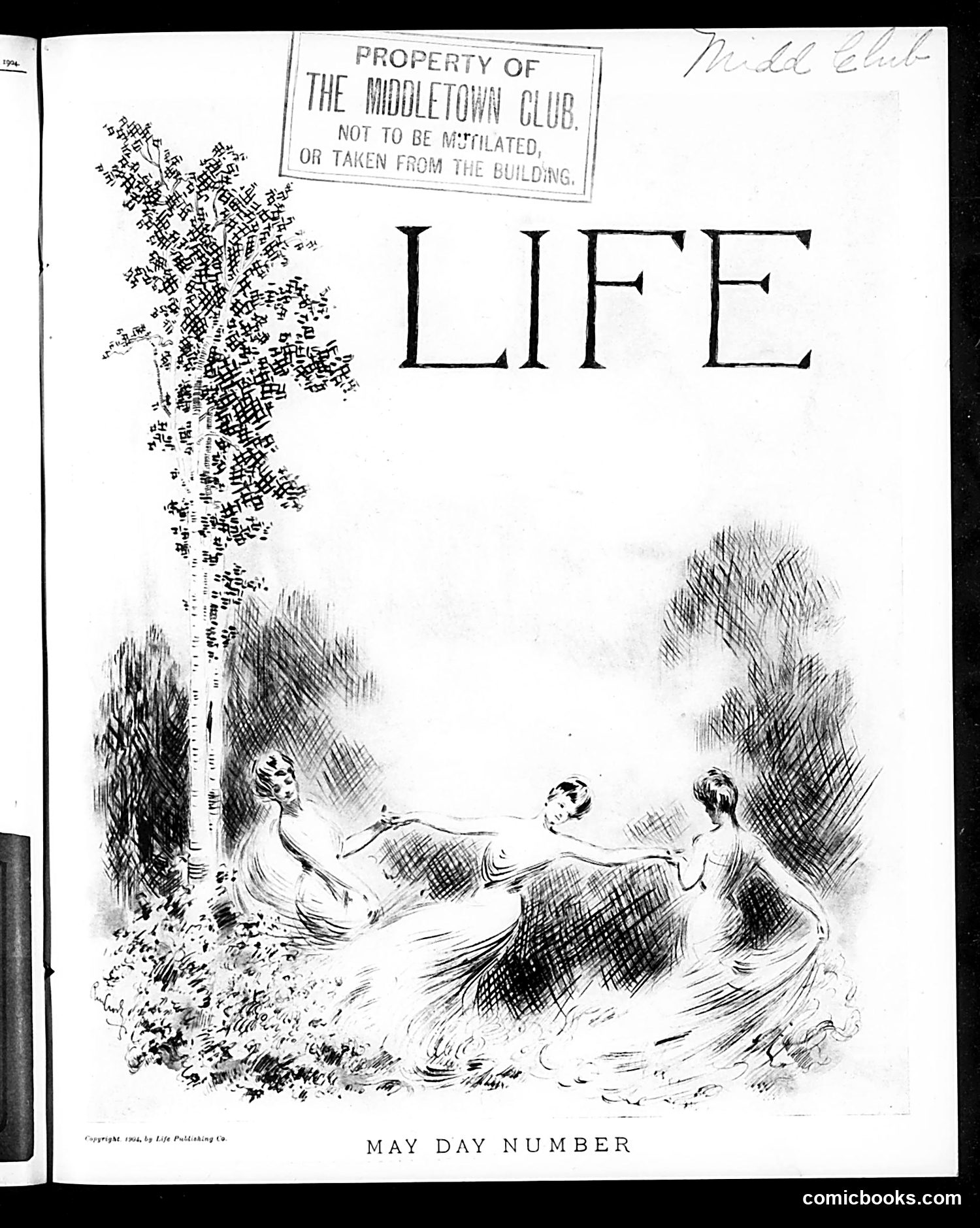
This is the cover of Life magazine's "May Day Number." The illustration depicts three female figures in flowing garments around a large tree, seemingly in a celebratory or ritualistic pose. The satire likely references May Day traditions—historically associated with both spring fertility celebrations and, by the early 20th century, labor and socialist movements. The decorative tree sprouting small repeated figures at the top appears to represent proliferation or growth, possibly satirizing May Day festivities or their ideological underpinnings. The elegant Art Nouveau style and the women's classical poses suggest Life was mocking romanticized or idealistic visions of May Day observances, though the specific target—whether socialist celebrations, pagan revival movements, or simply seasonal festivities—remains somewhat ambiguous from the image alone.
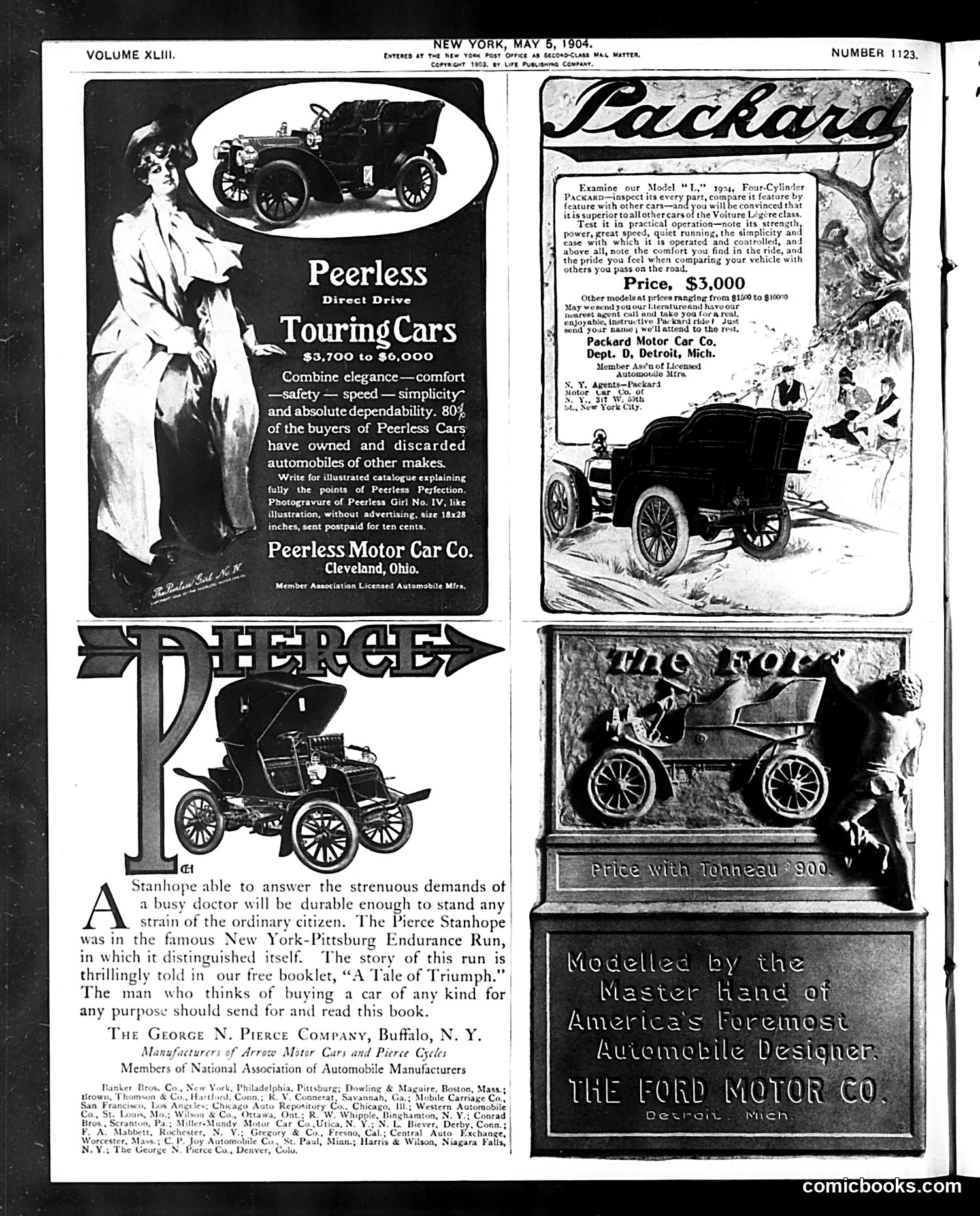
This page is primarily **advertising**, not satire or political commentary. It contains three automobile advertisements from 1904: 1. **Peerless Motor Car Co.** (Cleveland, Ohio) - emphasizes elegance, comfort, safety, and simplicity; prices $7,700 to $9,000 2. **Packard Motor Car Co.** (Detroit, Michigan) - advertises their Model "L" at $3,000, targeting doctors and professionals 3. **Pierce Motor Car Co.** (Buffalo, New York) - references their famous New York-Pittsburgh Endurance Run, positioning the vehicle as durable for demanding use The page reflects early 1900s automotive marketing targeting wealthy consumers. The ads use testimonials and prestige appeals rather than technical specifications. There is no political cartoon or satire present—this is straightforward period advertising for luxury automobiles.
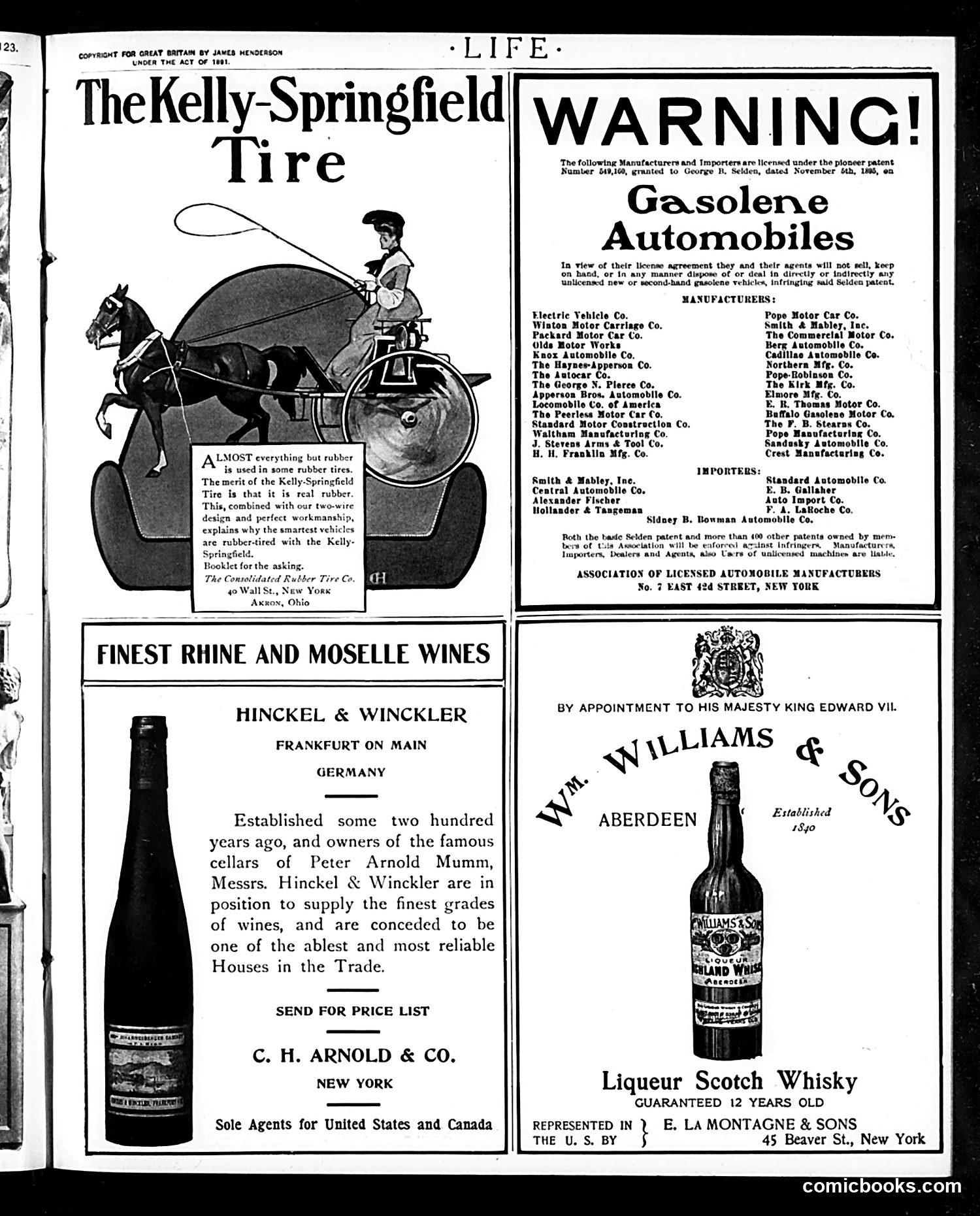
This page is **primarily advertising**, not editorial content or satire. It contains four commercial advertisements: 1. **Kelly-Springfield Tire** - promotes rubber tires with an illustration of a man lassoing a tire from a horse-drawn vehicle, emphasizing the product's reliability and workmanship. 2. **WARNING on Gasolene Automobiles** - a patent notice listing manufacturers and importers licensed under a Selden patent (No. 549,160), warning unlicensed makers against selling gasoline vehicles. This reflects early automotive patent disputes. 3. **Finest Rhine and Moselle Wines** - Hinckels & Winckler, German wine merchants. 4. **Wm. Williams & Sons** - Scottish whisky advertisement. The page reflects early 1900s consumer goods and emerging automotive industry patent conflicts, with no apparent satirical content.
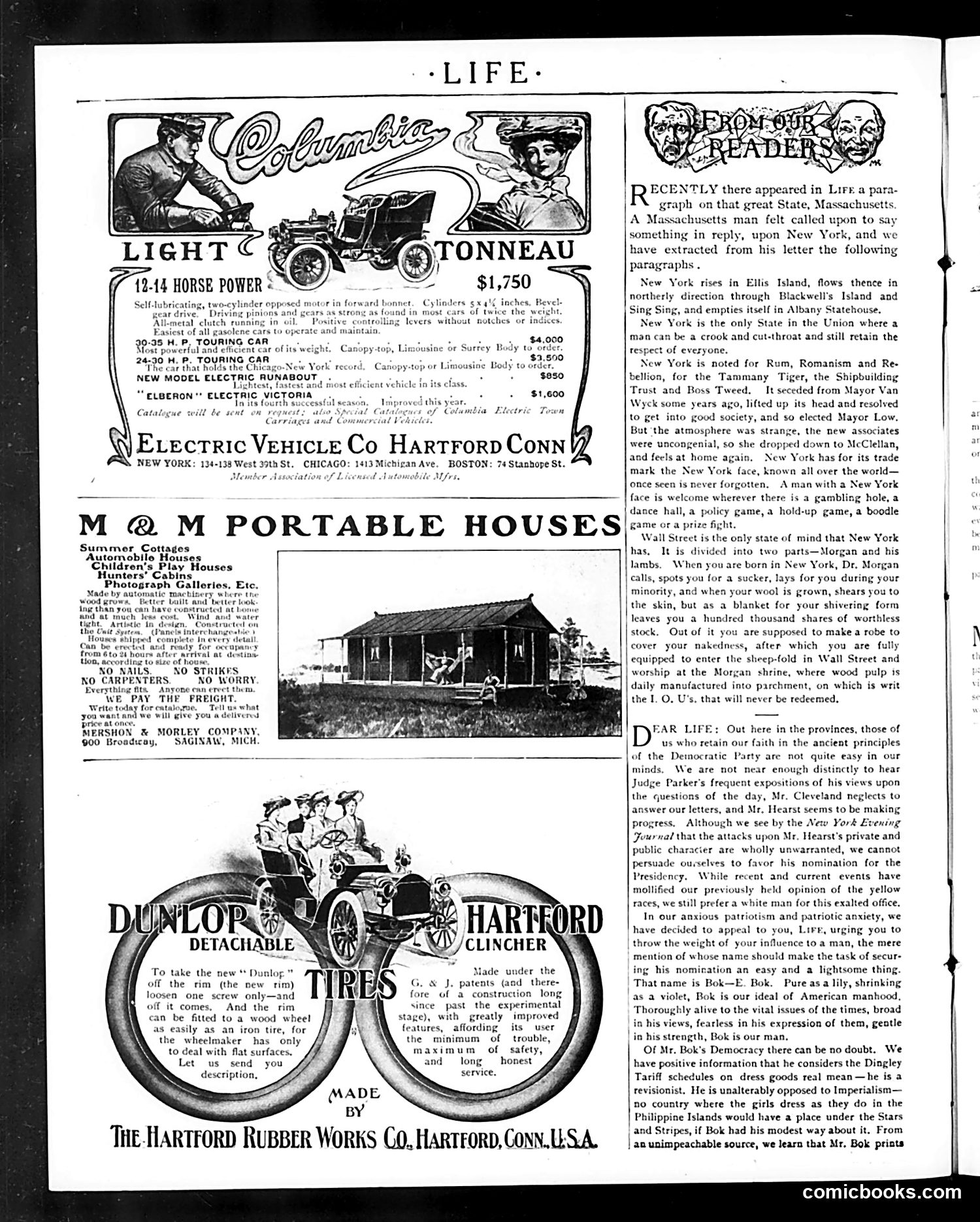
This page is primarily **advertisements** for automobiles and portable houses, with a brief editorial section titled "From Our Readers." The "From Our Readers" column discusses **New York politics**, specifically responding to a Massachusetts reader's letter about a "crook and cutthroat" New Yorker. The editorial defends New York's character while critiquing its reputation for corruption and materialism. It then pivots to endorsing **Bok** (likely Edward Bok, a prominent editor) for the Presidency, praising his opposition to protectionist tariffs and support for dress-reform—positions Life considers enlightened. The ads feature the Columbia Tonneau automobile, M&M Portable Houses, and Dunlop Hartford Tires—typical early 1900s advertisements with no satirical content visible.
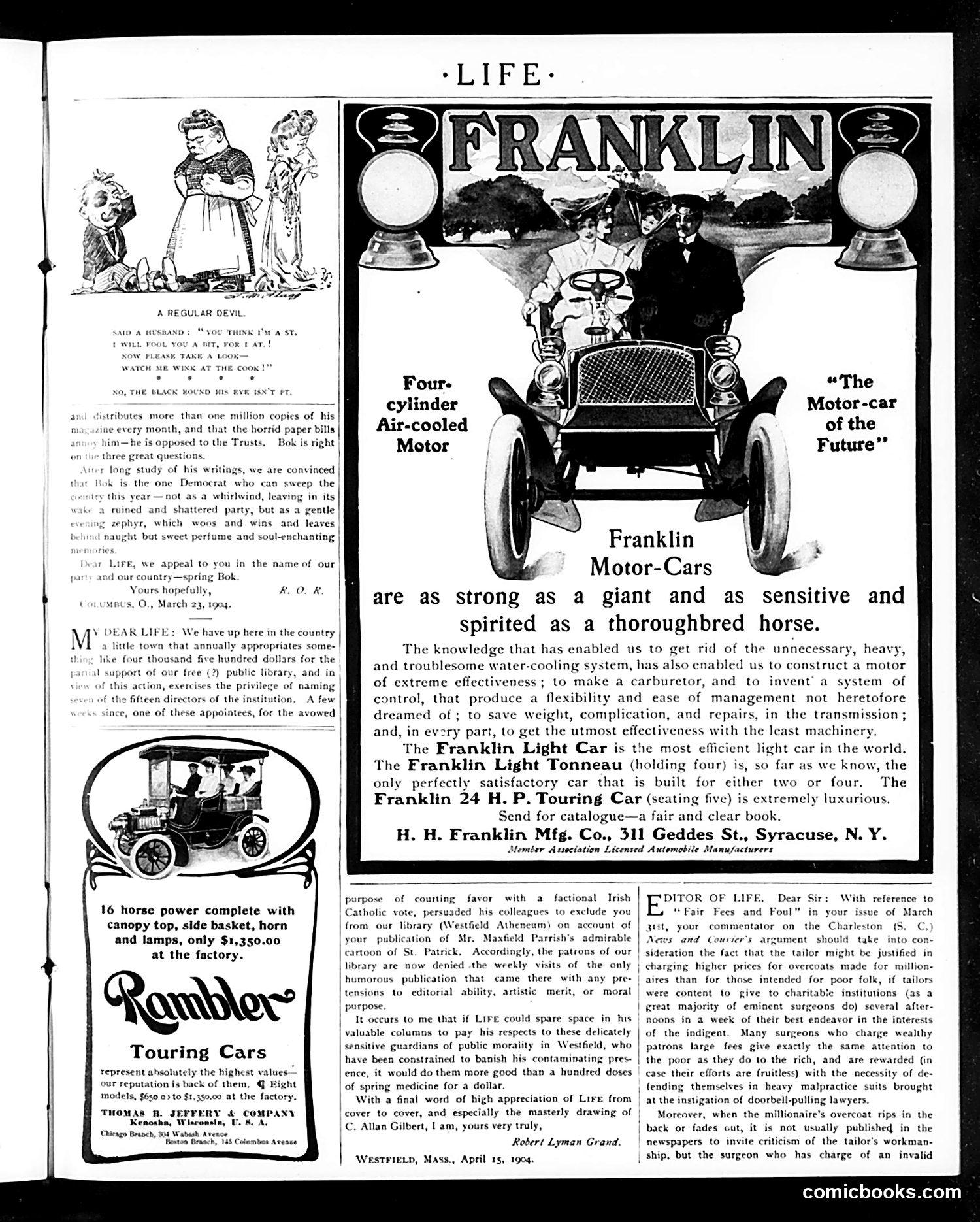
This page is primarily **advertising** rather than satire or political commentary. The dominant content consists of two car advertisements: 1. **Franklin Motor-Cars** (right): Promotes their "Four-cylinder Air-cooled Motor" as "The Motor-car of the Future," emphasizing engineering sophistication and reliability. 2. **Rambler Touring Cars** (lower left): Advertises their vehicles' value and quality. The left side contains **editorial letters** addressing library funding and Irish Catholic representation in *Life* magazine's content. The small cartoon at top left titled "A Regular Devil" is a humorous domestic scene about a husband fooling his wife about cooking—unrelated to political issues. This represents *Life* magazine functioning as a commercial publication mixing editorial content with paid advertising.
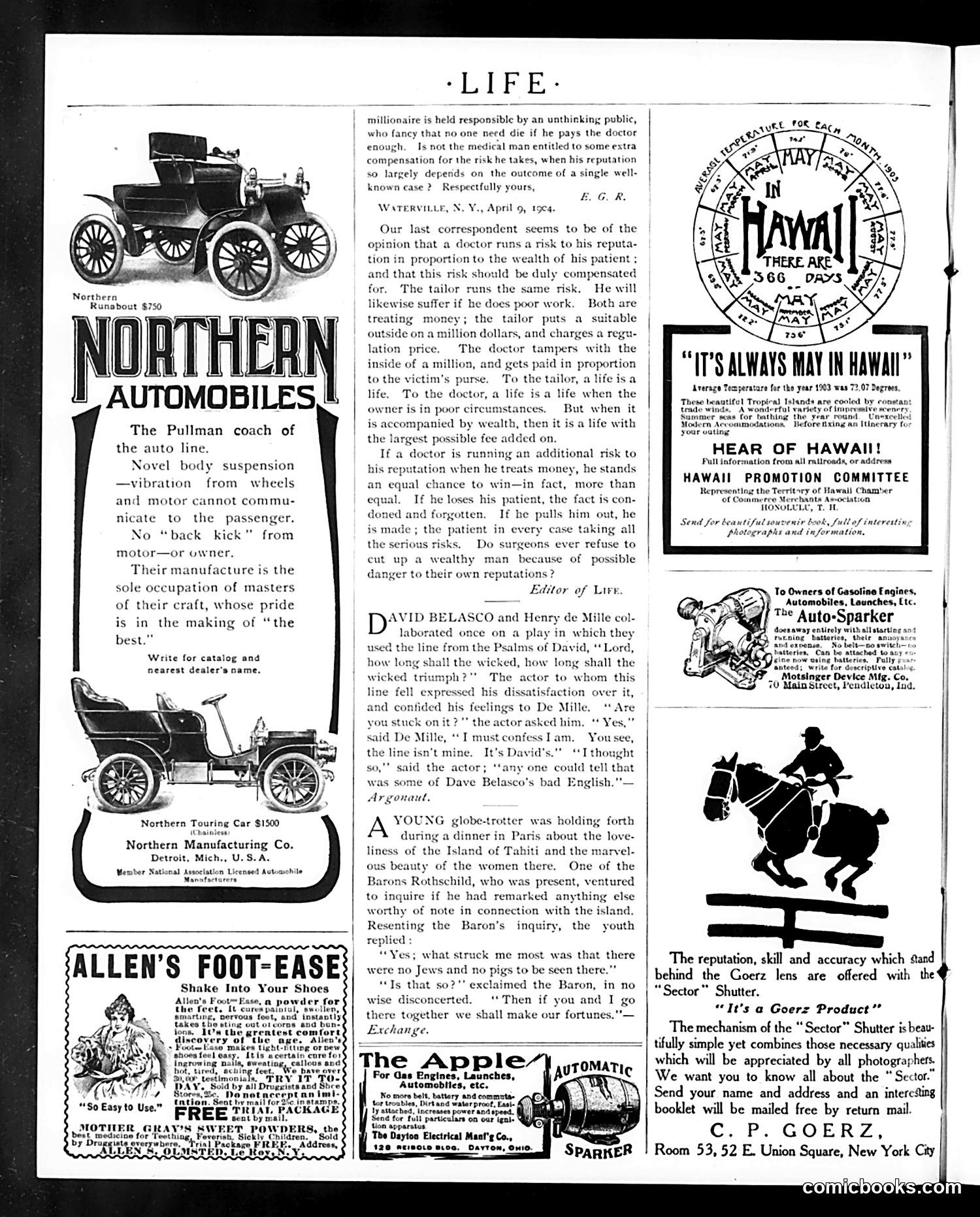
This page is primarily **advertising and miscellaneous content** rather than political satire. The main elements include: **Automobiles**: Northern Manufacturing Company advertises their Pullman coach automobile, emphasizing suspension and comfort—appealing to wealthy buyers in the early motorcar era. **Hawaii Tourism**: The Hawaii Promotion Committee advertises the islands as a tropical destination, noting "It's Always May in Hawaii." **Consumer Products**: Allen's Foot-Ease powder, Auto-Sparker ignition devices, and other commercial goods occupy the page. **Editorial Letter**: An extended debate discusses whether doctors should charge fees proportional to patients' wealth—a professional ethics question of the period. The page reflects 1904 concerns: emerging automobile technology, colonial-era tourism promotion, and class-based service pricing debates.
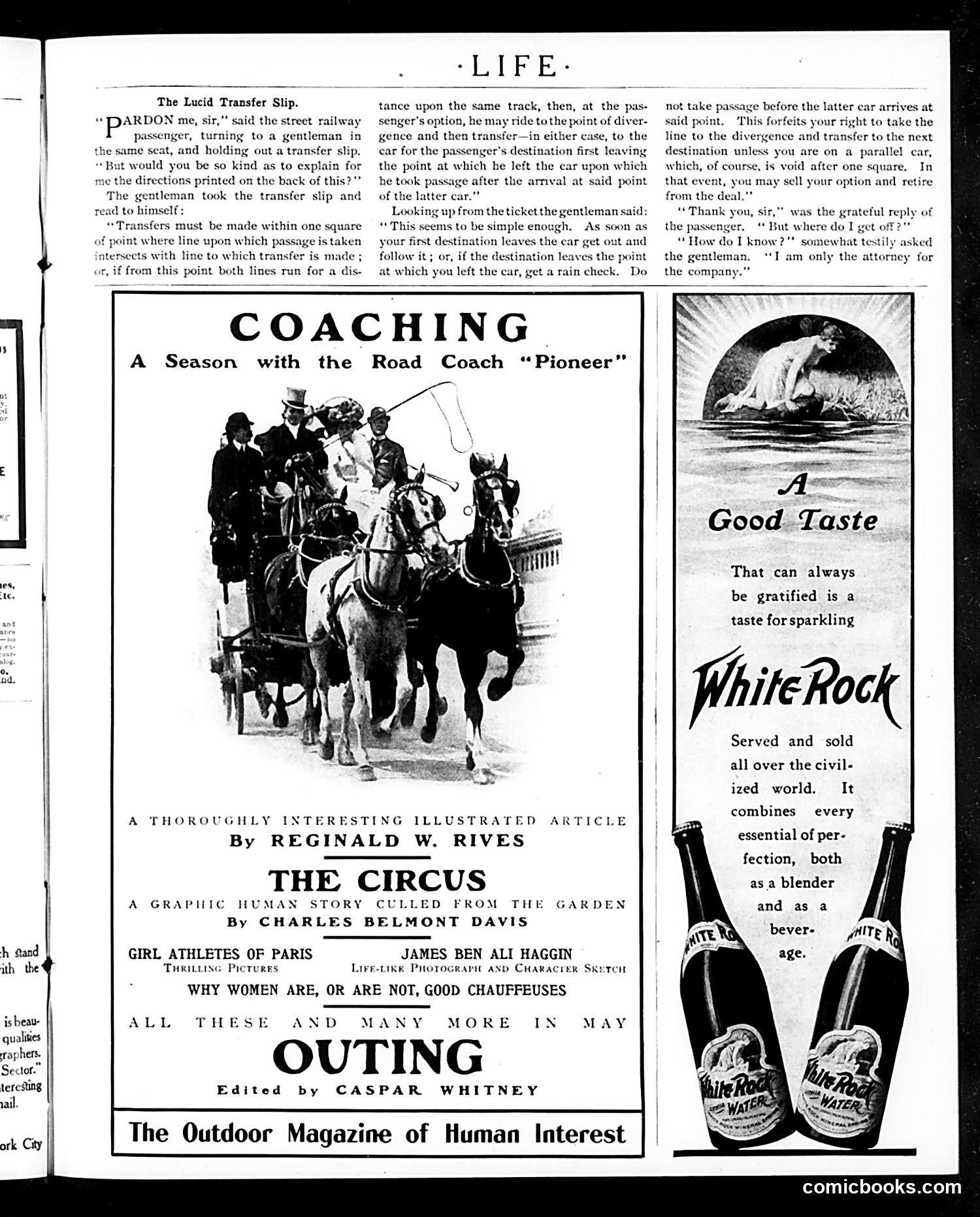
This page is primarily **advertising and promotional content** rather than political satire or comics. The left side features advertisements for upcoming articles and publications, including: - "Coaching: A Season with the Road Coach 'Pioneer'" (illustrated with a horse-drawn carriage) - Articles on "The Circus" and "Girl Athletes of Paris" - A magazine called *Outing*, described as "The Outdoor Magazine of Human Interest" The right side contains a **White Rock beverage advertisement** featuring sparkling water bottles and text about "good taste." No political cartoons or satirical commentary appear on this page. It represents typical early 20th-century magazine content mixing editorial promotion with commercial advertising.
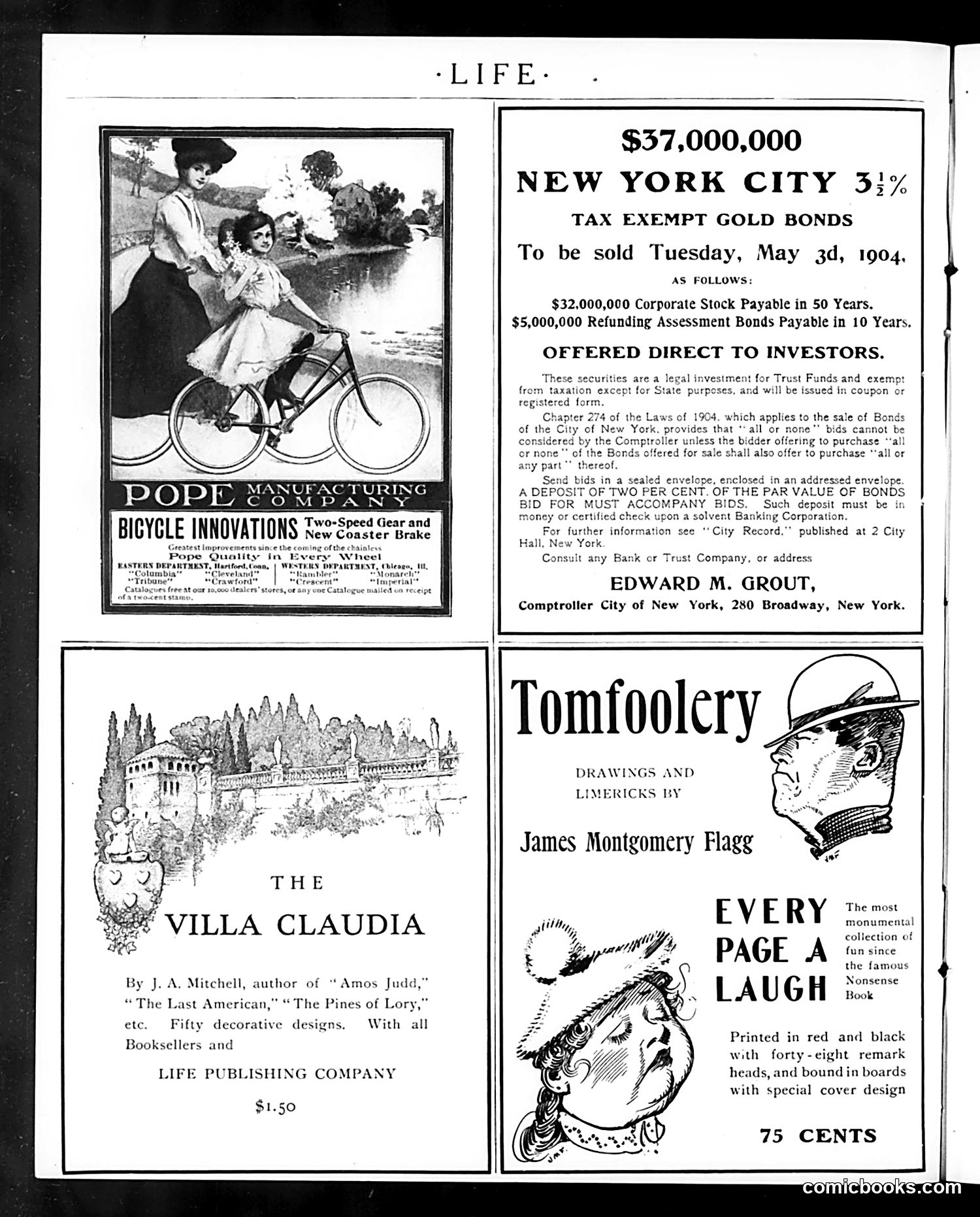
This is primarily an **advertising page** from *Life* magazine, circa 1904. It contains four advertisements: 1. **Pope Manufacturing bicycle ad** (top left): Features a woman and child on a bicycle, promoting "Two-Speed Gear and New Coaster Brake" innovations. 2. **New York City bonds** (top right): A financial announcement offering $37 million in tax-exempt gold bonds. 3. **The Villa Claudia** (bottom left): A book advertisement by J.A. Mitchell, described as "fifty decorative designs" published by Life Publishing Company. 4. **Tomfoolery** (bottom right): A humor book of drawings and limericks by James Montgomery Flagg, described as "every page a laugh" and priced at 75 cents. The page contains **no political cartoons or satire**—it is essentially a classified advertising section with period product and publication promotions.
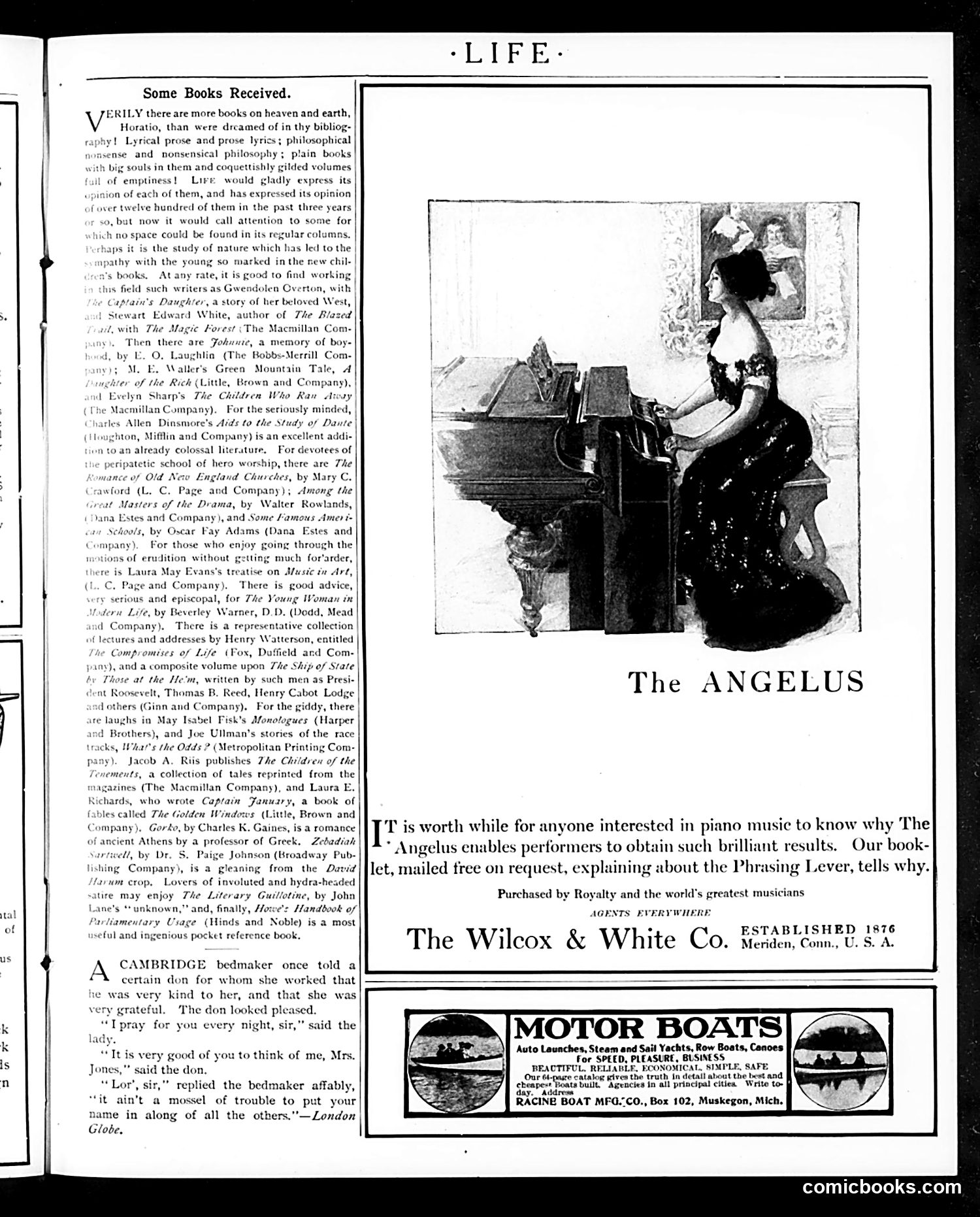
This page is primarily **advertising and book review content**, not political satire. The left column reviews recent books, discussing literary works by authors like Gwendolen Cawdton and Stewart Edward White. The main visual element is an illustration titled "The Angelus" (right side), depicting two figures in a classical pose—likely referencing Millet's famous 1859 painting of peasants praying in a field. Below this is an advertisement for **The Wilcox & White Co.**, a piano manufacturer established 1876, which "enables performers to obtain such brilliant results." At the bottom is a motor boat advertisement from the **Racing Boat Mfg. Co.** in Muskegon, Michigan. The page contains no evident political commentary or social satire—it's a typical early 20th-century magazine layout mixing editorial content with commercial advertisements.
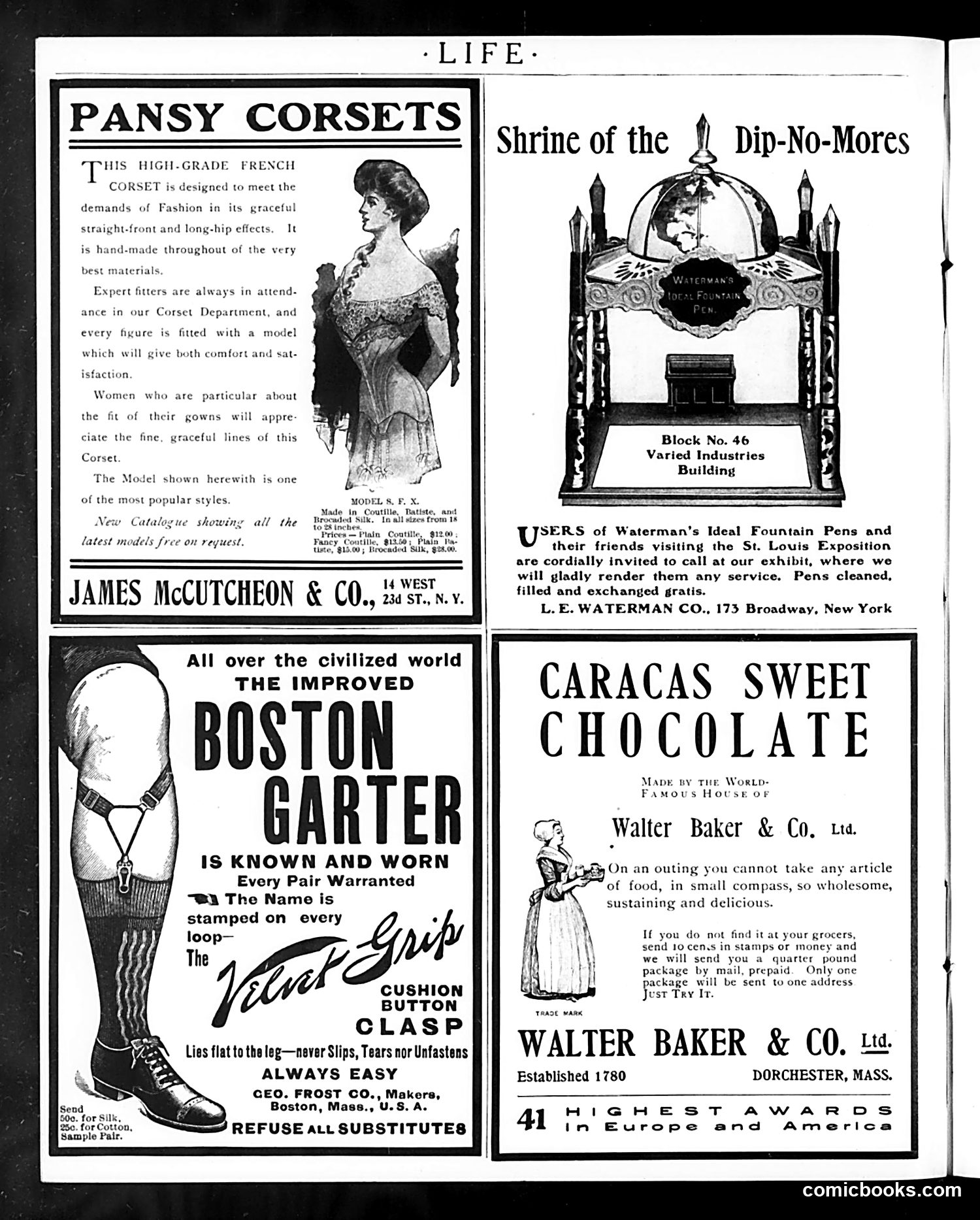
This page is primarily **advertising**, not satire or political commentary. It contains four distinct ads: 1. **Pansy Corsets** (top left): Promotes high-grade French corsets emphasizing "straight-front and long-hip effects"—reflecting early 1900s fashion silhouettes that required restrictive undergarments. 2. **Shrine of the Dip-No-Mores** (top right): An advertisement for Waterman's Ideal Fountain Pens at the St. Louis Exposition, using a decorative shrine motif. 3. **Boston Garter** (bottom left): Markets garters with a "Velvet Grip" cushion clasp, emphasizing they don't slip or tear—practical hosiery advertising. 4. **Caracas Sweet Chocolate** (bottom right): Walter Baker & Co. promotes chocolate, established 1780, claiming 41 highest awards. The page reflects consumer products and fashion standards of the early 20th century.
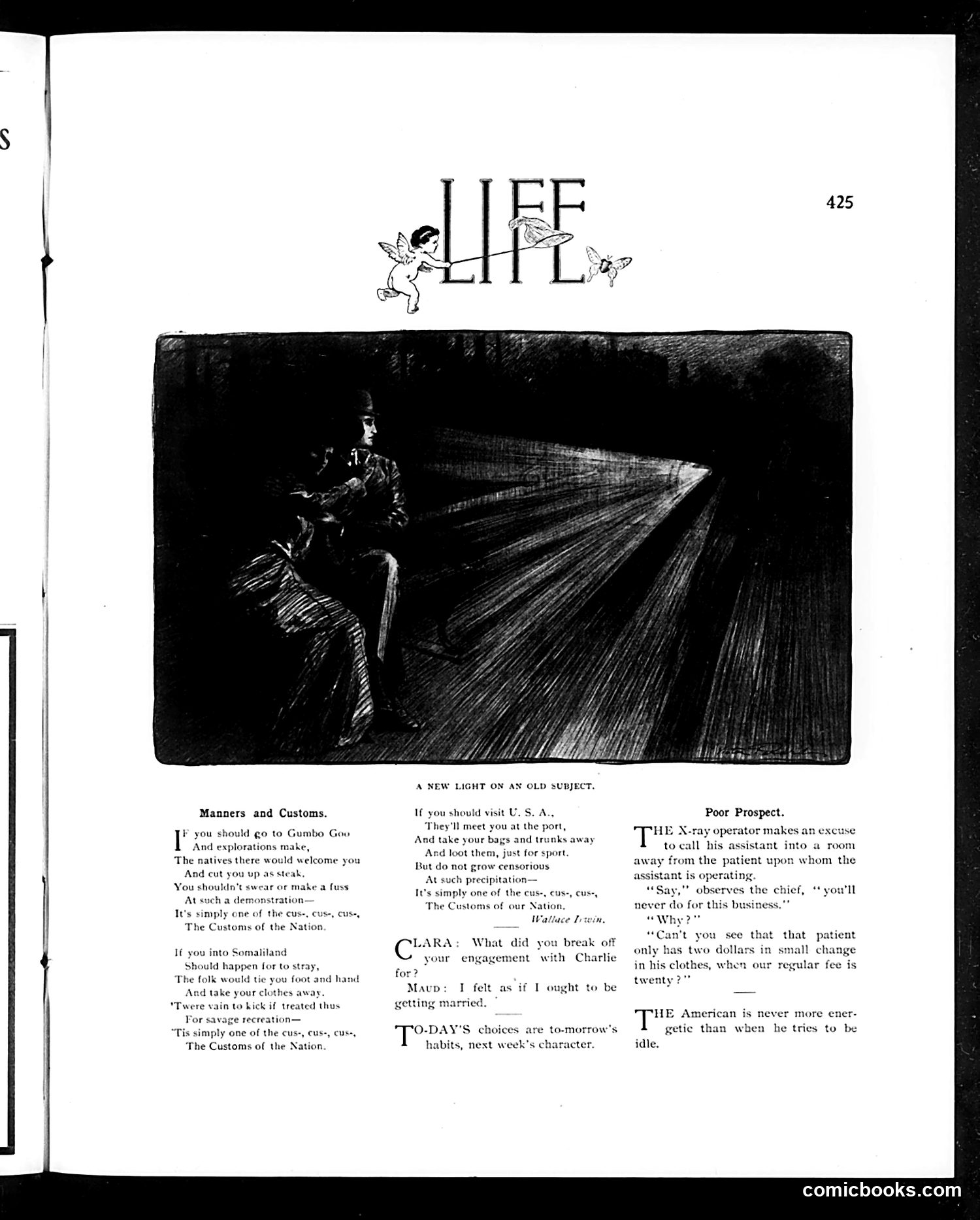
The main illustration depicts a figure holding a powerful searchlight beam, titled "A NEW LIGHT ON AN OLD SUBJECT." This appears to be political commentary using light/illumination as a metaphor for exposing truth or revealing hidden aspects of a topic. The text sections below include satirical commentary on American customs and manners, with sections titled "Manners and Customs" and "Poor Prospect." References include advice about visiting the U.S.A., Somaliland, and commentary on American behavior and character. A dialogue between characters named Clara and Maud discusses broken engagements, with closing observations that "TO-DAY'S choices are to-morrow's habits" and that "THE American is never more energetic than when he tries to be idle." The satirical tone mocks American social conventions and tourist behavior, typical of *Life* magazine's approach to social commentary.
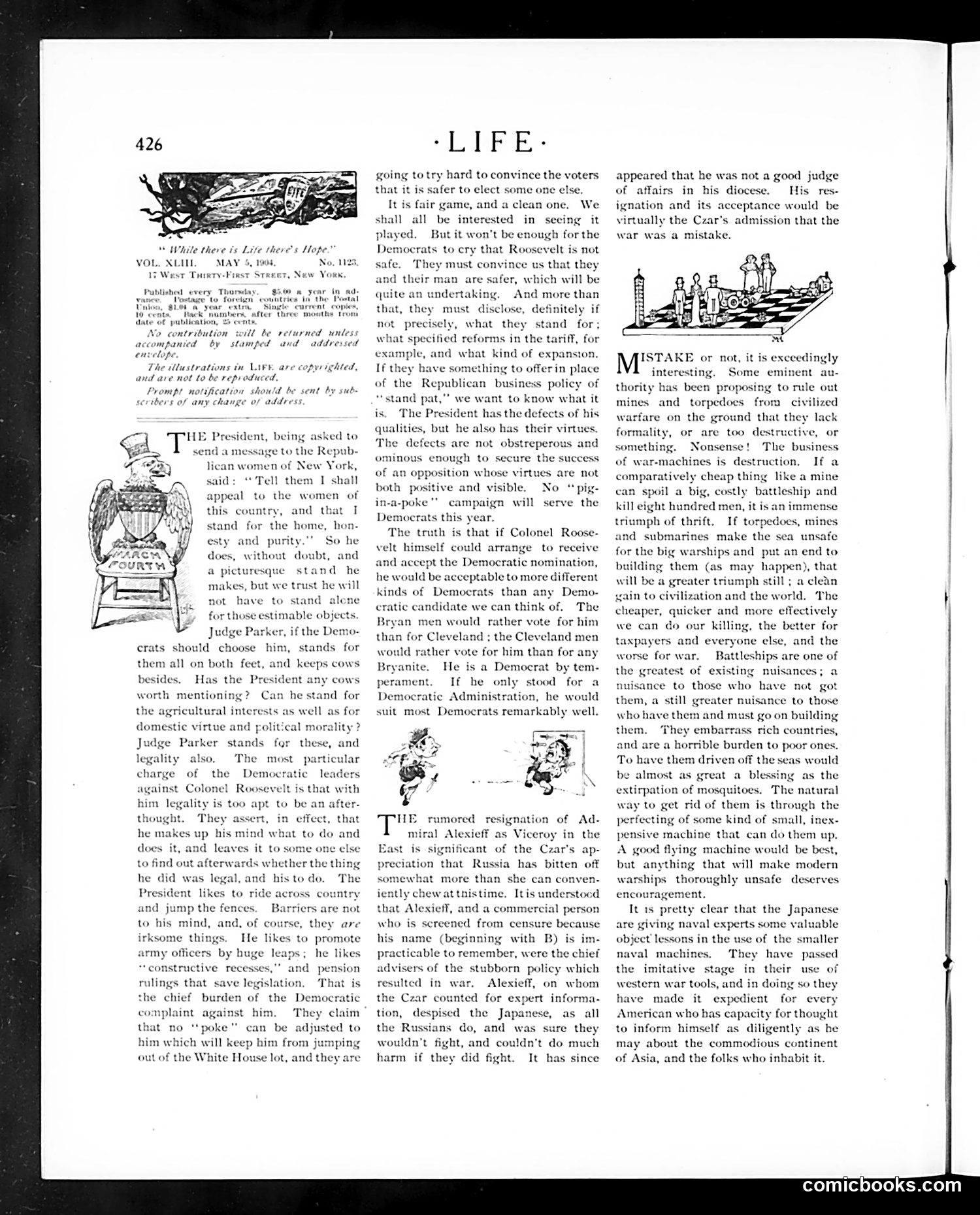
This page discusses the 1904 presidential election. The left column features a cartoon showing a figure labeled "FOURTH" (likely Judge Parker, the Democratic nominee) depicted as a scale or balance—a visual metaphor suggesting he lacks substance or weight as a candidate. The text argues that Democrats should nominate Parker as a safer alternative to Roosevelt, while also criticizing Roosevelt's defects. The article debates whether Colonel Roosevelt should receive the Democratic nomination, suggesting Democrats might actually prefer him to their own candidate. The right column discusses naval warfare and the Russo-Japanese War, praising Japanese naval innovations and suggesting American military leaders should study their methods. The satirical tone questions American military preparedness and technological advancement compared to Japan.
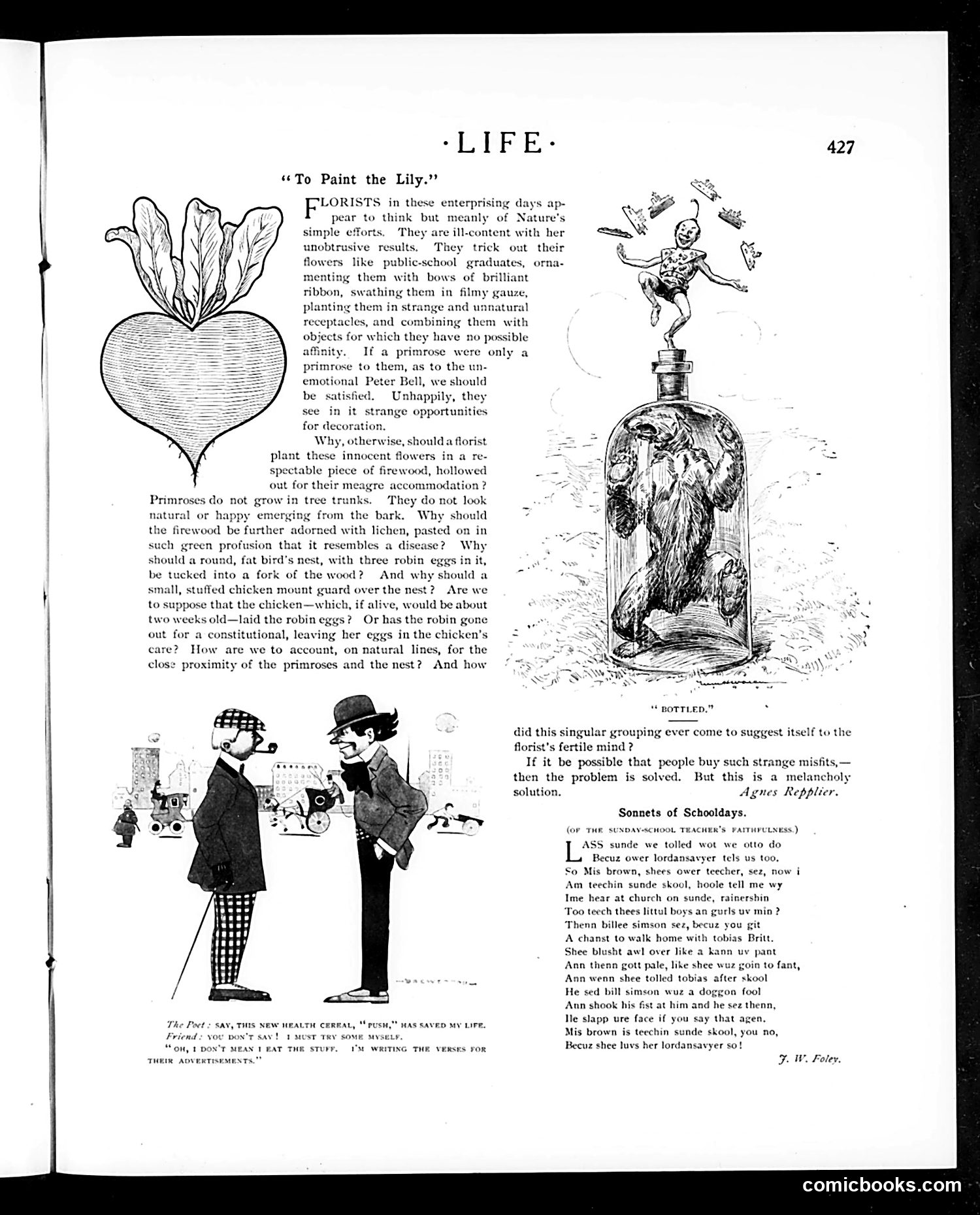
**"To Paint the Lily"** (by Agnes Repplier): This essay satirizes florists who over-decorate flowers with artificial embellishments. Repplier criticizes the practice of placing primroses in hollowed firewood, adding fake lichen and bird nests with stuffed chickens—creating absurd, unnatural arrangements. She argues florists treat flowers like "public-school graduates" needing adornment, when simple beauty suffices. The satire targets Victorian-era excess and artificiality in decoration, suggesting that if people buy such "strange misfits," the problem lies with consumers, not florists. **Bottom cartoon**: Two men discuss a new health cereal called "Push." One claims it saved his life; the other decides to try it—not because the cereal works, but because writing its advertising jingles is profitable. The joke mocks patent medicine advertising and opportunistic salesmanship. **"Sonnets of Schooldays"**: Phonetically spelled doggerel about a Sunday school teacher whom students teasingly suggest is motivated by romantic interest in a boy named Tobias Britt, not religious duty.
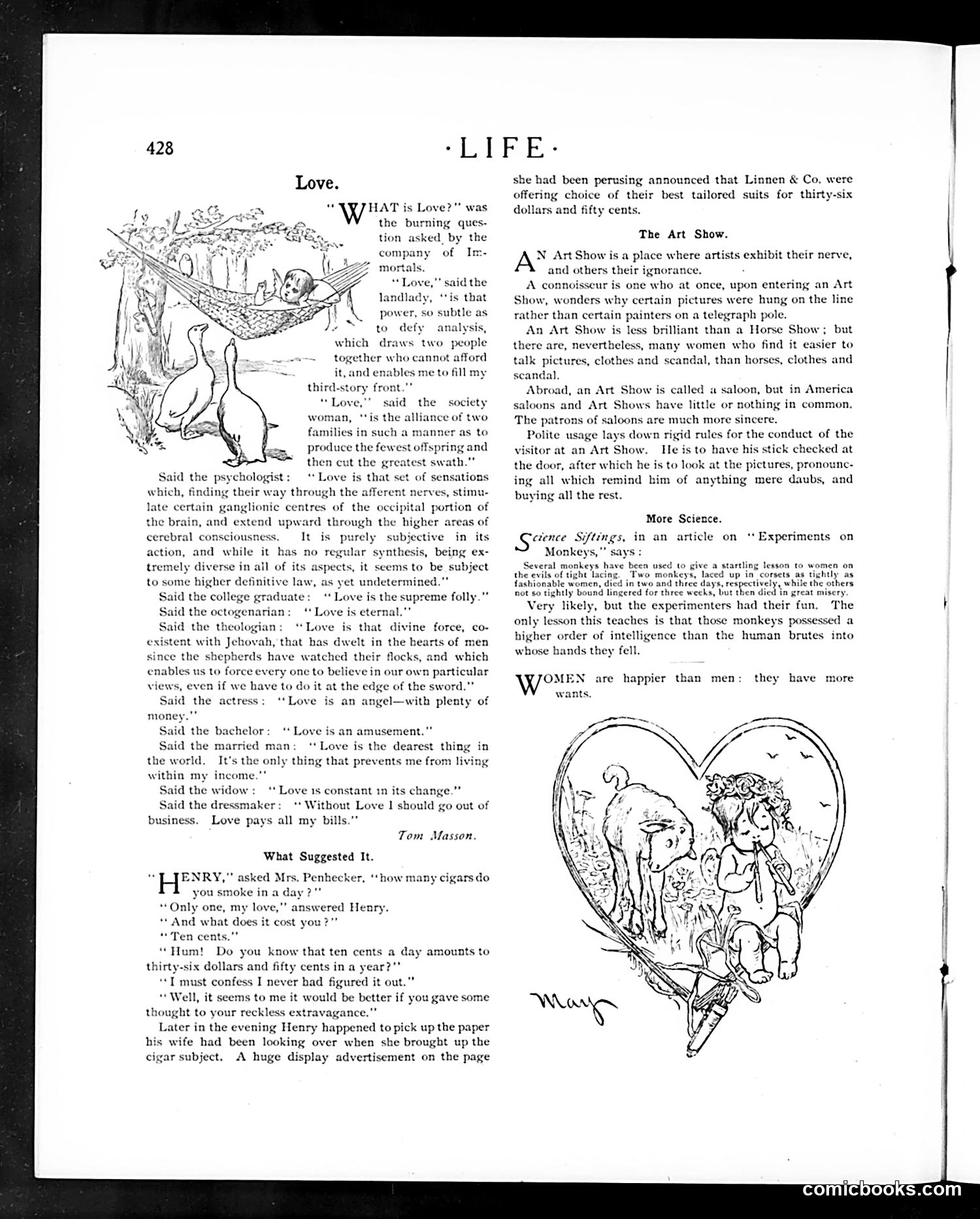
This page satirizes romantic love through multiple perspectives, then pivots to practical marital humor. **"Love" Section:** Various social figures—landlady, society woman, psychologist, clergy, actress, bachelor, widow, and dressmaker—define love according to their self-interest. The satire mocks how people rationalize love to serve their own needs: the landlady sees profit, the society woman sees family alliances, the actress wants money, and the dressmaker profits from wedding expenses. It's social commentary on how "love" becomes a convenient fiction masking economic and practical concerns. **"What Suggested It":** A husband brags he smokes only one cigar daily. His wife calculates this costs $36.50 yearly—then points out a newspaper advertisement for tailored suits at exactly that price. The joke: she's suggesting he should buy *her* a suit instead of smoking, using his own math against him. It's domestic satire about marriage as economic negotiation. The remaining sections on Art Shows and monkey corset experiments are separate satirical pieces typical of *Life* magazine's format.
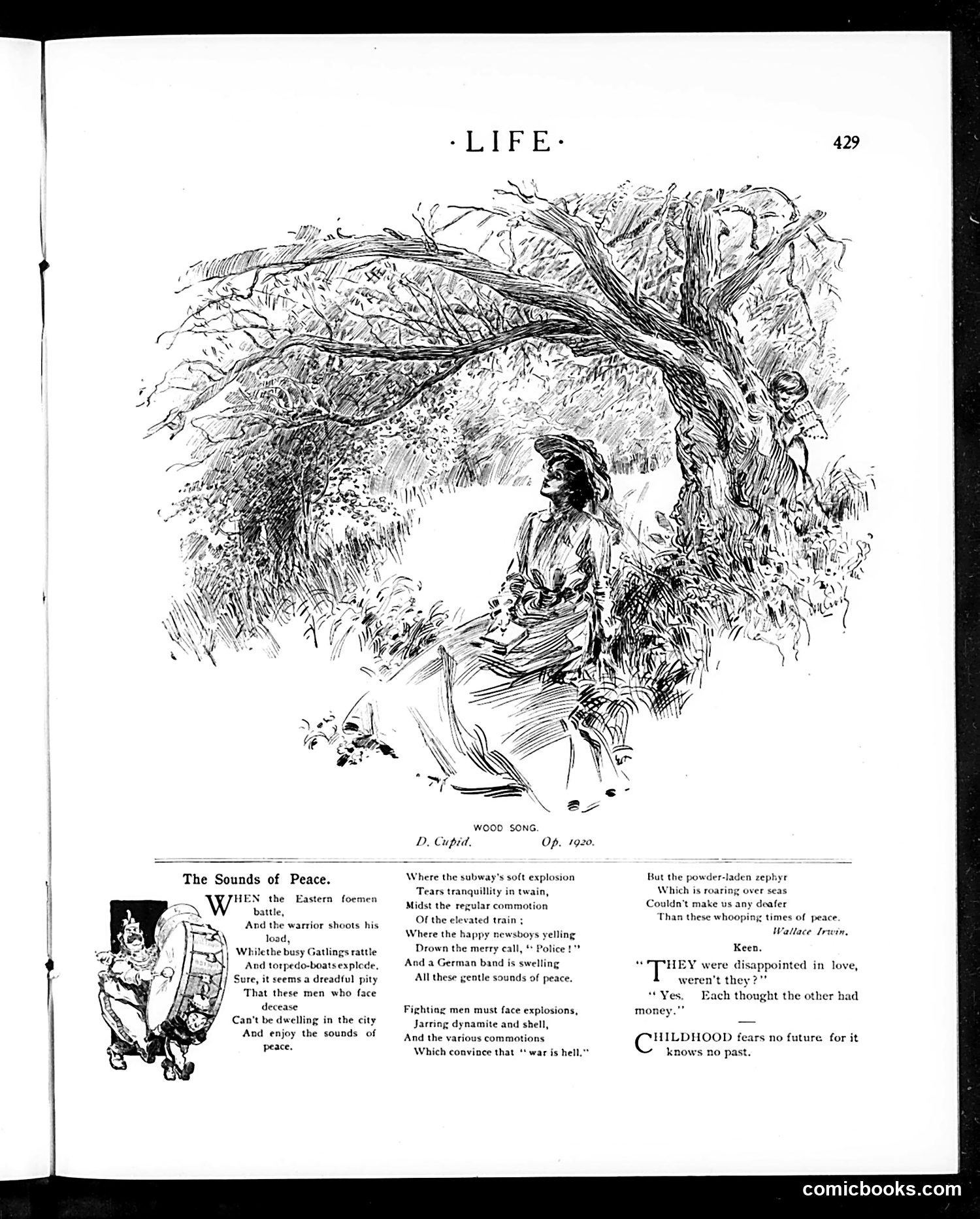
This page from *Life* magazine (1920, based on the "Op. 1920" notation) contains satirical poetry mocking American urban life by contrasting it unfavorably with World War I combat. **"The Sounds of Peace"** by Wallace Irwin presents ironic commentary: soldiers facing explosions in actual warfare are portrayed as fortunate compared to civilians enduring the constant noise pollution of modern cities—subways, elevated trains, newsboys, and street musicians. The joke inverts expectations: the "sounds of peace" are actually cacophonous and unbearable, suggesting urban civilization is as hellish as war itself. The accompanying illustration shows a couple beneath a gnarled tree, likely representing romantic idealism. Below this, a brief humorous exchange about disappointed lovers appears—each assumed the other was wealthy, subverting romantic sentiment with financial cynicism. The page reflects post-WWI American attitudes: urban modernization's downsides and skepticism about traditional romance.
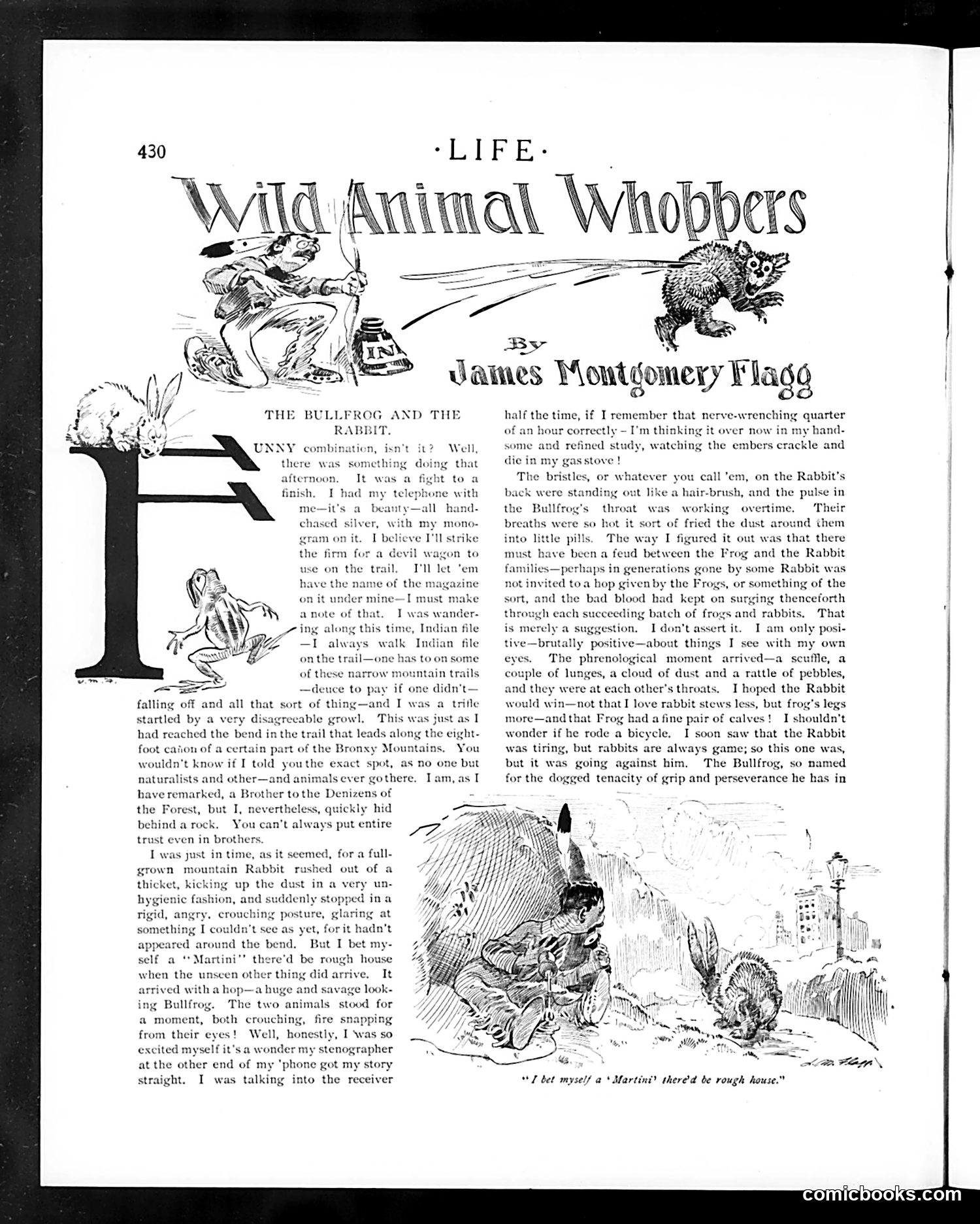
This is a tall tale by James Montgomery Flagg from *Life* magazine's humor section. The narrator claims to have witnessed a dramatic confrontation between a mountain rabbit and a bullfrog while hiking in the Bronx Mountains. The "story" is satirical fiction—a deliberately absurd claim presented as firsthand adventure reporting. The joke relies on the exaggeration typical of frontier tall tales: ordinary animals (a rabbit and frog) are described with anthropomorphic drama and intensity, complete with detailed anatomical observations and pseudo-scientific analysis. The illustrations show the animals in combat, treating them with heroic grandiosity. The satire likely mocks both sensationalist magazine writing and the American tall-tale tradition, where narrators recount increasingly implausible wilderness encounters with complete earnestness. The title "Whobbers" (exaggerations) signals readers this is fabricated entertainment, not genuine reportage.
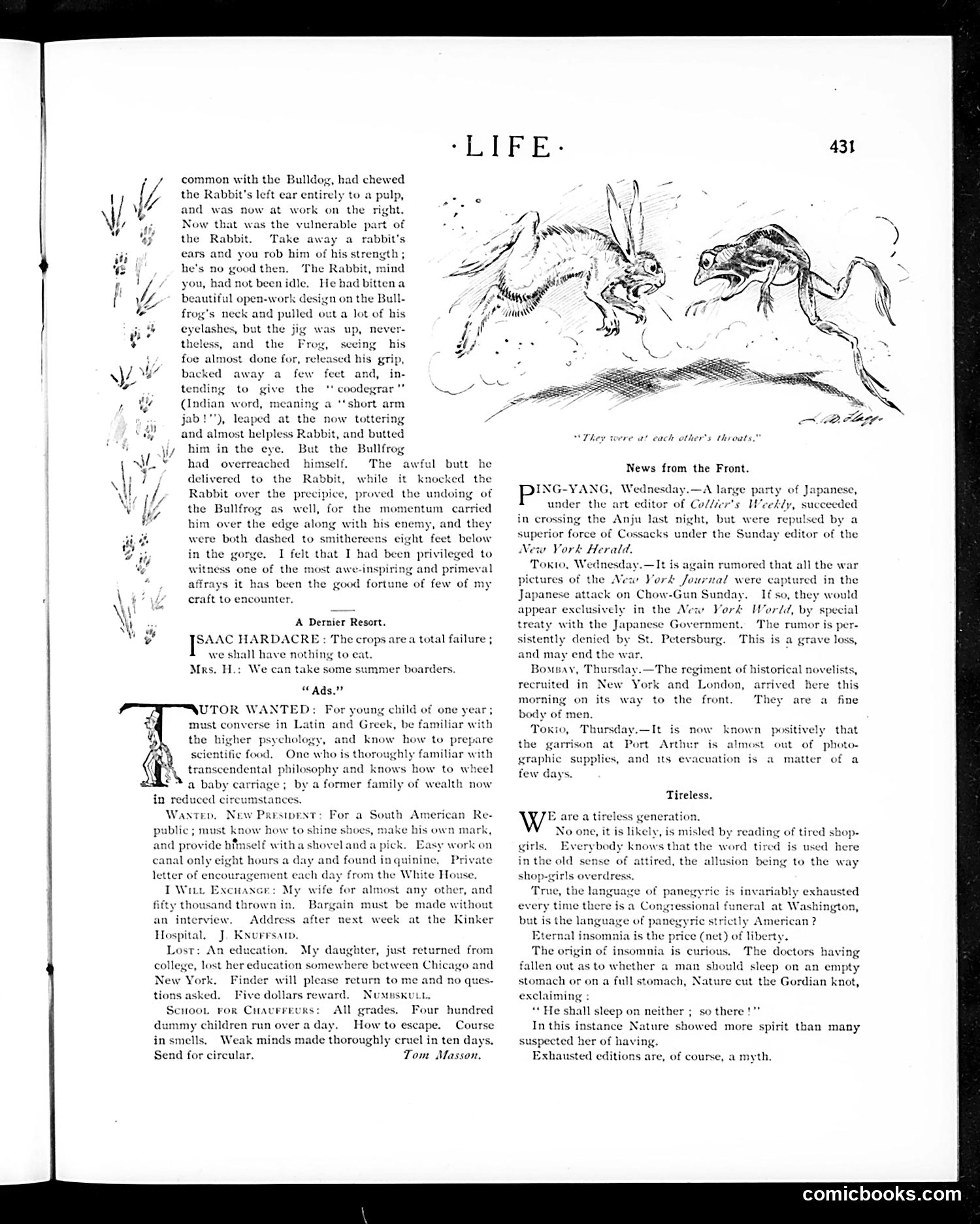
The main illustration depicts a **rabbit and bulldog in violent combat**, with the caption "They tore at each other's throats." This is a fable-style narrative describing an actual fight, where both animals are badly injured despite one seemingly winning—a metaphor for mutually destructive conflict. Below, the "News from the Front" section satirizes **war journalism during the Russo-Japanese War** (referenced by Japanese forces, Cossacks, Port Arthur). Life mocks sensationalized reporting: one joke suggests the *New York Journal*'s war photographs were "captured," so they'd appear exclusively in the *New York World* under treaty with Japan—absurd corporate rivalry masquerading as war reporting. The classified ads section offers crude humor: tutors for one-year-olds fluent in Latin/Greek, and a man advertising his wife for exchange. These mock ridiculous newspaper want-ads. The "Tireless" column critiques Americans as exhausted by constant Congressional funerals and patriotic speeches—a complaint about civic fatigue and performative patriotism.
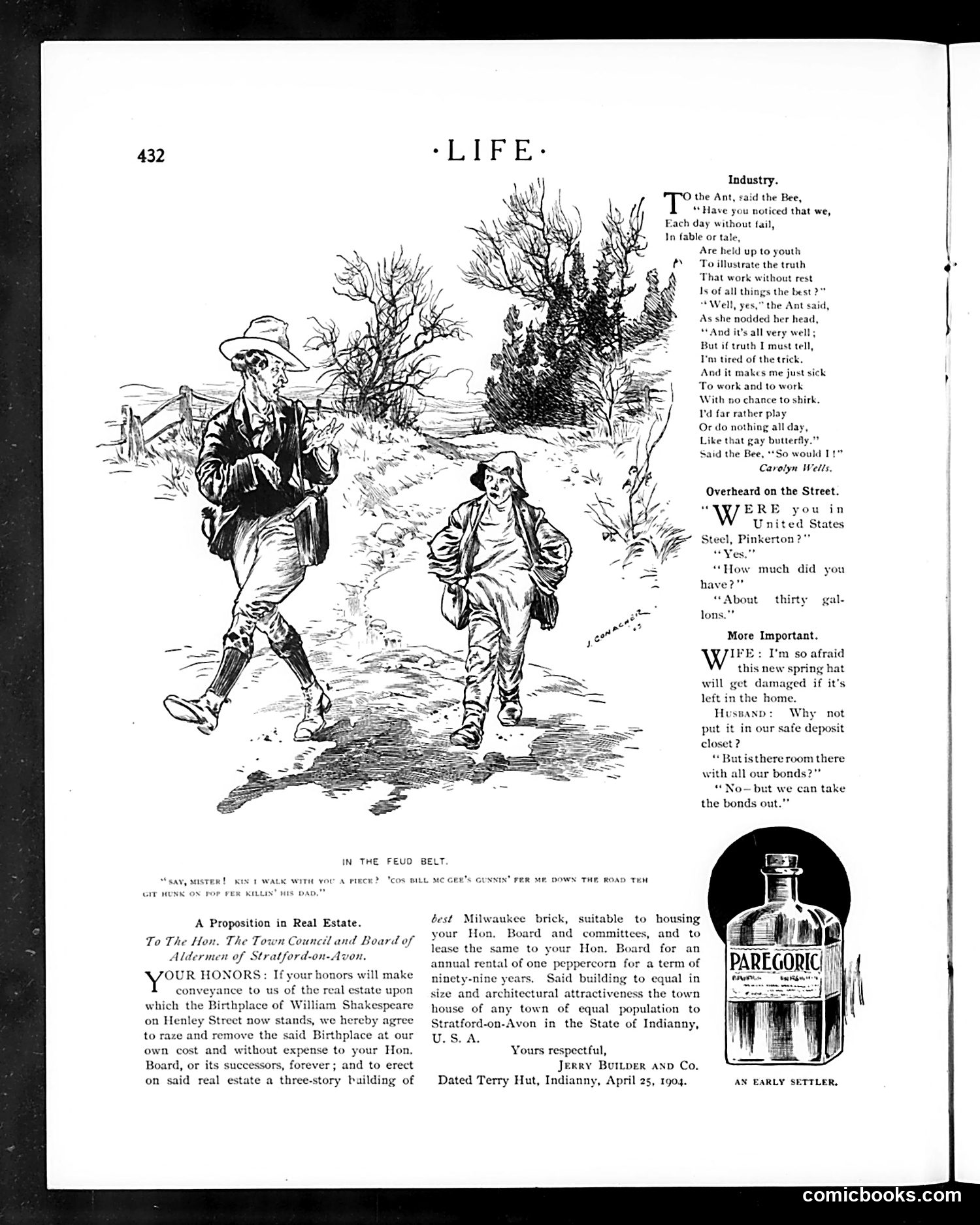
This page contains three separate satirical pieces typical of Life's humor: **"Industry"** (Carolyn Wells poem): A dialogue between Ant and Bee mocking the tiresome morality tale used to teach children about hard work. Both insects confess they're exhausted by the constant preaching that labor is virtuous—they'd rather play. The satire targets predictable, sanctimonious children's literature. **"Overheard on the Street"**: Two brief jokes. The first references U.S. Steel and Pinkerton (the notorious anti-labor detective agency), suggesting wage theft or exploitation. The second mocks the wealthy, showing a wife more concerned about her hat's safety than their bond investments—satirizing misplaced priorities among the affluent. **"A Proposition in Real Estate"**: A mock-serious proposal to demolish Shakespeare's Birthplace in Stratford-on-Avon and replace it with a generic Milwaukee brick building. The absurdist humor lies in the grotesque suggestion that a culturally irreplaceable historical site should yield to American commercialism and standardization.
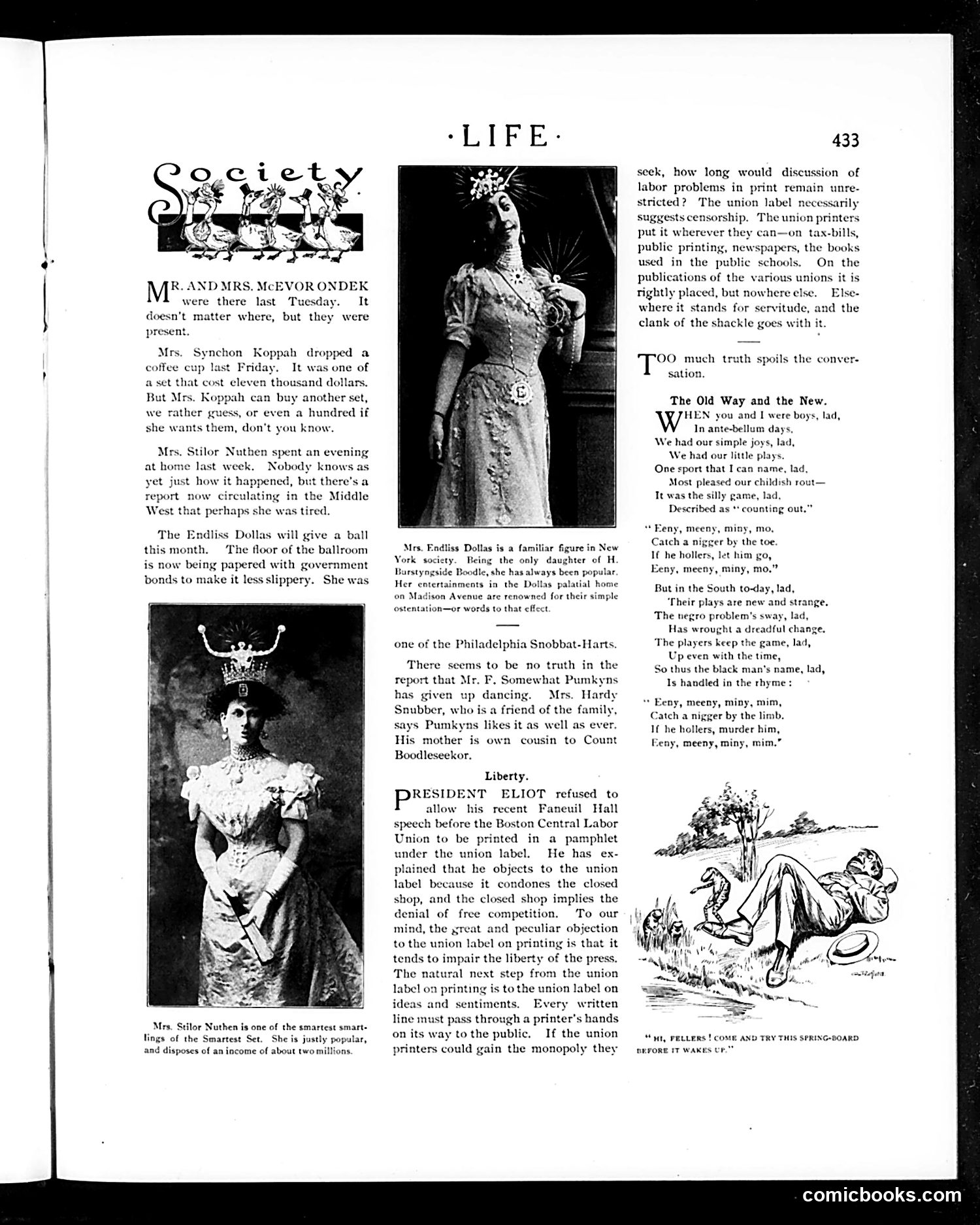
This page contains two distinct pieces of social satire: **Upper Section - Society Gossip:** The "Society" column mockingly chronicles the trivial lives of wealthy elites (the "Smartest Set"), featuring caricatured figures like Mrs. Endliss Dollas and Mrs. Stilor Nuthen. The satire ridicules their extravagance—papered ballroom floors with government bonds, thousand-dollar coffee sets—and the absurdity of their social reportage. This targets the nouveau riche and society page frivolity. **Lower Section - Labor Union Controversy:** The "Liberty" article discusses President Eliot's refusal to allow his speech printed under a union label. Life argues union labels on printing threaten press freedom and could enable censorship of labor discussions. This reflects genuine early-20th-century debates over unionization's scope and power. **Bottom - Racist Poem:** "The Old Way and the New" compares children's counting-out rhymes, contrasting a historical racist chant with an even more violent contemporary Southern version. This appears critical of Southern racial violence, though presented disturbingly.
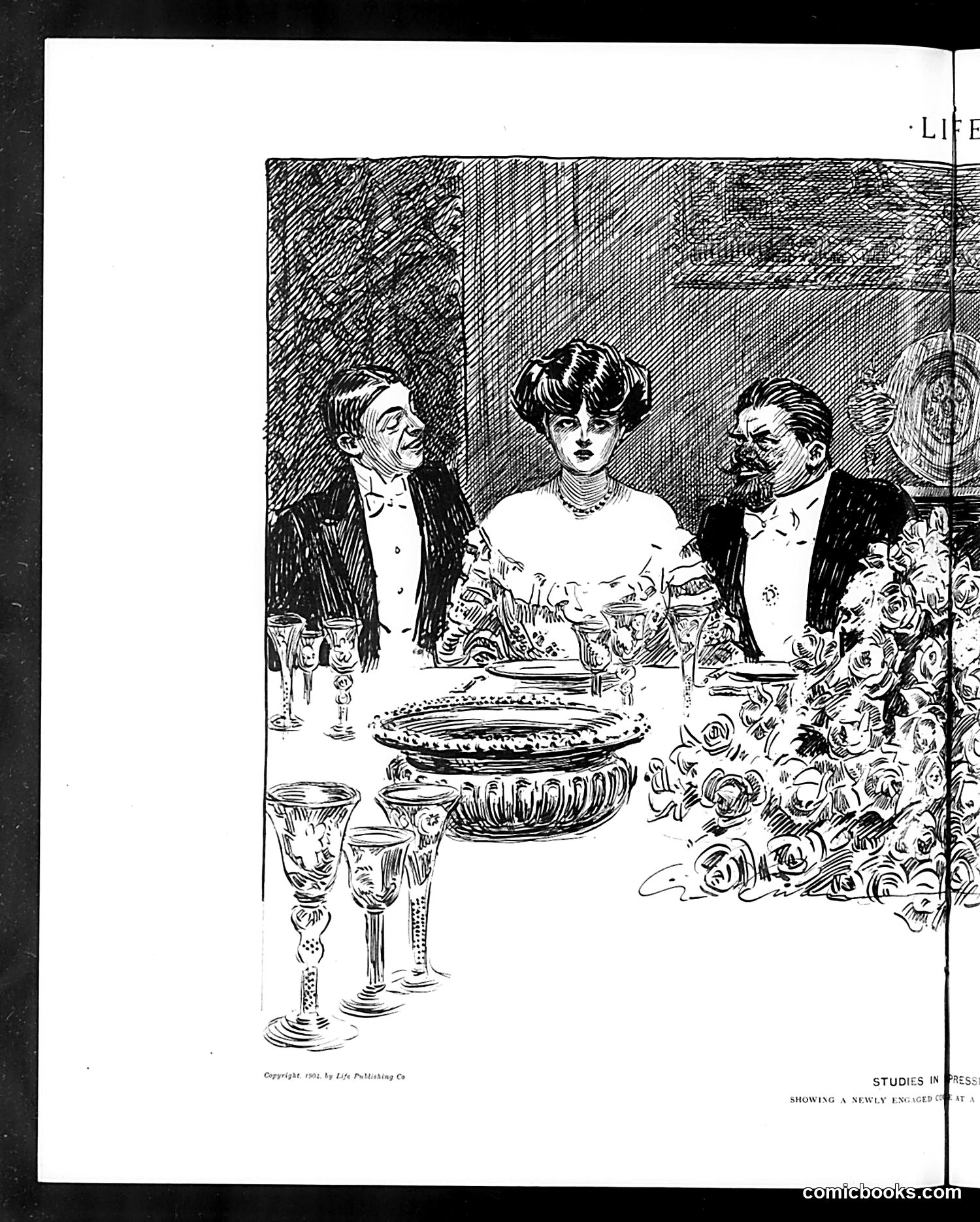
This illustration depicts an elegant formal dinner scene with three men in tuxedos and a woman in an off-shoulder white gown. The caption indicates this is "Studies in Dress: Showing a Newly Engaged Girl at a..." The satire appears to target upper-class courtship rituals and fashion display. The woman is prominently positioned as the focal point, wearing elaborate jewelry and a fashionable gown, while the men attend to her. The detailed rendering of fine dining elements—crystal glasses, flowers, and ornate serving vessels—emphasizes ostentatious wealth and formality. The humor likely mocks how newly engaged women were paraded in high society, with emphasis on appearance and material display rather than genuine connection. The men's expressions suggest amused or calculating observation rather than romantic interest.
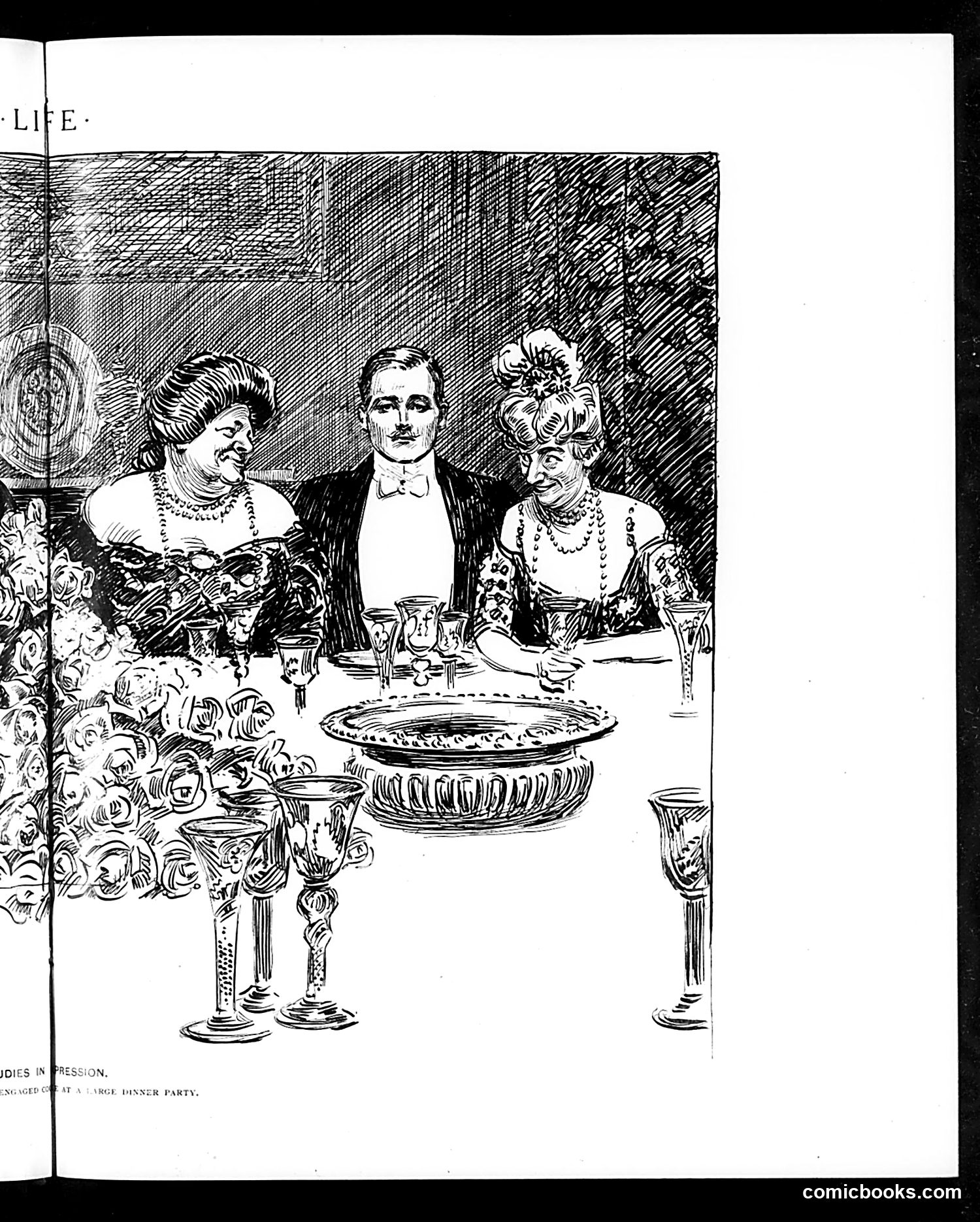
This appears to be a satirical illustration from *Life* magazine depicting a formal dinner party scene. Three well-dressed figures—two women in elaborate gowns with ornate jewelry and distinctive hairstyles, flanking a man in a tuxedo—are seated at a dining table surrounded by champagne glasses and floral arrangements. The cartoon likely satirizes wealthy high society and dinner culture of the early 20th century, mocking the affectations and pretensions of the upper class. The elaborate dress, abundant alcohol, and formal staging suggest commentary on excess or artificial sophistication. However, without clearer OCR text or additional context identifying these specific figures, the exact targets of satire remain unclear. The incomplete caption at bottom prevents definitive interpretation of the joke or social commentary intended.
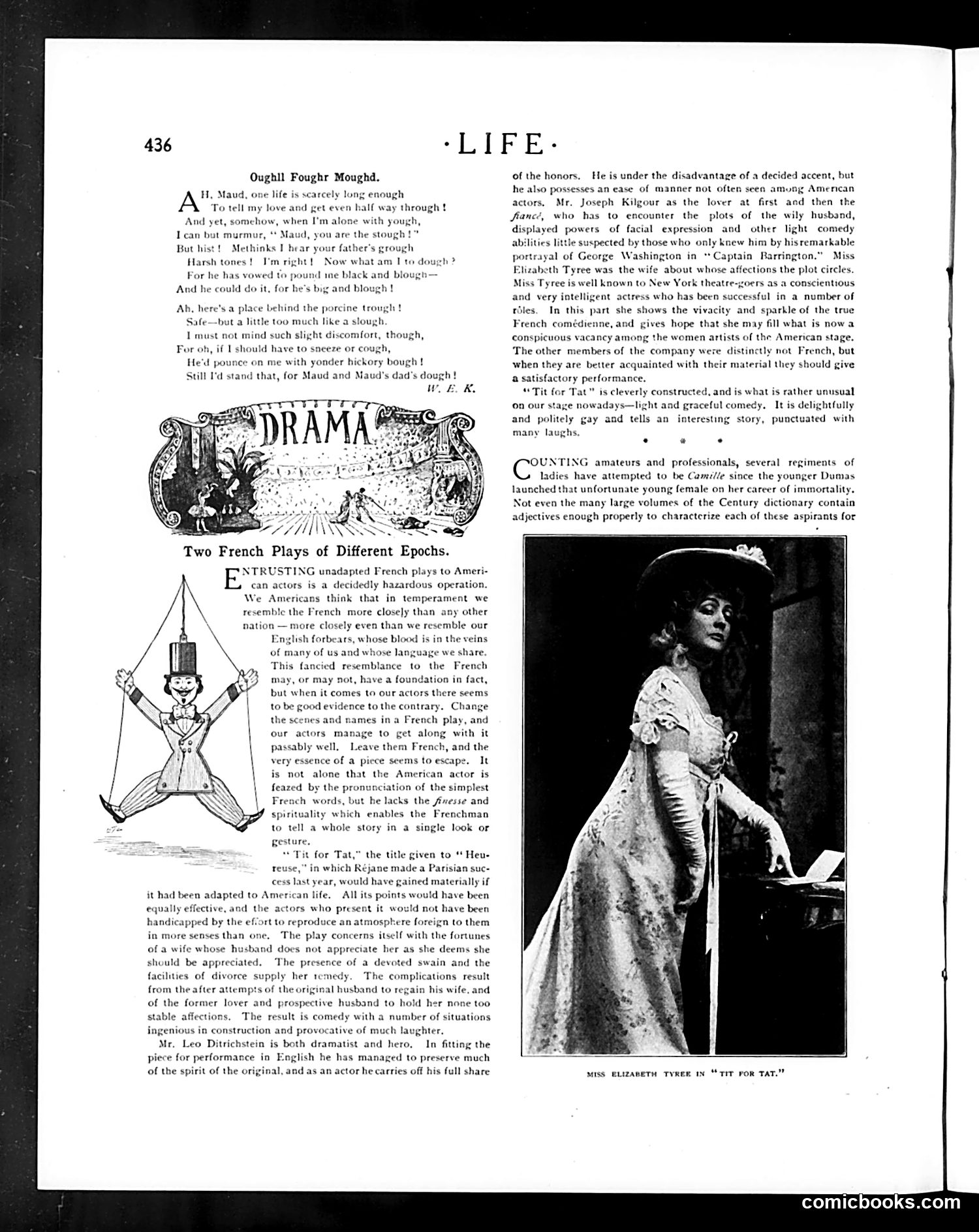
This *Life* magazine page contains two distinct pieces: **"Oughll Fought Moughd"** (top): A humorous poem satirizing overwrought Victorian romantic verse. The speaker attempts to confess love to "Maud" while hiding behind a pig trough, terrified of her father's violence. The joke lies in the exaggerated rhyme scheme (maughd/stough/brough/dough) and the absurd situation—true love compromised by physical cowardice and mercenary interest in "Maud's dad's dough" (money). It mocks both sentimental love poetry and the practical marriage calculations of the era. **"Two French Plays of Different Epochs"**: A theater review discussing Americans' difficulty performing unadapted French plays. The critic argues American actors lack the *finesse* and physical expressiveness of French performers, struggling with French pronunciation and atmosphere. The review discusses a production of "Tit for Tat" (adapted from a French play) starring actress Elizabeth Tyree and Leo Ditrichstein. The underlying point: American theater needs either culturally adapted scripts or actors capable of genuine Continental sophistication.
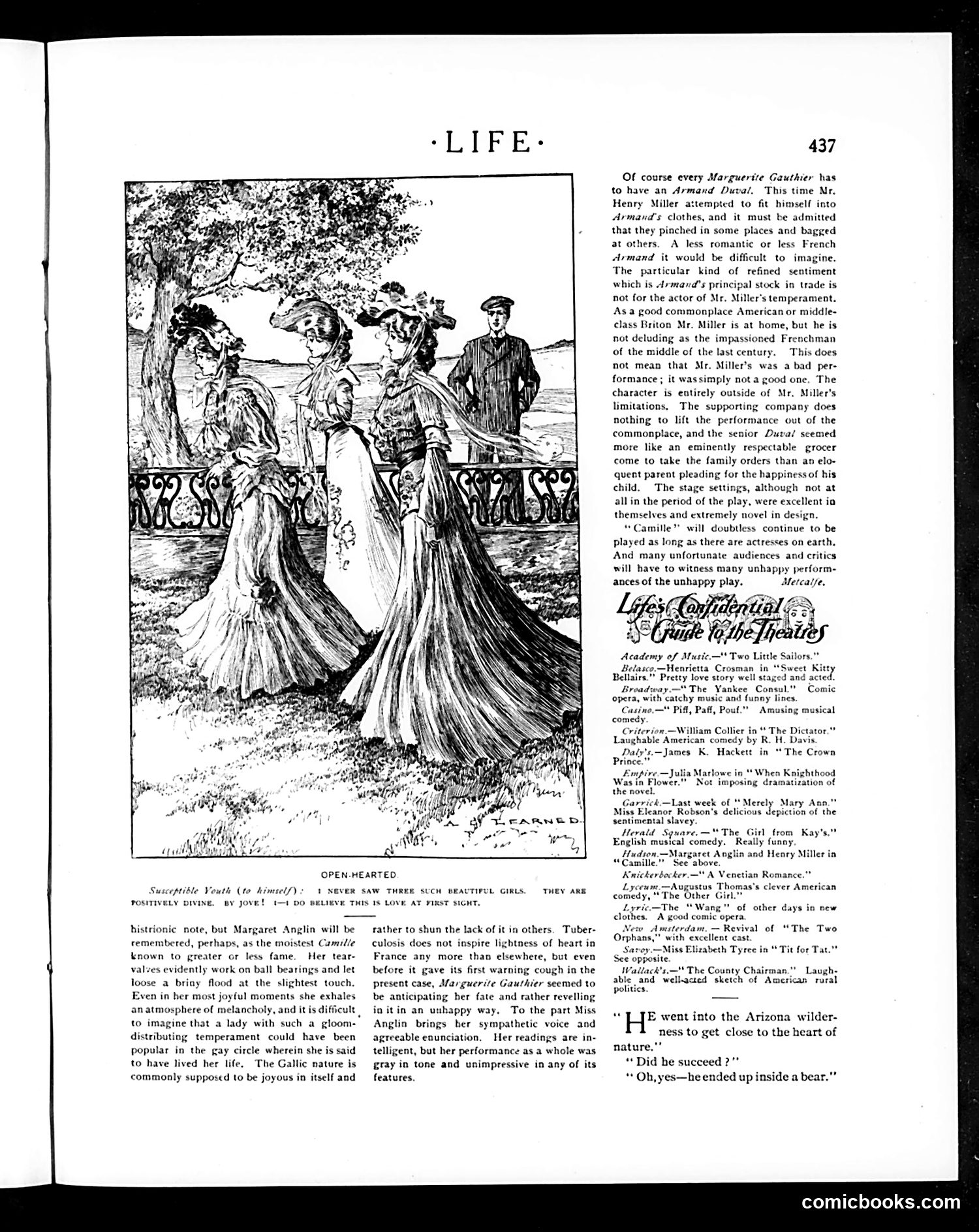
This page features a theatrical review and an accompanying cartoon titled "Open-Hearted." The cartoon depicts a young man observing three women in flowing Edwardian dresses near a tree and water, with his internal monologue expressing immediate romantic infatuation at "first sight." The satire targets **susceptible youth and romantic naiveté**—the joke is that the young man declares absolute love based purely on visual attraction, without any knowledge of the women's actual characters. The caption emphasizes this shallow basis for his emotion. The page's main text reviews Margaret Anglin's performance as Marguerite Gauthier in "Camille" (Alexandre Dumas's tragic romance), criticizing her excessive tearfulness and melancholy. This review context makes the cartoon's satire on surface-level romantic attraction particularly pointed—it mocks the very sentiment that drives the play's plot.
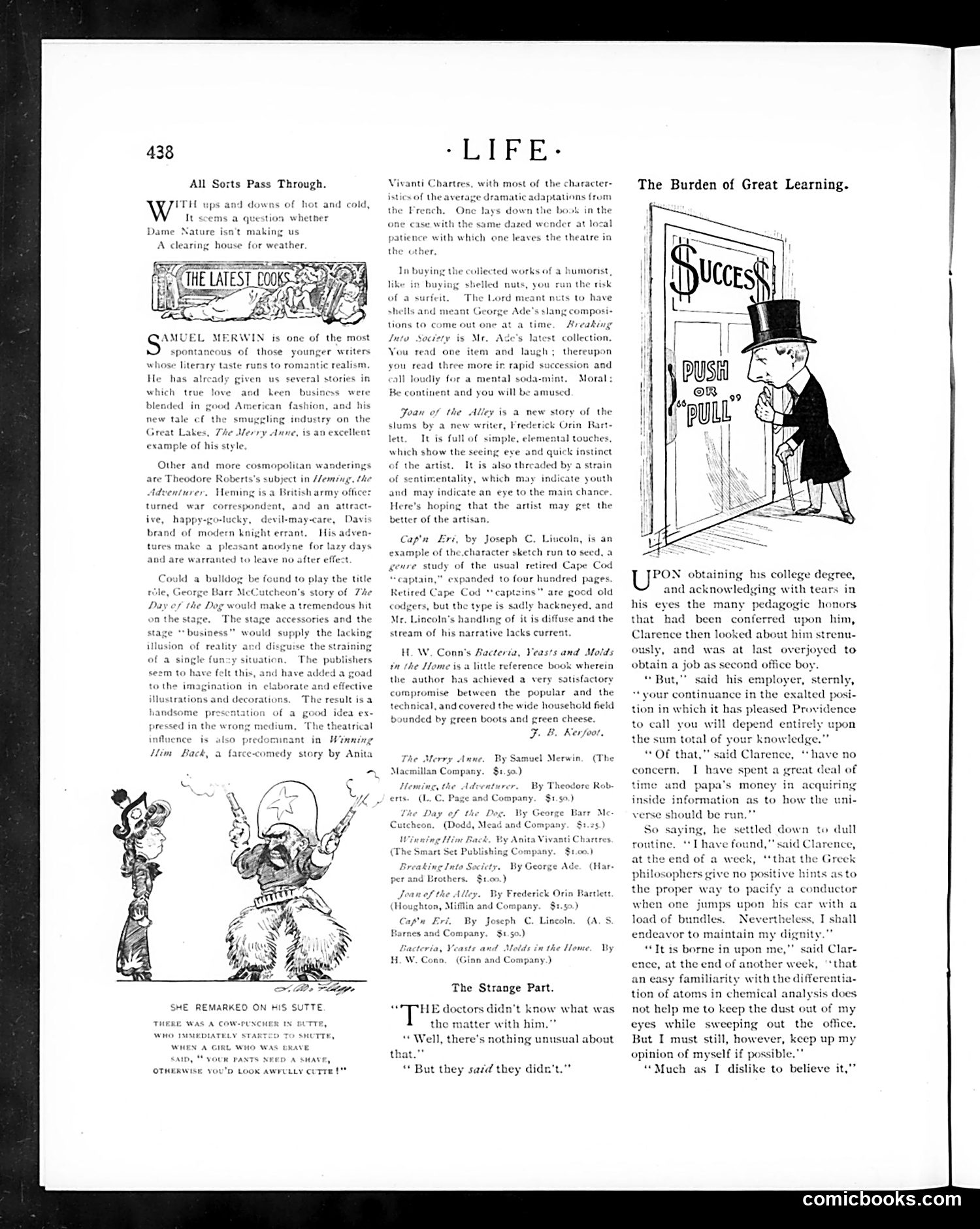
This page from Life magazine contains book reviews and satirical commentary typical of early 20th-century American literary journalism. **Main Content:** The page reviews recent novels by popular writers including Samuel Merwin, Theodore Roberts, and George Ade. Reviewers critique their romantic realism and humor, with particular commentary on Ade's "Breaking Into Society"—a collection of humorous sketches about social climbing. **Cartoons:** A small cartoon depicts a stammering cowpuncher attempting to court a brave girl, with the joke being that she finds his stutter endearing ("Otherwise you'd look awfully cute!"). The larger illustration titled "The Burden of Great Learning" shows a young man being pushed toward "Success" by a figure labeled "Push or Pull," satirizing the pressure on college graduates to immediately achieve financial success despite their lack of practical knowledge. **Satire:** The page mocks both literary pretension and American obsession with self-improvement and commercial success—typical Life magazine targets of the era.
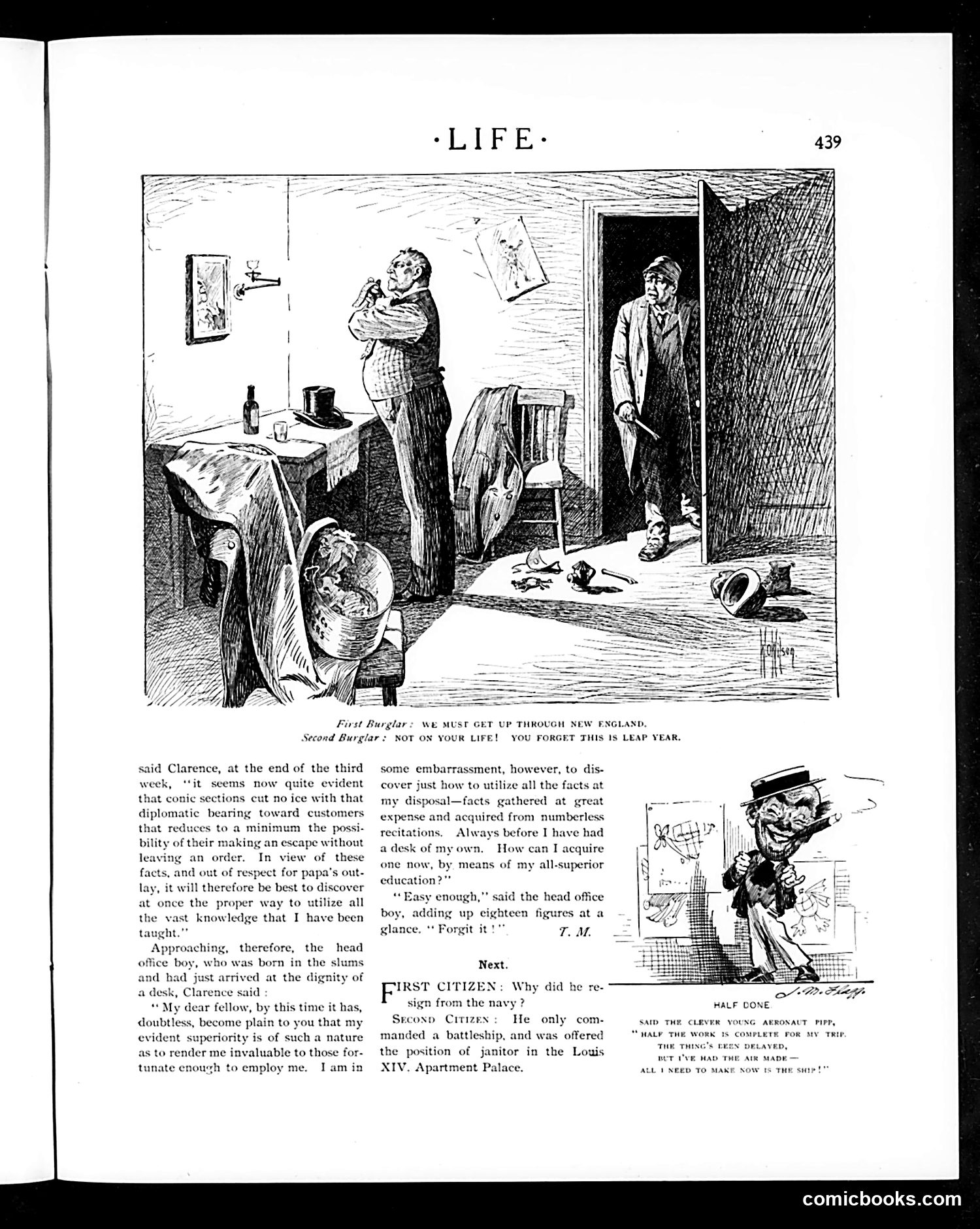
This page contains three separate satirical pieces mocking early 20th-century social pretension and incompetence. **Top cartoon**: A young man with superior education approaches an office boy seeking a desk position. Despite his "all-superior education" and "vast knowledge," the pragmatic office boy—born in the slums but street-smart—dismisses him with "Forgit it!" The satire mocks overeducated but impractical job applicants who lack common sense. **Middle joke**: A naval officer resigned from commanding a battleship to accept a janitor position at the Louis XIV Apartment Palace—a prestigious address. The humor lies in the absurd downward career move, likely satirizing social climbing and the hollow prestige of fancy addresses. **Bottom cartoon**: An aeronaut (balloon pilot) claims he only needs the "ship" (balloon envelope) to complete his aircraft, despite obvious incompleteness. This mocks incompetent inventors or overly confident but under-prepared entrepreneurs. All three target naïveté, misplaced confidence, and the gap between pretension and reality.
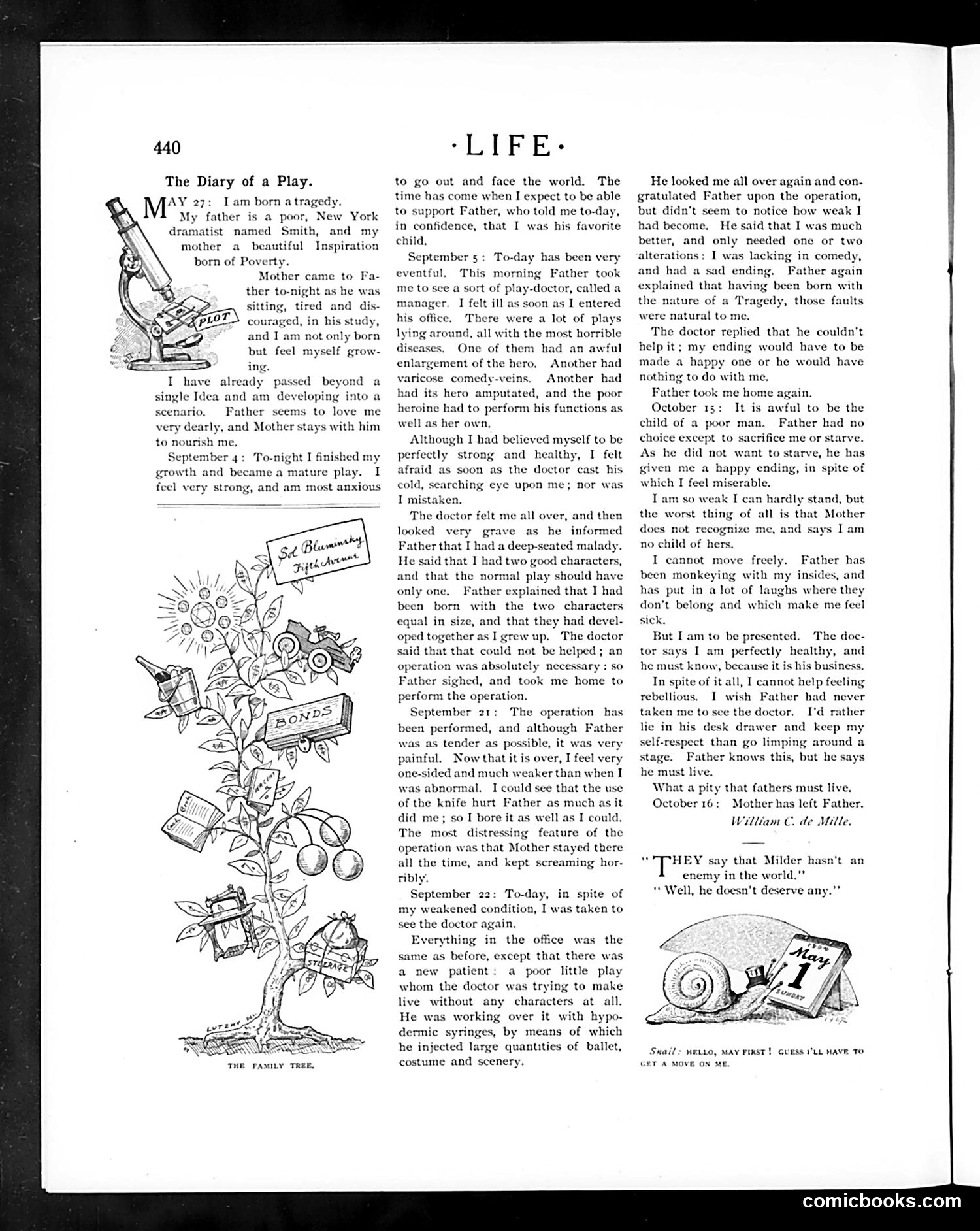
This page satirizes Broadway theatrical producers and the commercialization of playwriting. The narrative—told from a play's perspective—personifies a theatrical work as a child born to a poor playwright father and "Inspiration" mother. The satire targets a **play-doctor/manager** (theater producer) who diagnoses the script with various problems: two equal protagonists instead of one, insufficient comedy, and a sad ending. The producer demands alterations—particularly forcing a happy ending—regardless of the play's authentic nature as a tragedy. The critique is clear: commercial producers mutilate artistic works by imposing formulaic changes (added "ballet, costume and scenery") purely for market appeal, weakening the original vision. The mother's refusal to recognize her altered child symbolizes how the work becomes unrecognizable after such surgical rewrites. This reflects early 20th-century tensions between art and commerce in American theater, mocking producers' prioritization of profit and audience expectations over artistic integrity.
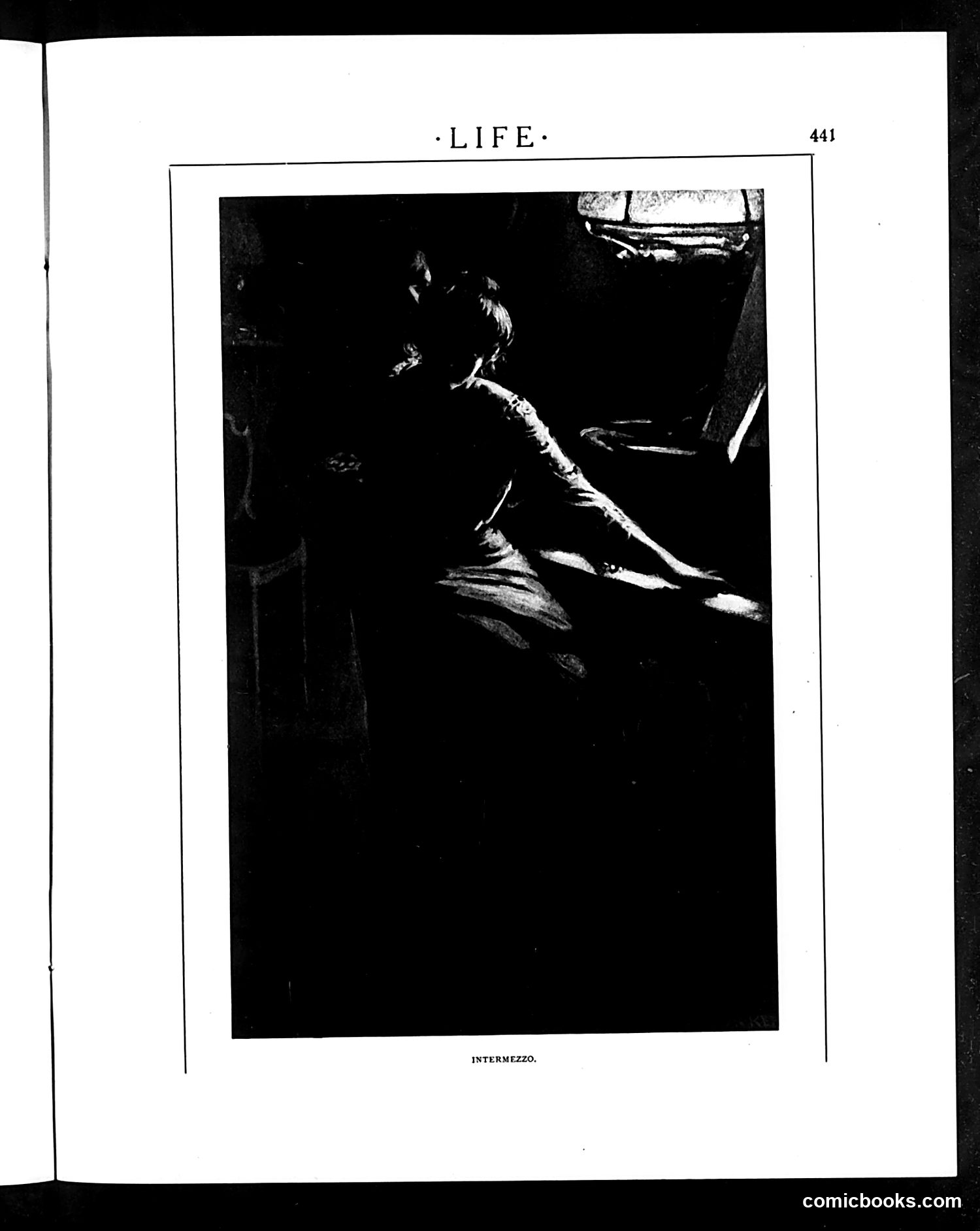
This page from *Life* magazine shows a dramatic black and white illustration titled "Intermezzo." The image depicts two figures in an intimate scene with strong contrasts of light and shadow, rendered in an expressionistic style. Without additional context from surrounding pages or a visible date, the specific reference is unclear. However, "Intermezzo" suggests this may reference a contemporary film, play, or social situation. The theatrical lighting and emotional intensity suggest satire of dramatic or romantic pretension—possibly mocking popular entertainment or a specific scandal of the era. The style and composition indicate this is likely social commentary rather than political satire, though the exact target remains uncertain without more information about the publication date and broader magazine content.
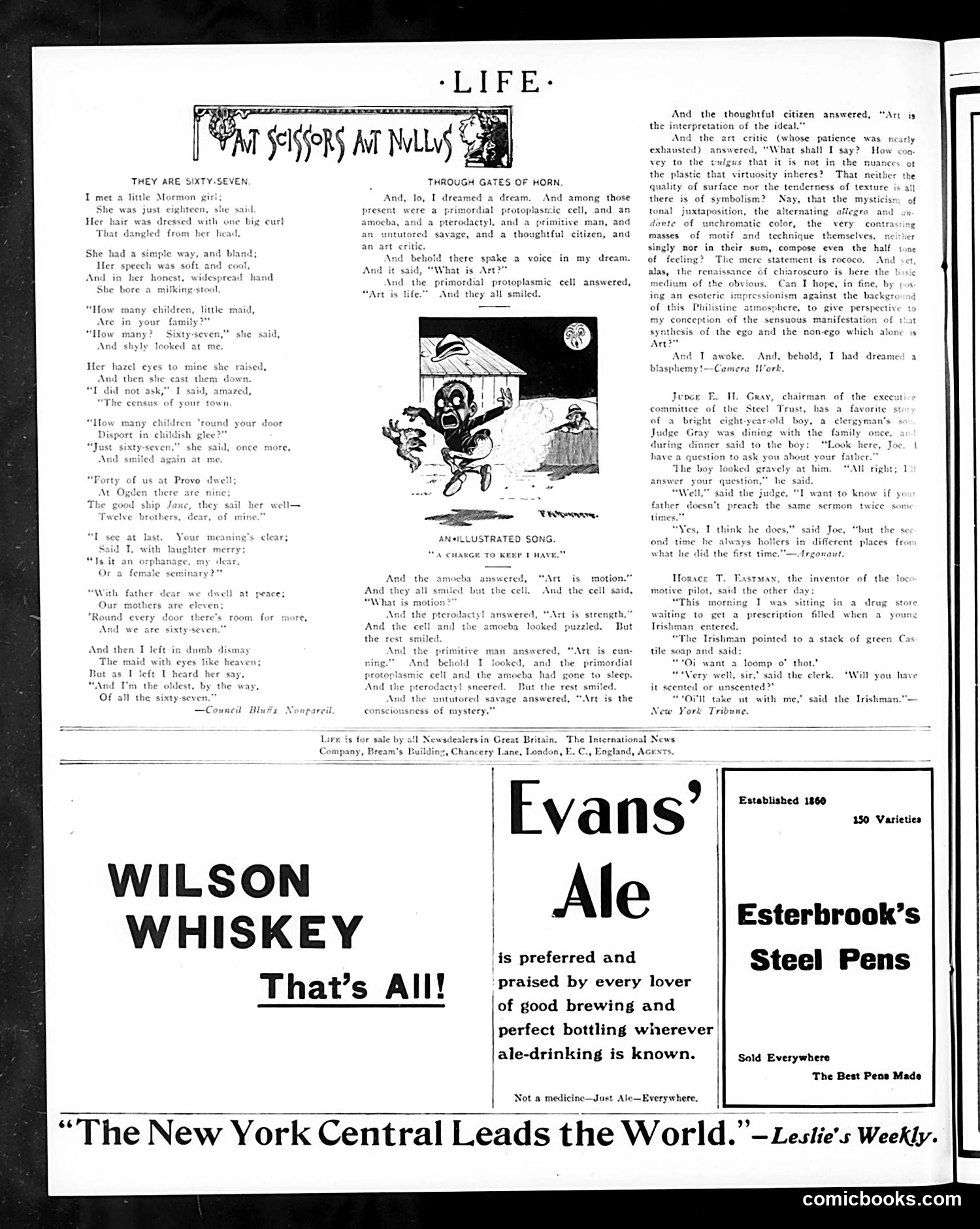
This page contains **two distinct pieces**: a serialized narrative poem titled "I'm Seniors at Nullus" (sixty-seven stanzas) and an "An Illustrated Song" section, alongside period advertisements. The main literary content appears to be **satirical verse about Mormon polygamy**—the opening stanza references meeting "a little Mormon girl" who was "just eighteen" with "one big curl," and subsequent verses mention "Forty of us at Provo dwell" and "Twelve brothers, all of mine." This reflects late-19th/early-20th century American satirical treatment of the LDS church's historical practice of polygamy, which was a common target of public ridicule and legislative action. The "An Illustrated Song" section contains philosophical wordplay between a "primitive man" and an "amoeba," debating whether "Art is life," "Art is motion," or "Art is strength"—likely mockery of contemporary artistic movements and pretentious aesthetic debates. The advertisements (Wilson Whiskey, Evans' Ale, Esterbrook's Steel Pens) are period products typical of *Life* magazine's commercial content.
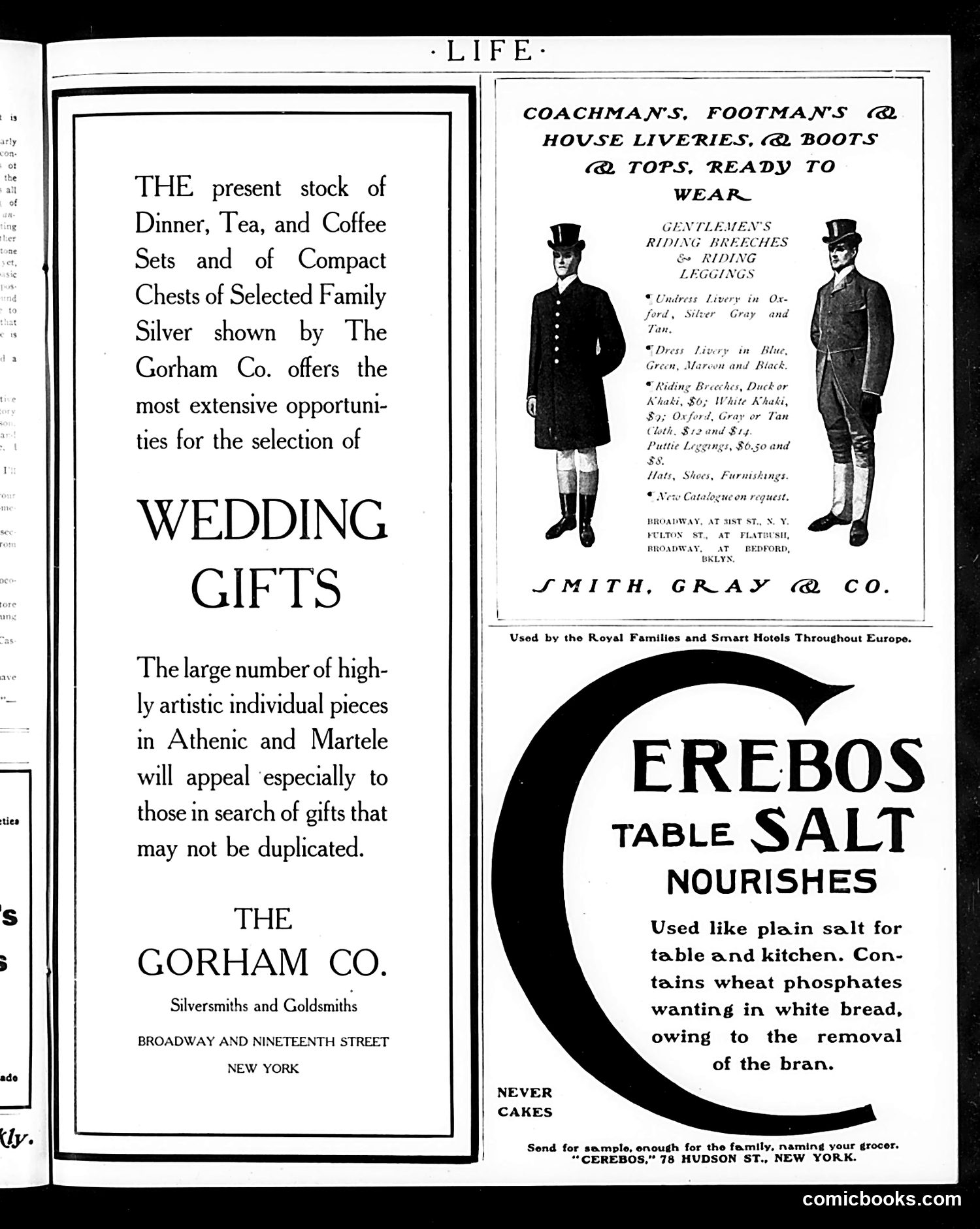
This page is primarily **advertising, not satire or cartoons**. It contains three separate commercial advertisements from what appears to be an early 20th-century issue of *Life* magazine: 1. **Gorham Co.** (left): Promotes silver dinnerware and serving pieces as wedding gifts, emphasizing uniqueness and artistic quality for the upscale market. 2. **Smith, Gray & Co.** (top right): Advertises ready-made formal clothing—coachman's and footman's liveries, riding clothes, and accessories. The two illustrated figures show gentlemen in formal riding attire. The tagline claims these are "Used by the Royal Families and Smart Hotels Throughout Europe," a common marketing tactic to suggest prestige. 3. **Erebos Table Salt** (bottom right): Promotes enriched salt containing wheat phosphates, positioning it as nutritionally superior to standard white bread salt—an early health-conscious marketing angle. No political commentary or satire is present; this is straightforward period advertising targeting wealthy consumers.
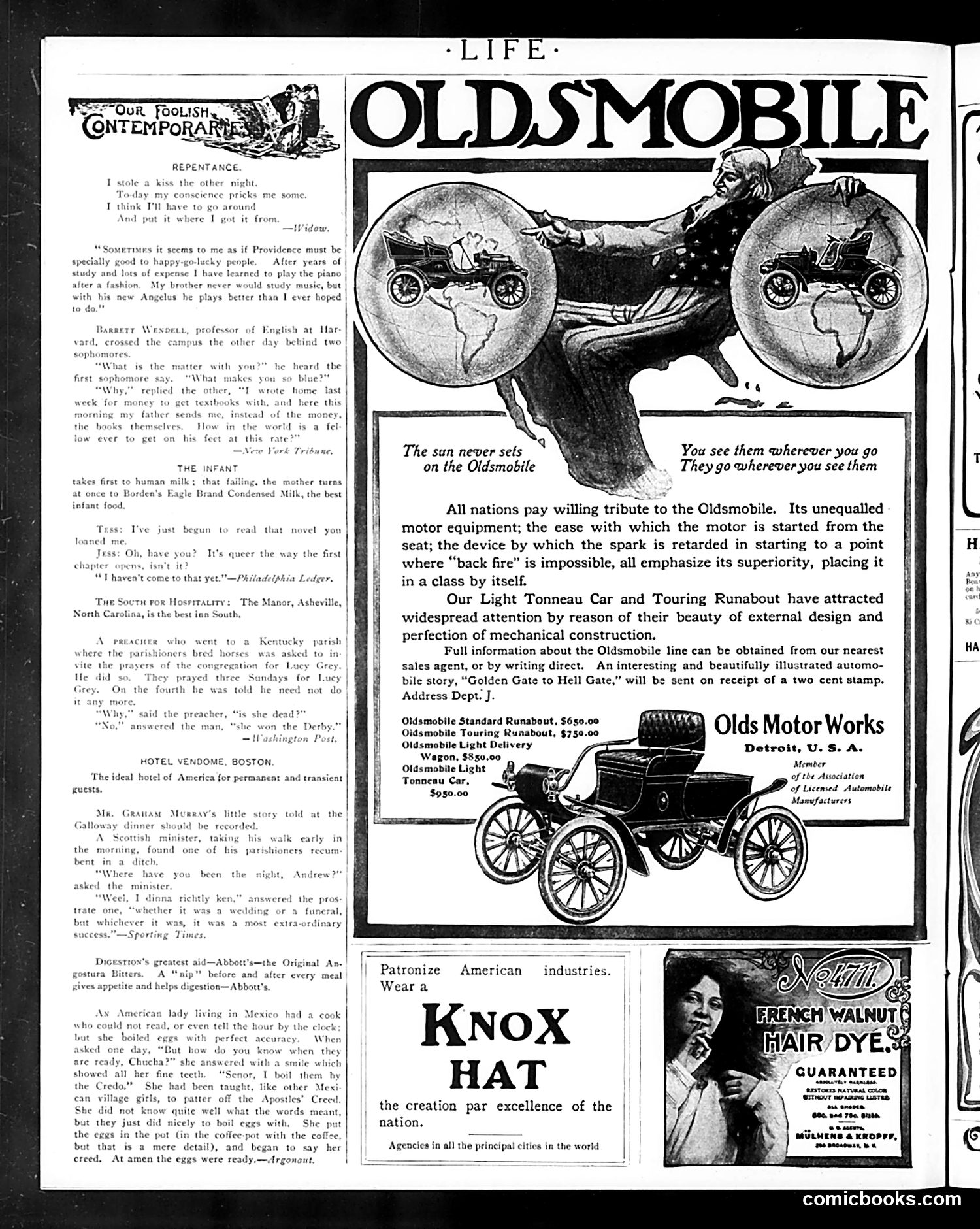
This is primarily an **advertisement page** for Oldsmobile automobiles, with the main cartoon being a playful globalization metaphor. The central illustration shows a giant figure holding two oversized globes, each depicting an Oldsmobile automobile. The caption reads: "The sun never sets on the Oldsmobile" and "You see them wherever you go / They go wherever you see them." This references the famous British imperial phrase about the sun never setting on the British Empire, humorously applying it to American automobile commerce. The joke asserts Oldsmobile's global dominance and ubiquity—by the early 1900s, they claim their cars are literally everywhere internationally. The surrounding text boasts of the car's superior engineering, ease of starting, and mechanical perfection. Supporting the advertisement are several brief humorous anecdotes and jokes about contemporary life (marital mishaps, cooking mishaps), plus ads for Knox Hats and French Walnut Hair Dye—typical Life magazine content from this era mixing editorial humor with commercial messaging.
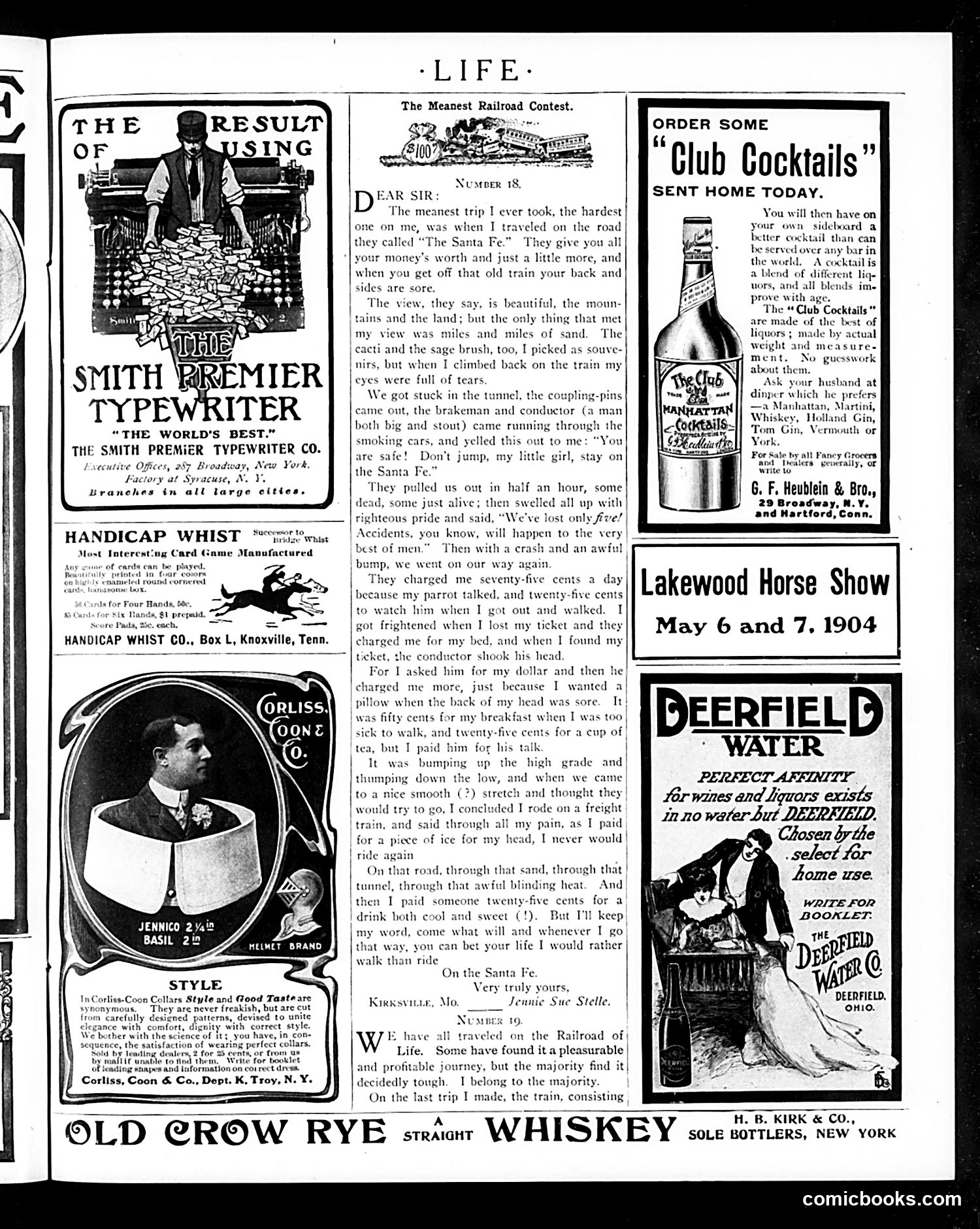
This page contains reader letters describing miserable railroad experiences, presented as "The Meanest Railroad Contest." The letters use exaggerated complaints—stuck tunnels, overcharges for minor services, a talking parrot causing fees—to satirize both railroad companies' nickel-and-diming practices and passengers' tendency to complain. The humor relies on readers recognizing the **Santa Fe Railroad** as a contemporary target. Early 1900s railroads were notorious for poor service, unexpected charges, and passenger mistreatment—common grievances that Life magazine frequently mocked. The surrounding advertisements (typewriters, whiskey, cocktails, horse shows) are period marketing unrelated to the satire. The contest format itself—inviting readers to submit their worst train stories—suggests this was a popular complaint genre, making the exaggeration relatable to an audience with shared frustrations about rail travel.
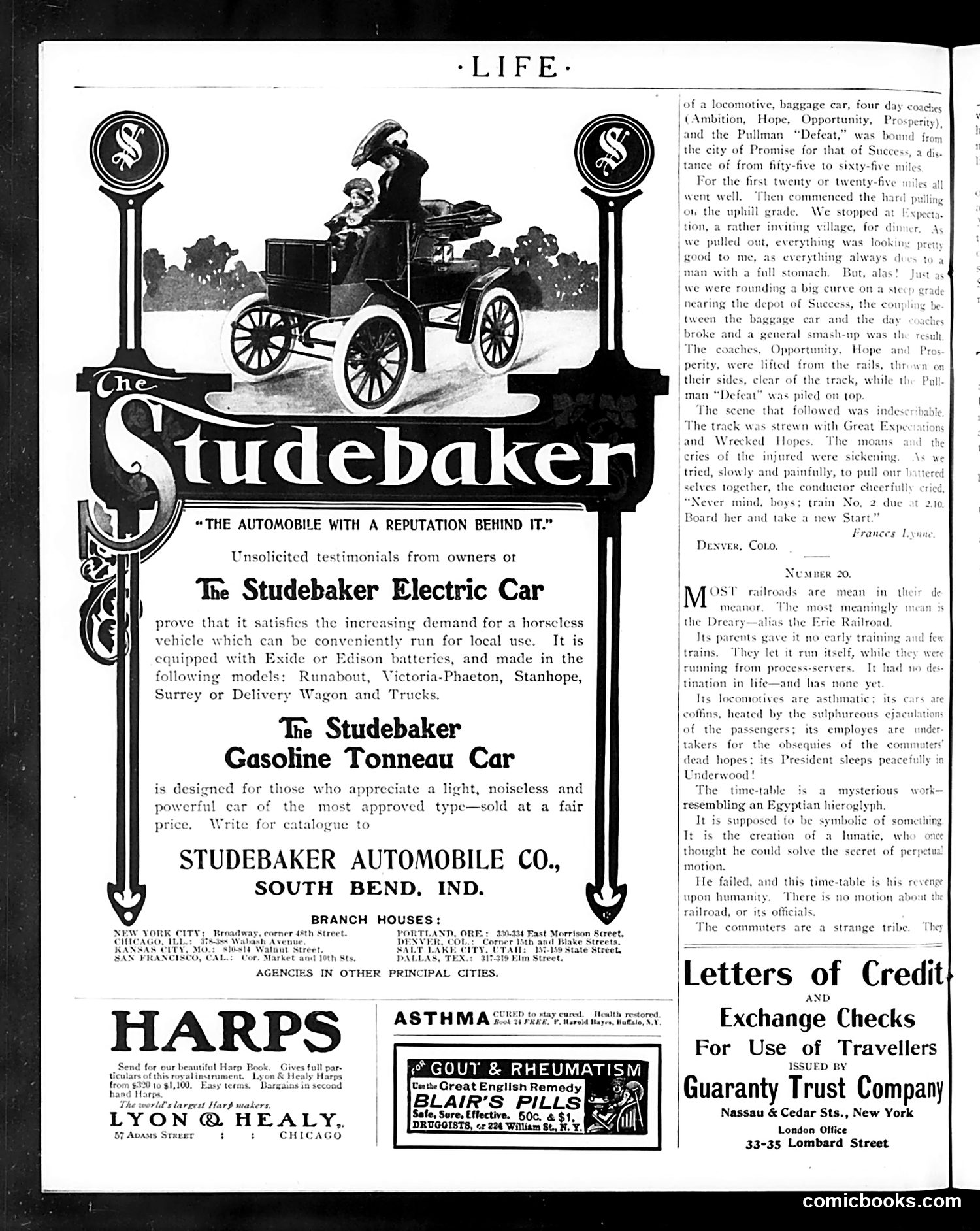
This page is primarily **advertising**, not political satire. The dominant feature is a large Studebaker automobile advertisement promoting both their electric and gasoline-powered cars—vehicles positioned as modern solutions for local transportation. The ad emphasizes the Studebaker's reputation and reliability. The right column contains a **satirical letter** about railroad mistreatment of passengers. The unnamed writer uses allegorical language, describing a train journey where coaches named "Ambition," "Hope," and "Prosperity" crash, with "Defeat" piled on top. The satire mocks railroad companies (specifically referencing the Erie Railroad) for their poor service, incompetent management, and indifference to passenger welfare. The time-table is called "mysterious" and "Egyptian," suggesting deliberate obfuscation. This reflects early 20th-century frustrations with railroad monopolies and their notorious customer service problems—a context where automobiles like Studebaker's represented liberating alternatives to rail travel's unreliability and corporate negligence.
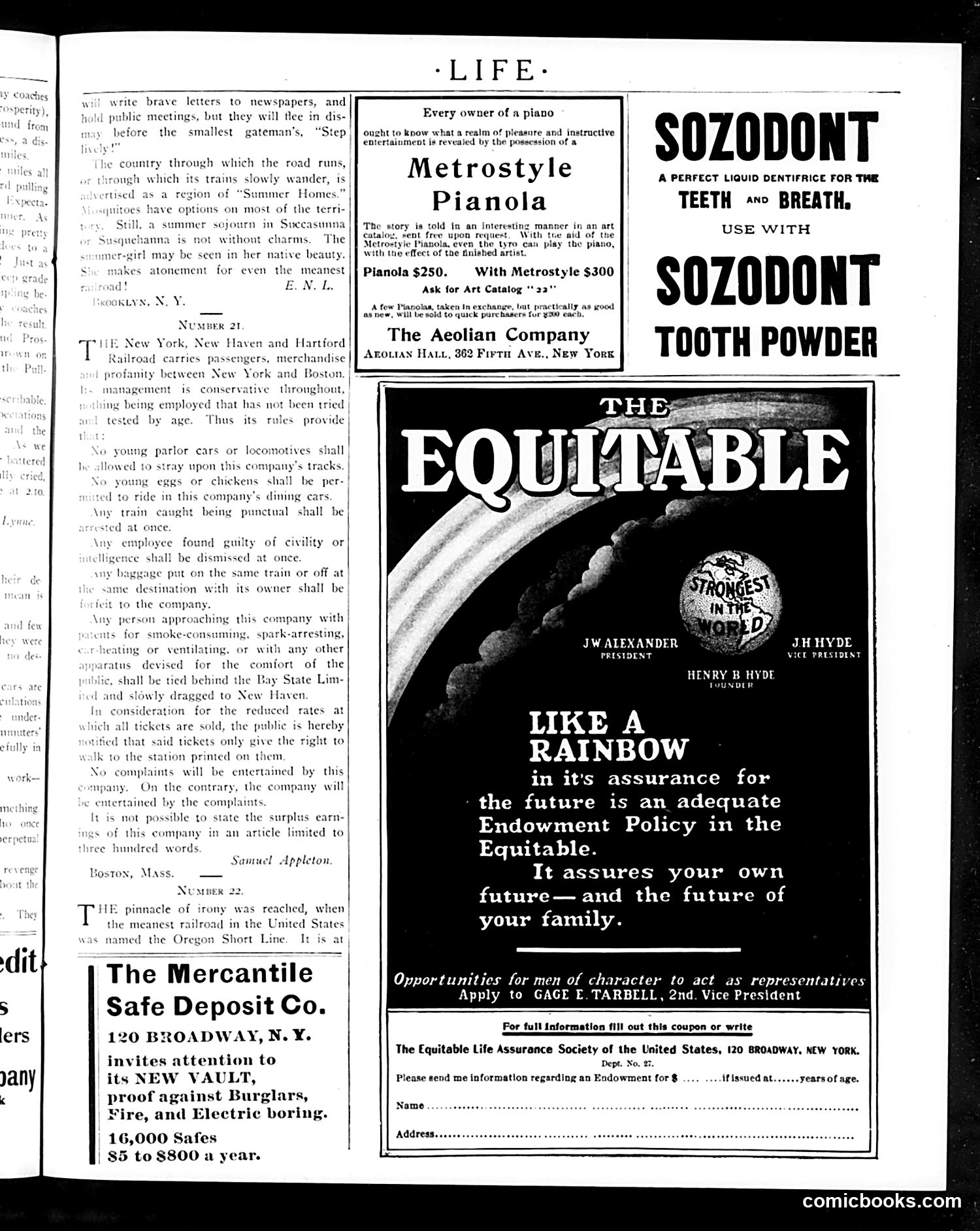
This page is primarily **advertising**, not political satire. It contains several product and financial service advertisements typical of early 20th-century American magazines. The main advertisements include: - **Sozodont** (dental products): a toothpaste and powder marketed as a "perfect liquid dentifrice" - **Metrostyle Pianola**: a player piano system allowing non-musicians to perform - **The Mercantile Safe Deposit Co.**: vault storage for valuables - **The Equitable Life Assurance Society**: life insurance/endowment policies, featuring a "rainbow" metaphor promising financial security for families The only editorial content visible is a brief column by Samuel Appleton (Number 22) mocking railroad company management rules—describing absurdly strict regulations about dining cars, employee conduct, and complaint procedures as representative of the "meanest railroad in the United States." The page reflects **turn-of-the-century consumer culture**: aimed at middle-class readers concerned with genteel entertainment (pianos), financial security, and personal hygiene. The railroad critique suggests contemporary anxieties about corporate rigidity and poor service.
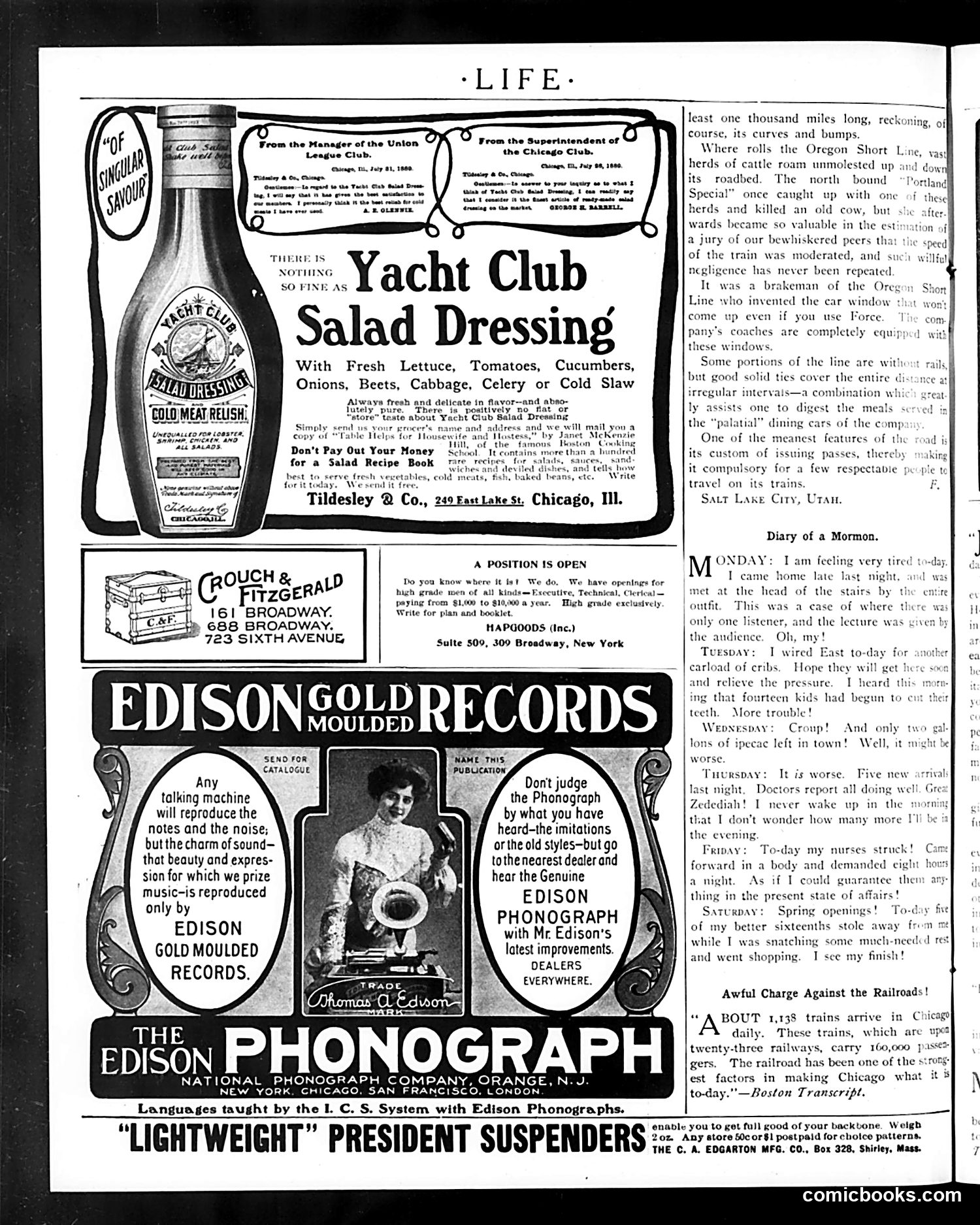
This page contains **primarily advertisements** rather than political cartoons. The main content includes: 1. **Yacht Club Salad Dressing ad** - a standard product advertisement with testimonial quotes from club managers 2. **Edison Gold Moulded Records ad** - promoting phonograph records with messaging about sound quality versus cheaper imitations 3. **"Diary of a Mormon"** - a satirical column mocking Mormon family life, presenting exaggerated domestic chaos (fourteen children losing teeth simultaneously, croup epidemics, constant crying). The humor relies on anti-Mormon stereotypes common in early 20th-century American periodicals, depicting polygamous families as comically overwhelmed 4. **"Awful Charge Against the Railroads"** - a brief item about Chicago's train congestion The page reflects **period advertising conventions** and **contemporary anti-Mormon sentiment** rather than containing coherent political cartooning. The satire targets religious groups and promotes consumer products typical of this era's Life magazine format.
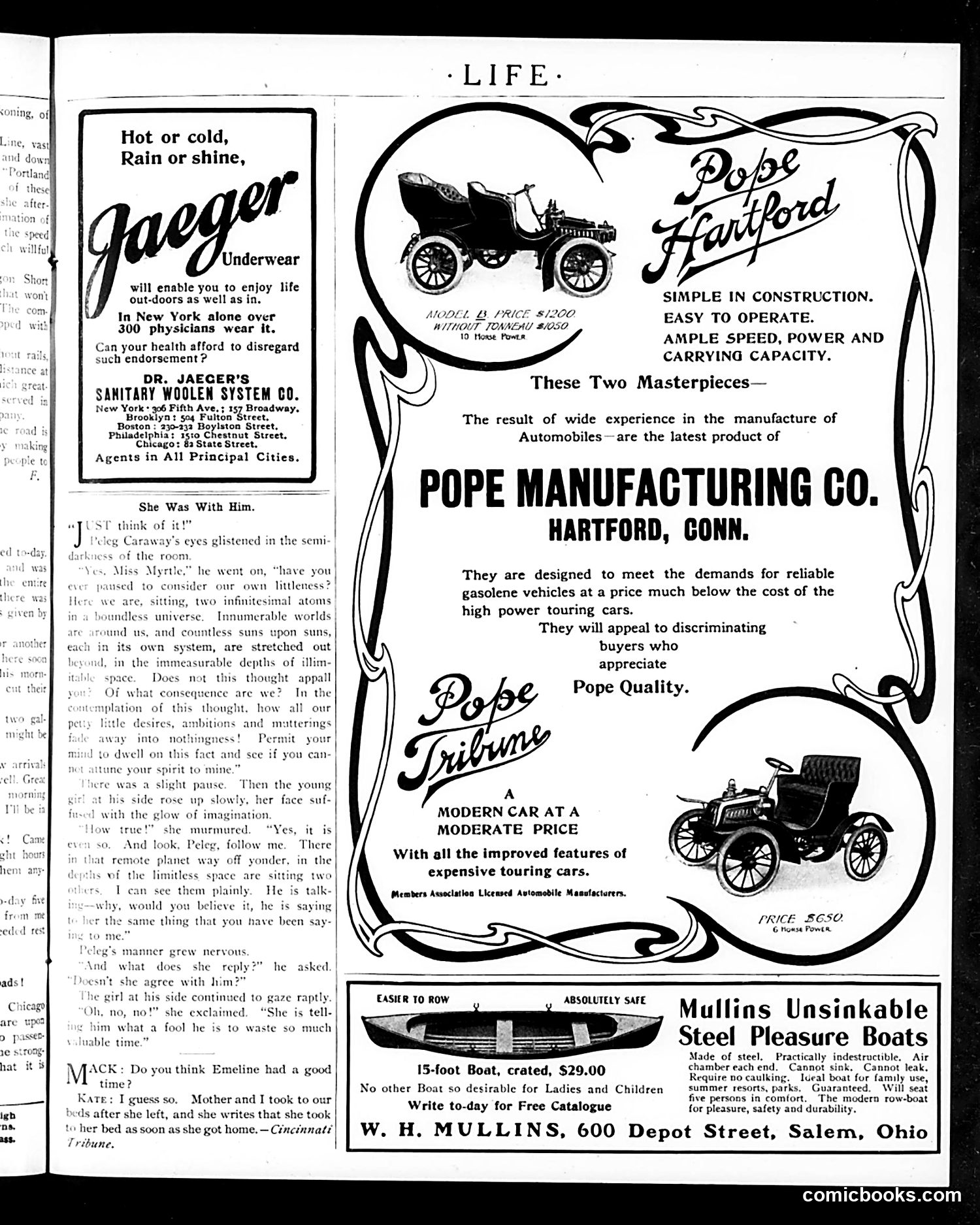
This page is **primarily advertisements** with a brief satirical story. The main content is a comic anecdote titled "She Was With Him," which satirizes romantic pretension. A man delivers grandiose philosophical musing to his female companion—waxing poetic about humanity's insignificance in an infinite universe. The joke: when asked what the woman thinks, she dismissively replies he's a fool wasting her time with such nonsense. The humor targets male self-importance and the gap between elaborate romantic gesturing and practical female skepticism. The advertisements showcase early 1900s consumer goods: Dr. Jaeger's thermal underwear (emphasizing physician endorsement as credibility), Pope Manufacturing Company automobiles (marketed as affordable, reliable alternatives to expensive touring cars), and Mullins Steel Pleasure Boats (marketed for family safety). These ads reflect emerging consumer culture and the marketing strategy of appealing to discriminating buyers through pseudo-scientific or safety claims.
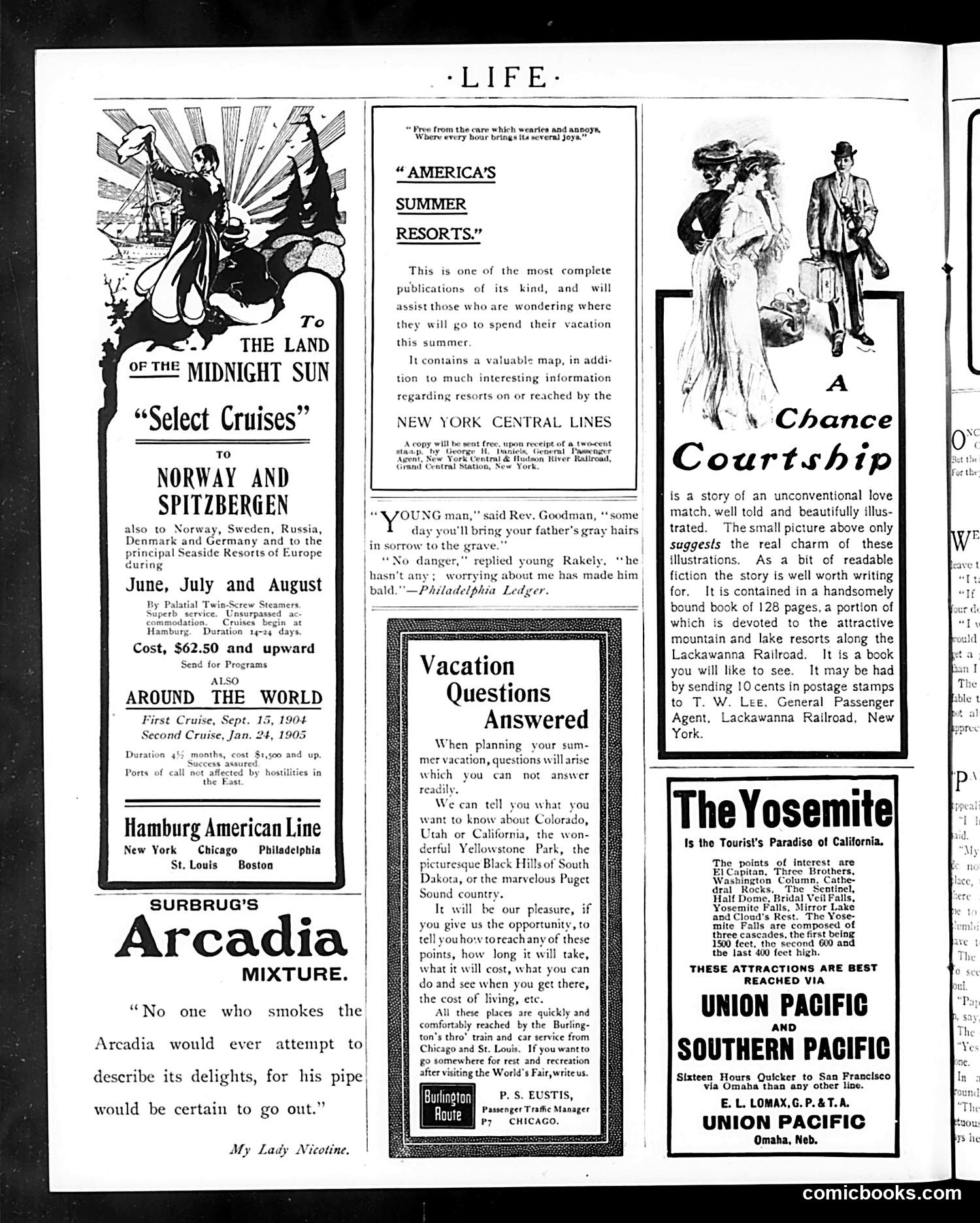
This page is primarily **advertising**, not satire or political commentary. It contains travel advertisements from the early 1900s promoting summer vacations and cruise lines. The main content includes: - **Hamburg American Line cruises** to Norway, Spitzbergen, and around the world (costs $62.50 and up) - **New York Central Lines** promoting American summer resorts - **Burlington Route** advertising western destinations (Yellowstone, Black Hills, Colorado) - **Union Pacific and Southern Pacific Railways** promoting Yosemite - A tobacco ad for "Arcadia Mixture" pipe tobacco - A promotional story called "A Chance Courtship" tied to Lackawanna Railroad resorts The only satirical element is the tobacco ad's joke: smoking Arcadia is so pleasurable that trying to describe it would make your pipe go out from neglect—a mild, product-focused humor typical of period advertising rather than social commentary. The page reflects early-20th-century leisure culture and the railroad industry's role in promoting American tourism.
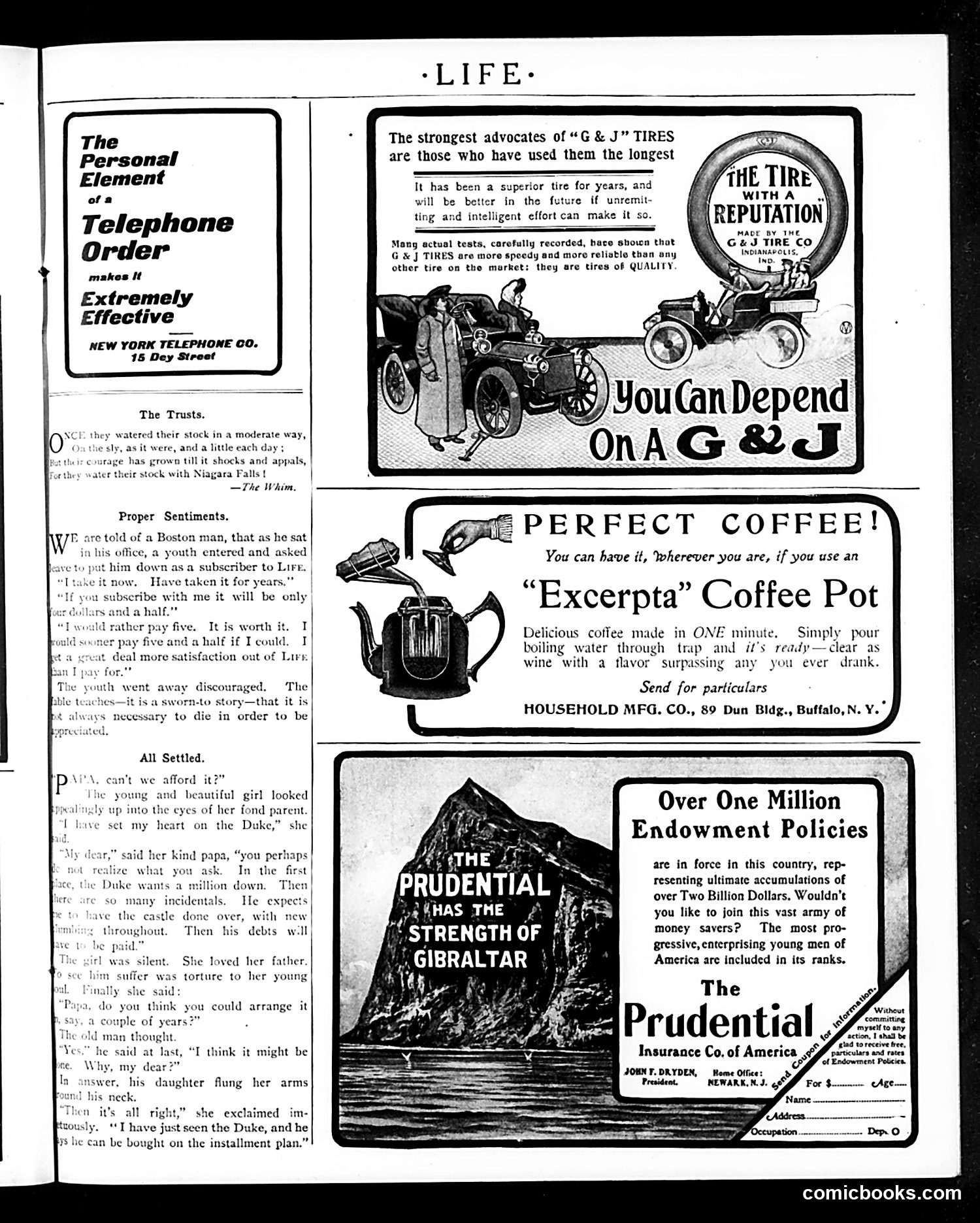
This page is **primarily advertising** with minimal editorial content. The ads reflect early 20th-century consumer products and services. The small editorial pieces include: **"The Trusts"** — A verse satirizing monopolies that inflate stock value unsustainably, comparing their bloated growth to Niagara Falls. **"All Settled"** — A romantic comedy sketch where a young woman persuades her wealthy father to arrange her marriage to a Duke by claiming the Duke can be "bought on the installment plan"—mocking both aristocratic pretension and the commodification of marriage among the wealthy. The **advertisements** showcase period concerns: G&J Tires (emphasizing durability and quality), the Excerpta Coffee Pot (promising convenience and speed), the New York Telephone Company (promoting telephone ordering efficiency), and The Prudential Insurance Company (targeting young men as savers and breadwinners). These ads collectively reflect early 1900s anxieties about modernization, consumption, financial security, and social aspiration among middle and upper-class readers.
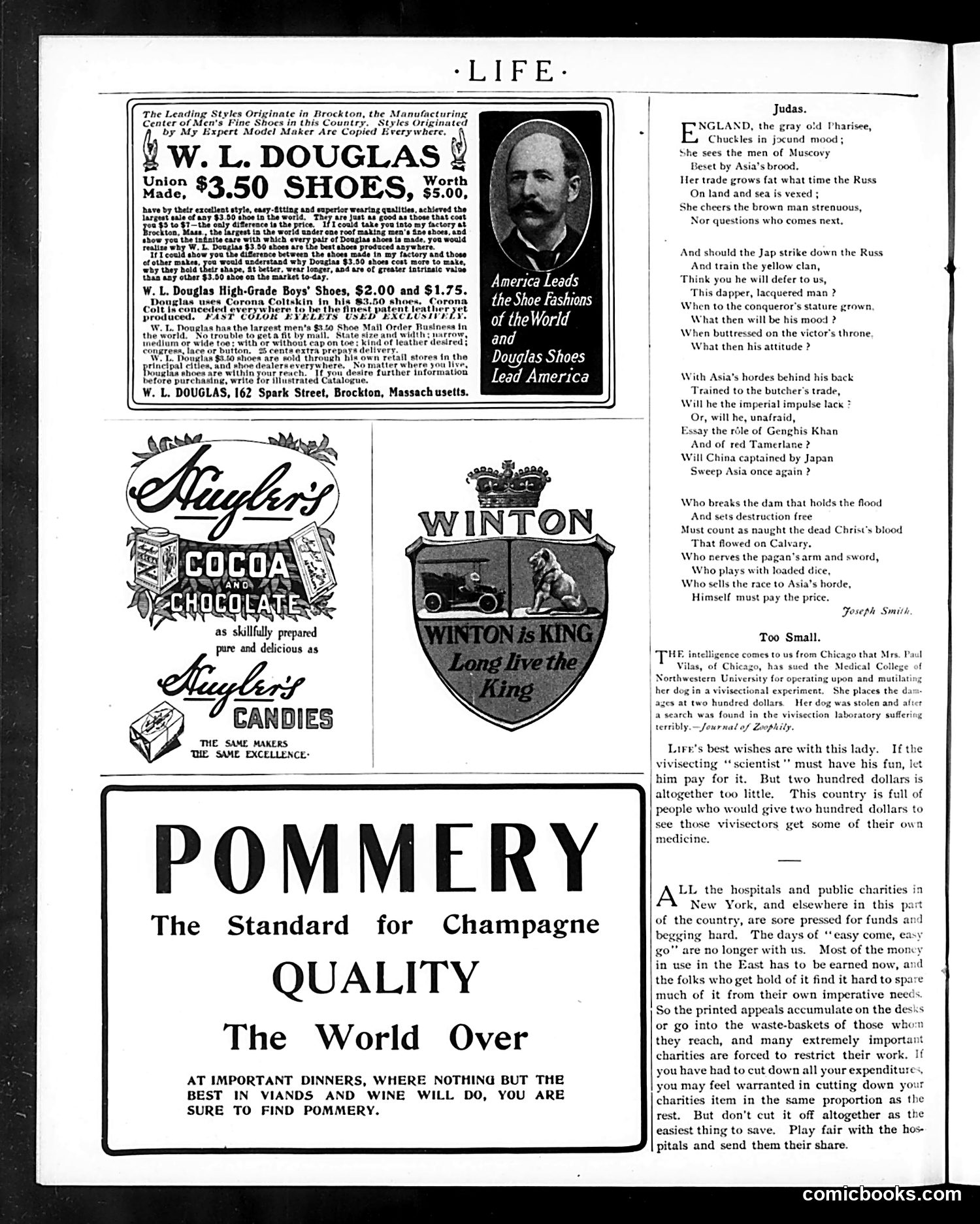
This page is primarily **advertising** with some editorial content. The main satirical piece is a poem titled "Judas" by Joseph Smith, occupying the right column. **The "Judas" Poem:** The poem critiques Britain's geopolitical strategy during what appears to be the Russo-Japanese War era (early 1900s). It accuses England of cynically encouraging Japan against Russia to benefit British trade, without considering the consequences. The satire warns that Britain's shortsighted policy—playing nations against each other—will backfire: a strengthened Japan might become the next imperial aggressor, potentially uniting Asia under its control (evoking Genghis Khan and Tamerlane as historical parallels). The poem's title suggests Britain is "Judas," betraying larger Christian civilization for profit. **Other Content:** Below the poem are two brief editorial notes: one defending a woman suing Northwestern University for vivisecting her dog, and another urging charitable donations despite economic hardship. The page is otherwise dominated by period advertisements for W.L. Douglas shoes, Stuyler's cocoa and candies, Winton automobiles, and Pommery champagne.
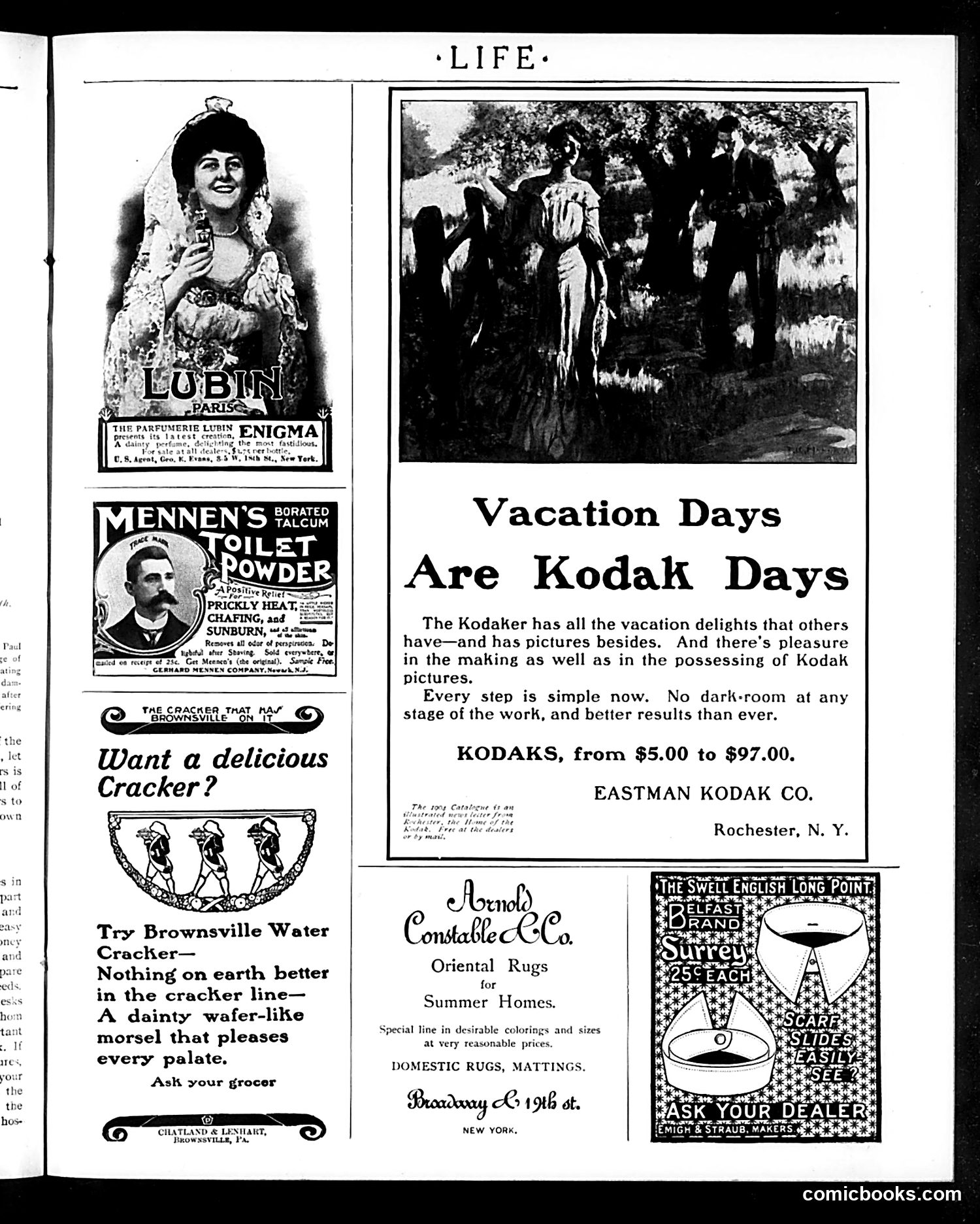
This page is **primarily advertising**, not political satire. It contains roughly six commercial advertisements from the early 20th century targeting middle- and upper-class consumers: - **Lubin Perfume** (Paris) and **Mennen's Toilet Powder** (personal grooming) - **Brownsville Water Cracker** (food) - **Kodak cameras** (the largest ad, emphasizing vacation photography as leisurely activity) - **Arnold Constable Oriental Rugs** (home furnishings) - **Belfast Linen Scarf Slides** (accessories) The **Kodak advertisement** is notable for its social messaging: it frames photography as an aspirational vacation activity and suggests that owning a Kodak (expensive at $5-$97) is essential to properly enjoying leisure time. The accompanying photograph shows well-dressed people in a garden setting. There is **no identifiable political cartoon or satire** on this page—it's a straightforward commercial layout reflecting consumer culture and advertising practices of the era.
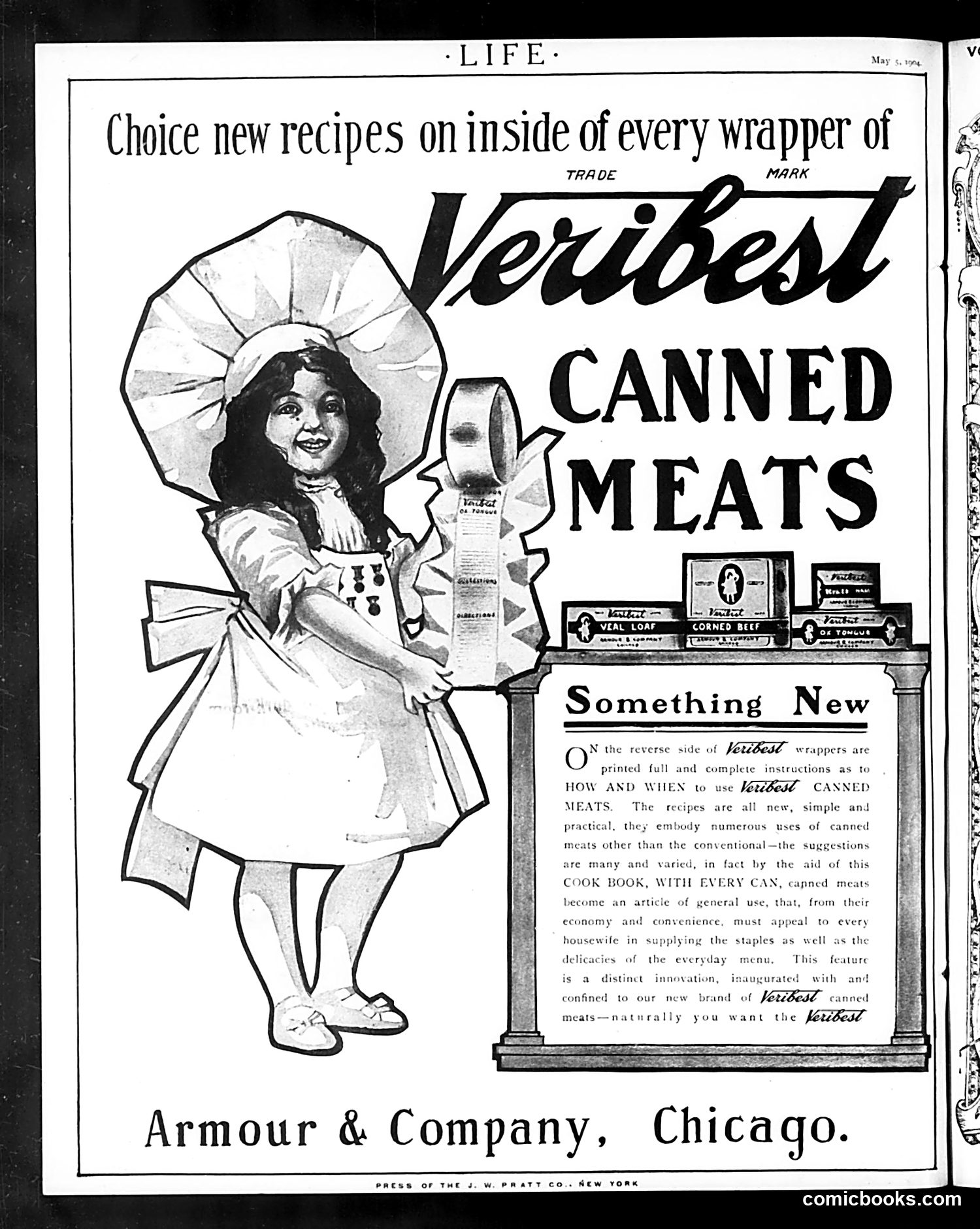
This is a full-page advertisement for Veribest canned meats by Armour & Company of Chicago, appearing in *Life* magazine (dated May 31, 1924). The page features an illustration of a young girl in a bonnet holding a can of Veribest product, positioned next to displayed cans of veal loaf and corned beef. The "Something New" text box promotes the product's innovation: recipe instructions printed on wrapper reverses, positioning canned meats as versatile pantry staples rather than mere convenience foods. There is no political satire or social commentary here. This is straightforward early-20th-century consumer advertising, emphasizing domestic efficiency and cooking practicality for housewives. The charming illustration and emphasis on "new" recipes reflect 1920s marketing appeals to modern homemakers. The page demonstrates how *Life* magazine—primarily known for satirical content—also accepted advertising revenue from major food manufacturers.