
Life, 1904-05-05 · page 22 of 40
Life — May 5, 1904 — page 22: what you’re looking at
What you’re looking at
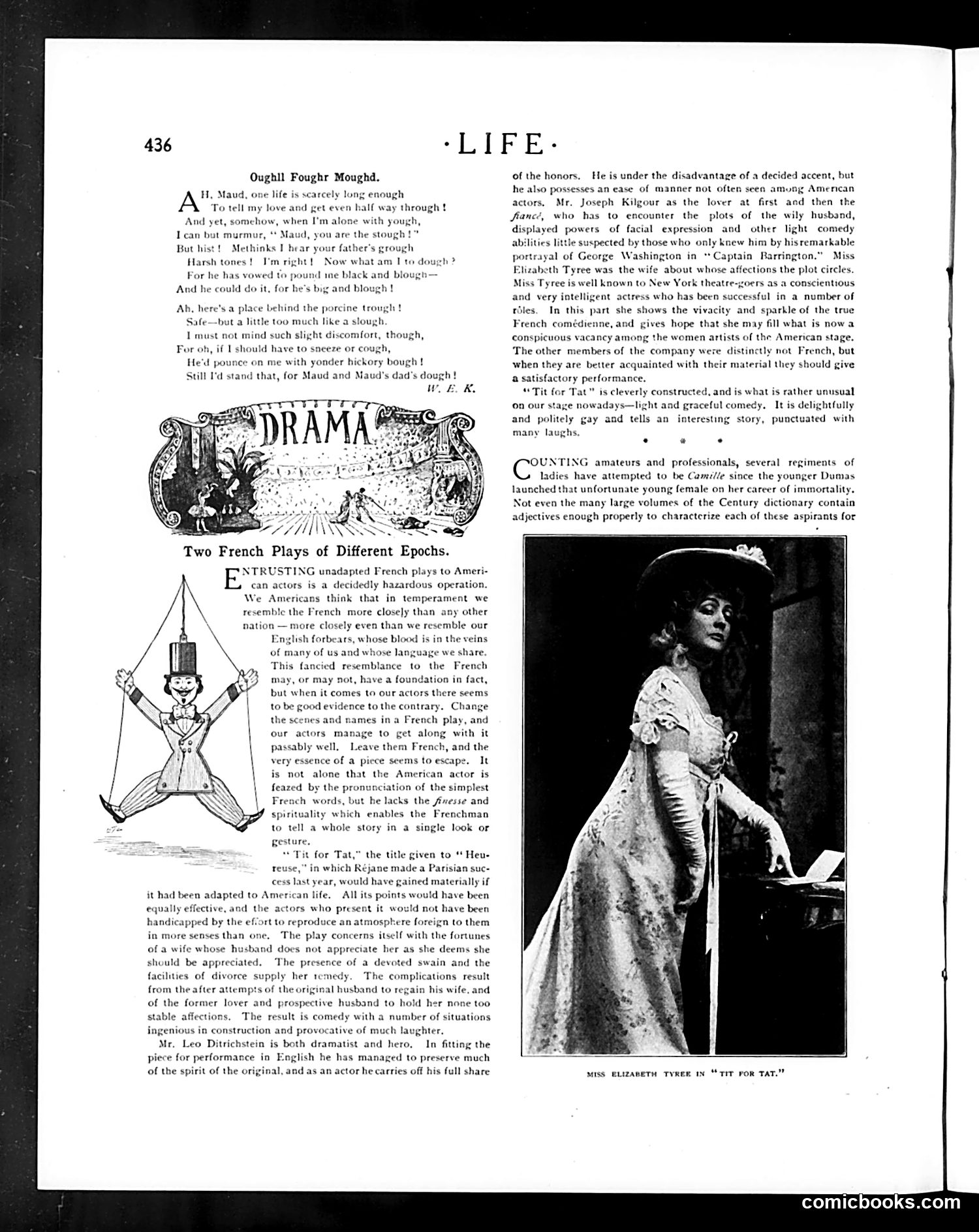
This *Life* magazine page contains two distinct pieces: **"Oughll Fought Moughd"** (top): A humorous poem satirizing overwrought Victorian romantic verse. The speaker attempts to confess love to "Maud" while hiding behind a pig trough, terrified of her father's violence. The joke lies in the exaggerated rhyme scheme (maughd/stough/brough/dough) and the absurd situation—true love compromised by physical cowardice and mercenary interest in "Maud's dad's dough" (money). It mocks both sentimental love poetry and the practical marriage calculations of the era. **"Two French Plays of Different Epochs"**: A theater review discussing Americans' difficulty performing unadapted French plays. The critic argues American actors lack the *finesse* and physical expressiveness of French performers, struggling with French pronunciation and atmosphere. The review discusses a production of "Tit for Tat" (adapted from a French play) starring actress Elizabeth Tyree and Leo Ditrichstein. The underlying point: American theater needs either culturally adapted scripts or actors capable of genuine Continental sophistication.
📄 Transcribed text from this page (OCR, searchable)
Machine-transcribed from the original scan — historical spelling and the odd misread are preserved.
436 Oughll Foughr Moughd. H, Maud, one life is scarcely long enough A To tell my love and get even half way through t And yet, somehow, when I'm alone with yough, Tcan but myer But hist ! Harsh tones , Maud, you are the stough !” Methinks I hear your father’s grou ! Now what am I tod I'm rig For he has vowed to pou And fh me black and blough— could do it, for he’s big and blough ! Ab, here's a place behind the porcine trough ! Safe—but a little too much like I must not mind such slight For oh, if 1 should have to snee: slough. comfort, though, Dr cough, He'd pounce on me with yonder hickory bough ! Still I'd stand that, for Maud and Maud’s dad's dough ! Two French Plays of Different Epochs. NTRUSTING unadapted French plays to Ameri- E can actors is a decidedly hazardous operation. We Americans think that in temperament we resemble the French more closely than any other nation — more closely even than we resemble our English forbears, whose blood is in the veins of many of us and whose language we share. This fancied resemblance to the French may, or may not, have a foundation in fact, but when it comes to our actors there seems to be good evidence to the contrary. Char the scenes and names in a French play, and our actors manage to get along with it passably well. Leave them French, and the very essence of a piece seems to escape. It is not alone that the American actor is feazed by the pronunciation of the simplest French words, but he lacks the finesse and spirituality which enables the Frenchman to tell a whole story in a single look or gesture, t for Tat,” the title given to Heu- reuse,” in which Réjane made a Parisian suc- cess last year, would have gained materially if, it had been adapted to American life, All its points would have been equally effective, and the actors who present it would not have been handicapped by the efvort to reproduce an atmosphere foreign to them in more senses than one, The play concerns itself with the fortunes of a wife whose husband does not appreciate her as she deems she should be appreciated. ce of a dev ‘The pres in and the facilities of divorce supply her remedy. The complications result from the after attempts of the orig: of the former lover and prospective husband to hold her none too stable ingenious in construction and provocative of much laughter, Mr. Leo Ditrichstein is both dramatist and hero, piece for performance in E of the spirit of the original, and as an actor he carries off his full share I husband to regain his wife, and flections, The result is comedy with a number of situations In fitting the lish he has managed to preserve much *LIFE-= of the honors, He is under the disadvantage of a decided accent, but he also possesses an ease of manner not often seen amoung American actors, Mr. Joseph Kilgour as the lover at first and then the fiancé, who has to encounter the plots of the wily husband, displayed powers of facial expression and other light comedy abilities little suspected by those who only knew him by hisremarkable portrayal of George Washington in “Captain Barrington.” Miss Elizabeth Tyree was the wife about whose affections the plot circles Miss Tyree is well known to New York theatre-goers as a conscientious and very intelligent actress who has been successful in a number of roles. In this part she shows the vivacity and sparkle of the true ne, and gives hope that she may fill what is now a conspicuous vacancy among the women artists of the American stage. ‘The other members of the company were distinctly not French, but when they are better acquainted with their material they should give a satisfactory performance. “Tit (or Tat” is cleverly constructed, and is what is rather unusual on our stage nowadays—light and graceful comedy. It is delightfully and politely gay and tells an interesting story, punctuated with many laughs, French comé . « . COUNTING amateurs and professionals, several regiments of ladies have attempted to be Camé/le since the younger Dumas launched that unfortunate young female on her career of immortality. Not even the many large volumes of the Century dictionary contain adjectives enough properly to characterize each of these aspirants for MISS ELIZARETH TYREE IN “TIT POR TAT.” comicbooks.com