
Life, 1904-05-05 · page 14 of 40
Life — May 5, 1904 — page 14: what you’re looking at
What you’re looking at
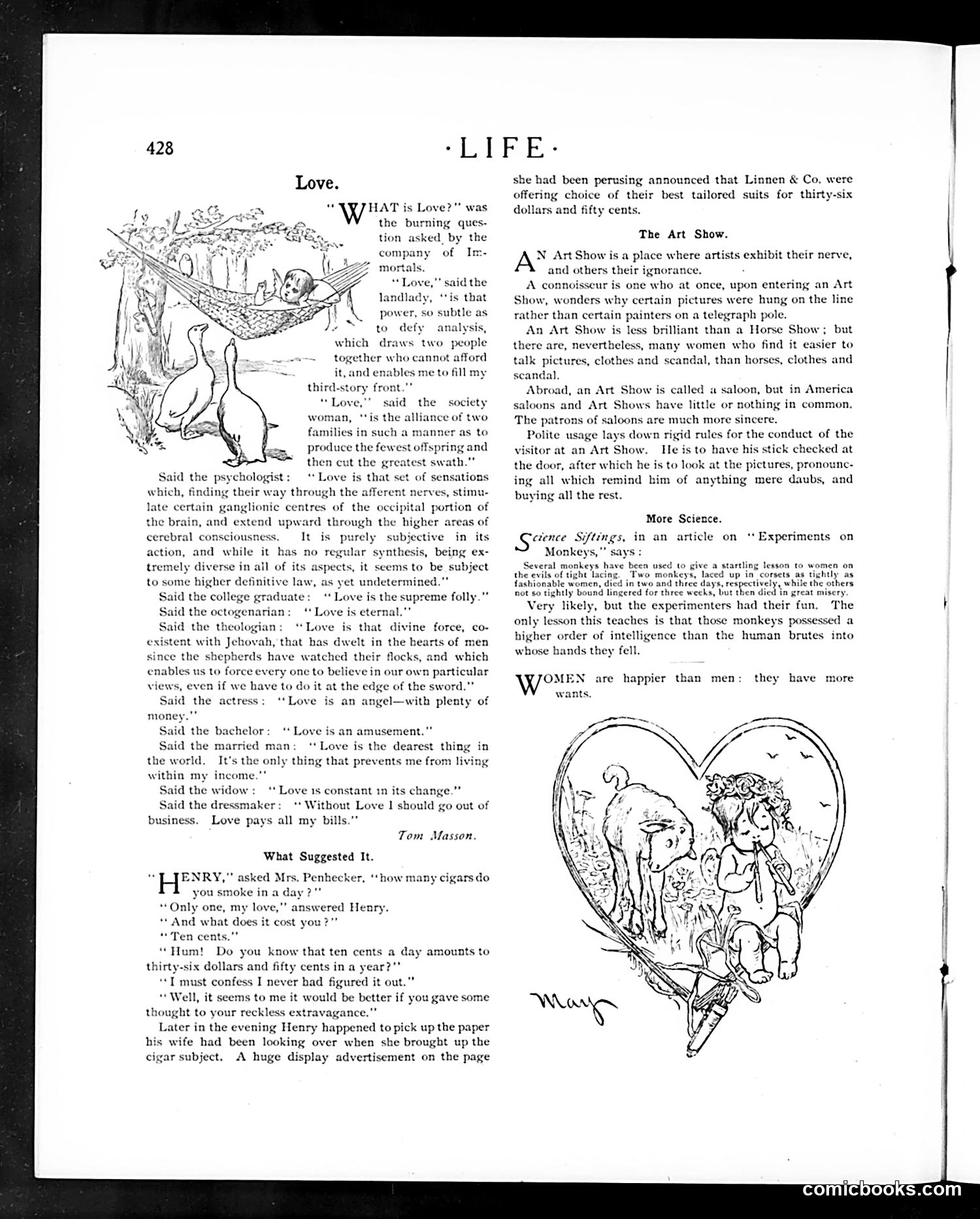
This page satirizes romantic love through multiple perspectives, then pivots to practical marital humor. **"Love" Section:** Various social figures—landlady, society woman, psychologist, clergy, actress, bachelor, widow, and dressmaker—define love according to their self-interest. The satire mocks how people rationalize love to serve their own needs: the landlady sees profit, the society woman sees family alliances, the actress wants money, and the dressmaker profits from wedding expenses. It's social commentary on how "love" becomes a convenient fiction masking economic and practical concerns. **"What Suggested It":** A husband brags he smokes only one cigar daily. His wife calculates this costs $36.50 yearly—then points out a newspaper advertisement for tailored suits at exactly that price. The joke: she's suggesting he should buy *her* a suit instead of smoking, using his own math against him. It's domestic satire about marriage as economic negotiation. The remaining sections on Art Shows and monkey corset experiments are separate satirical pieces typical of *Life* magazine's format.
📄 Transcribed text from this page (OCR, searchable)
Machine-transcribed from the original scan — historical spelling and the odd misread are preserved.
Love. “ HAT is Love?" was the burning ques- tion asked, by the company of Im- mortals. Love,” said the landlady, ‘tis that power, So subtle as to defy draws two people analysi which together who cannot afford it, and enables me to fill my third-story front.”’ “Love,"’ said the society woman, ‘is the alliance of two families in such a manner as to produce the fewest offspring and then the greatest swath.” Said the psychologist: ‘ Love is that set of sensations which, finding their way through the afferent nerves, stimu- late certain nglionic centres of the occipital portion of the brain, and extend upward through the higher areas of cerebral consciousness. It is purely subjective in its action, and while it has no regular synthesis, being ex- tremely diverse in all of its aspects, it seems to be subject to some higher definitive law, as yet undetermine Said the college graduate: “ Love is the supreme folly.” Said the octoge: “Love is eternal." Said the theolog “Love is that divine force, co- existent with Jehovah, that has dwelt in the hearts of men since the shepherds have watched their flocks, and which enables us to force every onc to believe in our own particular views, even if we have to do it at the edge of the sword." id the actress: ‘*Love is an angel—with plenty of money."" 1 the bachelor: ‘* Love is an amusement.” Said the married man: ‘Love is the dearest thing in the world. It’s the only thing that prevents me from living within my income Said the widow: ‘* Love 1s constant in its change.’” Said the dressmaker: ‘* Without Love | should go out of business. Love pays all my bills.”” Tom Masson. What Suggested It. NRY," asked Mrs. Penhecker, ‘‘how many cigars do ‘ou smoke in “Only one, my love, “And wi “Ten cents. ‘Hum! Do you know that ten cents a day amounts to irty-six dollars and fifty cents in a year?” I must confess I never had figured it out." “Well, it seems to me it would be better if you gave some thought to your reckless ex r Later in the evening Henry happened to pick up the paper wife had been looking over when she brought up the subject. A huge display advertisement on the page answered Henry. does it cost you?” ‘LIFE: she had been perusing announced that Linnen & Co, were offering choice of their best tailored suits for thirty-six dollars and fifty cents. The Art Show. A Art Show is a place where artists and others their ignorance. A connoisseur is one who at once, upon entering an Art Show, wonders why certain pictures were hung on the line rather than certain painters on a telegraph pole. An Art Show is less brilliant than a Horse Show; but , many women who find it T to d scandal, than horses, clothes and exhibit their nerve, there are, neverthele: ctures, clothes scandal, Abroad, an Art Show is called a saloon, but in America saloons and Art Shows have little or nothing in common, The patrons of saloons are much more sincere. Polite usage lays down rigid rules for the conduct of the visitor at an Art Show. He is to have his stick checked at the door, after which he is to look at the pictures, pronounc- ing all which remind bim of anything mere daubs, and buying all the rest. More Science. ctence Siftings, in an article on ‘Experiments on veral monkeys have been used to give a startling lesson to women on evils of tight lacing. Two monkeys, laced up in corsets as tightly as in two and three days, respectively, while the others not $0 tightly bound lingered for three weeks, but then died in great misery Very likely, but the experimenters had their fun. ‘The only lesson this teaches is that those monkeys possessed a higher order of intelligence than the human brutes into whose bands they fell. OMEN are happier than men: they bave more wants.