
Life, 1904-05-05 · page 19 of 40
Life — May 5, 1904 — page 19: what you’re looking at
What you’re looking at
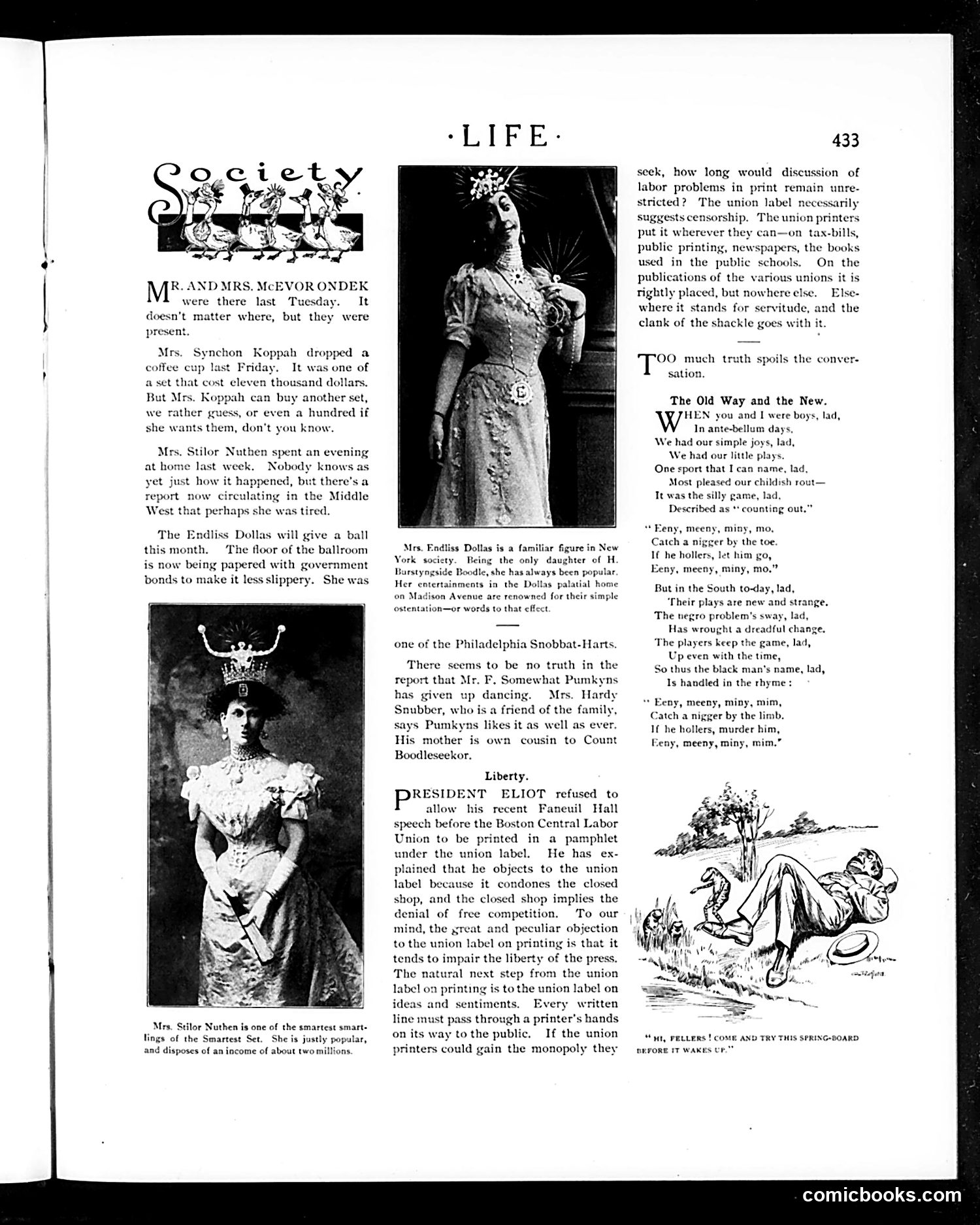
This page contains two distinct pieces of social satire: **Upper Section - Society Gossip:** The "Society" column mockingly chronicles the trivial lives of wealthy elites (the "Smartest Set"), featuring caricatured figures like Mrs. Endliss Dollas and Mrs. Stilor Nuthen. The satire ridicules their extravagance—papered ballroom floors with government bonds, thousand-dollar coffee sets—and the absurdity of their social reportage. This targets the nouveau riche and society page frivolity. **Lower Section - Labor Union Controversy:** The "Liberty" article discusses President Eliot's refusal to allow his speech printed under a union label. Life argues union labels on printing threaten press freedom and could enable censorship of labor discussions. This reflects genuine early-20th-century debates over unionization's scope and power. **Bottom - Racist Poem:** "The Old Way and the New" compares children's counting-out rhymes, contrasting a historical racist chant with an even more violent contemporary Southern version. This appears critical of Southern racial violence, though presented disturbingly.
📄 Transcribed text from this page (OCR, searchable)
Machine-transcribed from the original scan — historical spelling and the odd misread are preserved.
: ooo R, AND MRS. MCEVOR ONDEK were there last Tuesday. It doesn't matter where, but they were present. Mrs, Synchon Koppah dropped a coffee cup last Friday, It was one of a set that cost eleven thousand dollars. But Mrs. Koppah can buy another set, na hundred if she wants them, don’t you know. her guess, or ev we Mrs. Stilor Nuthen spent an evening at home last week. Nobody knows as yet just how it happened, but there report now circulating in the Middle West that perhaps she was tired. The Endliss Dollas will give a ball this month. The floor of the ballroom is now being papered with government bonds to make it less slippery. She was Mrs. Stilor Nuthen is one of the smartest smart- lings of the Smartest Set. She is justly popular, and disposes of an income of about twe Mrs, Eadliss Dollas is a familiar figure in New York society. Being the only daughter of H Burstyogside Boodle, she has always been popular Her entertainments in the Dollas palatial home on M ison Avenue are renowned for their simple ostentation—or words to that effect. one of the Philadelphia Snobbat-Harts. There seems to be no truth in the report that Mr. F, Somewhat Pumkyns has given up dancing. Mrs. Hardy Snubber, who is a friend of the family, ys Pumkyns likes it as well as ever. His mother is own cousin to Count Boodleseekor. Liberty. RESIDENT ELIOT refused to allow his recent Faneuil Hall speech before the Boston Central Labor Union to be printed in a pamphlet under the union label. He has ex- plained that he objects to the union label because it condones the closed shop, and the closed shop implies the denial of free competition. To our mind, the great and peculiar objection to the union label on printing is that it tends to impair the liberty of the press, The natural next step from the union label on printing is to the union label on ideas and sentiments. Every written line must pass through a printer's hands on its way to the public. If the union printers could gain the monopoly they 433 seek, how long would discussion of labor problems in print remain unre- stricted? The union label necessarily suggests censorship. The union printers put it wherever they can—on tax-bills, public printing, newspapers, the books used in the public schools. On the publications of the various unions it is rightly placed, but nowhere else. Else- where it stands for servitude, and the clank of the shackle goes with it. (OO much truth spoils the conver: sation, The Old Way and the New. HEN you and I were boys, lad, In ante-bellum days, We had our simple joys, lad, We had our little plays. One sport that I can name, lad, Most pleased our childish rout— Tt was the silly game, lad, Described as ** counting out,” Eeny, meeny, miny, mo, Catch a nigger by the toe. If he hollers, let him go, Eeny, meeny, miny, mo,” But in the South to-day, lad, ‘Their plays are new and strange. ‘The negro problem's sway, lad, Has wrought a dreadful change, ‘The players keep the game, lad, Up even with the time, So thus the black man’s name, lad, Is handled in the rhyme: * Eeny, meeny, miny, mim, Catch a nigger by the limb. If he hollers, murder him, Eeny, meeny, miny, mim.” “ML, PELLERS ! COME AND TRY THIS SPRING-BOARD DRFORE IT WAKES Ur. comicbooks.com