
A complete issue · 20 pages · 1904
Life — February 11, 1904
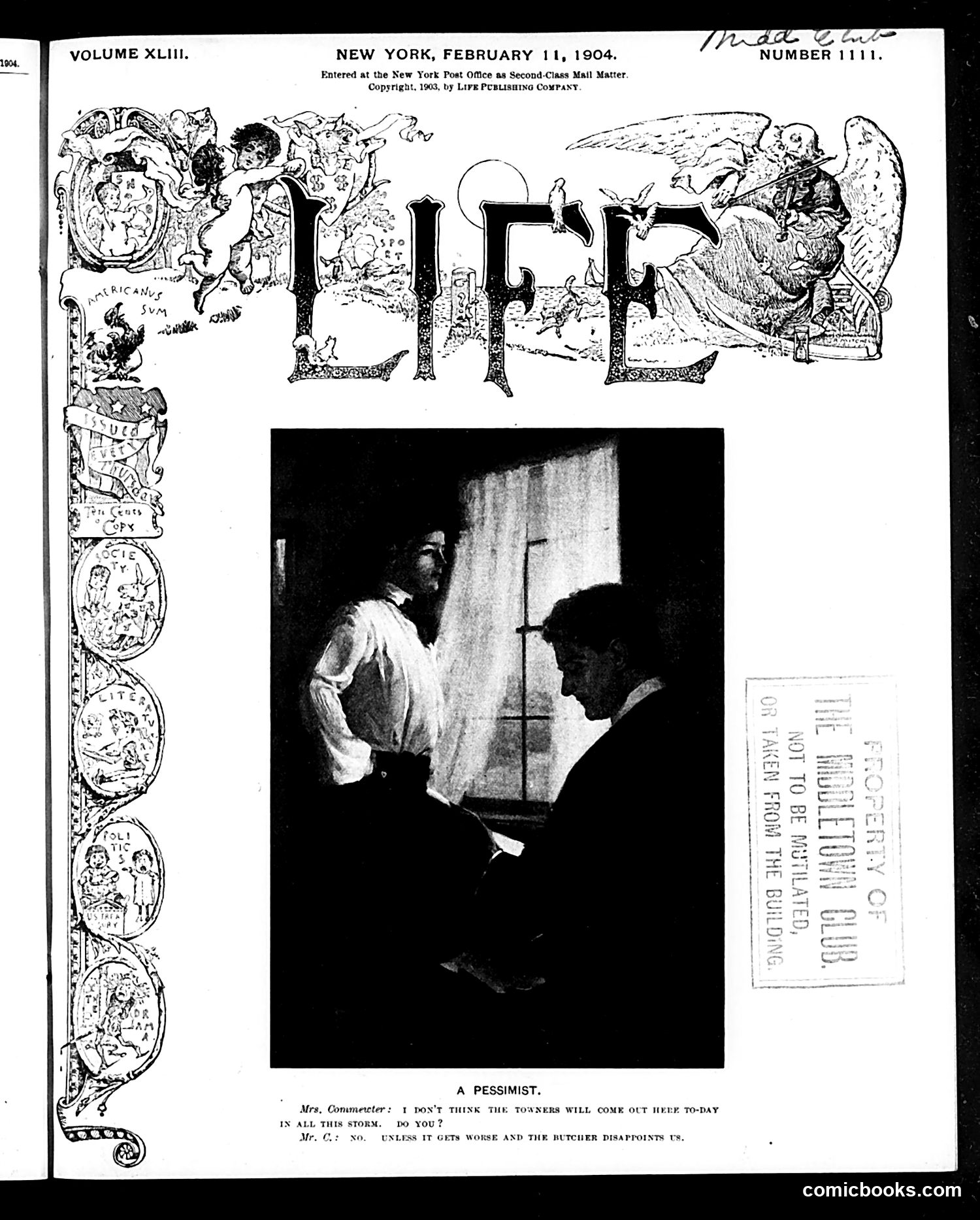
This cartoon satirizes pessimism through a domestic scene. A woman (labeled "Mrs. Commuter") expresses doubt that the laundry will be delivered during a storm, while a man (labeled "Mr. C.") responds dismissively, suggesting things will get "worse and the butcher disappoints us." The humor targets the "pessimist" character type—someone who expects the worst outcome regardless of circumstances. The domestic setting (laundry delivery, butcher service) grounds the satire in everyday middle-class life. The woman's reasonable concern about weather is contrasted with the man's blanket negativity, suggesting pessimism as an irrational personality flaw rather than realistic assessment. The ornate decorative border features classical motifs typical of Life's design from this era.
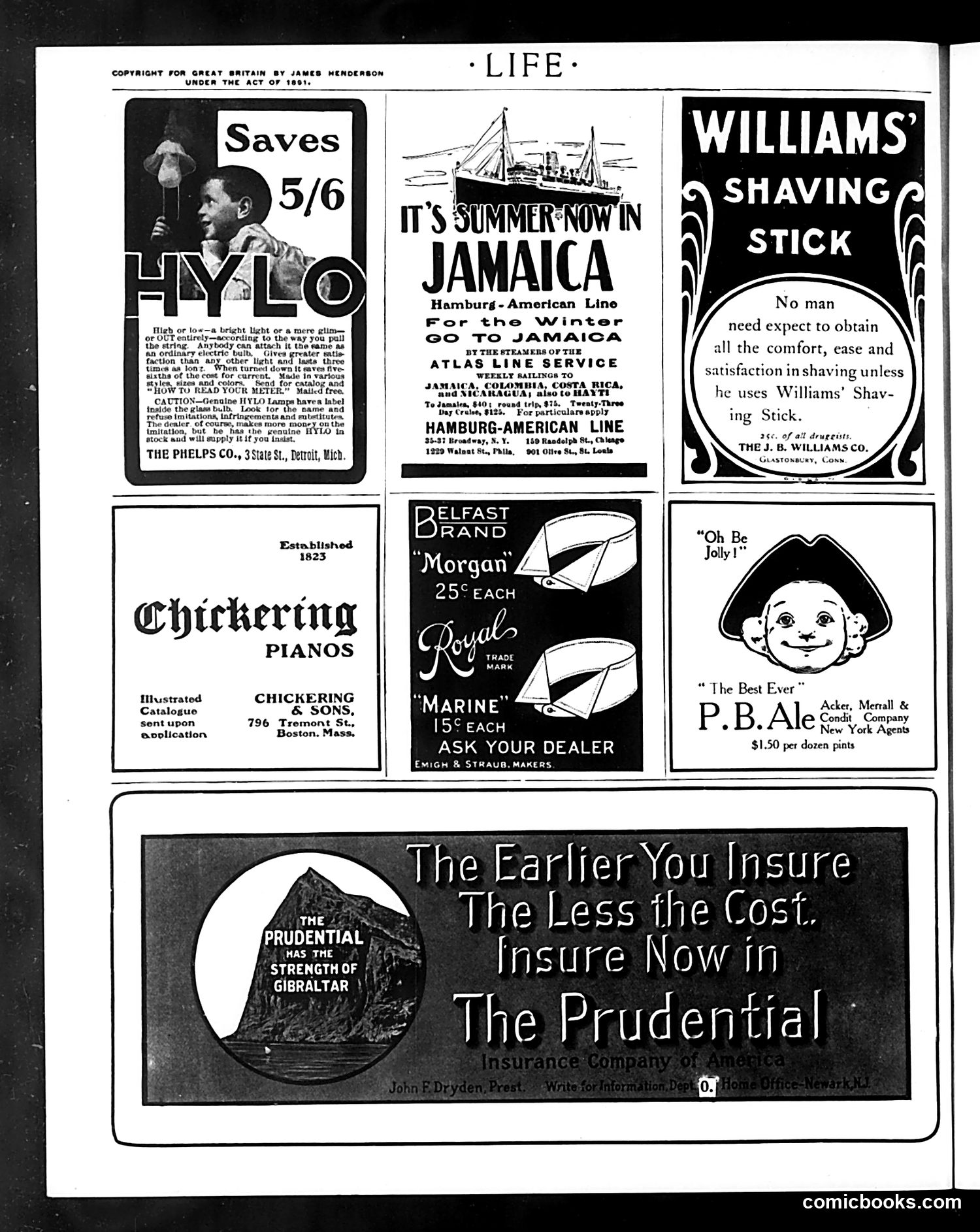
This page is primarily **advertising**, not editorial content or satire. It contains six distinct advertisements from the early 20th century: 1. **Hylo lamps** (saves 5/6) - lighting products 2. **Hamburg-American Line** - cruise ship travel to Jamaica 3. **Williams' Shaving Stick** - grooming product 4. **Chickering Pianos** - musical instruments 5. **Belfast Brand Morgan/Marine** - boat/marine products 6. **P.B. Ale** - beer ("The Best Ever") 7. **The Prudential Insurance** - life insurance The page demonstrates typical Life magazine monetization through paid advertisements rather than satirical or political content. The ads target middle-class consumers with products ranging from household items to luxury travel. There is no apparent political cartoon or social satire present—this is straightforward commercial advertising of the era.
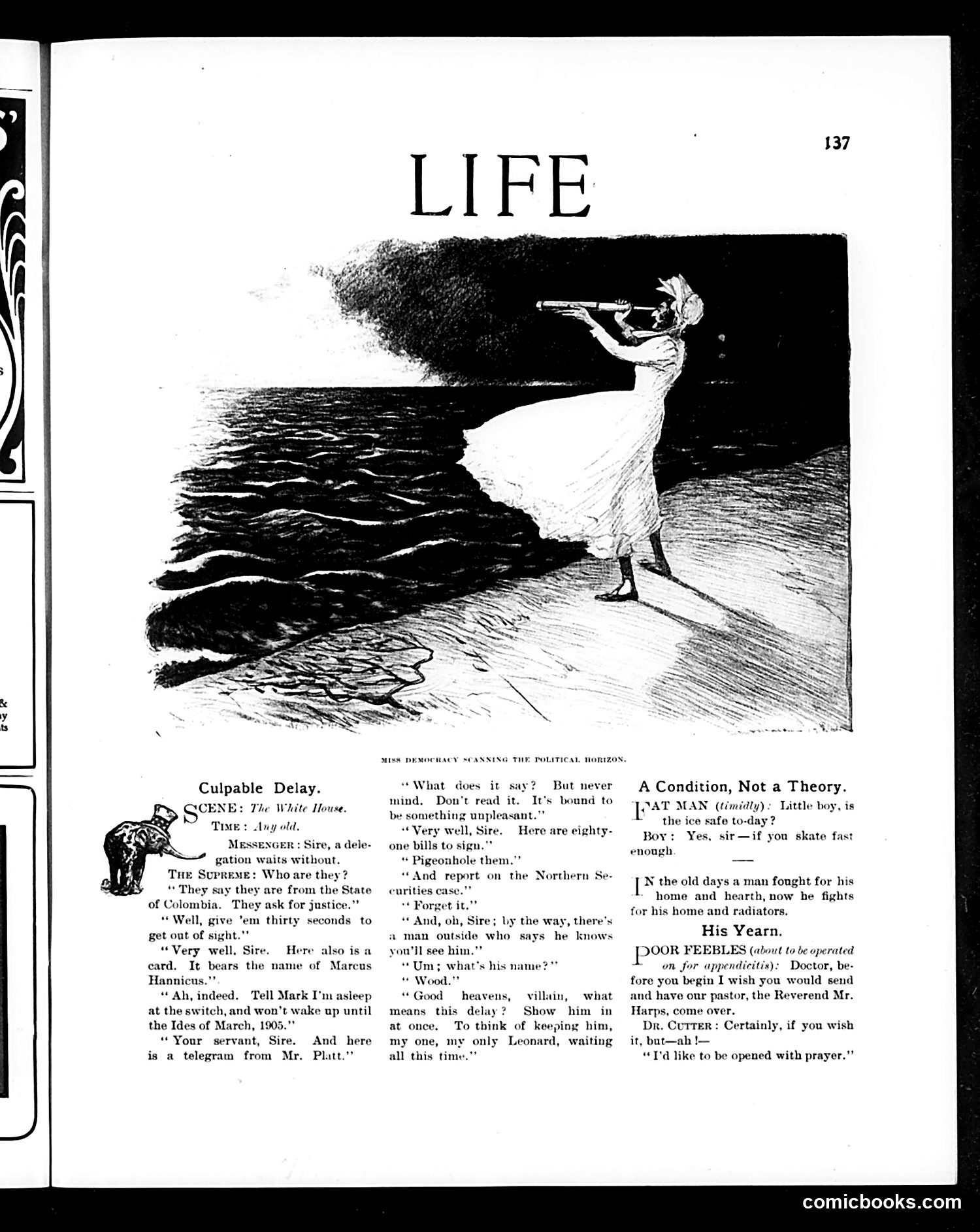
The main illustration depicts "Miss Democracy Scanning the Political Horizon" — a woman in classical dress using a telescope to peer across turbulent waters toward a dark, uncertain future. This represents democracy's vigilant observation of political threats. The accompanying text sketches below present brief satirical dialogues. "Culpable Delay" mocks bureaucratic incompetence, while "A Condition, Not a Theory" contrasts past civic virtue (fighting "for his home and heart") with present concerns about "radiators." "His Yearn" features a character named Poor Feebles seeking a pastor to perform an opening prayer. The overall theme appears to critique American political apathy and institutional decline, using classical symbolism and domestic humor to suggest democracy requires constant watchfulness against emerging dangers.
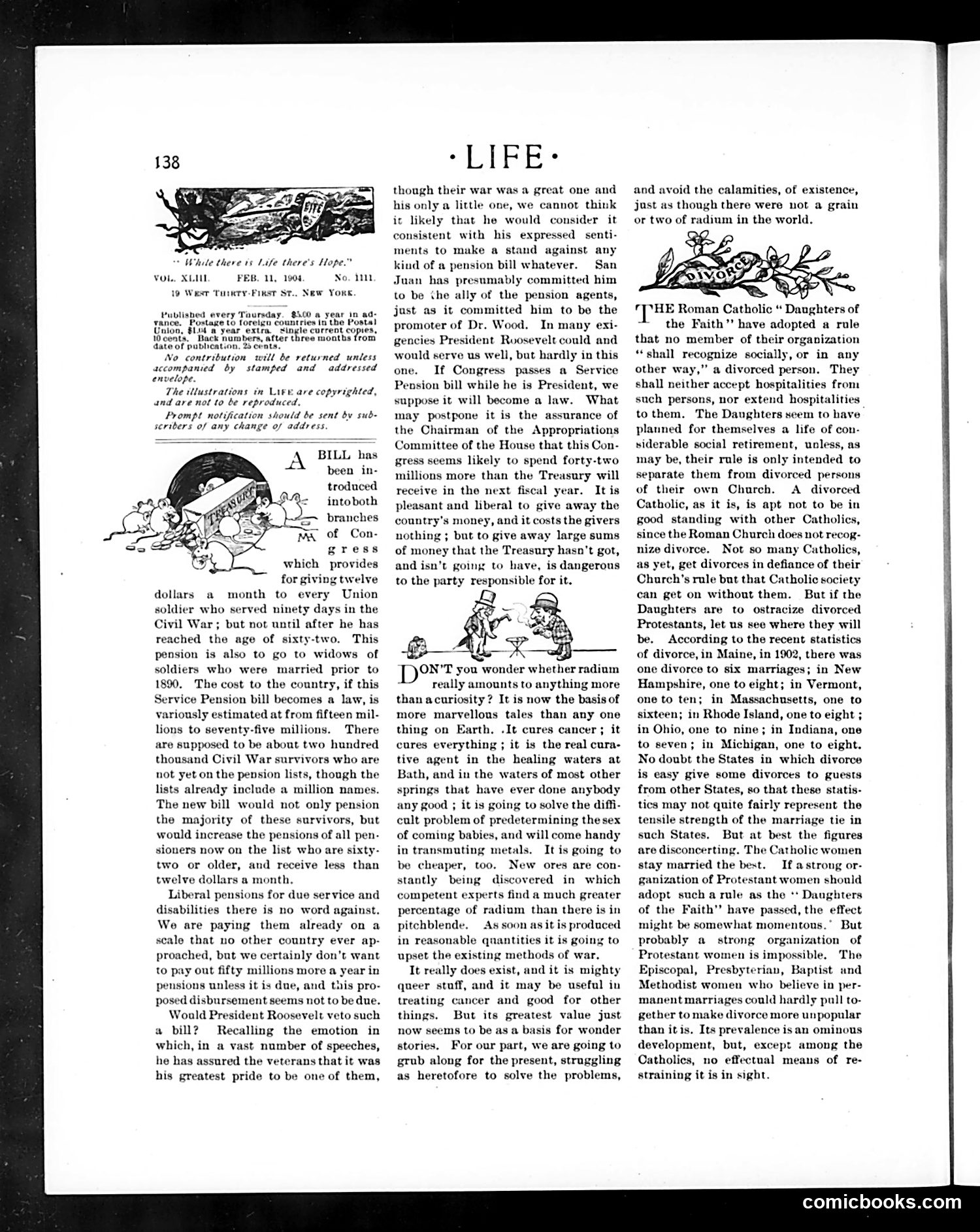
This page contains two satirical cartoons and accompanying text discussing early 1900s political issues. The **left cartoon** depicts a cornucopia or horn of plenty spilling coins, labeled to represent government spending on pensions. The satire criticizes a proposed Service Pension bill that would provide monthly payments to Civil War veterans regardless of financial need—a costly expansion of existing pension programs. The **right cartoon** shows two figures (appearing to be children or small people) on a seesaw or plank, illustrating the text's discussion about radium's supposed miraculous properties. The satire mocks contemporary claims that radium could cure cancer, solve sex determination, and solve other major problems—dismissing such enthusiasm as baseless wonder-mongering. Both cartoons exemplify *Life*'s satirical critique of government spending and scientific hype.
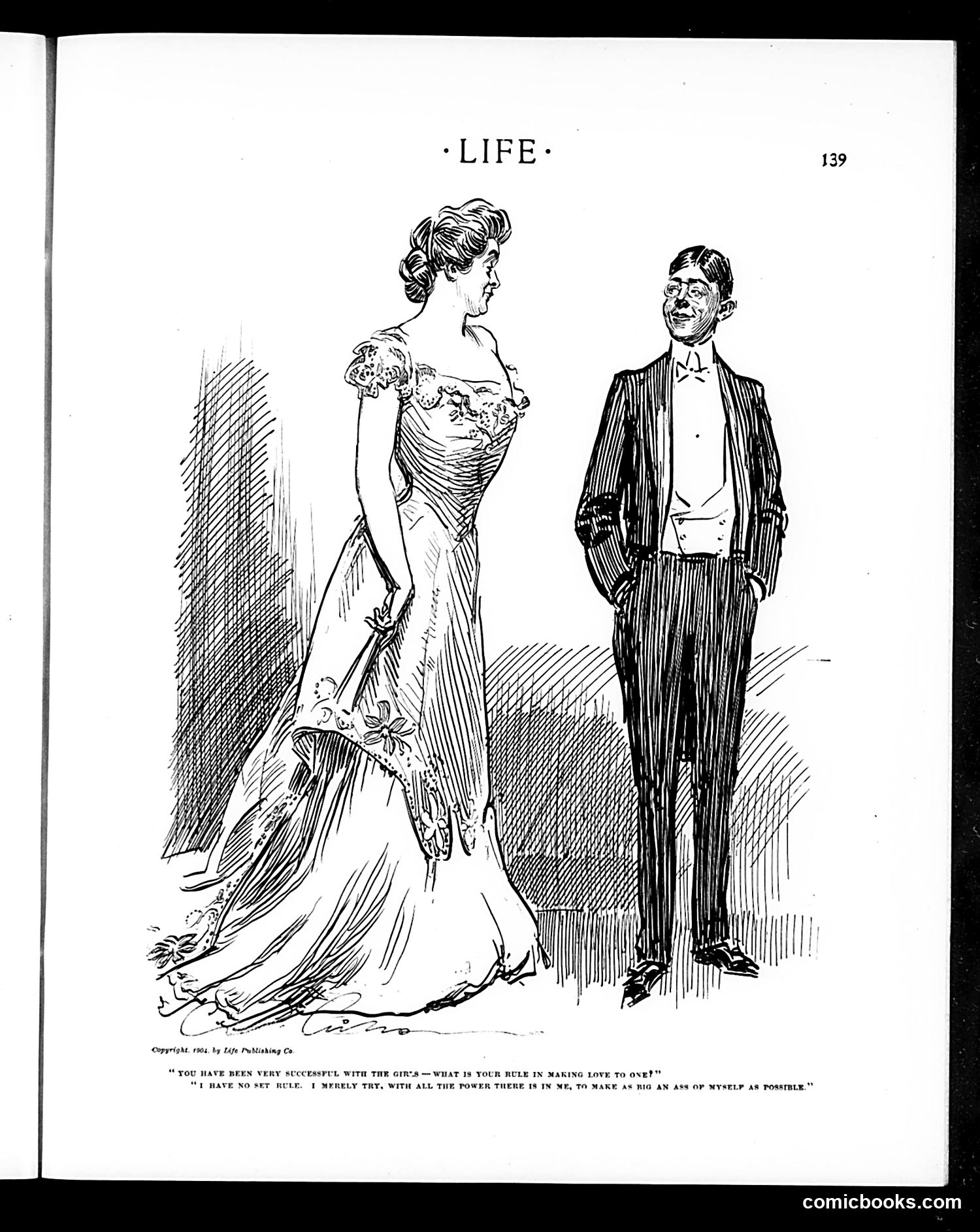
This Life magazine page (page 139) presents a satirical dialogue between a well-dressed man and an elegantly gowned woman in early 1900s formal attire. The caption reads: "You have been very successful with the girls—what is your rule in making love to one?" / "I have no set rule. I merely try, with all the power there is in me, to make as big an ass of myself as possible." The satire mocks courtship rituals of the era by suggesting that male romantic "success" derives from deliberate self-humiliation or foolish behavior. The joke reflects turn-of-the-century skepticism about conventional romance, implying that women are attracted to men who abandon dignity—a commentary on both masculine performance and female taste in that period. The artist's signature appears to be present at the bottom, though copyright reads "1904 by Life Publishing Co."
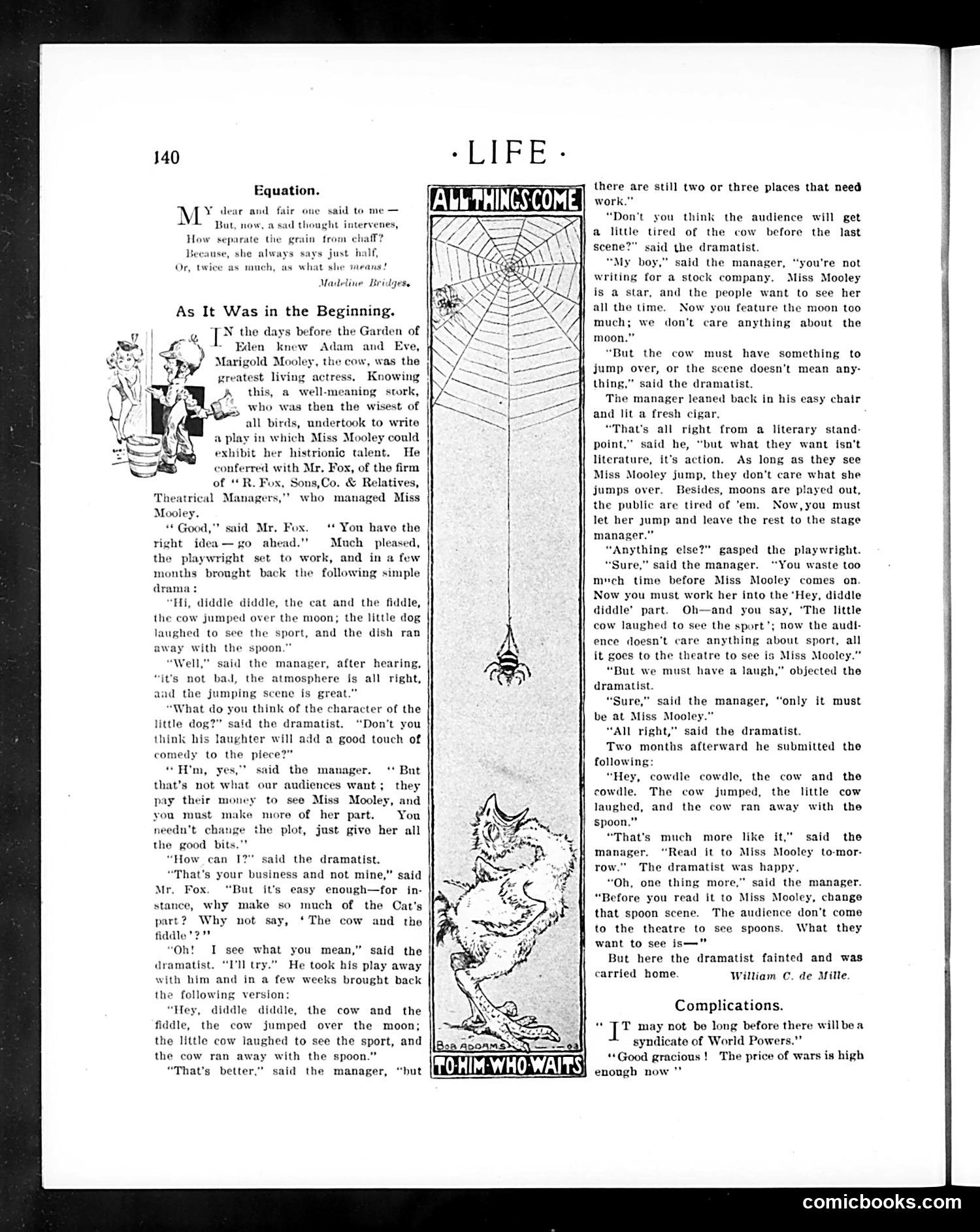
This page satirizes theatrical production through a dialogue between a playwright and theater manager about adapting the nursery rhyme "Hey Diddle Diddle" into a stage play. The central joke mocks commercial theater's demands: the manager insists on featuring the actress Miss Mooley prominently and adding a comedic "jump" scene (the cow jumping over the moon), even though these elements contradict the original rhyme's simplicity. The playwright protests that audiences want action and spectacle rather than faithful adaptation. The accompanying illustrations show the cow and other nursery-rhyme characters. This satire critiques how theatrical producers prioritize star power and crowd-pleasing spectacle over artistic integrity—a timeless Hollywood/Broadway complaint about commerce trumping art.
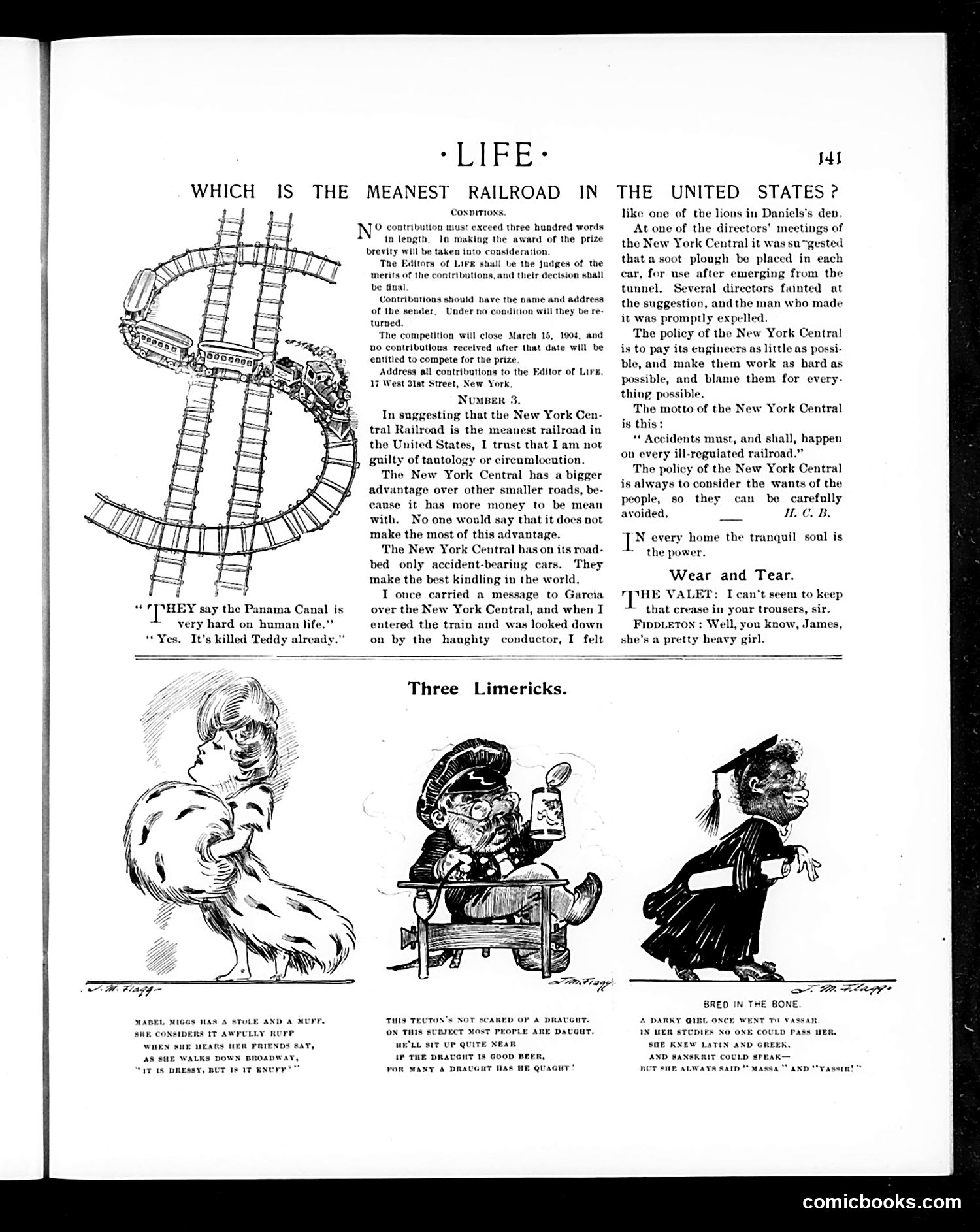
This page contains three distinct elements: **Top section**: A contest asking "Which is the meanest railroad in the United States?" The answer promotes the New York Central Railroad as "meanest"—employing this term as praise for deliberately harsh treatment of passengers and staff. The text boasts the railroad makes "the best kindling in the world" from accident-bearing cars and proudly describes its policy of treating engineers and workers as harshly as possible. **Bottom section**: Three limericks with accompanying caricatures satirizing social types—a woman considered physically undesirable, a drunken man ("Teuton"), and a "darky girl" employing ethnic stereotypes common to the era. The satire targets corporate cruelty and indifference toward worker and passenger safety, while the limericks reflect period attitudes toward appearance, ethnicity, and social class.
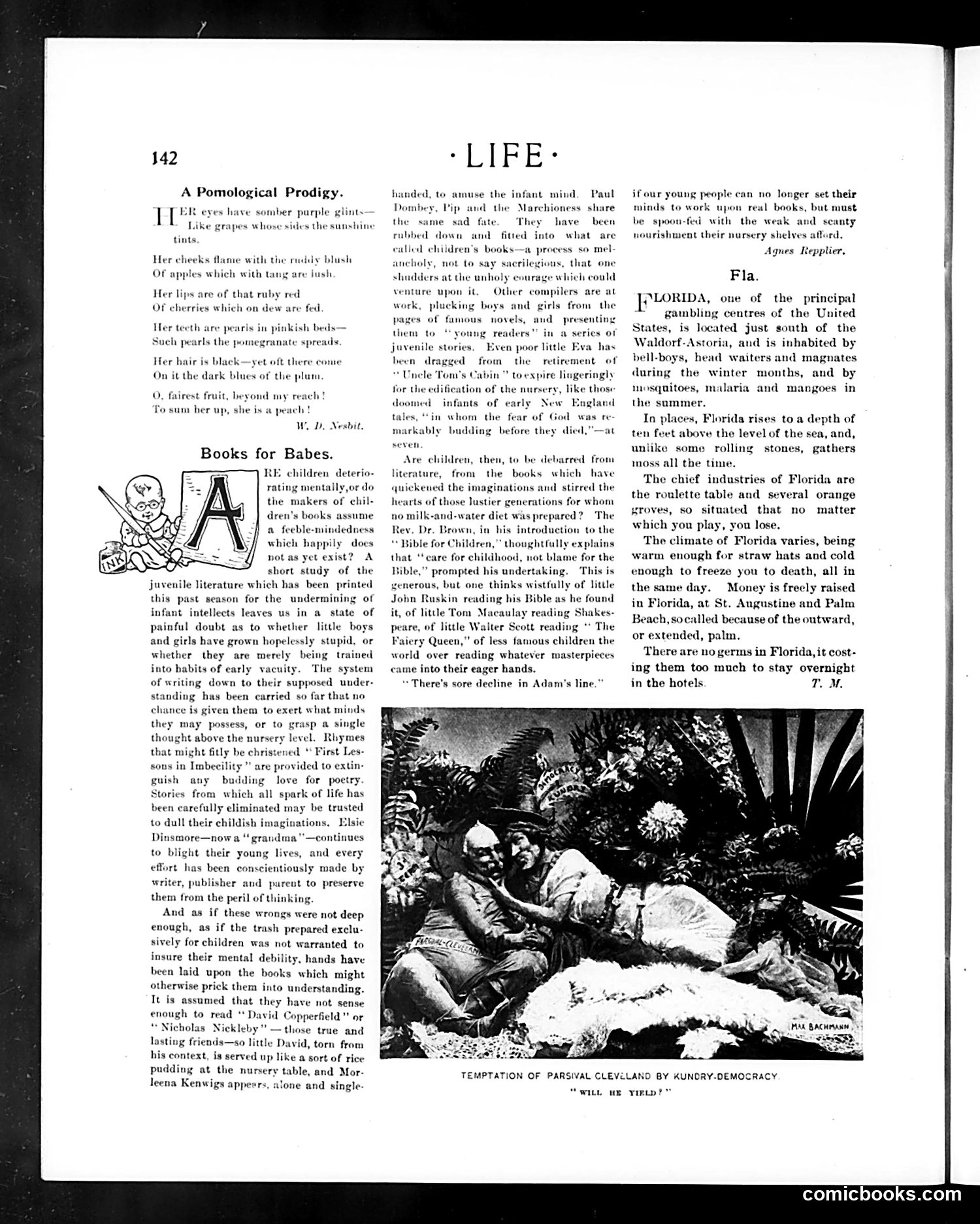
The cartoon titled "TEMPTATION OF PARSIVAL CLEVELAND BY HUNGRY-DEMOCRACY - 'WILL HE YIELD?'" appears to reference Grover Cleveland (U.S. President). The image shows a figure being tempted while reclining, with "Hungry-Democracy" (personified as a threatening force) surrounding him. The satire likely critiques Cleveland's political stance on economic or social issues—the "temptation" suggests pressure from democratic constituencies demanding action. The Parsival reference (the Arthurian knight) implies Cleveland is being tested morally or politically. Without the publication date visible, the exact policy being satirized remains unclear, but this represents typical Life magazine political commentary targeting a sitting or recent president's resistance to popular demands.
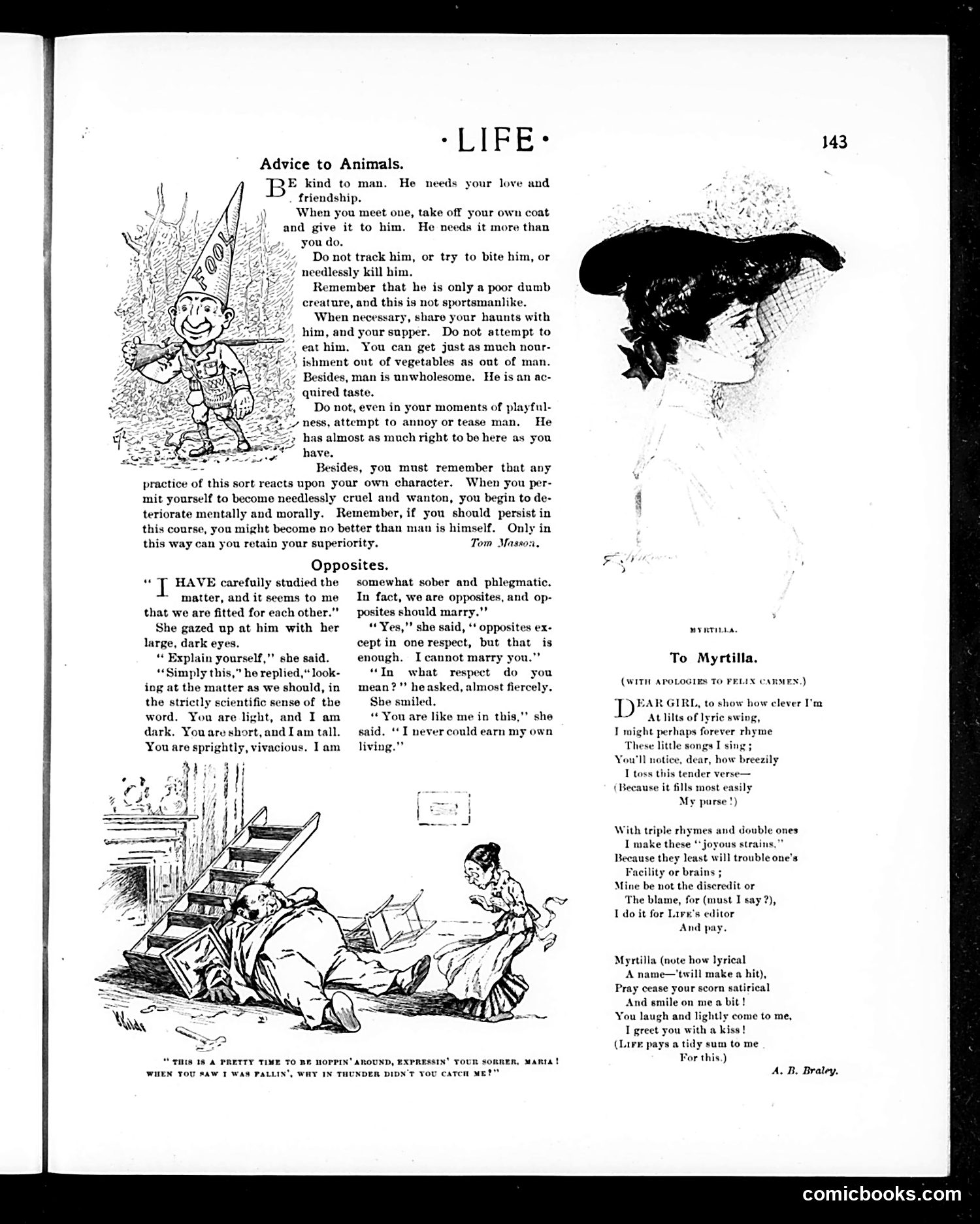
This page contains satirical advice from "Tom Mason" addressing animals about their conduct toward humans. The central illustration shows a gnome-like figure offering guidance—a common Life magazine device using whimsy to deliver social commentary. The main cartoon depicts a man being chased or confronted by a dog, with dialogue suggesting the dog should not be cruel or "unsportsmanlike" to humans. The satire inverts the typical relationship: rather than warning humans about animal behavior, it humorously advises animals to treat humans decently, implying humans often deserve criticism for their own bad behavior. The page also includes "Opposites" (a romantic dialogue) and "To Myrtilla" (poetry). The overall tone uses anthropomorphized animals to satirize human conduct—a common early 20th-century Life magazine approach to social criticism.
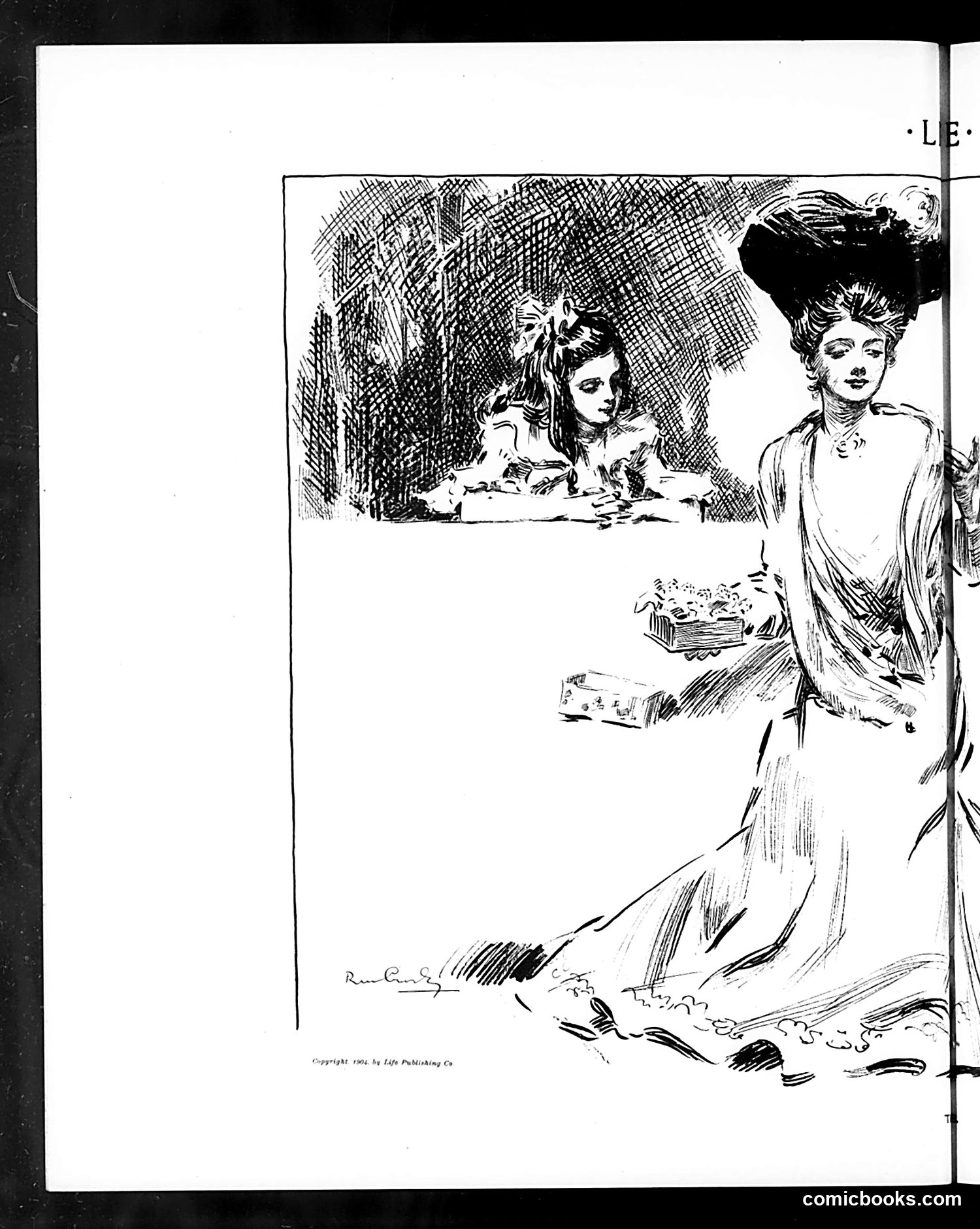
This appears to be an illustration from *Life* magazine, likely early 1900s based on the artistic style. The image shows a well-dressed woman in an elegant gown with an elaborate upswept hairstyle, characteristic of the Gibson Girl aesthetic popular during that era. In the background, there appears to be a mirror or window reflecting other figures, possibly suggesting themes of vanity, social aspiration, or the contrast between public appearance and private reality—common satirical subjects in *Life* magazine. The signature appears to be by the illustrator (possibly Cesare or similar), and there's a copyright notice visible at the bottom. Without clearer OCR text or additional context, I cannot definitively identify the specific social commentary or which public figure this might reference, though the fashion and style suggest commentary on contemporary female fashion, society, or gender roles of the Edwardian period.
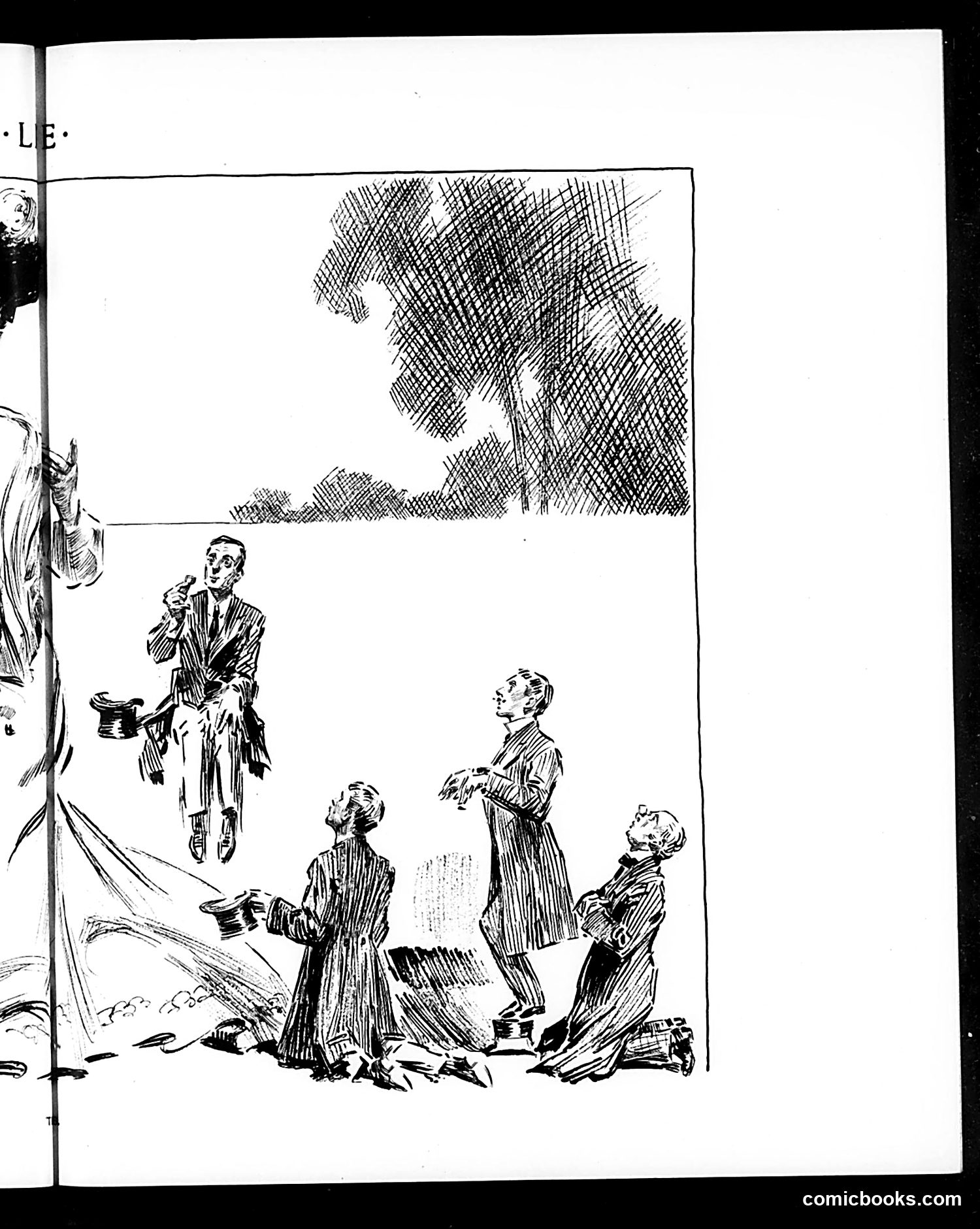
This appears to be a single-panel cartoon showing four men in formal attire kneeling or bowing before a large, menacing shadow or silhouette looming above them. The figures seem to be in positions of supplication or fear. Without visible text identifying the specific figures or date, I cannot definitively state who these men represent or what political event this satirizes. However, the composition suggests commentary on power dynamics—depicting submission to an ominous, undefined force or authority figure. The style and subject matter are consistent with early-to-mid 20th century American political satire, but without clearer identifying marks, captions, or OCR text providing context, I cannot specify the intended targets or the exact satirical point this cartoon makes.
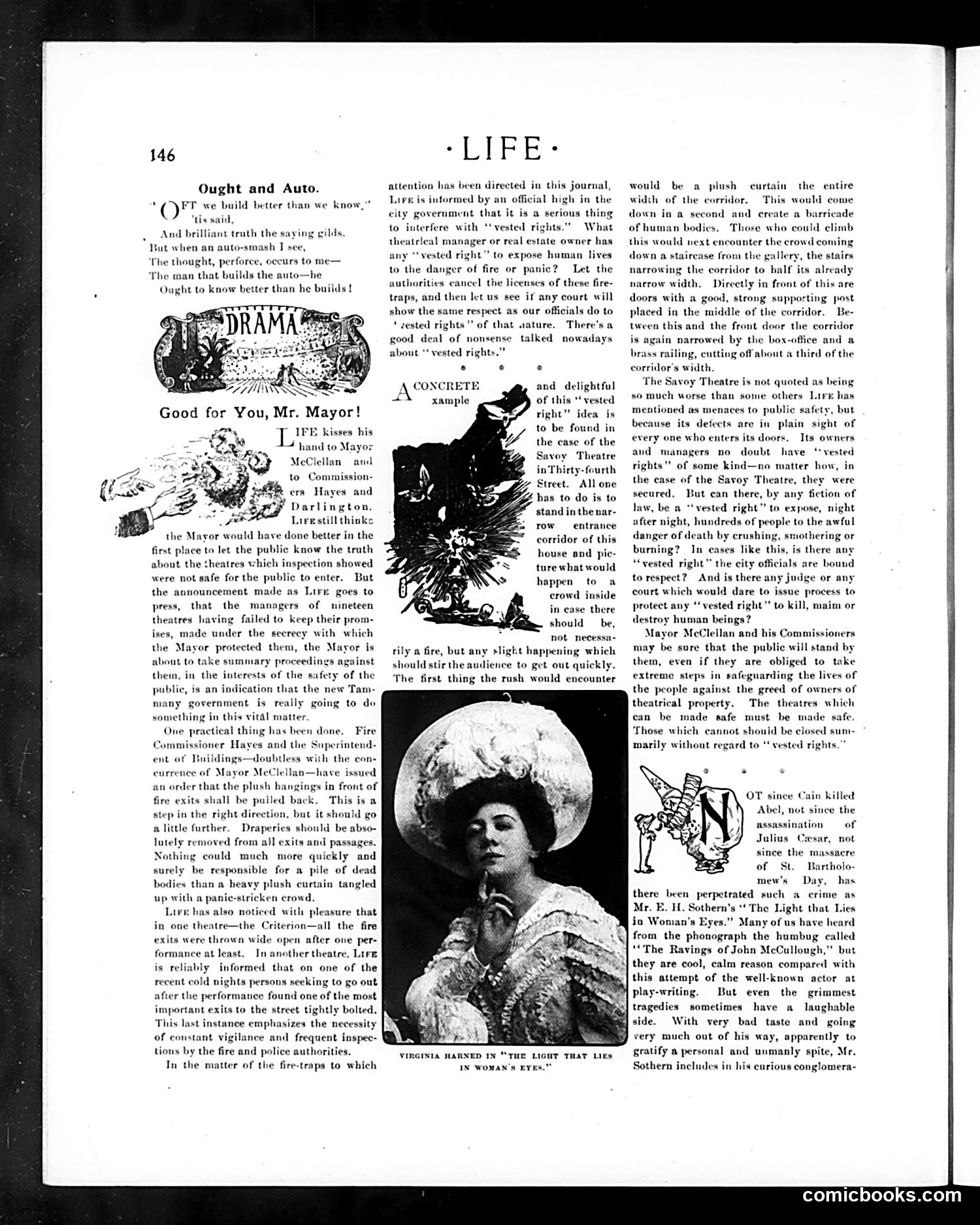
This page critiques theatrical safety regulations using Mayor McClellan of New York as its focus. The article "Good for You, Mr. Mayor!" praises the Mayor's efforts to enforce fire safety inspections at theaters after discovering unsafe conditions. The cartoon depicts a chaotic scene where a crowd rushes through a narrow theater corridor during an emergency, illustrating the article's main concern: "vested rights." Theater owners claimed property rights exempted them from safety regulations. The satire argues this is absurd—that no property right should permit endangering lives through inadequate fire exits or safety measures. The accompanying photograph shows Virginia Harned in "The Light That Lies in Woman's Eyes," representing contemporary theater. The piece advocates for mandatory theater closures if they cannot meet safety standards, mocking owners' resistance as greedy obstruction.
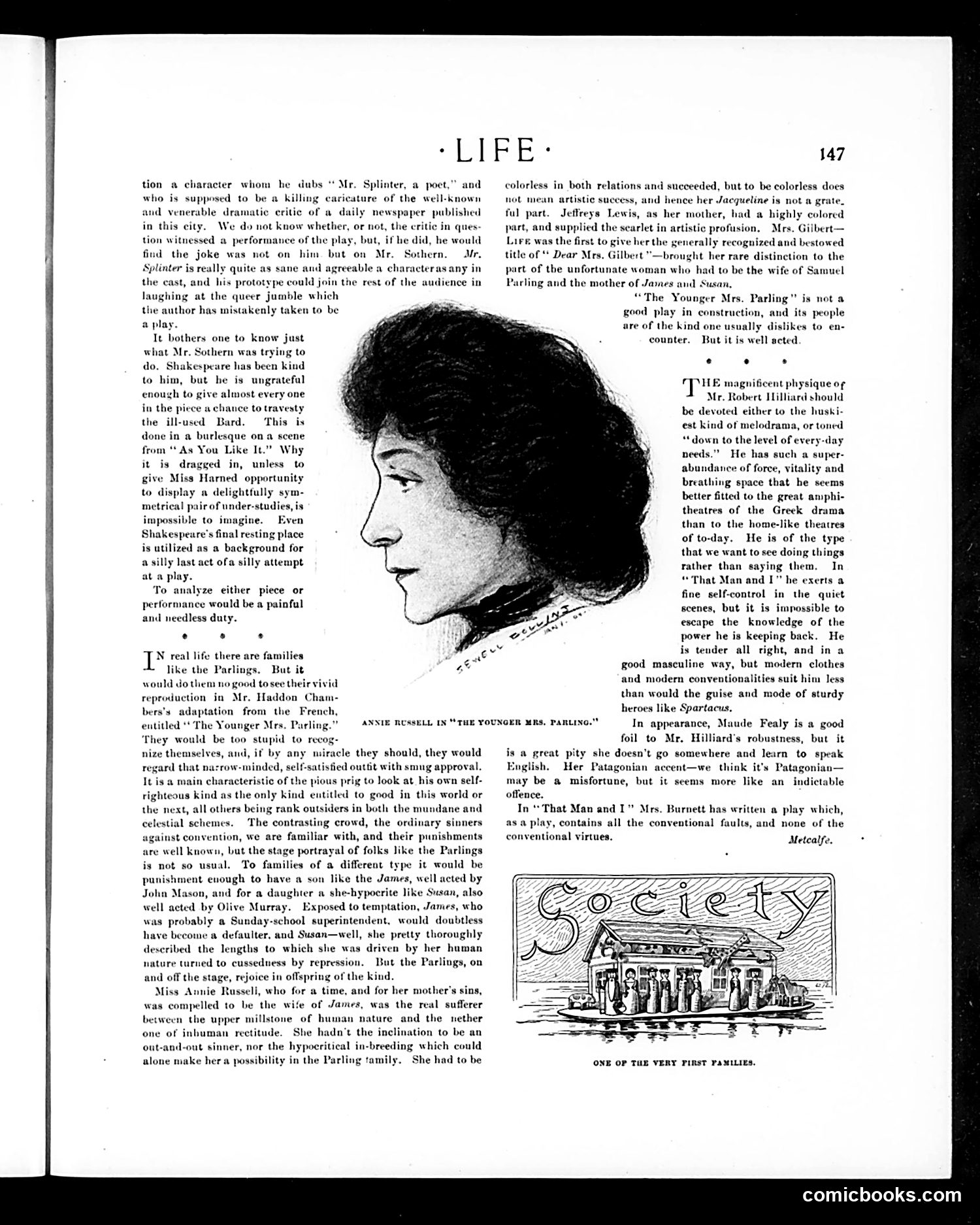
This page reviews two theatrical productions. The main content critiques an adaptation of Shakespeare's "As You Like It" starring actor Sothern, which the critic finds poorly constructed—a "silly attempt at a play" that uses Shakespeare as mere backdrop for cheap laughs and to showcase actress Harned's physical attributes. The portrait shows **Annie Russell** in "The Younger Mrs. Parling," a French adaptation about a hypocritical upper-class family. The critic argues such self-righteous, repressive families are tedious theatrical subjects, though Russell performs admirably in a thankless "colorless" role. The review praises supporting actresses (Jeffreys Lewis, Mrs. Gilbert) for bringing more vivid characterization to their parts. The satire targets theatrical mediocrity and the exploitation of classic literature for frivolous entertainment—concerns that remain relevant today.
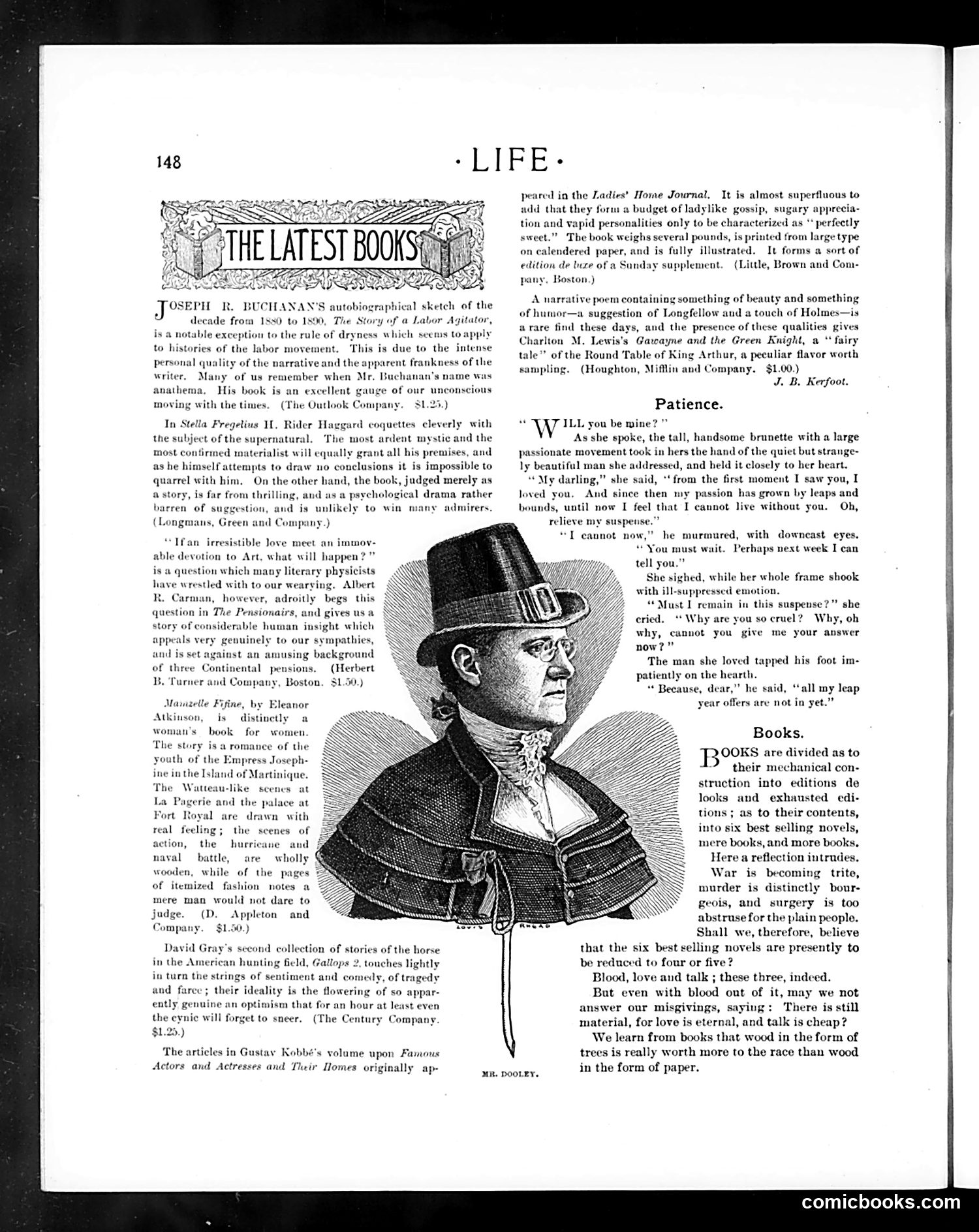
This page contains a book review section and a short serialized story titled "Patience." The illustrated story depicts a melodramatic romantic scene: a woman passionately declares her love to a man, demanding he answer her marriage proposal immediately. He refuses, asking her to wait until next week, causing her visible distress. The satire likely mocks the overwrought emotional theatricality of contemporary romance fiction—the breathless declarations, the swoons, the theatrical anguish over delayed answers. The man's calm refusal to be rushed by her "passionate movement" and emotional manipulation may also gently mock the era's gender dynamics, where women were expected to be the emotionally volatile party. The placement alongside book reviews about sentimental works reinforces that this represents typical popular fiction of the period: emotionally excessive, morally simplistic, and designed primarily for female readers.
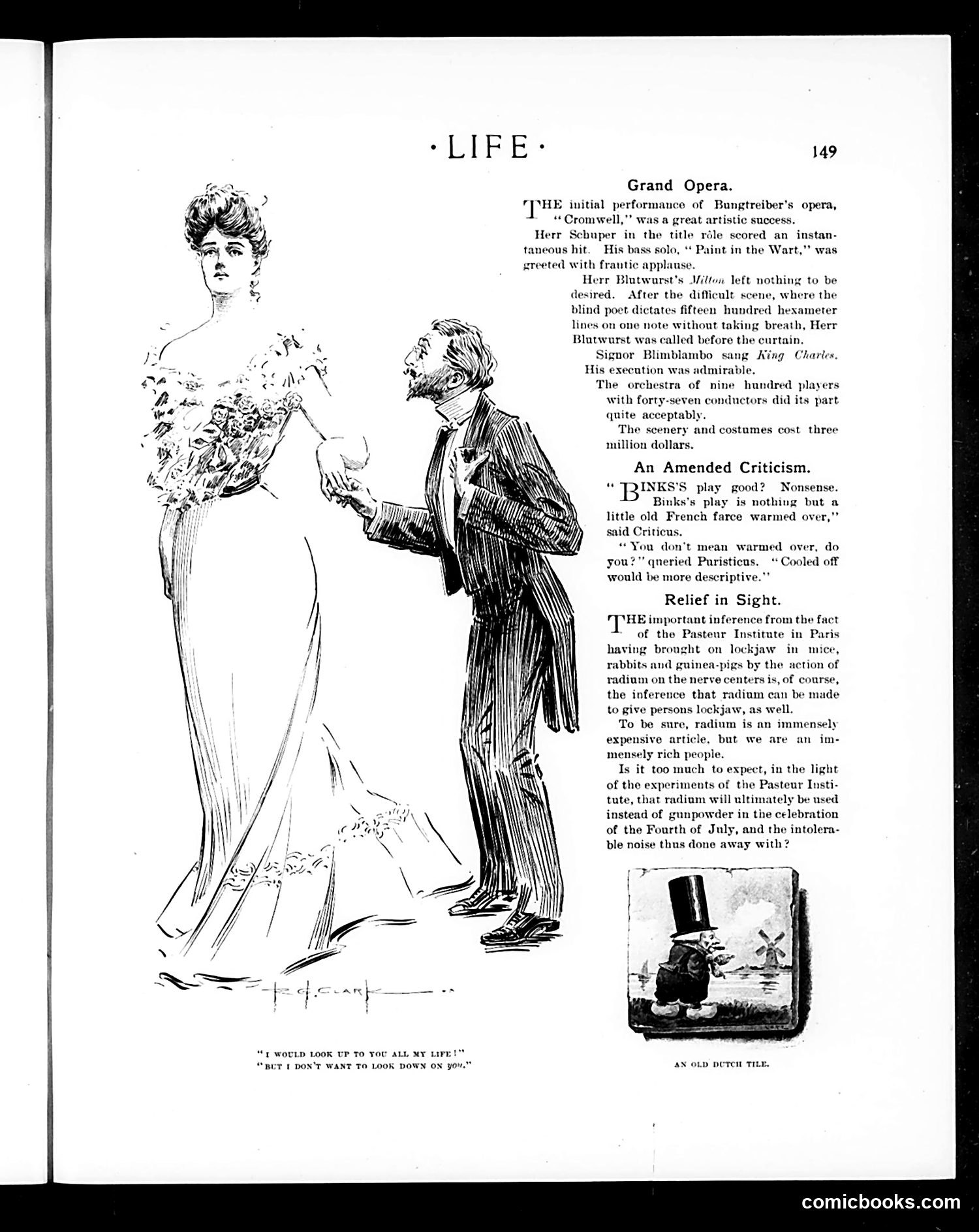
This page contains satirical commentary typical of *Life* magazine's early 20th-century humor. **The Main Cartoon** depicts a couple in formal dress with the caption about looking up versus looking down—likely satirizing social pretension or romantic power dynamics of the era. **"Grand Opera"** mocks operatic excess through absurd details: orchestras of 900 players with 47 conductors, $3 million costumes, and nonsensical character names (Bungtreiber, Schuper, Blatwurst, Blimblambo). The joke targets the pretentiousness and bloated budgets of grand opera productions. **"An Amended Criticism"** is a short joke about a theater critic calling a play "warmed over"—another critic pedantically corrects him that "cooled off" would be more accurate. This mocks both overwrought theatrical criticism and linguistic pedantry. **"Relief in Sight"** sarcastically proposes using radium (recently discovered, then fashionable and poorly understood) to replace gunpowder in Fourth of July fireworks to eliminate noise pollution—a darkly humorous commentary on both American wealth and early 20th-century scientific naïveté about radioactivity's dangers.
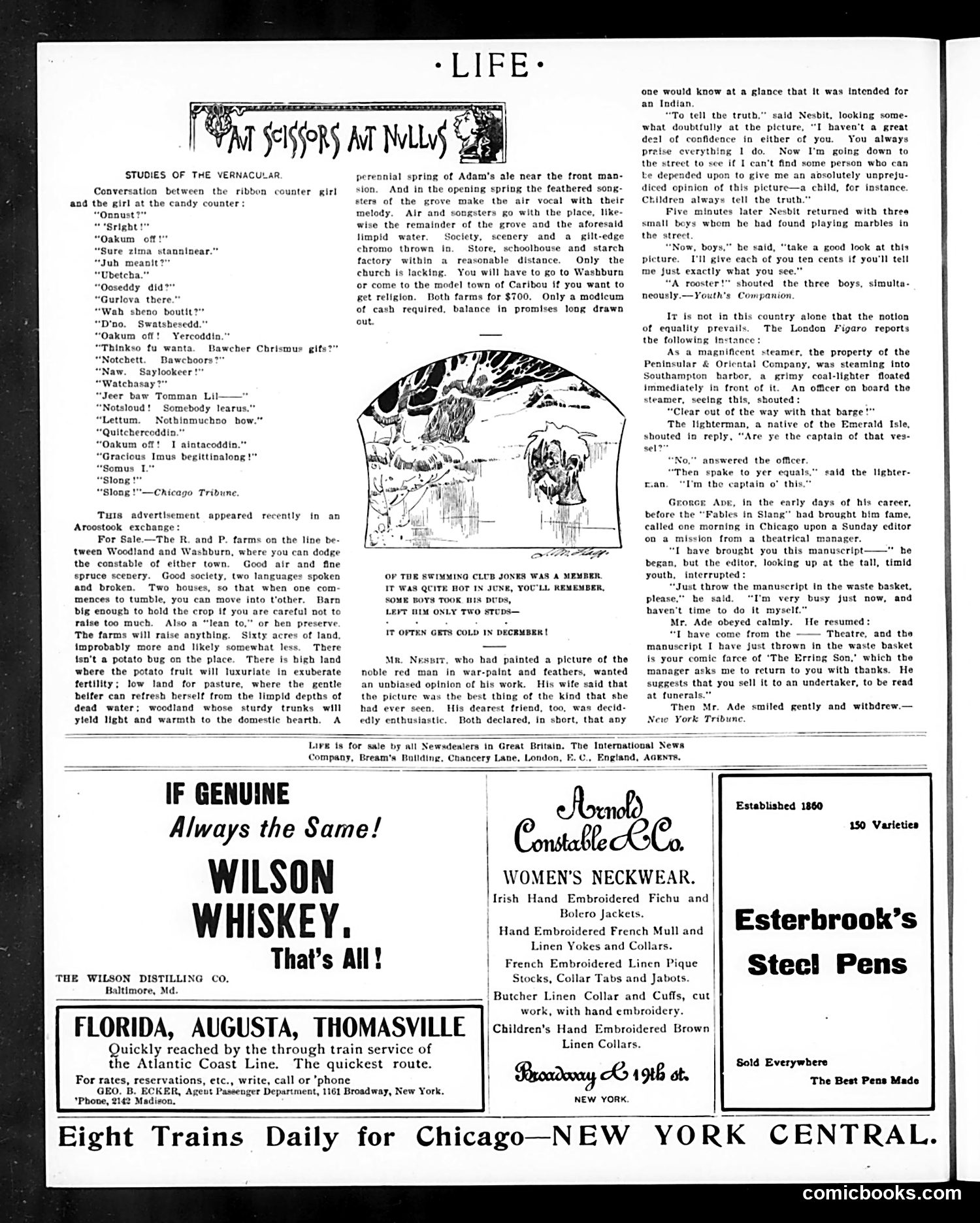
This page contains three distinct humorous pieces rather than a cohesive political cartoon: 1. **"Studies of the Vernacular"**: A satirical transcription of rapid, slang-filled dialogue between a ribbon clerk and a candy counter girl, mocking contemporary working-class speech patterns and their abbreviated, casual grammar ("Oakum off," "Swatshesedd"). 2. **A farm advertisement parody**: Mockingly advertises Maine farmland between two towns, humorous because buyers can "dodge the constable" by moving between jurisdictions. The exaggerated descriptions ridicule rustic farm marketing language. 3. **Three brief anecdotes**: Including a limerick about a swimming club hazing incident, a story where Nesbit shows his Native American painting to children who call it a rooster, and an incomplete account of British class dynamics between a ship officer and a coal-lighter worker. The page primarily satirizes vernacular speech, rural American marketing, and social pretension through everyday scenarios rather than targeting specific political figures or events.
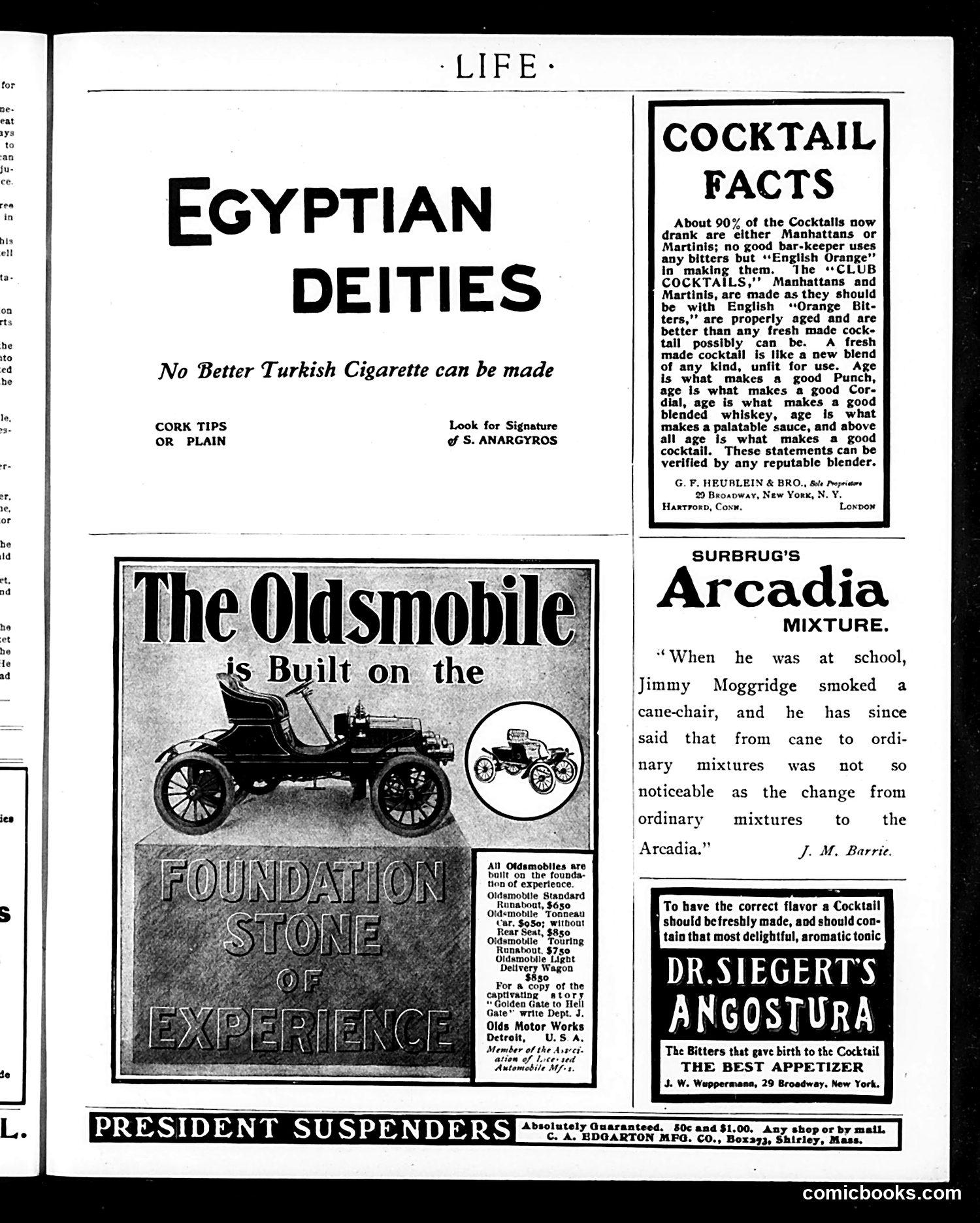
This page is primarily **advertising**, not satirical content. It contains product advertisements arranged around the masthead "LIFE." The main advertisements include: - **Egyptian Deities cigarettes** (top left): A straightforward product ad claiming superiority of Turkish cigarettes - **The Oldsmobile** (center): Features a large car illustration emphasizing "Foundation of Experience" as its selling point, with pricing details - **Cocktail Facts** (top right): G. F. Heublein & Bro. promoting their bitters and cocktail mixtures, with technical claims about proper aging - **Surbrugg's Arcadia Mixture**: A tobacco product endorsed with a quote attributed to J. M. Barrie - **Dr. Siegert's Angostura Bitters** (bottom right): Marketed as "the bitters that gave birth to the Cocktail" - **President Suspenders** (bottom): A brief product notice The page reflects **early 20th-century consumer culture**, with ads emphasizing product quality, proper technique, and celebrity endorsements. No political satire or cartoon commentary is present.
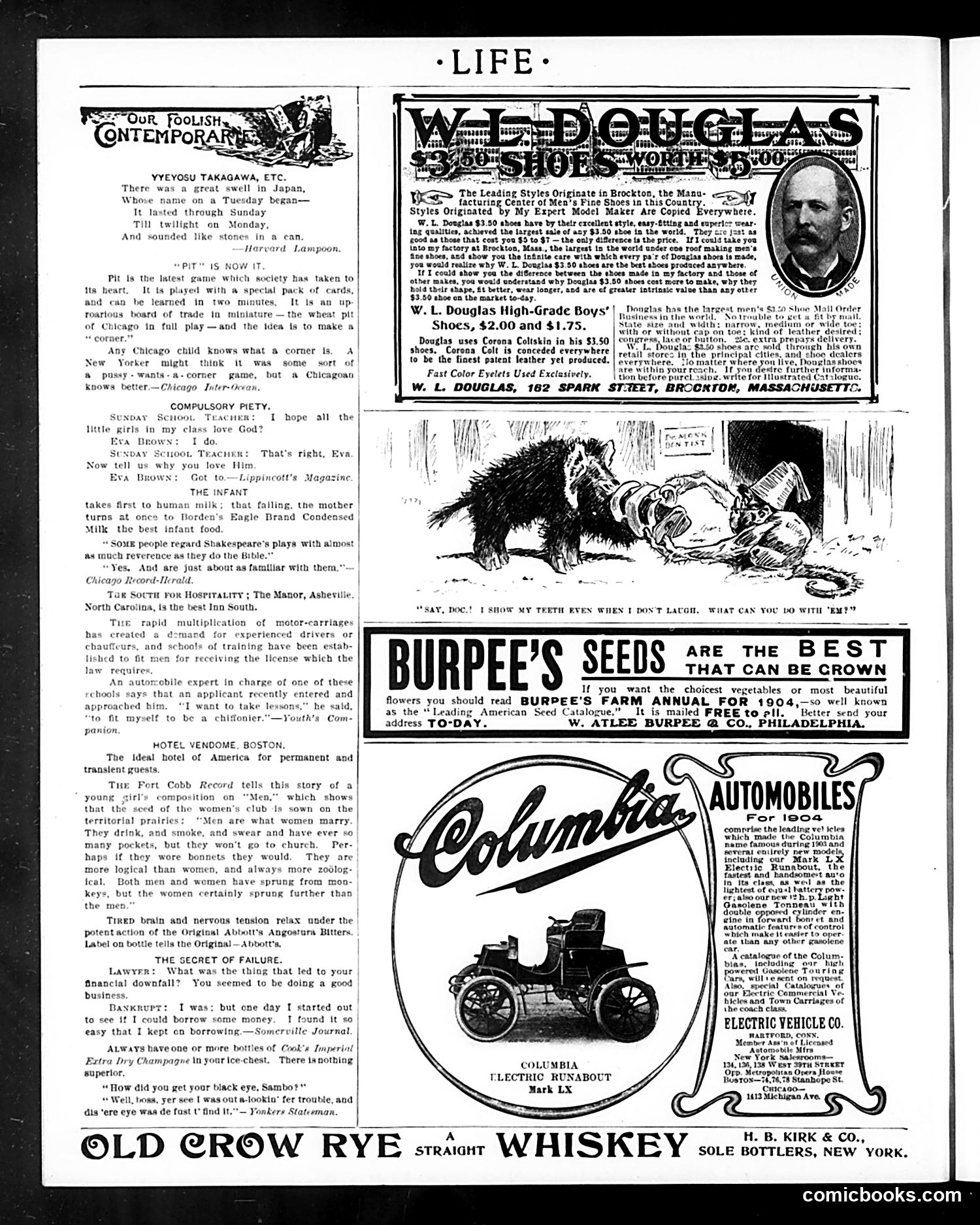
This page from *Life* magazine contains primarily **humorous anecdotes and advertisements** rather than political cartoons. The main content consists of short jokes and observations clipped from other publications. The notable cartoon depicts **a dog with bared teeth** refusing to laugh, captioned "Say, Doc! I show my teeth even when I don't laugh. What can you do with 'em?" This appears to be a dental humor joke, likely about tooth-pulling or dentistry. The page is dominated by **advertisements** for W.L. Douglas shoes, Burpee's seeds, Columbia automobiles, Old Crow whiskey, and other products typical of early 1900s marketing. The humor pieces touch on contemporary social observations: Japanese earthquakes, Chicago commodity trading ("the Pit"), mandatory religious instruction in schools, women's suffrage sentiment (a woman's composition on "Men"), and the dangers of easy credit. The overall tone reflects *Life*'s satirical approach to American society and modern conveniences of the early 1900s.
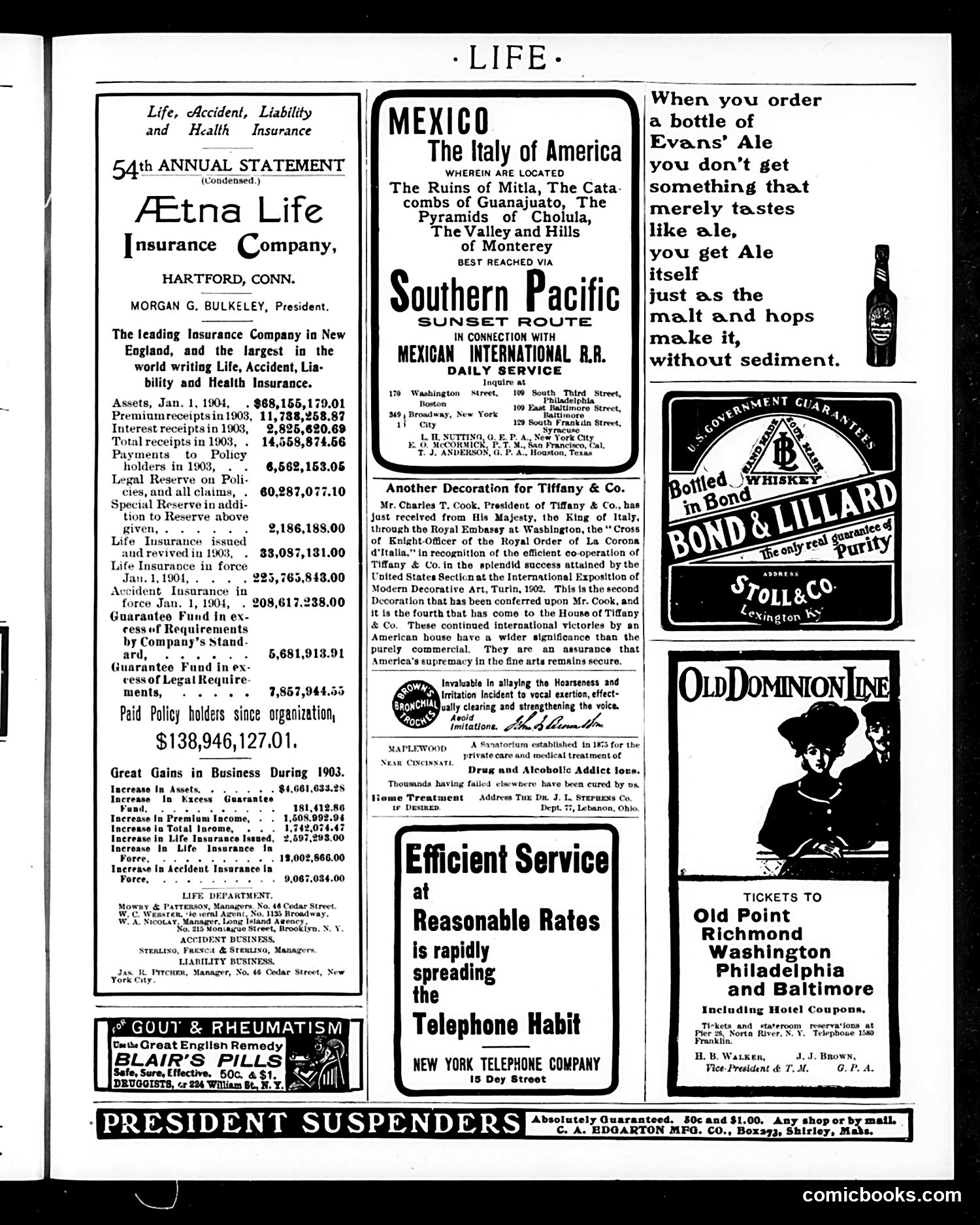
This page is primarily filled with advertisements and corporate notices, not satirical content. The dominant feature is Aetna Life Insurance Company's 54th annual financial statement, detailing assets and policy statistics from 1904. Several period advertisements appear: Evans' Ale (emphasizing natural ingredients), Bond & Lillard Whiskey, the Southern Pacific railroad promoting Mexico as "The Italy of America," and various commercial services. One notable non-advertising item describes Charles T. Cook of Tiffany & Co. receiving the Italian royal decoration "Cross of Knight-Officer" for his company's role in the 1902 Turin International Exposition of Modern Decorative Art—reflecting early 20th-century American commercial prestige and international trade relationships. The page contains little satire or cartooning; it's a straightforward commercial/financial publication typical of *Life* magazine's mixed advertising-editorial format during this period.
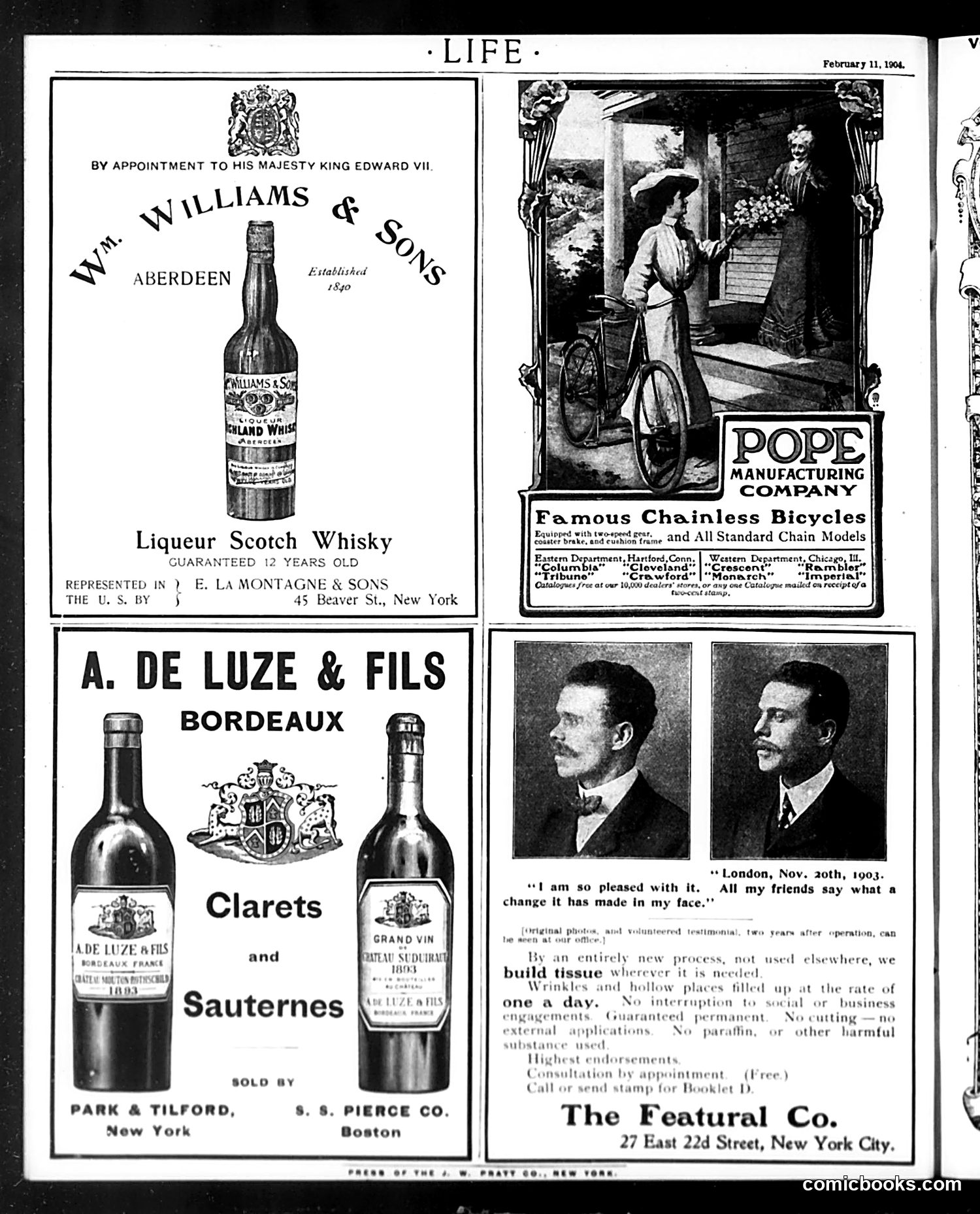
This page is primarily **advertising**, not political satire. It contains four commercial advertisements from February 1904: 1. **W.M. Williams & Sons** (Aberdeen): Scottish whisky, 12 years old 2. **Pope Manufacturing Company**: Chainless bicycles in various models 3. **A. De Luze & Fils** (Bordeaux): French wines—clarets and sauternes 4. **The Featural Co.**: A cosmetic/medical procedure claiming to fill wrinkles and "build tissue" using a proprietary process, with before-and-after photographs of men's faces The Featural Co. ad is the most notable to modern readers—it's an early example of dubious cosmetic claims, promising permanent results without surgery or harmful substances. The testimonial format and vague language ("entirely new process") typify unregulated medical advertising of the era. The other ads represent typical turn-of-century luxury goods marketed to affluent consumers.