
Life, 1904-02-11 · page 6 of 20
Life — February 11, 1904 — page 6: what you’re looking at
What you’re looking at
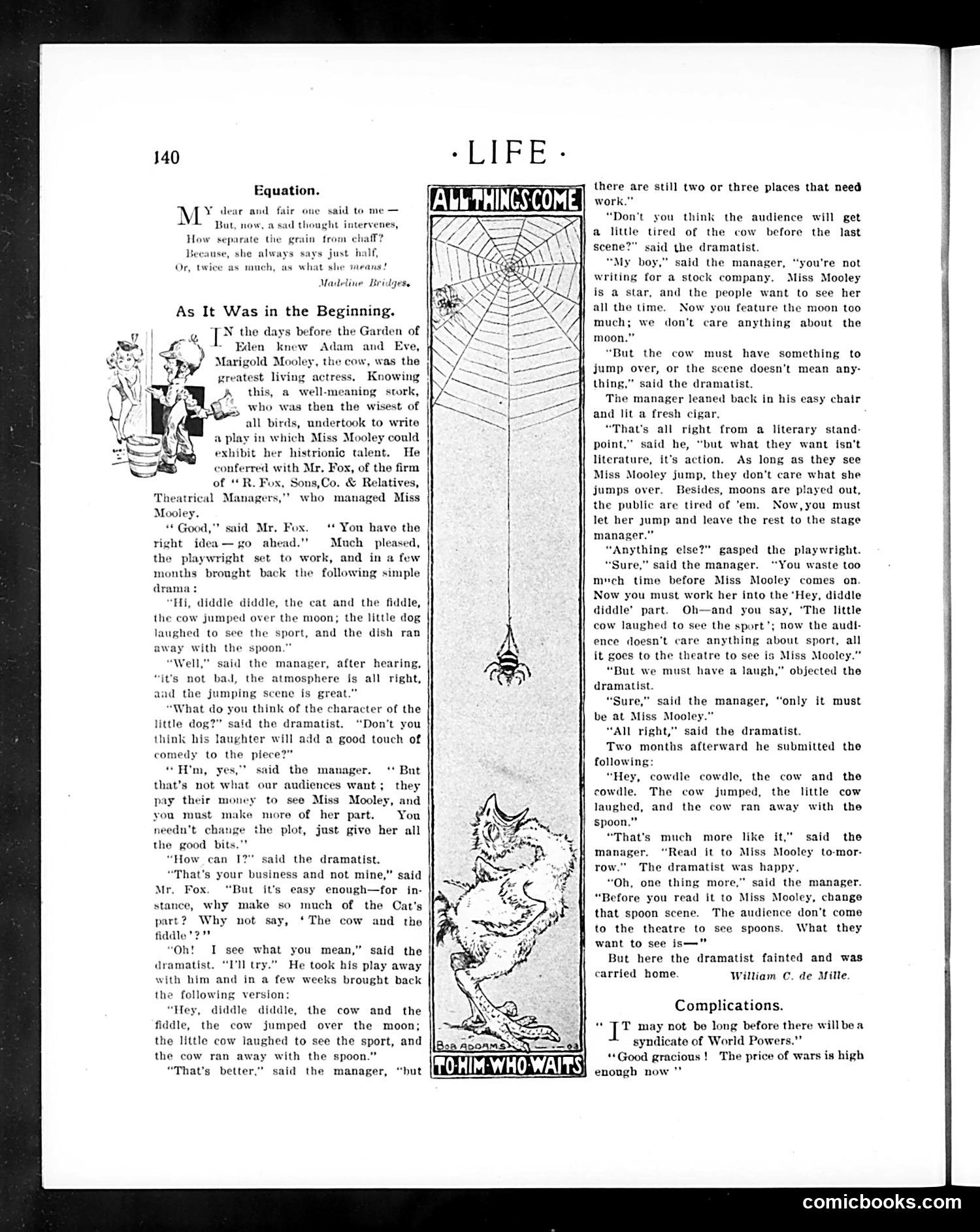
This page satirizes theatrical production through a dialogue between a playwright and theater manager about adapting the nursery rhyme "Hey Diddle Diddle" into a stage play. The central joke mocks commercial theater's demands: the manager insists on featuring the actress Miss Mooley prominently and adding a comedic "jump" scene (the cow jumping over the moon), even though these elements contradict the original rhyme's simplicity. The playwright protests that audiences want action and spectacle rather than faithful adaptation. The accompanying illustrations show the cow and other nursery-rhyme characters. This satire critiques how theatrical producers prioritize star power and crowd-pleasing spectacle over artistic integrity—a timeless Hollywood/Broadway complaint about commerce trumping art.
📄 Transcribed text from this page (OCR, searchable)
Machine-transcribed from the original scan — historical spelling and the odd misread are preserved.
Equation. Y dear and fair one said to me — thought intervenes, How separate the grain trom chaff? Because, she always says just half, Or, twice as much, as what she means! Madrline Bridges. As It Was in the Beginning. N the days before the Garden of Eden knew Adam and Eve, Marigold Mooley, the cow, was the living actres Knowing this, a well-meaning stork, who was then the wisest of all birds, undertook to write a play in which Miss Mooley could exhibit her histrionic talent. He conferred with Mr, Fox, of the firm ., 3,Co. & Relati Mooley. You have the right i J.” Much pleased, the playwi set to work, and in a few months brought back the following simple drama : “Hi, diddle diddle, the cat and the fiddle, the cow jumped over the moon; the little dog laughed to see the sport, and the dish ran away with the spoon Well,” said the manager, after hearing, “it's not bad, the atmosphere is all right, aad the jumping scene is great.” “What do you think of the cha ter of the little dog?” said the dramatist. “Don’t you think his laughter will add a good touch of comedy to the piece? “Him, yes,” said the manager. ‘ But that’s not what our audiences want; they pay their money to see Miss Mooley, and you must make more of her part. You needn't change the plot, just give her all the good bits. “How can 1?" said the dramatist. “That's your business and not mine,” said Mr. Fox. “But it's easy enough—for in- stance, why make so much of the Cat's part? Why not say, ‘The cow and the fiddle’? "" “Oh! I see what you mean,” said the dramatist. “I'll try.” He took his play away with him and in a few weeks brought back the following version: “Hey, diddle diddle, the cow and the fiddle, the cow jumped over the moon; the little cow laughed to see the sport, and the cow ran away with the spoon.” “That’s better,” said the manager, “but there are still two or three places that need work.” “Don't you think the audience will get a little tired of the cow before the last scen id the dramatist. ‘My boy,” said the manager, “you're not writing for a stock company. Miss Mooley is a star, and the people want to see her all the time. Now you feature the moon too much; we don’t care anything about the moon.” “But the cow must have something to jump over, or the scene doesn't mean any- thin, d the dramatist. The manager leaned back in his easy chair and lit a fresh cigar. “That's all right from a literary stand- point,” said he, “but what they want isn't literature, it’s action. As long as they see Miss Mooley jump, they don’t care what she jumps over. Besides, moons are played out, the public are tired of ‘em. Now,you must let her jump and leave the rest to the stage manager.” “Anything else?” gasped the playwright. “Sure,” said the manager. “You waste too mch time before Miss Mooley comes on. Now you must work her into the ‘Hey, diddle diddle’ part. Oh—and you si ‘The little cow laughed to see the sport’; now the audi- ence doesn’t care anything about sport, all it goes to the theatre to see is Miss Mooley.” “But we must have a laugh,” objected the dramatist “Sure,” said the manager, “only it must be at Miss Mooley.” “AIL right,” said the dramatist. Two months afterward he submitted the following: “Hey, cowdle cowdle, the cow and the cowdle. The cow jumped, the little cow laughed, and the cow ran away with the spoon.” “That's much more like it,” said the Read jt to Miss Mooley to-mor- The dramatist was happy. “Oh, one thing more,” said the manager. “Before you read it to Miss Mooley, change that spoon scene. The audience don’t come to the theatre to see spoons. What they want to see is—" But here the dramatist fainted and was carried home. William C. de Mille. Complications. “JT may not bo long before there will bea syndicate of World Powers.” “Good gracious! The price of wars is high enough now " comicbooks.com