
Life, 1904-02-11 · page 14 of 20
Life — February 11, 1904 — page 14: what you’re looking at
What you’re looking at
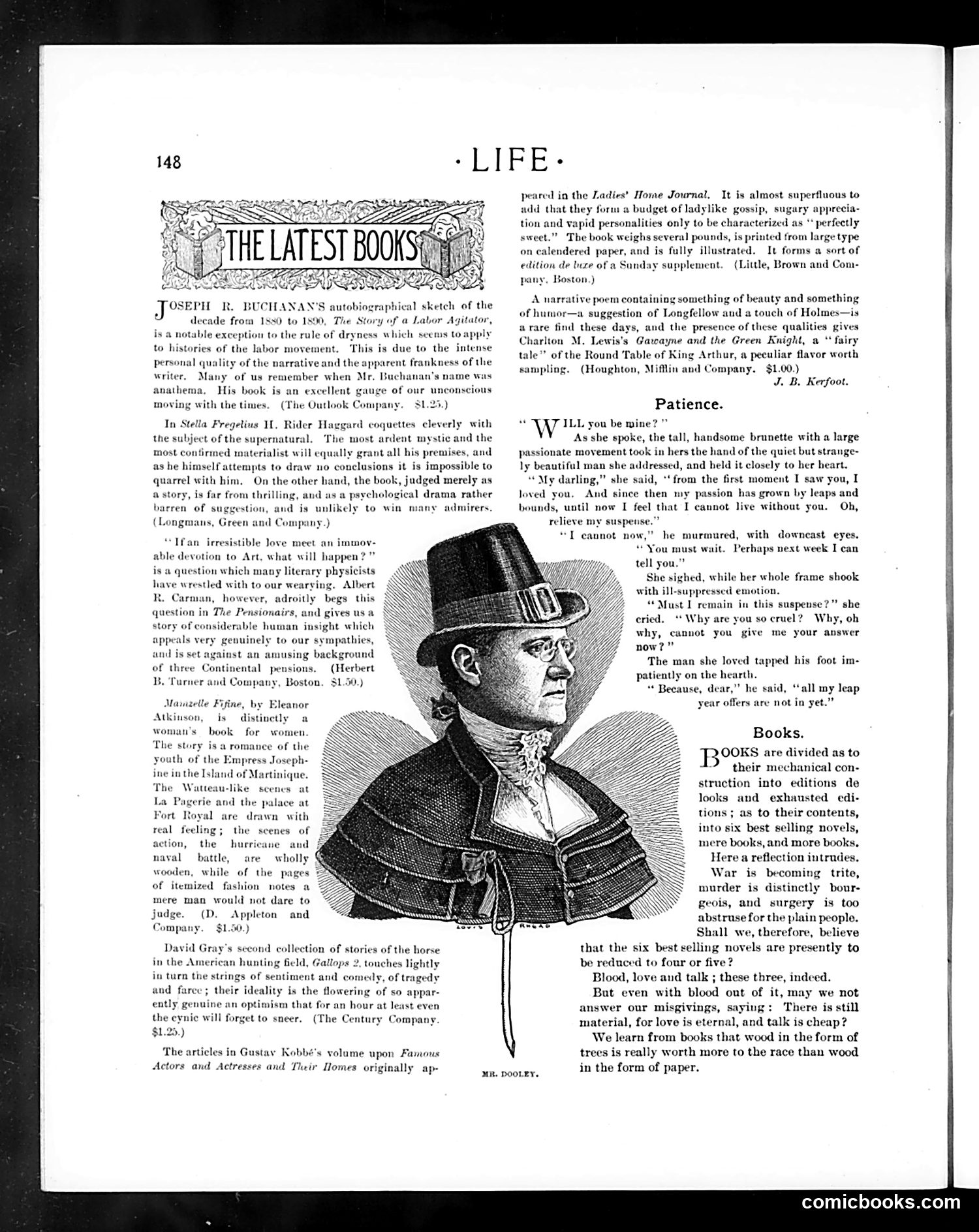
This page contains a book review section and a short serialized story titled "Patience." The illustrated story depicts a melodramatic romantic scene: a woman passionately declares her love to a man, demanding he answer her marriage proposal immediately. He refuses, asking her to wait until next week, causing her visible distress. The satire likely mocks the overwrought emotional theatricality of contemporary romance fiction—the breathless declarations, the swoons, the theatrical anguish over delayed answers. The man's calm refusal to be rushed by her "passionate movement" and emotional manipulation may also gently mock the era's gender dynamics, where women were expected to be the emotionally volatile party. The placement alongside book reviews about sentimental works reinforces that this represents typical popular fiction of the period: emotionally excessive, morally simplistic, and designed primarily for female readers.
📄 Transcribed text from this page (OCR, searchable)
Machine-transcribed from the original scan — historical spelling and the odd misread are preserved.
«LIFE= R. BUCHANAY’S a 1 sketch of the decade from 1880 to 1890, The Story ef a Labor Agit is a notable exception to the rule of dryness which seems to apply This is due to the intense pparent frank His book is an excellent gauge of our unconse’ moving with the times. (The Outlook Company. $1.25.) In Stella Fregetius IL, Rider Haggard coquettes cleverly with the subject of the supernatural. The most ardent mystic and the most contirmed materialist will equally grant all his premises, and as he himself attempts to draw no conclusions it is impossible to quarrel with him. On the other hand, the book, judged merely as a story, is far from thrilling, and as a psychological drama rather barren of suggestion, and is unlikely to win many admirers. (Longmans, pany “Ifan irresistible love meet an immoy- able devotion to Art, what will happen?” is a question which many literary phy wrestled with to our wearsing. Albert R. Carman, however, adroitly begs this question in The Pensionairs, and gives us a story of considerable human insight which genuinely to our sympathies, inst an amusing background of three Continental pensions. (Herbert B, Turner and Company, Boston. $1.50.) appeals ve Mamzelle Fisine, Atkinson, is distinetls woman's book for women. The story isa romance of the youth of the Empress Joseph- ine in the Island of Martinique. The Watteau-like scenes at La Pagerie and the palace at Fort Royal are drawn with real feeling; the scenes of action, the hurricane aud naval — battle, wholly wooden, while of the of itemized fashion notes mere man would not dare to judge. (D. Appleton and Company. $1.50.) David Gray's second collection of stories of the horse in the American hunting field, Gatlops 2, touches lightly in turn the strings of sentiment and comedy, of tragedy and farce; their ideality is the flowering of so appar- ently genuine sm that for an hour at least even to sneer. (The Century Company. The articles in Gustay Kobbé's volume upon Famous Actors and Actresses and Their Homes originally ap- MR. DOOLEY. peared in the Ladies’ Home Journal. It is almost superfluous to add that they form a budget of ladylike gossip, sugary apprecia- tion and vapid personalities only to be characterized as“ perfectly sweet.” The book weighs several pounds, is printed from large ty pe on calendered paper, and is fully illustrated, It forms a sort of edition de luze of a Sanday supplement. (Little, Brown and Com- pany, Boston.) A narrative poem containing someth of humor—a suggestion of Longfellow arare find these days, and the presen Charlton M. Lewis's Gavayne and the Green Knight, a “ fairy tale” of the Round Table of King Arthur, a peculiar flavor worth sampling. (Houghton, Mifflin and Company. $1.00.) J. B. Kerfoot. of beauty and something da touch of Holmes—i of these qualities Patience. OY TL you be wine? ” As she spoke, the tall, handsome brunette with a large passionate movement took in hers the hand of the quiet but strange- ly beautiful man she addressed, and held it closely to her heart, My darling,” she said, “from the first moment I saw you, I loved you. And since then my passion has grown by bounds, until now I feel that I cannot live without y relieve my suspense.” “TL eannot now,” he murmured, with downeast eyes. You must wait. Perhaps next week I can tell you.” She sighed, while her whole frame shook with ill-suppressed emotion, “Must I remain in this suspense?” she cried.“ Why are you so cruel? Why, oh why, cannot you give me your answer now? The man she loved tapped his foot im- patiently on the hearth. “ Because, dear,” he said, “all my leap year offers are not in yet.” Books. OOKS are divided as to their mechanical con- struction into editions de looks and exhausted edi- tions ; as to their contents, into six best selling novels, mere books, and more books Here a reflection intrude: War is becoming trite, murder is distinctly bour- geois, and surgery is too abstruse for the plain people. Shall we, therefore, believe that the six best selling novels are presently to be reduced to four or five? Blood, love and talk ; these three, indeed. But even with blood out of it, may we not answer our misgivings, saying: There is still material, for love is eternal, and talk is cheap? We learn from books that wood in the form of trees is really worth more to the race than wood in the form of paper. comicbooks.com