
Life, 1904-02-11 · page 4 of 20
Life — February 11, 1904 — page 4: what you’re looking at
What you’re looking at
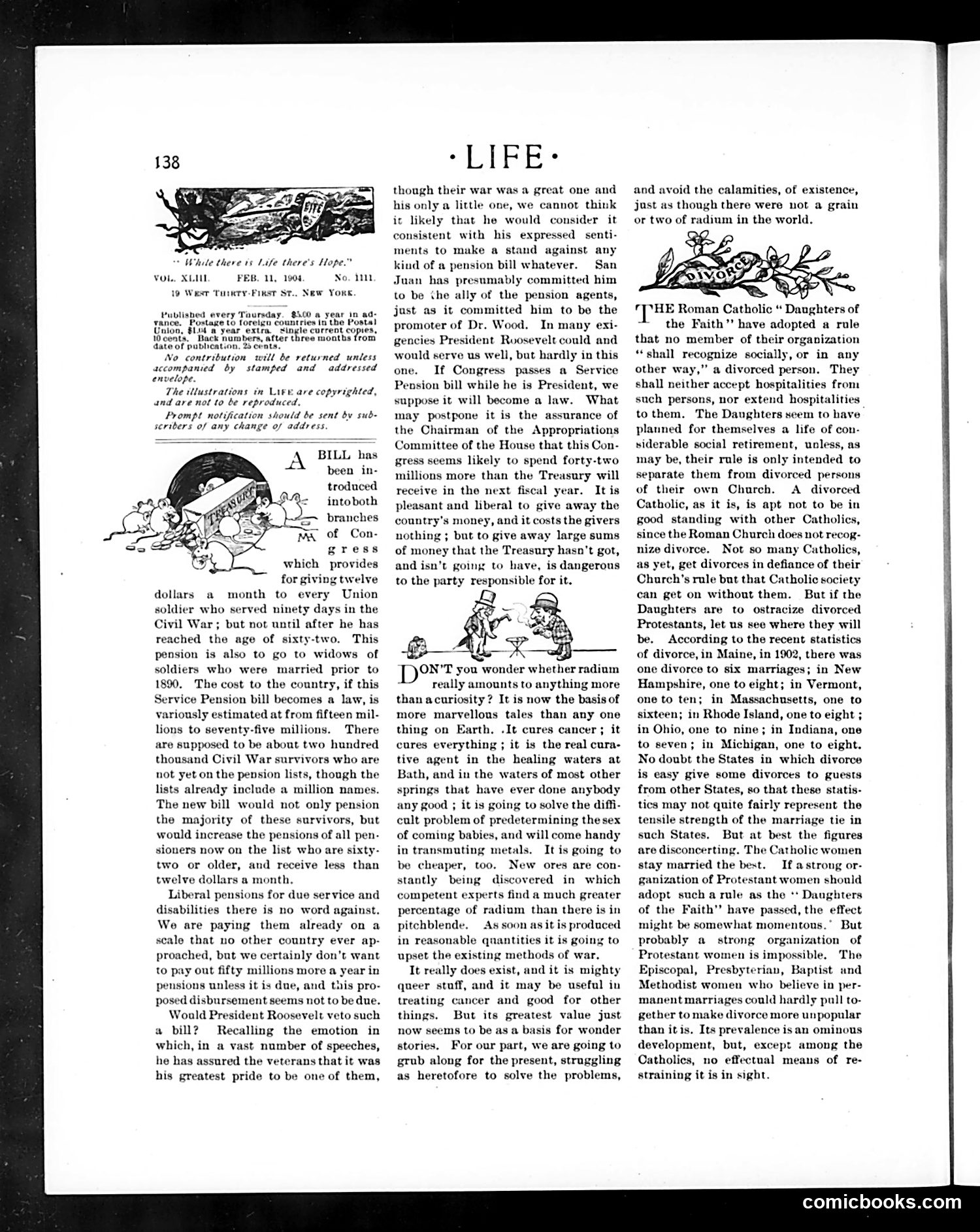
This page contains two satirical cartoons and accompanying text discussing early 1900s political issues. The **left cartoon** depicts a cornucopia or horn of plenty spilling coins, labeled to represent government spending on pensions. The satire criticizes a proposed Service Pension bill that would provide monthly payments to Civil War veterans regardless of financial need—a costly expansion of existing pension programs. The **right cartoon** shows two figures (appearing to be children or small people) on a seesaw or plank, illustrating the text's discussion about radium's supposed miraculous properties. The satire mocks contemporary claims that radium could cure cancer, solve sex determination, and solve other major problems—dismissing such enthusiasm as baseless wonder-mongering. Both cartoons exemplify *Life*'s satirical critique of government spending and scientific hype.
📄 Transcribed text from this page (OCR, searchable)
Machine-transcribed from the original scan — historical spelling and the odd misread are preserved.
* While there ts Life there's Hope.” VoL. XU FEB. 11, 19 Weer Turkey. 1904 No. it PinsT St.. New Yous. ‘ublished every Taursday. $3.00 a year in ad- eign countries in the Postal alon, $LOL a year extra. single current copies, cents. Back numbers, after three months from date of publication, 2 cents. No contribution will be returned unless accompanied by stamped and addressed envelope. The illustrations in Live are copyrighted, and are not to be reproduced, Prompt notification should be sent by sub- seribers of any change of address, BILL has been in- troduced intoboth branches of Con- gress which provides for giving twelve dollars a month to every Union soldier who served ninety days in the Civil War ; but not until after he has reached the age of sixty-two. This pension is also to go to widows of soldiers who were married prior to 1890. The cost to the country, if this Service Pension bill becomes a law, is variously estimated at from fifteen mil- lions to seventy-five millions. There are supposed to be about two hundred thousand Civil War survivors who are not yet on the pension lists, though the lists already include a million names. The new bill would not only pension the majority of these survivors, but would increase the pensions of all pen- sioners now on the list who are sixty- two or older, and receive less than twelve dollars a month, Liberal pensions for due service and disabilities there is no word against. We are paying them already on a scale that no other country ever ap- proached, but we certainly don’t want to pay out fifty millions more a year in pensions unless it is due, and this pro- posed disbursement seems not to be due. Woald President Roosevelt veto such a bill? Recalling the emotion in which, in a vast number of speeches, he has assured the veterans that it was his greatest pride to be one of them, “LIPE* though their war was a great one and his only a little one, we cannot think it likely that he would consider it consistent with his expressed senti- ments to make a stand against any kind of a pension bill whateve: San Juan has presumably committed him to be the ally of the pension agents, just as it committed him to be the promoter of Dr. Wood. In many exi- gencies President Ruosevelt could and would serve us well, but hardly in this one. If Congress passes a Service Pension bill while he is President, we suppose it will become a law. What may postpone it is the assurance of the Chairman of the Appropriations Committee of the House that this Con- gress seems likely to spend forty-two millions more than the Treasury will receive in the next fiscal year. It is pleasant and liberal to give away the country’s money, and it costs the givers nothing ; but to give away large sums of money that the Treasury hasn't got, and isn’t going to have, is dangerous to the party responsible for it. g At x ON’T you wonder whether radium really amounts to anything more than acuriosity ? It is now the basis of more marvellous tales than any one thing on Earth, .It cures cancer; it cures everything ; it is the real cura- tive agent in the healing waters at Bath, and in the waters of most other springs that have ever done anybody any good ; it is going to solve the diffi- cult problem of predetermining the sex of coming babies, and will come handy in transmuting metals. It is going to be cheaper, too. New ores are con- stantly being discovered in which competent experts find a much greater percentage of radium than there is in pitchblende. As soon as it is produced in reasonable quantities it is going to upset the existing methods of war, It really does exist, and it is mighty queer stuff, and it may be useful in treating cancer and good for other things. But its greatest value just now seems to be as a basis for wonder stories. For our part, we are going to grub along for the present, struggling as heretofore to solve the problems, and avoid the calamities, of existence, just as though there were not a grain or two of radium in the world. PH Roman Catholic “ Daughters of ~ the Faith’’ have adopted a rule that no member of their organization “shall recognize socially, or in any other way,” a divorced person. They shall neither accept hospitalities from such persons, nor extend hospitalities tothem. The Daughters seem to have planned for themselves a life of con- siderable social retirement, unless, as may be, their rule is only intended to separate them from divorced persons of their own Church. A divorced Catholic, as it is, is apt not to be i good standing with other Catholics, since the Roman Church does not recog- nize divorce. Not so many Catholic: as yet, get divorces in defiance of their Church's rule but that Catholic society can get on without them. But if the Daughters are to ostracize divorced Protestants, let us see where they will be. According to the recent statistics of divorce, in Maine, in 1902, there was one divorce to six marriages; in New Hampshire, one to eight; in Vermont, one to ten; in Massachusetts, one to sixteen; in Rhode Island, one to eight ; in Ohio, one to nine; in Indiana, one to seven; in Michigan, one to eight. No doubt the States in which divorce is easy give some divorces to guests from other States, so that these statis- tics may not quite fairly represent the tensile strength of the marriage tie in such States. But at best the figures are disconcerting. The Catholic women stay married the best. If a strong or- ganization of Protestant women should adopt such a rule as the ** Daughters of the Faith’ have passed, the effect might be somewhat momentous.” But probably a strong organization of Protestant women is impossible. The Episcopal, Presbyterian, Baptist and Methodist women who believe in per- manent marriages could hardly pull to- gether to make divorce more unpopular than itis. Its prevalence is an ominous development, but, except among the Catholics, no effectual means of re- straining it is in sight. comicbooks.com