
Life, 1904-02-11 · page 12 of 20
Life — February 11, 1904 — page 12: what you’re looking at
What you’re looking at
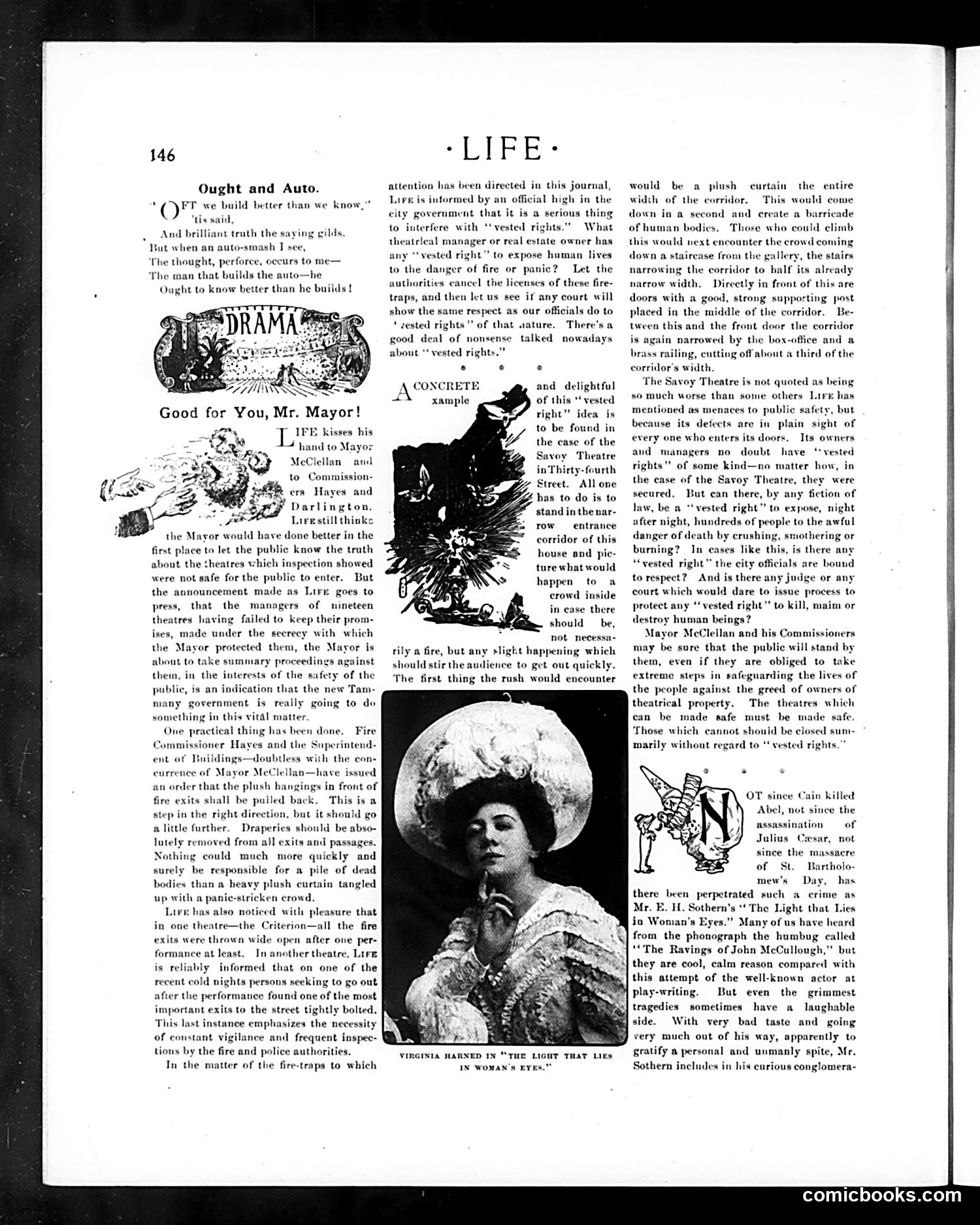
This page critiques theatrical safety regulations using Mayor McClellan of New York as its focus. The article "Good for You, Mr. Mayor!" praises the Mayor's efforts to enforce fire safety inspections at theaters after discovering unsafe conditions. The cartoon depicts a chaotic scene where a crowd rushes through a narrow theater corridor during an emergency, illustrating the article's main concern: "vested rights." Theater owners claimed property rights exempted them from safety regulations. The satire argues this is absurd—that no property right should permit endangering lives through inadequate fire exits or safety measures. The accompanying photograph shows Virginia Harned in "The Light That Lies in Woman's Eyes," representing contemporary theater. The piece advocates for mandatory theater closures if they cannot meet safety standards, mocking owners' resistance as greedy obstruction.
📄 Transcribed text from this page (OCR, searchable)
Machine-transcribed from the original scan — historical spelling and the odd misread are preserved.
146 Ought and Auto. "CFT re build better than we know,” tis said, And brilliant trath the saying gilds. Tut when an auto-smash I see, The thought, perfore ‘The man that builds the aute Ought to know better than he builds! occurs to me— —he Good for You, Mr. Mayor! IF ses his 4 hand to Mayor McC to Commission- $04B crs Hayes and er Darlington. P® Lirestill thinks the Mayor would have done better in the first place to let the public know the truth about the theatres which inspection showed were not safe for the public to enter. But the announcement made as Lire goes to press, that the managers of nineteen theatres having failed to keep their prom- ises, made under the secrecy with which the Mayor protected them, the Mayor is about to take summary proceedings against them, in the interests of the safety of the public, is an indication that the new Tam- many government is really go to do ital matter. One practical thing has been dor Commissioner Hayes and the Superintend- ent of Buildings—doubtless with the con- Mayor MeClellan—have issued that the plush hangings in front of fire exits shall be pulled back. This is a ction, but it should go alittle further. Draperies should be abso- lutely removed from all exits and passages. thing could much more quickly and surely be responsible for a pile of dead bodies than a heavy plush curtain tangled up with a panie-stricken crowd. Live has also noticed with p in one theatre—the Criterion— Han and something in this currence 6 an ord step in the right d sure that Il the fire ts were thrown wide open after one per- formance atleast. In another theatre, Lire y informed that on one of the recent cold nights persons seeking to go out afier the performance found one of the most important exits to the street tightly bolted. This last instance emphasizes the necessity of constant vigilance and frequent inspec- tions by the fire and police authorities. In the matter of the fire-traps to which “ LPE * attention has been directed in this journal, Lire is informed by an official high in the city government that it is a serious thing to interfere with “vested rights.” What ager or r r has any ‘vested right” to expose human lives to the danger of fire or panic? Let the uthorities cancel the licenses of the traps, and then let us see if any court will show the same respect as our officials do to ‘ yested rights” of that ature. There's a good deal of nonsense talked nowadays about “vested rights.” theatrical may Lestate own ¢ fire- * ° CONCRETE xample and delightful of this ** vested right” idea is to be found in the case of the y Theatre inThirty-fourth Street. All one has to do is to stand in thenar- row entrance corridor of this house and pic- ture what would happen to a crowd inside in case there should _ be, not necessit- rily a fire, but any slight happening which should stir the audience to get out quickly The first thing the rush would encounter Sav VIRGINIA HARNED IN “THE LIGHT THAT LiEs IN WOMAN'S EYES.” g] side. curtain the entire This would come 1 create a barricade ‘Those who could climb this would next encounter the crowd coming would be a plush width of the corridor, down in a second a of human bodies. down a staircase from the gallery, the stairs ¢ the corridor to balf its already narrow width. Directly in front of this are doors with a good, strong supporting post placed in the middle of the corridor. Be- tween this and the front door the corridor is again narrowed by the box-office and a brass railing, cutting off about a third of the corridor’s width. The Savoy Theatre is not quoted as being so much worse than some others Lirx has mentioned as menaces to public safety, but because its defects are in plain sight of every one who enters its doors, Its owners and doubt have rights” of some kind—no matter how, in the case of the Savoy Theatre, they were secured. But can there, by any fiction of law, be a “vested right” to expose, night after night, hundreds of people to the awful danger of death by crushing, smothering or burning? In cases like this, is there any “vested right” the city officials are bound to respect? And is there any judge or any court which would dare to issue process to protect any ‘vested right” to kill, destroy human beings? Mayor McClellan and his Commissioners may be sure that the public will stand by them, even if they are obliged to take extreme steps in safeguarding the lives of inst the greed of owners of theatrical property. The theatres which can be made safe must be m: Those which cannot should be closed sum- marily without regard to ‘vested rights.” managers no “vested maim or y safe. OT since Cain killed Abel, not since the Julius Cesar, not since the massacre of St. Barthoio- mew's Day, has there been perpetrated such a crime as Mr. E. H. Sothern’s ** Tho Light that Lies ia Woman's E: Many of us have heard from the phonograph the humbug called “*The Ravings of John McCullough,” but they are cool, calm reason compared with this attempt of the well-known actor at play-writing. But even the grimmest tragedies sometimes have a laughable With very bad taste and going very much out of his way, apparently to gratify a personal and unmanly spite, Mr. Sothern includes in his curious conglomera- comicbooks.com