
Life, 1904-02-11 · page 13 of 20
Life — February 11, 1904 — page 13: what you’re looking at
What you’re looking at
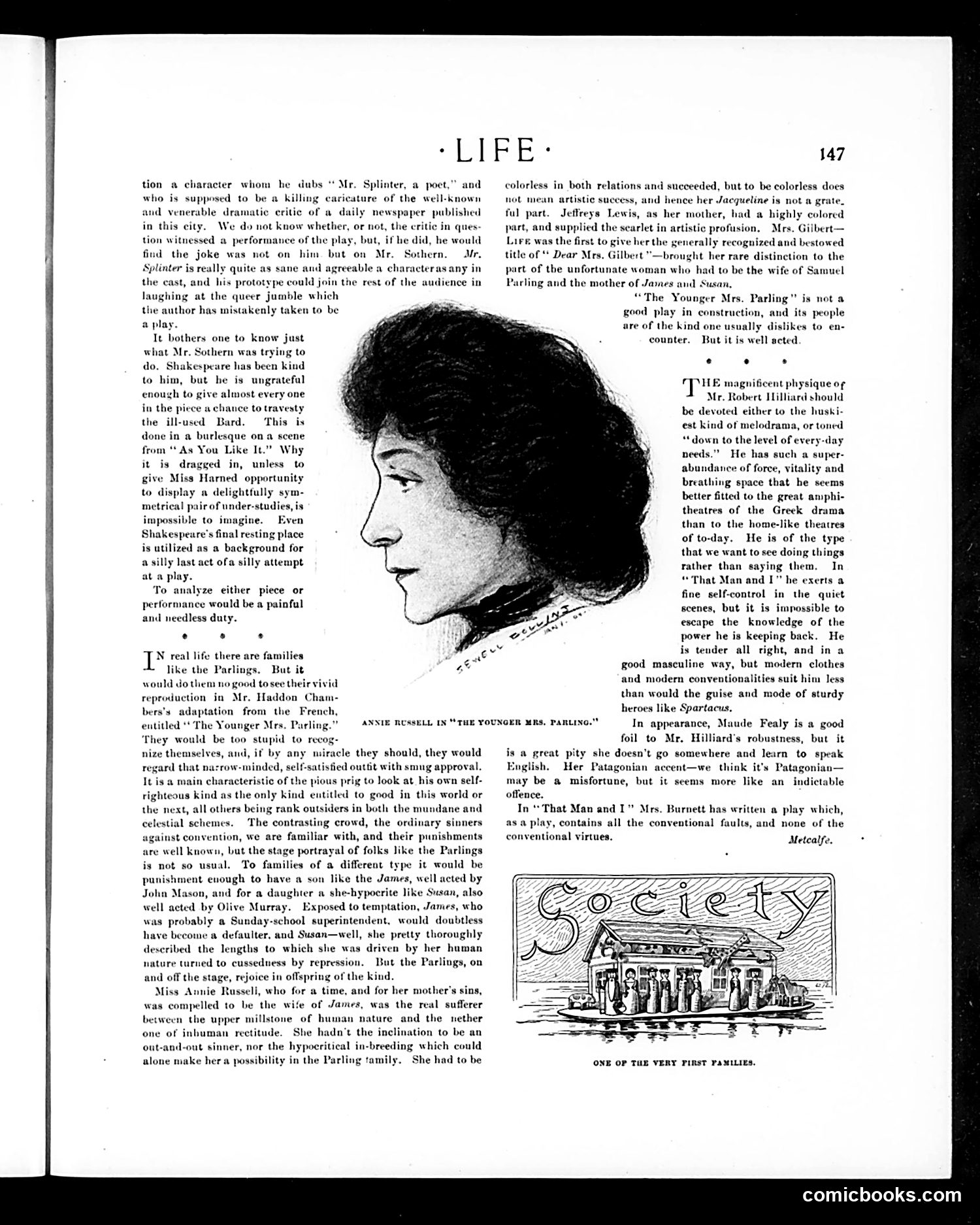
This page reviews two theatrical productions. The main content critiques an adaptation of Shakespeare's "As You Like It" starring actor Sothern, which the critic finds poorly constructed—a "silly attempt at a play" that uses Shakespeare as mere backdrop for cheap laughs and to showcase actress Harned's physical attributes. The portrait shows **Annie Russell** in "The Younger Mrs. Parling," a French adaptation about a hypocritical upper-class family. The critic argues such self-righteous, repressive families are tedious theatrical subjects, though Russell performs admirably in a thankless "colorless" role. The review praises supporting actresses (Jeffreys Lewis, Mrs. Gilbert) for bringing more vivid characterization to their parts. The satire targets theatrical mediocrity and the exploitation of classic literature for frivolous entertainment—concerns that remain relevant today.
📄 Transcribed text from this page (OCR, searchable)
Machine-transcribed from the original scan — historical spelling and the odd misread are preserved.
‘hip e- tion a character whom he dubs “Mr. Splinter, a poet,” and who is supposed to be a killing caricature of the well-known id venerable dramatic critic of a in this city. We do not know whether, of not, the eritic in ques- tion witnessed a performance of the play, but, if he did, he would wd the joke was not on him but on Mr. Sothern. Mr, Splinter is really quite as characterasany in the cast, and his prototype could join the rest of the audience in laughing at the queer jumble which the author has mistakenly taken to be a play. It bothers one to know just what Mr. Sothern was trying to do. Shakespeare has been kind to him, but he is ungratefal enough to give almost every one in the piece a chance to travesty the ill-used Bard. This is done in a burlesque ona scene from “ As You Like It.” Why it is dragged in, unless to give Miss Harned opportunity to display a delightfully sym- metrical pair of under-studies, is impossible to imagine. Even Shakespeare's final resting place is utilized as a background for a silly last act ofa silly attempt ata play. To analyze either piece or performance would be a painful and needless duty. jaily newspaper published and agreeable e . . N real life there are families like the Parlings. But it would do then no good tosee their vivid reproduction ia Mr, Haddon Cham- bers's adaptation from the French, entitled “ The Younger Mrs. Parling.” ‘They would be too stupid to recog- nize themselves, and, if by any miracle they should, they would rd that ni winded, self-satisfied outtit with smug approval. It is a main characteristic of the pious prig to look at his own self- righteous kind as the only kind entitled to good in this world or the next, all others being rank outsiders in both the mundane and celestial schemes. The contrasting crowd, the ordinary sinners against convention, we are familiar with, and their punishments are well known, but the stage portrayal of folks like the Parlings is not so usual. To families of a different type it would be punishment enough to have a son like the James, well acted by John Mason, and for a daughter a she-hypocrite like Susan, also well acted by Olive Murray. Exposed to temptation, James, who was probably a Sunday-school superintendent, would doubtless have become a defaulter, and Susan—well, she pretty thoroughly described the lengths to which she was driven by her human nature turned to cusseduess by repression. But the Parlings, on and off the stage, rejoice in offspring of the kind. Miss Annie Russell, who for a time, and for her mother’s sins, was compelled to be the wife of James, was the real sufferer between the upper millstone of human nature and the nether one of inhuman rectitude. She hadn't the inclination to be an out-and-out sinner, nor the hypocritical in-breeding which could alone make her a possibility in the Parling tamily. She had to be ANNIE RUSSELL IN “THE YOUNGER MRS. Pantino." 147 colorless in both relations and succeeded, but to be colorless does not mean artistic success, and hence her Jacqueline is not a grate. ful part. Jeffreys Lewis, as her mother, had a highly colored part, and supplied the scarlet in artistic profusia Mrs. Gilbert— Lire was the first to give her the generally recognized and bestowed title of * Dear Mrs, Gilbert "—brought her rare distinction to the part of the unfortunate woman who had to be the wife of Samuel Parling and the mother of James and Susan, “The Younger Mrs. Parling" is not a good play in construction, and its people are of the kind one usually dislikes to en- counter. But it is well acted. e . . WHE magnificent physique of Mr. Robert Hilliard should be devoted either to the huski- est kind of melodrama, or toned “down to the level of every-day needs.” He has such a super- abundance of force, vitality and breathing space that he see! better fitted to the great amphi- theatres of the Greek drama than to the home-like theatres of to-day. He is of the type that we want to see doing things rather than saying them. In “That Man and I" he exerts a fine self-control in the quiet scenes, but it is impossible to escape the knowledge of the power he is keeping back. He is teuder all right, and in a good masculine way, but modern clothes and modern conventionalities suit him less than would the guise and mode of sturdy heroes like Spartacus, In appearance, Maude Fealy is a good foil to Mr. Hilliard’s robustness, but it is a great pity she doesn't go somewhere and learn to speak English, Her Patagonian accent—we think it's Patagonian— may be a misfortune, but it seems more like an indictable offence. In “That Man and I” Mrs. Burnett has writte asa play, contains all the conventional virtues. a play which, conventional faults, and none of the Metcalf ONE OP THE VERY Pinst PaMiLizs. comicbooks.com