
A complete issue · 36 pages · 1904
Life — January 7, 1904
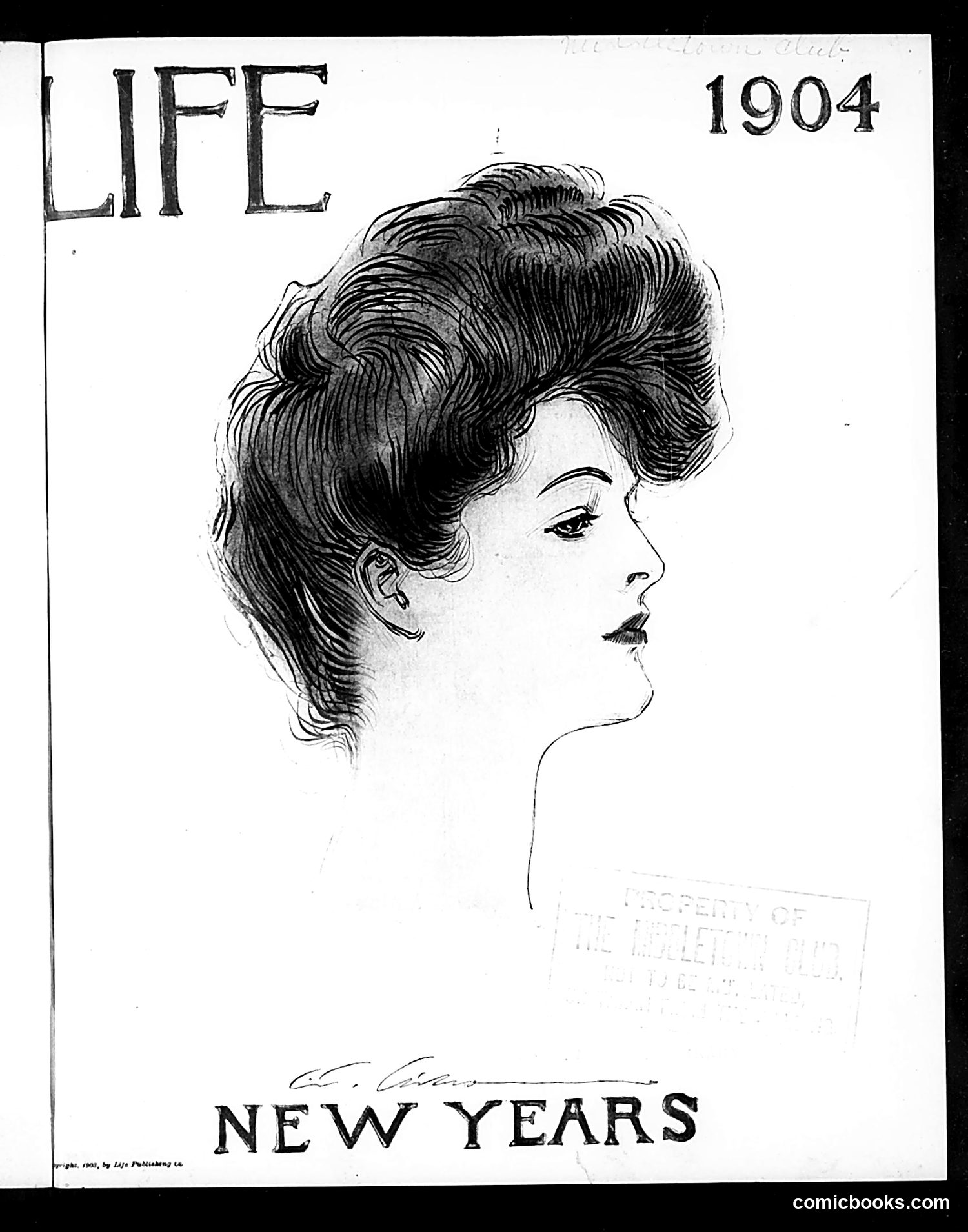
This is a cover illustration for Life magazine's New Year 1904 issue. It features a profile portrait of an elegant woman with elaborately styled hair characteristic of the Gibson Girl aesthetic—the idealized feminine beauty standard of the early 1900s. The cover's simplicity—just a refined pen-and-ink drawing of a woman's profile with "LIFE" and "NEW YEARS" text—suggests this is aspirational rather than satirical. It represents Life magazine's celebration of modern femininity and sophistication as Americans entered 1904. The Gibson Girl style indicated contemporary ideals of educated, fashionable womanhood. Without additional context or caricature, this appears more celebratory artwork than political commentary.
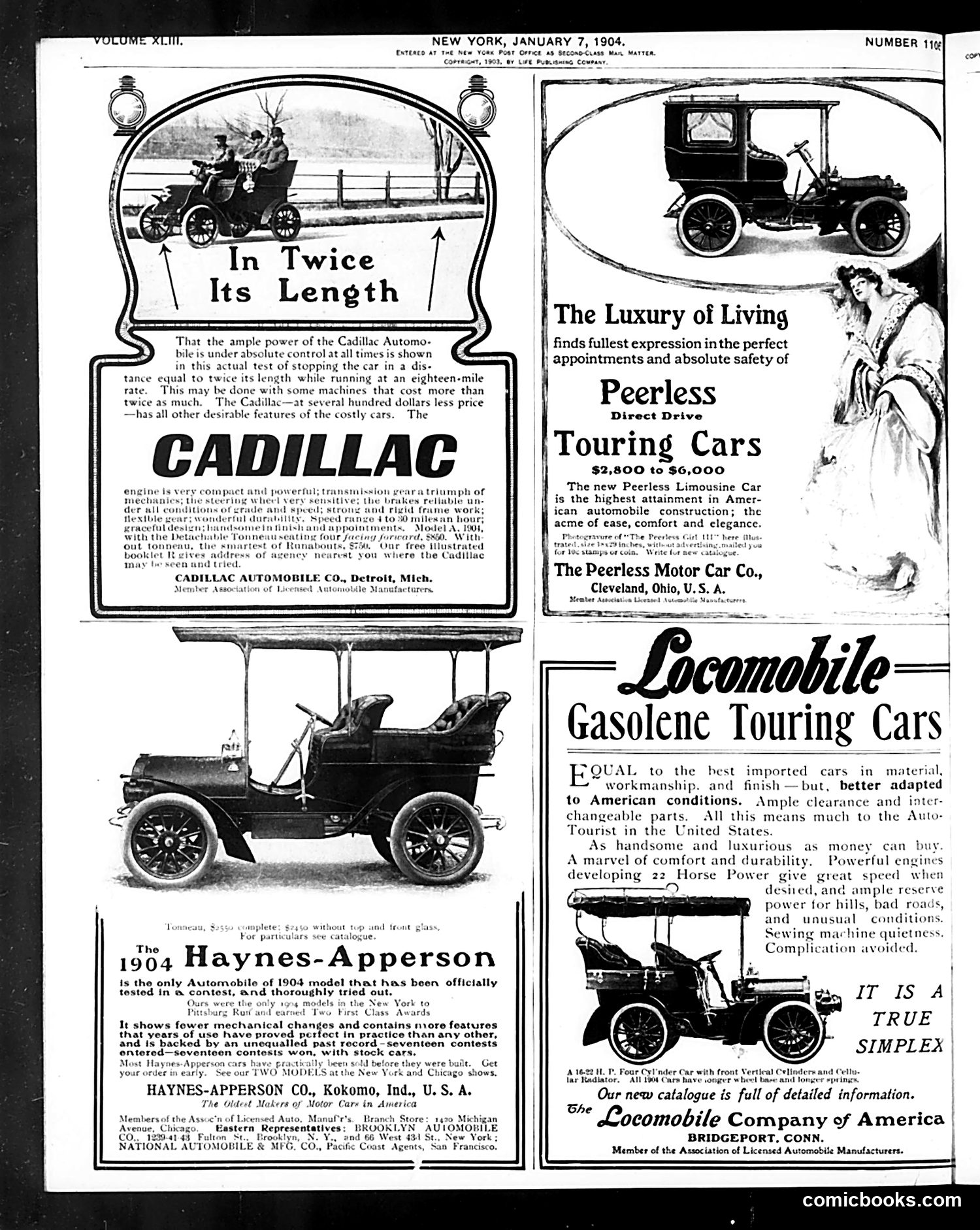
This page is primarily **automobile advertising**, not political satire. It contains four car advertisements from January 1904: 1. **Cadillac** - emphasizes power and control, claiming superiority in an "actual test" 2. **Peerless Touring Cars** - marketed as luxury vehicles ($2,400-$3,600) 3. **Haynes-Apperson** - highlights official contest wins and mechanical innovations 4. **Locomotile** - stresses American-made quality comparable to imported cars The only potential social commentary is implicit: these ads collectively reflect the **emerging automobile industry and early-1900s consumer culture**, when cars were luxury goods accessible only to the wealthy. The repeated emphasis on safety, power, and American manufacturing suggests growing competition and nationalist pride in domestic auto production. There are no political cartoons or satirical commentary on this page.
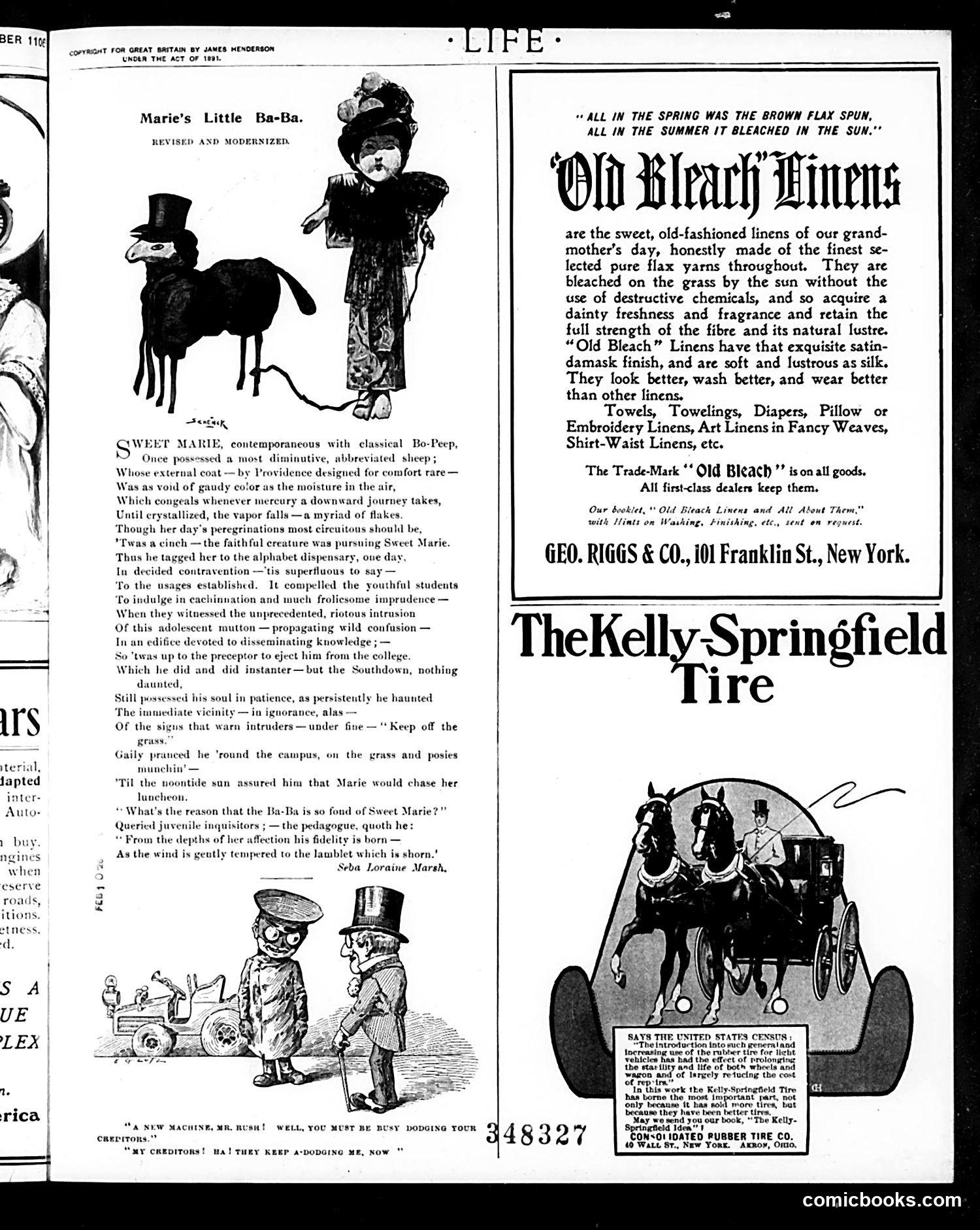
This page is primarily **advertising with one cartoon feature**. The main cartoon depicts a woman in Edwardian dress with an elaborate hat alongside a small dog, titled "Marie's Little Ba-Ba." The accompanying poem ("Sweet Marie") describes the dog's aristocratic pretensions and foolish behavior. The satire targets the affectations of wealthy society women who pamper lap dogs excessively. The dog's name "Ba-Ba" and its pretentious character mock both the pet and its owner's vanity. The cartoon suggests that such women indulge frivolous creatures while neglecting serious matters. The rest of the page contains product advertisements for "Old Bleach Linens" and "Kelly-Springfield Tire," typical of Life magazine's mixed content model blending humor with commercial messages.
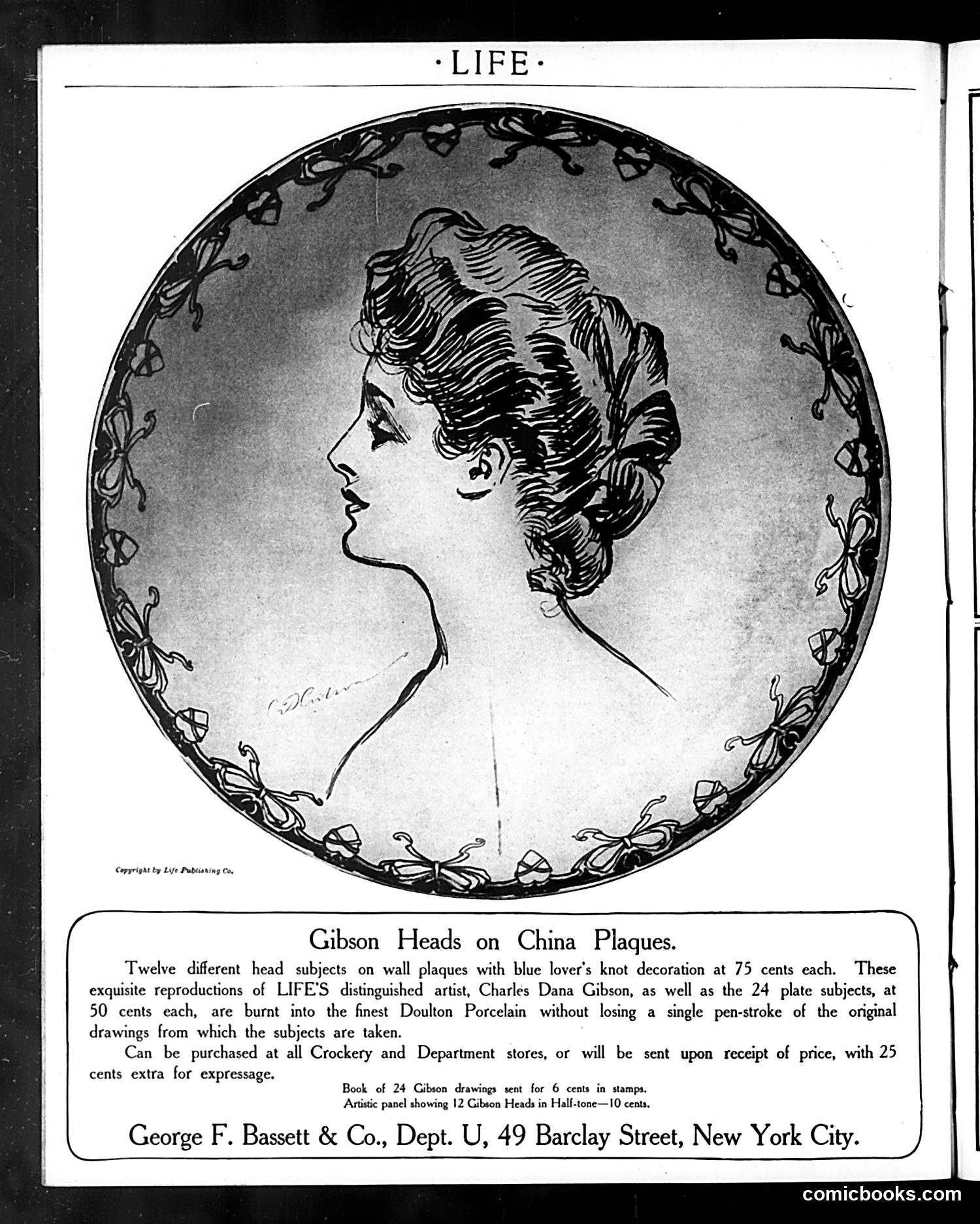
This page is **primarily an advertisement**, not a cartoon or satirical content. It advertises decorative china plaques featuring portrait heads drawn by Charles Dana Gibson, a prominent illustrator of the era. The image shows a classical circular portrait in profile of a woman's head with elaborate curled hair, framed by ornamental borders. This exemplifies Gibson's famous "Gibson Girl" style—idealized drawings of beautiful women that were extremely popular in early 20th-century American culture. The advertisement promotes twelve different head designs available on Doulton Porcelain plaques at 75 cents each, with additional 24-plate subjects at 50 cents. They could be purchased through crockery stores or ordered by mail from George F. Bassett & Co. in New York City. This represents commercialization of Gibson's artistic work rather than political satire.
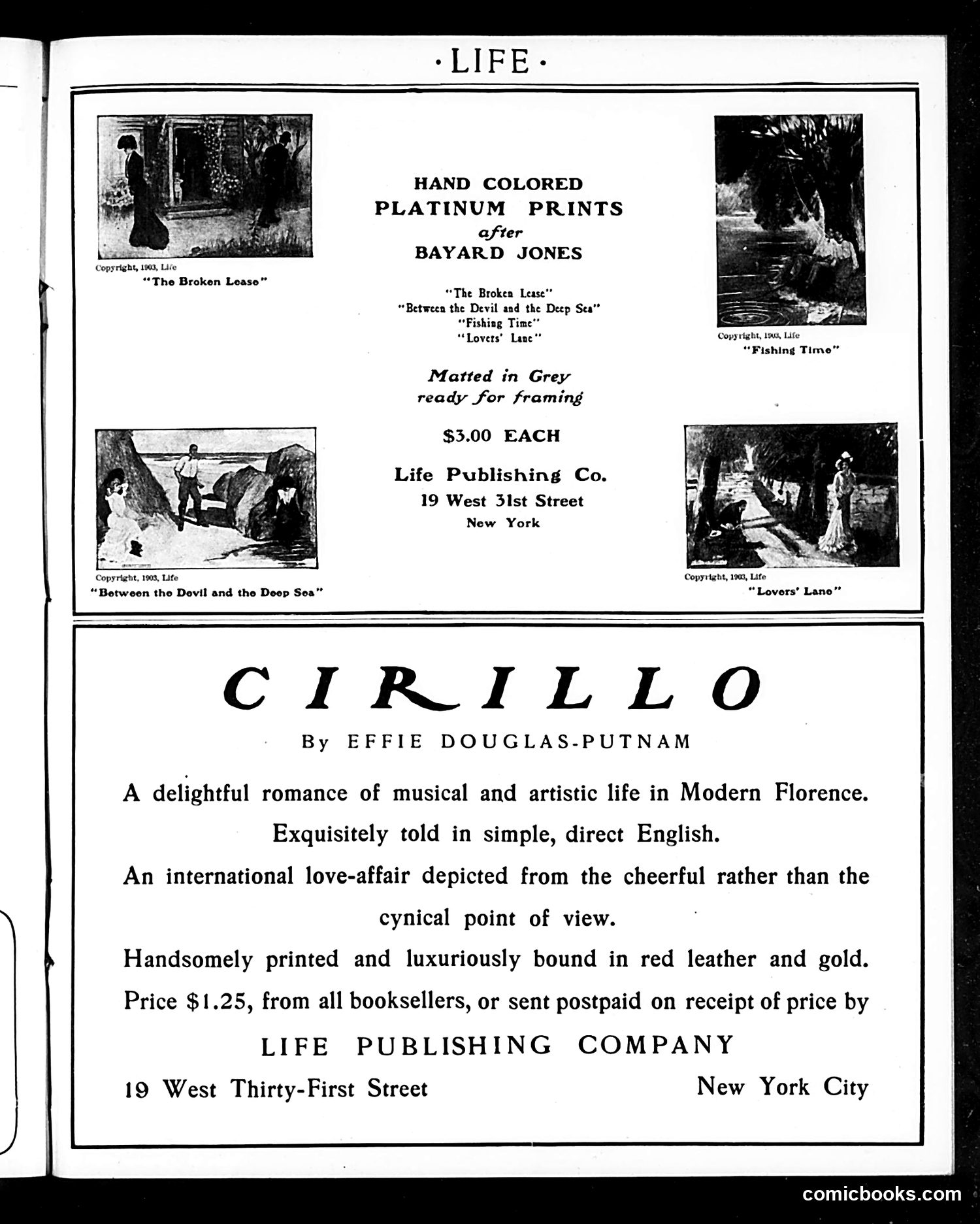
This page contains **advertising, not political satire**. The top half advertises hand-colored platinum prints after artist Bayard Jones—four titled works ("The Broken Lease," "Between the Devil and the Deep Sea," "Fishing Time," "Lovers' Lane") priced at $3.00 each, sold by Life Publishing Co. The bottom half promotes "Cirillo," a romance novel by Effie Douglas-Putnam set in Florence. The description emphasizes it's "exquisitely told" and "handsomely printed" in red leather and gold binding, priced at $1.25. Both advertisements target upper-middle-class readers interested in artistic prints and literary entertainment. The page demonstrates how *Life* magazine supplemented editorial content with luxury goods advertising aimed at affluent subscribers.
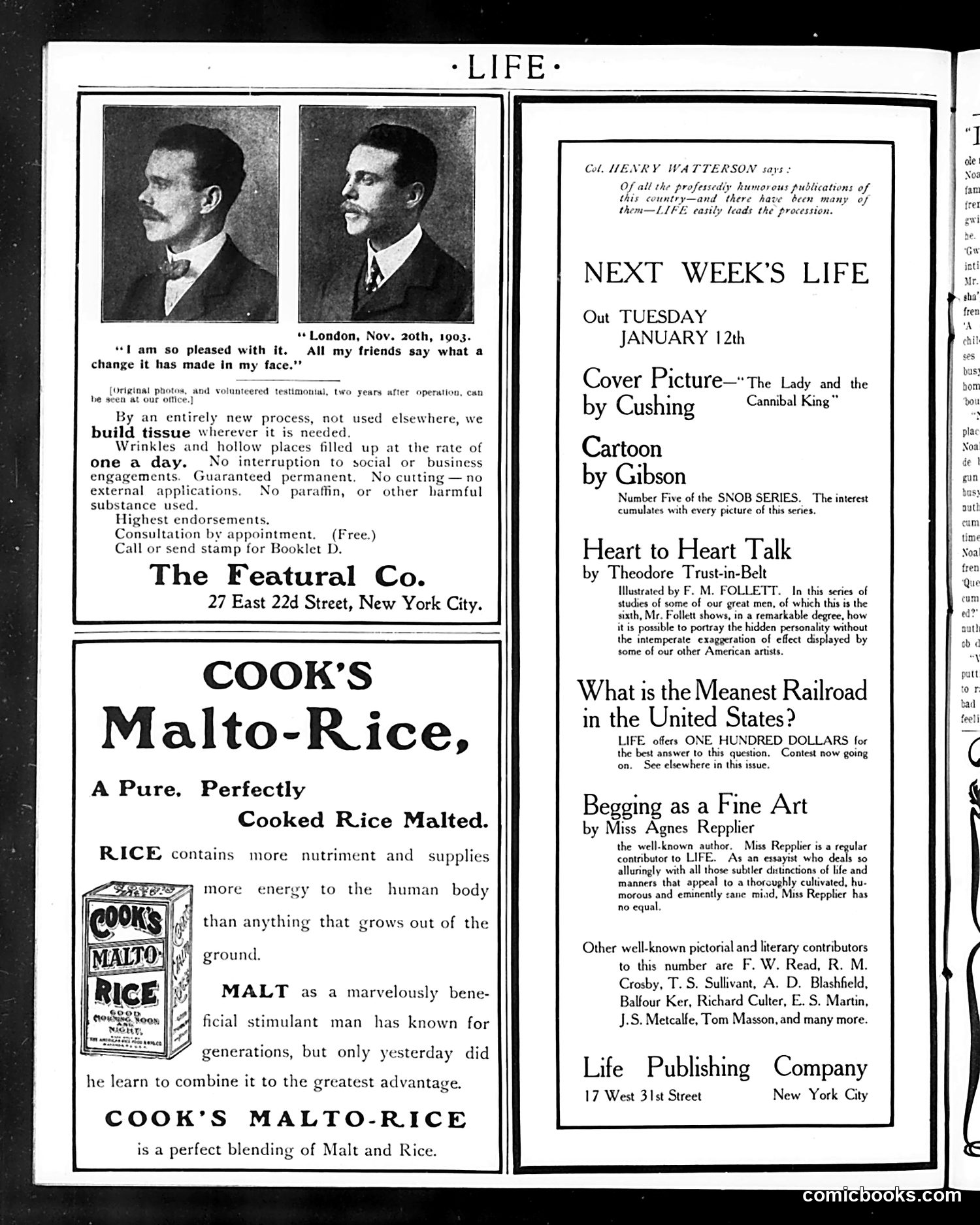
This page is **primarily advertising and editorial promotion** rather than satirical content. The top features two portrait photographs of **Col. Henry Watterson** (identified in the caption), dated November 20, 1903. The accompanying testimonial quotes him praising a facial procedure that reduces wrinkles—this is an advertisement for "The Featural Co.," a cosmetic treatment business in New York City. Below are ads for **Cook's Malto-Rice** (a nutritional product) and promotional content for **next week's Life magazine** featuring a cover by Cushing and Gibson cartoon. There is **no political satire visible** on this page. It represents the magazine's revenue model: mixing entertainment with commercial advertisements targeted at early-20th-century readers.
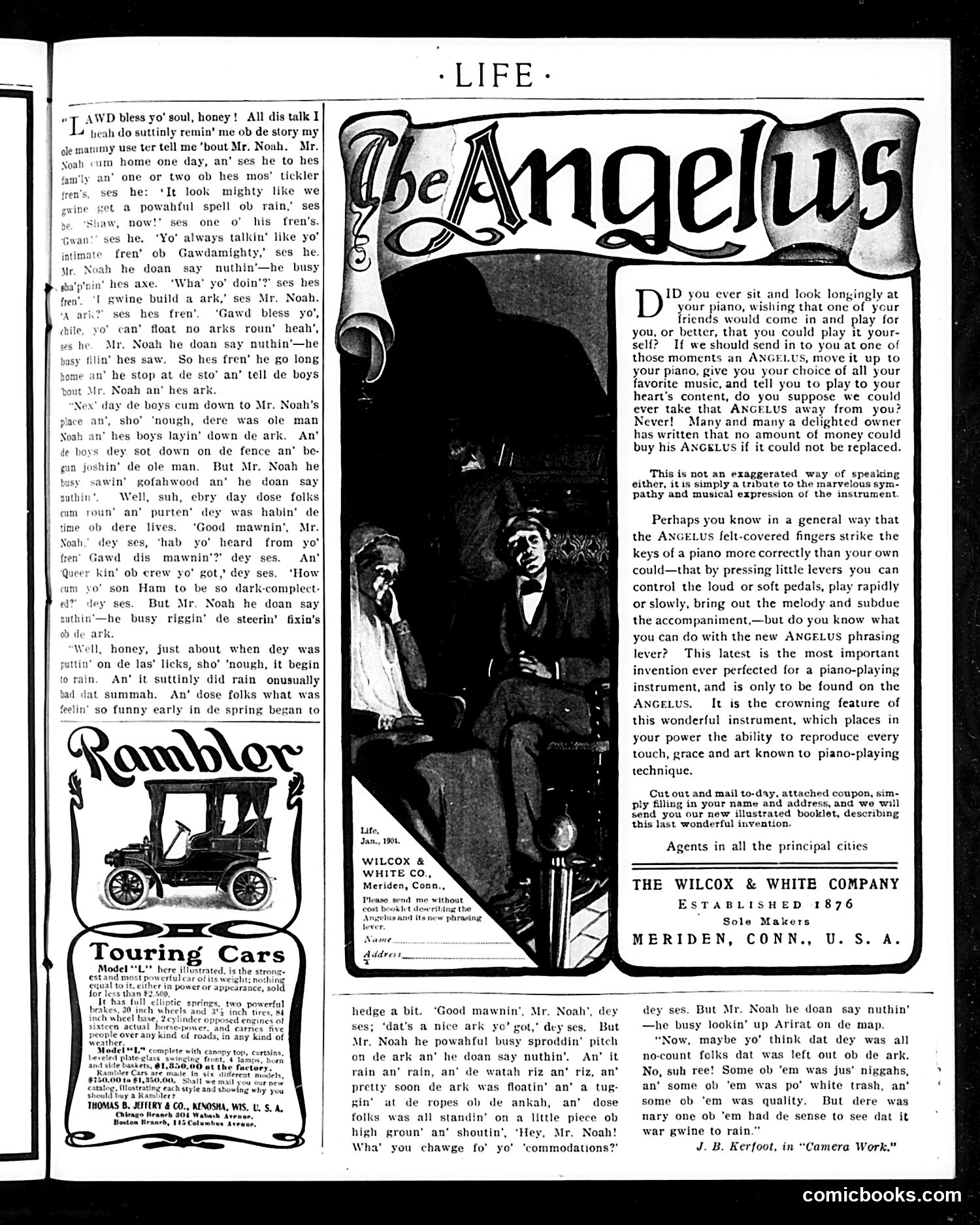
This page consists primarily of **advertising rather than satire or editorial content**. The left column contains a humorous dialect story titled "Rambler" about rural characters (Mr. Noah and others) discussing rain and farm life, written in exaggerated African American Vernacular English—a common literary device of the era, though by modern standards the portrayal reflects offensive stereotyping typical of early 20th-century publications. The right side advertises the **Angelus piano** by Wilcox & White Company (established 1876), featuring an image of a woman at a piano. The ad emphasizes the Angelus's mechanical "pressing lever" feature, claiming it allows anyone to play professional-quality music. There's also a small **Rambler automobile advertisement** in the lower left, unrelated to the text story above it. The page represents Life magazine functioning as a vehicle for both entertainment and commercial promotion.
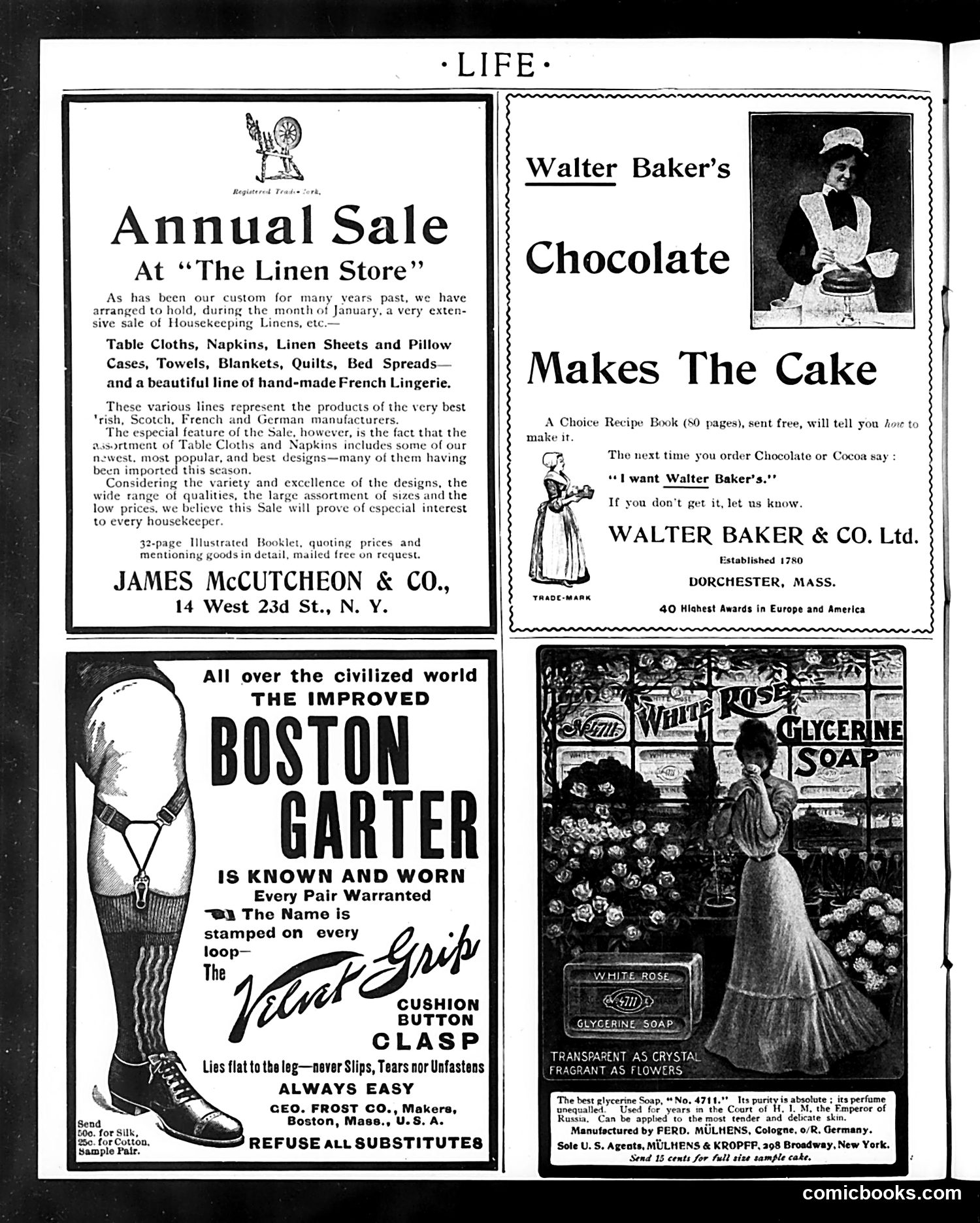
This page consists entirely of **advertisements**, not satirical cartoons. There is no political satire or social commentary to analyze. The four ads promote: a January linen sale at James McCutcheon & Co.; Walter Baker's chocolate and a recipe book; the "Improved Boston Garter" (a men's garter with a "Velvet Grip" clasp); and White Rose Glycerine Soap from Germany. These are straightforward commercial advertisements typical of early 20th-century magazines. The images show product illustrations and photographs designed to appeal to consumers—a woman using chocolate for baking, a leg demonstrating the garter, and a woman admiring flowers near soap displays. No satire or political meaning is present; this is simply a page of period advertising.
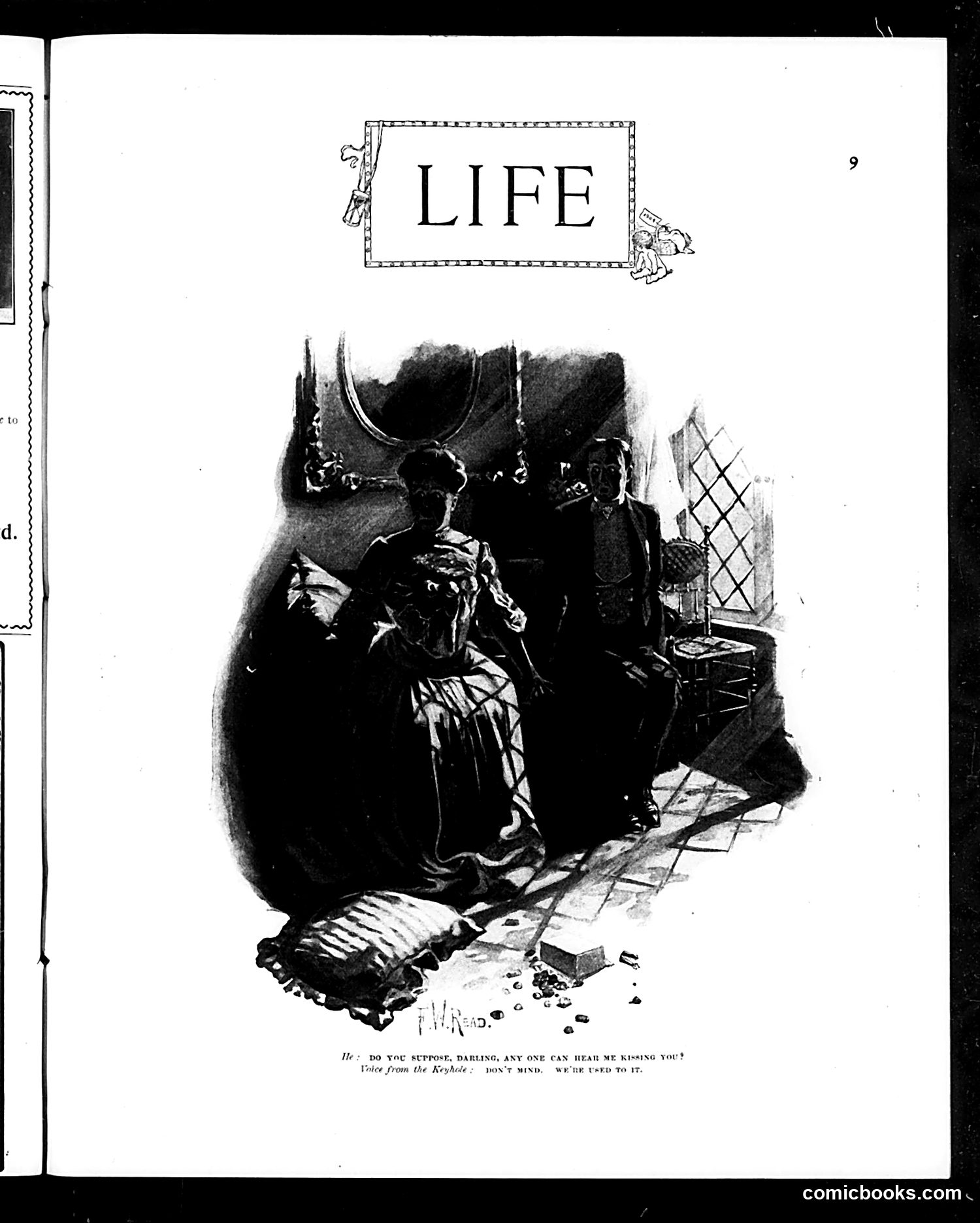
This appears to be a satirical illustration titled "LIFE" depicting what seems to be Russian or Eastern European figures in dark, dramatic clothing gathered together. The caption reads: "HE: 'DO YOU SUPPOSE, DARLING, ANY ONE CAN HEAR WE KISSING YOU?' / Voice from the Keyhole: 'DON'T MIND. WE'RE USED TO IT.'" The cartoon satirizes surveillance and eavesdropping, likely referencing Cold War-era fears about Soviet espionage or secret police monitoring. The "voice from the keyhole" suggests hidden observers constantly listening in—a commentary on totalitarian regimes' intrusive surveillance tactics. The darkly shadowed, sinister imagery emphasizes the oppressive atmosphere of such societies. The joke's dark humor highlights the pervasiveness of state surveillance as an inescapable reality for citizens.
This page satirizes Chicago labor disputes and working-class economics during what appears to be the early 1900s (based on references to a hackmen's strike and union-label funerals). The text critiques the assumption that high-wage earners automatically save money. It argues that wealthy individuals like Mr. Rockefeller maintain fixed, elastic standards of living—meaning increased income simply increases spending rather than savings. The article then shifts to Chicago's hackmen (carriage drivers) strike, describing how strikers prevented funeral processions and prevented bodies from reaching cemeteries. It mocks Chicagoans for tolerating such disruption, contrasting the city unfavorably with Philadelphia. The accompanying illustrations appear to be satirical vignettes of urban life and labor conflict, though specific figures remain unclear without additional context.
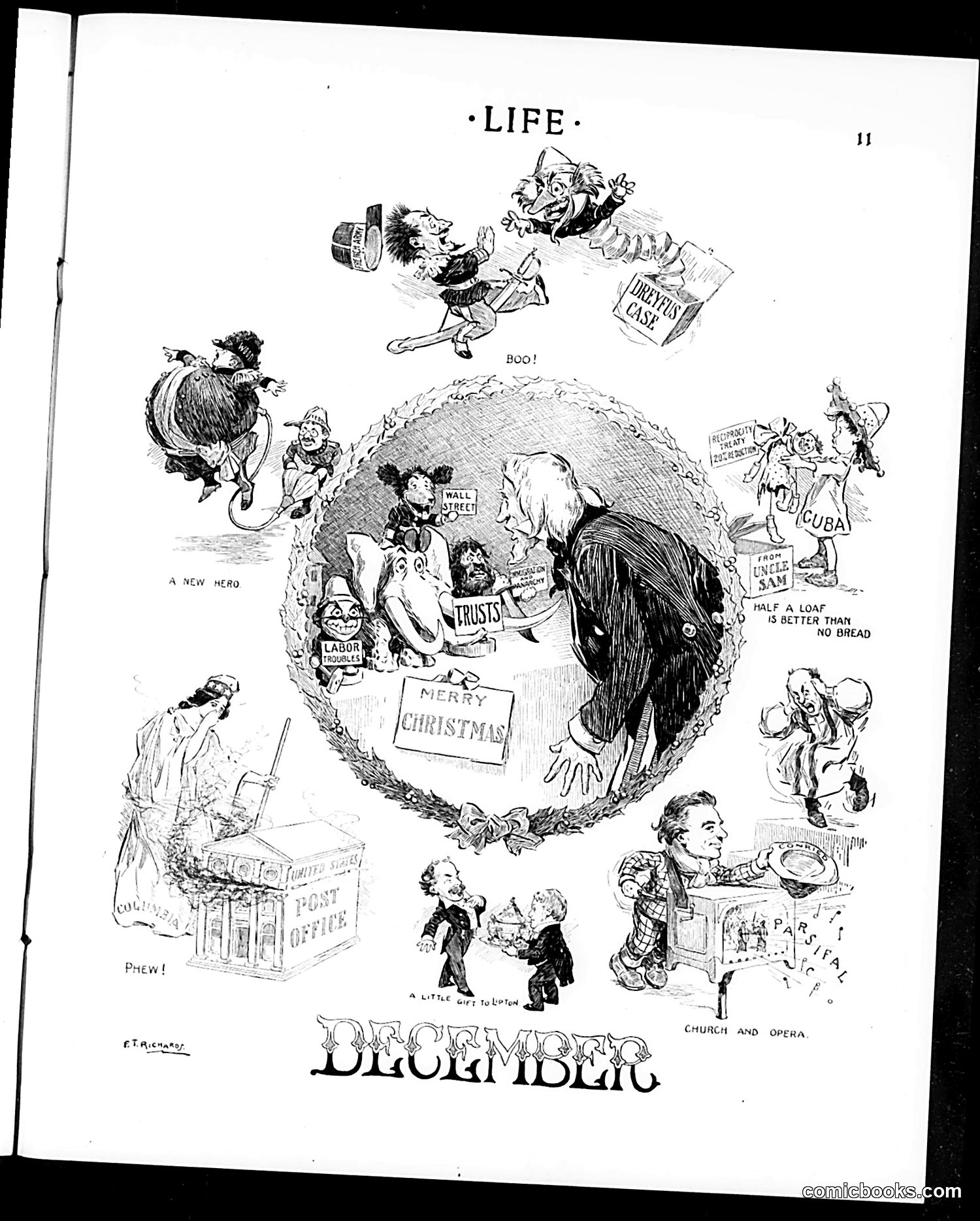
This is a satirical Life magazine page titled "December" depicting American social problems during what appears to be the late 19th or early 20th century. The central wreath contains vignettes showing poverty and hardship: "Wall Street," "Labor," "Trusts," and "Merry Christmas" are labeled, illustrating the contrast between wealthy institutions and struggling workers. The surrounding smaller cartoons address contemporary issues: "A New Hero" (likely political), "Phew!" (Post Office corruption), "Boomers" (possibly labor unrest), and references to Cuba (likely Spanish-American War context), "Church and Opera," and economic struggle ("Half a Loaf Is Better Than No Bread"). The overall satire critiques how Christmas charity rings hollow amid systemic inequality, Wall Street corruption, monopolistic trusts, and labor exploitation.
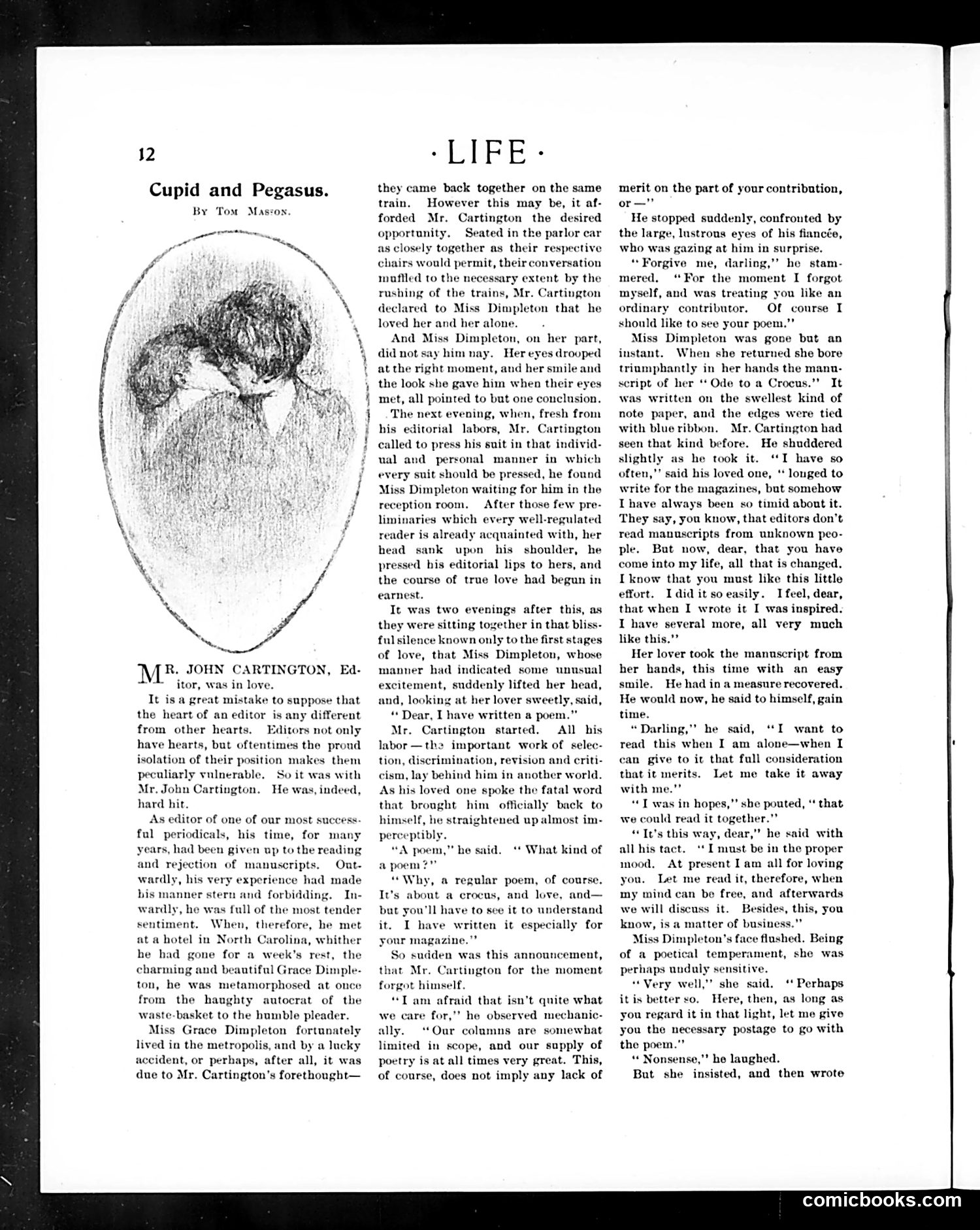
This page contains a short story rather than a political cartoon. The illustration shows a portrait of a man (likely Mr. John Cartington, the editor mentioned in the text). The narrative depicts a romantic subplot: Mr. Cartington, a stern newspaper editor, encounters Miss Grace Dimpleton, a woman from North Carolina living in the city. Though he maintains a cold professional demeanor, he becomes emotionally invested when she submits a poem to his magazine. The story explores the tension between his editorial severity and his developing romantic feelings, ultimately suggesting that even hard-hearted editors possess softer sentiments beneath their forbidding exterior. This appears to be sentimental fiction rather than satire.
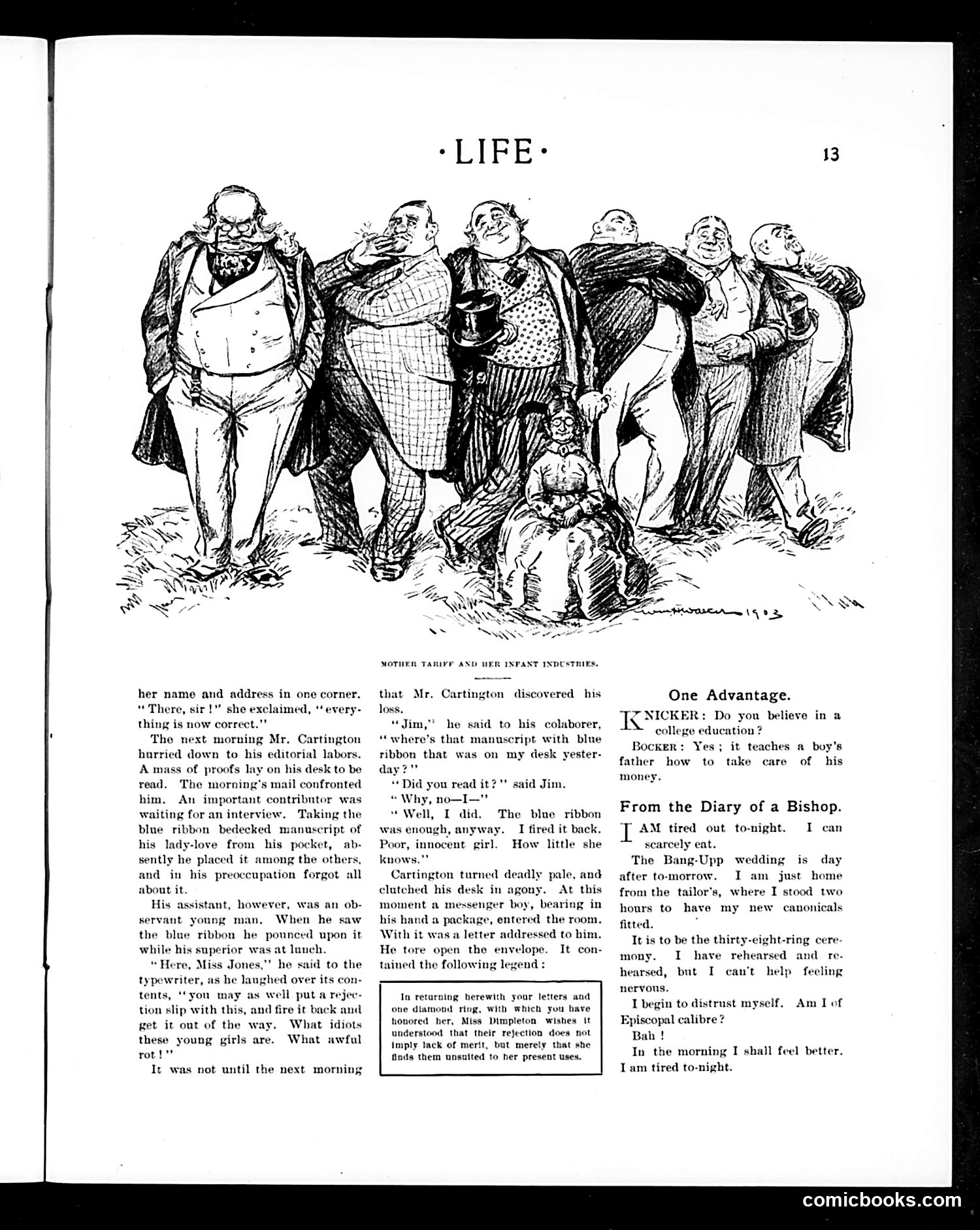
The page contains three distinct humorous pieces: **Main Illustration & Story ("Mother Tariff and Her Infant Industries"):** A editor named Cartington accidentally submits his love letter (with blue ribbon) to his assistant, who rejects it as manuscript. When Cartington's romantic gesture is returned by Miss Dimpleton with a formal rejection slip, he's publicly humiliated. The satire mocks both workplace incompetence and the pretensions of romantic gestures. **"One Advantage":** A brief joke contrasting Bocker's cynical view of college education—not about learning, but teaching boys money management—with Micker's optimism. **"From the Diary of a Bishop":** A satirical diary entry where an Episcopal bishop obsesses over ceremonial details (fittings, "thirty-eight-ring ceremony") while confessing exhaustion and self-doubt. The satire targets clerical vanity and the gap between ecclesiastical dignity and human weakness. All three pieces use satirical humor targeting professional and social pretension common to the era.
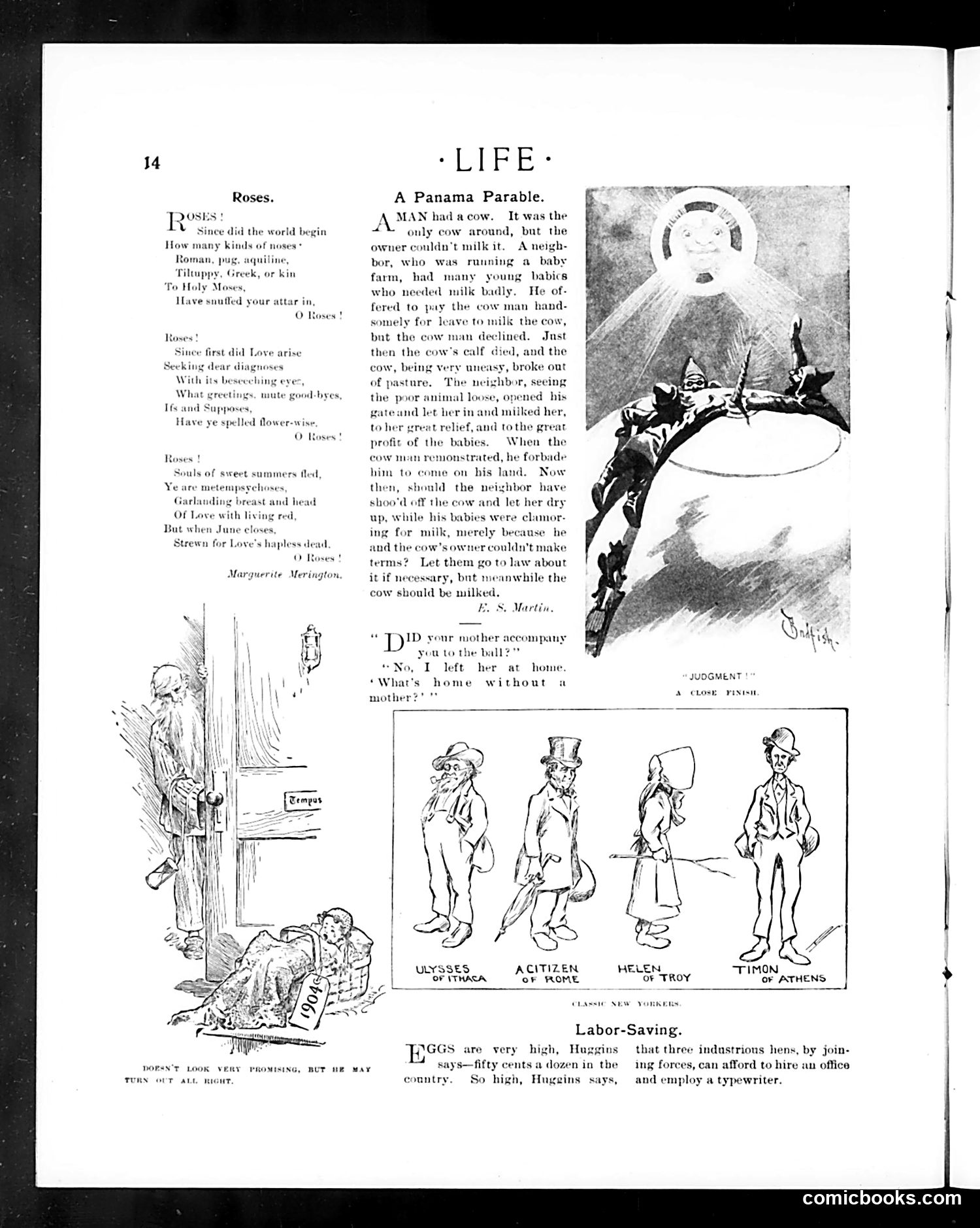
**"A Panama Parable"** uses a cow-ownership dispute as an allegory for the Panama Canal controversy. A man owns a cow but cannot use it; a neighbor with babies needs milk and milks the cow without permission. When the owner objects, the neighbor forbids him access to his own land. The parable satirizes the U.S. position regarding Panama—suggesting America is taking control of resources (the canal) that belong to Panama, justifying intervention through practical necessity while denying the original owner his rights. **"Classical New Yorkers"** shows four historical figures (Ulysses, a Roman citizen, Helen, Timon) as modern stereotypes, likely satirizing New York society types or contemporary personalities masked in classical names—a common Life magazine technique. **"Labor-Saving"** jokes that eggs are so expensive (fifty cents per dozen), three hens pooling resources could afford to hire an office worker and typewriter—absurdist humor about inflation and labor costs.
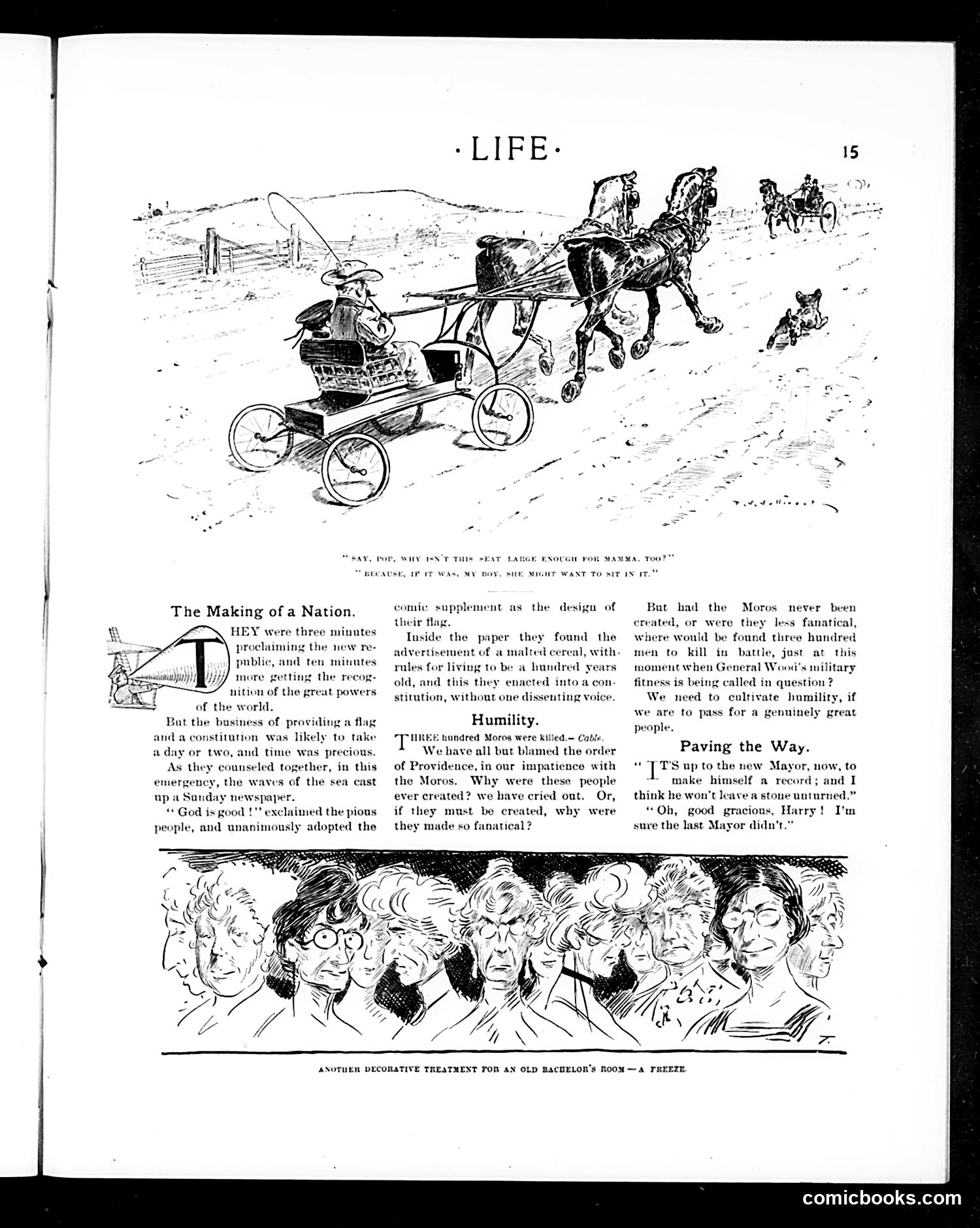
This satirical page critiques American imperialism and military policy circa early 1900s. **"The Making of a Nation"** mocks the hasty establishment of a new republic (likely the Philippines after the Spanish-American War). The joke: officials adopt a comic strip as their flag design and a cereal advertisement's health rules as their constitution—suggesting the new nation is built on frivolous American commerce rather than serious governance. **"Humility"** sarcastically addresses the killing of "three hundred Moros" (Muslim Filipinos). The author argues Americans hypocritically blame the Moros for their own fanaticism, when conveniently, these deaths serve General Wood's military reputation. The satire suggests America needs humility: we create the very enemies we then fight. **"Paving the Way"** is a brief political joke about a new mayor—unclear without more context, but likely mocking political corruption or empty promises. The top cartoon depicts rural/frontier life with exaggerated scale (the cart appears oversized for the passenger). The bottom illustration shows caricatured faces, labeled as "decorative treatment for an old bachelor's room."
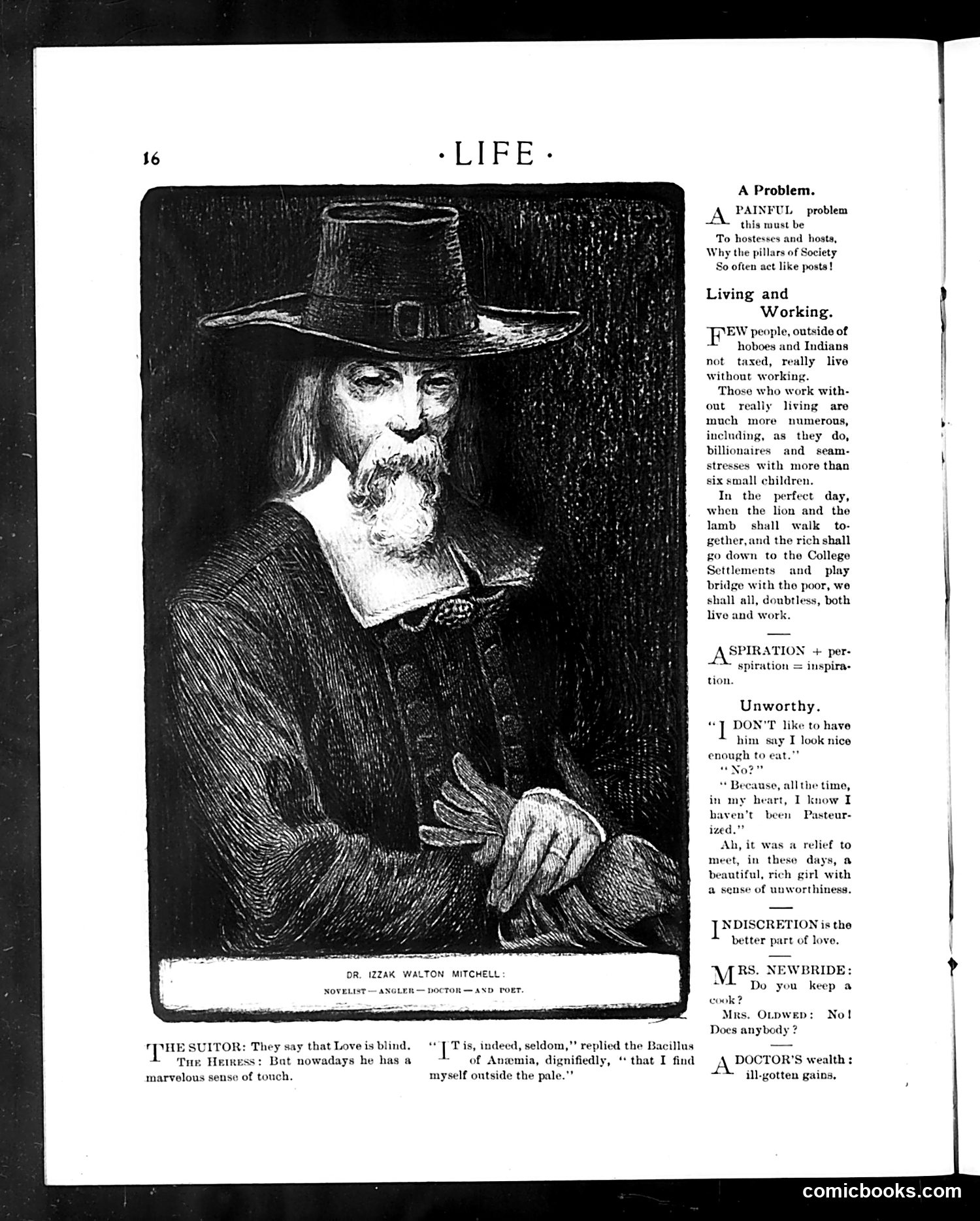
This page features a portrait of **Dr. Izak Walton Mitchell**, identified as a novelist, angler, doctor, and poet—a figure of cultural note at the time. The surrounding content uses satirical observations about contemporary society. The humor targets social pretense and hypocrisy: "pillars of Society" act like "posts" (immobile, useless); the wealthy and poor alike struggle with meaningless existence; a suitor's romantic compliment offends a woman who worries she hasn't been "Pasteurized" (a reference to Louis Pasteur's germ theory—she fears being perceived as unclean or diseased); and a doctor's wealth comes from "ill-gotten gains." The section "Living and Working" mocks class contradictions: billionaires and seamstresses are equally trapped in joyless toil, yet in an idealized future ("perfect day"), rich and poor will supposedly play bridge together as equals. The dialogue exchanges present quick satirical barbs on love, social anxiety, and domestic help—typical of *Life* magazine's witty, biting social commentary of this era.
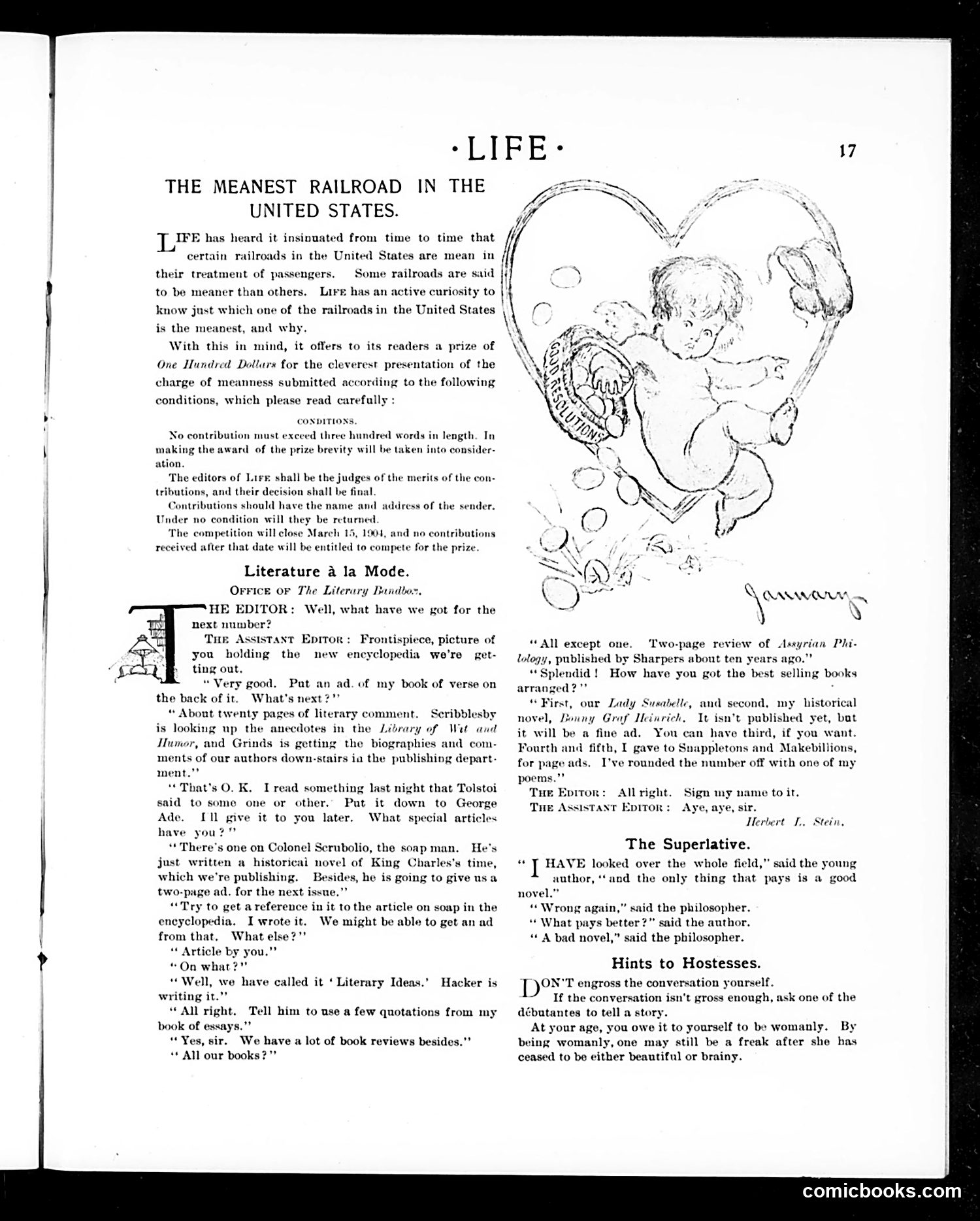
This page contains three satirical pieces mocking publishing and literary culture: **"The Meanest Railroad" (top):** A contest offering $100 for the best essay identifying America's meanest railroad. This appears to be genuine editorial content soliciting reader submissions—not satirical itself, though the premise that readers would eagerly catalog railroad mistreatment is mildly humorous. **"Literature à la Mode" (middle):** A dialogue between a magazine editor and assistant editor cynically exposing publishing industry corruption. They discuss fabricating book reviews, inserting self-promotional ads disguised as editorial content, attributing plagiarized quotes to celebrities (attributing Tolstoi's words to humorist George Ade), and manipulating bestseller lists through cross-promotion. The satire targets how literary magazines prioritized profit and advertising over honest criticism. **"The Superlative" and "Hints to Hostesses" (bottom):** Brief comic exchanges. The first jokes that bad novels sell better than good ones. The second offers tongue-in-cheek etiquette advice, including that women should remain "womanly" even if neither beautiful nor intelligent—light social satire about gender expectations.
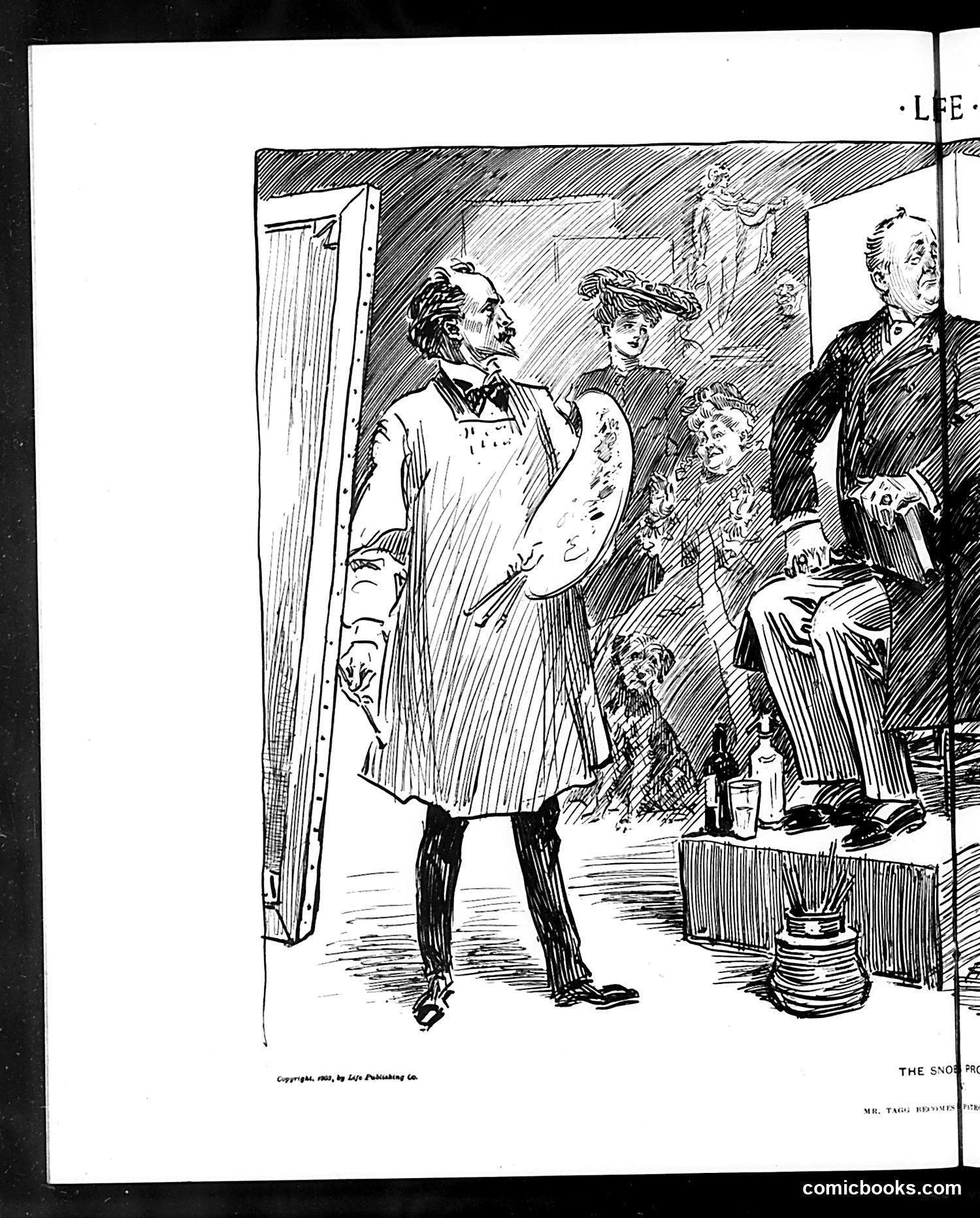
The OCR text is too corrupted to read clearly. Based on the IMAGE alone: This appears to be an early 20th-century satirical cartoon showing a domestic scene. A man in an apron (likely a servant or chef) stands prominently in a doorway, while well-dressed figures observe from behind—including women in fashionable hats and men in suits. A small dog is visible, along with what appears to be a barrel or container. The cartoon likely satirizes either: - Servant/class dynamics of the era - Gender roles (man in domestic/feminine role) - Social pretension or "putting on airs" Without legible caption text or clearer context, the specific satirical point remains unclear. The "Life" magazine credit suggests this is American satirical humor from roughly 1900-1920, but the exact target of the joke cannot be determined from the image alone.
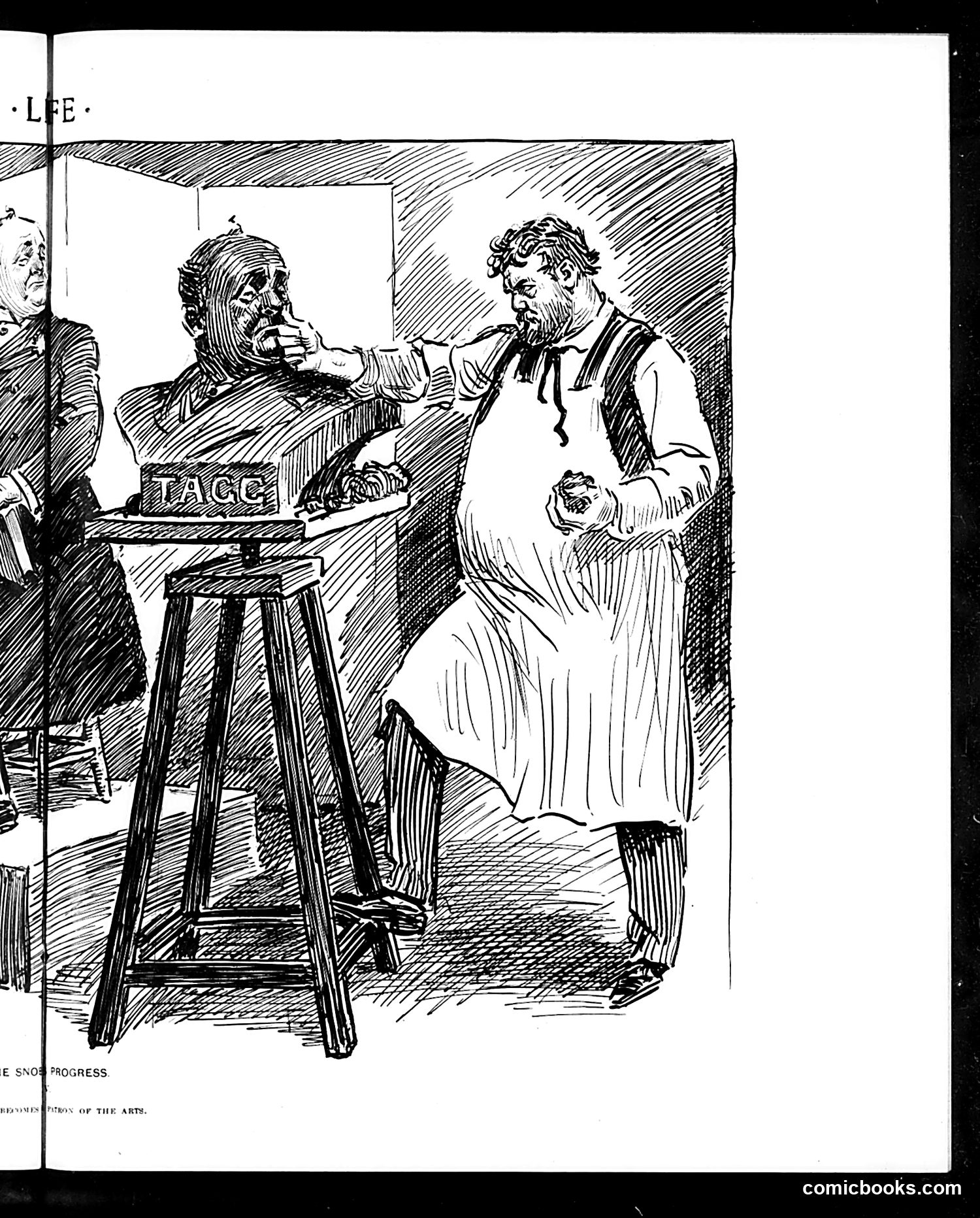
This Life magazine cartoon depicts two men in what appears to be an artist's studio or workshop. The seated figure (left) is caricatured with exaggerated facial features and wears formal attire. The standing figure (right) holds what looks like a palette or artwork, dressed as an artist or craftsman with a bow tie. The visible text references "PROGRESS" and mentions "DIVISIONS OF THE ARTS," suggesting this satirizes artistic or institutional developments. Without clearer context or visible publication date, the specific figures remain unclear, though the cartoon appears to mock either artistic pretension, professional divisions within the arts, or perhaps the relationship between criticism and creation in the art world. The caricature style and formal setting suggest commentary on contemporary art establishment figures.
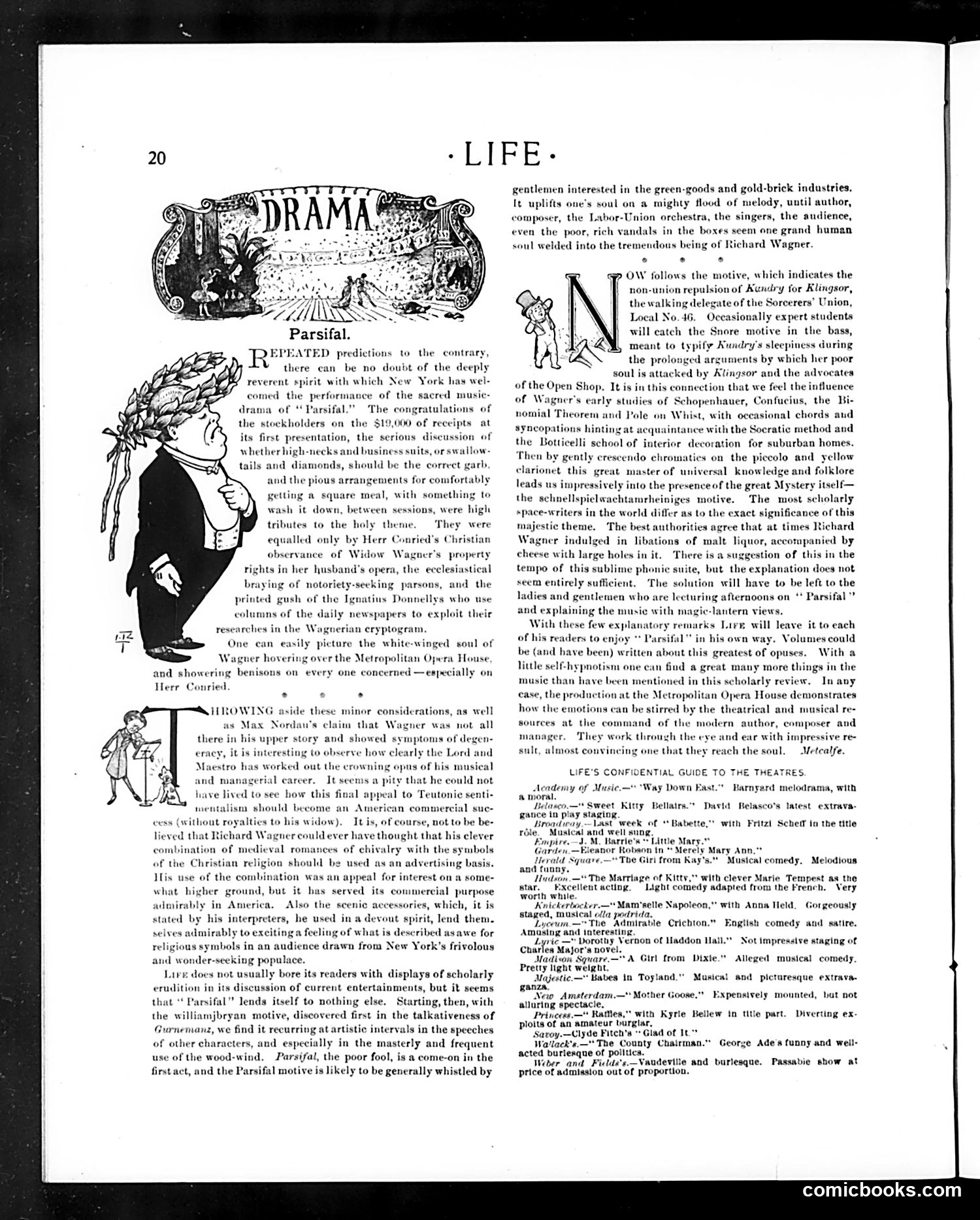
This page mocks the reverent reception of Wagner's opera *Parsifal* at New York's Metropolitan Opera House. The cartoons (showing figures in formal dress) satirize the contradiction between the opera's sacred religious themes and its actual American commercial exploitation. Life ridicules: - **Wealthy patrons** attending for social status rather than spiritual devotion, concerned with proper attire and meals between acts - **Copyright enforcement** by Wagner's widow as pure commercialism disguised as artistic respect - **American audiences** as frivolous consumers ("green-goods and gold-brick industries")—comparing them to marks for con artists The text jokes that Wagner couldn't have imagined his medieval Christian allegory becoming an advertising vehicle in America. It sardonically analyzes musical motifs as labor disputes ("Sorcerers' Union, Local No. 46") and parodies scholarly opera criticism, suggesting Americans elevate commerce above genuine spirituality.
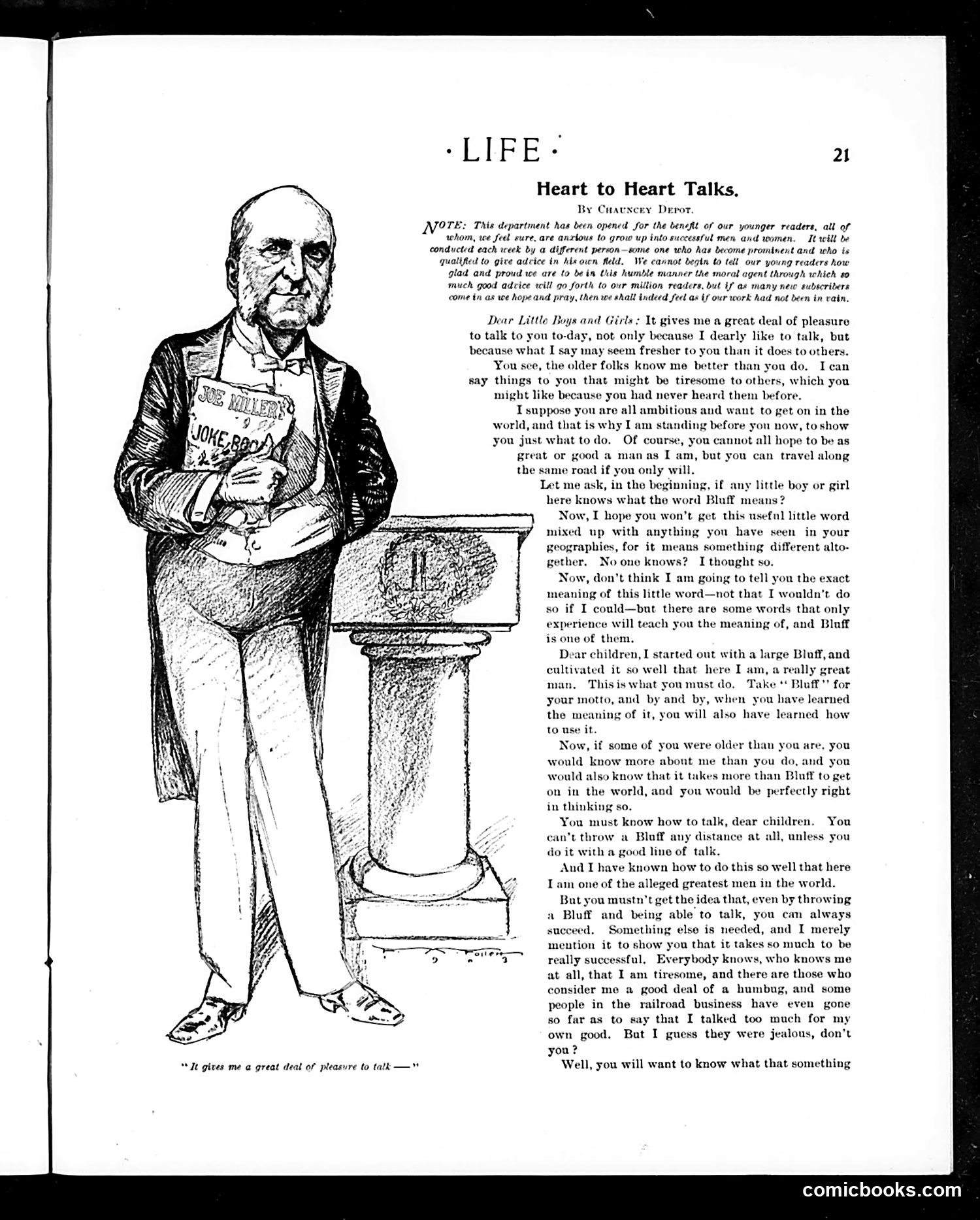
This is a satirical "advice column" by Chauncey Depew, a prominent late-19th/early-20th-century businessman and railroad executive, addressing young readers. The cartoon depicts Depew as a portly, self-satisfied figure. The satire is **self-aware mockery**: Depew purports to teach children about success through "Bluff" (deception/bluster) and talking—while simultaneously admitting he's "tiresome," considered "a humbug," and that railroad associates said he "talked too much." He acknowledges that bluffing alone doesn't guarantee success, yet recommends it as a philosophy. The humor lies in Depew's **transparent hypocrisy**—he's confessing to being a fraud while posing as a moral guide. This mocks both Depew's actual reputation (he was known as a garrulous, self-promoting railroad magnate) and the absurdity of having obviously questionable figures mentor youth. The page satirizes both the man and the entire concept of using prominent "successful" people as moral authorities.
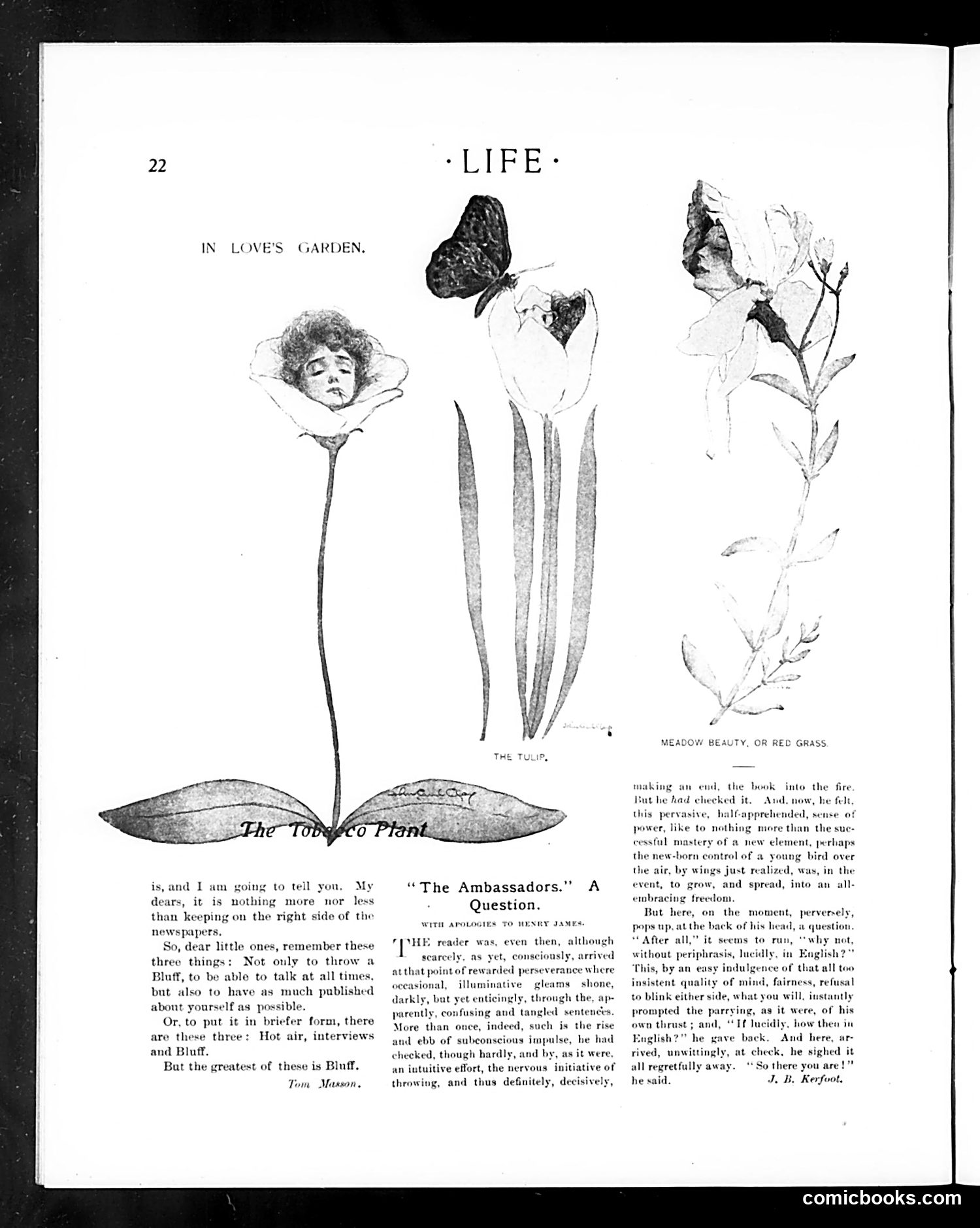
This page contains two distinct pieces of satire about early 20th-century American society. **The main cartoon** illustrates "The Tobacco Plant" with anthropomorphic flowers—including a cherub-faced bloom and butterflies—as a whimsical visual metaphor. The accompanying text by Tom Masson mocks the formula for success in America: securing newspaper coverage through "hot air, interviews and Bluff." The satire suggests that self-promotion and media manipulation matter more than actual substance or achievement. "Bluff" (deception) is identified as "the greatest of these"—a mockery of the biblical phrase about charity. **"The Ambassadors: A Question"** (with apologies to Henry James) appears to excerpt from or parody James's famous novel, critiquing the confused, tangled prose style of literary intellectuals who speak pretentiously rather than "lucidly, in English." Both pieces satirize contemporary American culture: one targeting shallow celebrity-chasing and media obsession, the other mocking obscure, affected literary pretension among the educated class.
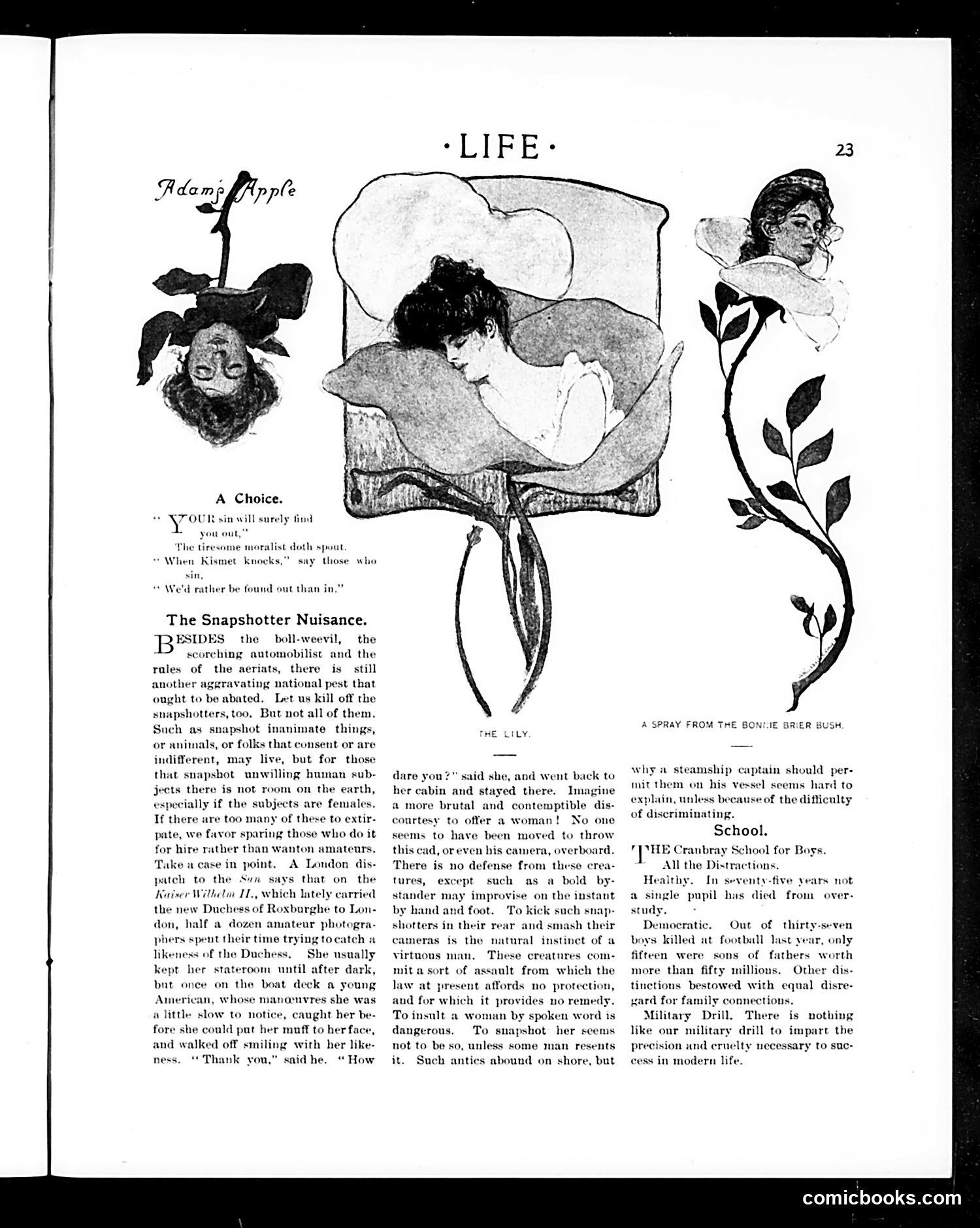
This page contains social satire on three topics: **"A Choice"** mocks moral hypocrisy—contrasting the proverb "your sin will surely find you out" with cynics who prefer being "found out" to restraint. **"The Snapshotter Nuisance"** attacks amateur photographers who obsessively photograph unwilling subjects, particularly women. The article describes an incident where an American photographer on the *Kaiser Wilhelm I* ship caught the Duchess of Roxburghe's image despite her efforts to avoid him. The satire argues such behavior is disrespectful and should be legally punished, yet lacks legal recourse—unlike spoken insults. The complaint appears genuine rather than ironic. **"The Cranbray School for Boys"** uses heavy sarcasm to critique elite education: praising the school for being "healthy" despite student deaths, "democratic" despite class distinctions, and emphasizing "military drill" to teach "precision and cruelty necessary to success in modern life." The overall theme critiques social rudeness, invasive technology, and institutional hypocrisy in early 20th-century America.
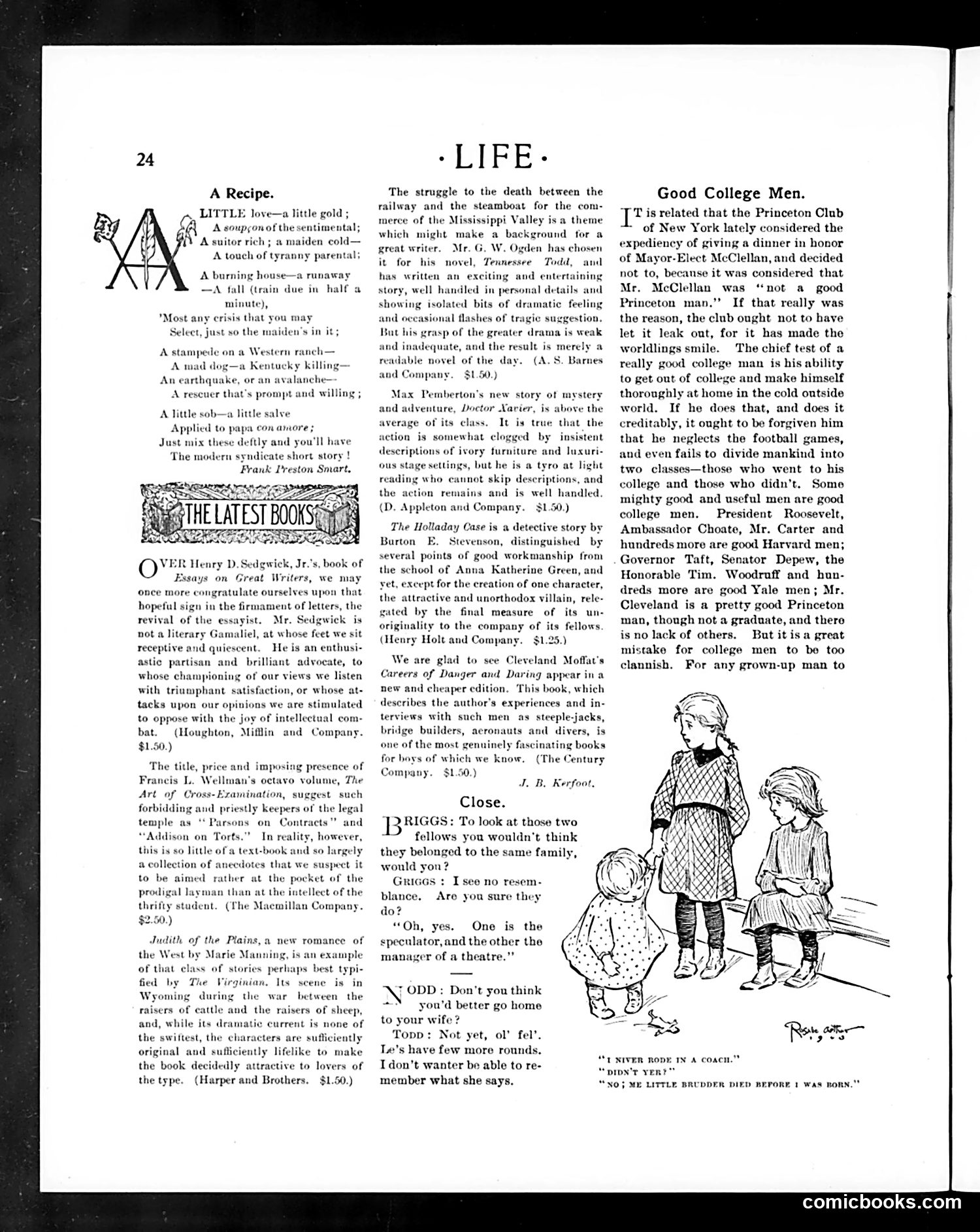
This page from *Life* magazine combines book reviews with satirical humor. **"A Recipe"** (top left) satirizes the formulaic construction of popular short stories in syndicated publications. The poem mockingly lists melodramatic ingredients—"little love," "a stampede on a Western ranch," "a mad dog," "a Kentucky killing"—suggesting that contemporary story-writers simply mixed stock dramatic elements rather than creating original narratives. This critiques the commercialization of literature for mass consumption. **The cartoons at bottom right** depict a brief dialogue between Briggs and Griggs about two men who look unrelated. The punchline reveals they *are* related: one is "the speculator, and the other the manager of a theatre." The joke appears to contrast financial speculation (risky, unstable) with theater management (legitimate business), suggesting these represent opposite character types—though the specific satirical target remains unclear without additional context about contemporary figures or scandals.
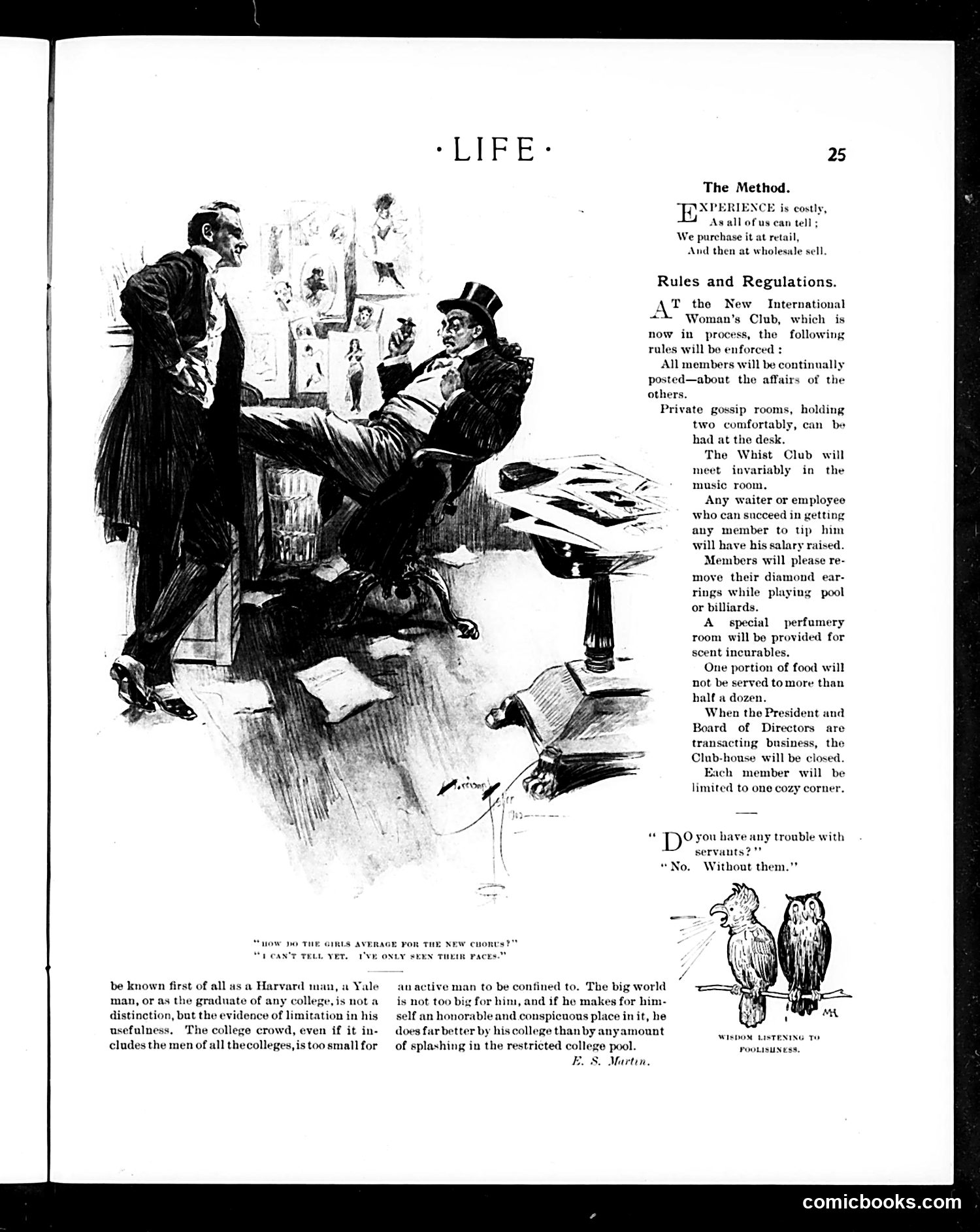
This page satirizes the newly opened International Woman's Club through mock "Rules and Regulations." The humor lies in exaggerating stereotypes about women's gossip and vanity: **The Main Cartoon** shows two men discussing the club's female members—one asking how the "girls average" for the new club, the other replying he can't tell yet because he's "only seen their faces." This plays on the shallow assumption that women's value is purely physical. **The "Rules" Section** mocks women's supposed preoccupations through absurdist regulations: mandatory gossip rooms, servants hired based on tipping ability, a "perfumery room for scent incurables," and members removing diamond earrings while playing pool (suggesting frivolous jewelry and leisure activities). **The Bottom Text** by E.S. Martin argues against college-educated men limiting themselves to collegiate social circles, presenting a counterpoint to provincial club mentality. The **Small Owl Cartoon** ("Wisdom Listening to Foolishness") appears unrelated, possibly filler. Overall, this 19th-century satire mocks women's clubs as frivolous gathering places dominated by gossip and vanity—a perspective that reflects period gender biases rather than endorses them.
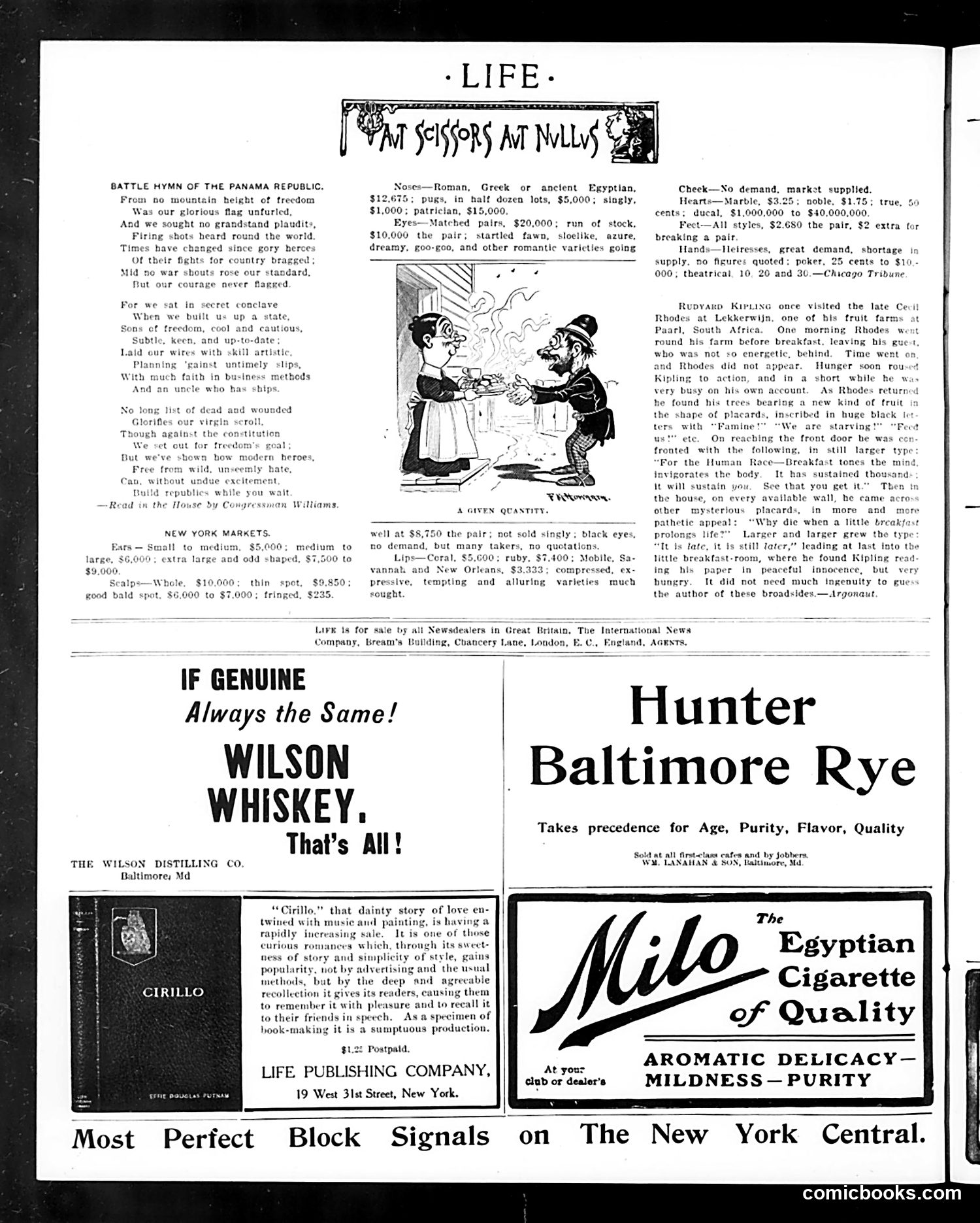
This page contains a satirical poem titled "Battle Hymn of the Panama Republic," mocking the U.S. involvement in Panama's independence. The accompanying cartoon shows two figures in what appears to be a commercial transaction—likely referencing how Panama's separation from Colombia was orchestrated through American financial and political manipulation rather than genuine grassroots revolution. The poem's irony is evident: it claims Panama achieved independence without "mountain heights of freedom" or "war shouts," instead admitting they "sat in secret conclave" and "laid our wires with skill"—suggesting backroom dealing. The repeated phrase about building "republics while you wait" sarcastically emphasizes the artificial, manufactured nature of the independence. The "New York Markets" section below extends this satire, grotesquely pricing human attributes (hearts, hands, feet, cheeks) as commodities, implying that Panama's creation was fundamentally a commercial transaction rather than a legitimate nation-building exercise. The page is primarily this political satire; the remaining content consists of period advertisements for whiskey, cigarettes, and a book.
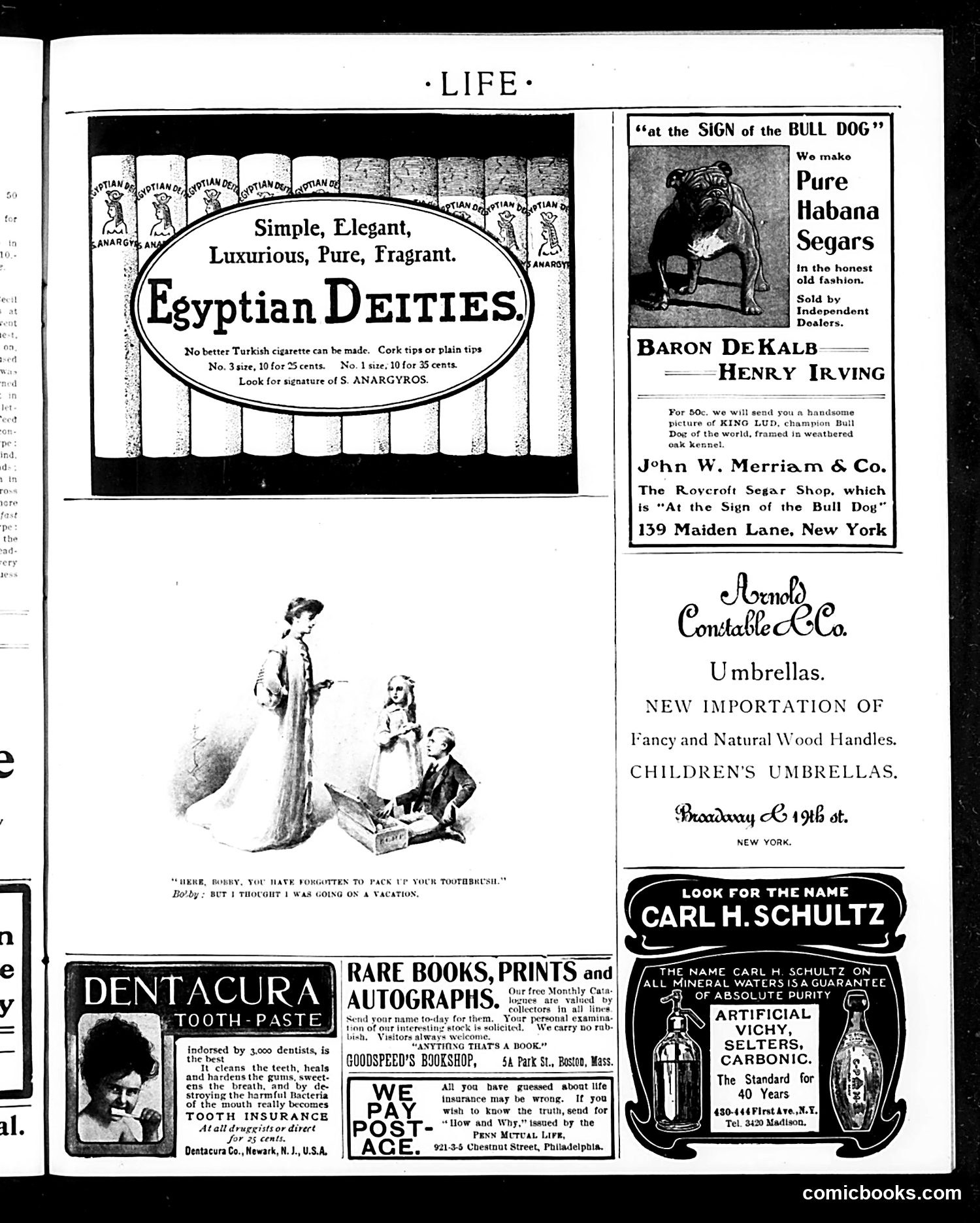
This page is primarily **advertisements** with one small cartoon. The main visual joke depicts a mother scolding her son "Bobby" for forgetting to pack his toothbrush before vacation—Bobby protests he thought he was "going on a vacation" (implying vacations don't require hygiene). The satire is gentle: it's a domestic humor piece playing on the idea that children resist proper grooming and parents must nag them about basics. The joke assumes readers will find it relatable that a boy would try to escape dental care obligations. The surrounding ads reflect early 20th-century consumer goods: Egyptian cigarettes, toothpaste (Dentacura), rare books, life insurance, cigars, umbrellas, and artificial mineral water. These ads reveal what middle-class Americans valued and purchased during this era. The "Bull Dog" branding appears repeatedly, suggesting it was a recognized mascot/trademark of the period. The page serves primarily as a commercial vehicle rather than political satire.
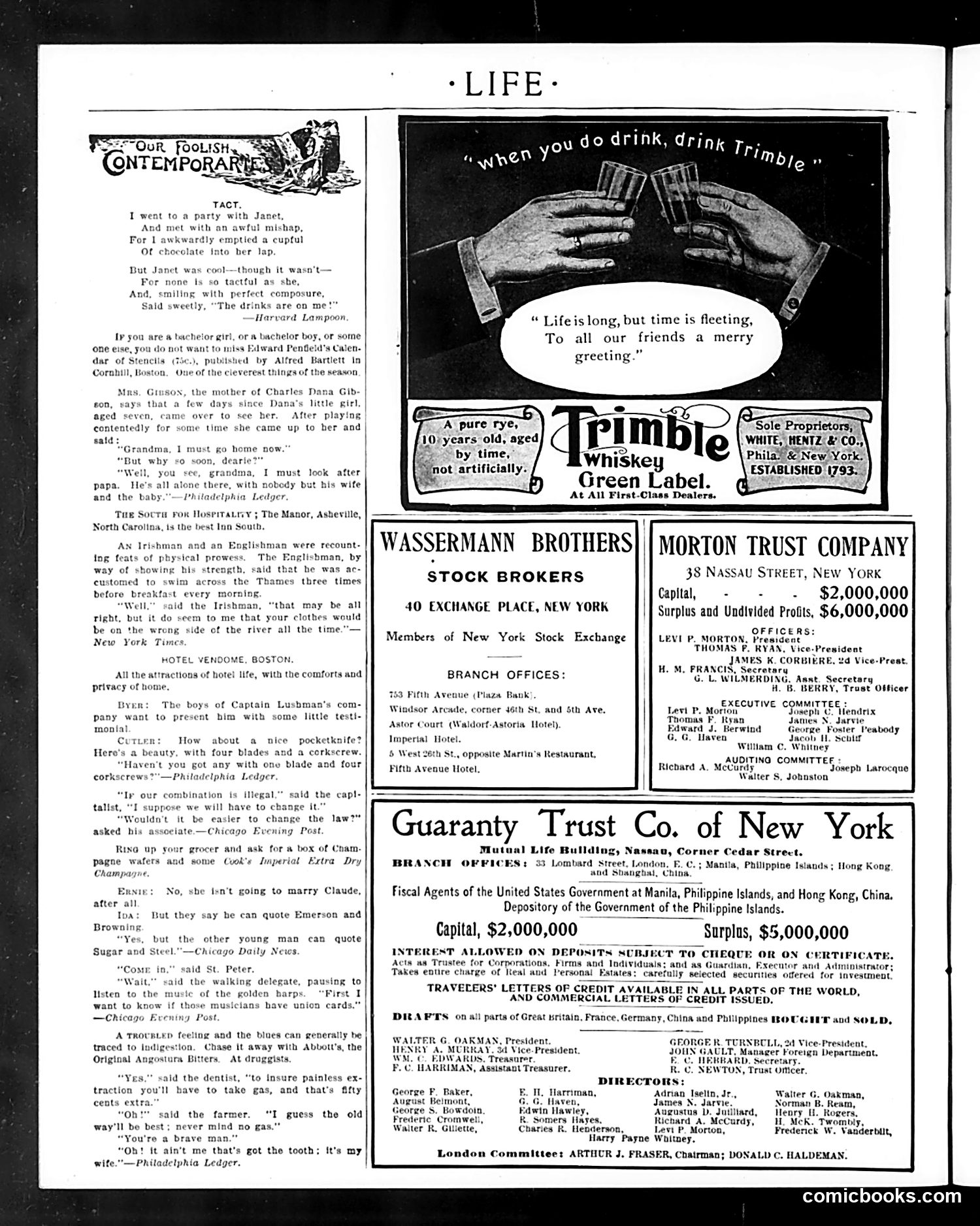
This page is primarily **advertising** for financial institutions and whiskey, with scattered humorous anecdotes rather than political cartoons. The main content includes: - A Trimble Whiskey advertisement featuring hands toasting, with a greeting about friendship and time's passage - Large ads for Wassermann Brothers (stock brokers) and Morton Trust Company - A major advertisement for Guaranty Trust Co. of New York, emphasizing its role as fiscal agent for the U.S. government in the Philippines The small humor pieces are innocuous social jokes: a woman's composure when chocolate spills on her lap, an Irish-English strength competition, and brief witticisms about marriage and dentistry. **Historical context**: The Philippine references date this to the early 1900s (post-1898 Spanish-American War), when American financial institutions were establishing themselves in newly-acquired territories. The page reflects Gilded Age prosperity and the expansion of American banking and commerce.
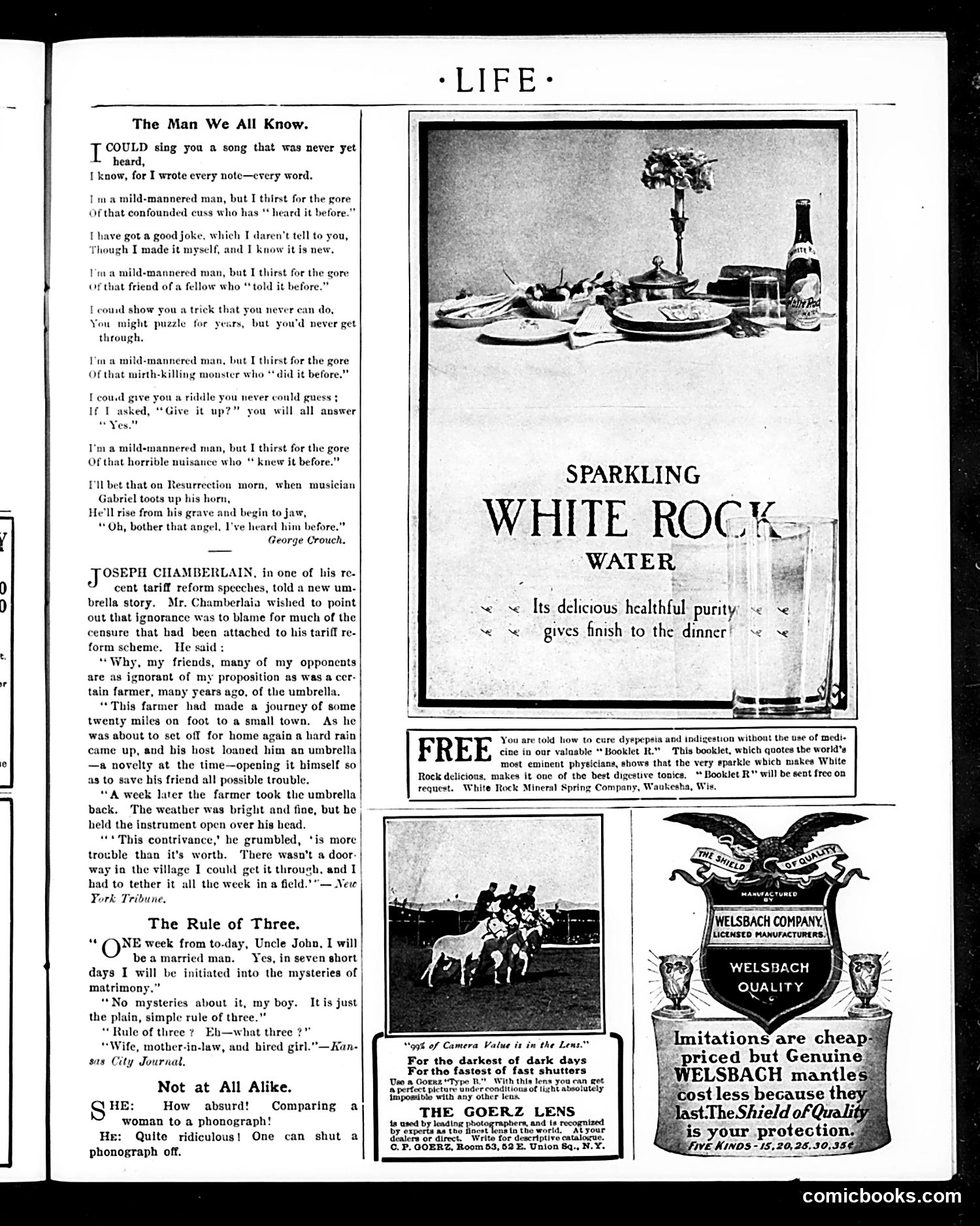
This poem satirizes a universal social irritant: the person who claims originality while others have "done it before." The mild-mannered narrator repeatedly expresses murderous rage toward anyone who steals his thunder—the friend who told his joke first, the person who knew the riddle, the one who "did it before." The satire mocks both the narrator's transparent pretense of mildness (repeatedly undercut by violent fantasies) and the petty competitiveness of people desperate to claim credit for novelty. It's social commentary on human vanity and the universal desire to be first, combined with dark humor about barely-suppressed hostility toward those who diminish our sense of originality. The accompanying Joseph Chamberlain anecdote reinforces the theme: ignorance prevents understanding, just as the farmer misunderstood the umbrella's purpose—a political metaphor for opposition to Chamberlain's tariff reform proposals. **The page is primarily literary/satirical content with period advertisements (White Rock Water, Goerz Lens, Welsbach mantles).**
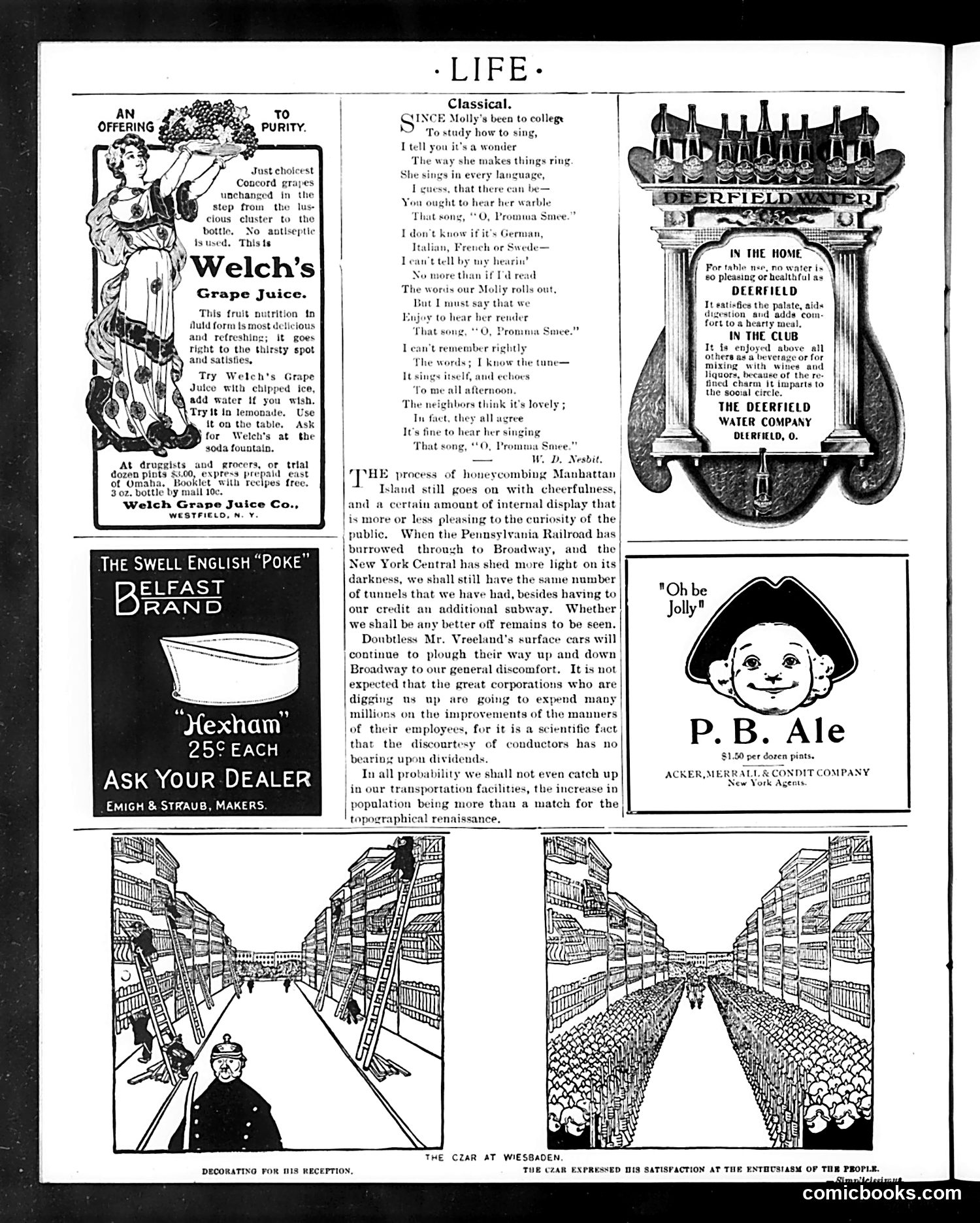
This page mixes advertisements with satirical commentary on early 1900s New York City infrastructure and social life. The main cartoon (bottom) depicts **Czar Nicholas II visiting Wiesbaden**, captioned with ironic praise for "the enthusiasm of the people"—likely mocking either the Czar's autocratic rule or staged public displays of support for a Russian monarch. The central article satirizes Manhattan's subway expansion, noting the Pennsylvania Railroad and New York Central are tunneling under Broadway. The writer cynically observes that despite these massive infrastructure projects and disruptions to the city, problems like rude conductors will persist because corporations won't spend money improving employee courtesy—"it is a scientific fact that the discourtesy of conductors has no bearing upon dividends." The satire targets corporate indifference to public welfare. The remaining content is period advertising for beverages (Welch's Grape Juice, P.B. Ale) and Deerfield Water, reflecting the magazine's commercial support model alongside its satirical commentary.
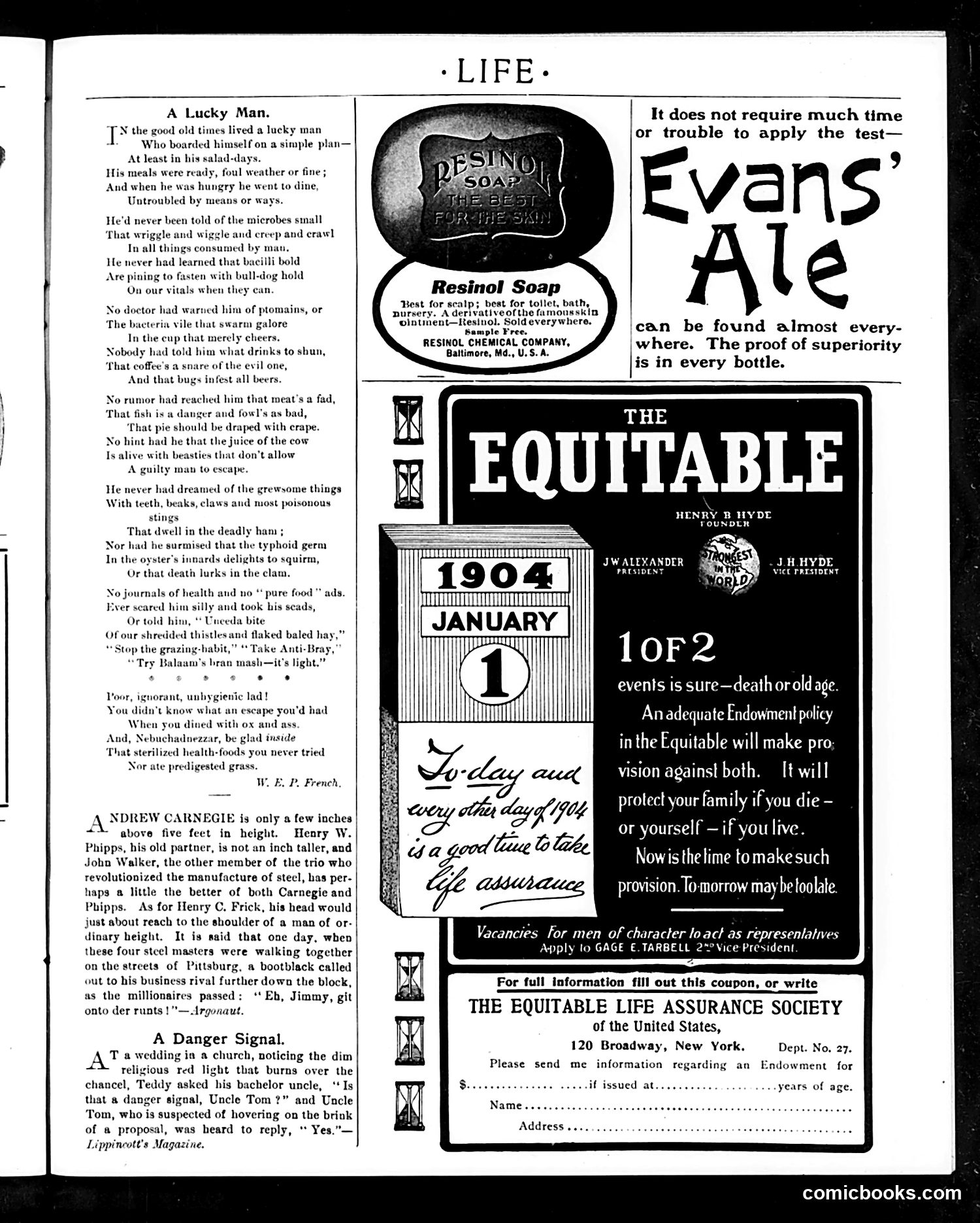
This page combines satirical poetry and advertisements typical of *Life* magazine's format. **"A Lucky Man"** (poem by W.E.P. French) satirizes turn-of-the-century health anxiety. It contrasts an ignorant man who ate freely without modern food-safety fears against contemporary readers bombarded by alarming "pure food" advertisements warning of microbes, bacteria, and ptomaines in everyday foods. The satire targets the growing hysteria around germ theory and commercial health-product marketing—suggesting the old way (blissful ignorance) was actually safer than modern neurotic food paranoia. **Side articles** humorously note that steel magnates Carnegie, Phipps, and Frick were unusually short, and that a church's red sanctuary light prompted a joke about marriage as a "danger signal." **Advertisements** for Resinol Soap and Equitable Life Assurance represent the commercial backdrop: products selling security against bodily and financial risks. The page's overall theme: modern life creates invented anxieties that advertisers exploit, while satirizing both germ-panic and the commercial response to it.
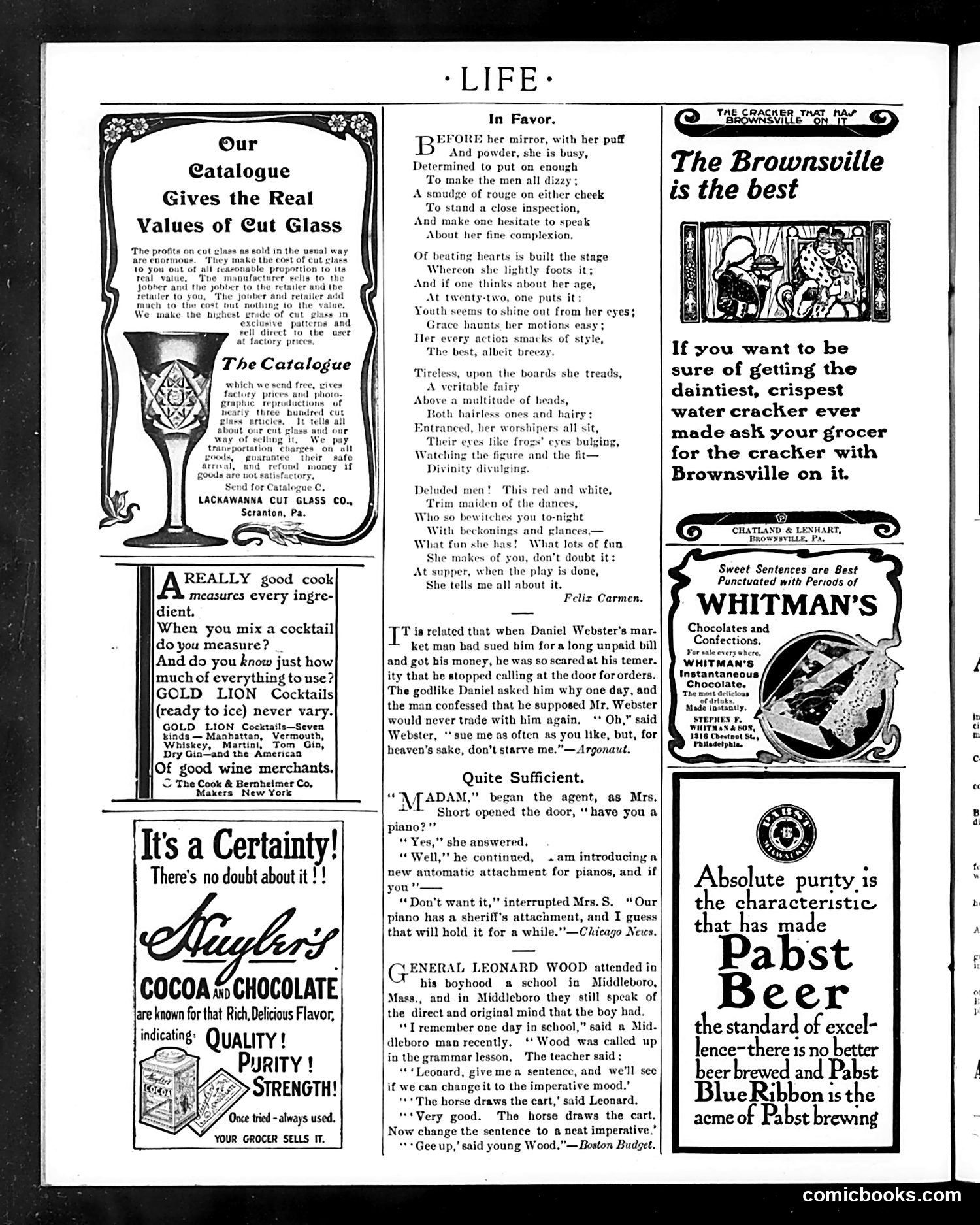
This page is primarily **advertising with interspersed humorous content**, typical of early 20th-century Life magazine. The advertisements promote consumer goods (cut glass, cocktails, cocoa, crackers, beer, chocolate) with earnest marketing copy. The humor appears in short comic pieces and anecdotes: - **"In Favor"** is a poem satirizing theatrical performers—particularly chorus girls or dancers—who heavily apply makeup and affect sophistication while privately mocking their male admirers. - **Humorous anecdotes** include a story about Daniel Webster's intimidated market man (playing on Webster's legendary dignity), and a joke about a woman whose piano has a "sheriff's attachment" (debt collector's lien) instead of needing a new mechanical device. - **The Leonard Wood anecdote** humorously depicts the future general as a literal-minded boy who responds to a grammar lesson request to convert "The horse draws the cart" to imperative mood with the simple command "Gee up." The satire targets **vanity, pretension, debt, and naive literalism**—common Life magazine themes. No specific political figures or events are referenced.
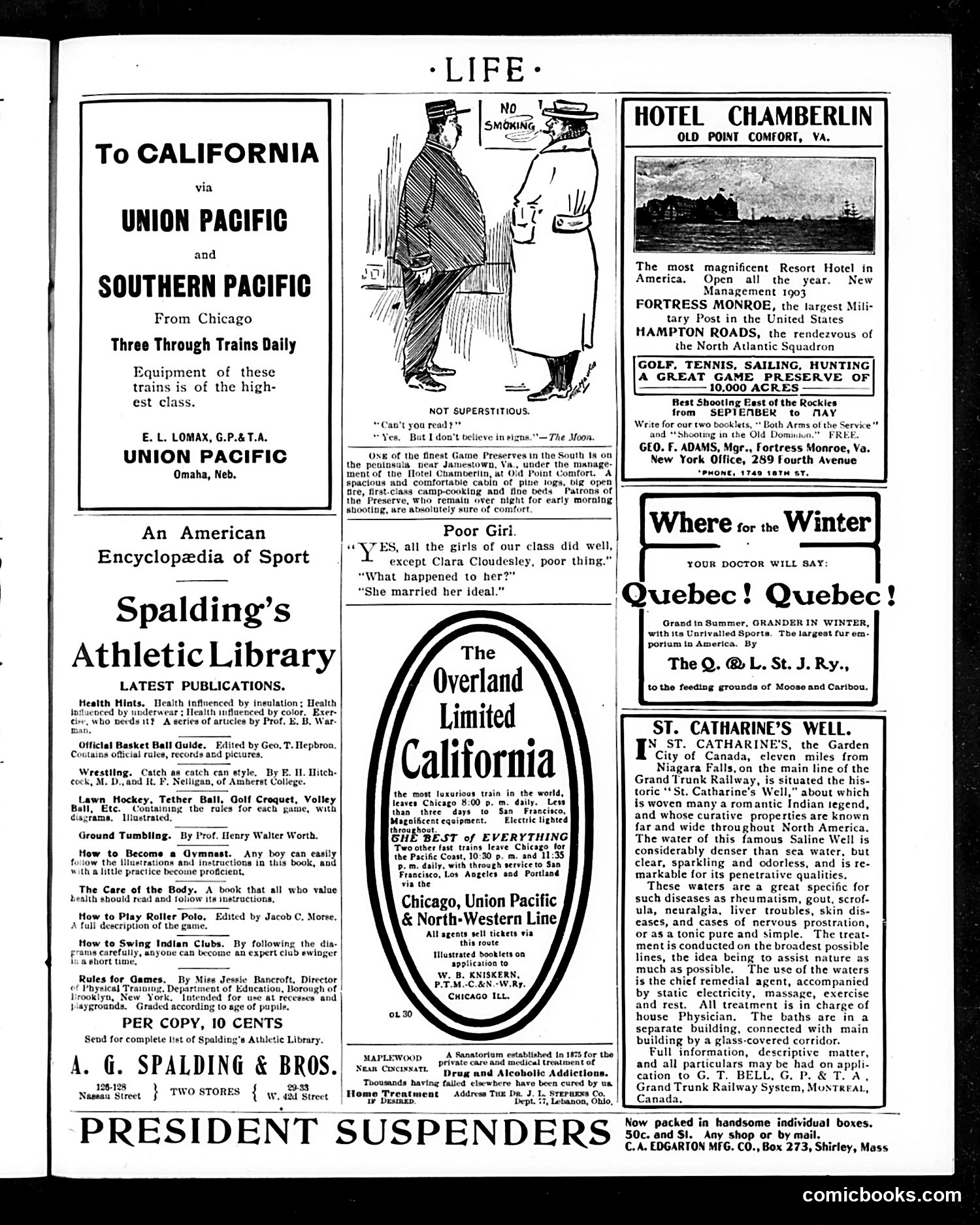
This page is primarily **advertising**, with one small cartoon joke embedded among travel and sports-related ads. ## The Cartoon: "Not Superstitious" The single cartoon shows two men in conversation. One says: "Can't you read?" The other replies: "Yes. But I don't believe in signs." —*The Moon.* **The joke:** A play on the word "signs"—one man points to a "No Smoking" sign, but the other claims not to believe in omens/superstitions rather than simply following posted rules. It's gentle humor about willful ignorance or stubbornness disguised as philosophical skepticism. ## Other Content The page features advertisements for California rail travel, resort hotels (Hotel Chamberlin, Quebec), sporting goods (Spalding's Athletic Library), and health/wellness destinations. A small humor piece titled "Poor Girl" jokes that a woman married "her ideal"—implying marrying beneath one's station was a disaster. The overall page reflects early 1900s American leisure culture and commercial expansion.
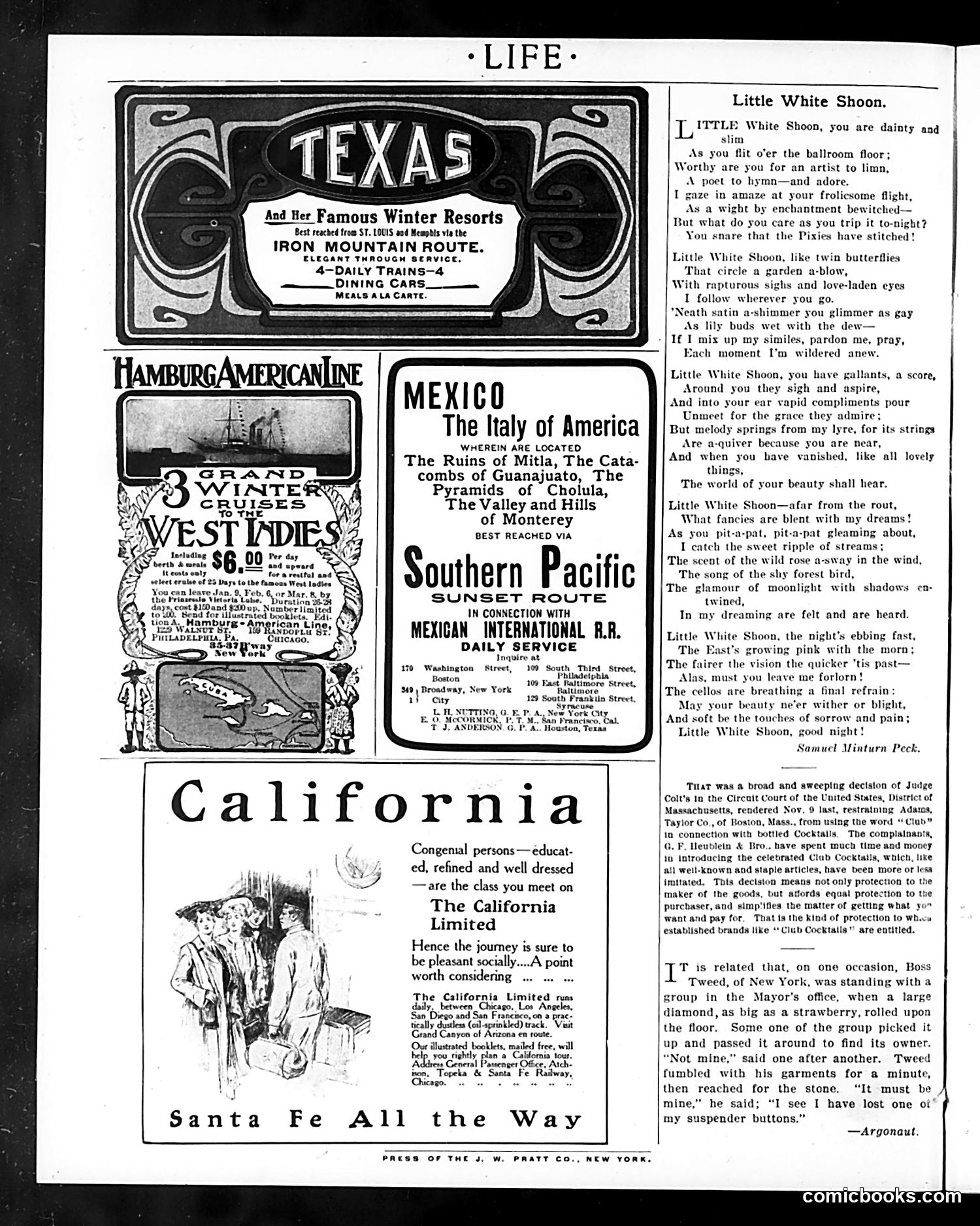
This page is primarily **travel and commercial advertising** with a romantic poem as filler content. The advertisements promote American rail travel to exotic destinations: Texas resorts via the Iron Mountain Route, Mexico (marketed as "the Italy of America") via the Sunset Route and Mexican International Railroad, and California via the California Limited. These ads emphasize luxury, comfort, and refined social experience—targeting educated, well-dressed travelers. The poem "Little White Shoon" by Samuel Minturn Peck is sentimental Victorian verse idealizing a woman's dancing slippers and, by extension, the woman wearing them—typical genteel magazine content of the era. A brief legal note discusses Judge Colt's trademark decision protecting "Club Cocktails" from imitation, showing early 20th-century brand protection concerns. There is no political satire or caricature on this page—it represents standard Life magazine content: aspirational advertising and light, romantic poetry aimed at affluent readers.
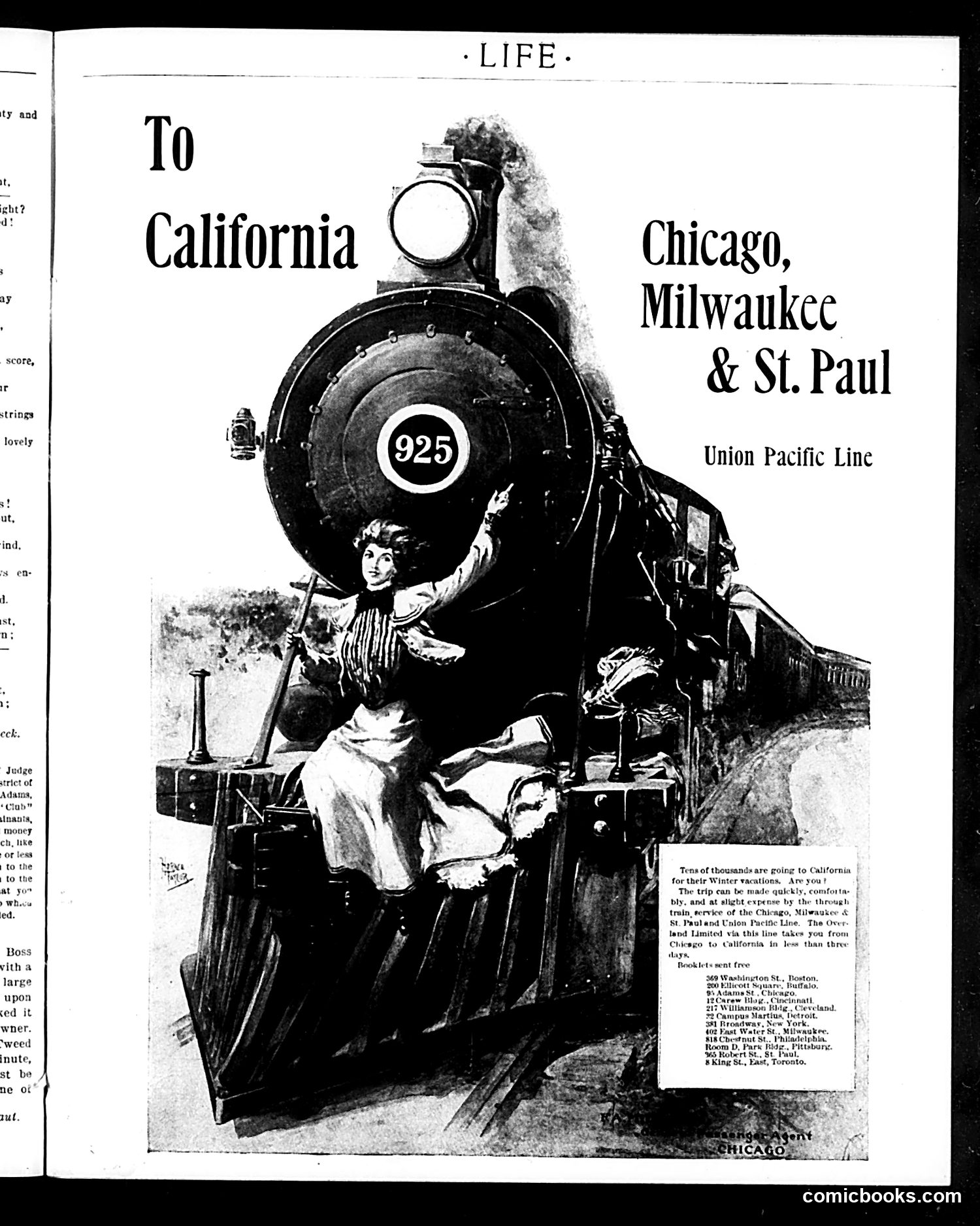
This is a **railroad advertisement**, not political satire. It promotes the Union Pacific Line's service from Chicago, Milwaukee, and St. Paul to California. The image features an allegorical female figure (representing either Liberty, Progress, or the spirit of travel) triumphantly perched on locomotive #925, one arm raised victoriously. She embodies the optimism and glamour associated with rail travel during the early 20th century. The sales pitch targets winter vacationers, emphasizing speed and luxury: the "Overland Limited" train completes the Chicago-to-California journey in under three days. The text lists booking offices in major cities. This reflects the era when transcontinental rail travel was prestigious and aspirational—a modern convenience marketed as an exciting adventure, not the utilitarian service it would later become.
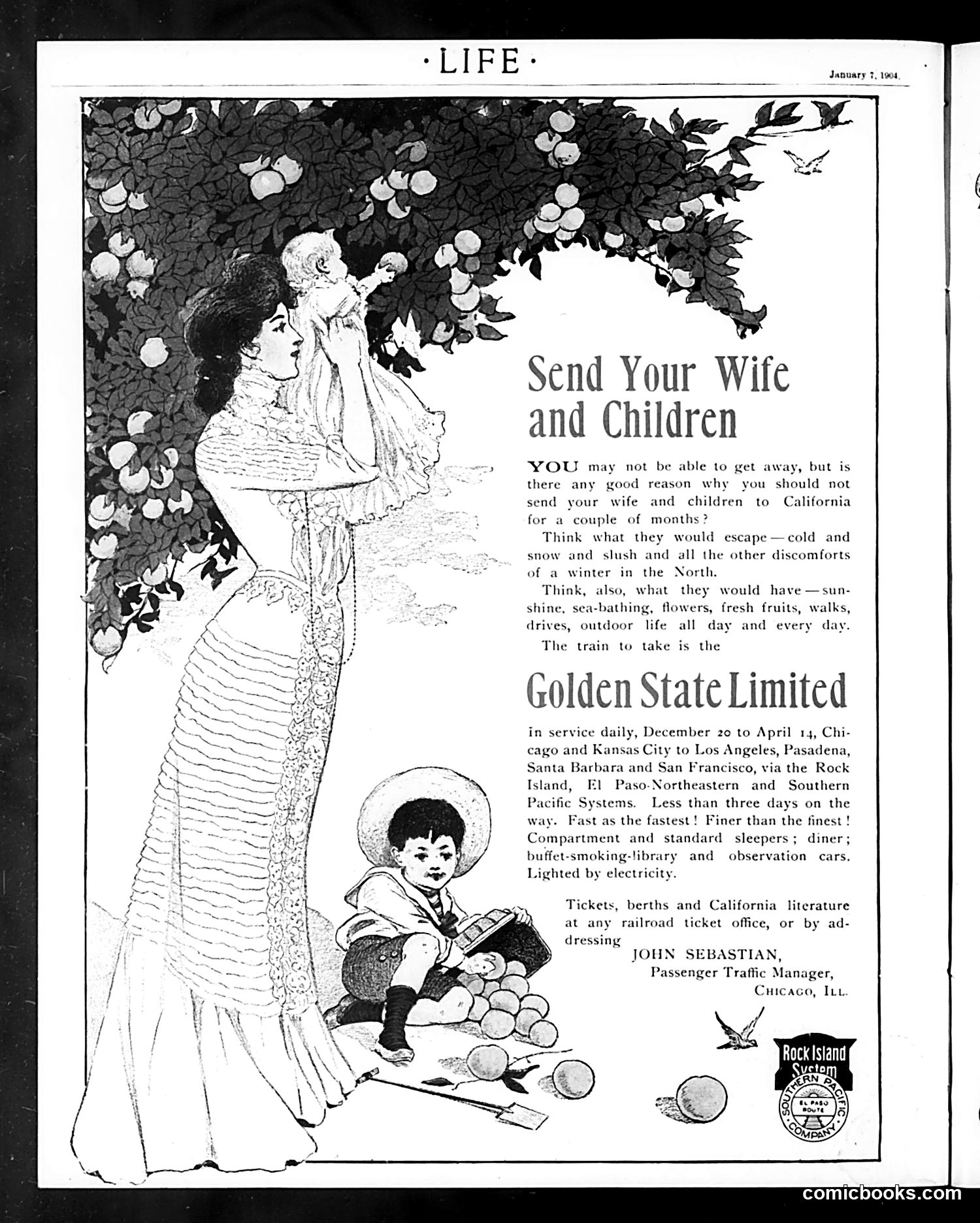
This is primarily **railroad advertising**, not political satire. The page promotes the "Golden State Limited" train service to California, targeting wealthy men who couldn't travel themselves but could afford to send their families west. The illustration depicts an elegantly dressed woman with a child, positioned beneath a fruit-laden tree—visual shorthand for California's abundant agriculture and mild climate. The imagery contrasts California's "sunshine, sea-bathing, flowers, fresh fruits" against Northern winter's "cold and snow and slush." The social assumption is revealing: husbands remain in Chicago and Kansas City for business while wives and children escape harsh winters as a leisure pursuit. The advertisement assumes upper-class domesticity where wives travel for pleasure while husbands work. The "satire" in Life magazine's context likely mocks this gender dynamic—wives sent away like delicate hothouse plants—though the ad itself is presented straightforwardly as commercial promotion.