
Life, 1904-01-07 · page 12 of 36
Life — January 7, 1904 — page 12: what you’re looking at
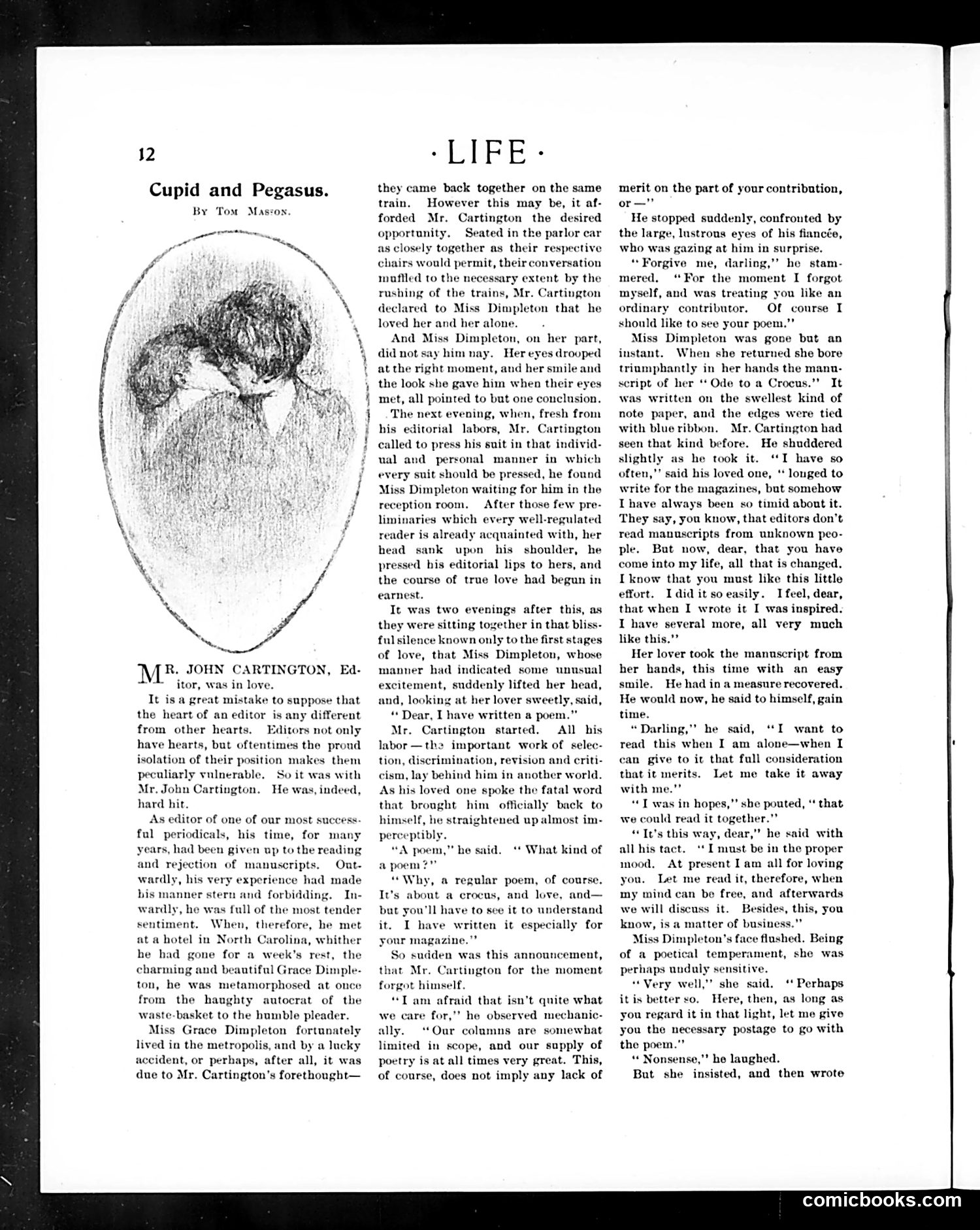
What you’re looking at
This page contains a short story rather than a political cartoon. The illustration shows a portrait of a man (likely Mr. John Cartington, the editor mentioned in the text). The narrative depicts a romantic subplot: Mr. Cartington, a stern newspaper editor, encounters Miss Grace Dimpleton, a woman from North Carolina living in the city. Though he maintains a cold professional demeanor, he becomes emotionally invested when she submits a poem to his magazine. The story explores the tension between his editorial severity and his developing romantic feelings, ultimately suggesting that even hard-hearted editors possess softer sentiments beneath their forbidding exterior. This appears to be sentimental fiction rather than satire.
📄 Transcribed text from this page (OCR, searchable)
Machine-transcribed from the original scan — historical spelling and the odd misread are preserved.
12 Cupid and Pegasus. By Tom Maszox. M®. JOHN CARTINGTON, Ed- ~~ itor, was in love. It isa great mistake to suppose that the heart of an editor is any different from other hearts. Editors not only have hearts, but oftentimes the proud isolation of their position makes them peculiarly vulnerable. So it was with Mr. John Cartington. He was, indeed, hard hit. As editor of one of our most success: ful periodicals, his time, for many years, had been given up to the reading and rejection of manuscripts. Ont- wardly, his very experience had made his manner stern and forbidding. In- wardly, he was full of the most tender sentiment. When, therefore, he met ata hotel in North rolina, whither he had gone for a week’s rest, the charming and beautiful Grace Dimple- ton, he was metamorphosed at once from the haughty autocrat of the waste-basket to the humble pleader. Miss Grace Dimpleton fortunately lived in the metropolis, and by a lucky accident, or perhaps, after all, it was due to Mr. Cartington’s forethought— “LIFE - they came back together on the same train. However this may be, it af- forded Mr. Cartington the desired opportunity, Seated in tke parlor car closely together as their respective chairs would permit, their conversation mufiled to the necessary extent by the rushing of the trains, Mr. Cartington declared to Miss Dimpleton that he loved her and her alone. And Miss Dimpleton, on her part, did not say him nay. Her eyes drooped at the right moment, and her smile and the look she gave him when their eyes met, all pointed to but one conclusion. The next evening, when, fresh from his editorial labors, Mr, Cartington called to press his suit in that individ- ual and personal manner in which every suit should be pressed, he found Miss Dimpleton waiting for him in the reception room. After those few pre- liminaries which every well-regulated reader is already acquainted with, her head sank upon his shoulder, he pressed his editorial lips to hers, and the course of true love had begun in earnest. It was two evenings after this, as they were sitting together in that bliss- ful silence known only to the first stages of love, that Miss Dimpleton, whose manner had indicated some unusual excitement, suddenly lifted her head, and, looking at her lover sweetly, said, “ Dear, I have written a poem.” Mr. Cartington started. All his labor —the important work of selec- tion, discrimination, revision and criti- cism, lay behind him in another world. As his loved one spoke the fatal word that brought him officially back to himself, he straightened up almost im- perceptibly. “A poem,” he said. a poem ? “Why, a regular poem, of course. It’s about a crocus, and love, and— but you'll have to see it to understand it. I have written it especially for your magazine.” > sudden was this announcement, that Mr. Cartington for the moment forgot himself. “Tam afraid that isn’t quite what we care for,’ he observed mechan: ally. ‘Our columns are somewhat limited in scope, and our supply of poetry is at all times very great. This, of course, does not imply any lack of “What kind of merit on the part of your contribution, or—" He stopped suddenly, confronted by the large, lustrous eyes of his fiancée, who was gazing at him in surprise. “Forgive me, darling,’ he stam- mered. “For the moment I forgot myself, and was treating you like an ordinary contributor, Of course I should like to see your poem Miss Dimpleton was gone but an instant. When she returned she bore triumphantly in her hands the manu- script of her ‘Ode to a Crocus was written on the swellest kind of note paper, and the edges were tied with blue ribbon. Mr. Cartington had seen that kind before. He shuddered slight), he took it. ‘I have so often,” said his loved one, * longed to write for the magazines, but somehow Lhave always been so timid abont it. They say, you know, that editors don’t read manuscripts from unknown peo- ple. But now, dear, that you have come into my life, all that is changed, Iknow that you must like this little effort. Idid it soeasily. I feel, dear, that when I wrote it I was inspired. I have several more, all very much like this.”” Her lover took the manuscript from her hands, this time with an easy smile. He had in a measure recovered. He would now, he said to himself, gain time. “Darling,” he said, “I want to read this when I am alone—when I can give to it that full consideration that it merits. Let me take it away with me.”” “Twas in hopes,” she pouted, “ that we could read it together.” “Te's this way, dear,” he said with all his tact. ‘tI must be in the proper mood. At present Iam all for loving you, Let me read it, therefore, when my mind can be free, and afterwards we will discuss it. Besides, this, you know, is a matter of busines: Miss Dimpleton’s face flushed. Being of a poetical temperament, s perhaps unduly sensitive. “Very well,” she said. ‘ Perhaps itis better so. Here, then, as long as. you regard it in that light, let me give you the necessary postage to go with the poem.” “* Nonsense,”’ he laughed. But she insisted, and then wrote comicbooks.com