
Life, 1904-01-07 · page 10 of 36
Life — January 7, 1904 — page 10: what you’re looking at
What you’re looking at
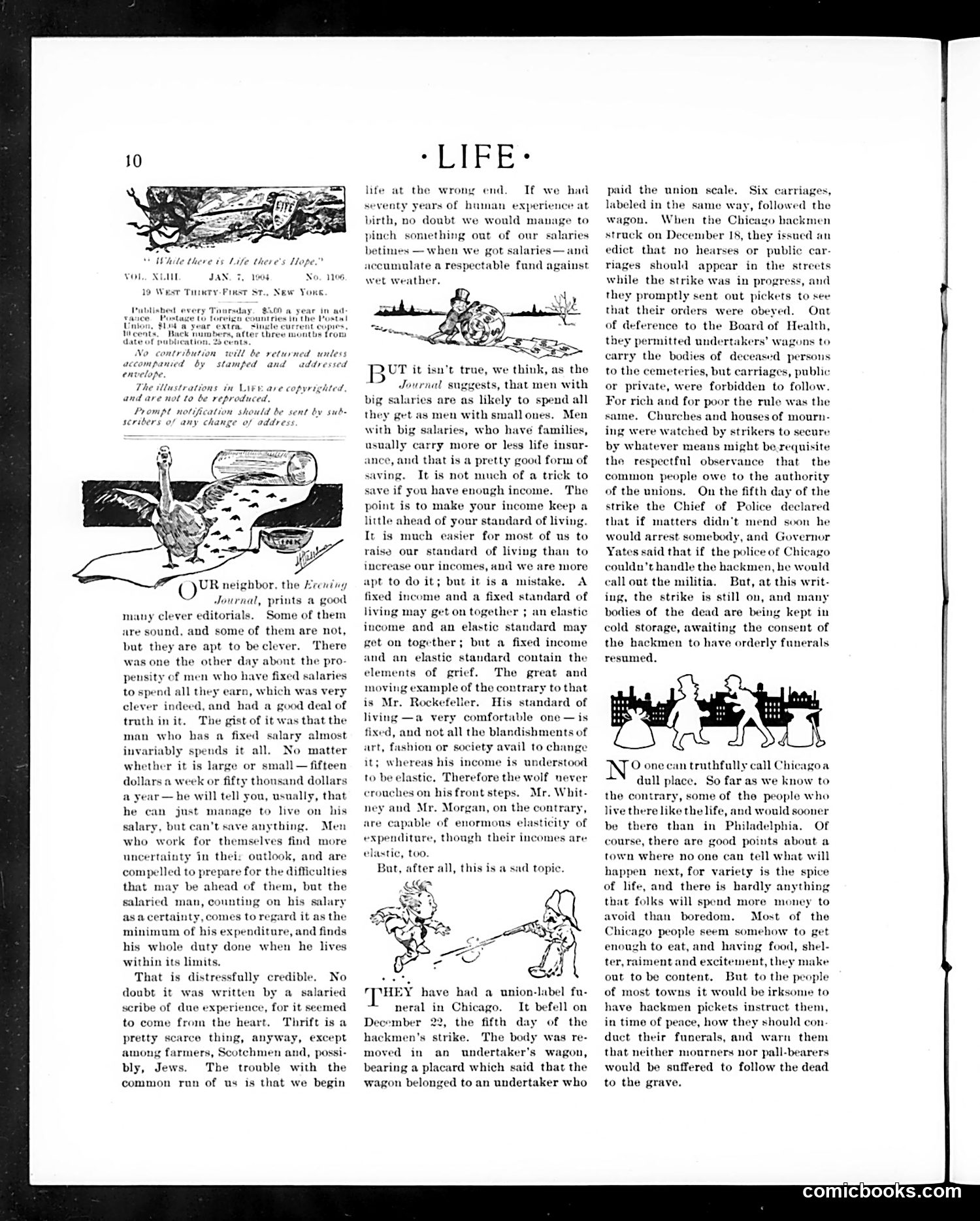
This page satirizes Chicago labor disputes and working-class economics during what appears to be the early 1900s (based on references to a hackmen's strike and union-label funerals). The text critiques the assumption that high-wage earners automatically save money. It argues that wealthy individuals like Mr. Rockefeller maintain fixed, elastic standards of living—meaning increased income simply increases spending rather than savings. The article then shifts to Chicago's hackmen (carriage drivers) strike, describing how strikers prevented funeral processions and prevented bodies from reaching cemeteries. It mocks Chicagoans for tolerating such disruption, contrasting the city unfavorably with Philadelphia. The accompanying illustrations appear to be satirical vignettes of urban life and labor conflict, though specific figures remain unclear without additional context.
📄 Transcribed text from this page (OCR, searchable)
Machine-transcribed from the original scan — historical spelling and the odd misread are preserved.
+ While there ts Life there's Hope Vou, NUM JAN. 7, 1004 No. 19 West Tunury-Prest St., New Yous will be returned untess mpanied by stamped and addressed The illustrati and are not to be reproduc Prompt notification scribers of any change 0 (UR neighbor. the Erening Journal, prints a good many clever editorials. Some of them are sound, and some of them are not, but they are apt to be clever. There was one the other day about the pro- pensity of men who have fixed salarie 11 they earn, which was very clever indeed, and 1 a good deal of truth init. The gist of it was that the man who has a fixed salary almost invariably spends it all. No matter whether it is large or small —fifteen dollars a week or fifty thousand dollars a year — he will tell you, usually, that he can just 1 ge to live on his salary, but can’t save anything. Men who work for themselves find more uncertainty in thei: outlook, and ar compelled to prepare for the difficulties that may be ahead of them, but the salaried man, counting on his salary as a certainty, comes to regard it as the minimum of his expenditure, and finds his whole duty done when he lives within its limit That is distressfully credible. No doubt it was written by a salaried scribe of due experience, for it seemed to come from the heart. Thrift is a pretty scarce thing, anyway, except among farmers, Scotchmen and, possi- bly, Jew The trouble with the common run of us is that we begin to spend * LUPE * If we had seventy years of human experience at life at the wrong end birth, no doubt we would manage to pinch thing out of our sa betimes — when we got salari accumulate a respectable fund against wet w But it isn’t true, we think, as the Journal suggests, that men with big salaries are as likely to spend all they get as men with smallones. Men with big who have families, usually carry more or less life insur- and that is a pretty good form of saving. It is not much of a trick to save if you have enough income. The point is to make your income keep a little ahead of your standard of living. It is much easier for most of us to raise our standard of living than to increase our incomes, and we are more apt to do it; but it is a mistake. A xed income and a fixed standard of living may get on together ; an elastic income and an elastic standard may get on together; but a fixed income and an elastic standard contain the elements of grief. The great and moving example of the contrary to that is Mr. Rockefeller. His standard of living —a very comfortable one — is fixed, and not all the blandishments of art, fashion or society avail to change it; whereas his income is understood Therefore the wolf uever crouches on hisfront steps. Mr. Whit- y and Mr. Morgan, on the contrary, enormous elasticity of to be elastic <penditure, though their income aastic, too But, after all, this is a sad topic. of PONG Ul A have had a union-label fu- It befell on of the The body was re- pH E neral in Chicago. the fifth da hackmen’s strike. moved in an undertaker's wagon, bearing a placard which said that the wagon belonged to an undertaker who paid the union scale, Six carriages, labeled in the same way, followed the wagon. When the Chi hackmen k on December 18, they issued an edict that no hearses or public car- riages should appear in the streets while the strike was in progress, and they promptly sent out pickets to see that their orders were obeyed. Ont f deference to the Board of Health, they permitted undertakers’ wag: carry the bodies of deceased persons to the cemeteries, but carriages, public or private, were forbidden to follow. For rich and for poor the rule was the same. Churches and houses of mourn- ing were watched by strikers to secure by whatever means might be requisite the respectful observance that the common people owe to the authority of the unions. On the fifth day of the strike the Chief of Police declared that if matters didn't mend soon he would arrest somebody, and Governor Yates said that if the police of Chicago couldn't handle the hackmen, he would call out the militia. But, at this writ- ing, the strike is still on, and many bodies of the dead are being kept in cold storage, awaiting the consent of the hackmen to have orderly funerals resumed. ns to } O one can truthfully call Chicagoa dull place. So far as we know to the contrary, some of the people who live there like the life, and would sooner be there than in Philadelphia. Of course, there are good points about a an tell wh ppen next, for variety is the spice of life, and there is hardly anything that folks will spend more money to void than boredom. Most of the Chicago people seem somehow to get enough to eat, and having food, shel- ter, raiment and excitement, they make out to be content. But to the people of most towns it would be irksome to have hackmen pickets instruct them, in time of peace, how they should con duct their funerals, and warn them that neither mourners nor pall-bearers would be suffered to follow the dead to the grave. comicbooks.com