
A complete issue · 32 pages · 1903
Life — August 20, 1903
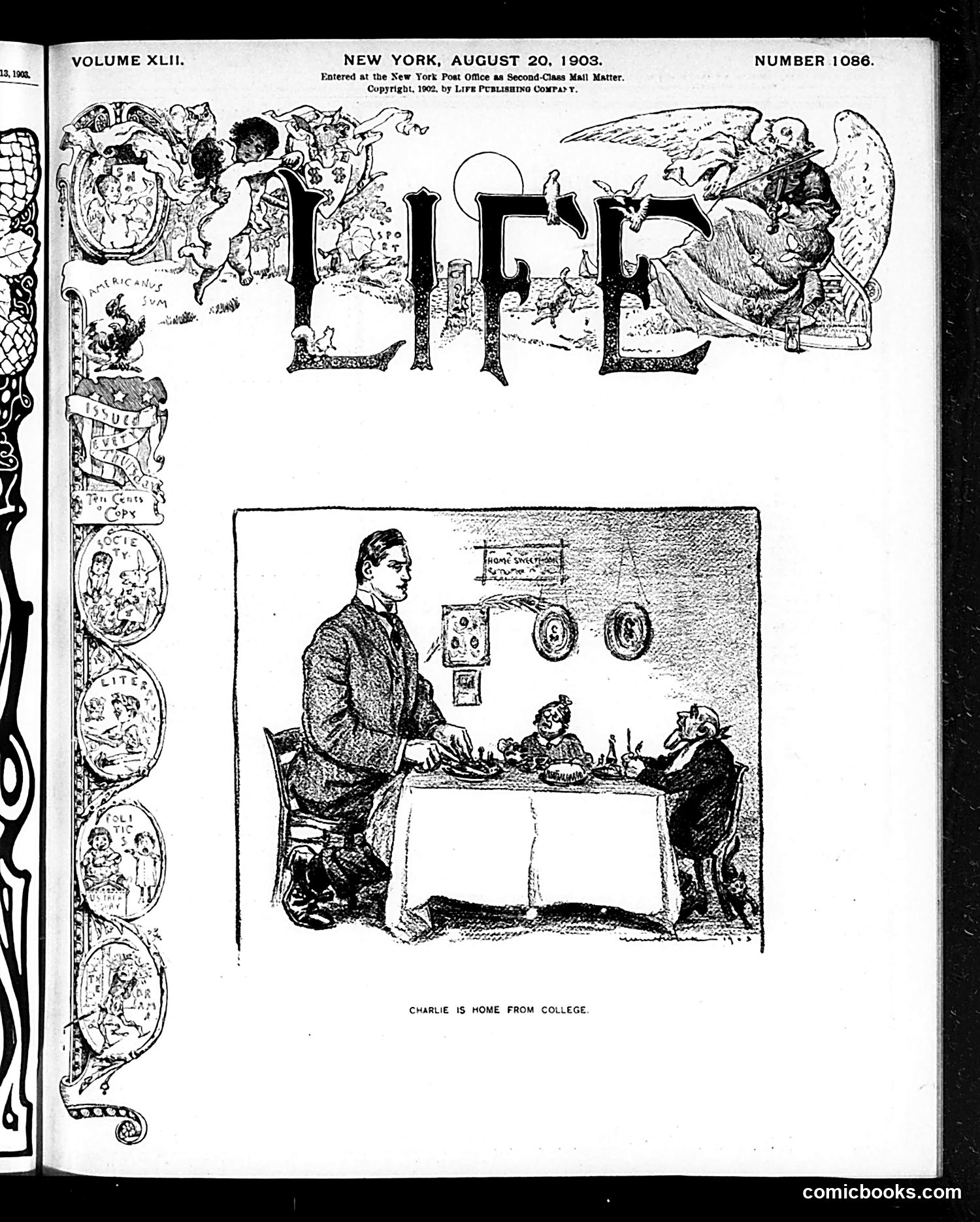
This cartoon satirizes the generational divide between a young college-educated man and his parents. Charlie, positioned at the table's head in a dominant pose, appears to be lecturing or pontificating to his elderly parents, who sit listening with expressions suggesting bewilderment or skepticism. The framed diplomas and certificates hanging on the wall behind emphasize his newfound education. The joke targets the pretentiousness of newly graduated college students who return home inflated with intellectual confidence, adopting a superior attitude toward their less-educated parents. This reflects early 1900s anxieties about how higher education was changing youth culture and family dynamics, creating generational conflict based on educational disparity.
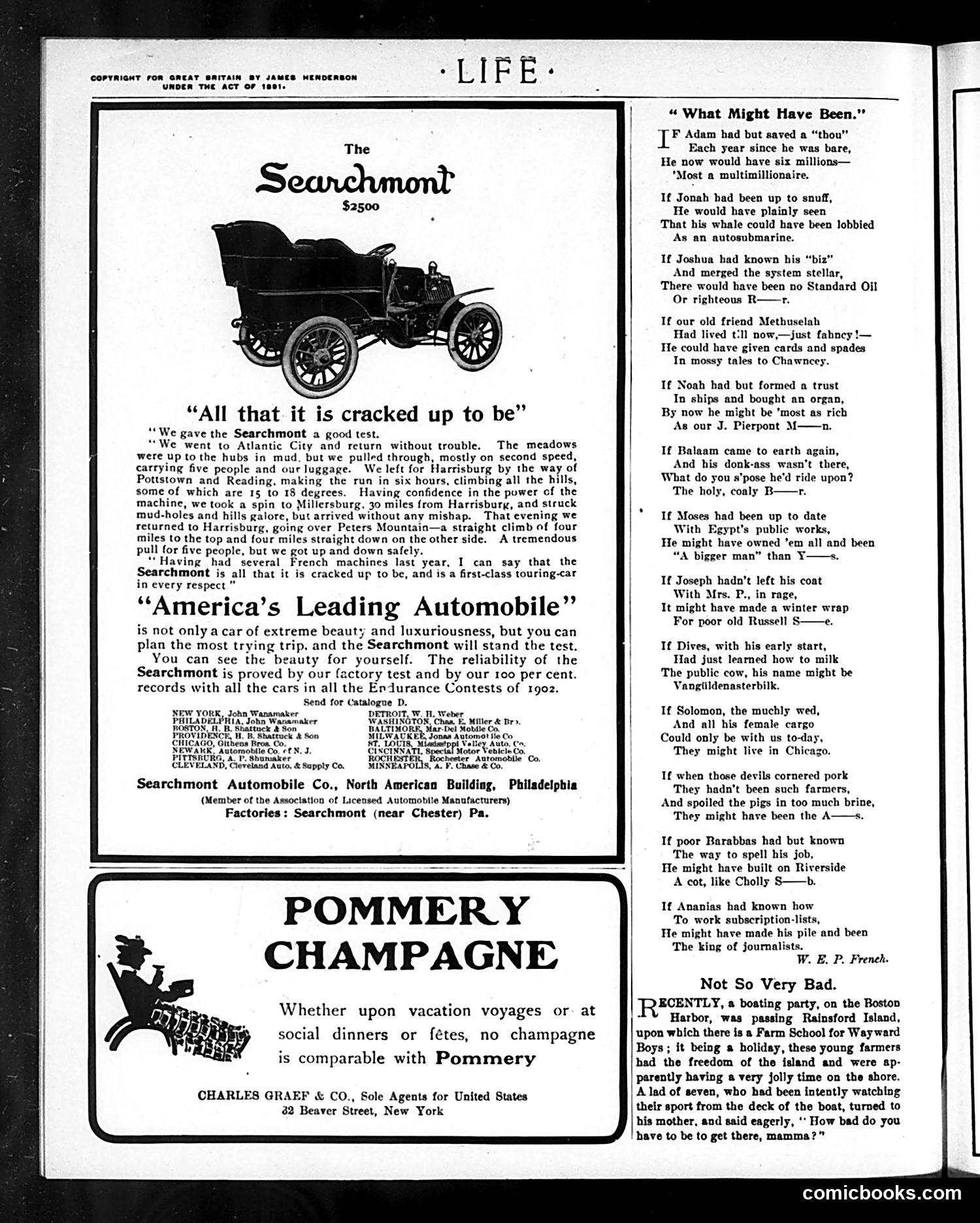
This page contains **primarily advertisements** for the Searchmont automobile ($2,500) and Pommery Champagne, with minimal editorial content. The right side features a poem titled **"What Might Have Been"** by W. E. P. French, a satirical piece imagining alternate histories for various named individuals—"Adam," "Jonah," "Joshua," "Methuselah," "Noah," etc.—had they possessed modern knowledge or opportunities. Each stanza humorously suggests these biblical/historical figures could have become wealthy industrialists, monopolists, or famous figures if they'd understood modern business and technology. Below this is a brief humorous anecdote titled **"Not So Very Bad"** about a young boy on a Boston Harbor boating party who ingeniously avoids seasickness. The page reflects early 1900s *Life* magazine's blend of advertising, light verse satire, and brief comic stories rather than political cartooning.
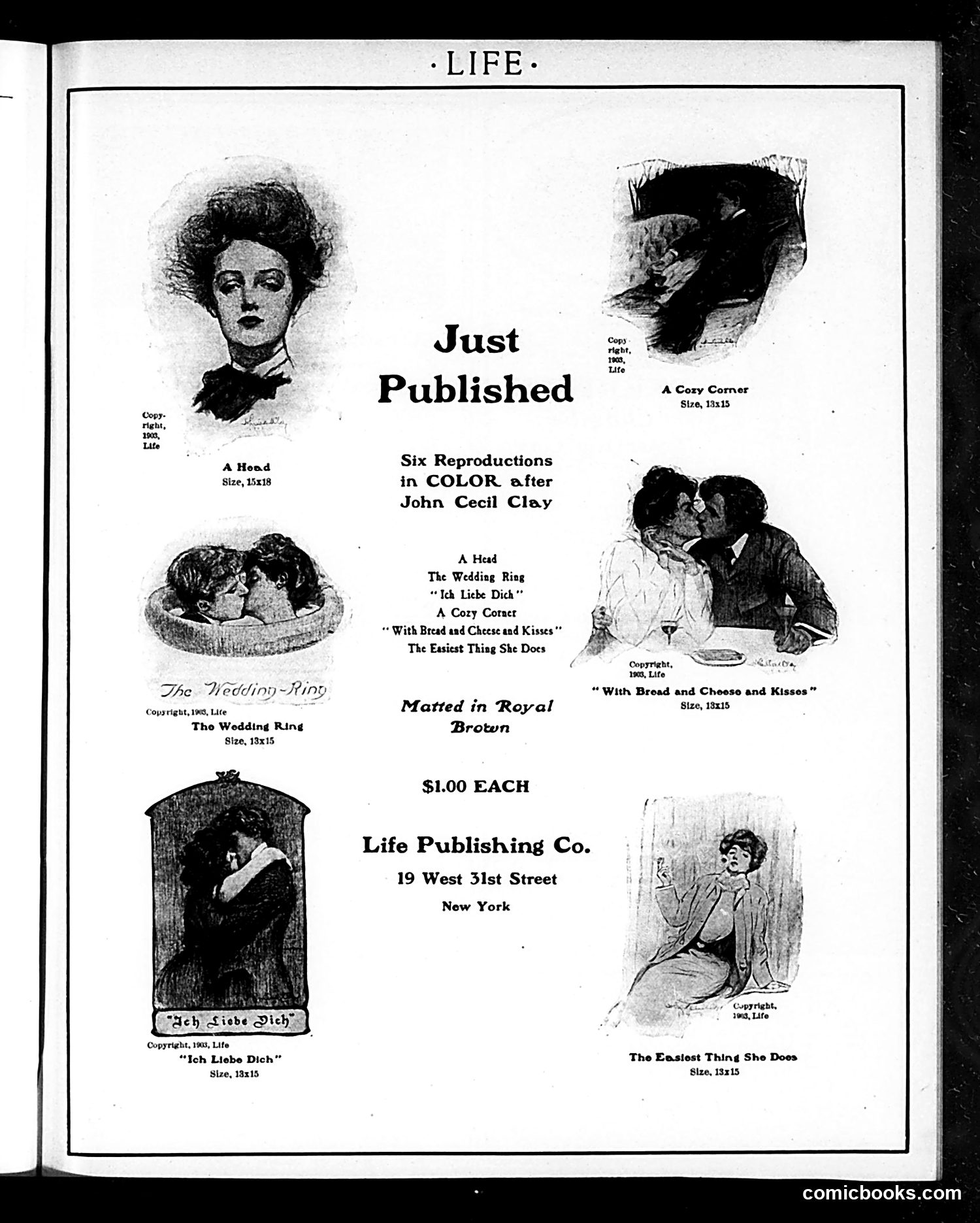
This is primarily an **advertisement page**, not political satire. Life Publishing Co. is promoting six color reproductions of paintings by artist **John Cecil Clay**. The works advertised are: - "A Head" - "A Cosy Corner" - "The Wedding Ring" - "Ich Liebe Dich" (German for "I love you") - "With Bread and Cheese and Kisses" - "The Easiest Thing She Does" The titles and romantic imagery—featuring intimate scenes of couples and women's portraits—suggest these are sentimental, domestic-themed artworks popular in early 20th-century illustrated magazines. Priced at $1.00 each, these reproductions were mass-market products for middle-class homes. The page reflects period aesthetic values emphasizing romance, domesticity, and refined sentimentality rather than social commentary.
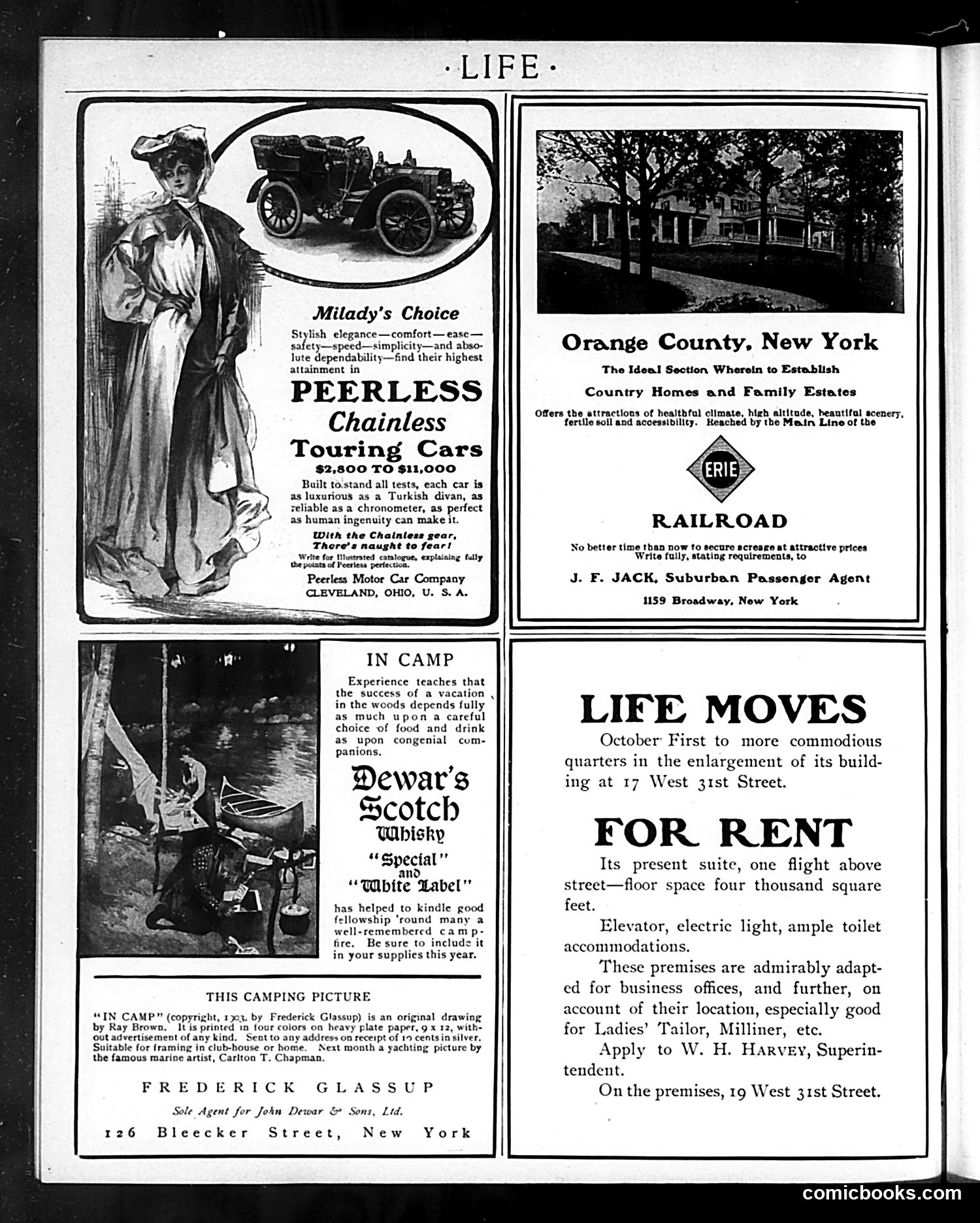
This page is primarily **advertising rather than satire or political commentary**. It contains four distinct advertisements: 1. **Peerless Chainless Touring Cars** ($2,800–$11,000): Appeals to women ("Milady's Choice"), emphasizing luxury and reliability. 2. **Erie Railroad to Orange County, New York**: Promotes suburban real estate development as ideal for country homes and estates. 3. **Dewar's Scotch Whisky**: Uses a camping scene to market alcohol as essential for vacations. 4. **Life Magazine announcement**: Notes the publication's relocation to larger offices on West 31st Street, advertising rental space availability. The page reflects early-1900s consumer culture, targeting affluent readers interested in automobiles, suburban living, and leisure goods. No political figures or satirical commentary are present.
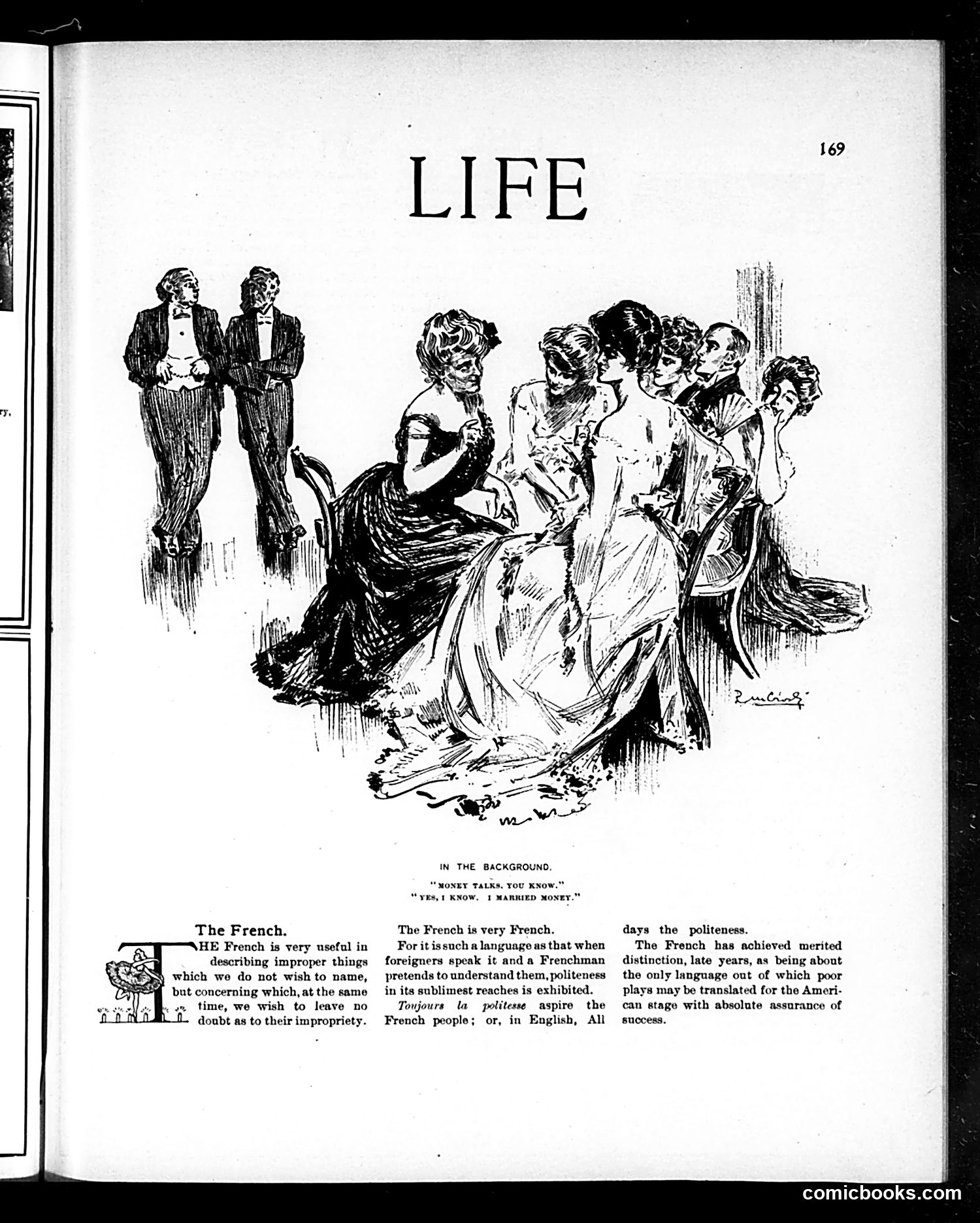
This satirical page depicts a social scene where two well-dressed men in the background observe a group of fashionably dressed women in conversation. The caption reads: "MONEY TALKS, YOU KNOW" / "YES, I KNOW. I MARRIED MONEY." The accompanying text, titled "The French," discusses French language and politeness, noting that French is "very useful in describing improper things" and that French phrases allow speakers to discuss delicate matters with propriety. The cartoon satirizes wealthy marriages and materialism—specifically, the joke that one man married a woman primarily for her wealth rather than love. The juxtaposition with commentary on French language suggests the satirist is mocking the pretense of genteel society, where euphemisms and foreign phrases mask base motivations like financial gain. The scene captures Gilded Age attitudes toward marriage and social status.
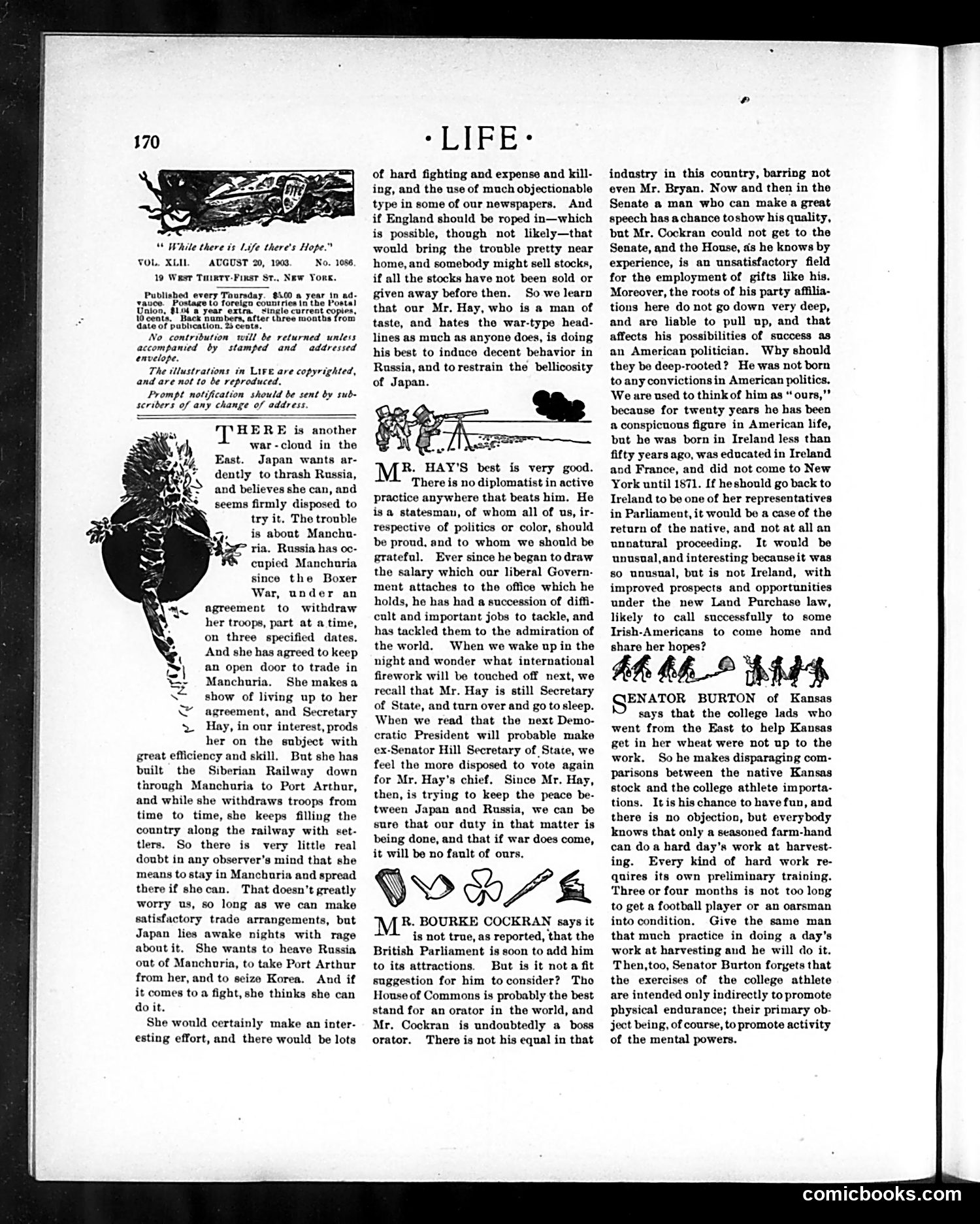
**The Main Cartoon** (left side) depicts a caricatured Asian figure with exaggerated features representing Manchuria, shown as a contested territory being fought over by imperial powers. The illustration satirizes the Russo-Japanese rivalry over control of Manchuria and Korea during this period of imperial competition in East Asia. **The Editorial Content** critiques various political figures, including discussion of Mr. Cockran's oratorical skills and Senator Burton's comments on college athletics versus farm labor. The satire mocks political posturing and the gap between politicians' rhetoric and practical concerns. The overall tone ridicules imperial ambitions and contemporary political hypocrisy—common themes in early 1900s American satirical journalism critiquing both foreign wars and domestic politics.
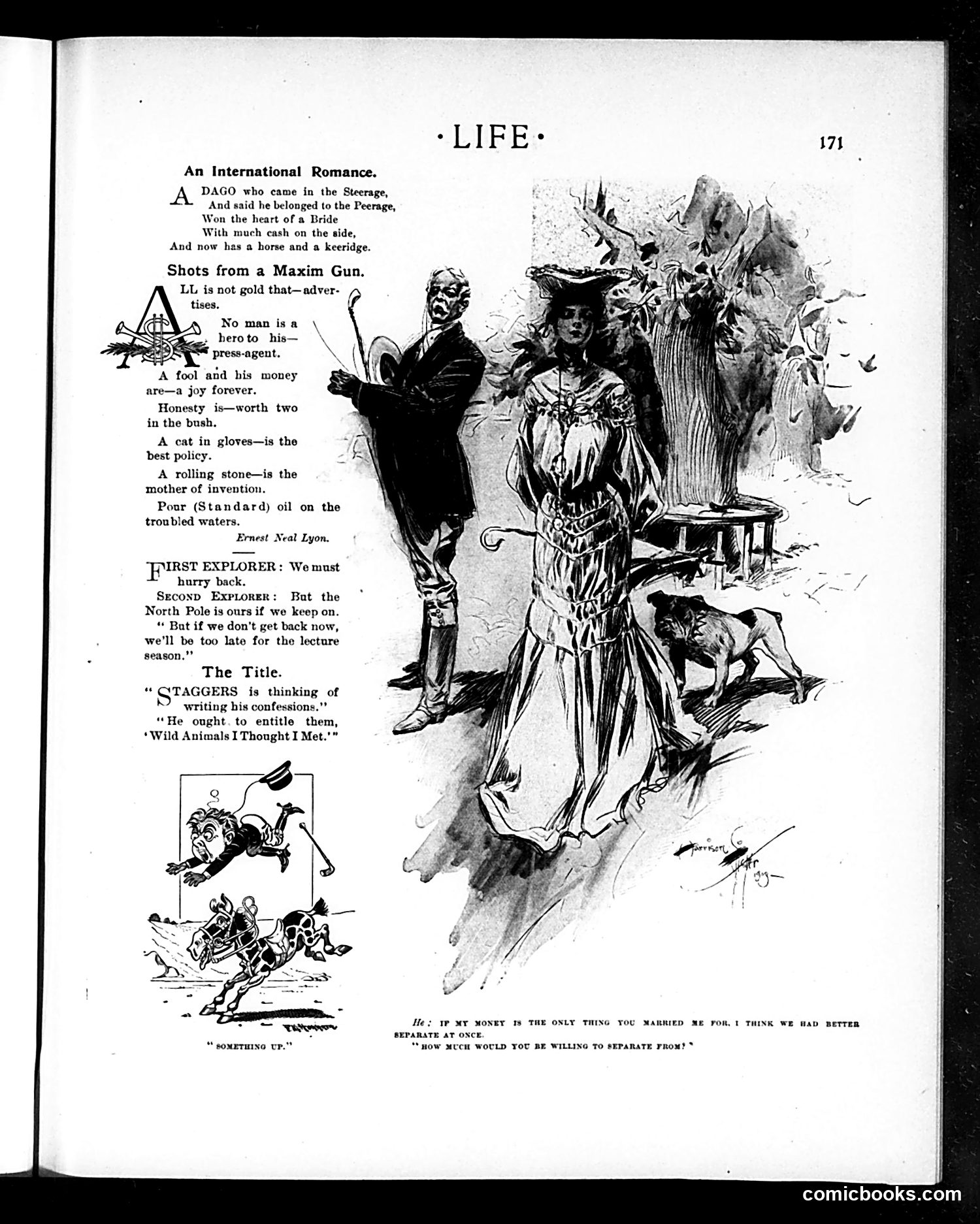
This page contains satirical commentary and illustrations typical of early 20th-century Life magazine. The main content includes: **"An International Romance"**: A brief satirical poem mocking a nobleman from abroad who visited the Peerage, arriving with "much cash on the side" and acquiring "a horse and a heiress"—suggesting wealthy foreigners married into American high society for status. **"Shots from a Maxim Gun"**: Aphoristic witticisms attributed to Ernest Neal Lyon, including cynical observations about money, honesty, and policy. **The illustrations** depict caricatured figures in dramatic poses, likely mocking contemporary social types—possibly nouveau riche Americans or international fortune-hunters. The humor targets wealth, social climbing, and the pretensions of the upper classes, reflecting Life's role as a satirical commentary on American society and manners.
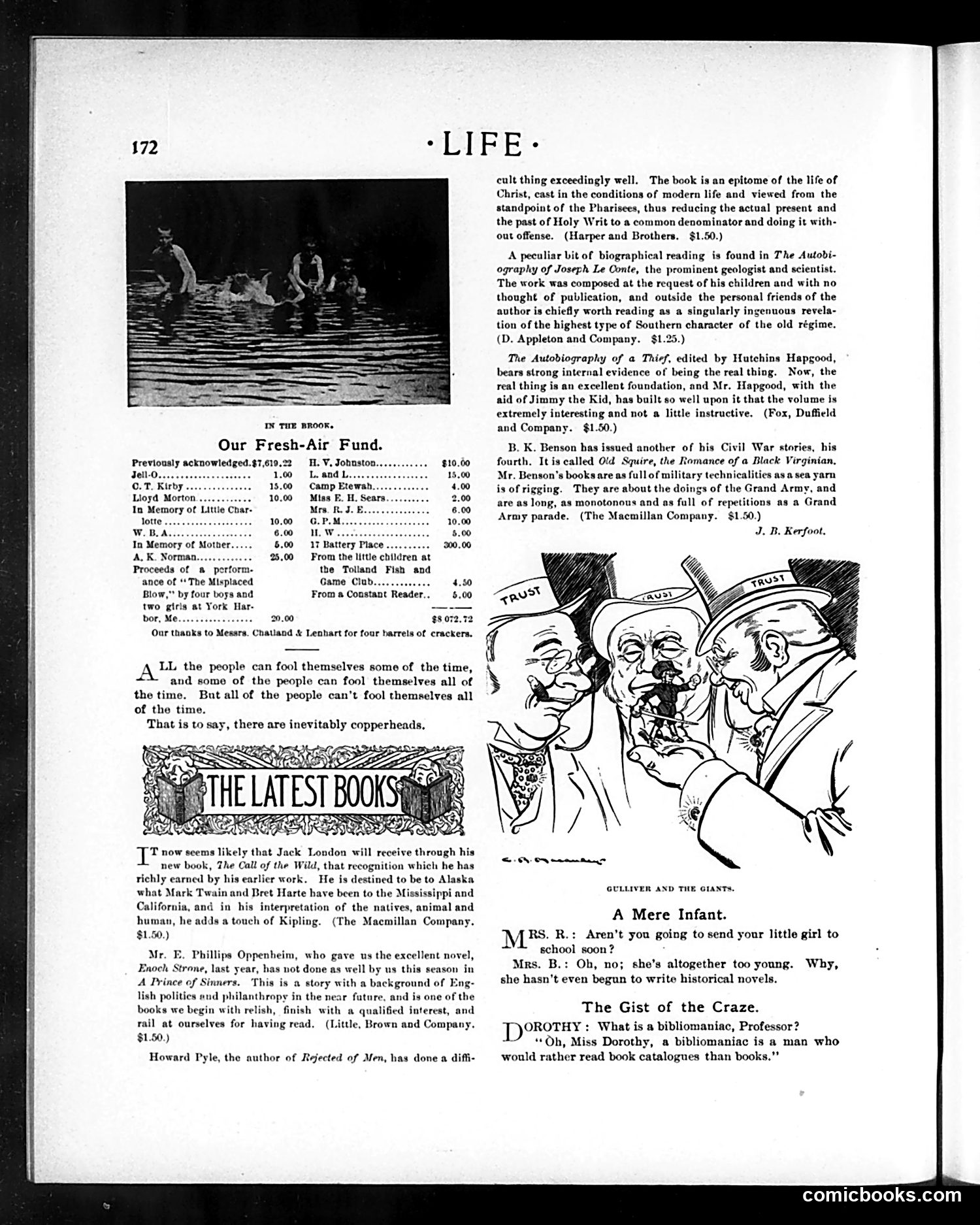
This political cartoon depicts three figures labeled "TRUST" looming over a much smaller person, referencing Jonathan Swift's *Gulliver's Travels*—where Gulliver is trapped by giants (Lilliputians). The satire compares large monopolistic trusts to oppressive giants constraining individual freedom or business. The three "TRUST" figures represent major industrial monopolies that dominated American business in the early 20th century, a major Progressive Era concern. The cartoon criticizes how these powerful corporations controlled markets and limited competition, positioning themselves as overwhelming forces crushing smaller competitors or the average person. This reflects widespread anti-monopoly sentiment that led to antitrust legislation during this period.
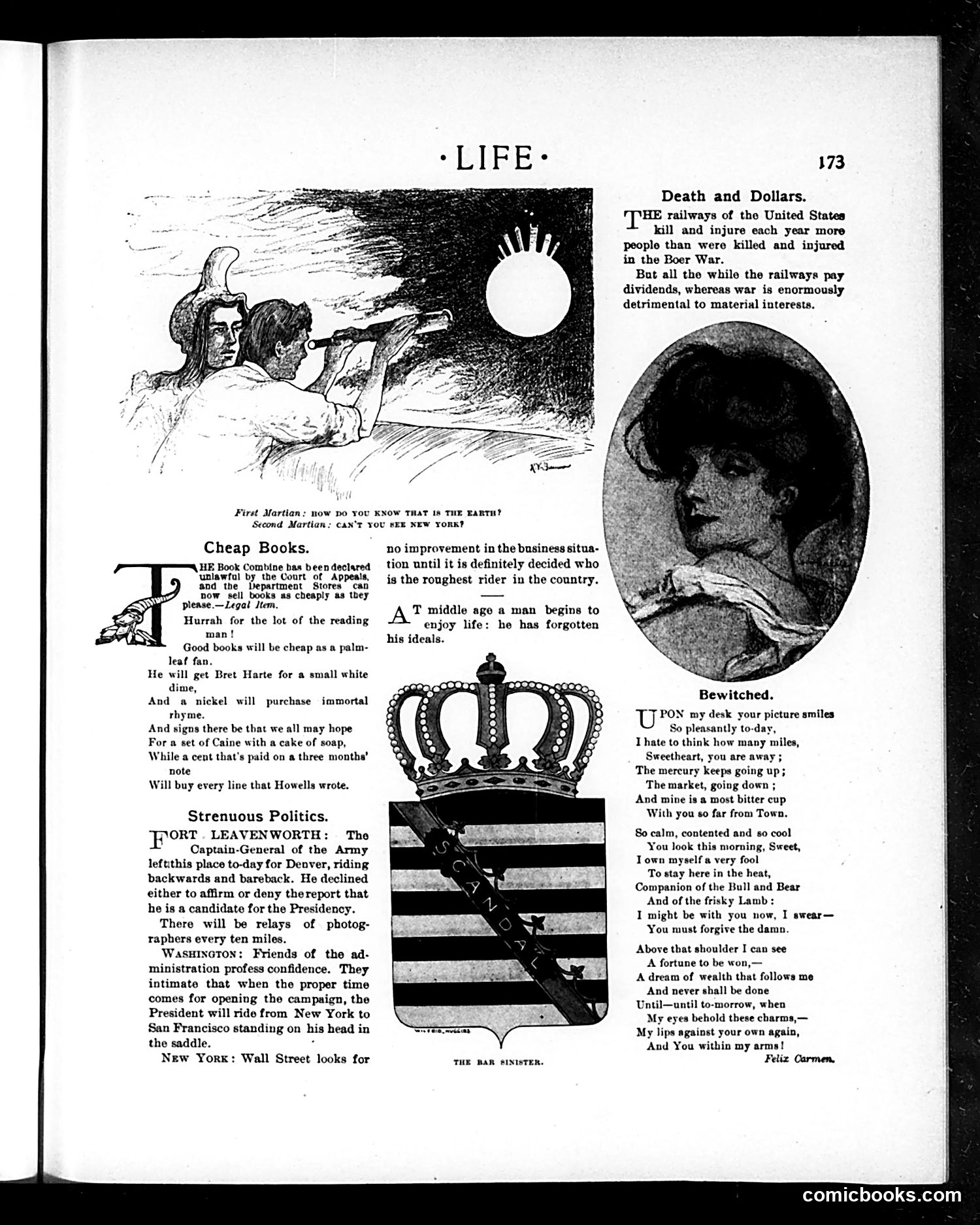
**"Death and Dollars"** (top): A satirical comparison claiming U.S. railroads kill more people annually than died in the Boer War, yet railways pay dividends while war damages material interests. The cartoon shows soldiers observing a rising sun, presumably depicting war's destruction. **"Cheap Books"**: Celebrates a court ruling allowing cheaper book sales, praising affordable access to literature like Bret Harte and Howells for working people. **"Strenuous Politics"**: Mocks Fort Leavenworth's Captain-General for refusing to comment on presidential candidacy rumors. It satirizes speculation about whether he'll campaign via cross-country horseback travel—a dig at Theodore Roosevelt's vigorous public persona and political ambitions. **"Bewitched"**: A love poem expressing distance and longing for an absent sweetheart.
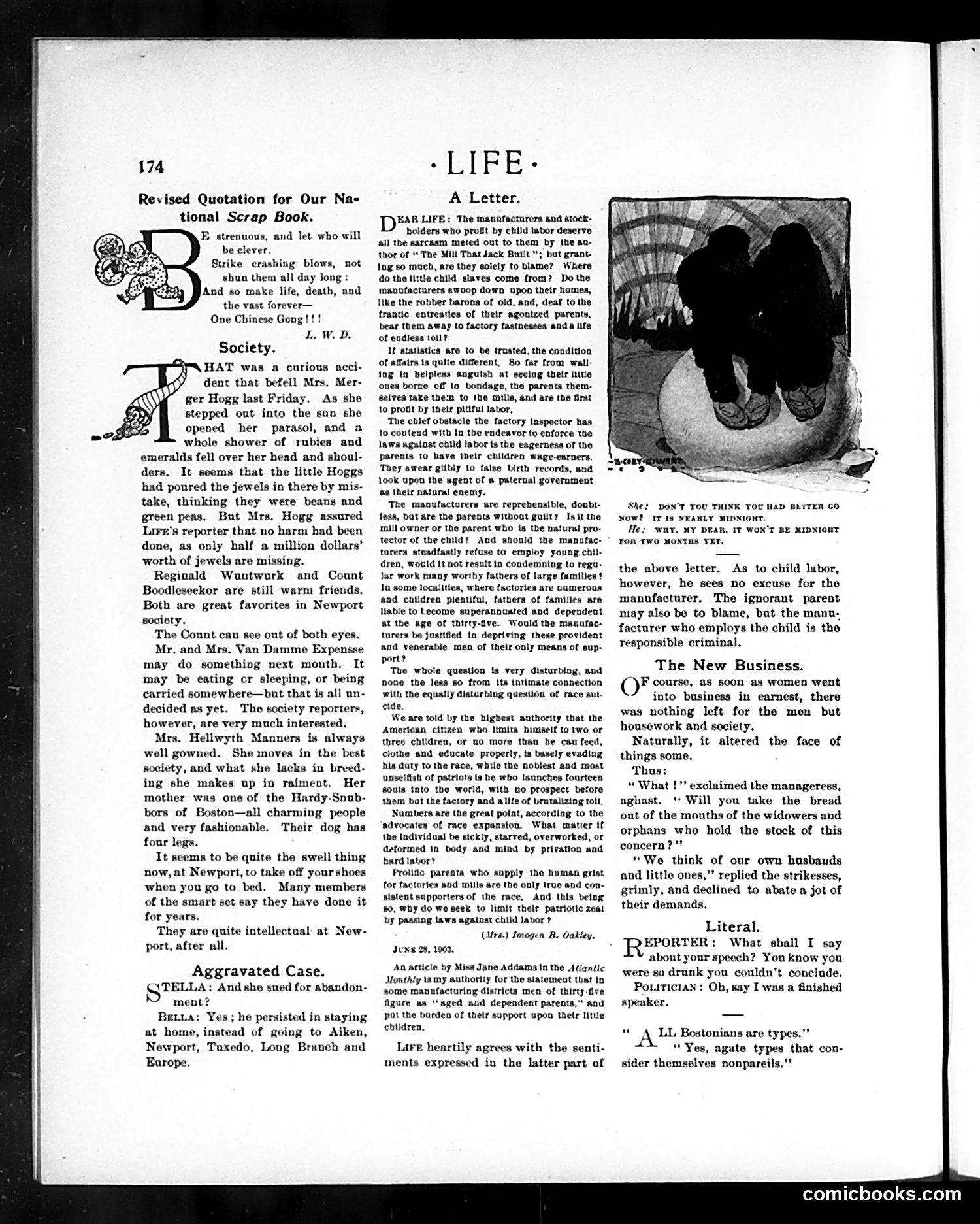
This page contains social commentary rather than political cartoons. The main article, "A Letter," criticizes manufacturers who employ child labor in factories. The piece argues that factory owners and negligent parents share blame for exploiting children, noting that some manufacturers deliberately hire young workers to replace adult laborers at lower wages. The accompanying sections—"Society" (mocking wealthy socialites), "Aggravated Case" (a brief dialogue about marital abandonment), and "The New Business" (satirizing how business opportunities displaced women from professional life)—use humor to critique class disparities and gender inequality in Gilded Age America. The overall message targets both industrial exploitation and upper-class indifference to working-class suffering.
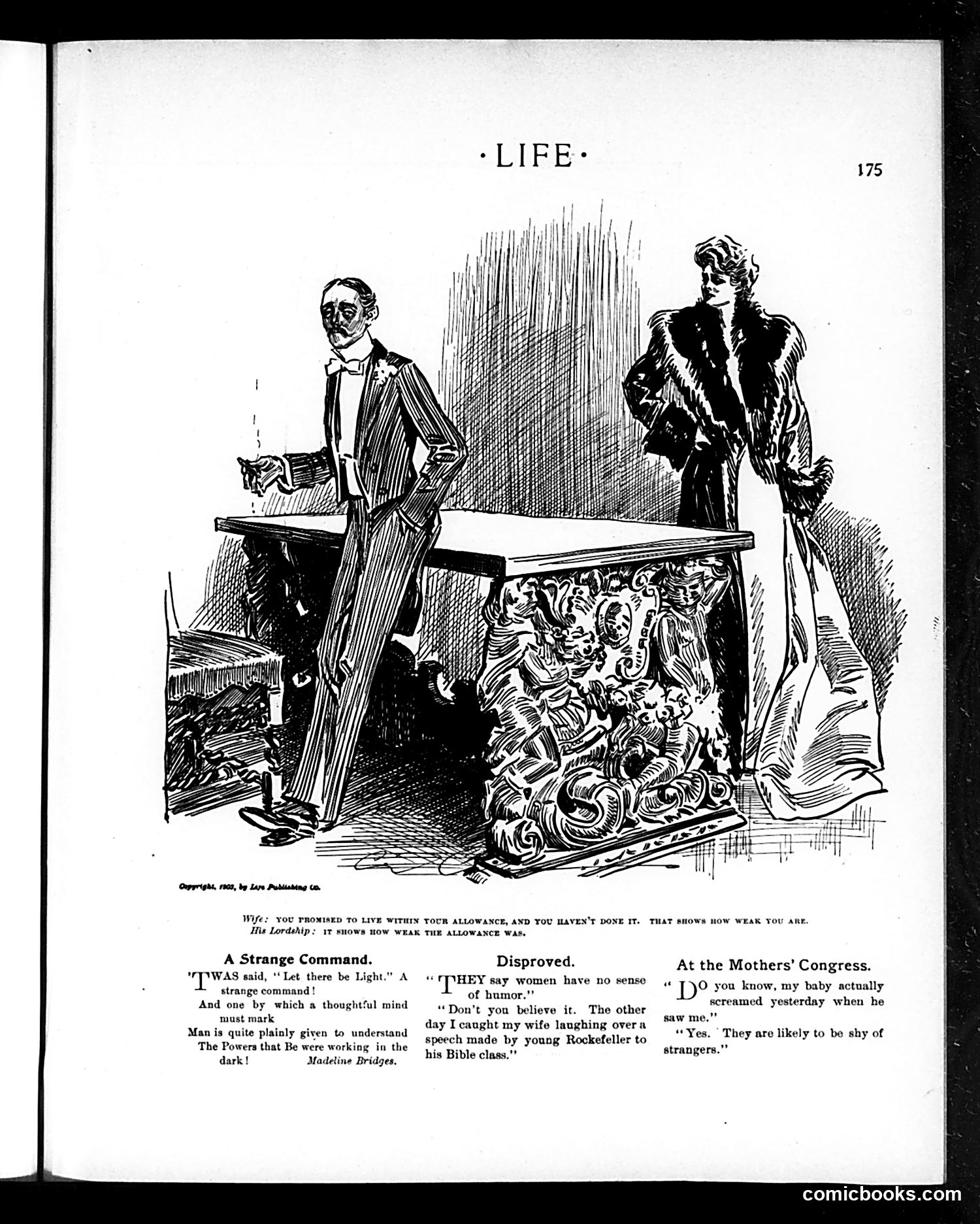
This page contains three separate satirical pieces from Life magazine (copyright 1902, per the credit line). **Main Illustration ("A Strange Command"):** Shows a well-dressed man at a desk confronting a woman in fur, likely depicting marital conflict over finances. The caption quotes a husband demanding his wife live within an allowance, revealing his weakness—suggesting satirical commentary on male economic control and the powerlessness it paradoxically exposes. **"Disproved":** A brief joke dismissing claims that women lack humor, citing evidence to the contrary. **"At the Mothers' Congress":** A humorous anecdote about a baby's behavior at what appears to be a women's gathering, playing on period anxieties about maternal instinct and social propriety. The page targets gender relations, marital dynamics, and evolving social roles of early 1900s America.
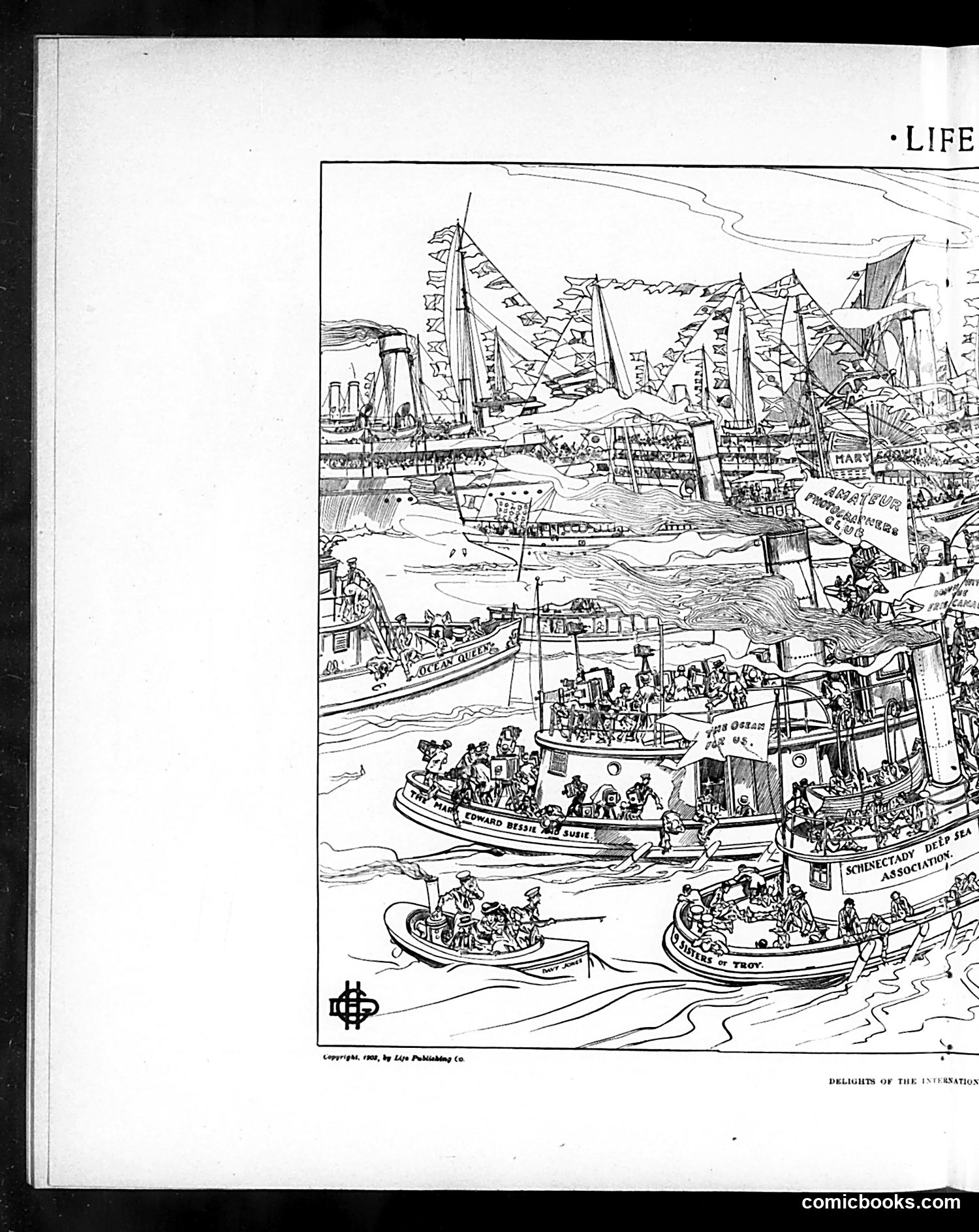
This is a detailed sketch of a busy harbor scene, likely depicting an international exposition or fair. Multiple large sailing vessels with distinctive flags and banners crowd the waterfront, while smaller boats and ferries transport crowds of visitors. The ships appear labeled with various names and associations, though most text is too small to read clearly in this reproduction. The copyright note indicates this is from Life Publishing Co., 1902. The caption references "Delights of the Exposition," suggesting this satirizes the experience of attending a major world's fair—probably the 1904 St. Louis World's Fair or similar contemporary event. The satire likely mocks the chaotic crowds, commercial spectacle, and transportation difficulties visitors faced accessing such events, rather than targeting specific political figures or events.
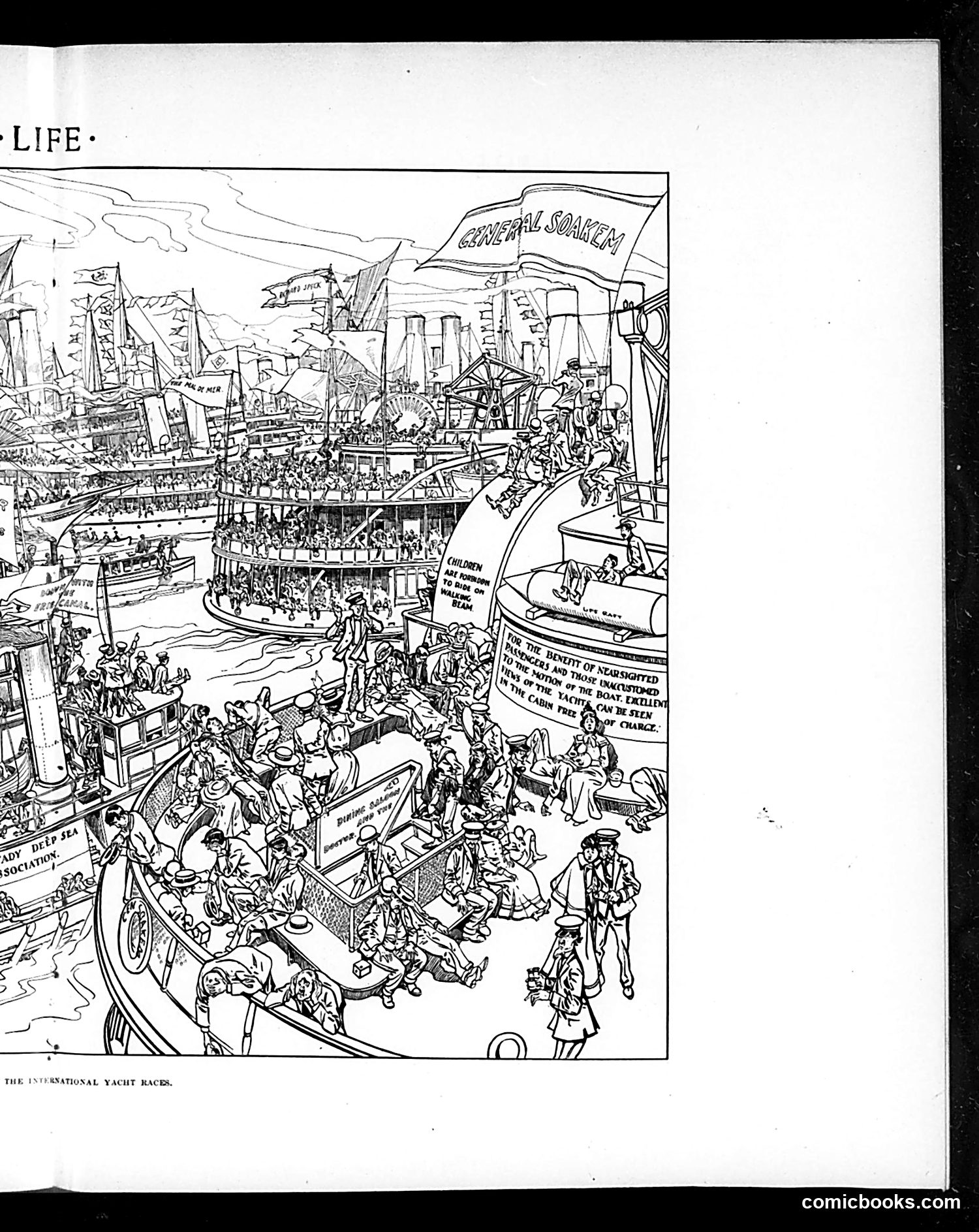
This satirical illustration depicts a crowded harbor scene centered on yacht racing. The drawing shows massive crowds of spectators, multiple vessels, and elaborate grandstands packed with onlookers. A prominent banner reading "GENERAL SOHERN" (or similar) flies above the scene. The cartoon appears to satirize the spectacle and excess surrounding international yacht racing—a wealthy, elite sporting event. The cramped composition emphasizes the overwhelming crowds and commercial chaos surrounding what was ostensibly a prestigious competition. Various vessels and boats crowd the water while masses of people fill viewing areas. The satire likely critiques either the event's growing commercialization, its drawing of enormous crowds, or tensions around international competition during this period. However, without clearer visible text or additional context, the specific political point remains unclear.
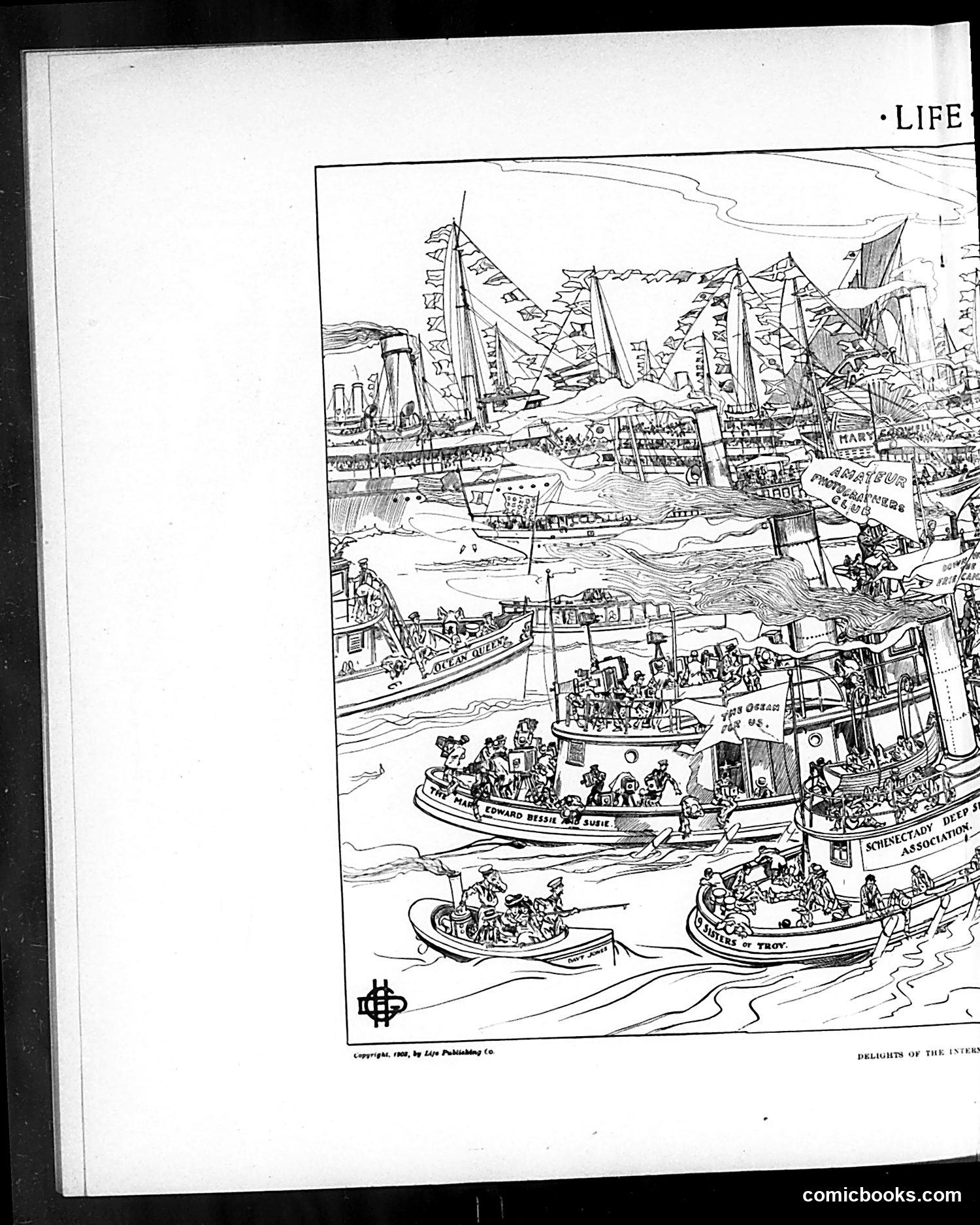
This 1908 Life magazine illustration depicts a bustling harbor scene crowded with steamships, sailboats, and smaller vessels. Multiple boats display names including references to "Ocean Queen" and what appears to be "Scheniady" and "Troy" (likely Hudson River locations). The cartoon satirizes the density and chaos of maritime traffic, possibly commenting on overcrowding in New York harbor or the proliferation of excursion boats serving tourists and day-trippers. The title "Delights of the Interstate" (partially visible) suggests irony about leisure travel—the "delights" appear overwhelming rather than pleasant, with countless vessels and passengers creating visual bedlam. The detailed, intricate linework emphasizes the chaotic profusion of activity, mocking the romance of water travel through sheer satirical excess.
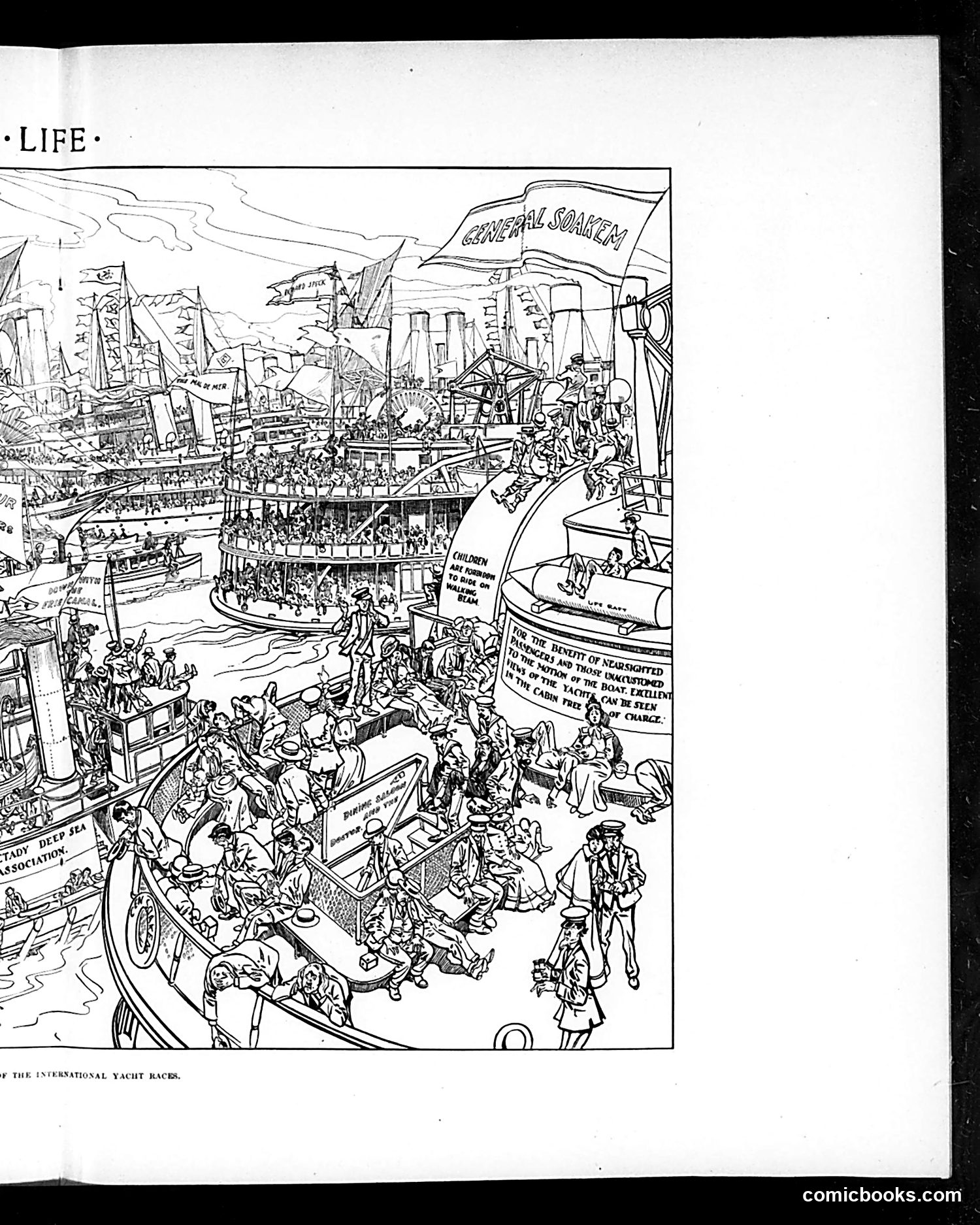
This is a detailed satirical illustration depicting a bustling harbor scene titled "Life," showing what appears to be an international yacht race event. The drawing teems with hundreds of figures—spectators, sailors, and officials—crowding boats, docks, and viewing areas around large vessels with flags. The text boxes visible in the image appear to contain commentary or regulations about boat facilities and race procedures, though the specific words are difficult to read at this resolution. The satire likely mocks the spectacle and chaos of wealthy leisure activities—the International Yacht Races mentioned at the bottom—contrasting the elaborate nautical infrastructure with the unruly crowds. However, without clearer text visibility, I cannot definitively identify specific political figures or pinpoint the exact satirical critique intended by this illustration.
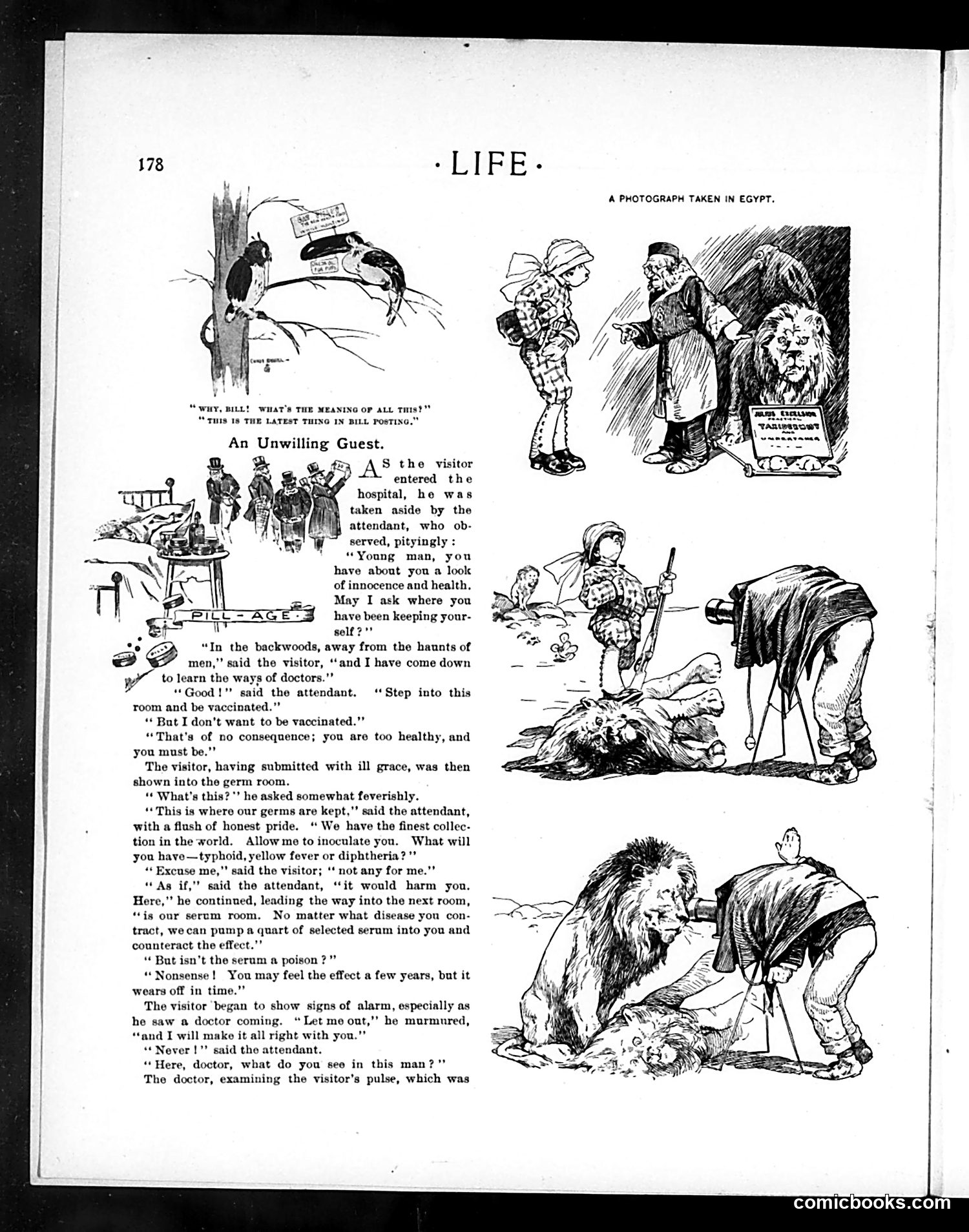
This satirical story mocks the era's aggressive medical interventions and the medical establishment's overconfidence. A healthy backwoods visitor enters a hospital and is forcibly subjected to vaccination, germ exposure, and serum injections against his wishes—despite his protests that these procedures might harm rather than help him. The satire targets early 20th-century medicine's zealous promotion of new treatments (vaccines, serums) as cure-alls. The hospital attendant's pride in his "germ collection" and casual mention that serum effects "wear off in time" lampoon doctors' dismissal of side effects. The visitor's alarm reflects public skepticism about mandatory medical procedures and the tension between medical authority and individual bodily autonomy—a debate that remained contentious during this era. The joke hinges on depicting medicine as an invasive, coercive institution imposing treatments on the unwilling.
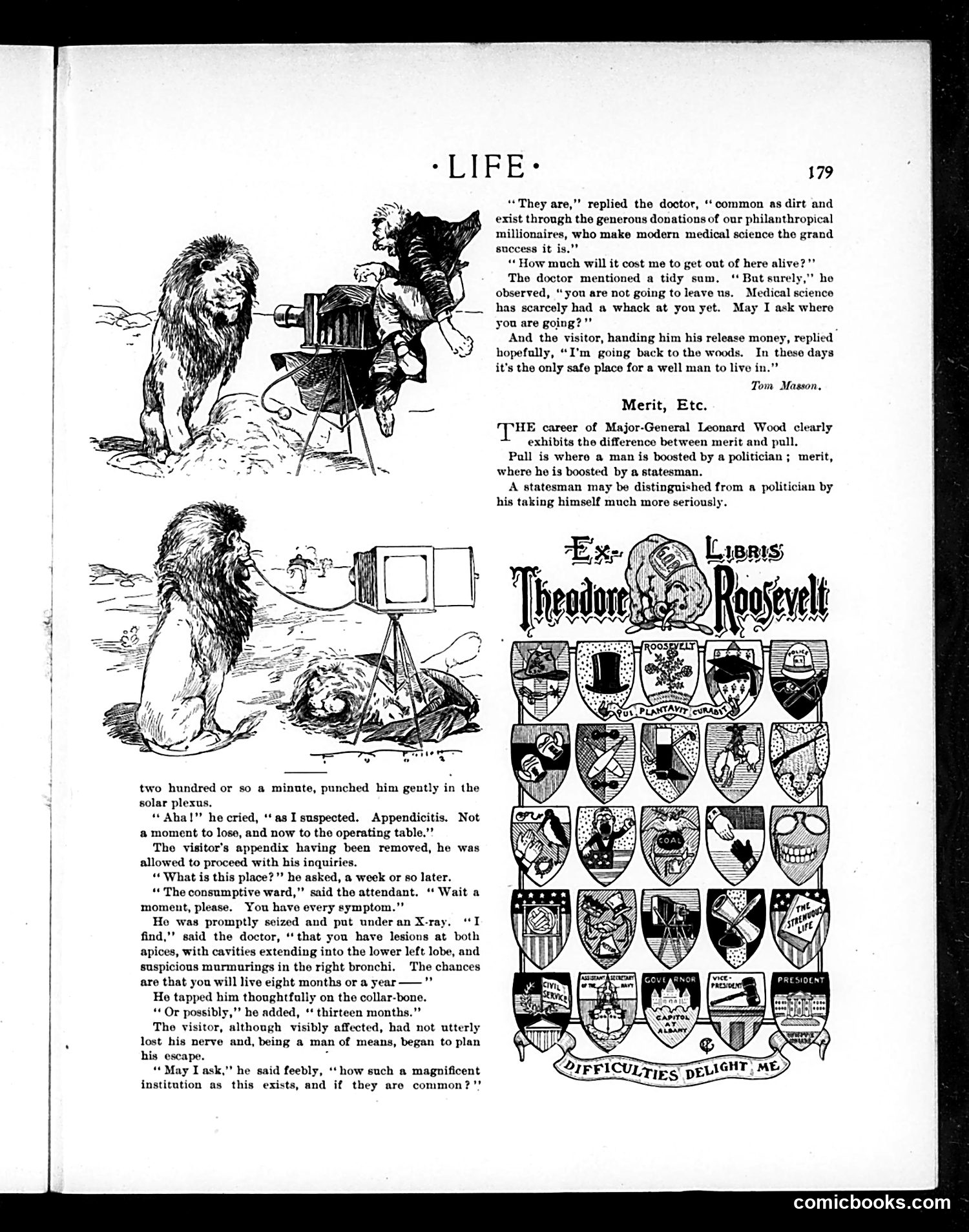
This page contains two distinct pieces of satire from Life magazine. **The Main Cartoon** (top two-thirds): A dark comedic narrative about a visitor to a hospital/medical institution who is aggressively diagnosed and treated for ailments he doesn't have—appendicitis, then tuberculosis. The joke satirizes overaggressive medical intervention and diagnostic excess. The punchline: the visitor escapes by paying the doctor a substantial sum, then ironically declares "the woods" the only safe place for a well person, since medicine itself has become the real danger. This mocks both the medical profession's profit motives and philanthropic medicine's tendency to over-treat patients. **"Merit, Etc." Section** (lower right): Brief commentary on Major-General Leonard Wood, contrasting "merit" (advancement by a statesman) versus "pull" (advancement by a politician). The joke suggests politicians boost people through patronage while statesmen do so through actual qualification—and that statesmen differ from politicians by taking themselves too seriously. This appears to be political commentary on Wood's career trajectory, though specific context is unclear without additional historical information. The **bookplate** for Theodore Roosevelt is decorative advertising.
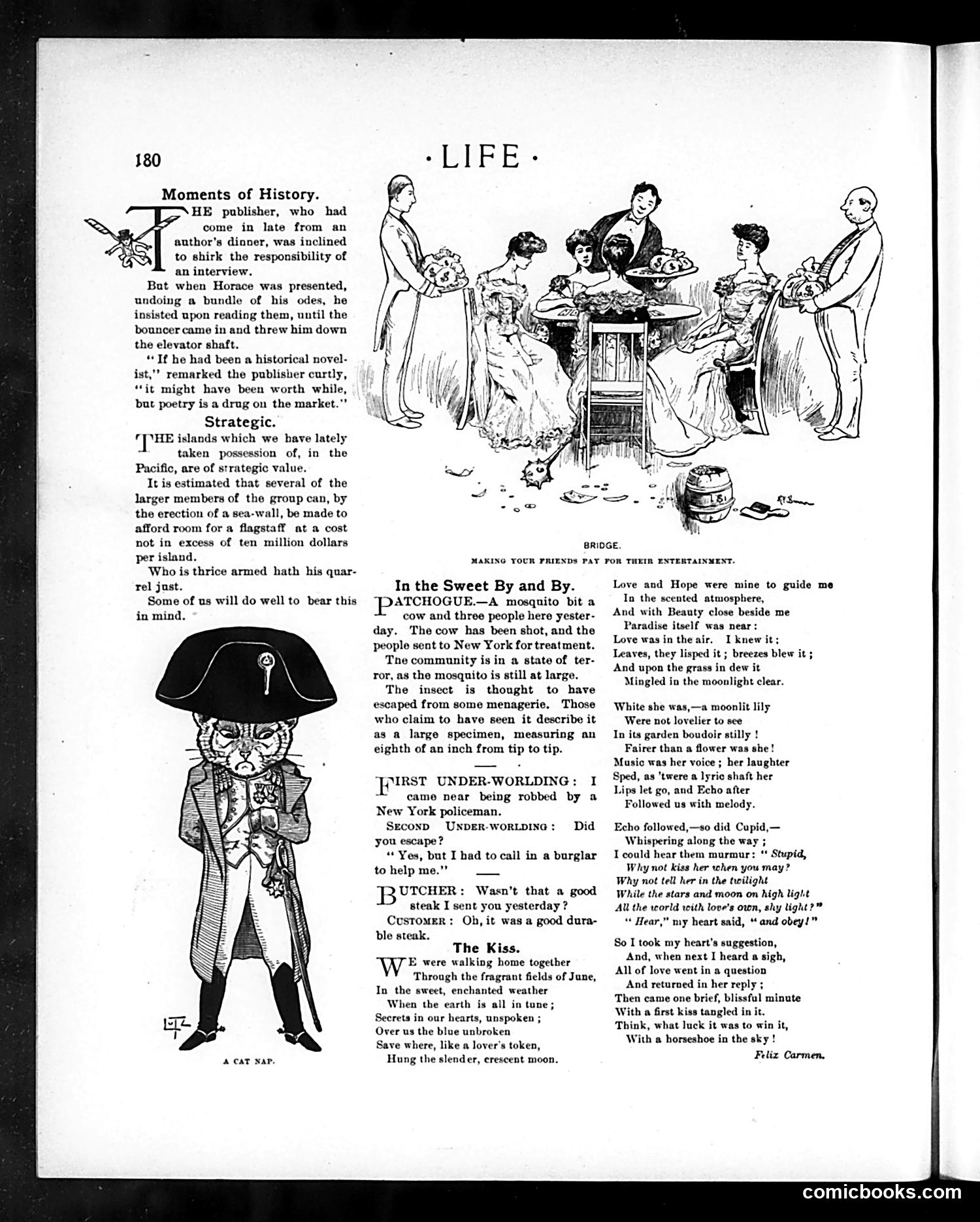
This page contains several satirical pieces mocking American society circa early 1900s: **"Moments of History"** ridicules a publisher who dismisses poetry as unmarketable while praising historical novels—satirizing publishing industry priorities. **"Strategic"** mocks U.S. imperial expansion in the Pacific, sarcastically suggesting Pacific islands seized as colonial possessions have minimal value—only large enough for flagstaffs at enormous cost ($10 million per island). This critiques American imperialism and wasteful government spending. **"The Bridge"** cartoon depicts wealthy people making servants carry heavy food platters, captioned "Making Your Friends Pay for Their Entertainment"—satirizing hypocritical hospitality where hosts burden guests with labor. **Lower vignettes** include absurdist humor about an oversized mosquito, criminals being robbed by policemen (role reversal), and a butcher's customer praising cheap, tough meat—all mocking urban life's ironies. **"The Kiss"** is romantic poetry unrelated to satire. The page exemplifies *Life*'s irreverent humor targeting politics, social pretense, and commercial absurdity.
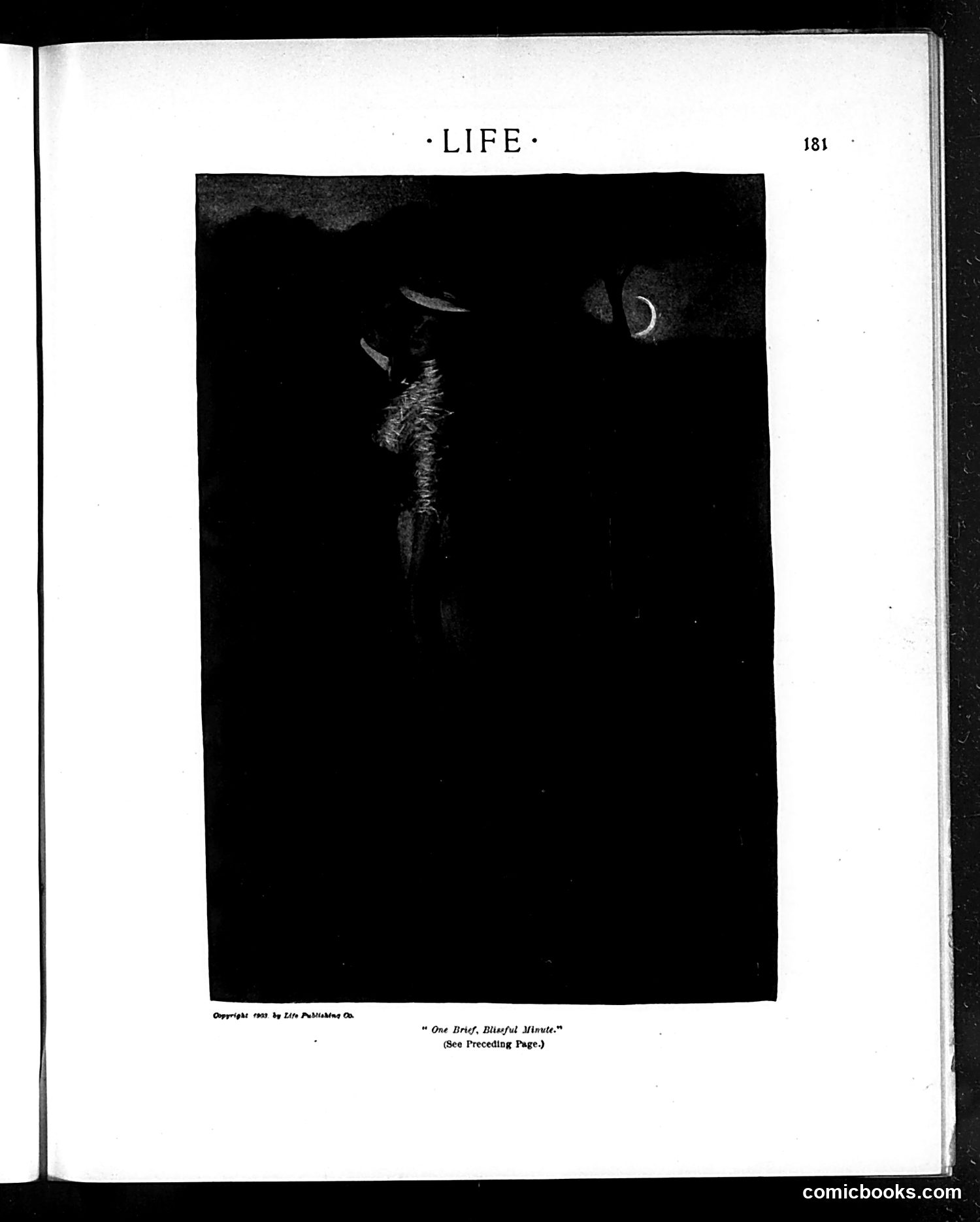
This page features a single dramatic illustration titled "One Brief, Blissful Minute," with a reference to the preceding page. The image is very dark—almost entirely black—with minimal visible detail except for a crescent moon and what appears to be a figure's profile in silhouette on the left side. Without access to the preceding page, the full satirical context is unclear. However, the title suggests romantic or comedic commentary on a fleeting romantic moment. The extreme darkness of the image may itself be part of the joke—perhaps satirizing melodramatic romance or the brevity of happiness. The 1909 date and Life magazine's tradition of social satire suggest this likely comments on contemporary attitudes about love or relationships, though the specific target remains uncertain without the preceding page's context.
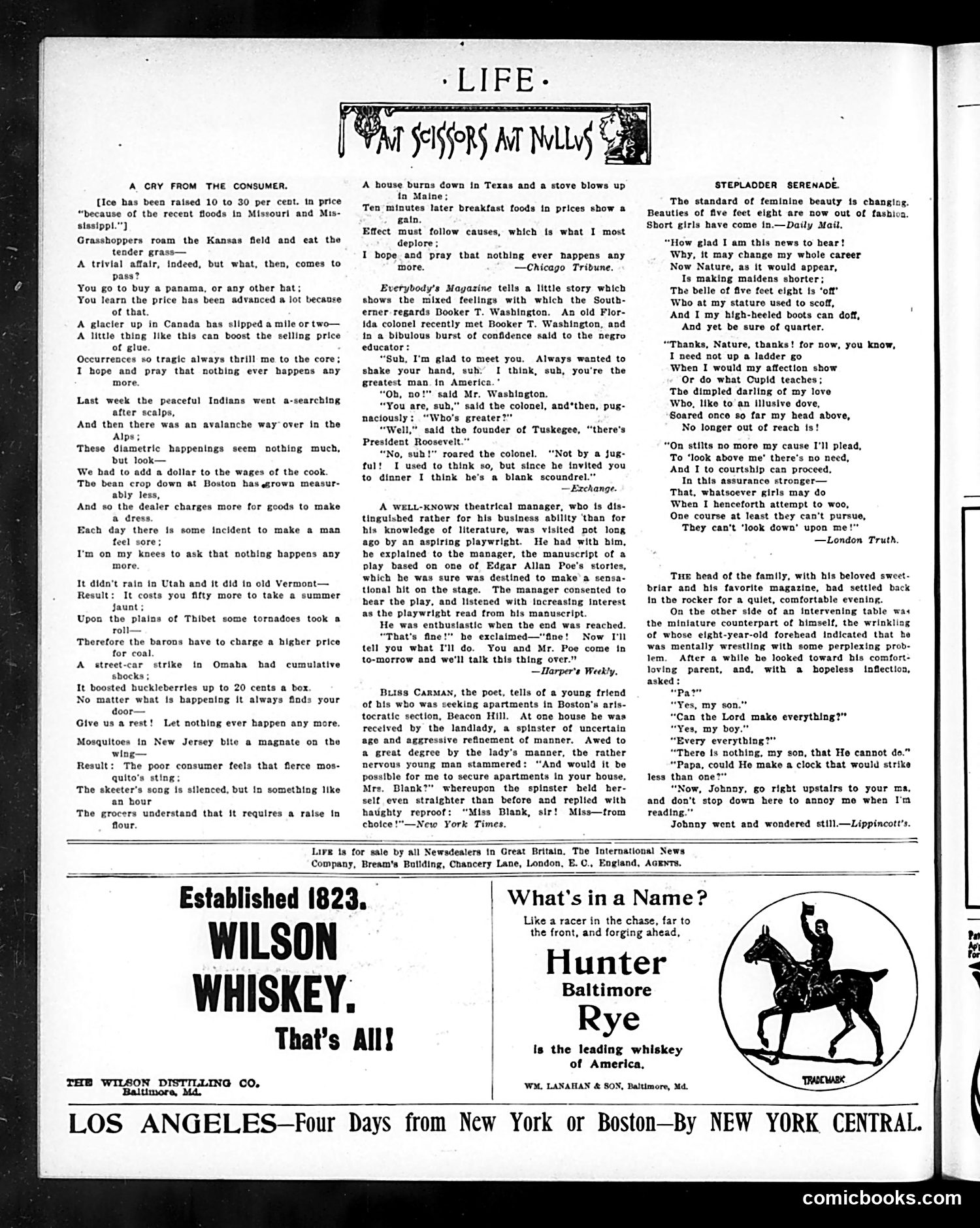
This page contains two distinct satirical pieces: **"A Cry from the Consumer"** (left column) attacks price-gouging during the early 1900s. The poem mocks merchants who use any minor incident—floods, grasshoppers, weather changes, even distant events (Tibetan tornadoes, Canadian glaciers)—as pretexts to raise prices on unrelated goods. It's consumer advocacy satire, ridiculing the exploitative logic that chains cause-and-effect to justify inflation. **Booker T. Washington Anecdote** (center) satirizes Southern racial attitudes. A bibulous Florida colonel praises Washington as "the greatest man in America," then—upon learning Roosevelt invited Washington to dinner—denounces Roosevelt as a "blank scoundrel." The joke exposes the colonel's contradictory racism: he'll praise a Black educator in theory but withdraws respect when treated with dignity by a white president. The bottom half is primarily **advertisements** for Wilson Whiskey and Hunter Baltimore Rye.
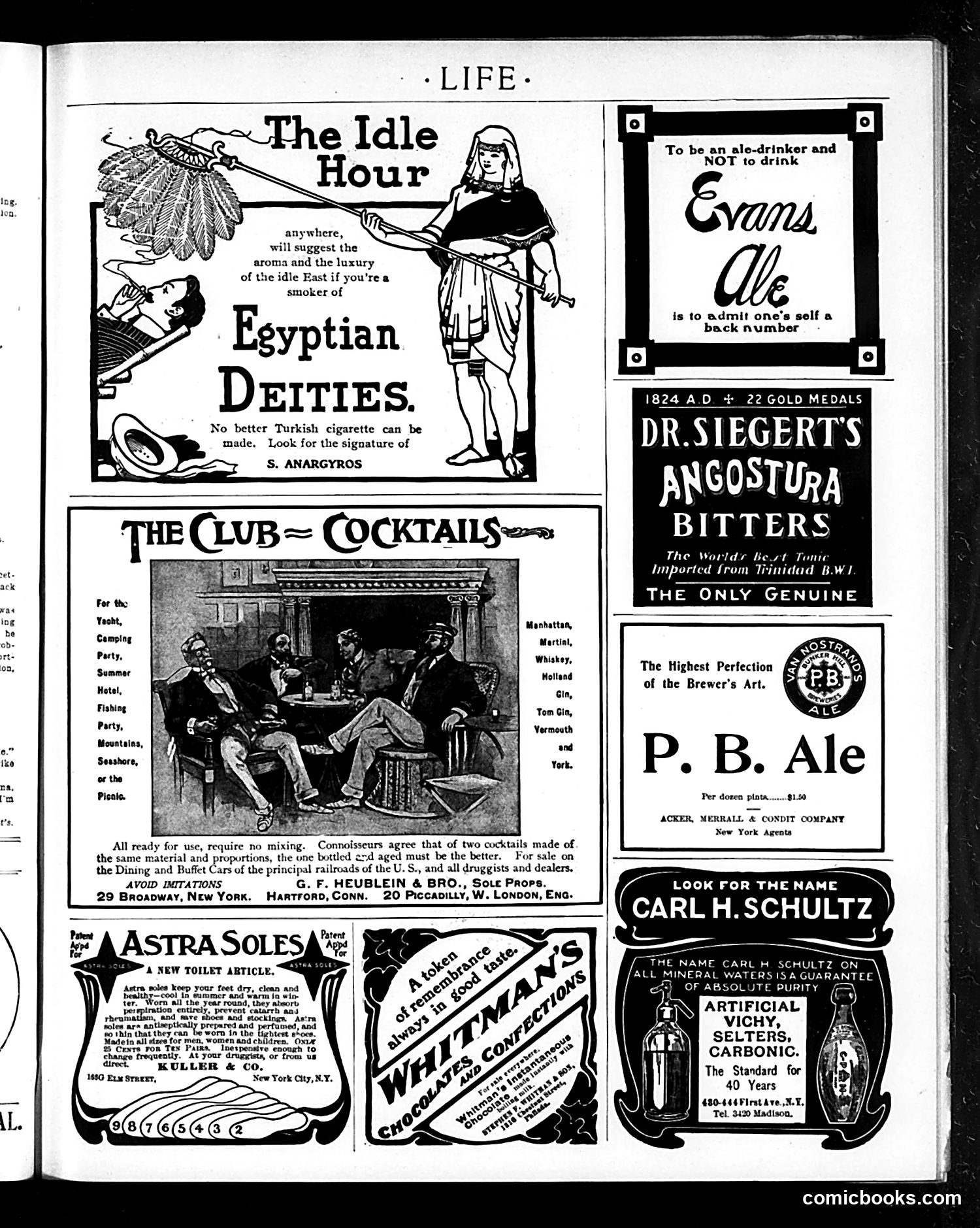
This is primarily an **advertising page** from Life magazine, not a political cartoon. The main content—"The Idle Hour"—is a satirical advertisement for Egyptian Deities cigarettes, featuring an illustration of a woman in Egyptian-style dress. The visual joke plays on the "idle East" stereotype, suggesting cigarette smoking evokes luxury and leisure associated with Orientalism. The page is dominated by period alcohol and tobacco advertisements: Club Cocktails, P.B. Ale, Dr. Siegert's Angostura Bitters, and Carl H. Schultz mineral waters. A secondary ad for Whitman's chocolates and Astra Solesa (a toilet product) round out the space. The only satirical element is the Evans Ale tagline mocking non-drinkers as "back numbers" (outdated)—reflecting early 20th-century drinking culture attitudes. Overall, this reflects the magazine's revenue model: high-end consumer advertising mixed with light editorial content.
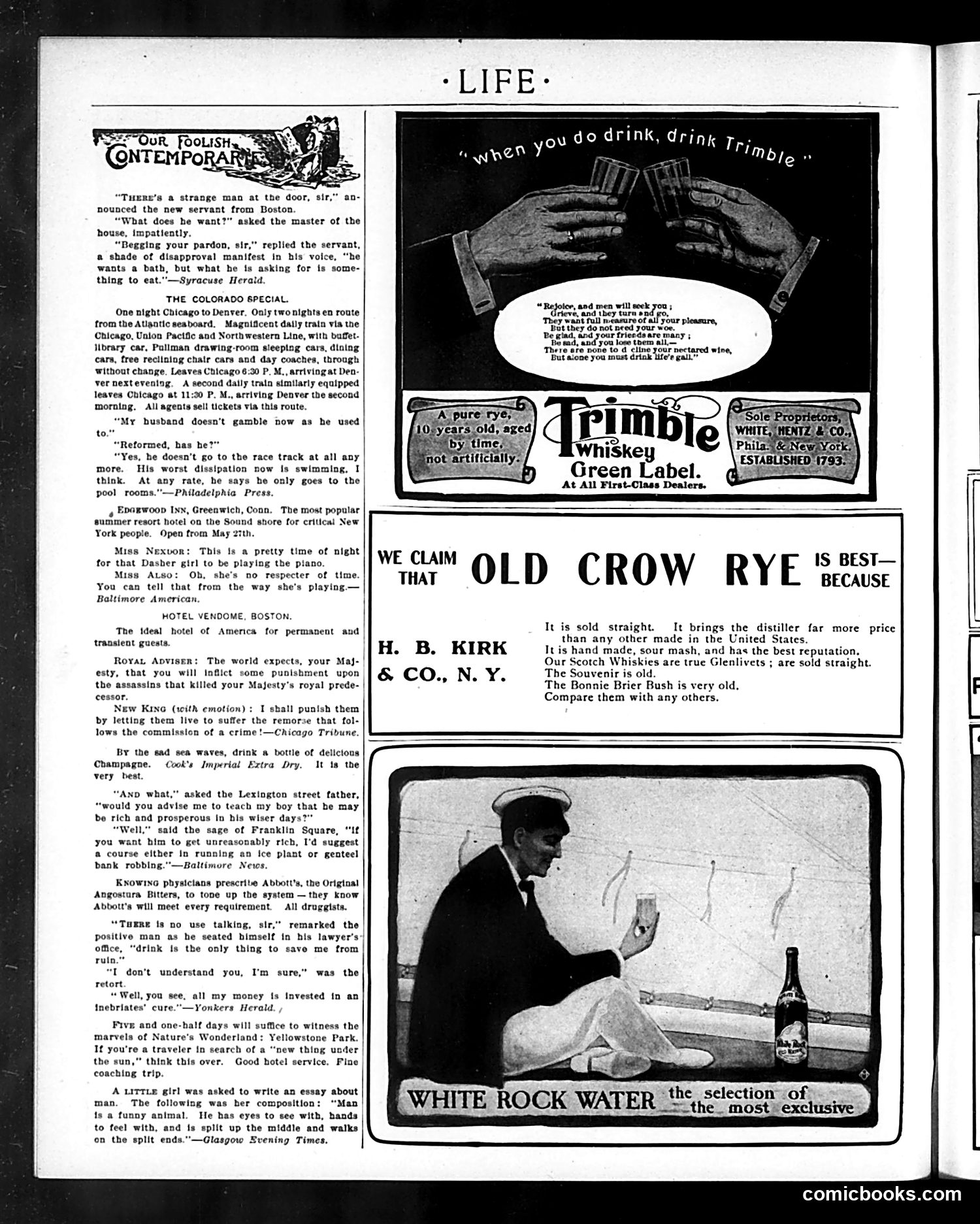
This is primarily an **advertising and humor page** from Life magazine, not a political cartoon. The page contains mostly jokes and product advertisements typical of early 20th-century American periodicals. **Key content:** - Multiple short humorous anecdotes on social themes (servants, gambling, marriage reform) - Several liquor advertisements (Trimble Whiskey, Old Crow Rye, White Rock Water) promoting alcohol as health/lifestyle products - A photograph of a man in formal attire with a bottle, advertising White Rock Water **Historical context modern readers need:** These advertisements openly marketed alcohol during the Prohibition era or its immediate aftermath, and presented drinking as desirable and socially advantageous—a stark contrast to modern anti-alcohol messaging. The jokes reflect period attitudes toward class, gender roles, and morality. The page reflects early 1900s American consumer culture and social values rather than containing political satire.
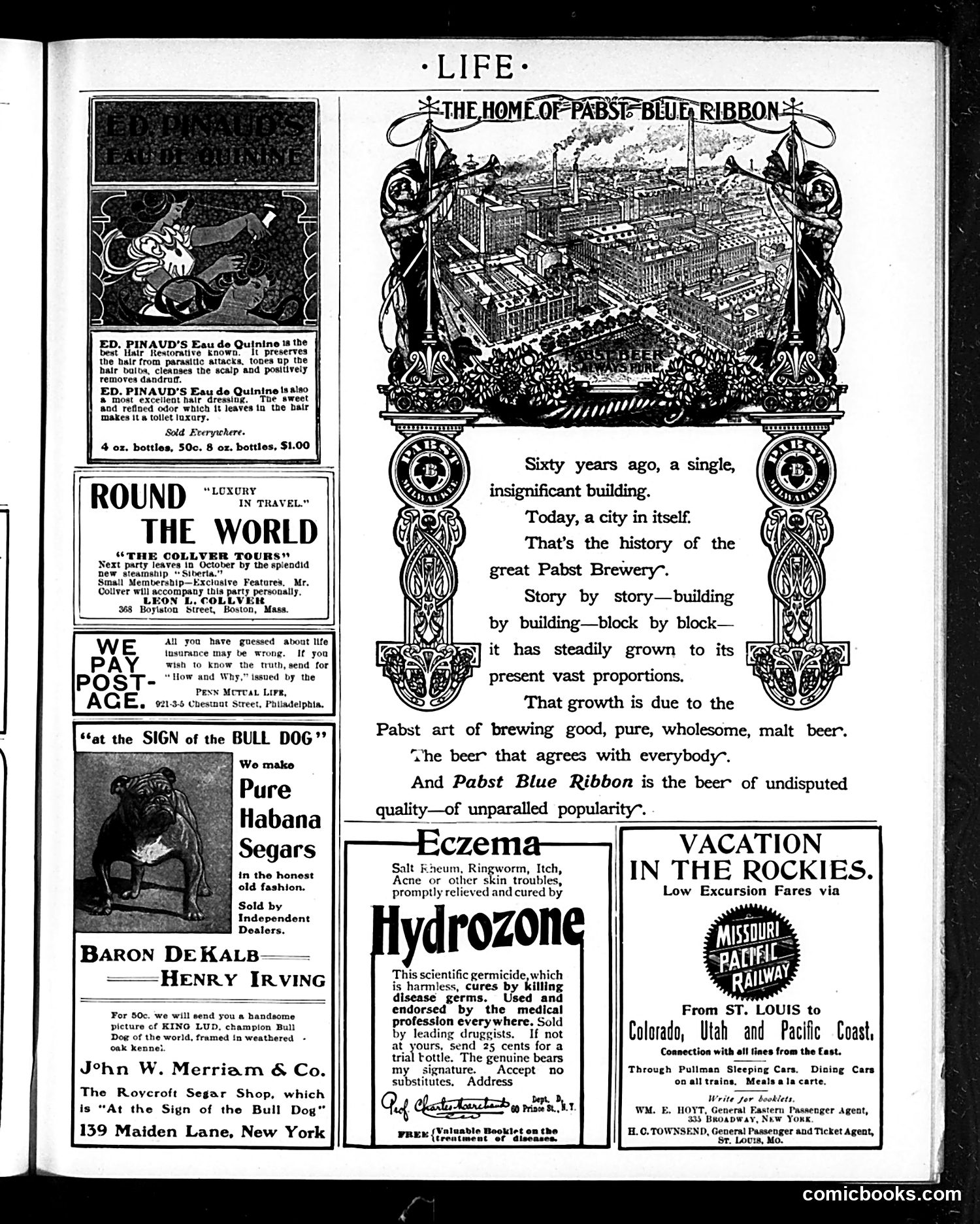
This is primarily an **advertising page** rather than a satirical cartoon page. It contains multiple commercial advertisements typical of early 20th-century American magazines: **Notable ads include:** - **Pabst Blue Ribbon brewery** (center): A substantial advertisement celebrating the brewery's 60-year growth, emphasizing beer quality and popularity—standard corporate boosterism of the era. - **Hair and grooming products** (top left): Ed. Pinaud's hair treatment, reflecting contemporary concerns about baldness and dandruff remedies. - **Travel services**: Round-the-world tours and Rocky Mountain excursions via Missouri Pacific Railway. - **Cigar advertisement** ("At the Sign of the Bull Dog"): Featuring a bull dog image, promoting "pure Habana Segars." - **Medical product (Hydrozone)**: Claiming to cure skin conditions through a "scientific germicide." The page reflects early 1900s consumer culture and advertising practices, with no discernible political satire or editorial cartooning—just commercial promotion.
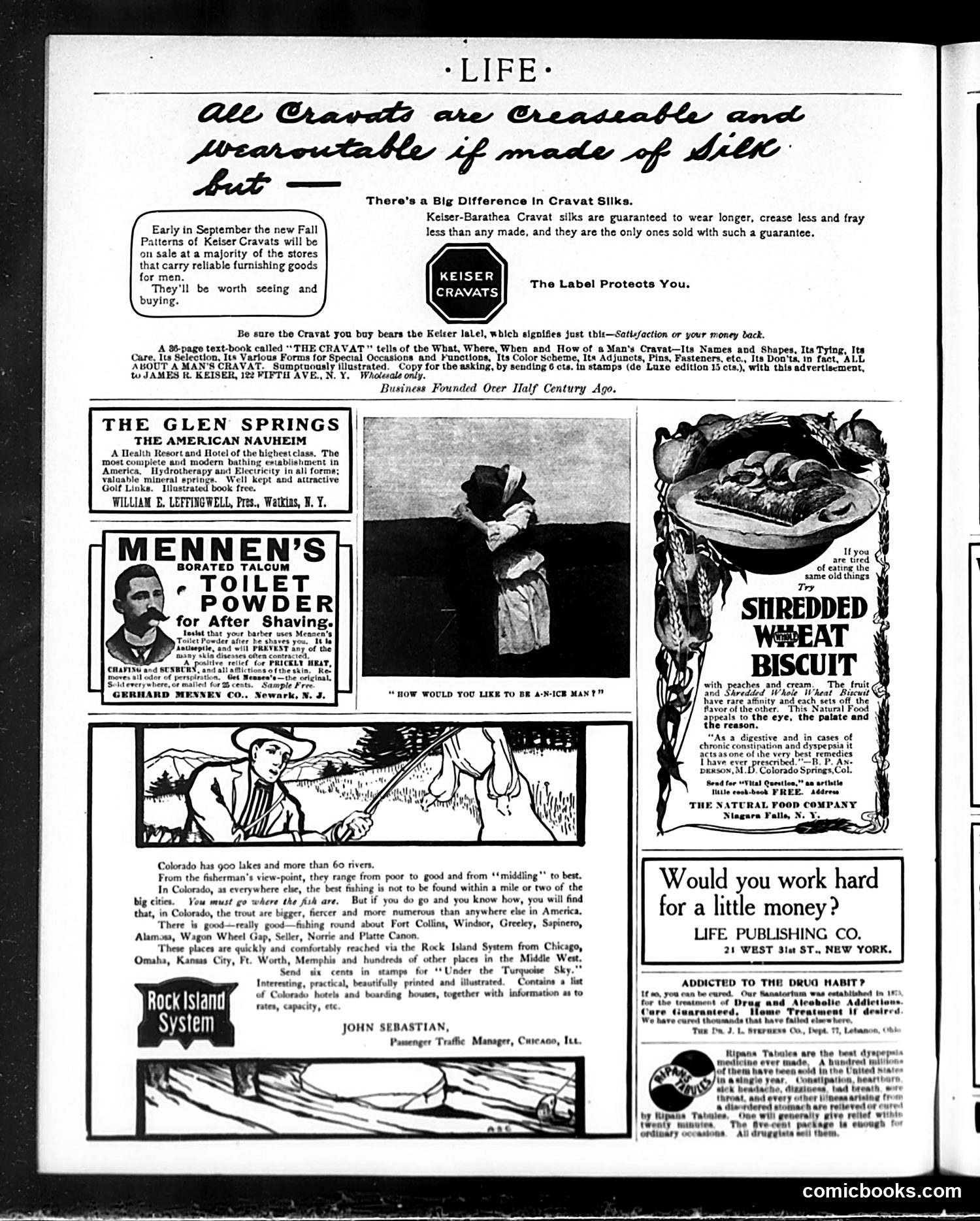
This is primarily an **advertising page** from Life magazine, not political satire. The content consists of commercial advertisements for various products and services typical of the early 1900s. The main advertisements include: - **Keiser Cravats** (neckties) — emphasizing durability and a satisfaction guarantee - **Glen Springs** — a health resort in Watkins, New York - **Mennen's Borated Talcum Powder** — for after-shaving - **Shredded Wheat Biscuit** — a breakfast cereal - **Rock Island System** — promoting train travel to Colorado for fishing - **Ripana Tabules** — patent medicine for digestive issues and drug addiction treatment The page includes a small illustration captioned "How Would You Like to Be a Rice Man?" (likely promoting agricultural or sales work) and various product images. **There is no significant political cartoon or satire on this page** — it represents straightforward commercial messaging typical of early-20th-century magazine advertising, reflecting consumer products and health remedies of that era.
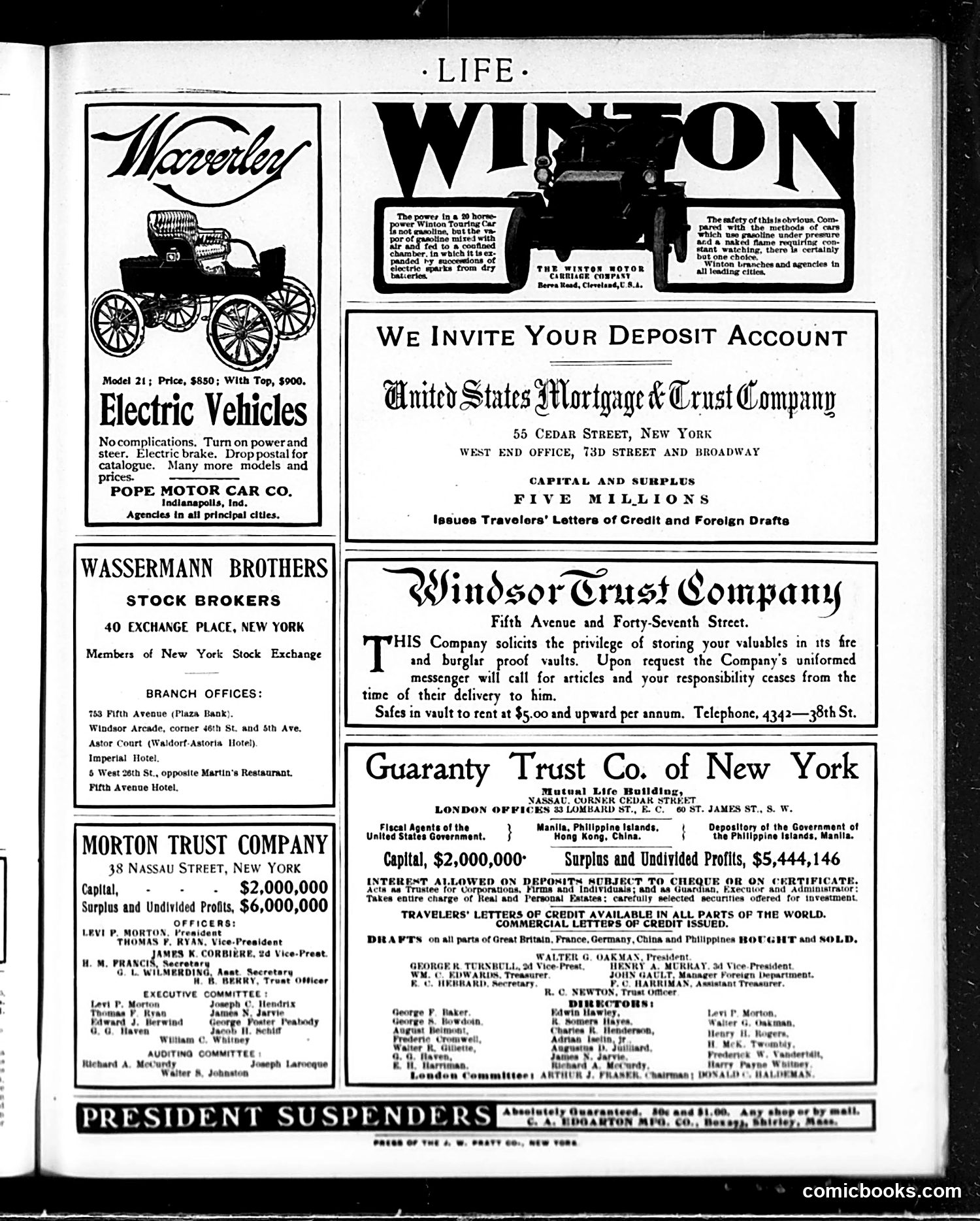
This is primarily a **financial services advertising page** from an early 1900s issue of Life magazine. There is **no political cartoon or satire visible**. The page features advertisements for: - **Pope Motor Car Co.** (electric vehicles) - **Wassermann Brothers** (stock brokers) - **Morton Trust Company** and other financial institutions - **Winton Motor Carriage Company** (automobiles) - Various trust and deposit companies The only notable visual element is the **Waverley electric vehicle illustration** on the left—a period automobile advertisement. The repeated emphasis on trust companies, deposit accounts, and financial services reflects the early 1900s financial landscape and suggests this page targets wealthy readers concerned with wealth management and investment security. The ads' prominence in Life indicates the magazine's affluent readership. This appears to be a revenue page rather than editorial content—the magazine's satirical cartoons would appear elsewhere in the issue.
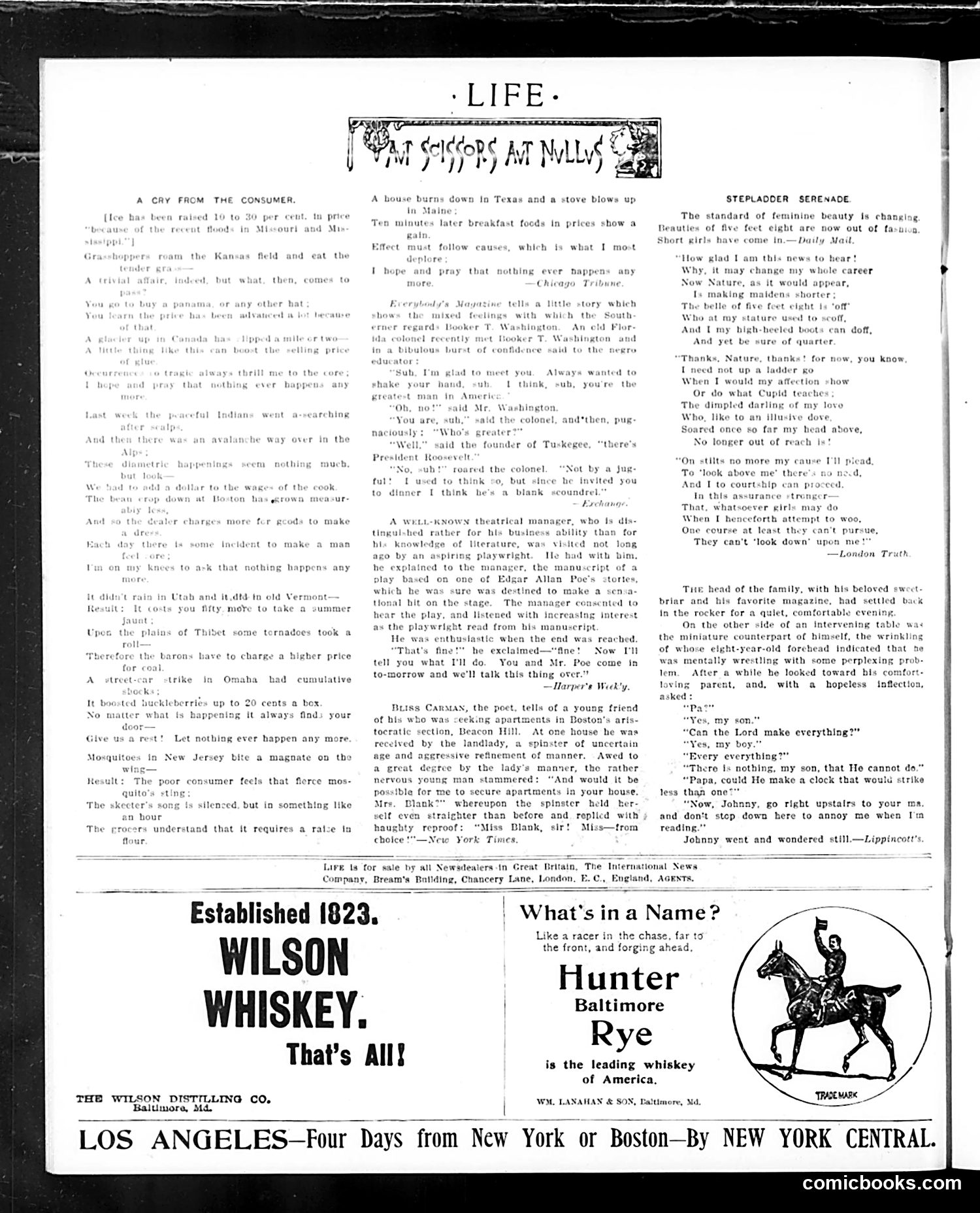
This page contains several satirical pieces typical of early 20th-century Life magazine humor: **"Stepladder Serenade"** is a poem mocking changing beauty standards. The text reveals that "the standard of feminine beauty is changing"—specifically, tall women (five feet eight inches) are "out of fashion" and shorter girls are now preferred. The poem presents a short man's delight that his previously unfashionable stature now makes him attractive to women who previously "looked down" on him. The satire targets the fickleness of fashion and beauty standards. **Other items** include consumer complaints about rising prices, anecdotes about race relations (referencing Booker T. Washington), and domestic humor involving a playwright, a theatrical manager, and apartment-hunting in Boston. The page is primarily **text-based humor and social commentary** rather than visual cartoons. The advertisements at bottom (Wilson Whiskey, Hunter Rye) are standard period advertising. The overall theme addresses economic hardship, class dynamics, and social absurdities of the era.
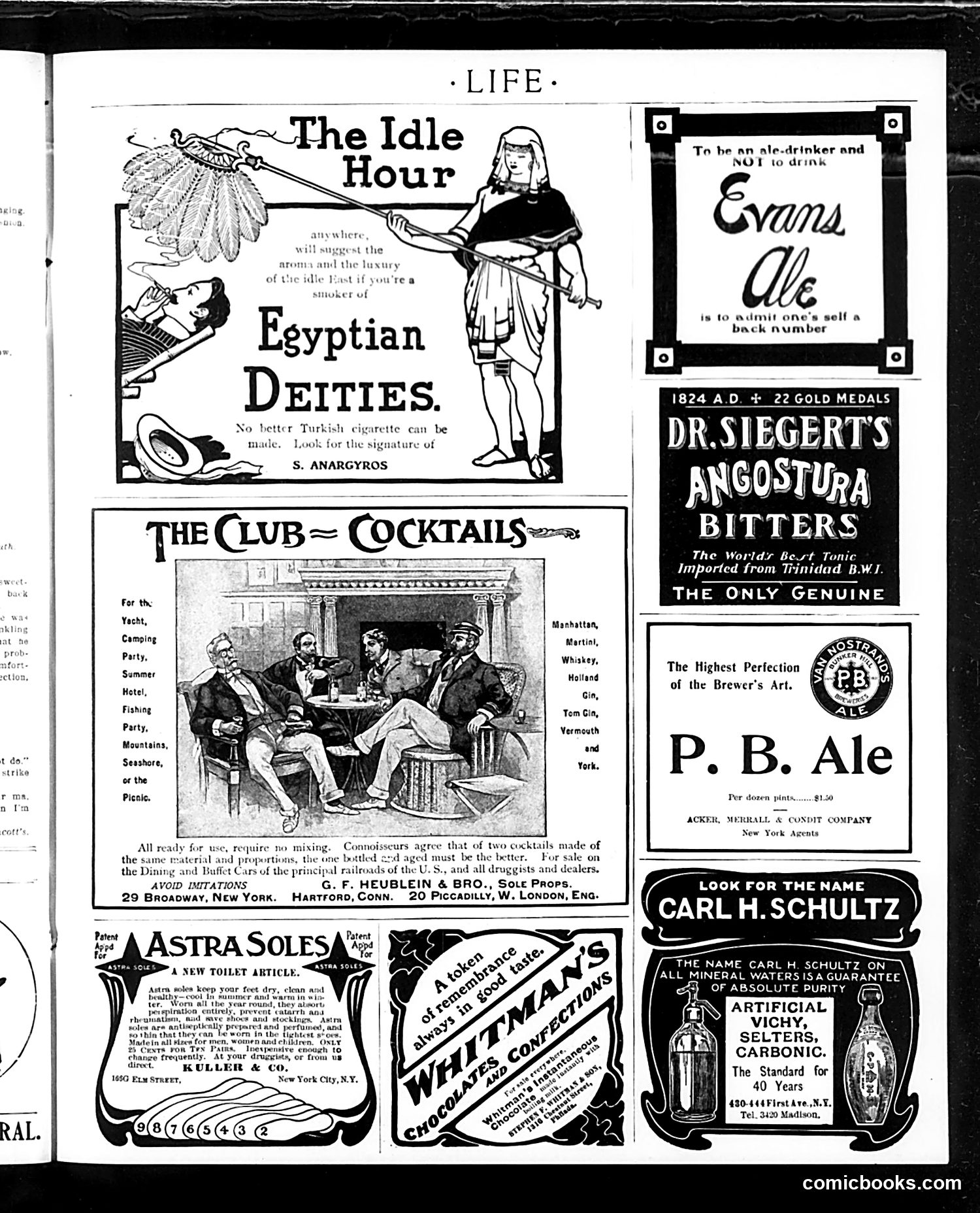
This page is primarily **advertising**, not editorial content. The main visual element—"The Idle Hour" featuring Egyptian deities and a reclining figure—is an ad for S. Anargyros Turkish cigarettes, using Orientalist imagery popular in early 20th-century marketing. The page showcases various alcohol and beverage advertisements typical of the pre-Prohibition era: club cocktails, bitters, ales, and mineral waters. Notable is "Evans Ale," which uses period advertising language claiming superiority over competitors. Dr. Siegert's Angostura Bitters emphasizes imported authenticity (Trinidad origin), while P.B. Ale touts "brewer's art." The advertisements reflect the era's consumer culture and before Prohibition (1920-1933) was enacted. Products like Carl H. Schultz's mineral waters and artificial Vichy waters suggest health-conscious marketing alongside alcoholic beverages—a contradiction that would soon become legally impossible in America.
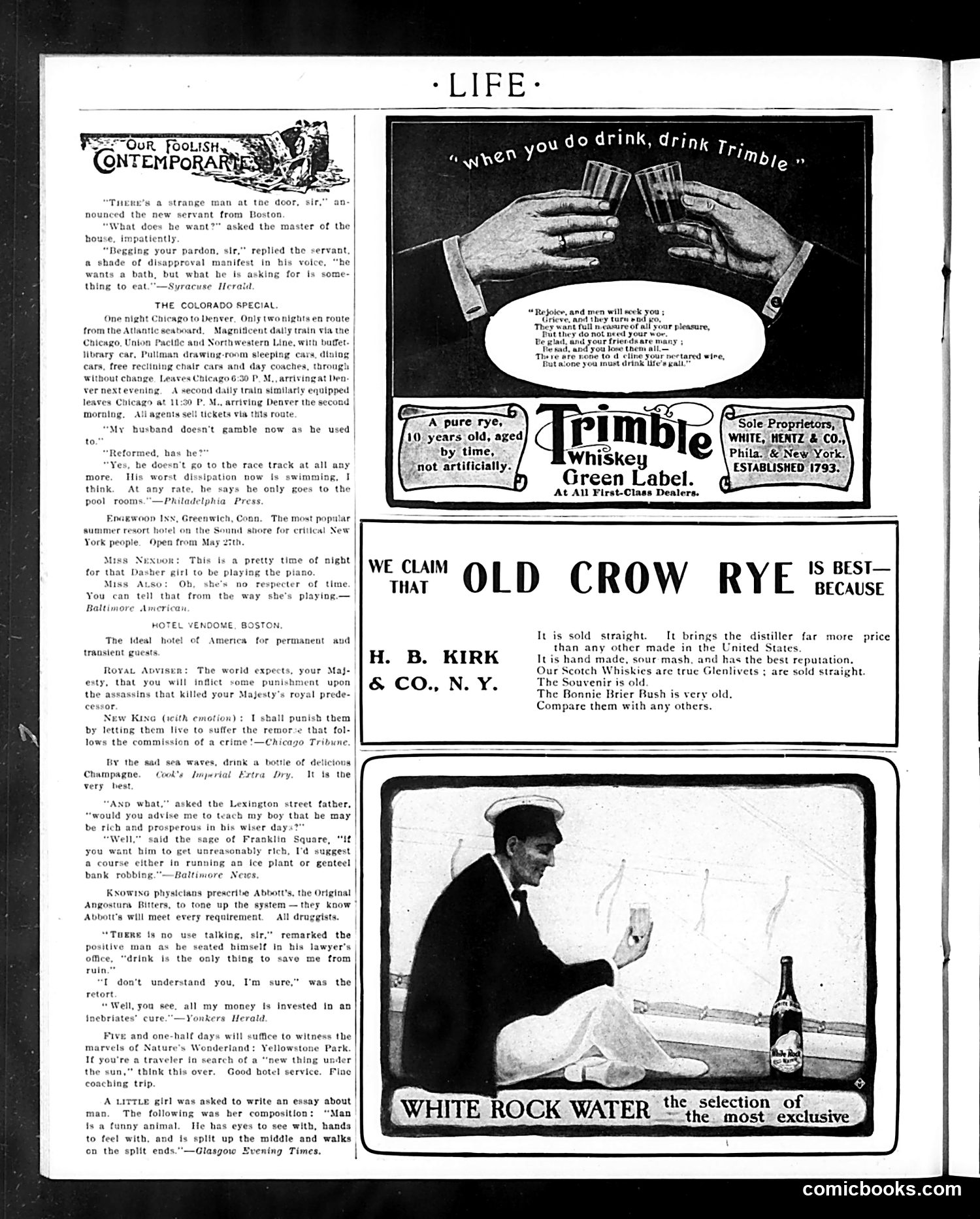
This **Life magazine page contains satirical humor pieces and period advertisements** from what appears to be the early 1900s. The "FOOLISH CONTEMPORARY" section offers brief comic anecdotes satirizing social pretensions and absurdities of the era—servants wanting food, husbands abandoning gambling only to take up swimming, piano-playing at inappropriate hours. These mock everyday situations with gentle irony typical of the magazine's comedic approach. **The advertisements are notable:** Trimble Whiskey, Old Crow Rye, and White Rock Water pitch themselves as quality products, using common marketing claims of the period (purity, age, respectability). These ads normalize alcohol consumption in ways modern readers might find striking, especially given we know Prohibition was approaching (1920s). **The Colorado Special train advertisement** showcases luxury rail travel—a major technology of the era. The political cartoon reference appears minimal on this page; the content is primarily domestic humor and commercial advertising reflecting middle-class American life in the pre-WWI era.
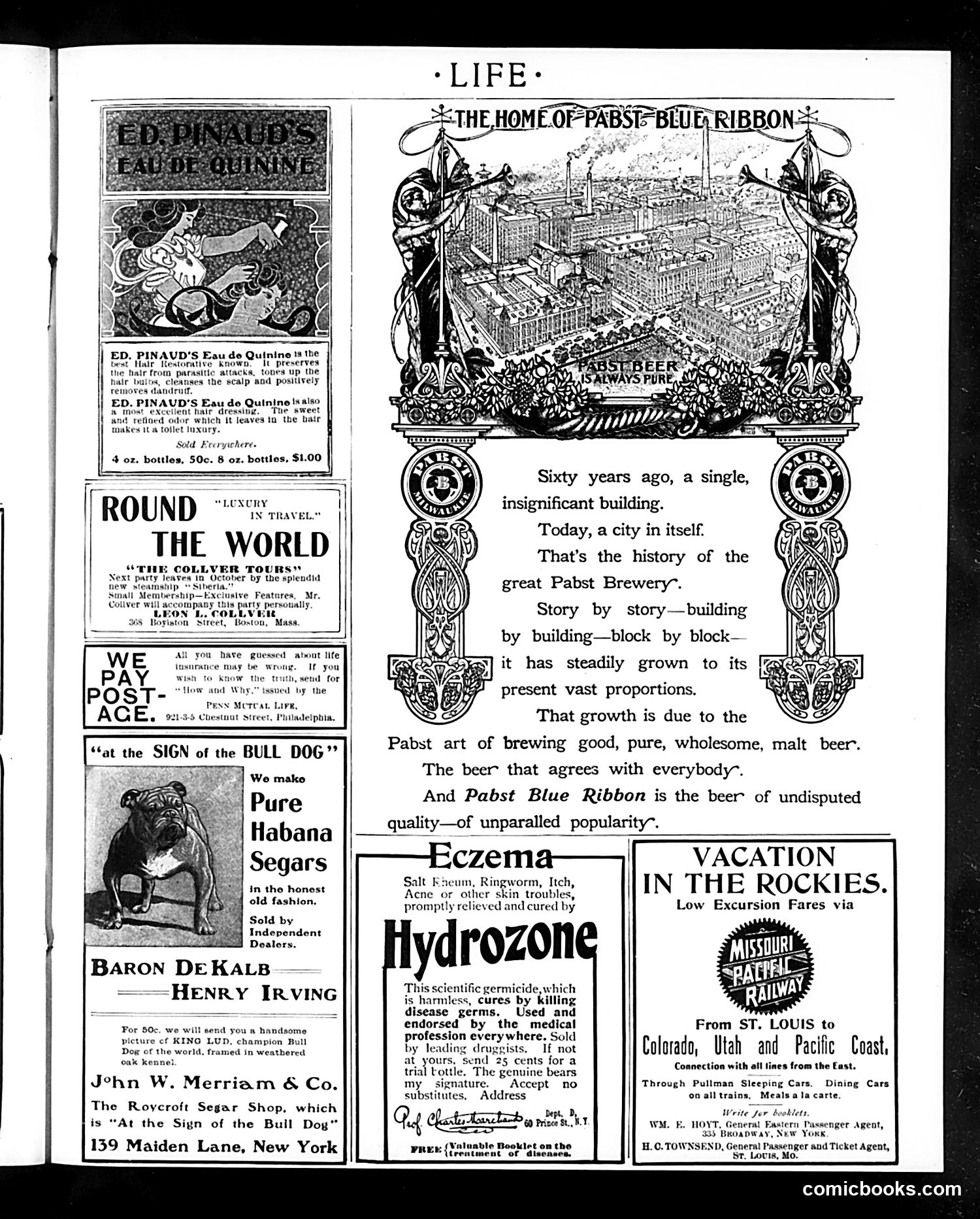
This page is primarily **advertising**, not political satire or comics. It's a collection of commercial advertisements typical of early 20th-century magazines. The main content includes: - **Ed. Pinaud's Eau de Quinine**: hair tonic promising to prevent hair loss and dandruff - **Pabst Blue Ribbon brewery**: a large illustrated advertisement celebrating the brewery's 60-year growth, emphasizing "pure, wholesome, malt beer" - **Hydrozone**: a germicide claiming to cure skin conditions like eczema by "killing disease germs" - **Baron de Kalb cigars** and other tobacco products - **Travel advertisements** for tours and Rocky Mountain vacations The Pabst ad is the most elaborate, using architectural imagery to symbolize industrial growth and prosperity. The other ads employ typical period marketing claims—many now-questionable (the germicide's efficacy, hair restoration promises). This reflects advertising standards before modern FDA/FTC regulation.
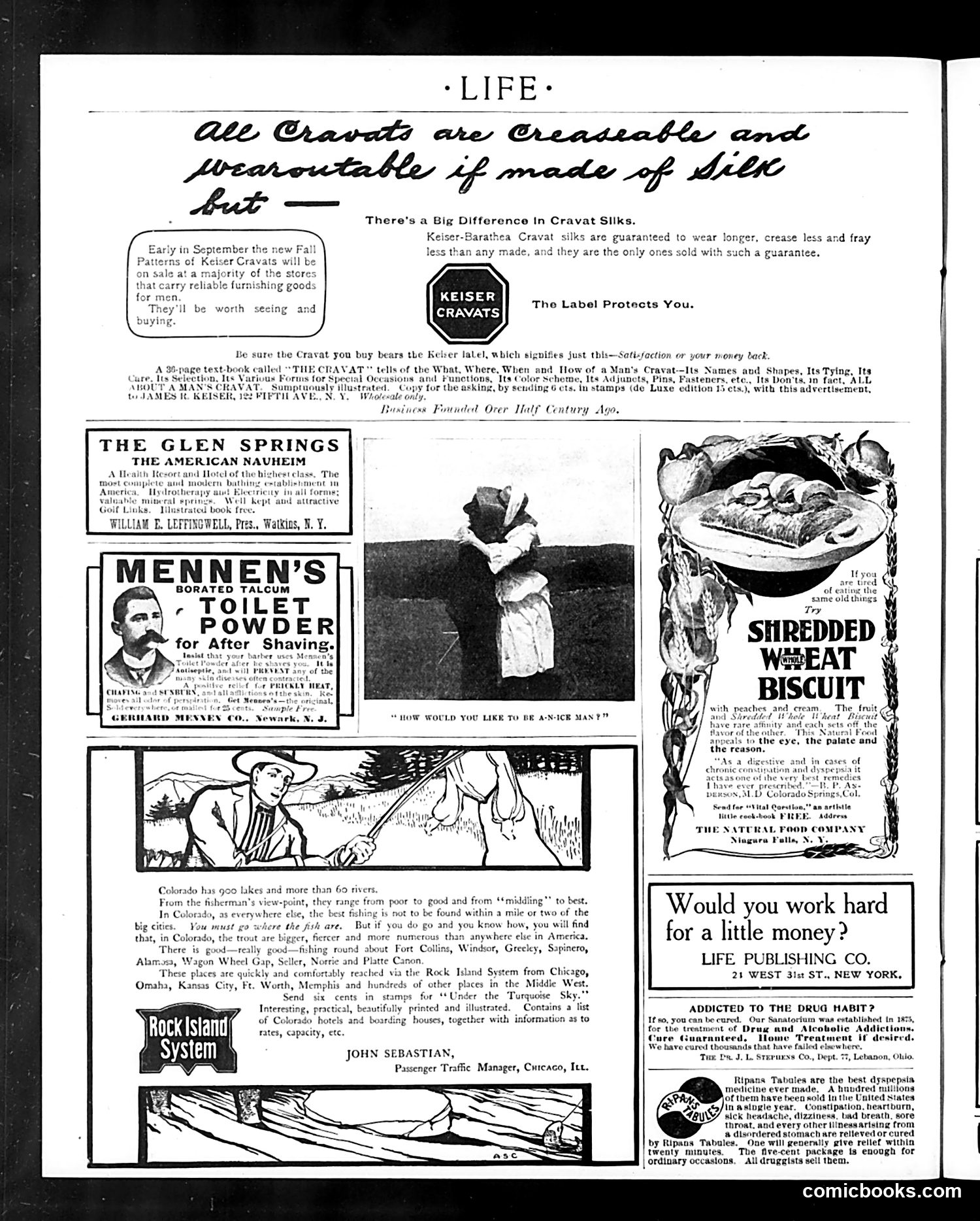
This page is primarily **advertising**, not political satire. It contains circa-1900s commercial ads for men's products and services: **Main content:** Ads for Keiser cravats (neckties), Glen Springs health resort, Mennen's talcum powder, Shredded Wheat biscuits, Rock Island railroad system (promoting Colorado fishing), Life Publishing Company job recruitment, drug-addiction treatment, and Ripans Tabules digestive tablets. **The one illustration** shows a cowboy-themed fishing scene, captioned "How Would You Like to Be a Nice Man?" — likely promoting the romantic appeal of Colorado fishing trips via the Rock Island railroad. **Context for modern readers:** This reflects early 20th-century male consumer culture, when magazines like Life mixed satirical editorial content with extensive advertising. The ads themselves use period marketing tactics: health resort appeals, "masculine" grooming products, and adventure tourism pitches. Nothing here is satirical commentary—it's straightforward period advertising.
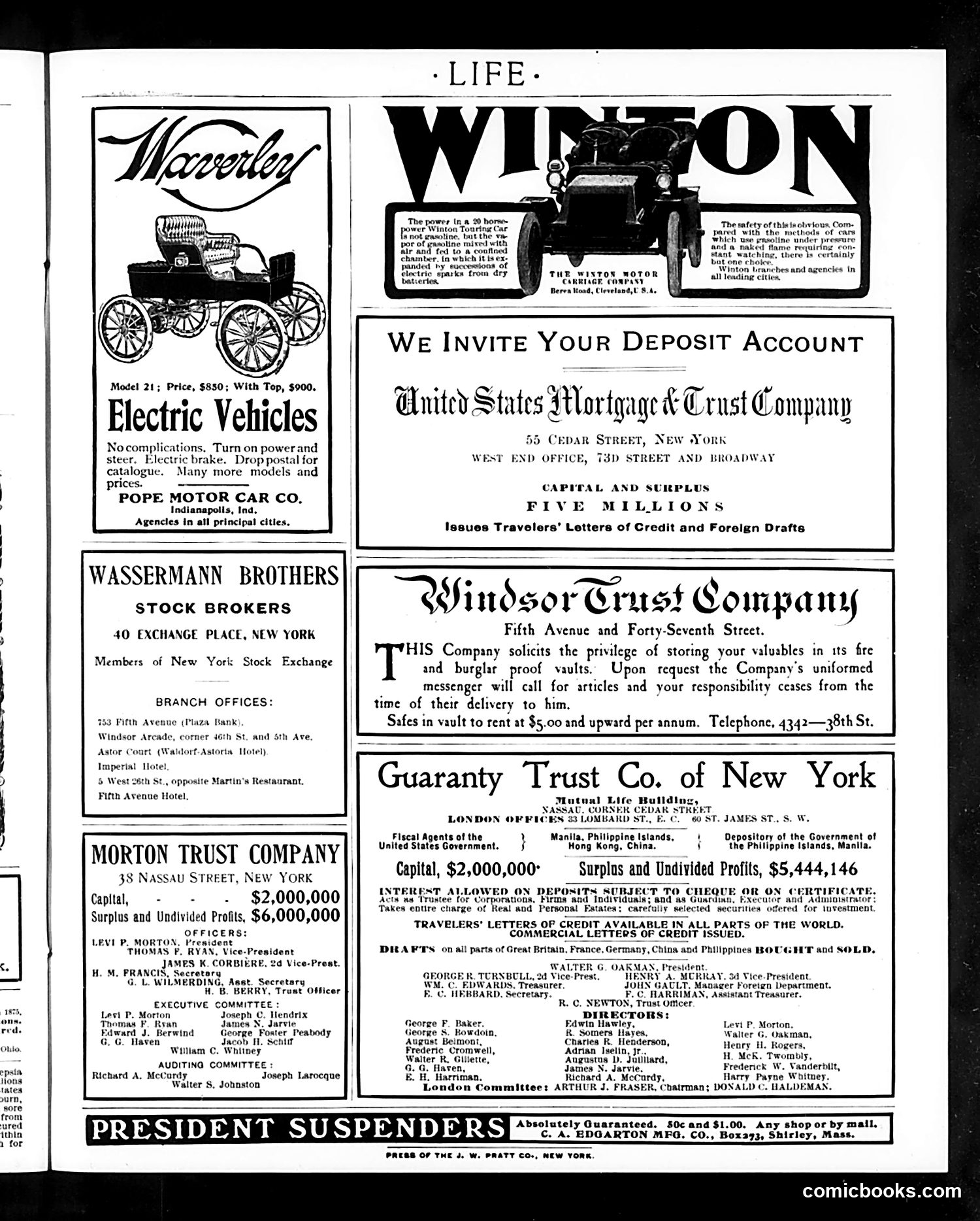
This is primarily a **full-page of financial and automotive advertisements**, not satirical content. The page features prominent New York financial institutions and early automobile companies aimed at wealthy readers. Key advertisers include: - **Pope Motor Car Co.** (electric vehicles) - **Morton Trust Company** and **Guaranty Trust Co. of New York** (major banking institutions) - **Windsor Trust Company** (safe deposit services) - Various stock brokers and financial firms The **Waverley electric vehicle ad** (top-left) appears to be the most substantial illustration, featuring an early automobile. There is **no political cartoon or satire** on this page. Rather, it reflects early-1900s American capitalism: advertisements targeting the wealthy for newly available automobiles (notably electric models), banking services, and investment opportunities. The proliferation of trust companies and financial services suggests the period immediately following financial consolidation of this era.
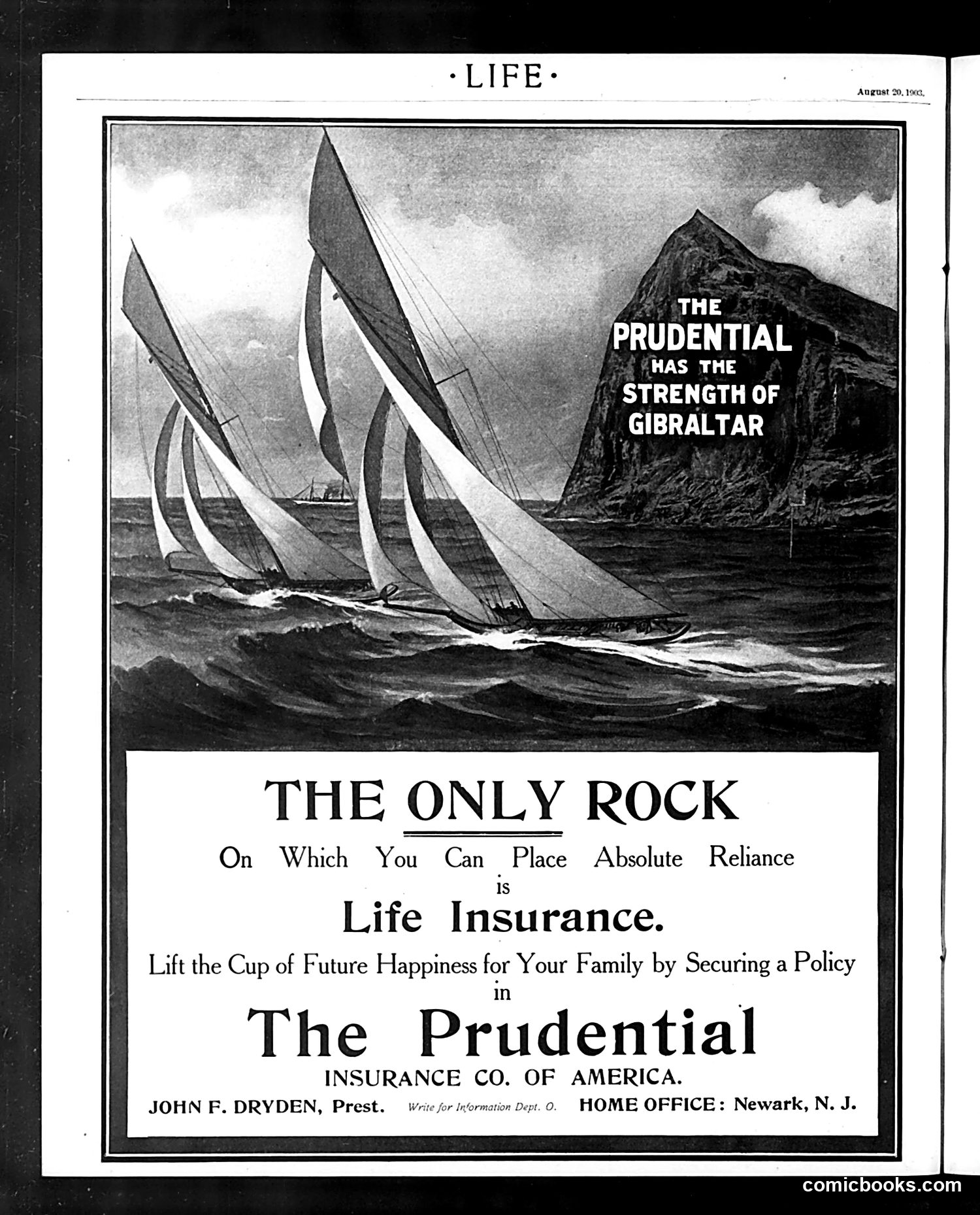
This is a **full-page advertisement**, not political satire. It's a Prudential Insurance Company ad from August 20, 1901 (OCR error shows "190"). The image shows sailing ships navigating rough seas near the Rock of Gibraltar, a famous natural landmark symbolizing strength and stability. The visual metaphor is explicit: just as Gibraltar is an unshakable rock, Prudential life insurance provides absolute security for families facing life's uncertainties. The tagline "The Strength of Gibraltar" was Prudential's actual advertising slogan from this era. The ad promises that securing a life insurance policy will "lift the cup of future happiness" for one's family—essentially, insurance provides financial protection against the unknown future, positioned as a reliable foundation like the Rock itself. This reflects early 20th-century insurance marketing, which emphasized stability and security during a period of economic uncertainty.