
Life, 1903-08-20 · page 6 of 32
Life — August 20, 1903 — page 6: what you’re looking at
What you’re looking at
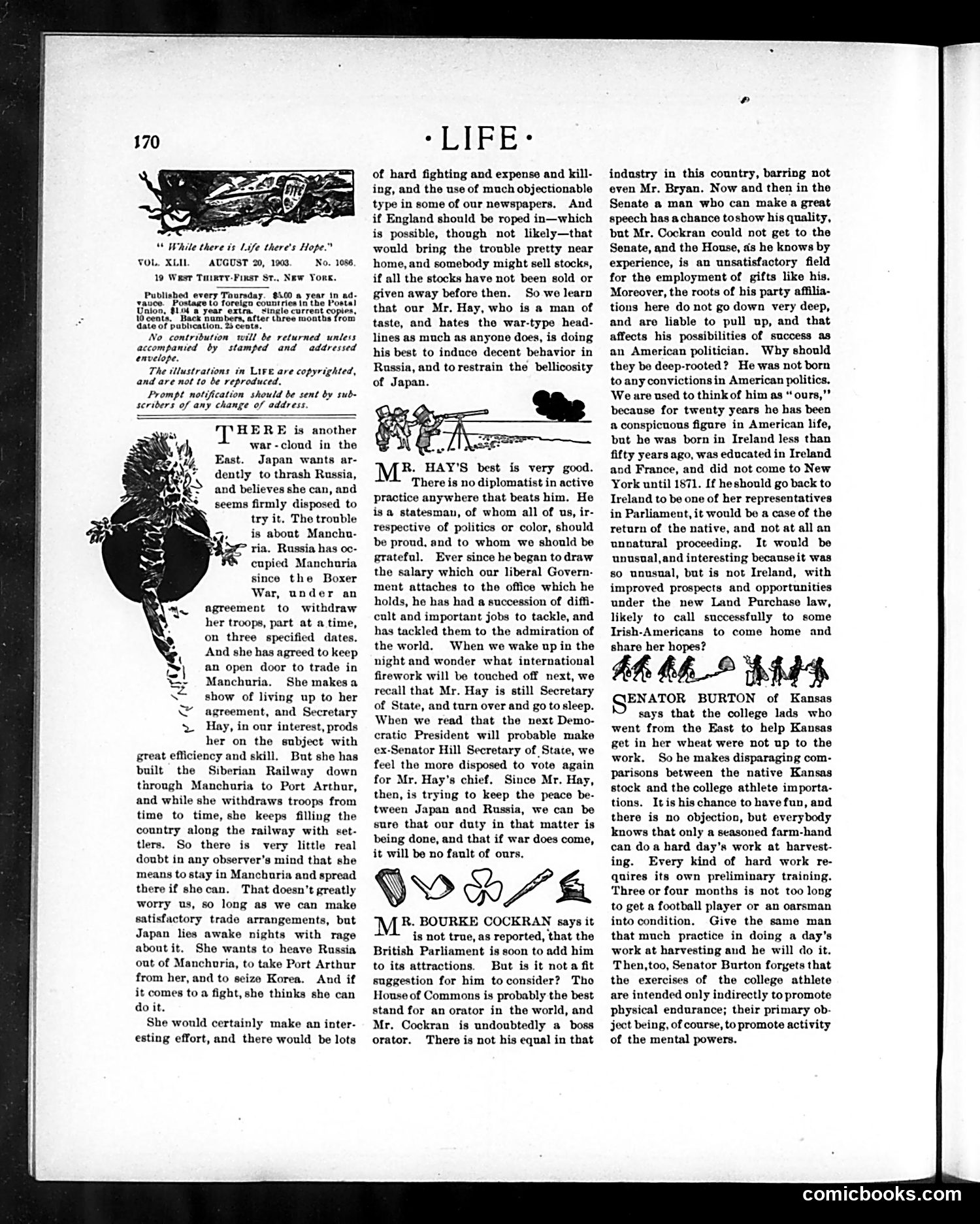
**The Main Cartoon** (left side) depicts a caricatured Asian figure with exaggerated features representing Manchuria, shown as a contested territory being fought over by imperial powers. The illustration satirizes the Russo-Japanese rivalry over control of Manchuria and Korea during this period of imperial competition in East Asia. **The Editorial Content** critiques various political figures, including discussion of Mr. Cockran's oratorical skills and Senator Burton's comments on college athletics versus farm labor. The satire mocks political posturing and the gap between politicians' rhetoric and practical concerns. The overall tone ridicules imperial ambitions and contemporary political hypocrisy—common themes in early 1900s American satirical journalism critiquing both foreign wars and domestic politics.
📄 Transcribed text from this page (OCR, searchable)
Machine-transcribed from the original scan — historical spelling and the odd misread are preserved.
\\ While there is Life there's Hope.” VOL. XLIL AUGUST 20, 1903. No. 1086, 19 Wrst Tairty-Fixst 31 New Yore. Published every Toursday. $400 a year 11 sauce. P to foreign countries In the Pi Union, $1.04 a year extra. single current coy \Weents. Back numbers, after three months from date of publication. 23 cents. No contribution will be returned unless accompanied by stamped and addressed envelope. The illustrations in Live are copyrighted, and are not to be reproduced. Prompt notification should be sent by sub- scribers of any change of address. YHERE is another war-cloud in the East. Japan wants ar- dently to thrash Russia, and believes she can, and seems firmly disposed to try it. The trouble is about Manchu- ria. Russia has oc- cupied Manchuria since the Boxer War, under an agreement to withdraw her troops, part at atime, on three specified dates. And she has agreed to keep fn open door to trade in Manchuria. She makesa show of living up to her agreement, and Secretary Hay, in our interest, prods her on the subject with great efficiency and skill. But she has built the Siberian Railway down through Manchuria to Port Arthur, and while she withdraws troops from time to time, she keeps filling the country along the railway with set- tlers. So there is very little real doubt in any observer's mind that she means to stay in Manchuria and spread there if she can. That doesn't greatly worry us, so long as we can make satisfactory trade arrangements, but Japan lies awake nights with rage about it. She wants to heave Russia out of Manchuria, to take Port Arthur from her, and to seize Korea. And if it comes toa fight, she thinks she can do it. She would certainly make an inter- esting effort, and there would be lots “ETRE of hard fighting and expense and kill- ing, and the use of much objectionable type in some of our newspapers. And if England should be roped in—which is possible, though not likely—that would bring the trouble pretty near home, and somebody might sell stocks, if all the stocks have not been sold or given away before then. So we learn that our Mr. Hay, who is a man of taste, and hates the war-type head- lines as much as anyone does, is doing his best to induce decent behavior in Rassia, and to restrain the bellicosity ME. HAY'S best is very good. There is no diplomatist in active practice anywhere that beats him. He is a statesman, of whom all of us, ir- respective of politics or color, should be proud, and to whom we should be grateful. Ever since he began to draw the salary which our liberal Govern- ment attaches to the office which he holds, he has had a succession of diffi- cult and important jobs to tackle, and has tackled them to the admiration of the world. When we wake up in the night and wonder what international firework will be touched off next, we recall that Mr. Hay is still Secretary of State, and turn over and go to sleep. When we read that the next Demo- cratic President will probable make ex-Senator Hill Secretary of Stace, we feel the more disposed to vote again for Mr. Hay’s chief. Since Mr. Hay, then, is trying to keep the peace be- tween Japan and Russia, we can be sure that our duty in that matter is being done, and that if war does come, it will be no fault of ours. VY HAS R. BOURKE COCKRAN says it is not true, as reported, that the British Parliament is soon to add him to its attractions. But is it nota fit suggestion for him toconsider? Tho House of Commons is probably the best stand for an orator in the world, and Mr. Cockran is undoubtedly a boss orator. There is not his equal in that industry in this country, barring not even Mr. Bryan. Now and then in the Senate a man who can make a great speech has achance toshow his quality, but Mr. Cockran could not get to the Senate, and the House, as he knows by experience, is an unsatisfactory field for the employment of gifts like his. Moreover, the roots of his party affilia- tions here do not go down very deep, and aro liable to pull up, and that affects his possibilities of success as an American politician. Why should they be deep-rooted? He was not born to any convictions in American politics. We are used to think of him as “ours,”” because for twenty years he has been a conspicuous figure in American life, but he was born in Ireland less than fifty years ago, was educated in Ireland and France, and did not come to New York until 1871. If heshould go back to Ireland to be one of her representatives in Parliament, it would be a case of the return of the native, and not at all an unnatural proceeding. It would be unusual,and interesting because it was so unusual, but is not Ireland, with improved prospects and opportunities under the new Land Purchase law, likely to call successfully to some Irish-Americans to come home and share her hopes? ah AG PIP ENATOR BURTON of Kansas says that the college lads who went from the East to help Kansas get in her wheat were not up to the work. So he makes disparaging com- parisons between the native Kansas stock and the college athlete importa- tions. It is his chance to havefun, and there is no objection, but everybody knows that only a seasoned farm-hand can doa hard day's work at harvest- ing. Every kind of hard work re- quires its own preliminary training. Three or four months is not too long to get a football player or an oarsman into condition. Give the same man that much practice in doing a day’s work at harvesting and he will do it. Then,too, Senator Burton forgets that the exercises of the college athlete are intended only indirectly to promote physical endurance; their primary ob- ject being, of course, to promote activity of the mental powers. comicbooks.com