
Life, 1903-08-20 · page 10 of 32
Life — August 20, 1903 — page 10: what you’re looking at
What you’re looking at
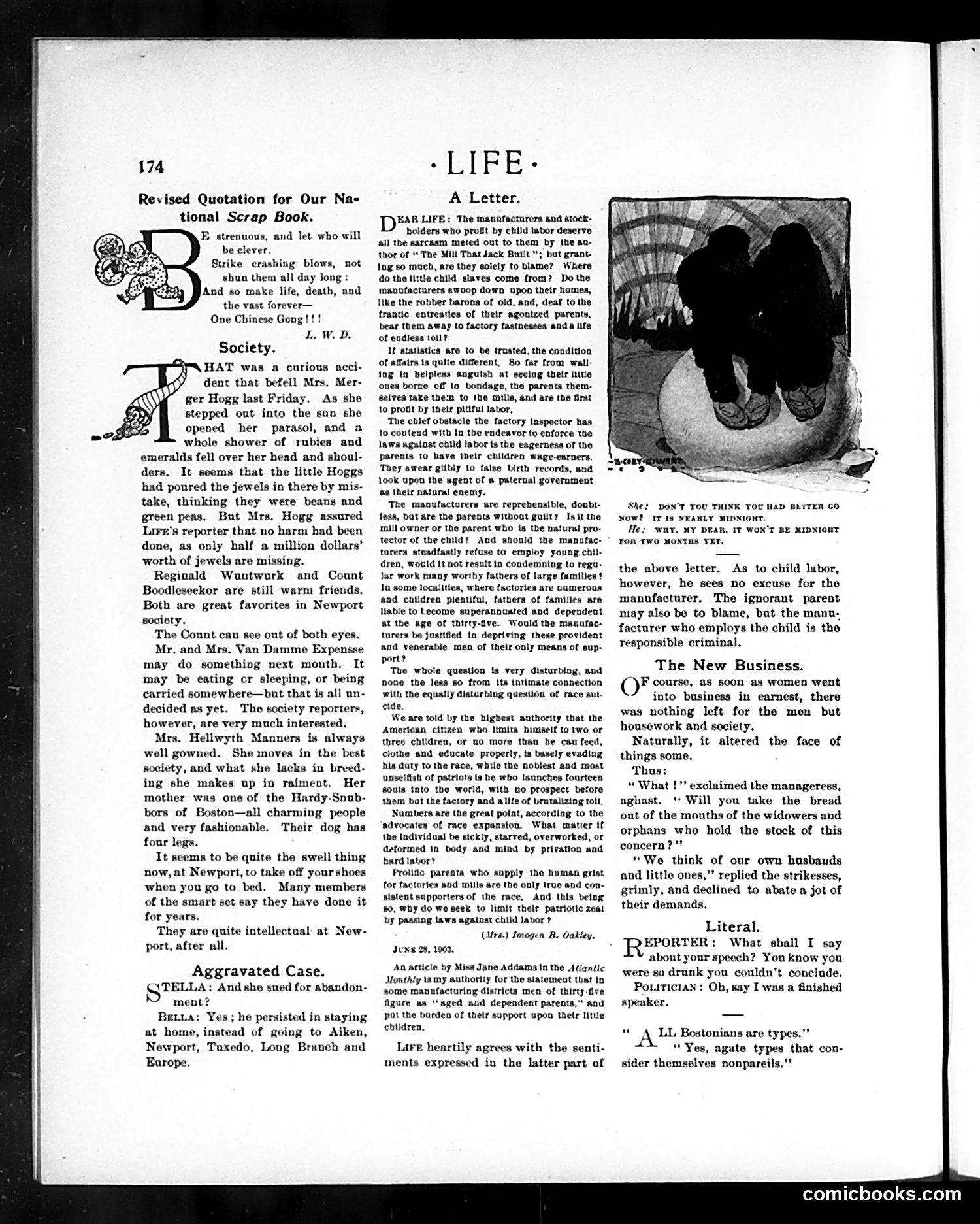
This page contains social commentary rather than political cartoons. The main article, "A Letter," criticizes manufacturers who employ child labor in factories. The piece argues that factory owners and negligent parents share blame for exploiting children, noting that some manufacturers deliberately hire young workers to replace adult laborers at lower wages. The accompanying sections—"Society" (mocking wealthy socialites), "Aggravated Case" (a brief dialogue about marital abandonment), and "The New Business" (satirizing how business opportunities displaced women from professional life)—use humor to critique class disparities and gender inequality in Gilded Age America. The overall message targets both industrial exploitation and upper-class indifference to working-class suffering.
📄 Transcribed text from this page (OCR, searchable)
Machine-transcribed from the original scan — historical spelling and the odd misread are preserved.
w% 174 Revised Quotation for Our Na- tional Scrap Book. E strenuous, and let who will be clever. Strike crashing blows, not shun them all day long [And so make life, death, and the vast forever— One Chinese Gong!!! L. W. D. Society. HAT was a curious acci- dent that befell Mrs. Mer- ger Hogg last Friday. As sho stepped out into the sun she opened her parasol, and a whole shower of rubies and emeralds fell over her head and shoul- ders. It seems that the little Hoggs had poured the jewels in there by mis- take, thinking they were beans and green peas. But Mrs. Hogg assured Life's reporter that no harm had been done, as only half a million dollars’ worth of jewels are missing. Reginald Wuntwuork and Count Boodleseekor are still warm friends. Both are great favorites in Newport society. The Count can see out of both eyes. Mr, and Mrs. Van Damme Expensse may do something next month, It may be eating or sleeping, or being carried somewhere—but that is all un- decided as yet. The society reporters, however, are very much interested. Mrs. Hellwyth Manners is always well gowned. She moves in the best society, and what she lacks in breed- ing she makes up in raiment. Her mother was one of the Hardy-Snub- bors of Boston—all charming people and very fashionable. Their dog has four legs. It seems to be quite the swell thing now, at Newport, to take off your shoes when you go to bed. Many members of the smart set say they have done it for years. They are quite intellectual at New- port, after all. Aggravated Case. GTELLA: And she sued for abandon- ment? Beiia: Yes; he persisted in staying at home, instead of going to Aiken, Newport, Tuxedo, Long Branch and Europe. ETRE A Letter. EAR LIFE: The manufacturers and stock- holders who profit by child lator deserve ail the sarcasm meted out to them by the aa- thor of “The Mill ThatJack Built"; bat grant- ing so much, are they solely to blame? Where do the little child slaves come from? Do the manufacturers swoop Gown upon their homes, like the robber barons of old, and, deaf to the frantic entreattes of their agonized parents, bear them away to factory fastnesses auda life of endless toll? If statistics are to be trusted. the condition of affairs ts quite disferent, So far from wall- ing in helpless anguish at seeing thelr itttie ones borne off to bondage, the parents them- selves take them to the mills, and are the first to pros by thelr pitiful labor, The chief obstacle the factory inspector has to contend with in the endeavor to enforce the Jaws against child labor is the eagerness of the Parents to have their children wage-earners, ‘They swear gitbly to false birth records, and look upon the agent of # paternal government as their natural enemy. ‘The manufacturers are reprebensible, doubt- leas, bat are the parents without gullt? Isit the mill owner or the parent who 1s the natural pro- tector of the child? And should the manufac- turers steadfastly refuse to employ young chil- dren, would tt not result in condemning to regu- lar work many worthy fathers of large families ? In some locatittes, where factories are numerous and children plentiful, fathers of families are Mabie to Lecome superannuated and dependent at the age of thirty-Gve. Would the manufac- turers be Justified in depriving these provident aod venerable men of their only means of sup- port? The whole question is very disturbing, and none the less so from its intimate connection ‘with the equally distarbing question of race sut- cide. We are told by the highest authority that the Amertcan citizen who limits himself to two or three childrea, or no more than he can feed, clothe and educate properly, is basely evading his duty to the race, while the noblest and most unselfish of patriots {s he who launches fourteen souls tnto the world, with no prospect before them bat the factory and alife of brutallzing toll, Numbers are the great point, according to the ‘advocates of race expansion. What matier if the Individual be sickly, starved, overworked, or deformed in body and mind by privation and hard labor? Prolific parents who supply tho human grist for factories and milis are the only true and con- sistent supporters of the race. And this being #0, why do we seek to limit thelr patriotic zeal by passing laws against child labor ? (lrs.) Imogen B. Oakley. Jens 28, 1903. An article by Miss Jane Addams in the Atlantic Monthly \s my authority for the statement that in some manufacturing districts men of thirty-five Ogure as “aged and dependent parents,” and pat the burden of their support upon thelr little chtidren, Lire heartily agrees with the senti- ments expressed in the latter part of She: DON'T YoU THINK You NAD BhrTER CO Now? 17 18 NEARLY MIDNIGHT. He: wu, MY DEAR, IT WON'T BE MIDNIGHT TOR TWO MONTHS YET. the above letter. As to child labor, however, he sees no excuse for tho manufacturer. The ignorant parent may also be to blame, but the manu- facturer who employs the child is the responsible criminal. The New Business. F course, as soon as women went into business in earnest, there was nothing left for the men but housework and society. Naturally, it altered the face of things some. Thus: “ What !'’ exclaimed the manageress, aghast. ‘ Will you take the bread out of the mouths of the widowers and orphans who hold the stock of this concern ?"’ “We think of our own husbands and little ones,"’ replied the strikesses, grimly, and declined to abate a jot of their demands. Literal. EPORTER: What shall I say about your speech? You know you were so drunk you couldn't conclude. Po.rtictan : Oh, say I was a finished speaker. “ A LL Bostonians are types.’’ + “Yes, agate types that con- sider themselves nonpareils.”’ comicbooks.com