
Life, 1903-08-20 · page 20 of 32
Life — August 20, 1903 — page 20: what you’re looking at
What you’re looking at
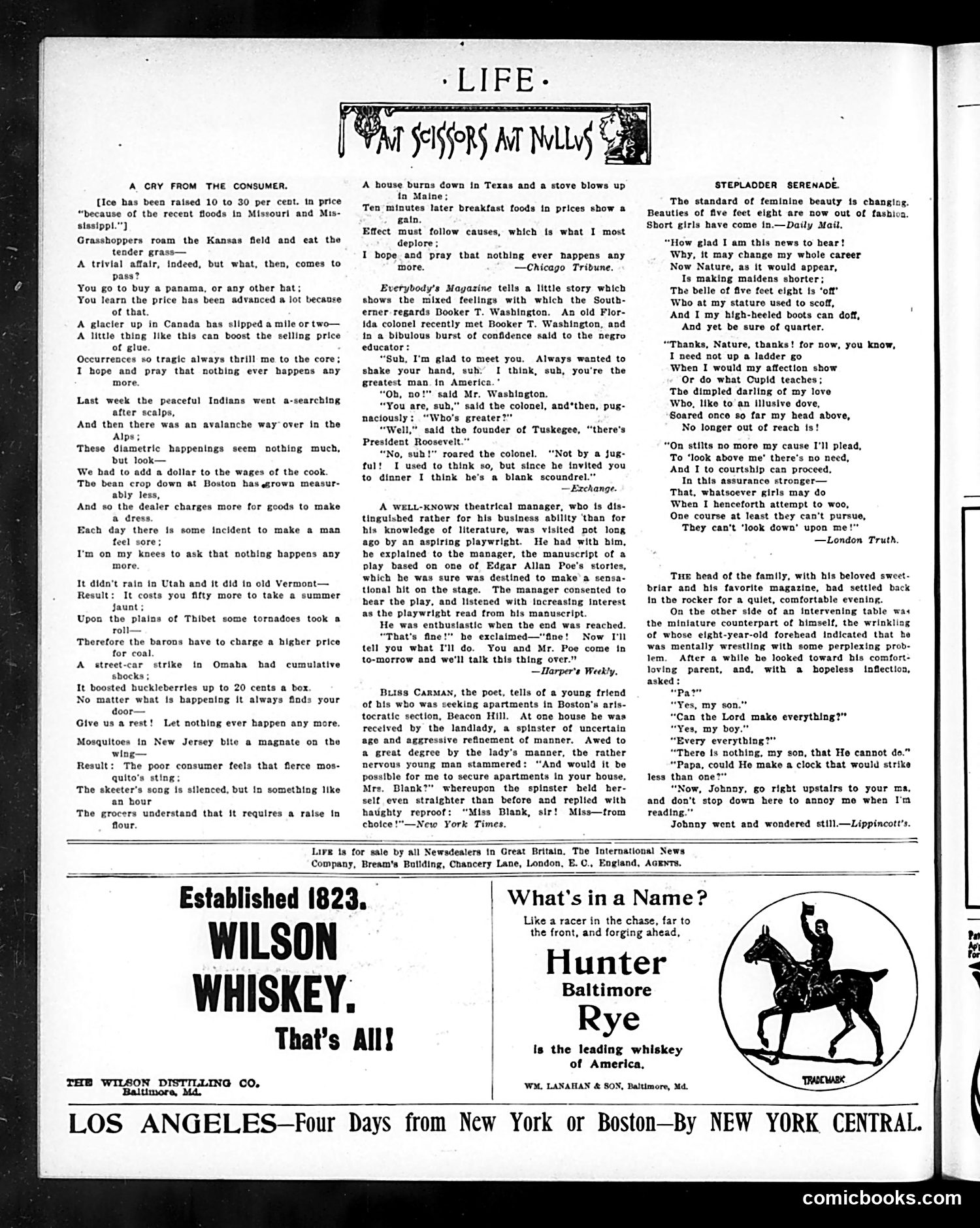
This page contains two distinct satirical pieces: **"A Cry from the Consumer"** (left column) attacks price-gouging during the early 1900s. The poem mocks merchants who use any minor incident—floods, grasshoppers, weather changes, even distant events (Tibetan tornadoes, Canadian glaciers)—as pretexts to raise prices on unrelated goods. It's consumer advocacy satire, ridiculing the exploitative logic that chains cause-and-effect to justify inflation. **Booker T. Washington Anecdote** (center) satirizes Southern racial attitudes. A bibulous Florida colonel praises Washington as "the greatest man in America," then—upon learning Roosevelt invited Washington to dinner—denounces Roosevelt as a "blank scoundrel." The joke exposes the colonel's contradictory racism: he'll praise a Black educator in theory but withdraws respect when treated with dignity by a white president. The bottom half is primarily **advertisements** for Wilson Whiskey and Hunter Baltimore Rye.
📄 Transcribed text from this page (OCR, searchable)
Machine-transcribed from the original scan — historical spelling and the odd misread are preserved.
A CRY FROM THE CONSUMER. [ce has been raised 10 to 30 per cent. tn price “because of the recent floods in Missourl and Mts- sissippl."") Grasshoppers roam the Kansas field and eat the tender grass— A trivial affair, indeed, but what, then, comes to pass? You go to buy a panama, or any other hat; You learn the price has been advanced @ lot because of that. A glacier up in Canada bas slipped a mile or two— A little thing like this can boost the selling price of glue. Occurrences so tragic always thrill me to the core; I hope and pray that nothing ever happens any more. Last week the peaceful Indians went a-searching after scalps, And then there was an avalanche way’ over in the Alps; These diametric happenings seem nothing much, but look— We had to add a dollar to the wages of the cook. The bean crop down at Boston has grown measur- ably less, And so the dealer charges more for gcods to make a dress. Each day there 1s some incident to make a man feel sore; I'm on my knees to ask that nothing happens any more. It didn’t rain in Utah and it did in old Vermont— Result: It costs you fifty more to take a summer jaunt; Upon the plains of Thibet some tornadoes took a roll— Therefore the barons have to charge a higher price for coal. A street-car strike sbocks ; It boosted huckleberrles up to 20 cents a box. No matter what 1s happening it always finds your door— Give us a rest! in Omaha had cumulative Let nothing ever happen any more. Mosquitoes in New Jersey bite a magnate on the wing— Result: The poor consumer feels that flerce mos- quito’s sting; ‘The skeeter’s song is silenced, but In something Ike an hour ‘The grocers understand that it requires a raise In flour. A house burns down in Texas and a stove blows up in Maine; Ten minutes later breakfast foods in prices show a gain. Effect must follow causes, which is what I most deplore ; I hope and pray that nothing ever nappens any more. —Chicago Tribune. Everybody's Mayazine tells a little story which shows the mixed feelings with which the South- erner regards Booker T. Washington. An old Flor- {da colonel recently met Booker T. Washington, and tn a bibulous burst of confidence sald to the negro educator: “Sub, I'm glad to meet you. Always wanted to shake your hand, sub: I think, sub, you're the greatest man in America.’ “Oh, no!" sald Mr. Washington. “You are, sub," said the colonel, and*then, pug- naciously: “Who's greater?" Well,” said the founder of Tuskegee, “there's President Roosevelt.” “No, sub!” roared the colonel. “Not by a jug- ful! I used to think so, but since he {nvited you to dinner I think he’s blank scoundrel.” —Exchange. A WELL-KNown theatrical manager, who 1s dis. tinguished rather for his business ability ‘than for his knowledge of literature, was visited not long ago by an aspiring playwright. He had with him, he explained to the manager, the manuscript of a play based on one of Edgar Allan Poe's stories, which he was sure was destined to make’ a sensa- tional hit on the stage. The manager consented to hear the play, and listened with increasing Interest as the playwright read from his manuscript. He was enthusiastic when the end was reached. “That's fine!" be exclaimed—"fine! Now I'll tell you what I'll do. You and Mr. Poe come in to-morrow and we'll talk this thing over.” —Harper's Weekly, Buiss Canaan, the poet, tells of a young friend of bis who was seeking apartments in Boston's aris- tocratic section, Beacon Hill. At one house he was received by the landlady, a spinster of uncertain age and aggressive refinement of manner. Awed to a great degree by the lady's manner, the rather nervous young man stammered: “And would it be possible for me to secure apartments In your house, Mre. Blank? whereupon tho spinster held her- self even straighter than before and replied with haughty reproof: “Miss Blank, sir! Miss—from chotce!"—New York Times. STEPLADDER SERENADE. Tho standard of feminine beauty 1s changing. Beauties of five feet eight are now out of fasbioa. Short girls have come in.—Daily Mait, “How glad I am this news to hear! Why, it may change my whole career Now Nature, as it would appear, Is making maidens shorter; The belle of five fect eight Is ‘oft’ Who at my stature used to scoff, And I my high-heeled boots can dof, And yet be sure of quarter. “Thanks, Nature, thanks! for now, you know, I need not up a ladder go When I would my affection show Or do what Cupid teaches The dimpled darling of my love Who, like to'an illusive dove, Soared onco so far my head above, No longer out of reach is! “On stilts no more my cause I'll plead, To ‘look above me’ there's no need, And I to courtship can proceed, In this assurance stronger— That, whatsoever girls may do When I henceforth attempt to woo, One course at least they can't pursue, They can't ‘look down’ upon me —London Truth. ‘THe head of the family, with his beloved sweet- briar and his favorite magazine, had settled back In the rocker for a quiet, comfortable evening. On the other side of an intervening table was the miniature counterpart of himself, the wrinkling of whose eight-year-old forehead indicated that he was mentally wrestling with some perplexing prob- lem. After a while be looked toward bis comfort: loving parent, and, with a hopeless inflection, asked: “Pat” ‘Yes, my son.” “Can the Lord make everything?” “Yes, my boy. “Every everything?” “Thero 1s nothing, my son, that He cannot do.” “Papa, could He make a clock that would strike less than one?" Now, Johnny, go right upstairs to your ma, and don't stop down here to annoy mo when I'm reading.” Jobnny went and wondered still.—Lippincott’s. Live is for sale by all N ‘ewsdealers in Great Britain, The International News Company, Bream's Batlding, Chancery Lane, London, E.C., England, AGENTS. Established (823, WILSO What's ina Name? Like a racer in the chase, far to the front, and forging ahead, Hunter Baltimore WHISKEY. That’s All! Rye Is the leading whiskey of America, THE WILSON DISTILLING CO. Baltimore, Ma. LOS ANGELES—Four Days from New York or Boston—By NEW YORK CENTRAL. WM. LANAHAN & SON, Baltimore, Md. comicbooks.com